


1 Samuel 22:23
- שְׁבָהshe·Vahremain !H3427V-Qal-Imp-2ms ¦ SfxVerb Qal Imperative 2nd Singular Masculineשְׁבָremainה!
- אִתִּי'i·Tiwith meH854Prep ¦ 1csPreposition Definiteאִתִּwithיme
- אַל'almay notH408NegParticle Negative
- תִּירָאti·Ra'you be afraidH3372V-Qal-Imperf-2msVerb Qal Imperfect 2nd Singular Masculine
- כִּיkiforH3588PrtParticle Conditional
- אֲשֶׁר'a·Sher[the one] whoH834RelParticle Relative
- יְבַקֵּשׁye·va·Keshhe seeksH1245V-Piel-Imperf-3msVerb Piel Imperfect 3rd Singular Masculine
- אֶת'et<obj.>H853DirObjMParticle Object Indicator
- נַפְשִׁיnaf·Shimy lifeH5315N-fsc ¦ 1csNoun Singular Feminine Constructנַפְשִׁlifeיmy
- יְבַקֵּשׁye·va·Keshhe seeksH1245V-Piel-Imperf-3msVerb Piel Imperfect 3rd Singular Masculine
- אֶת'et<obj.>H853DirObjMParticle Object Indicator
- נַפְשֶׁךָnaf·She·khayour lifeH5315N-fsc ¦ 2msNoun Singular Feminine Constructנַפְשֶׁlifeךָyour
- כִּיkiforH3588PrtParticle Conditional
- מִשְׁמֶרֶתmish·Me·ret[are] in good careH4931N-fsNoun Singular Feminine Absolute
- אַתָּה'a·TahyouH859Pro-2msPronoun Personal 2nd Singular Masculine
- עִמָּדִי'i·ma·Diwith meH5978Prep ¦ 1csPrepositionעִמָּדִwithיme
English is a literal word-by-word gloss of the Hebrew, not the KJV's wording. Why?
This is the original text the KJV's translators worked from — each Hebrew word with its own literal English meaning in this verse, prepared by scholars at Tyndale House, Cambridge. The KJV translates whole sentences, not word by word, so its wording differs: one Hebrew word can become several English words, and the KJV may choose “the LORD” where the gloss reads “Yahweh”. Both are faithful — they answer different questions. For the KJV's own rendering, switch to the KJV text.
Details
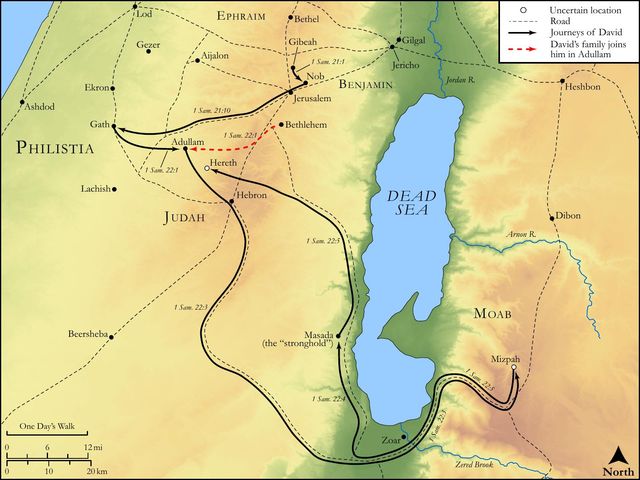
See on the biblical-era map
Study this verse
Public-domain commentary
Matthew Henry
From his Commentary on the Whole Bible. Henry comments on passages, not single verses — this entry covers 1 Samuel 22:20–23.
Here is, 1. The escape of Abiathar, the son of Ahimelech, out of the desolations of the priests' city. Probably when his father went to appear, upon Saul's summons, he was left at home to attend the altar, by which means he escaped the first execution, and, before Doeg and his bloodhounds came to Nob, he had intelligence of the danger, and had time to shift for his own safety. And whither should he go but to David? Sa1 22:20. Let those that suffer for the Son of David commit the keeping of their souls to him, Pe1 4:19. 2. David's resentment of the melancholy tidings he brought. He gave David an account of the bloody work Saul had made among the priests of the Lord (Sa1 22:21), as the disciples of John, when their master was beheaded, went and told Jesus, Mat 14:12. And David greatly lamented the calamity itself, but especially his being accessory to it: I have occasioned the death of all the persons of thy father's house, Sa1 22:22. Note, It is a great trouble to a good man to find himself in any way an occasion of the calamities of the church and ministry. David knew Doeg's character so well that he feared he would do some such mischief as this when he saw him at the sanctuary: I knew he would tell Saul. He calls him Doeg the Edomite, because he retained the heart of an Edomite, though, by embracing the profession of the Jewish religion, he had put on the mask of an Israelite. 3. The protection he granted to Abiathar. He perceived him to be terrified, as he had reason to be, and therefore bade him not to fear, he would be as careful for him as for himself: With me thou shalt be in safeguard, Sa1 22:23. David, having now time to recollect himself, speaks with assurance of his own safety, and promises that Abiathar shall have the full benefit of his protection. It is promised to the Son of David that God will hide him in the shadow of his hand (Isa 49:2), and, with him, all that are his may be sure that they shall be in safeguard, Psa 91:1. David had now not only a prophet, but a priest, a high-priest, with him, to whom he was a blessing and they to him, and both a happy omen of his success. Yet it appears (by Psa 28:6) that Saul had a high priest too, for he had a urim to consult: it is supposed that he preferred Ahitub the father of Zadok, of the family of Eleazar (Ch1 6:8), for even those that hate the power of godliness yet will not be without the form. It must not be forgotten here that David at this time penned Psa 52:1-9, as appears by the title of that psalm, wherein he represents Doeg not only as malicious and spiteful, but as false and deceitful, because though what he said was, for the substance of it, true, yet he put false colours upon it, with a design to do mischief. Yet even then, when the priesthood had become as a withered branch, he looks upon himself as a green olive-tree in the house of God, Psa 52:8. In this great hurry and distraction that David was continually in, yet he found both time and a heart for communion with God, and found comfort in it.
Historical interpretation
Historical reception
1 surviving comment on this verse from the historical church.
Stay with me, do not be afraid, etc. Remain, he said, in my love; do not be afraid of those who kill the body: if they persecuted me, they will also persecute you; but where I am, there will my servant also be; if anyone serves me, my Father will honor him (John XV; Matthew X; John XII). This betrayal and the attack by Doeg the Edomite, and during the times of the Lord and the Apostles in Judas Iscariot and other false brothers, and at the end of the world in the very Antichrist greater than the others, can be understood, in the manner of the fifty-first psalm, which is sung in reference to him, is not inappropriately applied to that enemy, as the title says: To the end, for understanding by David himself, when Doeg the Edomite came and reported to Saul, and said: Behold, David is in the house of Ahimelech; where “for understanding by David himself” is placed at the beginning not for any other reason than to signify that David understood among the hardships he suffered innocently, what wickedness would be plotted against the true David to be born from his seed by the scheming of the wicked. For he did come, boasting in malice, powerful in iniquity, thinking of injustice all day long, and the rest, which he added in the psalm. He who understood these things through the Spirit, burdened by sins and to be burdened by punishments, Judas announced to the Jews, and said: Behold, Jesus is accustomed to frequenting the garden of the Mount of Olives with his disciples. For from the ultimate tribulation how this title should be understood, clearly shows from what has been discussed above. But since we have extended our discourse and dictated a longer third book in the exposition of blessed Samuel, both second and first, we think it fitting to put an end to this labor with the triumph of the martyrs among the priests, and judging it proper to cease from the work for a time to recover strength in silence.
Continue studying 1 Samuel 22:23 across the web’s major study libraries — every link below opens this exact verse, chapter, or book on the destination site.
Read & Compare
 BibleGatewayThis verse in more than 200 translations and 70 languages.
 Bible.comThe YouVersion reader — hundreds of translations, reading plans, and highlights.
 ESV.orgCrossway's official English Standard Version reader.
 NET BibleThe NET translation with 60,000+ translators' notes on every rendering decision.
 STEP BibleTyndale House's free study tool — original text, vocabulary, and scholarly resources.
 BibliaLogos Bible Software's free web reader.
 USCCBThe New American Bible (Revised Edition) with the U.S. bishops' study notes.
Commentaries
 BibleHub CommentariesDozens of classic commentaries on this verse, gathered on one page.
 StudyLightMore than 100 commentary sets — the largest collection on the web.
 BibleRefPlain-English commentary on what this verse means, verse by verse.
 Enduring WordDavid Guzik's free commentary on this chapter, widely used by Bible teachers.
 Bible Study ToolsVerse commentary alongside Greek and Hebrew study aids.
Original Language & Research
- BibleHub InterlinearThe verse word by word — original language, transliteration, and English.
- BibleHub LexiconEvery word's original-language definition and Strong's entry.
 Blue Letter BibleDeep-study tools — Strong's numbers, concordance, and word studies.
 SefariaThe Hebrew text with Rashi and centuries of Jewish commentary.
Sermons, Hymns & Audio


TrulyRandomVerse is not affiliated with these sites and doesn’t control their content. They’re linked because they’re genuinely useful.
Summary
In 1 Samuel 22:23, David, though himself a hunted fugitive, extends a profound and compassionate promise of refuge and unwavering security to Abiathar, the sole survivor of King Saul's brutal massacre of the priests at Nob. This declaration not only offers immediate comfort and protection to a traumatized individual but also articulates a foundational principle of shared destiny and steadfast loyalty, emphasizing that those who align with David's God-ordained cause will share in both his perils and his ultimate divine safeguard. It powerfully showcases David's emerging character as a responsible, empathetic, and covenant-keeping leader, even amidst his most desperate circumstances.
Context
ShowHideLiterary Context
This pivotal verse is situated at a deeply traumatic and transformative moment in David's life, immediately following King Saul's horrific and sacrilegious slaughter of the priests of Nob. David had inadvertently brought this calamity upon them by seeking provisions and the sword of Goliath from Ahimelech, the high priest, while fleeing Saul (compare 1 Samuel 21:1-9). Doeg the Edomite, an official of Saul, witnessed this interaction and reported it, leading to Saul's command for the execution of all the priests, their families, and even their livestock in Nob (see 1 Samuel 22:9-19). Abiathar, Ahimelech's son, was the sole survivor of this massacre, fleeing to David at the cave of Adullam, where David had gathered a diverse group of the distressed, indebted, and discontented (as described in 1 Samuel 22:1-2). David, burdened by a profound sense of guilt and responsibility for the tragedy that befell Abiathar's family, offers this solemn pledge of protection, recognizing that his own fugitive status now directly endangers anyone who associates with him.
Historical & Cultural Context
The massacre at Nob represented a profound violation of sacred space and priestly authority, serving as a stark manifestation of Saul's escalating paranoia, spiritual decline, and complete disregard for divine institutions. In ancient Israel, priests, especially the high priest, held a revered position as intermediaries between God and His people, responsible for sacrifices, teaching the Law, and consulting the Lord via the ephod. Saul's act was not merely a political purge but an act of sacrilege, demonstrating his complete rejection of God's will and his own spiritual bankruptcy (compare 1 Samuel 15:23). In this context, David's immediate offer of refuge to Abiathar carries immense weight. Seeking refuge with a powerful figure or clan was a common and essential practice in the ancient Near East for those fleeing persecution or seeking protection. David, though an outlaw, was God's anointed king-in-waiting, and his promise of "safeguard" (Hebrew: mishmeret) reflects the ancient concept of a protector providing a secure dwelling and active defense to those under his care. Abiathar's arrival with the ephod also symbolically and practically signified the transfer of legitimate priestly authority and the means of divine consultation from Saul's compromised regime to David's emerging, God-sanctioned leadership.
Key Themes
ShowHideThis verse encapsulates several pivotal themes that resonate throughout the book of 1 Samuel and beyond. Firstly, it underscores the theme of divine protection and refuge, even when God's chosen servant is himself under intense persecution. David, though hunted, paradoxically becomes a haven for others, foreshadowing the ultimate refuge found in God, as frequently expressed in the Psalms (e.g., The Lord is my rock and my fortress and my deliverer or Psalm 91). Secondly, it highlights the profound theme of shared peril and solidarity. David explicitly states, "for he that seeketh my life seeketh thy life," establishing an unbreakable bond where Abiathar's fate is inextricably linked with David's. This emphasizes the cost and commitment of loyalty, especially to a leader chosen by God, and the reality that aligning with God's purposes often invites opposition (as Jesus later taught in Matthew 10:24-25). Thirdly, the compassionate command "fear not" coupled with the definitive promise of "safeguard" conveys assurance and comfort amidst dire circumstances. It speaks to the power of a leader's compassionate words to alleviate fear and instill hope, even when facing overwhelming odds (a theme echoed in Isaiah 41:10).
Exposition and Analysis
ShowHideKey Word Analysis
ShowHideThis primitive root verb (H3427) fundamentally means "to sit down," but broadly implies "to dwell," "to remain," or "to settle." In David's command, "Abide thou with me," it is an imperative invitation for Abiathar to establish a permanent and secure presence within David's company. It signifies more than just temporary shelter; it promises a continuous, stable dwelling and a lasting commitment to Abiathar's safety and belonging amidst the surrounding chaos. It conveys an offer of stability and a place of rest.
This feminine noun (H4931) derives from a root meaning "to watch" or "to guard." It denotes "a watch," "a charge," "a place of custody," or "a keeping." When David promises Abiathar will be "in safeguard," he is not merely offering passive shelter but pledging active guardianship and preservation from harm. It implies being under constant, protective watch, ensuring Abiathar's well-being and security under David's direct care and responsibility, much like a secure enclosure or a protected status.
This primitive root verb (H1245) means "to search out" (by any method), "to strive after," or "to require." In the phrase "he that seeketh my life seeketh thy life," it emphasizes the deliberate and intense pursuit by Saul. It signifies a malicious, active, and relentless attempt to find and destroy David and, by extension, anyone associated with him. This word highlights the dangerous and determined nature of the opposition they face.
This noun (H5315) properly refers to a "breathing creature" or "vitality," but is used very widely to mean "soul," "self," "person," or "life" in its entirety. In the context of "seeketh my life seeketh thy life," it refers to the very existence and well-being of David and Abiathar. Saul's intent is not merely to inconvenience them, but to destroy their very being, to take their lives. It underscores the existential threat they face.
Verse Breakdown
ShowHide"Abide thou with me, fear not:"
This opening phrase is a profound expression of compassionate leadership and immediate reassurance. David, despite his own precarious existence as a fugitive, immediately assumes the role of protector. "Abide" is a direct, imperative invitation to permanent dwelling and security, while "fear not" directly addresses Abiathar's understandable terror and trauma from the massacre, offering solace and courage. It demonstrates David's empathy, his willingness to take responsibility, and his emerging qualities as a shepherd-leader who prioritizes the well-being of a vulnerable individual.
"for he that seeketh my life seeketh thy life:"
This clause provides the crucial rationale behind David's promise and establishes the shared, perilous reality of their situation. David acknowledges that by joining him, Abiathar automatically becomes a direct target of Saul's relentless wrath, just as David is. This is a stark recognition of their solidarity and the dangerous implications of aligning with God's anointed in opposition to a tyrannical, unrighteous king. It highlights the principle that loyalty to a divine cause or a God-appointed leader often means sharing in their struggles and facing common adversaries.
"but with me thou [shalt be] in safeguard."
This is the core, definitive promise of the verse, offering a powerful assurance of protection. Despite the explicit shared danger, David pledges that Abiathar will find active security and preservation in his presence. The phrase "in safeguard" (Hebrew: mišmeret) implies being kept under constant watch, guarded, and preserved from harm. It underscores David's personal commitment to ensure Abiathar's safety, establishing a covenant of protection and mutual loyalty between them, a bond forged in the crucible of shared persecution.
Literary Devices
ShowHideThe verse effectively employs several literary devices to convey its powerful message of protection and solidarity. Direct Address and Imperative Mood are evident in David's opening commands, "Abide thou with me, fear not," which immediately establish his authority and compassionate intent. The phrase "he that seeketh my life seeketh thy life" utilizes Parallelism and explicitly states a principle of Shared Destiny or Solidarity, linking their fates inextricably and underscoring the communal nature of their peril and protection. This statement also functions as a form of Reasoning or Justification, providing the logical basis for David's subsequent promise of safeguard. Furthermore, David's compassionate response and assumption of responsibility for Abiathar's safety can be seen as Foreshadowing his future role as a just, protective, and shepherd-like king, demonstrating the qualities of a true leader even before his ascent to the throne. The entire utterance is a profound expression of Empathy, Covenantal Loyalty, and Assurance, as David binds himself to Abiathar in a time of extreme vulnerability.
Theological and Thematic Connections
ShowHideDavid's promise to Abiathar beautifully illustrates the biblical theme of finding refuge and security in God's chosen instruments, and ultimately, in God Himself. Just as David, though persecuted and a fugitive, paradoxically became a haven for the distressed and displaced, God consistently offers Himself as the ultimate fortress and deliverer for His people. This narrative foreshadows the deeper theological truth that true safety and peace are found in aligning with God's purposes and His anointed ones. The shared peril between David and Abiathar also mirrors the spiritual reality that those who follow God's path will often face opposition and persecution from the world, yet they are promised divine protection and companionship through their trials. This commitment to one another in the face of a common enemy speaks to the covenant faithfulness that God desires to see among His people, reflecting His own steadfast loyalty to those who trust in Him.
Reflection and Application
ShowHideDavid's compassionate and resolute promise to Abiathar offers a powerful paradigm for how we are called to live out our faith in community and respond to those in distress. In a world often characterized by fear, uncertainty, and persecution, the call to "fear not" and to find "safeguard" is profoundly relevant. This verse challenges us to consider where we seek our ultimate security and to whom we extend refuge. Are we willing to stand in solidarity with those who are persecuted for righteousness' sake, recognizing that their struggles may indeed become our own? It reminds us that true leadership, whether in the church, family, or community, involves taking responsibility for the vulnerable, offering genuine protection, and providing comfort rooted in a shared commitment to God's purposes. Just as Abiathar found safety in David's presence, believers are called to abide in Christ, finding our security and peace in His unwavering presence, even amidst the spiritual battles and trials of this world. Our commitment to Him means sharing in His life, which includes both the challenges of discipleship and the ultimate triumph and eternal security He provides. This passage encourages us to be havens of safety and sources of assurance for others, reflecting the protective nature of God Himself.
Questions for Reflection
ShowHideFAQ
ShowHideWhat was the significance of Abiathar bringing the ephod to David?
ShowHideAbiathar bringing the ephod to David (as mentioned in 1 Samuel 23:6) was profoundly significant because the ephod was a sacred priestly garment that contained the Urim and Thummim, objects used for divine consultation. With the ephod, the high priest could inquire of the Lord and receive direct guidance on important matters. By bringing it to David, Abiathar effectively transferred the legitimate means of divine consultation from Saul's compromised and rejected kingship to David, God's anointed king-in-waiting. This act underscored David's growing legitimacy and God's continued favor upon him, despite his fugitive status. It meant David could now seek God's will directly, a privilege Saul had lost due to his disobedience and spiritual decline (compare 1 Samuel 28:6).
Why did David feel responsible for the massacre at Nob?
ShowHideDavid felt a profound sense of responsibility for the massacre at Nob because his desperate actions had inadvertently set in motion the tragic events. While fleeing from Saul, David had gone to Ahimelech, the high priest, seeking provisions and a weapon (as detailed in 1 Samuel 21:1-9). Ahimelech, unaware of David's true predicament and Saul's intense enmity, innocently provided him with the consecrated bread and Goliath's sword. When Saul discovered this through Doeg the Edomite, he unjustly accused Ahimelech and the entire priestly family of conspiring with David and ordered their slaughter (see 1 Samuel 22:11-19). Upon hearing Abiathar's harrowing account, David immediately recognized his culpability, stating in 1 Samuel 22:22, "I have occasioned the death of all the persons of thy father's house." This deeply felt guilt and sorrow motivated his solemn and unconditional promise of protection to Abiathar.
Christ-Centered Fulfillment
ShowHideDavid's promise in 1 Samuel 22:23 serves as a powerful and poignant foreshadowing of the ultimate refuge and perfect safeguard found in Jesus Christ. David, though an anointed king, was himself a hunted fugitive, yet he offered a secure haven to the persecuted Abiathar, declaring a shared destiny of peril and protection. This mirrors Christ, the true Anointed One and King of kings, who, though Himself persecuted, rejected, and ultimately crucified, offers perfect and eternal safeguard to all who "abide" in Him. Just as David declared, "he that seeketh my life seeketh thy life," Jesus taught His disciples that the world would hate them because it first hated Him (as seen in John 15:18-20). Following Christ means sharing in His sufferings, but more profoundly, it means sharing in His ultimate triumph and eternal security. He is the true "strong tower" into which the righteous run and are safe (as promised in Proverbs 18:10), the "refuge and strength, a very present help in trouble" (as celebrated in Psalm 46:1). Unlike David, whose protection was earthly and temporary, Jesus offers a divine and everlasting safeguard, promising, "I give them eternal life, and they will never perish, and no one will snatch them out of my hand" (John 10:28). In Christ, we find perfect peace and an unbreakable bond, knowing that even in the face of the world's hostility, we are eternally "in safeguard" with Him, for nothing "will be able to separate us from the love of God that is in Christ Jesus our Lord" (Romans 8:38-39).