


Nahum 1:7
Bible text: King James Version (1769 Blayney text) · Public domain
Bible text: Berean Standard Bible · Public domain
Bible text: American Standard Version (1901) · Public domain
Bible text: World English Bible, Messianic edition · Public domain
Bible text: Geneva Bible (1599) · Public domain
Bible text: Young's Literal Translation · Public domain
- טוֹבTov[is] goodH2896Adj-msAdjective Singular Masculine Absolute
- יְהוָהYah·wehYahwehH3068N-properNoun Proper Title
- לְמָעוֹזle·ma·'oz<into> a refugeH4581Prep-l ¦ N-msNoun Singular Masculine Absoluteלְ<into>מָעוֹזa refuge
- בְּיוֹםbe·Yomin a day ofH3117Prep-b ¦ N-mscNoun Singular Masculine Constructבְּinיוֹםa day of
- צָרָהtza·RahtroubleH6869N-fsNoun Singular Feminine Absolute
- וְיֹדֵעַve·yo·De·a'and [he is] knowingH3045Conj-w ¦ V-Qal-Prtcpl-msVerb Qal Participle Singular Masculine Absoluteוְandיֹדֵעַ[he is] knowing
- חֹסֵיCho·sei[those who] take refugeH2620V-Qal-Prtcpl-mpVerb Qal Participle Plural Masculine Construct
- בוֹvoin himPrep-b ¦ 3msSuffix Personal 3rd Singular Masculineבinוֹhim
English is a literal word-by-word gloss of the Hebrew, not the KJV's wording. Why?
This is the original text the KJV's translators worked from — each Hebrew word with its own literal English meaning in this verse, prepared by scholars at Tyndale House, Cambridge. The KJV translates whole sentences, not word by word, so its wording differs: one Hebrew word can become several English words, and the KJV may choose “the LORD” where the gloss reads “Yahweh”. Both are faithful — they answer different questions. For the KJV's own rendering, switch to the KJV text.
Details
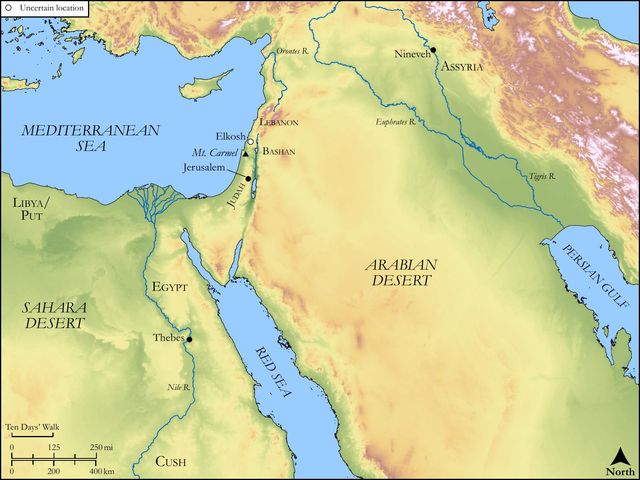
See on the biblical-era map
Study this verse
Public-domain commentary
Matthew Henry
From his Commentary on the Whole Bible. Henry comments on passages, not single verses — this entry covers Nahum 1:2–8. His four-level outline is real structure in the source text, so it is rendered as structure.
Nineveh knows not God, that God that contends with her, and therefore is here told what a God he is; and it is good for us all to mix faith with that which is here said concerning him, which speaks a great deal of terror to the wicked and comfort to good people; for this glorious description of the Sovereign of the world, like the pillar of cloud and fire, has a bright side towards Israel and a dark side towards the Egyptians. Let each take his portion from it; let sinners read it and tremble; let saints read it and triumph. The wrath of God is here revealed from heaven against him enemies, his favour and mercy are here assured to his faithful loyal subjects, and his almighty power in both, making his wrath very terrible and his favour very desirable.
I.He is a God of inflexible justice, a jealous God, and will take vengeance on his enemies; let Nineveh know this, and tremble before him.
Their idols are insignificant things; there is nothing formidable in them. But the God of Israel is greatly to be feared; for,
1.He resents the affronts and indignities done him by those that deny his being or any of his perfections, that set up other gods in competition with him, that destroy his laws, arraign his proceedings, ridicule his word, or are abusive to his people. Let such know that Jehovah, the one only living and true God, is a jealous God, and a revenger; he is jealous for the comfort of his worshippers, jealous for his land (Joe 2:18), and will not have that injured. He is a revenger, and he is furious; he has fury (so the word is), not as man has it, in whom it is an ungoverned passion (so he has said, Fury is not in me, Isa 27:4), but he has it in such a way as becomes the righteous God, to put an edge upon his justice, and to make it appear more terrible to those who otherwise would stand in no awe of it. He is Lord of anger (so the Hebrew phrase is for that which we read, he is furious); he has anger, but he has it at command and under government. Our anger is often lord over us, as theirs that have no rule over their own spirits, but God is always Lord of his anger and weighs a path to it, Psa 78:50.
2.He resolves to reckon with those that put those affronts upon him. We are told here, not only that he is a revenger, but that he will take vengeance; he has said he will, he has sworn it, Deu 32:40, Deu 32:41. Whoever are his adversaries and enemies among men, he will make them feel his resentments; and, though the sentence against his enemies is not executed speedily, yet he reserves wrath for them and reserves them for it in the day of wrath. Against his own people, who repent and humble themselves before him, he keeps not his anger for ever, but against his enemies he will for ever let out his anger. He will not at all acquit the wicked that sin, and stand to it, and do not repent, Nah 1:3. Those wickedly depart from their God that depart, and never return (Psa 18:21), and these he will not acquit. Humble supplicants will find him gracious, but scornful beggars will not find him easy, or that the door of mercy will be opened to a loud, but late, Lord, Lord. This revelation of the wrath of God against his enemies is applied to Nineveh (Nah 1:8), and should be applied by all those to themselves who go on still in their trespasses: With an over-running flood he will make an utter end of the place thereof. The army of the Chaldeans shall overrun the country of the Assyrians, and lay it all waste. God's judgments, when they come with commission, are like a deluge to any people, which they cannot keep off nor make head against. Darkness shall pursue his enemies; terror and trouble shall follow them, whitersoever they go, shall pursue them to utter darkness; if they think to flee from the darkness which pursues them they will but fall into that which is before them.
II.He is a God of irresistible power, and is able to deal with his enemies, be they ever so many, ever so mighty, ever so hardy.
He is great in power (Nah 1:3), and therefore it is good having him our friend and bad having him our enemy. Now here,
1.The power of God is asserted and proved by divers instances of it in the kingdom of nature, where we always find its visible effects in the ordinary course of nature, and sometimes in the surprising alterations of that course.
(1.)If we look up into the regions of the air, there we shall find proofs of his power, for he has his ways in the whirlwind and the storm. Which way soever God goes he carries a whirlwind and a storm along with him, for the terror of his enemies, Psa 18:9, etc. And, wherever there is a whirlwind and a storm, God has the command of it, the control of it, makes his way through it, goes on his way in it, and serves his own purposes by it. He spoke to Job out of the whirlwind, and even stormy winds fulfil his word. He has his way in the whirlwind, that is, he goes on undiscerned, and the methods of his providence are to us unaccountable; as it is said, His way is in the sea. The clouds are the dust of his feet; he treads on them, walks on them, raises them when he pleases, as a man with his feet raises a cloud of dust. It is but by permission, or usurpation rather, that the devil is the prince of the power of the air, for that power is in God's hand.
(2.)If we cast our eye upon the great deeps, there we find that the sea is his, for he made it; for, when he pleases, he rebukes the sea and makes it dry, by drying up all the rivers with which it is continually supplied. He gave those proofs of his power when he divided the Red Sea and Jordan, and can do the same again whenever he pleases.
(3.)If we look round us on this earth, we find proofs of his power, when, either by the extreme heat and drought of summer or the cold and frost of winter, Bashan languishes, and Carmel, and the flower of Lebanon languishes, the choicest and strongest flower languishes. His power is often seen in earthquakes, which shake the mountains (Nah 1:5), melt the hills, and melt them down, and level them with the plains. When he pleases the earth is burnt at his presence by the scorching heat of the sun, and he could burn it with fire from heaven, as he did Sodom, and at the end of time he will burn the world and all that dwell therein. The earth, and all the works that are therein, shall be burnt up. Thus great is the Lord and of great power.
2.This is particularly applied to his anger. If God be an almighty God, we may thence infer (Nah 1:6), Who can stand before his indignation? The Ninevites had once found God slow to anger (as he says Nah 1:3), and perhaps presumed upon the mercy they had then had experience of, and thought they might make bold with him; but they will find he is just and jealous as well as merciful and gracious, and, having shown the justice of his wrath, in the next he shows the power of it, and the utter insufficiency of his enemies to contend with him. It is in vain for the stoutest and strongest of sinners to think to make their part good against the power of God's anger.
(1.)See God here as a consuming fire, terrible and mighty. Here is his indignation against sin, and the fierceness of his anger, his fury poured out, not like water, but like fire, like the fire and brimstone rained on Sodom, Psa 11:6. Hell is the fierceness of God's anger, Rev 16:19. God's anger is so fierce that it beats down all before it: The rocks are thrown down by him, which seemed immovable. Rocks have sometimes been rent by the eruption of subterraneous fires, which is a faint resemblance of the fierceness of God's anger against sinners whose hearts are rocky, for none ever hardened their hearts against him and prospered.
(2.)See sinners here are stubble before the fire, weak and impotent, and a very unequal match for the wrath of God.
[1.]They are utterly unable to bear up against it, so as to resist it, and put by the strokes of it: Who can stand before his indignation? Not the proudest and most daring sinner; not the world of the ungodly; no, not the angels that sinned.
[2.]They are utterly unable to bear up under it so as to keep up their spirits, and preserve any enjoyment of themselves: Who can abide in the fierceness of his anger? As it is irresistible, so it is intolerable. Some of the effects of God's displeasure in this world a man may bear up under, but the fierceness of his anger, when it fastens immediately upon the soul, who can bear? Let us therefore fear before him; let us stand in awe, and not sin.
III.He is a God of infinite mercy; and in the midst of all this wrath mercy is remembered.
Let the sinners in Zion be afraid, that go on still in their transgressions, but let not those that trust in God tremble before him. For,
1.He is slow to anger (Nah 1:3), not easily provoked, but ready to show mercy to those who have offended him and to receive them into favour upon their repentance.
2.When the tokens of his rage against the wicked are abroad he takes care for the safety and comfort of his own people (Nah 1:7): The Lord is good to those that are good, and to them he will be a stronghold in the day of trouble. Note, The same almighty power that is exerted for the terror and destruction of the wicked is engaged, and shall be employed, for the protection and satisfaction of his own people; he is able both to save and to destroy. In the day of public trouble, when God's judgments are in the earth, laying all waste, he will be a place of defence to those that by faith put themselves under his protection, those that trust in him in the way of their duty, that live a life of dependence upon him, and devotedness to him; he knows them, he owns them for his, he takes cognizance of their case, knows what is best for them, and what course to take most effectually for their relief. They are perhaps obscure and little regarded in the world, but the Lord knows them, Psa 1:6.
Historical interpretation
Historical reception
1 surviving comment on this verse from the historical church.
(Verse 7) The Lord is good and strengthening in the day of tribulation, and He knows those who hope in Him. Septuagint: The Lord is sweet to those who wait for Him in the day of tribulation, and He knows those who fear Him. When He begins to be angry with the nations, and to destroy once powerful kingdoms, He will know those who are His, and He will not overwhelm those who sail with one storm. But the day of tribulation, according to interpretation (ἀναγωγὴν), let us understand as the day of judgment, about which Isaiah wrote: "Behold, the day of the Lord comes, inexorable, full of fury and rage, to make the world a desert, and to destroy sinners from it" (Isaiah 13:9). Let us hope in the Lord, and through his patience let us await his coming, so that when he comes, we may perceive him as good, not as a judge, and let him recognize those who hope in him or fear him (2 Timothy 2). For the Lord knows those who are his.
Continue studying Nahum 1:7 across the web’s major study libraries — every link below opens this exact verse, chapter, or book on the destination site.
Read & Compare
 BibleGatewayThis verse in more than 200 translations and 70 languages.
 Bible.comThe YouVersion reader — hundreds of translations, reading plans, and highlights.
 ESV.orgCrossway's official English Standard Version reader.
 NET BibleThe NET translation with 60,000+ translators' notes on every rendering decision.
 STEP BibleTyndale House's free study tool — original text, vocabulary, and scholarly resources.
 BibliaLogos Bible Software's free web reader.
 USCCBThe New American Bible (Revised Edition) with the U.S. bishops' study notes.
Commentaries
 BibleHub CommentariesDozens of classic commentaries on this verse, gathered on one page.
 StudyLightMore than 100 commentary sets — the largest collection on the web.
 BibleRefPlain-English commentary on what this verse means, verse by verse.
 Enduring WordDavid Guzik's free commentary on this chapter, widely used by Bible teachers.
 Bible Study ToolsVerse commentary alongside Greek and Hebrew study aids.
Original Language & Research
- BibleHub InterlinearThe verse word by word — original language, transliteration, and English.
- BibleHub LexiconEvery word's original-language definition and Strong's entry.
 Blue Letter BibleDeep-study tools — Strong's numbers, concordance, and word studies.
 SefariaThe Hebrew text with Rashi and centuries of Jewish commentary.
Sermons, Hymns & Audio


TrulyRandomVerse is not affiliated with these sites and doesn’t control their content. They’re linked because they’re genuinely useful.
Summary
Nahum 1:7 offers a profound theological anchor amidst the prophet's severe pronouncements of judgment against Nineveh, the capital of Assyria. This verse pivots from divine wrath to divine grace, assuring Judah of God's inherent goodness, His unwavering protection as an impenetrable refuge in times of distress, and His intimate, personal knowledge of those who faithfully place their trust in Him. It serves as a comforting declaration of God's steadfast character and covenantal faithfulness to His people, even as He executes justice upon the wicked.
Context
ShowHideLiterary Context
Nahum 1:7 stands as a pivotal statement within the larger oracle of Nahum, which is primarily a declaration of God's impending judgment against Nineveh. The preceding verses (Nahum 1:2-6) vividly portray the Lord as a jealous, avenging God, slow to anger but great in power, who will by no means clear the guilty. His wrath is depicted with powerful imagery of storms, mountains melting, and the earth quaking before Him. In this context of overwhelming divine power directed towards destruction, Nahum 1:7 introduces a crucial counterpoint, revealing the other side of God's character: His goodness and protection for His own. It functions as a theological hinge, demonstrating that while God is a consuming fire to His enemies, He is a secure fortress to those who trust Him, thereby providing hope and assurance to the oppressed people of Judah.
Historical & Cultural Context
The book of Nahum is set against the backdrop of the late 7th century BCE, a period dominated by the brutal Assyrian Empire. Nineveh, its formidable capital, was notorious for its cruelty, military might, and oppressive rule over conquered nations, including Judah. The people of Judah had suffered greatly under Assyrian subjugation, enduring tribute, deportation, and the constant threat of invasion. For them, the Assyrians represented an overwhelming, seemingly invincible force. In this atmosphere of fear and despair, Nahum's prophecy of Nineveh's utter destruction would have been a message of immense comfort and liberation. Nahum 1:7 specifically addresses the plight of Judah, assuring them that despite the global turmoil and the terror of Assyrian power, their God remains a reliable refuge, intimately aware of their suffering and faithful to protect them, contrasting sharply with the transient power of human empires.
Key Themes
ShowHideNahum 1:7 contributes significantly to several overarching themes within the book and broader biblical theology. It underscores the sovereignty and justice of God, demonstrating that He is in control of nations and will bring judgment upon wickedness, as seen in the broader message of Nineveh's fall. Simultaneously, it highlights God's covenant faithfulness and protective care for His people, even amidst a world steeped in sin and violence. The verse emphasizes the contrast between divine wrath and divine grace, showcasing that the same God who is a terrifying force to His enemies is a benevolent guardian to His own. Furthermore, it stresses the importance of trust in God as the proper response to His character, distinguishing those who will experience His protection from those who will face His judgment, a theme echoed in passages like Psalm 9:10 which proclaims, "And they that know thy name will put their trust in thee: for thou, LORD, hast not forsaken them that seek thee." This confidence in God's character provides a foundation for hope, even in the "day of trouble," a concept often explored in the wisdom literature, such as Proverbs 18:10.
Exposition and Analysis
ShowHideKey Word Analysis
ShowHideThis word, derived from H2896, encompasses a vast semantic range, indicating not merely moral uprightness but also that which is beneficial, pleasant, prosperous, beautiful, and bountiful. When applied to the LORD, it signifies His inherent benevolence, His perfect character, and His disposition to act for the well-being of His creation, especially His covenant people. It is the very essence of His being, informing all His actions, including His judgments, which are ultimately for a good and righteous purpose.
This term denotes a fortified place, a defense, a fortress, or a rock. It evokes imagery of an impregnable stronghold, a secure refuge providing ultimate safety and protection against external threats. In the context of Nahum 1:7, it portrays God as an unassailable sanctuary for those who seek Him, offering stability and security in times of intense distress and danger, when human defenses prove futile.
Derived from H3045, this verb signifies a deep, intimate, and experiential knowledge, far exceeding mere intellectual acquaintance. It implies personal recognition, affectionate care, and covenantal commitment. When God "knows" those who trust in Him, it means He has chosen them, entered into a relationship with them, and actively cares for their well-being, providing for and protecting them based on this profound, relational bond.
Verse Breakdown
ShowHide"The LORD is good"
This foundational declaration establishes God's inherent nature. It asserts His perfect moral character and His benevolent disposition towards His creation, particularly His covenant people. His goodness is not circumstantial but essential, meaning all His actions, including His judgments, flow from this righteous and loving core.
"a strong hold in the day of trouble"
Building on His goodness, this phrase portrays the practical manifestation of God's character. He is depicted as an unshakeable fortress, an impenetrable refuge that provides ultimate safety and stability for His people when they face distress, adversity, or danger. The "day of trouble" can refer to personal crises, national calamities (like the Assyrian threat), or the broader context of divine judgment upon the wicked, from which His faithful are shielded.
"and he knoweth them that trust in him"
This final clause clarifies who benefits from God's goodness and protection. The word "knoweth" (Hebrew: yâdaʻ) signifies a deep, intimate, and personal relationship, far beyond mere intellectual awareness. It implies God's affectionate recognition, His active care, and His covenantal commitment to those who place their faith, reliance, and refuge in Him. Their trust initiates and sustains this profound relationship, making them the beneficiaries of His protective presence.
Literary Devices
ShowHideNahum 1:7 is rich in Imagery, particularly the vivid depiction of God as "a strong hold." This metaphor transforms an abstract theological concept (God's protection) into a concrete, relatable image of an impregnable fortress, conveying absolute security and reliability. This imagery stands in stark Contrast to the preceding verses that describe God's destructive power against His enemies, highlighting His dual nature as both judge and protector. Furthermore, the phrase "he knoweth them that trust in him" employs Personification, attributing to God the human-like quality of intimate knowledge and personal recognition. This device emphasizes the relational aspect of God's character, assuring believers that they are not merely abstract entities but individuals intimately known and cherished by their Creator. The verse also functions as an Antithesis, juxtaposing the "day of trouble" with God as a "strong hold," underscoring that even in the midst of chaos and adversity, divine refuge is available.
Theological and Thematic Connections
ShowHideNahum 1:7 profoundly articulates God's dual nature as both a righteous judge and a compassionate deliverer, a tension central to biblical theology. While the immediate context is God's impending judgment on Nineveh, this verse assures His covenant people that His goodness and protective power are specifically directed towards them. It speaks to the unwavering faithfulness of God, who, despite His terrifying power and wrath against sin, remains intimately concerned with the well-being of those who seek refuge in Him. This intimate knowledge is not passive awareness but an active, covenantal relationship that guarantees His intervention and preservation. The verse thus serves as a powerful reminder that while God's justice is universal, His mercy and protection are specifically extended to those who respond to Him in faith and trust.
Reflection and Application
ShowHideNahum 1:7 offers profound comfort and practical guidance for believers navigating a world filled with uncertainty, suffering, and spiritual opposition. In moments of personal crisis, societal turmoil, or existential dread—our own "day of trouble"—this verse calls us to remember the unchanging character of God. He is inherently good, meaning His motives are always pure and His actions ultimately benevolent, even when His ways are mysterious. This truth provides a stable anchor for our souls, allowing us to trust His providence even when circumstances are difficult. Furthermore, the imagery of a "strong hold" invites us to actively seek Him as our ultimate refuge. We are encouraged to run to Him, not just intellectually acknowledge His power, but to depend on Him for our safety, peace, and stability. This reliance is not passive but an active, moment-by-moment surrender of our fears and anxieties to His sovereign care. The assurance that He "knoweth" us deeply and personally transforms our faith from a distant concept into an intimate relationship, reminding us that we are never forgotten or overlooked, but are cherished and protected by a God who truly sees and cares.
Questions for Reflection
ShowHideFAQ
ShowHideHow can God be "good" if He also brings judgment and wrath, as seen in the rest of Nahum?
ShowHideThe Bible consistently portrays God as both perfectly good and perfectly just. His goodness (H2896, ṭôwb) is His inherent nature, meaning He is always righteous, benevolent, and seeks what is ultimately best. His judgment and wrath, as seen against Nineveh, are not arbitrary acts of malice but manifestations of His justice against profound evil, oppression, and unrepentant sin. For a God to be truly good, He must also be just and hold wickedness accountable. Thus, His judgment is an extension of His goodness, ensuring that evil does not prevail and that His moral order is upheld. For those who trust in Him, His goodness is expressed as protection and refuge; for those who defiantly oppose Him, it is expressed as righteous judgment, as seen in Romans 2:5-8.
What is the difference between God "knowing" someone and simply being aware of them?
ShowHideThe Hebrew word for "knoweth" (H3045, yâdaʻ) in this context signifies far more than mere intellectual awareness. It denotes a deep, intimate, and relational knowledge, akin to the knowledge between a husband and wife (Genesis 4:1). When God "knows" those who trust in Him, it implies a covenantal relationship, a personal recognition, and an active, affectionate care. It means He has chosen them, entered into a bond with them, and is committed to their well-being and protection. It's the kind of knowledge that leads to active engagement and provision, as opposed to a detached observation. This intimate knowledge is the basis for His protective actions, distinguishing His own from those He does not "know" in this relational sense (Matthew 7:23).
Christ-Centered Fulfillment
ShowHideNahum 1:7 finds its ultimate and most profound fulfillment in the person and work of Jesus Christ. He is the very embodiment of God's inherent goodness, perfectly revealing the Father's character to humanity (John 14:9). In Jesus, the abstract concept of God's goodness becomes tangible and accessible, demonstrated through His healing, teaching, and sacrificial love. Furthermore, Christ is the ultimate "strong hold in the day of trouble." He is our secure refuge, not merely from earthly calamities, but from the far greater trouble of sin, death, and the wrath of God. Through His atoning work on the cross, He provides an unshakeable fortress for all who trust in Him, offering eternal security and peace that transcends any earthly storm (Colossians 1:13-14). Most significantly, Jesus perfectly fulfills the promise that God "knoweth them that trust in him." As the Good Shepherd, He declares, "I am the good shepherd, and I know my sheep and am known of mine" and "My sheep hear my voice, and I know them, and they follow me". This intimate, covenantal knowledge is the foundation of our salvation and eternal security, assuring us that in Christ, we are not merely known intellectually, but are deeply loved, recognized, and eternally cherished by God. He is the one in whom all God's promises of goodness, refuge, and intimate knowledge are perfectly realized for those who believe (2 Corinthians 1:20).