


Genesis 4:1
Bible text: King James Version (1769 Blayney text) · Public domain
Bible text: Berean Standard Bible · Public domain
Bible text: American Standard Version (1901) · Public domain
Bible text: World English Bible, Messianic edition · Public domain
Bible text: Geneva Bible (1599) · Public domain
Bible text: Young's Literal Translation · Public domain
- וְהָאָדָםve·Ha·'a·Damand the manH120Conj-w ¦ Art ¦ N-msNoun Singular Masculine Absoluteוְandהָtheאָדָםman
- יָדַעya·Da'he knewH3045V-Qal-Perf-3msVerb Qal Perfect 3rd Singular Masculine
- אֶת'et<obj.>H853DirObjMParticle Object Indicator
- חַוָּהcha·VahEveH2332N-proper-fNoun Proper Feminine
- אִשְׁתּוֹ'ish·Tohis wifeH802N-fsc ¦ 3msNoun Singular Feminine Constructאִשְׁתּwifeוֹhis
- וַתַּהַרva·Ta·harand she conceivedH2029Conj-w ¦ V-Qal-ConsecImperf-3fsVerb Qal Consecutive Imperfect 3rd Singular Feminineוַandתַּהַרshe conceived
- וַתֵּלֶדva·Te·ledand she boreH3205Conj-w ¦ V-Qal-ConsecImperf-3fsVerb Qal Consecutive Imperfect 3rd Singular Feminineוַandתֵּלֶדshe bore
- אֶת'et<obj.>H853DirObjMParticle Object Indicator
- קַיִןKa·yinCainH7014N-proper-mNoun Proper Masculine
- וַתֹּאמֶרva·To·merand she saidH559Conj-w ¦ V-Qal-ConsecImperf-3fsVerb Qal Consecutive Imperfect 3rd Singular Feminineוַandתֹּאמֶרshe said
- קָנִיתִיka·Ni·tiI have acquiredH7069V-Qal-Perf-1csVerb Qal Perfect 1st Singular common gender
- אִישׁ'isha manH376N-msNoun Singular Masculine Absolute
- אֶת'etwithH854PrepPreposition
- יְהוָהYah·wehYahwehH3068N-properNoun Proper Title
English is a literal word-by-word gloss of the Hebrew, not the KJV's wording. Why?
This is the original text the KJV's translators worked from — each Hebrew word with its own literal English meaning in this verse, prepared by scholars at Tyndale House, Cambridge. The KJV translates whole sentences, not word by word, so its wording differs: one Hebrew word can become several English words, and the KJV may choose “the LORD” where the gloss reads “Yahweh”. Both are faithful — they answer different questions. For the KJV's own rendering, switch to the KJV text.
Details
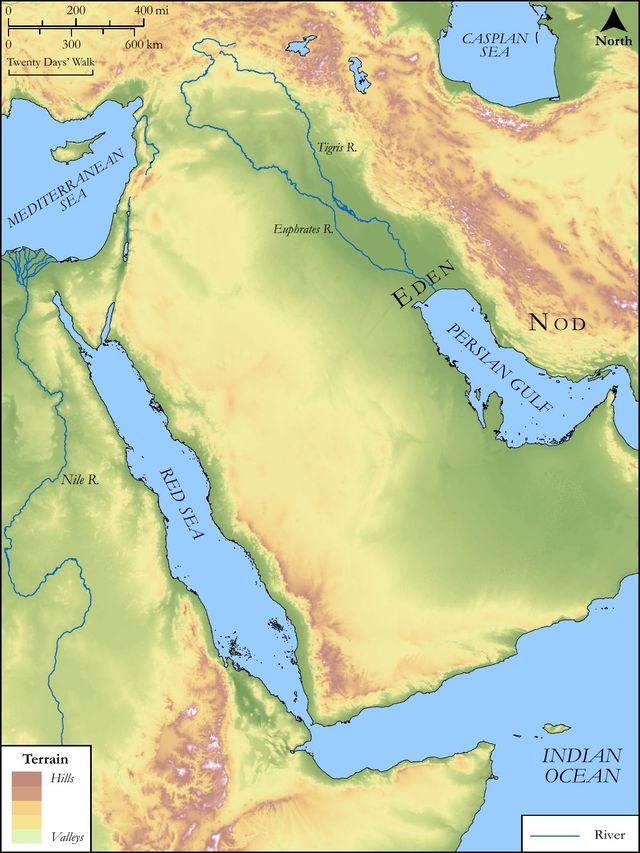
See on the biblical-era maps


Study this verse
Public-domain commentary
Matthew Henry
From his Commentary on the Whole Bible. Henry comments on passages, not single verses — this entry covers Genesis 4:1–2. His two-level outline is real structure in the source text, so it is rendered as structure.
Adam and Eve had many sons and daughters, Gen 5:4. But Cain and Abel seem to have been the two eldest. Some think they were twins, and, as Esau and Jacob, the elder hated and the younger loved. Though God had cast our first parents out of paradise, he did not write them childless; but, to show that he had other blessings in store for them, he preserved to them the benefit of that first blessing of increase. Though they were sinners, nay, though they felt the humiliation and sorrow of penitents, they did not write themselves comfortless, having the promise of a Saviour to support themselves with. We have here,
I.The names of their two sons.
1.Cain signifies possession; for Eve, when she bore him, said with joy, and thankfulness, and great expectation, I have gotten a man from the Lord. Observe, Children are God's gifts, and he must be acknowledged in the building up of our families. It doubles and sanctifies our comfort in them when we see them coming to us from the hand of God, who will not forsake the works and gifts of his own hand. Though Eve bore him with the sorrows that were the consequence of sin, yet she did not lose the sense of the mercy in her pains. Comforts, though alloyed, are more than we deserve; and therefore our complaints must not drown our thanksgivings. Many suppose that Eve had a conceit that this son was the promised seed, and that therefore she thus triumphed in him, as her words may be read, I have gotten a man, the Lord, God-man. If so, she was wretchedly mistaken, as Samuel, when he said, Surely the Lord's anointed is before me, Sa1 16:6. When children are born, who can foresee what they will prove? He that was thought to be a man, the Lord, or at least a man from the Lord, and for his service as priest of the family, became an enemy to the Lord. The less we expect from creatures, the more tolerable will disappointments be.
2.Abel signifies vanity. When she thought she had obtained the promised seed in Cain, she was so taken up with that possession that another son was as vanity to her. To those who have an interest in Christ, and make him their all, other things are as nothing at all. It intimates likewise that the longer we live in this world the more we may see of the vanity of it. What, at first, we are fond of, as a possession, afterwards we see cause to be dead to, as a trifle. The name given to this son is put upon the whole race, Psa 39:5. Every man is at his best estate Abel - vanity. Let us labour to see both ourselves and others so. Childhood and youth are vanity.
II.The employments of Cain and Abel.
Observe, 1. They both had a calling. Though they were heirs apparent to the world, their birth noble and their possessions large, yet they were not brought up in idleness. God gave their father a calling, even in innocency, and he gave them one. Note, It is the will of God that we should every one of us have something to do in this world. Parents ought to bring up their children to business. "Give them a Bible and a calling (said good Mr. Dod), and God be with them." 2. Their employments were different, that they might trade and exchange with one another, as there was occasion. The members of the body politic have need one of another, and mutual love is helped by mutual commerce. 3. Their employments belonged to the husbandman's calling, their father's profession - a needful calling, for the king himself is served of the field, but a laborious calling, which required constant care and attendance. It is now looked upon as a mean calling; the poor of the land serve for vine-dressers and husbandmen, Jer 52:16. But the calling was far from being a dishonour to them; rather, they were an honour to it. 4. It should seem, by the order of the story, that Abel, though the younger brother, yet entered first into his calling, and probably his example drew in Cain. 5. Abel chose that employment which most befriended contemplation and devotion, for to these a pastoral life has been looked upon as being peculiarly favourable. Moses and David kept sheep, and in their solitudes conversed with God. Note, That calling or condition of life is best for us, and to be chosen by us, which is best for our souls, that which least exposes us to sin and gives us most opportunity of serving and enjoying God.
Historical interpretation
Six Centuries of Reception
5 surviving comments on this verse. Each one is dated, so this reads as a timeline rather than a list.
Select a marker to jump to its quote. Markers stagger vertically where authors wrote within a few decades of each other.
After his disobedience, after their loss of the garden, then it was that the practice of intercourse had its beginning. You see, before their disobedience they followed a life like that of angels, and there was not mention of intercourse.
(Chapter 4, Verse 1) And she conceived and gave birth to Cain, and said, I have gained a man from God. Cain, meaning acquisition or possession, is interpreted as κτῆσις in Greek, and expressing its etymology, it is said, Canithi, meaning possession of a man from God.
(Ver. 4.) And God looked upon Abel and upon his offerings: but upon Cain and his offerings he did not look. And Cain was very angry, and his countenance fell. So Cain knew that God had accepted his brother's offerings and rejected his own, unless that interpretation which Theodotion has given is true. And the Lord was angry with Abel and his offering: but with Cain and his offering he was not angry. But fire used to come from heaven to devour the sacrifice: and we read of it in the dedication of the temple under Solomon, and when Elijah built an altar on Mount Carmel (2 Chronicles 7:1; 1 Kings 18:38).
Note that the name Cain means "ownership," which explains what was said at the time of his birth by his father or mother: "I have come into possession of a man through God."
Now Adam knew Eve his wife, and she conceived and bore Cain, saying: I have acquired a man through God. Henceforth, after the delights of paradise and the guilt of the first transgression, the events of this world and mortal life are narrated, when the first-created, who had been made immortal, after receiving the condition of dying, began to generate mortal offspring from themselves, all conceived in iniquity and brought forth from the womb in sins. Cain is interpreted as possession, the reason for which name the mother herself explained when she said: I have acquired a man through God. And with this statement, our mother now teaches us with catholic discernment that although she bore a son subject to the sin of her transgression, nonetheless this which was born a man, that is, which possessed a soul and body, was a gift of divine creation and the first blessing.
Since Adam had been blinded in the eyes of his soul and had fallen from the life imperishable, he began to look with his physical eyes. He turned the vision of his eyes on visible objects with affectionate desire and “knew Eve his wife, and she conceived and bore Cain.” Such knowledge is in reality ignorance of all goodness, for had he not first fallen from the knowledge and contemplation of God he would not have been brought down to this knowledge.
Continue studying Genesis 4:1 across the web’s major study libraries — every link below opens this exact verse, chapter, or book on the destination site.
Read & Compare
 BibleGatewayThis verse in more than 200 translations and 70 languages.
 Bible.comThe YouVersion reader — hundreds of translations, reading plans, and highlights.
 ESV.orgCrossway's official English Standard Version reader.
 NET BibleThe NET translation with 60,000+ translators' notes on every rendering decision.
 STEP BibleTyndale House's free study tool — original text, vocabulary, and scholarly resources.
 BibliaLogos Bible Software's free web reader.
 USCCBThe New American Bible (Revised Edition) with the U.S. bishops' study notes.
Commentaries
 BibleHub CommentariesDozens of classic commentaries on this verse, gathered on one page.
 StudyLightMore than 100 commentary sets — the largest collection on the web.
 BibleRefPlain-English commentary on what this verse means, verse by verse.
 Enduring WordDavid Guzik's free commentary on this chapter, widely used by Bible teachers.
 Bible Study ToolsVerse commentary alongside Greek and Hebrew study aids.
Original Language & Research
- BibleHub InterlinearThe verse word by word — original language, transliteration, and English.
- BibleHub LexiconEvery word's original-language definition and Strong's entry.
 Blue Letter BibleDeep-study tools — Strong's numbers, concordance, and word studies.
 SefariaThe Hebrew text with Rashi and centuries of Jewish commentary.
Sermons, Hymns & Audio


TrulyRandomVerse is not affiliated with these sites and doesn’t control their content. They’re linked because they’re genuinely useful.
Summary
Genesis 4:1 profoundly marks the continuation of humanity outside the Garden of Eden, detailing the first human conception and birth subsequent to the Fall. This pivotal verse records Adam and Eve's intimate union, the miraculous conception and delivery of their first son, Cain, and Eve's deeply significant declaration, expressing a profound hope that she had "gotten a man from the LORD." It establishes the foundational narrative for the human family, highlighting God's enduring grace amidst judgment, the immediate consequences of sin, and the nascent longing for a promised deliverer in salvation history.
Context
ShowHideLiterary Context
Genesis 4:1 immediately follows the somber narrative of humanity's expulsion from the Garden of Eden in Genesis 3:24, where cherubim guard the way to the tree of life. The abrupt transition from judgment and exile to the intimacy of marital union and the miracle of birth underscores God's continued engagement with humanity despite their sin. This verse initiates the "generations of Adam" (Genesis 5:1), setting the stage for the unfolding saga of human history, marked by both divine grace and escalating human depravity, ultimately leading to the flood narrative in Genesis 6, Genesis 7, Genesis 8, Genesis 9. It also serves as a direct, albeit complex, response to the curse on Eve regarding childbearing in Genesis 3:16, demonstrating that even within the curse, life continues.
Historical & Cultural Context
In Scripture, procreation was highly valued, often seen as a divine blessing and a means of continuing the family line and legacy. The birth of a firstborn son, in particular, was a cause for great celebration and hope, carrying significant social and religious implications. Eve's exclamation reflects this cultural emphasis on progeny, but it is imbued with a unique theological dimension given her recent experience of the Fall and the divine promise. The act of "knowing" one's wife, as a euphemism for sexual union, was a universally understood and accepted part of marital life, sanctioned by God from creation as seen in Genesis 1:28. The immediate procreation outside Eden signifies humanity's new existence in a world now subject to toil, pain, and death, yet still under God's sovereign hand.
Key Themes
ShowHideThis verse introduces several profound themes that resonate throughout Genesis and the rest of Scripture. Firstly, it highlights God's Sustaining Grace and Faithfulness, demonstrating that even after severe judgment, God does not abandon humanity but enables the continuation of life and the human family. Secondly, it underscores the Hope for a Deliverer, as Eve's statement likely reflects her immediate and profound longing for the "seed" promised in Genesis 3:15, who would crush the serpent's head. This theme of a coming deliverer becomes a central thread in redemptive history. Thirdly, it marks the Beginning of Human History and Family outside Paradise, establishing the foundational unit of society and setting the stage for the complex dynamics of sibling rivalry, sin, and the unfolding of God's covenant plan through subsequent generations, as seen in the narratives of Noah, Abraham, and beyond.
Exposition and Analysis
ShowHideKey Word Analysis
ShowHideThis primitive root signifies "to know," but in this context, it is a euphemism for intimate sexual union. It denotes a profound, experiential, and personal relationship, far beyond mere intellectual acquaintance. The act of "knowing" implies a deep, relational bond that leads to the physical act of procreation, underscoring the sanctity and purpose of marital intimacy in God's design.
This primitive root means "to be (or become) pregnant." It points to the miraculous biological process of conception, initiated through the act of "knowing." In the post-Fall context, where Eve was cursed with increased pain in childbirth (Genesis 3:16), the very possibility of conception and new life demonstrates God's continuing grace and the perpetuation of His creation mandate.
This primitive root means "to erect," "to create," "to procure," or "to possess." In Eve's declaration, "I have gotten a man from the LORD," it carries significant theological weight. It suggests an act of acquisition or creation, implying that she views Cain as a divine gift or even as the fulfillment of a divine promise. The nuance of "from the LORD" (Hebrew: 'et YHWH) further complicates its interpretation, suggesting either acquisition with the Lord's help, from the Lord, or even the audacious idea that she had "gotten the Lord" (i.e., the promised deliverer) himself.
Verse Breakdown
ShowHide"¶ And Adam knew Eve his wife;"
This opening clause establishes the intimate marital relationship between Adam and Eve, using the euphemistic Hebrew verb yâdaʻ (to know) to signify sexual union. It highlights the foundational act of procreation within the divinely ordained covenant of marriage, even after the Fall. This act is presented as natural and expected, fulfilling the creation mandate to "be fruitful and multiply" (Genesis 1:28).
"and she conceived, and bare Cain,"
This clause describes the miraculous outcome of their union: conception and birth. The naming of the firstborn son, Cain (Hebrew: Qayin), is significant, as it immediately precedes Eve's interpretive declaration. The birth of Cain marks the beginning of the human family outside the Garden of Eden, a new phase in humanity's existence, now subject to the realities of a fallen world.
"and said, I have gotten a man from the LORD."
This is Eve's profound and highly debated declaration. The Hebrew phrase qânîtî 'îsh 'et YHWH (I have gotten a man with/from/the LORD) is rich with interpretive possibilities. Eve's use of qânâh (to get, acquire, create) coupled with 'et YHWH (from/with/the LORD) suggests a deep hope, possibly a belief that Cain was the promised "seed" who would crush the serpent's head (Genesis 3:15). Her words reflect a mixture of joy, expectation, and perhaps a nascent misunderstanding of how divine redemption would unfold. This statement sets a hopeful, yet ultimately tragic, tone for the initial chapters of human history, as Cain's later actions would starkly contrast with Eve's hopeful pronouncement, leading to the first murder in Genesis 4:8.
Literary Devices
ShowHideGenesis 4:1 employs several key literary devices that enrich its meaning. The most prominent is Euphemism, specifically the use of "knew" (yâdaʻ) to denote sexual intimacy. This indirect language respects the private nature of the act while clearly conveying its outcome, a common feature in biblical narrative for sensitive topics. The verse also utilizes Foreshadowing, as Eve's hopeful declaration about Cain, though ultimately misplaced, subtly points to the future need for a true deliverer. Her words, "a man from the LORD," resonate with the promise of the "seed" in Genesis 3:15, setting up an expectation that will only be truly fulfilled in Christ. Furthermore, there is a strong element of Irony present. Eve's profound hope for a deliverer in Cain, the firstborn, stands in stark contrast to his subsequent actions, which lead to the first act of murder and further human depravity, thus highlighting the pervasive nature of sin even in humanity's earliest generations.
Theological and Thematic Connections
ShowHideGenesis 4:1 is a foundational text that immediately follows the Fall, demonstrating God's unwavering commitment to His creation and His redemptive plan. Despite humanity's disobedience and expulsion from paradise, God's decree to "be fruitful and multiply" (Genesis 1:28) remains in effect, showcasing His sustaining grace. Eve's hopeful declaration, "I have gotten a man from the LORD," reflects a profound, albeit perhaps misdirected, understanding of the promise of a deliverer given in the Protoevangelium (Genesis 3:15). This verse thus lays the groundwork for the ongoing tension between human sin and divine grace, and the persistent longing for salvation that permeates all of biblical history.
Reflection and Application
ShowHideGenesis 4:1 offers profound insights into the human condition and God's character. In the immediate aftermath of humanity's greatest failure, God's grace shines through the gift of new life. This reminds us that even in our darkest moments, after our most significant falls, God does not abandon us. He continues to provide, to sustain, and to work His purposes. Eve's initial hope, though misplaced in Cain, speaks to the inherent human longing for redemption and deliverance from the consequences of sin. This longing is universal and points us toward the true source of hope. For us today, it encourages us to place our hope not in human efforts or expectations, but in God alone, who faithfully brings forth His redemptive plan in His perfect timing. It calls us to recognize the sanctity of life, the beauty of family, and the enduring power of God's grace even in a fallen world.
Questions for Reflection
ShowHideFAQ
ShowHideWhat does "Adam knew Eve his wife" truly mean in this context?
ShowHideThe phrase "Adam knew Eve his wife" uses the Hebrew verb yâdaʻ (H3045), which signifies a deep, intimate, and experiential knowledge. In this context, it is a common biblical euphemism for sexual union. It highlights the profound personal relationship and physical intimacy between husband and wife that leads to conception, emphasizing the relational and covenantal aspect of procreation rather than merely a biological act.
Why does Eve say, "I have gotten a man from the LORD"?
ShowHideEve's statement, "I have gotten a man from the LORD," is laden with theological significance and reflects her profound hope and perhaps a nascent understanding or misunderstanding of God's promise. The Hebrew word for "gotten" (qânâh, H7069) can mean to acquire, create, or possess. Coupled with the phrase "from the LORD" ('et YHWH, H3068), it has been interpreted in various ways: she may have believed she acquired a man with the Lord's help, from the Lord as a divine gift, or even that she had "gotten the LORD" himself, implying she thought Cain was the promised "seed" who would crush the serpent's head, as foretold in Genesis 3:15. This last interpretation suggests a deep, albeit misplaced, messianic hope.
Is this the very first human birth recorded in the Bible?
ShowHideYes, Genesis 4:1 records the first instance of human conception and birth in the biblical narrative. It marks a crucial milestone in the history of humanity, as it signifies the continuation of the human race outside the Garden of Eden and the beginning of the human family's journey in a fallen world.
Does the birth of Cain imply that God approved of Adam and Eve's sin?
ShowHideNo, the birth of Cain does not imply God approved of Adam and Eve's sin. Rather, it powerfully demonstrates God's enduring grace, mercy, and faithfulness to His creation. Despite their disobedience and the ensuing judgment, God allowed humanity to continue and procreate, fulfilling His original creation mandate to "be fruitful and multiply" (Genesis 1:28). It shows that even in the midst of consequences for sin, God's redemptive plan continues to unfold.
Christ-Centered Fulfillment
ShowHideEve's hopeful declaration in Genesis 4:1, though tragically unfulfilled in Cain, profoundly foreshadows the ultimate Christ-centered fulfillment of God's redemptive promise. Her longing for a "man from the LORD" who would bring deliverance points directly to Jesus Christ, the true "seed" promised in Genesis 3:15, who would ultimately crush the serpent's head. Unlike Cain, who brought further sin and death into the world, Jesus, the Son of God, truly came "from the LORD" (as seen in Galatians 4:4, "God sent forth His Son") to conquer sin, death, and the power of the devil (Hebrews 2:14). He is the ultimate deliverer, the "last Adam" (1 Corinthians 15:45), who reverses the curse of sin and offers new life and reconciliation with God. Eve's initial, misplaced hope finds its perfect and true realization in Christ, who is indeed the man from the Lord who brings salvation to all who believe.