


1 Kings 2:35
Bible text: King James Version (1769 Blayney text) · Public domain
Bible text: Berean Standard Bible · Public domain
Bible text: American Standard Version (1901) · Public domain
Bible text: World English Bible, Messianic edition · Public domain
Bible text: Geneva Bible (1599) · Public domain
Bible text: Young's Literal Translation · Public domain
- וַיִּתֵּןvai·yi·Tenand he putH5414Conj-w ¦ V-Qal-ConsecImperf-3msVerb Qal Consecutive Imperfect 3rd Singular Masculineוַandיִּתֵּןhe put
- הַמֶּלֶךְha·Me·lekhthe kingH4428Art ¦ N-msNoun Singular Masculine Absoluteהַtheמֶּלֶךְking
- אֶת'et<obj.>H853DirObjMParticle Object Indicator
- בְּנָיָהוּbe·na·Ya·huBenaiahH1141N-proper-mNoun Proper Masculine
- בֶןven[the] son ofH1121N-mscNoun Singular Masculine Construct
- יְהוֹיָדָעye·ho·ya·Da'JehoiadaH3077N-proper-mNoun Proper Masculine
- תַּחְתָּיוtach·Tavin place of himH8478N-mpc ¦ 3msNoun Plural Masculine Constructתַּחְתָּיin place ofוhim
- עַל'aloverH5921PrepPreposition
- הַצָּבָאha·tza·Va'the armyH6635Art ¦ N-msNoun Singular Masculine Absoluteהַtheצָּבָאarmy
- וְאֶתve·'Etand <obj.>H853Conj-w ¦ DirObjMParticle Object Indicatorוְandאֶת<obj.>
- צָדוֹקtza·DokZadokH6659N-proper-mNoun Proper Masculine
- הַכֹּהֵןha·ko·Henthe priestH3548Art ¦ N-msNoun Singular Masculine Absoluteהַtheכֹּהֵןpriest
- נָתַןna·Tanhe putH5414V-Qal-Perf-3msVerb Qal Perfect 3rd Singular Masculine
- הַמֶּלֶךְha·Me·lekhthe kingH4428Art ¦ N-msNoun Singular Masculine Absoluteהַtheמֶּלֶךְking
- תַּחַתTa·chatin place ofH8478N-mscNoun Singular Masculine Construct
- אֶבְיָתָר'ev·ya·TarAbiatharH54N-proper-mNoun Proper Masculine
English is a literal word-by-word gloss of the Hebrew, not the KJV's wording. Why?
This is the original text the KJV's translators worked from — each Hebrew word with its own literal English meaning in this verse, prepared by scholars at Tyndale House, Cambridge. The KJV translates whole sentences, not word by word, so its wording differs: one Hebrew word can become several English words, and the KJV may choose “the LORD” where the gloss reads “Yahweh”. Both are faithful — they answer different questions. For the KJV's own rendering, switch to the KJV text.
Details
See on the biblical-era maps

Study this verse
Public-domain commentary
Matthew Henry
From his Commentary on the Whole Bible. Henry comments on passages, not single verses — this entry covers 1 Kings 2:35–46. His two-level outline is real structure in the source text, so it is rendered as structure.
Here is, I. The preferment of Benaiah and Zadok, two faithful friends to Solomon and his government, Kg1 2:35. Joab being put to death, Benaiah was advanced to be general of the forces in his room, and, Abiathar being deposed, Zadok was made high priest in his room, and therein was fulfilled the word of God, when he threatened to cut off the house of Eli (Sa1 2:35), I will raise me up a faithful priest, and will build him a sure house. Though sacred offices may be disgraced, they shall not be destroyed, by the mal-administration of those that are entrusted with them, nor shall God's work ever stand still for want of hands to carry it on. No wonder that he who was a king so immediately of God's making was empowered to make whom he though fit high priest; and he exercised this power with equity, for the ancient right was in Zadok, he being of the family of Eleazar, whereas Eli and his house were of Ithamar.
II.The course that was taken with Shimei.
He is sent for, by a messenger, from his house at Bahurim, expecting perhaps no better than Adonijah's doom, being conscious of his enmity to the house of David; but Solomon knows how to make a difference of crimes and criminals. David had promised Shimei his life for his time. Solomon is not bound by that promise, yet he will not go directly contrary to it.
1.He confines him to Jerusalem, and forbids him, upon any pretence whatsoever, to go out of the city any further than the brook Kidron, Kg1 2:36, Kg1 2:37. He would suffer him to continue at his country seat lest he should make mischief among his neighbours, but took him to Jerusalem, where he kept him prisoner at large. This might make Shimei's confinement easy to himself, for Jerusalem was beautiful for situation, the joy of the whole earth, the royal city, the holy city (he had no reason to complain of being shut up in such a paradise); it would also make it the more safe for Solomon, for there he would have him under his eye and be able to watch his motions; and he plainly tells him that if he ever go out of the rules he shall certainly die for it. This was a fair trial of his obedience, and such a test of his loyalty as he had no reason to complain of. He has his life upon easy terms: he shall live if he will but be content to live at Jerusalem.
2.Shimei submits to the confinement, and thankfully takes his life upon those terms. He enters into recognizance (Kg1 2:38), under the penalty of death, not to stir out of Jerusalem, and owns that the saying is good. Even those that perish cannot but own the conditions of pardon and life unexceptionable, so that their blood, like Shimei's, must rest upon their own heads. Shimei promised, with an oath, to keep within his bounds, Kg1 2:42.
3.Shimei forfeits his recognizance, which was the thing Solomon expected; and God was righteous in suffering him to do it, that he might now suffer for his old sins. Two of his servants (it seems, though he was a prisoner, he lived like himself, well attended) ran from him to the land of the Philistines, Kg1 2:39. Thither he pursued them, and thence brought them back to Jerusalem, Kg1 2:40. For the keeping of it private he saddled his ass himself, probably went in the night, and came home he thought undiscovered. "Seeking his servants," says bishop Hall, "he lost himself; those earthly things either are, or should be, our servants. How commonly do we see men run out of the bounds set by God's law, to hunt after them, till their souls incur a fearful judgment!" 4. Solomon takes the forfeiture. Information is given him that Shimei has transgressed, Kg1 2:41. The king sends for him, and, (1.) charges him with the present crime (Kg1 2:42, Kg1 2:43), that he had put a great contempt upon the authority and wrath both of God and the king, that he had broken the oath of the Lord and disobeyed the commandment of his prince, and by this it appeared what manner of spirit he was of, that he would not be held by the bonds of gratitude or conscience. Had he represented to Solomon the urgency of the occasion, and begged leave to go, perhaps Solomon might have given him leave; but to presume either upon his ignorance or his connivance was to affront him in the highest degree. (2.) He condemns him for his former crime, cursing David, and throwing stones at him in the day of his affliction: The wickedness which thy heart is privy to, Kg1 2:44. There was no need to examine witnesses for the proof of the fact, his own conscience was instead of a thousand witnesses. That wickedness which men's own hearts alone are privy to is enough, if duly considered, to fill them with confusion, in expectation of its return upon their own heads; for if the heart be privy to it, God is greater than the heart and knoweth all things. Others knew of Shimei's cursing David, but Shimei himself knew of the wicked principles of hatred and malice against David which he displayed in cursing him and that his submission was but feigned and forced. (3.) He blessed himself and his government (Kg1 2:45.): King Solomon shall be blessed, notwithstanding Shimei's impotent curses, which perhaps, in fury and despair, he now vented freely: Let them curse, but bless thou. And the throne of David shall be established, by taking away those that would undermine it. It is a comfort, in reference to the enmity of the church's enemies, that, how much soever they rage, it is a vain thing they imagine. Christ's throne is established, and they cannot shake it. (4.) He gives orders for the execution of Shimei immediately, Kg1 2:46. All judgment is committed to the Lord Jesus, and, though he be King of peace, he will be found a King of righteousness; and this will shortly be his word of command concerning all his enemies, that would not have him to reign over them: Bring them forth, and slay them before me; the reproaches of those that blasphemed him will fall on themselves, to their eternal condemnation.
Continue studying 1 Kings 2:35 across the web’s major study libraries — every link below opens this exact verse, chapter, or book on the destination site.
Read & Compare
 BibleGatewayThis verse in more than 200 translations and 70 languages.
 Bible.comThe YouVersion reader — hundreds of translations, reading plans, and highlights.
 ESV.orgCrossway's official English Standard Version reader.
 NET BibleThe NET translation with 60,000+ translators' notes on every rendering decision.
 STEP BibleTyndale House's free study tool — original text, vocabulary, and scholarly resources.
 BibliaLogos Bible Software's free web reader.
 USCCBThe New American Bible (Revised Edition) with the U.S. bishops' study notes.
Commentaries
 BibleHub CommentariesDozens of classic commentaries on this verse, gathered on one page.
 StudyLightMore than 100 commentary sets — the largest collection on the web.
 BibleRefPlain-English commentary on what this verse means, verse by verse.
 Enduring WordDavid Guzik's free commentary on this chapter, widely used by Bible teachers.
 Bible Study ToolsVerse commentary alongside Greek and Hebrew study aids.
Original Language & Research
- BibleHub InterlinearThe verse word by word — original language, transliteration, and English.
- BibleHub LexiconEvery word's original-language definition and Strong's entry.
 Blue Letter BibleDeep-study tools — Strong's numbers, concordance, and word studies.
 SefariaThe Hebrew text with Rashi and centuries of Jewish commentary.
Sermons, Hymns & Audio


TrulyRandomVerse is not affiliated with these sites and doesn’t control their content. They’re linked because they’re genuinely useful.
Summary
1 Kings 2:35 marks a pivotal moment in the consolidation of King Solomon's reign, illustrating his decisive actions to secure his nascent throne. Following the systematic removal of key figures who had challenged his succession, Solomon strategically appointed loyal and capable individuals to the most critical positions of power: Benaiah, son of Jehoiada, as commander of the army, and Zadok as the high priest, replacing Joab and Abiathar respectively. These appointments were instrumental in establishing a stable, secure, and divinely sanctioned administration, signaling the true beginning of Solomon's undisputed rule over Israel.
Context
ShowHideLiterary Context
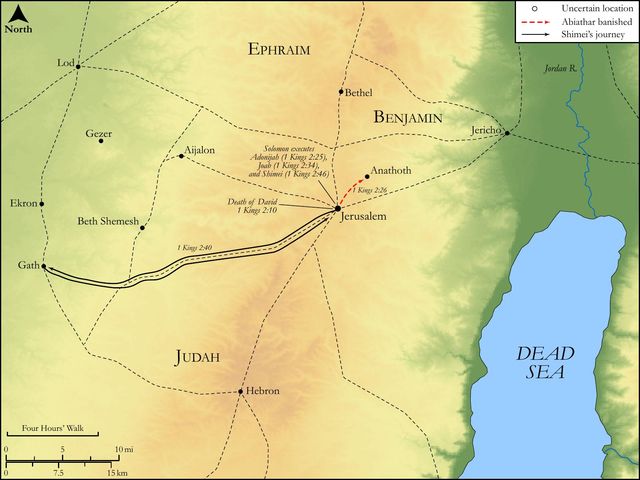
This verse serves as the concluding act in a foundational chapter of 1 Kings, which meticulously details the tumultuous transfer of power from the aging King David to his designated successor, Solomon. The narrative immediately preceding 1 Kings 2:35 recounts Solomon's swift and firm actions against those who had opposed his ascension. This includes the execution of his half-brother and rival, Adonijah, for a perceived attempt to usurp the throne (1 Kings 2:25), the banishment of Abiathar the priest (1 Kings 2:26), and the execution of Joab, David's long-serving but often disloyal army commander (1 Kings 2:34). Thus, 1 Kings 2:35 represents the final, crucial step in establishing Solomon's authority, directly fulfilling the charge given by David to Solomon to deal with those who threatened the stability of the kingdom (1 Kings 2:6). It transitions the narrative from a period of purging to one of establishing a new, loyal order.
Historical & Cultural Context
Among the kings of that day, the succession of a new monarch was often a precarious period, frequently marked by political intrigue, violence, and the elimination of potential rivals. A new king's ability to maintain power hinged significantly on securing the unwavering loyalty of his military commander ("over the host") and the religious legitimacy provided by the high priest. The high priest wielded immense spiritual and often political influence, serving as a crucial intermediary between the divine and the people, and frequently advising the king on matters of state and religious law. The replacement of Abiathar with Zadok was particularly profound. Abiathar belonged to the priestly line of Eli, against whom a divine judgment had been prophesied generations earlier, foretelling the removal of his house from the priesthood due to their unfaithfulness (1 Samuel 2:30-36). Zadok, conversely, had demonstrated steadfast loyalty to David during Absalom's rebellion and to Solomon during Adonijah's attempted coup, representing a faithful and legitimate priestly line. This shift not only secured Solomon's political position but also aligned his reign with a long-standing divine decree, affirming the theological legitimacy of his actions.
Key Themes
ShowHideThis passage powerfully illuminates several interconnected themes essential to understanding the early Solomonic kingdom. Firstly, it underscores the Consolidation of Power, as Solomon, through decisive and often ruthless actions, systematically eliminates threats and replaces disloyal figures with trusted, faithful individuals, thereby establishing a new, unified administration. This demonstrates the pragmatic realities of ancient kingship and the necessity of absolute loyalty for a stable reign. Secondly, the passage highlights Divine Sovereignty and Justice, particularly evident in the change of the high priesthood. While Solomon executed the human decisions, the text subtly implies that God's hand was at work, fulfilling ancient prophecies concerning the house of Eli and establishing a righteous priesthood under Zadok. This illustrates that even amidst the complex and often violent machinations of human politics, God's overarching plan prevails, guiding events toward His intended purposes, as seen in the prophecy of a faithful priest in 1 Samuel 2:35. Lastly, the verse vividly portrays the Consequences of Loyalty and Disloyalty. Benaiah and Zadok's unwavering faithfulness to David and Solomon was rewarded with elevation to positions of immense power and honor, while Joab and Abiathar's disloyalty led to their swift removal, serving as a stark reminder of the importance of faithfulness to divinely appointed authority and the repercussions of rebellion.
Exposition and Analysis
ShowHideKey Word Analysis
ShowHideA primitive root meaning "to give," but used with the greatest latitude of application, including "put," "make," "appoint," or "assign." In this context, it signifies Solomon's sovereign act of placing individuals into specific, high-authority roles. It emphasizes the king's active agency and the deliberate nature of these appointments, which were not merely successions but strategic installations of trusted personnel.
Referring to a "mass of persons (or figuratively, things), especially regularly organized for war (an army)." To be "over the host" meant to be the commander-in-chief, the supreme military authority responsible for national defense, internal security, and executing the king's will through force. Solomon's appointment of Benaiah to this role was paramount for securing his direct control over the military apparatus, ensuring its loyalty and effectiveness.
An active participle literally meaning "one officiating," a priest. Here, it refers specifically to the high priest, the chief religious official in Israel. This individual was responsible for leading national worship, offering sacrifices, and interpreting divine law, thus holding significant spiritual and often political influence. The transfer of this sacred office from Abiathar to Zadok was not merely a political maneuver but a profound theological shift, aligning the priesthood with God's divine will and prophetic plan.
Verse Breakdown
ShowHide"And the king put Benaiah the son of Jehoiada in his room over the host:"
This clause details Solomon's first critical appointment, establishing his authority over the military. Benaiah, known for his unwavering loyalty to both David and Solomon, and his proven prowess as a warrior (having just executed Joab), is elevated to the supreme command of the army. This strategic move ensured that the formidable power of Israel's military forces was now under the direct and unquestioning control of the king, replacing the often independently-minded Joab. It signified a decisive break from the old guard and the firm establishment of Solomon's personal authority over the kingdom's military might.
"and Zadok the priest did the king put in the room of Abiathar."
This second clause describes the equally pivotal change in the religious leadership of the nation. Abiathar, who had sided with Adonijah's attempted coup, was removed from his esteemed position as high priest. In his stead, Zadok, who had consistently demonstrated faithfulness to both David and Solomon throughout various crises, was installed as the sole high priest. This appointment carried immense significance, not only for political stability by removing a disloyal figure but also for its profound theological implications, as it fulfilled the divine judgment pronounced against the house of Eli in 1 Samuel 2, thereby establishing a new, legitimate, and divinely sanctioned priestly line.
Literary Devices
ShowHideThe passage employs Juxtaposition to powerfully highlight the stark contrast between the old, disloyal administration and the new, faithful leadership. The immediate succession of the removal of Joab and Abiathar with the appointment of Benaiah and Zadok underscores Solomon's decisive and efficient transition of power. There is also a strong element of Fulfillment of Prophecy embedded in the narrative, particularly concerning the high priesthood. The elevation of Zadok and the removal of Abiathar directly align with the ancient divine judgment against the house of Eli, adding a layer of divine validation and inevitability to Solomon's actions. Furthermore, the narrative demonstrates Symbolism, as these key appointments are not merely administrative changes but represent the inauguration of a new, stable, and divinely sanctioned era under Solomon's rule, free from the lingering threats and disloyalties of the past, marking the true beginning of his peaceful and prosperous reign.
Theological and Thematic Connections
ShowHideThe strategic appointments detailed in 1 Kings 2:35 underscore the profound biblical principle that effective leadership in God's kingdom necessitates both divine anointing and unwavering human faithfulness. Solomon's actions, though seemingly ruthless in their execution, are presented within the biblical narrative as necessary for the stability and purity of the divinely established monarchy, aligning with God's sovereign plan for Israel. The removal of Abiathar and the elevation of Zadok specifically highlight God's unwavering faithfulness to His prophetic word, demonstrating that He orchestrates human decisions and historical events to bring about His ultimate purposes. This passage serves as a potent reminder that God is actively involved in the affairs of nations and the lives of leaders, justly rewarding loyalty and faithfully bringing consequences for disloyalty.
Reflection and Application
ShowHide1 Kings 2:35 offers profound insights into the nature of leadership, the far-reaching consequences of our choices, and the overarching sovereignty of God in human affairs. Solomon's decisive actions demonstrate that effective leadership often requires courage, discernment, and the willingness to make difficult, even unpopular, decisions for the greater good and long-term stability of the organization, community, or nation. His reward of Benaiah and Zadok highlights the enduring and invaluable nature of loyalty, integrity, and faithfulness in service, whether to an earthly leader or, more profoundly, to God Himself. This passage also provides immense comfort and assurance that even amidst political turmoil, personal betrayals, or challenging transitions in our own lives, God's ultimate plan remains unshaken and His purposes will prevail. He sovereignly uses human instruments, both faithful and flawed, to accomplish His divine will, reminding us that His ultimate control transcends all earthly chaos. We are called to embody faithfulness in our own spheres of influence, trusting that God is actively at work, even when circumstances seem most uncertain.
Questions for Reflection
ShowHideFAQ
ShowHideWhy was Abiathar removed from the priesthood, and Zadok appointed in his place?
ShowHideAbiathar was removed primarily due to his disloyalty to Solomon. He had actively sided with Adonijah in his attempt to usurp the throne (1 Kings 1:7), thereby opposing Solomon, whom God and David had clearly chosen as the rightful successor. Beyond this immediate political disloyalty, Abiathar's removal also fulfilled a long-standing prophecy against the house of Eli, his ancestor, foretelling the end of their priestly line due to their unfaithfulness and corruption (1 Samuel 2:30-36). Zadok, conversely, had consistently demonstrated steadfast loyalty to David during Absalom's rebellion and to Solomon during Adonijah's coup. His appointment was a direct reward for his faithfulness and a divine confirmation of his priestly legitimacy, establishing a new, righteous high priestly line in accordance with God's sovereign plan.
What does the phrase "in his room" mean in this verse?
ShowHideThe phrase "in his room" is an archaic English expression found in the King James Version. It simply means "in his place" or "as his successor." In the context of 1 Kings 2:35, it indicates a direct and complete replacement: Benaiah took Joab's position as commander of the army, and Zadok took Abiathar's position as high priest. The underlying Hebrew conveys the sense of one being "over" or "in the stead of" another, signifying a full transfer of authority, responsibility, and the duties associated with the role.
How do these appointments reflect Solomon's character as a king?
ShowHideThese appointments powerfully demonstrate Solomon's decisive, strategic, and resolute character as a king. Instead of allowing lingering threats or disloyal elements to destabilize his nascent reign, he acted swiftly and firmly to establish a loyal and competent administration. This reveals his understanding of the absolute necessity for unified authority and unwavering loyalty in leadership to ensure the security, stability, and prosperity of the kingdom. It reflects a pragmatic and unwavering approach to governance, laying the essential groundwork for the peaceful and prosperous reign that would follow, a period of unparalleled peace and wealth for Israel (1 Kings 4:20-25).
Christ-Centered Fulfillment
ShowHideThe establishment of Solomon's kingdom through the strategic appointment of loyal and righteous officials serves as a profound foreshadowing of the far greater and eternal kingdom of Jesus Christ. Solomon, as an earthly king, had to secure his throne through human means, including the removal of adversaries and the installation of trusted servants. In stark contrast, Christ's authority is inherent, eternal, and universal, not gained through political maneuvering or earthly power struggles, but through His divine nature and His redemptive work on the cross (Matthew 28:18). Just as Solomon appointed Benaiah as commander of his host, Jesus Christ is the ultimate Commander of the hosts of heaven and earth, leading His church in spiritual warfare against the forces of darkness (Ephesians 6:12). Furthermore, Zadok's elevation as the faithful high priest points directly to Jesus Christ, our great High Priest, who is eternally faithful, without sin, and perfectly mediates between God and humanity. He offered a superior and permanent sacrifice for sins, establishing a new and living way to God (Hebrews 4:14-16, Hebrews 7:25-27). While Solomon's kingdom was earthly, temporary, and dependent on human loyalty, Christ's kingdom is spiritual, everlasting, and founded not on human power but on divine love, grace, and His unwavering faithfulness, where all who are loyal to Him are given a place in His eternal reign (Luke 1:33).