


1 Kings 2:42
- וַיִּשְׁלַחvai·yish·Lachand he sentH7971Conj-w ¦ V-Qal-ConsecImperf-3msVerb Qal Consecutive Imperfect 3rd Singular Masculineוַandיִּשְׁלַחhe sent
- הַמֶּלֶךְha·Me·lekhthe kingH4428Art ¦ N-msNoun Singular Masculine Absoluteהַtheמֶּלֶךְking
- וַיִּקְרָאvai·yik·Ra'and he summonedH7121Conj-w ¦ V-Qal-ConsecImperf-3msVerb Qal Consecutive Imperfect 3rd Singular Masculineוַandיִּקְרָאhe summoned
- לְשִׁמְעִיle·shim·'I<to> ShimeiH8096Prep-l ¦ N-proper-mNoun Proper Masculineלְ<to>שִׁמְעִיShimei
- וַיֹּאמֶרvai·Yo·merand he saidH559Conj-w ¦ V-Qal-ConsecImperf-3msVerb Qal Consecutive Imperfect 3rd Singular Masculineוַandיֹּאמֶרhe said
- אֵלָיו'e·Lavto himH413Prep ¦ 3msPrepositionאֵלָיtoוhim
- הֲלוֹאha·Lo'¿ notH3808Interrog ¦ NegParticle Negativeהֲ¿לוֹאnot
- הִשְׁבַּעְתִּיךָhish·ba'·Ti·khadid I make swear youH7650V-Hiphil-Perf-1cs ¦ 2msVerb Hiphil Perfect 1st Singular common genderהִשְׁבַּעְתִּיdid I make swearךָyou
- בַיהוָהba·Yah·wehby YahwehH3068Prep-b ¦ N-properNoun Proper TitleבַbyיהוָהYahweh
- וָאָעִדva·'a·'Idand did I warn?H5749Conj-w ¦ V-Hiphil-ConsecImperf-1csVerb Hiphil Consecutive Imperfect 1st Singular common genderוָandאָעִדdid I warn?
- בְּךָbe·Kha<in> youPrep-b ¦ 2msSuffix Personal 2nd Singular Masculineבְּ<in>ךָyou
- לֵאמֹרle·Mor<to> sayingH559Prep-l ¦ V-Qal-InfVerb Qal Infinitive Constructלֵ<to>אמֹרsaying
- בְּיוֹםbe·Yomon [the] dayH3117Prep-b ¦ N-mscNoun Singular Masculine Constructבְּonיוֹם[the] day
- צֵאתְךָtze·te·Khagoing out youH3318V-Qal-Inf ¦ 2msVerb Qal Infinitive Constructצֵאתְgoing outךָyou
- וְהָלַכְתָּve·ha·lakh·Taand you will goH1980Conj-w ¦ V-Qal-ConsecPerf-2msVerb Qal Consecutive Perfect 2nd Singular Masculineוְandהָלַכְתָּyou will go
- אָנֶה'A·nehwhere?H575InterrogParticle Interrogative
- וָאָנָהva·'A·nahand where?H575Conj-w ¦ InterrogParticle Interrogativeוָandאָנָהwhere?
- יָדֹעַya·Do·a'certainly <to know>H3045V-Qal-InfAbsVerb Qal Infinitive Absolute
- תֵּדַעte·Da'you will knowH3045V-Qal-Imperf-2msVerb Qal Imperfect 2nd Singular Masculine
- כִּיkithatH3588PrtParticle Conditional
- מוֹתMotcertainly <to die>H4191V-Qal-InfAbsVerb Qal Infinitive Absolute
- תָּמוּתta·Mutyou will dieH4191V-Qal-Imperf-2msVerb Qal Imperfect 2nd Singular Masculine
- וַתֹּאמֶרva·To·merand you saidH559Conj-w ¦ V-Qal-ConsecImperf-2msVerb Qal Consecutive Imperfect 2nd Singular Masculineוַandתֹּאמֶרyou said
- אֵלַי'e·Laito meH413Prep ¦ 1csPrepositionאֵלַtoיme
- טוֹבTov[is] goodH2896Adj-msAdjective Singular Masculine Absolute
- הַדָּבָרha·da·Varthe wordH1697Art ¦ N-msNoun Singular Masculine Absoluteהַtheדָּבָרword
- שָׁמָעְתִּיsha·Ma·'e·tiI have heardH8085V-Qal-Perf-1csVerb Qal Perfect 1st Singular common gender
English is a literal word-by-word gloss of the Hebrew, not the KJV's wording. Why?
This is the original text the KJV's translators worked from — each Hebrew word with its own literal English meaning in this verse, prepared by scholars at Tyndale House, Cambridge. The KJV translates whole sentences, not word by word, so its wording differs: one Hebrew word can become several English words, and the KJV may choose “the LORD” where the gloss reads “Yahweh”. Both are faithful — they answer different questions. For the KJV's own rendering, switch to the KJV text.
Details
See on the biblical-era maps
Study this verse
Public-domain commentary
Matthew Henry
From his Commentary on the Whole Bible. Henry comments on passages, not single verses — this entry covers 1 Kings 2:35–46. His two-level outline is real structure in the source text, so it is rendered as structure.
Here is, I. The preferment of Benaiah and Zadok, two faithful friends to Solomon and his government, Kg1 2:35. Joab being put to death, Benaiah was advanced to be general of the forces in his room, and, Abiathar being deposed, Zadok was made high priest in his room, and therein was fulfilled the word of God, when he threatened to cut off the house of Eli (Sa1 2:35), I will raise me up a faithful priest, and will build him a sure house. Though sacred offices may be disgraced, they shall not be destroyed, by the mal-administration of those that are entrusted with them, nor shall God's work ever stand still for want of hands to carry it on. No wonder that he who was a king so immediately of God's making was empowered to make whom he though fit high priest; and he exercised this power with equity, for the ancient right was in Zadok, he being of the family of Eleazar, whereas Eli and his house were of Ithamar.
II.The course that was taken with Shimei.
He is sent for, by a messenger, from his house at Bahurim, expecting perhaps no better than Adonijah's doom, being conscious of his enmity to the house of David; but Solomon knows how to make a difference of crimes and criminals. David had promised Shimei his life for his time. Solomon is not bound by that promise, yet he will not go directly contrary to it.
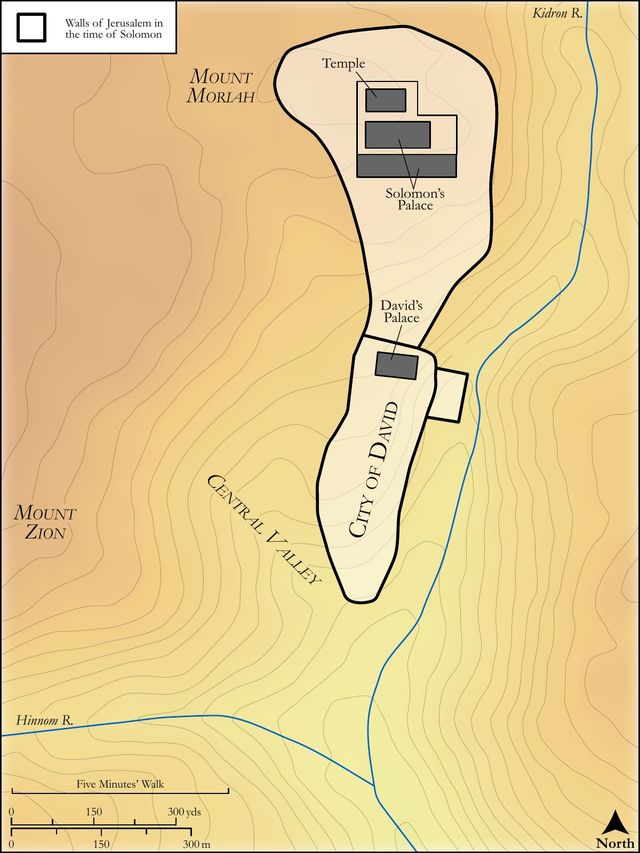
1.He confines him to Jerusalem, and forbids him, upon any pretence whatsoever, to go out of the city any further than the brook Kidron, Kg1 2:36, Kg1 2:37. He would suffer him to continue at his country seat lest he should make mischief among his neighbours, but took him to Jerusalem, where he kept him prisoner at large. This might make Shimei's confinement easy to himself, for Jerusalem was beautiful for situation, the joy of the whole earth, the royal city, the holy city (he had no reason to complain of being shut up in such a paradise); it would also make it the more safe for Solomon, for there he would have him under his eye and be able to watch his motions; and he plainly tells him that if he ever go out of the rules he shall certainly die for it. This was a fair trial of his obedience, and such a test of his loyalty as he had no reason to complain of. He has his life upon easy terms: he shall live if he will but be content to live at Jerusalem.
2.Shimei submits to the confinement, and thankfully takes his life upon those terms. He enters into recognizance (Kg1 2:38), under the penalty of death, not to stir out of Jerusalem, and owns that the saying is good. Even those that perish cannot but own the conditions of pardon and life unexceptionable, so that their blood, like Shimei's, must rest upon their own heads. Shimei promised, with an oath, to keep within his bounds, Kg1 2:42.
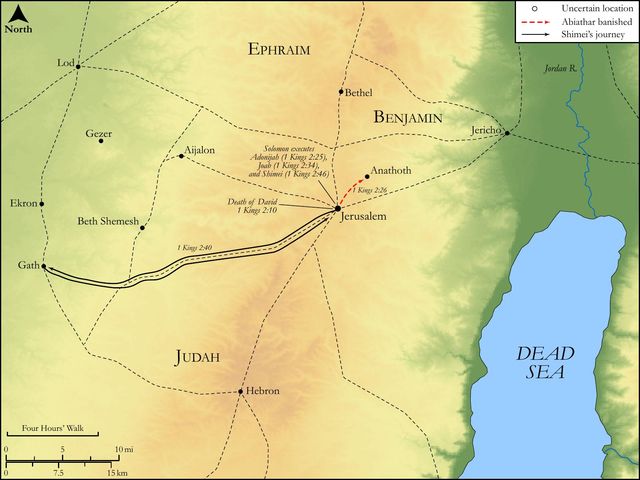
3.Shimei forfeits his recognizance, which was the thing Solomon expected; and God was righteous in suffering him to do it, that he might now suffer for his old sins. Two of his servants (it seems, though he was a prisoner, he lived like himself, well attended) ran from him to the land of the Philistines, Kg1 2:39. Thither he pursued them, and thence brought them back to Jerusalem, Kg1 2:40. For the keeping of it private he saddled his ass himself, probably went in the night, and came home he thought undiscovered. "Seeking his servants," says bishop Hall, "he lost himself; those earthly things either are, or should be, our servants. How commonly do we see men run out of the bounds set by God's law, to hunt after them, till their souls incur a fearful judgment!" 4. Solomon takes the forfeiture. Information is given him that Shimei has transgressed, Kg1 2:41. The king sends for him, and, (1.) charges him with the present crime (Kg1 2:42, Kg1 2:43), that he had put a great contempt upon the authority and wrath both of God and the king, that he had broken the oath of the Lord and disobeyed the commandment of his prince, and by this it appeared what manner of spirit he was of, that he would not be held by the bonds of gratitude or conscience. Had he represented to Solomon the urgency of the occasion, and begged leave to go, perhaps Solomon might have given him leave; but to presume either upon his ignorance or his connivance was to affront him in the highest degree. (2.) He condemns him for his former crime, cursing David, and throwing stones at him in the day of his affliction: The wickedness which thy heart is privy to, Kg1 2:44. There was no need to examine witnesses for the proof of the fact, his own conscience was instead of a thousand witnesses. That wickedness which men's own hearts alone are privy to is enough, if duly considered, to fill them with confusion, in expectation of its return upon their own heads; for if the heart be privy to it, God is greater than the heart and knoweth all things. Others knew of Shimei's cursing David, but Shimei himself knew of the wicked principles of hatred and malice against David which he displayed in cursing him and that his submission was but feigned and forced. (3.) He blessed himself and his government (Kg1 2:45.): King Solomon shall be blessed, notwithstanding Shimei's impotent curses, which perhaps, in fury and despair, he now vented freely: Let them curse, but bless thou. And the throne of David shall be established, by taking away those that would undermine it. It is a comfort, in reference to the enmity of the church's enemies, that, how much soever they rage, it is a vain thing they imagine. Christ's throne is established, and they cannot shake it. (4.) He gives orders for the execution of Shimei immediately, Kg1 2:46. All judgment is committed to the Lord Jesus, and, though he be King of peace, he will be found a King of righteousness; and this will shortly be his word of command concerning all his enemies, that would not have him to reign over them: Bring them forth, and slay them before me; the reproaches of those that blasphemed him will fall on themselves, to their eternal condemnation.
Continue studying 1 Kings 2:42 across the web’s major study libraries — every link below opens this exact verse, chapter, or book on the destination site.
Read & Compare
 BibleGatewayThis verse in more than 200 translations and 70 languages.
 Bible.comThe YouVersion reader — hundreds of translations, reading plans, and highlights.
 ESV.orgCrossway's official English Standard Version reader.
 NET BibleThe NET translation with 60,000+ translators' notes on every rendering decision.
 STEP BibleTyndale House's free study tool — original text, vocabulary, and scholarly resources.
 BibliaLogos Bible Software's free web reader.
 USCCBThe New American Bible (Revised Edition) with the U.S. bishops' study notes.
Commentaries
 BibleHub CommentariesDozens of classic commentaries on this verse, gathered on one page.
 StudyLightMore than 100 commentary sets — the largest collection on the web.
 BibleRefPlain-English commentary on what this verse means, verse by verse.
 Enduring WordDavid Guzik's free commentary on this chapter, widely used by Bible teachers.
 Bible Study ToolsVerse commentary alongside Greek and Hebrew study aids.
Original Language & Research
- BibleHub InterlinearThe verse word by word — original language, transliteration, and English.
- BibleHub LexiconEvery word's original-language definition and Strong's entry.
 Blue Letter BibleDeep-study tools — Strong's numbers, concordance, and word studies.
 SefariaThe Hebrew text with Rashi and centuries of Jewish commentary.
Sermons, Hymns & Audio


TrulyRandomVerse is not affiliated with these sites and doesn’t control their content. They’re linked because they’re genuinely useful.
Summary
1 Kings 2:42 records King Solomon's direct confrontation with Shimei, forcefully reminding him of the solemn oath he swore by the LORD and the explicit, unambiguous warning that departing Jerusalem would result in his certain death. Solomon meticulously recalls Shimei's own affirmation that the terms of this confinement were "good," thereby establishing the undeniable justice and self-incrimination inherent in Shimei's impending judgment. This pivotal verse powerfully underscores the sanctity of divine oaths, the inevitable consequences of deliberate disobedience, and the king's unwavering authority in upholding established covenants and securing the stability of his realm.
Context
ShowHideLiterary Context
This verse marks the climactic moment of Shimei's fate, a direct consequence of his violation of a solemn oath and royal decree. It follows immediately after Shimei's transgression, where he left Jerusalem to retrieve runaway servants, despite Solomon's explicit prohibition (1 Kings 2:39-40). The narrative thread concerning Shimei begins earlier in 2 Samuel 16:5-13, where he cursed King David during Absalom's rebellion. Though David spared his life, his final charge to Solomon included instructions to deal with Shimei's past treachery (1 Kings 2:8-9). Solomon, upon ascending the throne, had confined Shimei to Jerusalem under strict terms, making him swear by the LORD not to leave the city, with death as the penalty for transgression (1 Kings 2:36-38). Shimei had explicitly agreed to these terms, stating, "The word that I have heard is good" (1 Kings 2:38). Thus, 1 Kings 2:42 is the final act in a carefully constructed legal and theological drama, demonstrating Solomon's methodical consolidation of power and justice.
Historical & Cultural Context
Oaths in ancient Israel, especially those sworn "by the LORD" (Yahweh), were profoundly serious and legally binding. They invoked God as a divine witness and guarantor, transforming a human promise into a sacred covenant. Breaking such an oath was not merely a social or legal infraction but a grave offense against God Himself, often incurring severe earthly and divine consequences, as seen in the Mosaic Law concerning vows (Numbers 30:2). Confinement to a specific city was a recognized form of punishment or probation in the ancient Near East, used to control potentially dangerous individuals or ensure loyalty. Solomon's actions reflect the absolute authority of the king in ancient monarchies, particularly in matters of justice and securing the stability of the realm. His meticulous recounting of the terms and Shimei's prior agreement underscores the legal and moral justification for his actions, demonstrating that Shimei's death was a consequence of his own deliberate violation rather than arbitrary cruelty, thereby solidifying Solomon's legitimate rule.
Key Themes
ShowHideThis verse powerfully illustrates several crucial themes. Foremost is the gravity and sanctity of oaths and covenants, particularly when made before God. Shimei's tragic end serves as a stark reminder that promises made under divine witness carry immense weight and that their breach incurs severe consequences, echoing the warnings found in Deuteronomy 23:21-23. It also highlights the inevitability of consequences for disobedience, demonstrating that deliberate violation of clear commands, even if delayed, will eventually be met with justice. This principle is foundational to biblical understanding of sin and judgment, as articulated in Galatians 6:7. Furthermore, the passage showcases royal authority and righteous justice, as Solomon, in his role as king, upholds the terms he set and administers justice to secure his throne and maintain order, reflecting the king's duty to establish the land by justice as seen in Proverbs 29:4. Finally, the verse underscores the weight of one's own words; Shimei's initial agreement, "The word that I have heard is good," becomes a crucial part of the indictment against him, emphasizing accountability for one's verbal commitments, a theme also present in Matthew 12:37.
Exposition and Analysis
ShowHideKey Word Analysis
ShowHideThis primitive root means "to seven oneself," implying a complete or full declaration, often by repeating a statement seven times. When used with "by the LORD" (H3068, Yᵉhôvâh), it signifies the most solemn and binding form of oath in ancient Israel. It elevates the promise from a mere human agreement to a divinely witnessed covenant, making its breach a direct offense against God Himself. The act of swearing by Yahweh placed the oath-taker's very life and future under God's potential judgment if they failed to uphold their word, indicating an unbreakable commitment.
This root means "to duplicate or repeat," and by implication, "to protest" or "testify." In this context, it indicates that Solomon did not merely state the terms but made them abundantly clear, providing an explicit, formal, and undeniable warning. It implies a solemn declaration, leaving no room for Shimei to claim ignorance or misunderstanding of the dire consequences. Solomon's "protestation" served as a legal and moral safeguard, ensuring that Shimei's subsequent actions were a deliberate violation of fully understood and reiterated terms.
This adjective, used here as part of Shimei's direct quote, signifies that which is pleasant, agreeable, or beneficial. Shimei's affirmation, "The word [that] I have heard [is] good," confirms his full and unreserved consent to the terms and conditions laid out by the king. It indicates that he not only understood the warning but also affirmed its justice and reasonableness at the time. This affirmation removes any potential defense of coercion or unfairness, making his subsequent violation a clear act of rebellion against both human and divine authority, based on his own acknowledged acceptance.
Verse Breakdown
ShowHide"And the king sent and called for Shimei, and said unto him,"
This opening clause establishes Solomon's deliberate and formal action. It is not an impulsive act but a calculated summons, indicating that Shimei's violation has been noted and a reckoning is at hand. The king's initiative underscores his authority and commitment to enforcing the established order, highlighting the gravity of the situation and the methodical nature of Solomon's justice.
"Did I not make thee to swear by the LORD, and protested unto thee, saying,"
Solomon's rhetorical question serves as a direct and unassailable accusation. He reminds Shimei of the sacred nature of the oath, sworn under divine witness, and the explicit, unambiguous warning ("protested") that accompanied it. This immediately places the burden of responsibility squarely on Shimei, highlighting his conscious knowledge of the terms and the solemnity of his commitment.
"Know for a certain, on the day thou goest out, and walkest abroad any whither, that thou shalt surely die?"
This is the precise reiteration of the original command and its dire consequence. The phrase "Know for a certain" emphasizes the absolute clarity and certainty of the warning, leaving no room for misinterpretation. The scope ("any whither") leaves no loophole for Shimei to claim he only went a short distance or to an insignificant place. The penalty, "thou shalt surely die," is unequivocal and final, underscoring the severity of the consequence for breaking the oath.
"and thou saidst unto me, The word [that] I have heard [is] good."
This concluding clause is devastatingly effective. Solomon uses Shimei's own words of acceptance against him. By recalling Shimei's affirmation that the terms were "good," Solomon demonstrates that Shimei willingly entered into this covenant, fully understanding and agreeing to its conditions and consequences. This makes Shimei's subsequent death a direct result of his own choices and broken word, not an arbitrary act of royal power, but a just consequence of his self-incrimination.
Literary Devices
ShowHideThe passage employs several potent Literary Devices to underscore its message and the gravity of Shimei's situation. The most prominent is the Rhetorical Question ("Did I not make thee to swear by the LORD...?"), which Solomon uses not to elicit information but to emphasize Shimei's undeniable culpability and prior knowledge of the terms. This technique forces Shimei, and the reader, to acknowledge the clear and unarguable nature of his transgression. There is also a strong element of Irony in Shimei's own words, "The word that I have heard is good," becoming the very basis for his condemnation. What he once affirmed as acceptable now seals his fate, highlighting the tragic consequences of a broken promise. Furthermore, the scene functions as a dramatic fulfillment of Foreshadowing established in 1 Kings 2:36-38; the initial command and Shimei's agreement set the stage for this inevitable confrontation, creating a sense of dramatic tension that resolves in this verse. Solomon's precise Repetition of the oath's terms and Shimei's acceptance reinforces the justice and legitimacy of his actions, leaving no doubt about Shimei's deliberate transgression.
Theological and Thematic Connections
ShowHideThis confrontation between Solomon and Shimei serves as a powerful theological lesson on the sanctity of oaths and the severe consequences of violating them. In ancient Israel, an oath sworn "by the LORD" was considered a sacred covenant, a binding agreement witnessed and guaranteed by God Himself. To break such an oath was not merely a breach of human trust or a legal infraction but a direct affront to God's holiness, faithfulness, and authority. This incident underscores the biblical principle that God takes our words seriously, especially when His name is invoked, and that there are indeed dire consequences for unfaithfulness and disobedience to His established commands. It reflects God's own righteous character, who is faithful to His covenants and expects His people to reflect that faithfulness in their own commitments. Shimei's death, therefore, is not merely a political execution but an act of divine justice administered through the king, demonstrating that disregard for solemn vows ultimately leads to severe repercussions, affirming the principle that what one sows, one will also reap.
Reflection and Application
ShowHideThe account of Shimei's broken oath and its consequences in 1 Kings 2:42 offers profound lessons for contemporary believers. It challenges us to consider the weight and integrity of our own words, particularly promises, vows, and commitments we make, whether to God or to others. In a world where promises are often lightly given and easily broken, this passage reminds us that our word should be our bond, a reflection of the faithfulness of God Himself, who is utterly trustworthy in all His declarations. It encourages us to be meticulous in our agreements, ensuring we fully understand the terms and are prepared to honor them, especially when we invoke God's name or commit ourselves in His presence, recognizing that He holds us accountable. Furthermore, Shimei's story is a stark reminder that disregarding established boundaries or clear warnings, even after acknowledging their validity, inevitably leads to consequences. This applies not only to human agreements but, more importantly, to our covenant relationship with God. Our obedience to His commands and our faithfulness to the principles He has laid out are not arbitrary but are foundational to our spiritual well-being, our relationship with Him, and our witness to the world. We are called to live lives of integrity, where our "yes" means yes and our "no" means no, recognizing that our choices, both good and bad, have spiritual repercussions.
Questions for Reflection
ShowHideFAQ
ShowHideWhy was Shimei confined to Jerusalem in the first place?
ShowHideShimei was confined to Jerusalem because he had previously cursed King David during Absalom's rebellion, a grave offense that warranted death. While David had shown him mercy, Solomon, upon consolidating his kingdom, viewed Shimei as a potential threat to his reign and a symbol of lingering disloyalty. Confining Shimei to Jerusalem was a strategic move to neutralize this threat, keeping him under close watch and preventing him from stirring up further trouble or aligning with enemies of the throne. The oath was a binding agreement to ensure his compliance, with a clear penalty for violation, as detailed in 1 Kings 2:36-38.
Was Solomon's action against Shimei just, considering David had spared him?
ShowHideFrom a biblical and ancient Near Eastern perspective, Solomon's action was considered just and necessary for the stability of his newly established kingdom. While David had shown mercy to Shimei, he also instructed Solomon to deal with him according to his wisdom, implying that Shimei's past actions still required a definitive resolution (1 Kings 2:8-9). Solomon did not execute Shimei immediately but gave him a clear, explicit condition for his continued life: remaining in Jerusalem. Shimei willingly agreed to this condition, swearing by the LORD and affirming its goodness (1 Kings 2:38). His subsequent death was not an arbitrary act of royal cruelty but the direct, agreed-upon consequence of his own deliberate violation of a sacred oath and a clear royal command. Solomon was upholding the rule of law and the sanctity of oaths, which was vital for the integrity and justice of his kingdom.
Christ-Centered Fulfillment
ShowHideThe narrative of Shimei's broken oath and its fatal consequence provides a stark backdrop against which the perfect faithfulness of Jesus Christ shines with unparalleled brilliance. Shimei, a man who swore an oath by the LORD and then deliberately broke it, stands in sharp contrast to Christ, who is the embodiment of perfect obedience and covenant fidelity. While Shimei's words, "The word...is good," became his undoing, Jesus, the Word made flesh, perfectly fulfilled every word, every promise, and every righteous requirement of God's law. He did not break a single command but lived a life of complete submission to the Father's will, even to the point of death on a cross (Philippians 2:8). Shimei's death for his transgression foreshadows the ultimate consequence of sin—spiritual death and separation from God (Romans 6:23). Yet, in Christ, we find the one who bore the penalty for our broken promises and disobedience. He perfectly kept the covenant that we continually fail to uphold, and through His sacrifice, He established a new and better covenant where our sins are forgiven, and we are empowered by His Spirit to live lives of integrity and obedience, not by our own strength but by His grace, writing His laws on our hearts (Jeremiah 31:31-34). Thus, Shimei's tragic end points us to the glorious truth that Jesus is the faithful one who fulfills all righteousness and offers redemption from the consequences of our unfaithfulness, inviting us into a relationship founded on His unwavering covenant love.