


1 Kings 2:38
Bible text: King James Version (1769 Blayney text) · Public domain
Bible text: King James Version with Strong's numbers · Public domain
Bible text: Berean Standard Bible · Public domain
Bible text: American Standard Version (1901) · Public domain
Bible text: World English Bible, Messianic edition · Public domain
Bible text: Geneva Bible (1599) · Public domain
Bible text: Young's Literal Translation · Public domain
- וַיֹּאמֶרvai·Yo·merand he saidH559Conj-w ¦ V-Qal-ConsecImperf-3msVerb Qal Consecutive Imperfect 3rd Singular Masculineוַandיֹּאמֶרhe said
- שִׁמְעִיshim·'IShimeiH8096N-proper-mNoun Proper Masculine
- לַמֶּלֶךְla·Me·lekhto the kingH4428Prep-l ¦ N-msNoun Singular Masculine Absoluteלַto theמֶּלֶךְking
- טוֹבTov[is] goodH2896Adj-msAdjective Singular Masculine Absolute
- הַדָּבָרha·da·Varthe wordH1697Art ¦ N-msNoun Singular Masculine Absoluteהַtheדָּבָרword
- כַּאֲשֶׁרka·'a·Sherjust asH834Prep-k ¦ RelParticle Relativeכַּjustאֲשֶׁרas
- דִּבֶּרdi·Berhe has spokenH1696V-Piel-Perf-3msVerb Piel Perfect 3rd Singular Masculine
- אֲדֹנִי'a·do·Nimy lordH113N-msc ¦ 1csNoun Singular Masculine Constructאֲדֹנִlordיmy
- הַמֶּלֶךְha·Me·lekhthe kingH4428Art ¦ N-msNoun Singular Masculine Absoluteהַtheמֶּלֶךְking
- כֵּןkensoH3651AdvAdverb
- יַעֲשֶׂהya·'a·Sehhe will doH6213V-Qal-Imperf-3msVerb Qal Imperfect 3rd Singular Masculine
- עַבְדֶּךָ'av·De·khayour servantH5650N-msc ¦ 2msNoun Singular Masculine Constructעַבְדֶּservantךָyour
- וַיֵּשֶׁבvai·Ye·shevand he dweltH3427Conj-w ¦ V-Qal-ConsecImperf-3msVerb Qal Consecutive Imperfect 3rd Singular Masculineוַandיֵּשֶׁבhe dwelt
- שִׁמְעִיshim·'IShimeiH8096N-proper-mNoun Proper Masculine
- בִּירוּשָׁלִַםbi·ru·sha·Limin JerusalemH3389Prep-b ¦ N-properNoun Proper LocationבִּinירוּשָׁלִַםJerusalem
- יָמִיםya·MimdaysH3117N-mpNoun Plural Masculine Absolute
- רַבִּיםra·BimmanyH7227Adj-mpAdjective Plural Masculine Absolute
English is a literal word-by-word gloss of the Hebrew, not the KJV's wording. Why?
This is the original text the KJV's translators worked from — each Hebrew word with its own literal English meaning in this verse, prepared by scholars at Tyndale House, Cambridge. The KJV translates whole sentences, not word by word, so its wording differs: one Hebrew word can become several English words, and the KJV may choose “the LORD” where the gloss reads “Yahweh”. Both are faithful — they answer different questions. For the KJV's own rendering, switch to the KJV text.
Details
See on the biblical-era maps

Study this verse
Public-domain commentary
Matthew Henry
From his Commentary on the Whole Bible. Henry comments on passages, not single verses — this entry covers 1 Kings 2:35–46. His two-level outline is real structure in the source text, so it is rendered as structure.
Here is, I. The preferment of Benaiah and Zadok, two faithful friends to Solomon and his government, Kg1 2:35. Joab being put to death, Benaiah was advanced to be general of the forces in his room, and, Abiathar being deposed, Zadok was made high priest in his room, and therein was fulfilled the word of God, when he threatened to cut off the house of Eli (Sa1 2:35), I will raise me up a faithful priest, and will build him a sure house. Though sacred offices may be disgraced, they shall not be destroyed, by the mal-administration of those that are entrusted with them, nor shall God's work ever stand still for want of hands to carry it on. No wonder that he who was a king so immediately of God's making was empowered to make whom he though fit high priest; and he exercised this power with equity, for the ancient right was in Zadok, he being of the family of Eleazar, whereas Eli and his house were of Ithamar.
II.The course that was taken with Shimei.
He is sent for, by a messenger, from his house at Bahurim, expecting perhaps no better than Adonijah's doom, being conscious of his enmity to the house of David; but Solomon knows how to make a difference of crimes and criminals. David had promised Shimei his life for his time. Solomon is not bound by that promise, yet he will not go directly contrary to it.
1.He confines him to Jerusalem, and forbids him, upon any pretence whatsoever, to go out of the city any further than the brook Kidron, Kg1 2:36, Kg1 2:37. He would suffer him to continue at his country seat lest he should make mischief among his neighbours, but took him to Jerusalem, where he kept him prisoner at large. This might make Shimei's confinement easy to himself, for Jerusalem was beautiful for situation, the joy of the whole earth, the royal city, the holy city (he had no reason to complain of being shut up in such a paradise); it would also make it the more safe for Solomon, for there he would have him under his eye and be able to watch his motions; and he plainly tells him that if he ever go out of the rules he shall certainly die for it. This was a fair trial of his obedience, and such a test of his loyalty as he had no reason to complain of. He has his life upon easy terms: he shall live if he will but be content to live at Jerusalem.
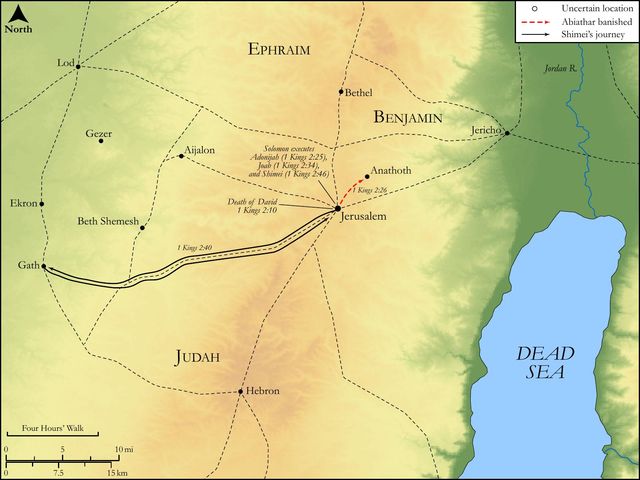
2.Shimei submits to the confinement, and thankfully takes his life upon those terms. He enters into recognizance (Kg1 2:38), under the penalty of death, not to stir out of Jerusalem, and owns that the saying is good. Even those that perish cannot but own the conditions of pardon and life unexceptionable, so that their blood, like Shimei's, must rest upon their own heads. Shimei promised, with an oath, to keep within his bounds, Kg1 2:42.
3.Shimei forfeits his recognizance, which was the thing Solomon expected; and God was righteous in suffering him to do it, that he might now suffer for his old sins. Two of his servants (it seems, though he was a prisoner, he lived like himself, well attended) ran from him to the land of the Philistines, Kg1 2:39. Thither he pursued them, and thence brought them back to Jerusalem, Kg1 2:40. For the keeping of it private he saddled his ass himself, probably went in the night, and came home he thought undiscovered. "Seeking his servants," says bishop Hall, "he lost himself; those earthly things either are, or should be, our servants. How commonly do we see men run out of the bounds set by God's law, to hunt after them, till their souls incur a fearful judgment!" 4. Solomon takes the forfeiture. Information is given him that Shimei has transgressed, Kg1 2:41. The king sends for him, and, (1.) charges him with the present crime (Kg1 2:42, Kg1 2:43), that he had put a great contempt upon the authority and wrath both of God and the king, that he had broken the oath of the Lord and disobeyed the commandment of his prince, and by this it appeared what manner of spirit he was of, that he would not be held by the bonds of gratitude or conscience. Had he represented to Solomon the urgency of the occasion, and begged leave to go, perhaps Solomon might have given him leave; but to presume either upon his ignorance or his connivance was to affront him in the highest degree. (2.) He condemns him for his former crime, cursing David, and throwing stones at him in the day of his affliction: The wickedness which thy heart is privy to, Kg1 2:44. There was no need to examine witnesses for the proof of the fact, his own conscience was instead of a thousand witnesses. That wickedness which men's own hearts alone are privy to is enough, if duly considered, to fill them with confusion, in expectation of its return upon their own heads; for if the heart be privy to it, God is greater than the heart and knoweth all things. Others knew of Shimei's cursing David, but Shimei himself knew of the wicked principles of hatred and malice against David which he displayed in cursing him and that his submission was but feigned and forced. (3.) He blessed himself and his government (Kg1 2:45.): King Solomon shall be blessed, notwithstanding Shimei's impotent curses, which perhaps, in fury and despair, he now vented freely: Let them curse, but bless thou. And the throne of David shall be established, by taking away those that would undermine it. It is a comfort, in reference to the enmity of the church's enemies, that, how much soever they rage, it is a vain thing they imagine. Christ's throne is established, and they cannot shake it. (4.) He gives orders for the execution of Shimei immediately, Kg1 2:46. All judgment is committed to the Lord Jesus, and, though he be King of peace, he will be found a King of righteousness; and this will shortly be his word of command concerning all his enemies, that would not have him to reign over them: Bring them forth, and slay them before me; the reproaches of those that blasphemed him will fall on themselves, to their eternal condemnation.
Continue studying 1 Kings 2:38 across the web’s major study libraries — every link below opens this exact verse, chapter, or book on the destination site.
Read & Compare
 BibleGatewayThis verse in more than 200 translations and 70 languages.
 Bible.comThe YouVersion reader — hundreds of translations, reading plans, and highlights.
 ESV.orgCrossway's official English Standard Version reader.
 NET BibleThe NET translation with 60,000+ translators' notes on every rendering decision.
 STEP BibleTyndale House's free study tool — original text, vocabulary, and scholarly resources.
 BibliaLogos Bible Software's free web reader.
 USCCBThe New American Bible (Revised Edition) with the U.S. bishops' study notes.
Commentaries
 BibleHub CommentariesDozens of classic commentaries on this verse, gathered on one page.
 StudyLightMore than 100 commentary sets — the largest collection on the web.
 BibleRefPlain-English commentary on what this verse means, verse by verse.
 Enduring WordDavid Guzik's free commentary on this chapter, widely used by Bible teachers.
 Bible Study ToolsVerse commentary alongside Greek and Hebrew study aids.
Original Language & Research
- BibleHub InterlinearThe verse word by word — original language, transliteration, and English.
- BibleHub LexiconEvery word's original-language definition and Strong's entry.
 Blue Letter BibleDeep-study tools — Strong's numbers, concordance, and word studies.
 SefariaThe Hebrew text with Rashi and centuries of Jewish commentary.
Sermons, Hymns & Audio


TrulyRandomVerse is not affiliated with these sites and doesn’t control their content. They’re linked because they’re genuinely useful.
Summary
1 Kings 2:38 records Shimei's immediate and seemingly compliant acceptance of King Solomon's strict decree, which confined him to Jerusalem under penalty of death. This pivotal moment occurs early in Solomon's reign, showcasing his decisive and methodical approach to securing his nascent kingdom and fulfilling the weighty instructions left by his father, King David. Shimei's verbal submission, coupled with his initial adherence, sets the stage for a critical test of loyalty and obedience that will ultimately determine his fate and further underscore the unwavering authority of the new monarch.
Context
ShowHideLiterary Context
This verse is strategically positioned within the broader narrative of King Solomon's consolidation of power at the very outset of his reign. It directly follows Solomon's explicit and severe decree to Shimei, which confines him to Jerusalem and strictly forbids him from crossing the Kidron Valley, with the dire consequence of death for disobedience (1 Kings 2:36-37). This decree, in turn, is a direct and calculated fulfillment of King David's dying charge to Solomon concerning Shimei's past treachery during Absalom's rebellion (1 Kings 2:8-9). Shimei's apparent compliance in this verse establishes the critical baseline for his eventual transgression and execution, which is meticulously detailed in the subsequent verses (1 Kings 2:39-46), thereby completing Solomon's systematic elimination of potential threats to his throne, alongside figures like Adonijah and Joab, ensuring the stability of his rule.
Historical & Cultural Context
In Israel, the king's word held supreme authority, functioning as law, and oaths of loyalty were binding covenants, often carrying capital consequences for their violation. The Kidron Valley, a natural ravine situated to the east of Jerusalem, served not only as a geographical marker but also as a potent symbolic boundary. Crossing it could signify leaving the protective sphere of the city and the king's direct oversight, or even an act of ritual defilement, as it was a place where cultic impurities and refuse were sometimes disposed of. Shimei's background as a Benjaminite, from the tribe of King Saul, and his previous act of cursing King David during a moment of profound vulnerability (2 Samuel 16:5-8), marked him as a figure of known disloyalty and potential sedition. Solomon's decree, therefore, was not merely a punitive measure but a deliberate test of allegiance, offering Shimei a chance to live under strictly defined terms while simultaneously providing a clear and justifiable basis for future judgment should those terms be violated. This methodical approach underscored the absolute nature of royal authority.
Key Themes
ShowHideThis verse powerfully underscores the theme of Solomon's Authority and his decisive establishment of control over the nascent kingdom. By issuing such a strict mandate and securing Shimei's public agreement, Solomon demonstrates his unwavering resolve to maintain order and uphold the principles of justice inherited from his father, King David, as he consolidates his reign (see 1 Kings 2). It also highlights the theme of Obedience and Consequences, as Shimei's verbal submission immediately sets up a direct and inescapable link between his future actions and his very life. His initial compliance, while seemingly positive, ultimately serves to heighten the gravity of his eventual disobedience. Furthermore, the narrative implicitly addresses the theme of Justice and Accountability, illustrating that past wrongs, even those seemingly overlooked or deferred, can eventually demand a reckoning, ensuring that the new king's reign is founded on firm principles of righteousness and stability, securing the throne for generations (compare with the promises in 2 Samuel 7).
Exposition and Analysis
ShowHideKey Word Analysis
ShowHideShimei's declaration, "The saying is good," employs a common Hebrew adjective that signifies something as "pleasing," "right," "fitting," or "acceptable." In this specific context, it conveys Shimei's acknowledgment that the king's decree is reasonable, legitimate, or at the very least, unchallengeable from his perspective. It represents a pragmatic acceptance of the terms, rather than necessarily an enthusiastic endorsement, indicating a public display of agreement.
This term, used by Shimei as "my lord," is derived from a root meaning "to rule" and denotes a "sovereign," "controller," "master," or "owner." It is a standard and highly deferential form of address when speaking to a king, emphasizing the speaker's subordinate status and humble submission. Shimei's use of this title underscores his outward posture of loyalty and obedience, aligning himself verbally with the king's supreme will.
The verb "dwelt" implies a settled residence or habitation over a sustained period, rather than a mere temporary stay. The phrase "dwelt in Jerusalem many days" indicates that Shimei genuinely took up residence in the city and initially complied with the terms of his confinement. This establishes a period of apparent peace and adherence, subtly foreshadowing that this period will not be indefinite and setting the stage for his eventual transgression.
Verse Breakdown
ShowHide"And Shimei said unto the king, The saying [is] good:"
This initial clause captures Shimei's immediate verbal response to Solomon's decree. His acknowledgment that the "saying is good" indicates either a genuine acceptance of the terms as just and reasonable, or a shrewd, self-preservational agreement designed to avoid immediate conflict with the powerful new king. Regardless of his internal disposition, it signifies his public and explicit consent to the conditions laid upon him.
"as my lord the king hath said, so will thy servant do."
This is a formal and solemn declaration of obedience, a verbal oath of allegiance. Shimei pledges his full compliance, committing himself to abide by the king's specific instructions. This profound commitment places him directly under Solomon's absolute authority and establishes the clear terms of his continued existence and freedom from immediate punishment.
"And Shimei dwelt in Jerusalem many days."
This concluding clause serves as a crucial narrative bridge, confirming Shimei's initial adherence to the decree and indicating the passage of a significant period of time during which he remained confined to Jerusalem. The phrase "many days" subtly foreshadows that this period of compliance will not be indefinite, setting the stage for his eventual failure to uphold his oath and the inevitable consequences that will follow.
Literary Devices
ShowHideThe verse employs several impactful literary devices that deepen its meaning and narrative tension. Foreshadowing is subtly present in the phrase "many days," which hints that Shimei's period of compliance will not be everlasting, thereby preparing the reader for his eventual transgression and the judgment that will inevitably follow. There is a strong element of Irony in Shimei's solemn declaration, "as my lord the king hath said, so will thy servant do," given his ultimate and documented failure to keep this very promise later in the chapter. This highlights the deceptive nature of outward submission when true, heart-level loyalty is absent. Furthermore, the narrative creates a stark Contrast between Shimei's past rebellious actions against King David, where he openly cursed the king (2 Samuel 16:5-8), and his current, outwardly submissive posture before Solomon. This contrast powerfully underscores the significant shift in power dynamics and the firm, unwavering control exerted by the new monarch, who is systematically addressing lingering threats to the stability of his throne.
Theological and Thematic Connections
ShowHideThis verse, while seemingly simple in its description of an agreement, carries profound theological weight, touching on themes of divine justice, the nature of human obedience, and the inevitable consequences of broken covenants and unaddressed sin. God's sovereignty is subtly yet powerfully at play, as He works through Solomon to establish a stable and righteous kingdom, even if through severe and decisive means. Shimei's story serves as a stark reminder that words matter, and oaths made before legitimate authority, whether human or divine, carry immense weight and are expected to be upheld. It underscores the biblical principle that genuine obedience is not merely verbal assent or temporary compliance but sustained faithfulness rooted in the heart. The narrative demonstrates that past actions, even if seemingly forgiven or deferred, can eventually demand a reckoning in God's perfect timing and plan. This passage highlights the tension between a period of conditional grace and the eventual demand for accountability, demonstrating that while God is merciful, He is also perfectly just and righteous in His judgments.
Reflection and Application
ShowHideShimei's initial, seemingly compliant response to Solomon's decree, followed by his eventual failure to adhere to its terms, offers a powerful and enduring lesson on the nature of true obedience and integrity. It reveals that it is not enough to merely give verbal assent or to make a solemn promise; genuine faithfulness requires sustained adherence to our commitments, especially those made before God or legitimate human authority. This passage challenges us to deeply examine the sincerity of our own "yeses"—do our actions consistently align with our words, or are we prone to outward compliance while inwardly harboring resistance, resentment, or self-serving intentions? The narrative reminds us that while grace may offer a new beginning and a period of testing, past patterns of disobedience, if unaddressed at the heart level, can resurface and lead to inevitable, often painful, consequences. It calls us to a life of genuine submission, understanding that God sees beyond our outward performance to the true condition and intentions of our hearts, urging us to cultivate an integrity that is consistent and enduring.
Questions for Reflection
ShowHideFAQ
ShowHideWhy did Solomon not execute Shimei immediately, as David had implied?
ShowHideDavid's instruction to Solomon concerning Shimei (1 Kings 2:8-9) was not an immediate command for execution but rather a charge to ensure that Shimei's past treachery would not ultimately go unpunished. David left the timing and method to Solomon's wisdom and discretion. Solomon's approach demonstrates a desire for justice tempered with an initial opportunity for Shimei to prove his loyalty. By confining Shimei to Jerusalem under a clear, explicit prohibition, Solomon established a test. This allowed Shimei to live under a conditional grace period, but also ensured that any future transgression would be a direct, undeniable act of rebellion against the king's explicit command, providing a clear and public justification for his ultimate punishment. This methodical and deliberate approach solidified Solomon's authority and demonstrated his commitment to establishing a just and stable kingdom.
What was the significance of the Kidron Valley as a boundary for Shimei?
ShowHideThe Kidron Valley, a natural ravine bordering Jerusalem to the east, served as a highly significant geographical and symbolic boundary. For Shimei, it represented a clear, tangible line drawn by the king; crossing it would be an unambiguous act of disobedience and defiance. Symbolically, the Kidron Valley was often associated with death, judgment, and defilement in biblical thought. It was a place where cultic impurities and even the ashes of idols were sometimes disposed of (e.g., 2 Kings 23:4-6). Remaining within Jerusalem, the holy city and seat of the king, signified being under the king's direct protection and authority. Therefore, leaving Jerusalem and crossing the Kidron Valley was not merely a geographical movement but a symbolic breaking of the covenant of loyalty and a direct defiance of the king's explicit terms, making Shimei's eventual transgression all the more grave and inexcusable.
Christ-Centered Fulfillment
ShowHideThe narrative of Shimei's conditional obedience and ultimate failure in 1 Kings 2:38-46 powerfully foreshadows the universal human inability to perfectly keep covenants, even when given clear terms and a measure of grace. Shimei's outward submission, which ultimately proved superficial and self-serving, stands in stark contrast to the perfect, genuine, and unwavering obedience of Jesus Christ. As the true King of Kings and ultimate Son of David, Jesus did not merely give verbal assent to the Father's will; He perfectly embodied it, living a life of complete faithfulness and submission, even to the point of death on the cross (Philippians 2:8). Unlike Shimei, whose past rebellion and inherent treachery ultimately caught up with him, Jesus, though innocent, bore the full weight of humanity's rebellion and broken covenants, offering Himself as the ultimate, spotless sacrifice for sin (Isaiah 53:5-6). Through His atoning work, Jesus establishes a new covenant, not based on flawed human performance or outward compliance, but on His perfect righteousness and the indwelling of the Holy Spirit, enabling His followers to live lives of true, Spirit-empowered obedience from the heart (Jeremiah 31:33 and Hebrews 8:10). While Shimei faced judgment for his treachery and disobedience, Christ offers forgiveness and true reconciliation, inviting all to enter His eternal kingdom where genuine peace and perfect justice reign, secured not by human decrees or conditional agreements but by His finished work on the cross (Colossians 1:19-20).