


1 Kings 2:37
Bible text: King James Version (1769 Blayney text) · Public domain
Bible text: King James Version with Strong's numbers · Public domain
Bible text: Berean Standard Bible · Public domain
Bible text: American Standard Version (1901) · Public domain
Bible text: World English Bible, Messianic edition · Public domain
Bible text: Geneva Bible (1599) · Public domain
Bible text: Young's Literal Translation · Public domain
- וְהָיָהve·ha·Yahand it will beH1961Conj-w ¦ V-Qal-ConsecPerf-3msVerb Qal Consecutive Perfect 3rd Singular Masculineוְandהָיָהit will be
- בְּיוֹםbe·Yomon [the] dayH3117Prep-b ¦ N-msNoun Singular Masculine Absoluteבְּonיוֹם[the] day
- צֵאתְךָtze·te·Khagoing out youH3318V-Qal-Inf ¦ 2msVerb Qal Infinitive Constructצֵאתְgoing outךָyou
- וְעָבַרְתָּve·'a·var·Taand you will pass overH5674Conj-w ¦ V-Qal-ConsecPerf-2msVerb Qal Consecutive Perfect 2nd Singular Masculineוְandעָבַרְתָּyou will pass over
- אֶת'et<obj.>H853DirObjMParticle Object Indicator
- נַחַלNa·chal[the] wadi ofH5158N-mscNoun Singular Masculine Construct
- קִדְרוֹןkid·RonKidronH6939N-properNoun Proper Location
- יָדֹעַya·Do·a'certainly <to know>H3045V-Qal-InfAbsVerb Qal Infinitive Absolute
- תֵּדַעte·Da'you will knowH3045V-Qal-Imperf-2msVerb Qal Imperfect 2nd Singular Masculine
- כִּיkithatH3588PrtParticle Conditional
- מוֹתMotcertainly <to die>H4191V-Qal-InfAbsVerb Qal Infinitive Absolute
- תָּמוּתta·Mutyou will dieH4191V-Qal-Imperf-2msVerb Qal Imperfect 2nd Singular Masculine
- דָּמְךָda·me·Khayour bloodH1818N-msc ¦ 2msNoun Singular Masculine Constructדָּמְbloodךָyour
- יִהְיֶהyih·Yehit will beH1961V-Qal-Imperf-3msVerb Qal Imperfect 3rd Singular Masculine
- בְרֹאשֶׁךָve·ro·She·khaon your own headH7218Prep-b ¦ N-msc ¦ 2msNoun Singular Masculine Constructבְonרֹאשֶׁown headךָyour
English is a literal word-by-word gloss of the Hebrew, not the KJV's wording. Why?
This is the original text the KJV's translators worked from — each Hebrew word with its own literal English meaning in this verse, prepared by scholars at Tyndale House, Cambridge. The KJV translates whole sentences, not word by word, so its wording differs: one Hebrew word can become several English words, and the KJV may choose “the LORD” where the gloss reads “Yahweh”. Both are faithful — they answer different questions. For the KJV's own rendering, switch to the KJV text.
Details
See on the biblical-era maps

Study this verse
Public-domain commentary
Matthew Henry
From his Commentary on the Whole Bible. Henry comments on passages, not single verses — this entry covers 1 Kings 2:35–46. His two-level outline is real structure in the source text, so it is rendered as structure.
Here is, I. The preferment of Benaiah and Zadok, two faithful friends to Solomon and his government, Kg1 2:35. Joab being put to death, Benaiah was advanced to be general of the forces in his room, and, Abiathar being deposed, Zadok was made high priest in his room, and therein was fulfilled the word of God, when he threatened to cut off the house of Eli (Sa1 2:35), I will raise me up a faithful priest, and will build him a sure house. Though sacred offices may be disgraced, they shall not be destroyed, by the mal-administration of those that are entrusted with them, nor shall God's work ever stand still for want of hands to carry it on. No wonder that he who was a king so immediately of God's making was empowered to make whom he though fit high priest; and he exercised this power with equity, for the ancient right was in Zadok, he being of the family of Eleazar, whereas Eli and his house were of Ithamar.
II.The course that was taken with Shimei.
He is sent for, by a messenger, from his house at Bahurim, expecting perhaps no better than Adonijah's doom, being conscious of his enmity to the house of David; but Solomon knows how to make a difference of crimes and criminals. David had promised Shimei his life for his time. Solomon is not bound by that promise, yet he will not go directly contrary to it.
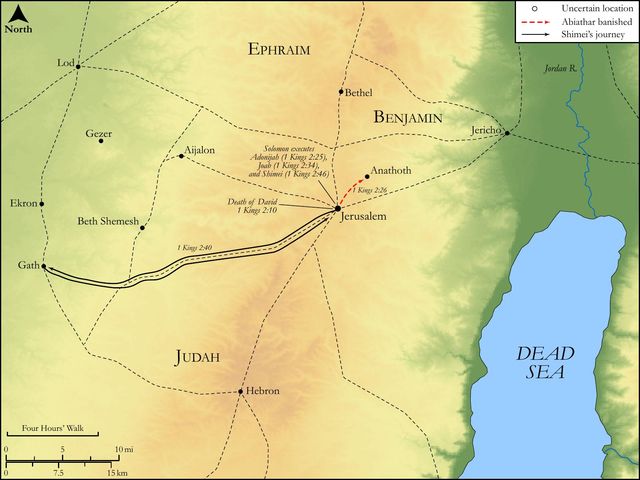
1.He confines him to Jerusalem, and forbids him, upon any pretence whatsoever, to go out of the city any further than the brook Kidron, Kg1 2:36, Kg1 2:37. He would suffer him to continue at his country seat lest he should make mischief among his neighbours, but took him to Jerusalem, where he kept him prisoner at large. This might make Shimei's confinement easy to himself, for Jerusalem was beautiful for situation, the joy of the whole earth, the royal city, the holy city (he had no reason to complain of being shut up in such a paradise); it would also make it the more safe for Solomon, for there he would have him under his eye and be able to watch his motions; and he plainly tells him that if he ever go out of the rules he shall certainly die for it. This was a fair trial of his obedience, and such a test of his loyalty as he had no reason to complain of. He has his life upon easy terms: he shall live if he will but be content to live at Jerusalem.
2.Shimei submits to the confinement, and thankfully takes his life upon those terms. He enters into recognizance (Kg1 2:38), under the penalty of death, not to stir out of Jerusalem, and owns that the saying is good. Even those that perish cannot but own the conditions of pardon and life unexceptionable, so that their blood, like Shimei's, must rest upon their own heads. Shimei promised, with an oath, to keep within his bounds, Kg1 2:42.
3.Shimei forfeits his recognizance, which was the thing Solomon expected; and God was righteous in suffering him to do it, that he might now suffer for his old sins. Two of his servants (it seems, though he was a prisoner, he lived like himself, well attended) ran from him to the land of the Philistines, Kg1 2:39. Thither he pursued them, and thence brought them back to Jerusalem, Kg1 2:40. For the keeping of it private he saddled his ass himself, probably went in the night, and came home he thought undiscovered. "Seeking his servants," says bishop Hall, "he lost himself; those earthly things either are, or should be, our servants. How commonly do we see men run out of the bounds set by God's law, to hunt after them, till their souls incur a fearful judgment!" 4. Solomon takes the forfeiture. Information is given him that Shimei has transgressed, Kg1 2:41. The king sends for him, and, (1.) charges him with the present crime (Kg1 2:42, Kg1 2:43), that he had put a great contempt upon the authority and wrath both of God and the king, that he had broken the oath of the Lord and disobeyed the commandment of his prince, and by this it appeared what manner of spirit he was of, that he would not be held by the bonds of gratitude or conscience. Had he represented to Solomon the urgency of the occasion, and begged leave to go, perhaps Solomon might have given him leave; but to presume either upon his ignorance or his connivance was to affront him in the highest degree. (2.) He condemns him for his former crime, cursing David, and throwing stones at him in the day of his affliction: The wickedness which thy heart is privy to, Kg1 2:44. There was no need to examine witnesses for the proof of the fact, his own conscience was instead of a thousand witnesses. That wickedness which men's own hearts alone are privy to is enough, if duly considered, to fill them with confusion, in expectation of its return upon their own heads; for if the heart be privy to it, God is greater than the heart and knoweth all things. Others knew of Shimei's cursing David, but Shimei himself knew of the wicked principles of hatred and malice against David which he displayed in cursing him and that his submission was but feigned and forced. (3.) He blessed himself and his government (Kg1 2:45.): King Solomon shall be blessed, notwithstanding Shimei's impotent curses, which perhaps, in fury and despair, he now vented freely: Let them curse, but bless thou. And the throne of David shall be established, by taking away those that would undermine it. It is a comfort, in reference to the enmity of the church's enemies, that, how much soever they rage, it is a vain thing they imagine. Christ's throne is established, and they cannot shake it. (4.) He gives orders for the execution of Shimei immediately, Kg1 2:46. All judgment is committed to the Lord Jesus, and, though he be King of peace, he will be found a King of righteousness; and this will shortly be his word of command concerning all his enemies, that would not have him to reign over them: Bring them forth, and slay them before me; the reproaches of those that blasphemed him will fall on themselves, to their eternal condemnation.
Continue studying 1 Kings 2:37 across the web’s major study libraries — every link below opens this exact verse, chapter, or book on the destination site.
Read & Compare
 BibleGatewayThis verse in more than 200 translations and 70 languages.
 Bible.comThe YouVersion reader — hundreds of translations, reading plans, and highlights.
 ESV.orgCrossway's official English Standard Version reader.
 NET BibleThe NET translation with 60,000+ translators' notes on every rendering decision.
 STEP BibleTyndale House's free study tool — original text, vocabulary, and scholarly resources.
 BibliaLogos Bible Software's free web reader.
 USCCBThe New American Bible (Revised Edition) with the U.S. bishops' study notes.
Commentaries
 BibleHub CommentariesDozens of classic commentaries on this verse, gathered on one page.
 StudyLightMore than 100 commentary sets — the largest collection on the web.
 BibleRefPlain-English commentary on what this verse means, verse by verse.
 Enduring WordDavid Guzik's free commentary on this chapter, widely used by Bible teachers.
 Bible Study ToolsVerse commentary alongside Greek and Hebrew study aids.
Original Language & Research
- BibleHub InterlinearThe verse word by word — original language, transliteration, and English.
- BibleHub LexiconEvery word's original-language definition and Strong's entry.
 Blue Letter BibleDeep-study tools — Strong's numbers, concordance, and word studies.
 SefariaThe Hebrew text with Rashi and centuries of Jewish commentary.
Sermons, Hymns & Audio


TrulyRandomVerse is not affiliated with these sites and doesn’t control their content. They’re linked because they’re genuinely useful.
Summary
King Solomon's pronouncement serves as a definitive declaration of the non-negotiable consequences for Shimei's potential disobedience. It unequivocally states that should Shimei cross the geographical boundary of the Kidron Valley, he will incur the certain penalty of death, with the full responsibility for this outcome resting squarely upon himself. This verse powerfully underscores the absolute authority of the newly established monarchy and the severe, self-inflicted nature of judgment for violating a clear, understood royal decree, setting a critical precedent for Solomon's reign.
Context
ShowHideLiterary Context
This verse is strategically placed within the critical opening chapters of Solomon's reign, immediately following the death of King David and Solomon's ascension to the throne. The preceding narrative in 1 Kings 2 details David's final instructions to his son, including specific directives regarding individuals who had either supported or opposed David during his lifetime. Solomon's initial actions involve consolidating his power by systematically dealing with potential threats to his nascent kingdom. In 1 Kings 2:36, Solomon had already confined Shimei to Jerusalem, explicitly warning him of the fatal consequence should he cross the Kidron Valley. Verse 1 Kings 2:37 reiterates and reinforces this warning with emphatic certainty and personal accountability, thereby setting the stage for Shimei's eventual transgression and execution, as recounted in 1 Kings 2:40-46.
Historical & Cultural Context
Shimei, a Benjaminite from Bahurim, had previously cursed and thrown stones at King David during Absalom's rebellion, an act of profound disrespect and treason against the anointed king (as detailed in 2 Samuel 16:5-13). While David had sworn not to kill Shimei at that specific moment, he later instructed Solomon to handle the matter with wisdom, implying that justice for Shimei's past actions was still warranted (1 Kings 2:8-9). The "brook Kidron" (or Kidron Valley) was a significant geographical feature located to the east of Jerusalem, serving as a natural boundary and often holding symbolic significance, sometimes associated with defilement or judgment (e.g., 2 Samuel 15:23). Solomon's decree and the explicit warning reflect the absolute authority of a king in that day and the severe penalties for violating royal commands, which were often viewed as divine decrees. The phrase "thy blood shall be upon thine own head" was a common legal idiom, signifying that the individual was solely responsible for their own demise.
Key Themes
ShowHideThe verse vividly illustrates the theme of consequences of disobedience, presenting a direct and inevitable outcome when a clear, sovereign command is violated. Shimei's impending death is portrayed not as an arbitrary act by Solomon, but as a direct result of his own knowing choice to transgress the established boundary. This ties into the overarching theme of justice and accountability, as Solomon is depicted establishing a firm and righteous rule, holding individuals responsible for both their past actions and their present adherence to his decrees. Such firm governance was crucial for the stability and security of his nascent kingdom. Furthermore, the narrative highlights the solemnity of oaths and agreements, as Shimei had explicitly agreed to Solomon's terms in 1 Kings 2:38, making his subsequent transgression a deliberate breach of his sworn word. Finally, Solomon's decisive actions against those who had opposed David or posed a threat to his new reign are integral to the broader theme of the divine establishment and consolidation of kingship, showcasing God's work in securing Solomon's rule over Israel.
Exposition and Analysis
ShowHideKey Word Analysis
ShowHideRefers to the Nahal Kidron, a wadi (seasonal riverbed) situated east of Jerusalem, which geographically separates the Temple Mount from the Mount of Olives. This location served as a natural and well-known boundary. Biblically, the Kidron Valley was sometimes associated with rites of purification or judgment, and was used for disposing of cultic impurities (e.g., 1 Kings 15:13 and 2 Chronicles 29:16). Its specific mention here underscores a clear, tangible, and unambiguous demarcation.
The root word for "die" in this emphatic phrase. The Hebrew construction "מוֹת תָּמוּת" (mot tamut) is an infinitive absolute, a powerful grammatical device that intensifies the verb, conveying absolute certainty and inevitability. It means "you will surely die" or "you will certainly die," leaving no ambiguity about the finality of the consequence. This emphasizes the non-negotiable nature of Solomon's decree.
Refers to the life-fluid, often associated with life itself and, when shed, with death. In the idiom "thy blood shall be upon thine own head," it signifies the culpability for one's own demise or misfortune, indicating that the individual is the sole cause of their own destruction.
Literally the highest part of the body, but figuratively used to denote leadership, origin, or, in this idiom, the seat of responsibility. The phrase "upon thine own head" powerfully conveys that the responsibility and consequence for one's actions fall directly and solely on the individual.
Verse Breakdown
ShowHide"For it shall be, [that] on the day thou goest out, and passest over the brook Kidron,"
This initial clause precisely establishes the condition and trigger for the severe penalty. It defines the specific prohibited action—"going out" of Jerusalem and "passing over" the brook Kidron—and the exact timing of its occurrence ("on the day"). The explicit mention of the "brook Kidron" highlights a well-known, unmistakable geographical boundary, ensuring that Shimei's subsequent violation would be entirely deliberate and without excuse.
"thou shalt know for certain that thou shalt surely die:"
This segment of the verse emphatically underscores the absolute certainty and inevitability of the consequence. The phrase "know for certain" (derived from the repeated Hebrew root יָדַע, yadaʻ) signifies that Shimei is fully cognizant of the terms and the gravity of the warning, thereby eliminating any claim of ignorance. The emphatic "surely die" (as explained in the Key Word Analysis) reinforces the non-negotiable and irreversible nature of the royal decree.
"thy blood shall be upon thine own head."
This concluding idiom serves as a powerful legal declaration, assigning full and undeniable responsibility for the impending death directly to Shimei himself. It proclaims that his demise will be a direct and self-inflicted consequence of his own actions, rather than an arbitrary act of royal tyranny. This legitimizes Solomon's future enforcement of the sentence, absolving him of blame and emphasizing Shimei's complete culpability.
Literary Devices
ShowHideThe verse employs several potent literary techniques to amplify its impact and convey its message with undeniable force. The most prominent is the Idiom "thy blood shall be upon thine own head," a powerful and ancient Hebrew legal phrase. This idiom functions to transfer complete culpability to Shimei, thereby absolving Solomon of any moral blame for the future execution and emphasizing Shimei's self-inflicted judgment. There is also a strong element of Foreshadowing and Prophecy in Solomon's declaration; his words are not merely a warning but a definitive pronouncement of Shimei's inescapable fate should he transgress. The use of the Hebrew infinitive absolute, translated as "surely die," functions as a device of Emphasis, stressing the absolute certainty and inevitability of the stated consequence. This emphatic language, coupled with the precise geographical boundary, creates a clear, unambiguous, and legally binding declaration.
Theological and Thematic Connections
ShowHideThe warning issued to Shimei in 1 Kings 2:37 resonates deeply with broader biblical themes of divine justice, human accountability, and the consequences of violating established commands. Just as God sets clear boundaries for humanity—whether in the Garden of Eden (Genesis 2:17) or through the Mosaic Law—earthly rulers, especially those established by God, also issue decrees that demand obedience. Shimei's fate serves as a stark reminder that deliberate disobedience, particularly when a clear warning has been issued and understood, inevitably leads to severe repercussions. It highlights the timeless principle that actions have consequences, and that individuals are ultimately responsible for the choices they make. This principle is not limited to legal decrees but extends profoundly to the moral and spiritual boundaries set by God, where transgression brings its own inherent penalty.
Reflection and Application
ShowHideThe narrative of Shimei's ultimate demise, powerfully foreshadowed in 1 Kings 2:37, offers profound and enduring lessons for contemporary believers. It compels us to soberly consider the boundaries—both divine and human—that wisely govern our lives and the profound gravity of our choices. Just as Shimei was given a clear command and understood its dire consequences, we too are given explicit instructions in God's Word regarding how to live a life that honors Him. Disregarding these divine boundaries, whether out of convenience, defiance, or a misguided sense of impunity, inevitably leads to undesirable outcomes, often resulting in self-inflicted harm and spiritual distress. This verse calls us to embrace radical personal responsibility for our actions and their far-reaching ripple effects, reminding us that true freedom is found not in boundless license, but in living within the wise, loving, and protective parameters set by our Creator. It challenges us to reflect deeply on the integrity of our own commitments and the seriousness with which we treat the warnings, wisdom, and precepts found in Holy Scripture.
Questions for Reflection
ShowHideFAQ
ShowHideWas Solomon's punishment of Shimei just, given David's earlier promise?
ShowHideSolomon's action is presented as just within the biblical narrative, fulfilling David's final instructions and consolidating his own reign. While King David had indeed sworn not to kill Shimei at the time of Absalom's rebellion (2 Samuel 19:23), he later advised Solomon to deal with Shimei wisely, implying that Shimei's past treachery should not go unaddressed (1 Kings 2:8-9). Solomon's decree was not an immediate execution for past offenses, but a conditional punishment based on a new, explicit royal command that Shimei willingly accepted and swore to obey (1 Kings 2:38). Shimei's death was a direct consequence of his own knowing violation of this clear, agreed-upon boundary, making his "blood upon his own head." This act solidified Solomon's reign and demonstrated his commitment to justice, order, and the non-negotiable nature of royal authority.
Christ-Centered Fulfillment
ShowHideWhile 1 Kings 2:37 starkly illustrates the severe consequences of disobedience under the Old Covenant, it ultimately points with profound depth to the redemptive and substitutionary work of Jesus Christ. Shimei's fate—his "blood upon his own head"—represents the universal human condition under the Law: sin inevitably brings death, and the responsibility for that death lies squarely with the sinner (Romans 6:23). Humanity, in its rebellion, continually crosses divine boundaries, incurring a debt of "blood" that it is utterly incapable of paying. However, Jesus, the Greater Solomon, did not come to exact judgment for our self-inflicted wounds but to bear them Himself. He, the innocent Lamb of God (John 1:29), willingly took the "blood upon His own head" at Calvary, though He was entirely without sin. His perfect obedience and sacrificial death on the cross absorbed the full penalty that was rightfully ours, effectively removing the curse of "blood upon our own head" for all who believe (Colossians 2:14). Through His atoning work, the ultimate consequence of our disobedience is transformed from certain death to eternal life, offering a new covenant of grace where our past transgressions are no longer counted against us, but are covered and cleansed by His precious blood (Hebrews 9:22).