


2 Chronicles 29:16
Bible text: King James Version (1769 Blayney text) · Public domain
Bible text: King James Version with Strong's numbers · Public domain
Bible text: Berean Standard Bible · Public domain
Bible text: American Standard Version (1901) · Public domain
Bible text: World English Bible, Messianic edition · Public domain
Bible text: Geneva Bible (1599) · Public domain
Bible text: Young's Literal Translation · Public domain
- וַיָּבֹאוּvai·ya·Vo·'uand they wentH935Conj-w ¦ V-Qal-ConsecImperf-3mpVerb Qal Consecutive Imperfect 3rd Plural Masculineוַandיָּבֹאוּthey went
- הַכֹּהֲנִיםHa·ko·ha·nimthe priestsH3548Art ¦ N-mpNoun Plural Masculine Absoluteהַtheכֹּהֲנִיםpriests
- לִפְנִימָהlif·Ni·mahto withinH6441Prep-l ¦ AdvAdverbלִtoפְנִימָהwithin
- בֵיתveit[the] house ofH1004N-mscNoun Singular Masculine Construct
- יְהוָהYah·wehYahwehH3068N-properNoun Proper Title
- לְטַהֵרle·ta·Herto cleanse [it]H2891Prep-l ¦ V-Piel-InfVerb Piel Infinitive Constructלְtoטַהֵרcleanse [it]
- וַיּוֹצִיאוּvai·yo·Tzi·'uand they brought outH3318Conj-w ¦ V-Hiphil-ConsecImperf-3mpVerb Hiphil Consecutive Imperfect 3rd Plural Masculineוַandיּוֹצִיאוּthey brought out
- אֵת'et<obj.>H853DirObjMParticle Object Indicator
- כָּלkolallH3605N-mscNoun Singular Masculine Construct
- הַטֻּמְאָהha·tum·'Ahthe uncleannessH2932Art ¦ N-fsNoun Singular Feminine Absoluteהַtheטֻּמְאָהuncleanness
- אֲשֶׁר'a·SherwhichH834RelParticle Relative
- מָצְאוּma·tze·'Uthey foundH4672V-Qal-Perf-3cpVerb Qal Perfect 3rd Plural common gender
- בְּהֵיכַלbe·hei·Khalin [the] temple ofH1964Prep-b ¦ N-mscNoun Singular Masculine Constructבְּinהֵיכַל[the] temple of
- יְהוָהYah·wehYahwehH3068N-properNoun Proper Title
- לַחֲצַרla·cha·Tzarto [the] court ofH2691Prep-l ¦ N-cscNoun Singular common gender Constructלַtoחֲצַר[the] court of
- בֵּיתbeit[the] house ofH1004N-mscNoun Singular Masculine Construct
- יְהוָהYah·wehYahwehH3068N-properNoun Proper Title
- וַיְקַבְּלוּvay·ka·be·Luand they received [it]H6901Conj-w ¦ V-Piel-ConsecImperf-3mpVerb Piel Consecutive Imperfect 3rd Plural Masculineוַandיְקַבְּלוּthey received [it]
- הַלְוִיִּםhal·vi·Yimthe LevitesH3881Art ¦ N-mpNoun Gentilic Plural Masculine AbsoluteהַtheלְוִיִּםLevites
- לְהוֹצִיאle·ho·Tzi'to bring [it] outH3318Prep-l ¦ V-Hiphil-InfVerb Hiphil Infinitive Constructלְtoהוֹצִיאbring [it] out
- לְנַחַלle·na·chalto [the] wadi ofH5158Prep-l ¦ N-mscNoun Singular Masculine Constructלְtoנַחַל[the] wadi of
- קִדְרוֹןkid·RonKidronH6939N-properNoun Proper Location
- חוּצָהChu·tzah[the] outside towardsH2351N-ms ¦ SfxNoun Singular Masculine Absoluteחוּצָ[the] outsideהtowards
English is a literal word-by-word gloss of the Hebrew, not the KJV's wording. Why?
This is the original text the KJV's translators worked from — each Hebrew word with its own literal English meaning in this verse, prepared by scholars at Tyndale House, Cambridge. The KJV translates whole sentences, not word by word, so its wording differs: one Hebrew word can become several English words, and the KJV may choose “the LORD” where the gloss reads “Yahweh”. Both are faithful — they answer different questions. For the KJV's own rendering, switch to the KJV text.
Details
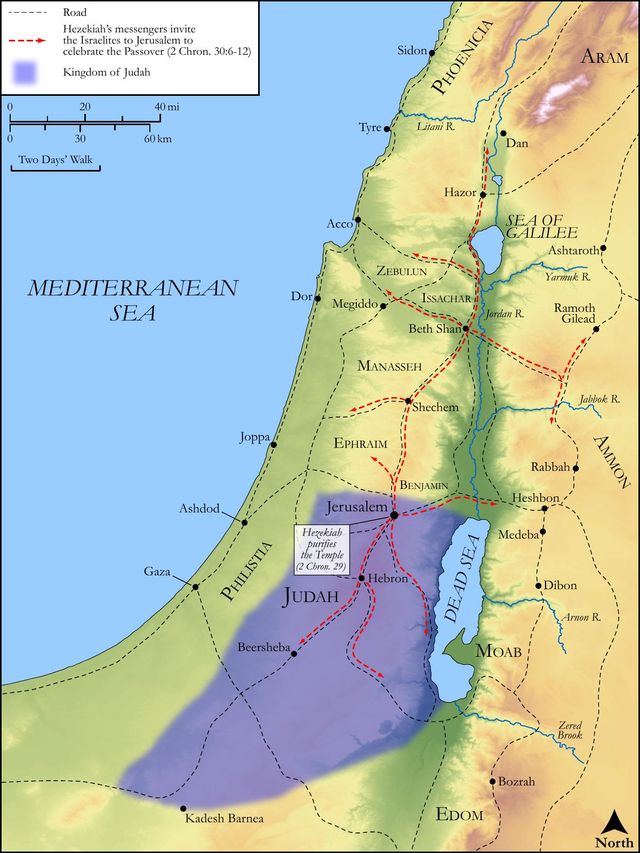
See on the biblical-era map
Study this verse
Public-domain commentary
Matthew Henry
From his Commentary on the Whole Bible. Henry comments on passages, not single verses — this entry covers 2 Chronicles 29:12–19. His two-level outline is real structure in the source text, so it is rendered as structure.
We have here busy work, good work, and needful work, the cleansing of the house of the Lord.
I.The persons employed in this work were the priests and Levites, who should have kept the temple clean, but, not having done that, were concerned to make it clean. Several of the Levites are here named, two of each of the three principal houses, Kohath, Gershon, and Merari (Ch2 29:12), and two of each of the three families of singers, Asaph, Heman, and Jeduthun, Ch2 29:13, Ch2 29:14. We cannot think these are named merely because they were chief in place (for then surely the high priest, or some of the heads of the courses of the priests, would have been mentioned), but because they were more zealous and active than the rest. When God has work to do he will raise up leading men to preside in it. And it is not always that the first in place and rank are most fit for service or most forward to it. These Levites not only bestirred themselves, but gathered their brethren, and quickened them to do according to the commandment of the king by the word of the Lord. Observe, They did according to the king's command, but with an eye to God's word. The king commanded them what was already their duty by the word of God, and, in doing it, they regarded God's word as a rule to them and the king's commandment as a spur to them.
II.The work was cleansing the house of God,
1.From the common dirt it had contracted while it was shut up - dust, and cobwebs, and the rust of the vessels.
2.From the idols and idolatrous altars that were set up in it, which, though kept ever so neat, were a greater pollution to it than if it had been made the common sewer of the city. The priests were none of them mentioned as leading men in this work, yet none but they durst go into the inner part of the house, no, not to cleanse it, which they did, and perhaps the high priest into the holy of holies, to cleanse that. And, though the Levites had the honour to be the leaders in the work, they did not disdain to be servitors to the priests according to their office; for what filth the priests brought into the court the Levites carried to the brook Kidron. Let not men's usefulness, be it ever so eminent, make them forget their place.
III.The expedition with which they did this work was very remarkable.
They began on the first day of the first month, a happy beginning of the new-year, and one that promised a good year. Thus should every year begin with the reformation of what is amiss, and the purging away, by true repentance, of all the defilements contracted the foregoing year. In eight days they cleared and cleansed the temple, and in eight days more the courts of the temple, Ch2 29:17. Let those that do good work learn to rid work and get it done. Let what is amiss be amended quickly.
IV.The report they made of it to Hezekiah was very agreeable, Ch2 29:18, Ch2 29:19.
They gave him an account of what they had done, because it was he that set them on work, boasted not of their own care and pains, nor did they come to him to be paid, but to let him know that all things that had been profaned were now sanctified according to law, and were ready to be used again whenever he pleased. They knew the good king had set his heart upon God's altar, and longed to be attending that, and therefore they insisted most upon the readiness they had put that into - that the vessels for the altar were scoured and brightened. Those vessels which Ahaz, in his transgression, had cast away as vessels in which there was no pleasure, they gathered together, sanctified them, and laid them in their place before the altar. Though the vessels of the sanctuary may be profaned for a while, God will find a time and a way to sanctify them. Neither his ordinances nor his people shall be suffered to fail for ever.
Continue studying 2 Chronicles 29:16 across the web’s major study libraries — every link below opens this exact verse, chapter, or book on the destination site.
Read & Compare
 BibleGatewayThis verse in more than 200 translations and 70 languages.
 Bible.comThe YouVersion reader — hundreds of translations, reading plans, and highlights.
 ESV.orgCrossway's official English Standard Version reader.
 NET BibleThe NET translation with 60,000+ translators' notes on every rendering decision.
 STEP BibleTyndale House's free study tool — original text, vocabulary, and scholarly resources.
 BibliaLogos Bible Software's free web reader.
 USCCBThe New American Bible (Revised Edition) with the U.S. bishops' study notes.
Commentaries
 BibleHub CommentariesDozens of classic commentaries on this verse, gathered on one page.
 StudyLightMore than 100 commentary sets — the largest collection on the web.
 BibleRefPlain-English commentary on what this verse means, verse by verse.
 Enduring WordDavid Guzik's free commentary on this chapter, widely used by Bible teachers.
 Bible Study ToolsVerse commentary alongside Greek and Hebrew study aids.
Original Language & Research
- BibleHub InterlinearThe verse word by word — original language, transliteration, and English.
- BibleHub LexiconEvery word's original-language definition and Strong's entry.
 Blue Letter BibleDeep-study tools — Strong's numbers, concordance, and word studies.
 SefariaThe Hebrew text with Rashi and centuries of Jewish commentary.
Sermons, Hymns & Audio


TrulyRandomVerse is not affiliated with these sites and doesn’t control their content. They’re linked because they’re genuinely useful.
Summary
Second Chronicles 29:16 vividly portrays a pivotal moment in King Hezekiah's spiritual revival of Judah: the meticulous purification of the defiled temple. It details the distinct, divinely ordained roles of the priests, who entered the innermost sanctums to meticulously remove all ritual and moral uncleanness, and the Levites, who then transported these defiled materials from the temple courts out of the city and into the Kidron Valley. This comprehensive act signified a decisive rejection of the idolatry, spiritual neglect, and covenant infidelity that had desecrated God's sacred dwelling, laying the groundwork for the restoration of pure worship and national covenant fidelity.
Context
ShowHideLiterary Context
This verse is situated within the initial, zealous actions of King Hezekiah upon his ascension to the throne of Judah. Following the profoundly apostate reign of his father, King Ahaz, who had not only closed the doors of the LORD's house but also erected pagan altars throughout Jerusalem, Hezekiah's paramount concern was the immediate restoration of proper worship to Yahweh. The preceding narrative (2 Chronicles 29:3-15) recounts Hezekiah's impassioned charge to the Levites and priests, urging them to consecrate themselves and the temple, acknowledging the profound unfaithfulness of their predecessors. Verse 16 precisely describes the meticulous execution of this command, marking the culmination of the internal cleansing phase before the temple could be rededicated through sacrifices and offerings. This thorough purification was an essential prerequisite, setting the stage for the subsequent grand celebration of the Passover and the widespread eradication of idolatry throughout the land of Judah.
Historical & Cultural Context
The Temple in Jerusalem stood as the preeminent center of Israelite worship, consecrated by God as His dwelling place among His people and a symbol of His holiness. Its defilement under King Ahaz, characterized by the introduction of foreign altars and the cessation of daily sacrifices, represented a severe spiritual crisis for the nation, severing their covenant relationship with Yahweh. Hezekiah's cleansing operation was far more than a mere physical tidying; it was a profound symbolic and actual removal of everything that violated God's covenant and holiness. The distinct roles of priests and Levites were meticulously prescribed by Mosaic Law (e.g., Numbers 3 and Numbers 18), with priests granted access to the inner sanctuary for sacred duties and Levites assisting with the transport, maintenance, and guarding of the temple precincts. The Kidron Valley, located to the east of Jerusalem, historically functioned as a common and symbolic dumping ground for idolatrous objects and defiled materials, as evidenced by the actions of King Asa and later King Josiah. Its use here powerfully symbolizes a complete and decisive rejection and separation from impurity.
Key Themes
ShowHideThe overarching theme in this passage is the restoration of pure worship to Yahweh following a period of profound national apostasy. Hezekiah's actions underscore the non-negotiable importance of adhering to God's prescribed ways of worship and the severe consequences of spiritual neglect and disobedience. Intricately linked is the theme of purity and holiness, emphasizing God's absolute demand for a consecrated space and a consecrated people. The "uncleanness" removed from the temple encompassed not only physical debris but, more significantly, the spiritual contamination resulting from idolatry, moral corruption, and the cessation of proper sacrifices. The verse also highlights divine order and cooperation, as the distinct yet complementary roles of the priests and Levites are meticulously fulfilled, demonstrating faithful obedience to God's established protocols for temple service. Finally, it powerfully illustrates the rejection of idolatry, as the defiled objects are not merely hidden or set aside but decisively carried out and disposed of in a place historically associated with the eradication of paganism, signifying a definitive break from the past and a resolute return to covenant faithfulness.
Exposition and Analysis
ShowHideKey Word Analysis
ShowHideThis term (H2932) refers to a state of ritual impurity that renders a person or object unfit for sacred service or participation in the community's worship. Beyond ritual defilement, it often denotes moral or spiritual contamination, particularly associated with idolatry, sin, and anything that violates God's holiness. In the context of 2 Chronicles 29:16, it encompasses both the physical debris accumulated from neglect and the profound spiritual contamination resulting from King Ahaz's pagan practices, which had rendered the temple unfit for God's presence and proper worship. Its thorough removal signifies a comprehensive purification, addressing both outward defilement and its underlying spiritual causes.
The verb (H2891) signifies to make bright, and by implication, to be pure, clean, or purified. This can apply physically (e.g., sound, unadulterated), Levitically (uncontaminated for sacred purposes), or morally (innocent, holy). Here, it denotes the active process of purification and sanctification. The priests' mission "to cleanse" the temple was not a superficial tidying but a deep, ritualistic, and spiritual act of purging all that was defiled, restoring the sanctuary to a state of holiness acceptable for God's presence and worship. This required a deliberate and thorough removal of all that had polluted it.
This proper noun (H6939) refers to the Kidron Valley, a natural ravine on the eastern side of Jerusalem. Its name, derived from a root meaning "dusky" or "dark," reflects its often-dry, shadowy nature. Historically, the Kidron Valley served as a literal and symbolic dumping ground for refuse and, critically, for objects associated with idolatry and pagan worship. Carrying the temple's defiled materials to the Kidron signified a complete, irreversible rejection and public disposal of the temple's impurities. This act emphasized a decisive and public break from the past idolatry and spiritual compromise that had corrupted the sanctuary, ensuring that the defilement was not merely hidden but utterly removed from the sacred sphere.
Verse Breakdown
ShowHide"And the priests went into the inner part of the house of the LORD, to cleanse [it],"
This opening clause identifies the primary agents—the priests—and their initial, crucial action. As those consecrated for sacred service and uniquely authorized to enter the Holy Place, they initiated the cleansing. Their entry into the "inner part" signifies the pervasive nature of the defilement and the thoroughness required for purification, reaching beyond superficial areas to the very heart of the sanctuary. Their explicit mission "to cleanse [it]" underscores the purposeful, ritualistic, and divinely mandated nature of their work, aiming to restore the temple's sanctity.
"and brought out all the uncleanness that they found in the temple of the LORD into the court of the house of the LORD."
This clause describes the immediate outcome of the priests' meticulous work. They did not merely clean within the inner sanctum; they actively "brought out" every item of "uncleanness"—whether physical debris, idolatrous objects, or accumulated filth from prolonged neglect—from the consecrated interior. Their action moved this defilement from the sacred inner spaces to the outer "court," making it accessible for the next stage of removal by the Levites. This step emphasizes the systematic, staged, and cooperative nature of the temple's comprehensive purification.
"And the Levites took [it], to carry [it] out abroad into the brook Kidron."
This final clause details the essential role of the Levites in the cleansing process. Once the priests had brought the defiled materials to the outer court, the Levites, in accordance with their designated duties as temple assistants, took over. Their task was to "carry [it] out abroad"—beyond the temple precincts and even outside the city walls—to the "brook Kidron." This final act of disposal was critical for completely separating the temple and the people from the defilement, symbolizing a decisive, public, and irreversible break with the past idolatry and spiritual compromise that had polluted the sanctuary.
Literary Devices
ShowHideThe passage effectively employs several literary devices to convey its profound theological and spiritual message. Symbolism is profoundly evident, with the "uncleanness" representing not merely physical dirt but the pervasive spiritual defilement of idolatry, moral corruption, and neglect that had permeated Judah's worship. The act of carrying this defilement to the "brook Kidron" is highly symbolic, signifying a complete, irreversible rejection and public disposal of past apostasy, as the Kidron Valley was historically a designated place for the eradication of detestable pagan objects. There is a clear Contrast established between the previous reign of King Ahaz, characterized by temple closure and rampant idolatry, and Hezekiah's immediate, zealous, and divinely-ordered efforts to purify and restore. The precise delineation of roles between the Priests and Levites illustrates Divine Order and Cooperation, highlighting the structured, hierarchical, and obedient nature of temple service according to God's commands. This division of labor also serves as a form of Synecdoche, where the specific, complementary actions of these consecrated groups represent the broader national commitment to spiritual renewal and a return to covenant faithfulness.
Theological and Thematic Connections
ShowHideThis passage powerfully underscores God's unwavering demand for holiness and purity, particularly concerning His dwelling place and among His covenant people. The defilement of the temple was not merely an aesthetic issue but a grave offense against God's character, His covenant, and His very presence, necessitating a thorough and immediate cleansing. It reflects the profound truth that sin and idolatry, like pervasive "uncleanness," cannot coexist with God's holy presence and must be decisively removed and cast away. The cooperative and ordered effort of the priests and Levites also highlights the importance of structured service and collective responsibility within the community of faith for maintaining the purity of worship and the sanctity of God's house. This Old Testament account serves as a powerful type, foreshadowing the New Testament understanding of the believer and the church as God's spiritual temple, emphasizing the ongoing need for spiritual purification, separation from defilement, and a life consecrated to God.
Reflection and Application
ShowHideThe meticulous cleansing of the temple under Hezekiah, as detailed in 2 Chronicles 29:16, serves as a profound and enduring metaphor for the continuous spiritual purification required in the lives of individual believers and within the corporate body of the church today. Just as the physical temple had accumulated "uncleanness" from neglect, idolatry, and spiritual compromise, our hearts and our Christian communities can become defiled by unconfessed sin, hidden idolatries, spiritual apathy, worldly influences, and anything that displaces God from His rightful place of preeminence. This passage issues a compelling call to radical self-examination, urging us to identify and decisively remove "uncleanness"—whether it manifests as moral impurity, unholy practices, or a lack of fervent devotion—from our inner "sanctuaries." It emphasizes the need for a proactive, thorough, and cooperative effort, much like the priests initiating the cleansing and the Levites ensuring complete removal, to restore purity of worship and wholehearted devotion to God. This spiritual cleansing is not a one-time event but a continuous process of repentance, confession, and renewed commitment to holiness, ensuring that our lives and our churches remain fit dwelling places for the Holy Spirit and vibrant centers of pure, authentic worship.
Questions for Reflection
ShowHideFAQ
ShowHideWhy was the Kidron Valley chosen as the disposal site for the temple's defilement?
ShowHideThe Kidron Valley, a natural ravine situated on the eastern side of Jerusalem, held significant historical and symbolic importance as a disposal site. It was commonly used for refuse and, more notably, for objects associated with idolatry and pagan worship. Its selection for disposing of the temple's "uncleanness" was highly symbolic, representing a complete and irreversible separation from the defilement. This act signified a decisive break from the past idolatry and spiritual compromise that had polluted God's house. This practice is consistently observed in other biblical accounts, such as King Asa's disposal of his grandmother's idol and King Josiah's widespread destruction of pagan altars and idols in the Kidron Valley. It powerfully underscored the finality, public nature, and symbolic eradication of the temple's impurities.
What was the significance of the priests and Levites having distinct roles in the cleansing process?
ShowHideThe distinct roles of the priests and Levites were meticulously prescribed by Mosaic Law (e.g., Numbers 3 and Numbers 18) for the sacred service of the tabernacle and later the temple. Priests, as direct descendants of Aaron, were authorized to enter the inner sanctuary (the Holy Place and, for the High Priest, the Most Holy Place) and were responsible for performing sacred rituals, offering sacrifices, and handling holy objects. Levites, members of the tribe of Levi but not direct descendants of Aaron, served as assistants, responsible for carrying, maintaining, and guarding the temple precincts. In 2 Chronicles 29:16, the priests' specific role was to enter the "inner part" to remove the initial, deeply embedded defilement, while the Levites then took these materials from the outer court to carry them away to the Kidron Valley. This division of labor highlights the adherence to divine order, the specialized and complementary nature of temple service, and the cooperative effort required for a thorough and proper cleansing, demonstrating faithful obedience to God's established protocols for maintaining His holy dwelling.
Christ-Centered Fulfillment
ShowHideThe meticulous cleansing of the temple under King Hezekiah in 2 Chronicles 29:16 finds its ultimate and perfect fulfillment in the person and redemptive work of Jesus Christ. While the Old Testament temple was a physical structure requiring repeated purifications from human sin and defilement, Jesus Himself declared, "Destroy this temple, and in three days I will raise it up," profoundly speaking of the temple of His own body (John 2:21). He is the true and perfect temple, the very embodiment of God's presence among humanity, in whom the fullness of the Godhead dwells bodily (Colossians 2:9). Furthermore, just as the priests and Levites diligently removed the "uncleanness" from the physical temple, Jesus, as our great High Priest (Hebrews 4:14), offered Himself as the ultimate, once-for-all sacrifice, cleansing us from all sin and defilement by His own precious blood (Hebrews 9:14 and 1 John 1:7). His sacrificial death and glorious resurrection not only purified the spiritual "temple" of our individual hearts, making us living stones built into God's spiritual house (1 Peter 2:5), but also cleansed the corporate "temple" of the church, "that He might present her to Himself a glorious church, not having spot or wrinkle or any such thing, but that she should be holy and without blemish" (Ephesians 5:27). The physical cleansing depicted in 2 Chronicles 29:16 thus powerfully points forward to the spiritual, eternal, and complete cleansing accomplished by Christ, who perfectly purifies His people and establishes His dwelling place among them forever.