


2 Chronicles 29:12
Bible text: King James Version (1769 Blayney text) · Public domain
Bible text: King James Version with Strong's numbers · Public domain
Bible text: Berean Standard Bible · Public domain
Bible text: American Standard Version (1901) · Public domain
Bible text: World English Bible, Messianic edition · Public domain
Bible text: Geneva Bible (1599) · Public domain
Bible text: Young's Literal Translation · Public domain
- וַיָּקֻמוּvai·ya·Ku·muand they aroseH6965Conj-w ¦ V-Qal-ConsecImperf-3mpVerb Qal Consecutive Imperfect 3rd Plural Masculineוַandיָּקֻמוּthey arose
- הַלְוִיִּםHal·vi·yimthe LevitesH3881Art ¦ N-mpNoun Gentilic Plural Masculine AbsoluteהַtheלְוִיִּםLevites
- מַחַתMa·chatMahathH4287N-proper-mNoun Proper Masculine
- בֶּןben[the] son ofH1121N-mscNoun Singular Masculine Construct
- עֲמָשַׂי'a·ma·SaiAmasaiH6022N-proper-mNoun Proper Masculine
- וְיוֹאֵלve·yo·'Eland JoelH3100Conj-w ¦ N-proper-mNoun Proper MasculineוְandיוֹאֵלJoel
- בֶּןben[the] son ofH1121N-mscNoun Singular Masculine Construct
- עֲזַרְיָהוּ'a·zar·ya·HuAzariahH5838N-proper-mNoun Proper Masculine
- מִןminofH4480PrepPreposition
- בְּנֵיbe·Nei[the] descendants ofH1121N-mpcNoun Plural Masculine Construct
- הַקְּהָתִיha·ke·ha·Tithe Kohathite[s]H6956Art ¦ N-msNoun Gentilic Singular Masculine AbsoluteהַtheקְּהָתִיKohathite[s]
- וּמִןu·minand ofH4480Conj-w ¦ PrepPrepositionוּandמִןof
- בְּנֵיbe·Nei[the] descendants ofH1121N-mpcNoun Plural Masculine Construct
- מְרָרִיme·ra·RiMerariH4847N-proper-mNoun Proper Masculine
- קִישׁkishKishH7027N-proper-mNoun Proper Masculine
- בֶּןben[the] son ofH1121N-mscNoun Singular Masculine Construct
- עַבְדִּי'av·DiAbdiH5660N-proper-mNoun Proper Masculine
- וַעֲזַרְיָהוּva·'a·zar·Ya·huand AzariahH5838Conj-w ¦ N-proper-mNoun Proper MasculineוַandעֲזַרְיָהוּAzariah
- בֶּןben[the] son ofH1121N-mscNoun Singular Masculine Construct
- יְהַלֶּלְאֵלye·ha·lel·'ElJehallelelH3094N-proper-mNoun Proper Masculine
- וּמִןu·minand ofH4480Conj-w ¦ PrepPrepositionוּandמִןof
- הַגֵּרְשֻׁנִּיha·Ge·re·shu·Nithe Gershonite[s]H1649Art ¦ N-msNoun Gentilic Singular Masculine AbsoluteהַtheגֵּרְשֻׁנִּיGershonite[s]
- יוֹאָחyo·'AchJoahH3098N-proper-mNoun Proper Masculine
- בֶּןben[the] son ofH1121N-mscNoun Singular Masculine Construct
- זִמָּהzi·MahZimmahH2155N-proper-mNoun Proper Masculine
- וְעֵדֶןve·'E·denand EdenH5731Conj-w ¦ N-proper-mNoun Proper MasculineוְandעֵדֶןEden
- בֶּןben[the] son ofH1121N-mscNoun Singular Masculine Construct
- יוֹאָחyo·'AchJoahH3098N-proper-mNoun Proper Masculine
English is a literal word-by-word gloss of the Hebrew, not the KJV's wording. Why?
This is the original text the KJV's translators worked from — each Hebrew word with its own literal English meaning in this verse, prepared by scholars at Tyndale House, Cambridge. The KJV translates whole sentences, not word by word, so its wording differs: one Hebrew word can become several English words, and the KJV may choose “the LORD” where the gloss reads “Yahweh”. Both are faithful — they answer different questions. For the KJV's own rendering, switch to the KJV text.
Details
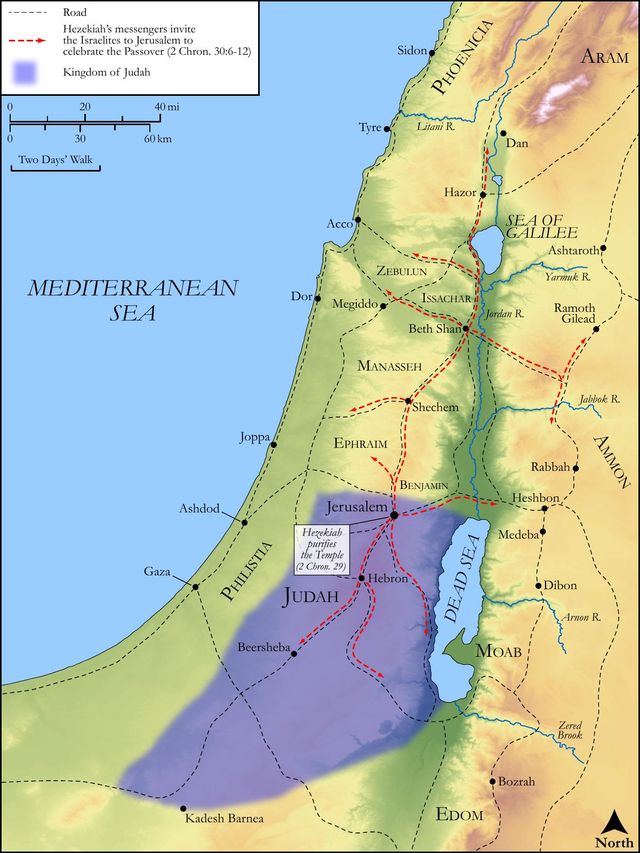
See on the biblical-era map
Study this verse
Public-domain commentary
Matthew Henry
From his Commentary on the Whole Bible. Henry comments on passages, not single verses — this entry covers 2 Chronicles 29:12–19. His two-level outline is real structure in the source text, so it is rendered as structure.
We have here busy work, good work, and needful work, the cleansing of the house of the Lord.
I.The persons employed in this work were the priests and Levites, who should have kept the temple clean, but, not having done that, were concerned to make it clean. Several of the Levites are here named, two of each of the three principal houses, Kohath, Gershon, and Merari (Ch2 29:12), and two of each of the three families of singers, Asaph, Heman, and Jeduthun, Ch2 29:13, Ch2 29:14. We cannot think these are named merely because they were chief in place (for then surely the high priest, or some of the heads of the courses of the priests, would have been mentioned), but because they were more zealous and active than the rest. When God has work to do he will raise up leading men to preside in it. And it is not always that the first in place and rank are most fit for service or most forward to it. These Levites not only bestirred themselves, but gathered their brethren, and quickened them to do according to the commandment of the king by the word of the Lord. Observe, They did according to the king's command, but with an eye to God's word. The king commanded them what was already their duty by the word of God, and, in doing it, they regarded God's word as a rule to them and the king's commandment as a spur to them.
II.The work was cleansing the house of God,
1.From the common dirt it had contracted while it was shut up - dust, and cobwebs, and the rust of the vessels.
2.From the idols and idolatrous altars that were set up in it, which, though kept ever so neat, were a greater pollution to it than if it had been made the common sewer of the city. The priests were none of them mentioned as leading men in this work, yet none but they durst go into the inner part of the house, no, not to cleanse it, which they did, and perhaps the high priest into the holy of holies, to cleanse that. And, though the Levites had the honour to be the leaders in the work, they did not disdain to be servitors to the priests according to their office; for what filth the priests brought into the court the Levites carried to the brook Kidron. Let not men's usefulness, be it ever so eminent, make them forget their place.
III.The expedition with which they did this work was very remarkable.
They began on the first day of the first month, a happy beginning of the new-year, and one that promised a good year. Thus should every year begin with the reformation of what is amiss, and the purging away, by true repentance, of all the defilements contracted the foregoing year. In eight days they cleared and cleansed the temple, and in eight days more the courts of the temple, Ch2 29:17. Let those that do good work learn to rid work and get it done. Let what is amiss be amended quickly.
IV.The report they made of it to Hezekiah was very agreeable, Ch2 29:18, Ch2 29:19.
They gave him an account of what they had done, because it was he that set them on work, boasted not of their own care and pains, nor did they come to him to be paid, but to let him know that all things that had been profaned were now sanctified according to law, and were ready to be used again whenever he pleased. They knew the good king had set his heart upon God's altar, and longed to be attending that, and therefore they insisted most upon the readiness they had put that into - that the vessels for the altar were scoured and brightened. Those vessels which Ahaz, in his transgression, had cast away as vessels in which there was no pleasure, they gathered together, sanctified them, and laid them in their place before the altar. Though the vessels of the sanctuary may be profaned for a while, God will find a time and a way to sanctify them. Neither his ordinances nor his people shall be suffered to fail for ever.
Continue studying 2 Chronicles 29:12 across the web’s major study libraries — every link below opens this exact verse, chapter, or book on the destination site.
Read & Compare
 BibleGatewayThis verse in more than 200 translations and 70 languages.
 Bible.comThe YouVersion reader — hundreds of translations, reading plans, and highlights.
 ESV.orgCrossway's official English Standard Version reader.
 NET BibleThe NET translation with 60,000+ translators' notes on every rendering decision.
 STEP BibleTyndale House's free study tool — original text, vocabulary, and scholarly resources.
 BibliaLogos Bible Software's free web reader.
 USCCBThe New American Bible (Revised Edition) with the U.S. bishops' study notes.
Commentaries
 BibleHub CommentariesDozens of classic commentaries on this verse, gathered on one page.
 StudyLightMore than 100 commentary sets — the largest collection on the web.
 BibleRefPlain-English commentary on what this verse means, verse by verse.
 Enduring WordDavid Guzik's free commentary on this chapter, widely used by Bible teachers.
 Bible Study ToolsVerse commentary alongside Greek and Hebrew study aids.
Original Language & Research
- BibleHub InterlinearThe verse word by word — original language, transliteration, and English.
- BibleHub LexiconEvery word's original-language definition and Strong's entry.
 Blue Letter BibleDeep-study tools — Strong's numbers, concordance, and word studies.
 SefariaThe Hebrew text with Rashi and centuries of Jewish commentary.
Sermons, Hymns & Audio


TrulyRandomVerse is not affiliated with these sites and doesn’t control their content. They’re linked because they’re genuinely useful.
Summary
Second Chronicles 29:12 meticulously lists key Levites who promptly and willingly responded to King Hezekiah's urgent call to purify and reconsecrate the defiled Jerusalem Temple. This detailed record of individuals from the Kohathite, Merarite, and Gershonite families underscores the immediate, organized, and comprehensive effort required for the spiritual restoration of Judah, setting the stage for a nationwide revival of true worship after years of apostasy and neglect under King Ahaz.
Context
ShowHideLiterary Context
This verse is strategically placed at the very beginning of King Hezekiah's reign, immediately following the dark period of his father, King Ahaz, who had not only permitted but actively promoted idolatry, even shutting the doors of the Lord's house and building altars to other gods throughout Jerusalem (compare 2 Chronicles 28:24 with 2 Chronicles 29:3). Hezekiah, in stark contrast, began his reign with a radical and immediate commitment to spiritual reform. The preceding verses (2 Chronicles 29:3-11) record Hezekiah's direct and impassioned address to the Levites, urging them to sanctify themselves and cleanse the Temple, recognizing that the past defilement had brought God's wrath upon Judah. Verse 12 serves as the immediate and positive response to this royal decree, demonstrating the Levites' readiness and obedience, initiating the physical and spiritual purification process that would culminate in renewed covenant worship and national revival.
Historical & Cultural Context
The Levites, descendants of Levi, were divinely appointed for sacred service in the Tabernacle and later the Temple, responsible for its maintenance, the carrying out of rituals, teaching the Law, and leading worship. Their roles were meticulously defined, with specific duties assigned to the Kohathites (care of holy objects), Merarites (transport of heavy materials like frames and pillars), and Gershonites (care of curtains and coverings), as detailed in books like Numbers 3. Under Ahaz, the Temple had been not only neglected but actively desecrated, filled with impurities and idol worship, even being shut down. Hezekiah's call, therefore, was not merely for a cleaning but a re-consecration, a return to the purity and holiness demanded by God's covenant. The naming of specific individuals in 2 Chronicles 29:12 highlights the structured, lineage-based nature of their service and the importance of individual accountability within the divinely ordained system for maintaining the purity of Israel's worship and national identity.
Key Themes
ShowHideThis verse, though primarily a list of names, powerfully contributes to several overarching themes within 2 Chronicles 29 and the broader Deuteronomistic history. It emphasizes the theme of restoration and renewal, showcasing Hezekiah's commitment to reversing the spiritual decline and restoring Judah's relationship with God. The prompt action of the Levites highlights readiness for service and obedience to divine and righteous human authority, demonstrating that spiritual revival often begins with the willing participation of dedicated individuals. The detailed listing also underscores the divine order and corporate responsibility inherent in Israelite worship; the cleansing of the Temple was a massive undertaking requiring the coordinated efforts of specific individuals from established priestly families. Finally, it reinforces the crucial theme of the importance of purity and holiness in worship, a foundational principle that Hezekiah's reforms sought to re-establish, paving the way for acceptable offerings and renewed covenant blessings (see 2 Chronicles 29:15-19).
Exposition and Analysis
ShowHideKey Word Analysis
ShowHideDerived from Levi, the third son of Jacob, this term refers to the members of the tribe set apart by God for sacred service. They were not priests (who were descendants of Aaron, a Levite), but assistants in the Tabernacle and Temple, responsible for various duties including maintenance, music, gatekeeping, and teaching the Law. Their prominence in this verse underscores their divinely appointed role in maintaining the purity and order of Israel's worship, and their willingness to "arise" signifies their commitment to their sacred calling despite years of neglect and apostasy.
This verb signifies "to stand up," "to rise," or "to take action." In this context, it conveys more than mere presence; it denotes a prompt, decisive, and willing response to Hezekiah's urgent command. It implies initiative and readiness, a stark contrast to the spiritual apathy that characterized the previous reign. The Levites did not hesitate but actively stepped forward to undertake the vital and demanding task of purification, reflecting their commitment to the restoration of true worship. This active "rising" is a motif often associated with divine calling and human obedience in the Old Testament, indicating a shift from passive observation to active participation.
Verse Breakdown
ShowHide"¶ Then the Levites arose,"
This opening clause establishes the immediate and positive response of the Levites to King Hezekiah's charge in the preceding verses. The term "arose" (קוּם, qûm) signifies a proactive and willing readiness to undertake the arduous task of cleansing the Temple, indicating their commitment to the spiritual restoration of Judah. It suggests a decisive movement from a state of inaction to one of purposeful engagement.
"Mahath the son of Amasai, and Joel the son of Azariah, of the sons of the Kohathites:"
This specifies the first two named individuals, Mahath and Joel, who represent the Kohathite branch of the Levites. The Kohathites were traditionally responsible for the most sacred elements of the Tabernacle and Temple, including the Ark of the Covenant, suggesting their prominence and the gravity of the task at hand. Their inclusion here underscores the involvement of those most intimately connected with the holy vessels, highlighting the importance of their specialized knowledge and authority in handling sacred objects.
"and of the sons of Merari, Kish the son of Abdi, and Azariah the son of Jehalelel:"
Following the Kohathites, Kish and Azariah are named from the Merarite family. The Merarites were responsible for the structural components of the Tabernacle and Temple, such as frames, pillars, and bases. Their participation highlights the comprehensive nature of the cleansing, involving not just the sacred objects but the very fabric and infrastructure of the sanctuary, indicating that no part of the defiled Temple was to be overlooked.
"and of the Gershonites; Joah the son of Zimmah, and Eden the son of Joah:"
Finally, Joah and Eden are listed from the Gershonite branch. The Gershonites were responsible for the coverings, curtains, and cords of the Tabernacle. Their presence ensures that every aspect of the Temple, from its most sacred interior to its outer coverings, would be thoroughly purified. The meticulous listing from all three major Levitical families emphasizes the comprehensive and organized nature of the restoration effort, rooted in the ancient divine order for Temple service, ensuring that every necessary task was assigned and undertaken.
Literary Devices
ShowHideThe verse primarily employs Listing and Genealogy, common literary devices in biblical texts, particularly in historical and priestly narratives. By meticulously naming specific individuals and their lineage (e.g., "Mahath the son of Amasai"), the text lends authenticity and authority to the account, emphasizing that these were real people fulfilling specific, divinely ordained roles within a structured system. This detailed enumeration also serves to highlight the corporate responsibility and organized effort involved in the Temple cleansing; it was not a haphazard undertaking but a structured response led by recognized individuals from each major Levitical division. The repetition of "sons of" reinforces the established Levitical order and the continuity of their sacred duties across generations, even after periods of neglect, underscoring the enduring nature of God's covenant with Levi.
Theological and Thematic Connections
ShowHideThe immediate and willing response of these Levites in 2 Chronicles 29:12 serves as a powerful theological statement about the nature of true worship and obedience. Their "arising" signifies not merely a physical act but a spiritual readiness to participate in God's redemptive work, even when it involves arduous and unpleasant tasks like cleansing defilement. This act of purification was essential for the restoration of the covenant relationship between God and His people, demonstrating that God requires holiness and purity in the places and people dedicated to Him. The specific naming of individuals from the three major Levitical families underscores the importance of order, accountability, and the fulfillment of divinely appointed roles within the community of faith, illustrating that corporate spiritual renewal is often contingent upon the faithful and diligent service of its individual members, each contributing according to their God-given function.
Reflection and Application
ShowHideThe seemingly simple list of names in 2 Chronicles 29:12 carries profound lessons for believers today. It calls us to consider our own readiness and willingness to respond when God, through His Word or His Spirit, calls for spiritual cleansing and restoration in our lives, our families, or our communities. Just as the Temple had been defiled and required diligent effort to purify, our hearts and our churches may accumulate impurities that hinder true worship and fellowship with God. This verse reminds us that such purification often requires proactive "arising" – taking initiative, committing to difficult tasks, and working collaboratively with others who are also dedicated to God's standards. Every individual's contribution, however seemingly small or behind-the-scenes, is vital for the larger work of spiritual renewal and the advancement of God's kingdom. The readiness of these Levites under Hezekiah's leadership ultimately paved the way for a powerful Passover celebration and widespread spiritual revival throughout Judah, demonstrating the transformative power of obedient and unified service.
Questions for Reflection
ShowHideFAQ
ShowHideWhy are these specific names listed in the Bible?
ShowHideThe listing of specific names from the Kohathite, Merarite, and Gershonite families in 2 Chronicles 29:12 serves several important purposes. Firstly, it provides historical authenticity and accountability, demonstrating that the Temple cleansing was a real event carried out by identifiable individuals within the established Levitical order. Secondly, it highlights the organized and comprehensive nature of the restoration effort, as representatives from all three major Levitical divisions, each with distinct responsibilities for the Temple's care (as outlined in Numbers 3), were involved. Lastly, it emphasizes the importance of individual obedience and readiness to serve, showcasing those who willingly "arose" to fulfill their sacred duties in a time of urgent spiritual need, underscoring the value of each person's contribution to God's work.
What was the significance of the Levites' role in this cleansing and restoration?
ShowHideThe Levites played a crucial and indispensable role in the cleansing and restoration of the Temple under King Hezekiah. As the divinely appointed guardians and ministers of the sanctuary, they were uniquely qualified and responsible for maintaining its ritual purity and proper functioning. Their work involved not only physically removing the defilement and debris accumulated during Ahaz's reign but also carrying out the necessary purification rites and sacrifices to reconsecrate the sacred space. This act was not merely a physical cleaning but a spiritual re-dedication, essential for re-establishing acceptable worship and restoring God's presence among His people. Their diligent work, detailed in 2 Chronicles 29:16-19, directly enabled the subsequent renewal of the Passover and other covenant celebrations, making them central to Judah's spiritual revival.
Christ-Centered Fulfillment
ShowHideThe readiness of these Levites to cleanse the defiled Temple foreshadows the ultimate and perfect cleansing accomplished by Jesus Christ. While the Levites purified a physical structure and its contents, Christ, as our great High Priest, entered the true, heavenly sanctuary not with the blood of animals but with His own precious blood, making a once-for-all purification for sin (Hebrews 9:11-14). Just as Hezekiah's reforms aimed to restore proper worship, Christ's work inaugurated a new covenant where true worship is no longer confined to a physical temple but is offered in spirit and truth (John 4:23-24). Moreover, the Levites' willingness to "arise" and serve prefigures the call to every believer in Christ to be part of a "royal priesthood" and a "holy nation" (1 Peter 2:9), called to purify ourselves from all defilement and present our bodies as living sacrifices (Romans 12:1-2). The cleansing of the Temple in 2 Chronicles 29 points forward to Christ's own zeal for the purity of God's house (John 2:13-17), and ultimately, to His work in making us, His church, a holy temple in whom God dwells by His Spirit (Ephesians 2:19-22), purified and made fit for His presence.