


2 Chronicles 29:18
Bible text: King James Version (1769 Blayney text) · Public domain
Bible text: King James Version with Strong's numbers · Public domain
Bible text: Berean Standard Bible · Public domain
Bible text: American Standard Version (1901) · Public domain
Bible text: World English Bible, Messianic edition · Public domain
Bible text: Geneva Bible (1599) · Public domain
Bible text: Young's Literal Translation · Public domain
- וַיָּבוֹאוּvai·ya·Vo·'uand they wentH935Conj-w ¦ V-Qal-ConsecImperf-3mpVerb Qal Consecutive Imperfect 3rd Plural Masculineוַandיָּבוֹאוּthey went
- פְנִימָהfe·Ni·mahwithinH6441AdvAdverb
- אֶל'eltoH413PrepPreposition
- חִזְקִיָּהוּchiz·ki·Ya·huHezekiahH2396N-proper-mNoun Proper Masculine
- הַמֶּלֶךְha·Me·lekhthe kingH4428Art ¦ N-msNoun Singular Masculine Absoluteהַtheמֶּלֶךְking
- וַיֹּאמְרוּvai·Yo·me·Ruand they saidH559Conj-w ¦ V-Qal-ConsecImperf-3mpVerb Qal Consecutive Imperfect 3rd Plural Masculineוַandיֹּאמְרוּthey said
- טִהַרְנוּti·Har·nuwe have cleansedH2891V-Piel-Perf-1cpVerb Piel Perfect 1st Plural common gender
- אֶת'et<obj.>H853DirObjMParticle Object Indicator
- כָּלkolallH3605N-mscNoun Singular Masculine Construct
- בֵּיתbeit[the] house ofH1004N-mscNoun Singular Masculine Construct
- יְהוָהYah·wehYahwehH3068N-properNoun Proper Title
- אֶת'et<obj.>H853DirObjMParticle Object Indicator
- מִזְבַּחmiz·Bach[the] altar ofH4196N-mscNoun Singular Masculine Construct
- הָעוֹלָהha·'o·Lahthe burnt offeringH5930Art ¦ N-fsNoun Singular Feminine Absoluteהָtheעוֹלָהburnt offering
- וְאֶתve·'Etand <obj.>H853Conj-w ¦ DirObjMParticle Object Indicatorוְandאֶת<obj.>
- כָּלkolallH3605N-mscNoun Singular Masculine Construct
- כֵּלָיוke·Lavits utensilsH3627N-mpc ¦ 3msNoun Plural Masculine Constructכֵּלָיutensilsוits
- וְאֶתve·'Etand <obj.>H853Conj-w ¦ DirObjMParticle Object Indicatorוְandאֶת<obj.>
- שֻׁלְחַןshul·Chan[the] table ofH7979N-mscNoun Singular Masculine Construct
- הַמַּעֲרֶכֶתha·ma·'a·Re·khetthe rowH4635Art ¦ N-fsNoun Singular Feminine Absoluteהַtheמַּעֲרֶכֶתrow
- וְאֶתve·'Etand <obj.>H853Conj-w ¦ DirObjMParticle Object Indicatorוְandאֶת<obj.>
- כָּלkolallH3605N-mscNoun Singular Masculine Construct
- כֵּלָיוke·Lavits utensilsH3627N-mpc ¦ 3msNoun Plural Masculine Constructכֵּלָיutensilsוits
English is a literal word-by-word gloss of the Hebrew, not the KJV's wording. Why?
This is the original text the KJV's translators worked from — each Hebrew word with its own literal English meaning in this verse, prepared by scholars at Tyndale House, Cambridge. The KJV translates whole sentences, not word by word, so its wording differs: one Hebrew word can become several English words, and the KJV may choose “the LORD” where the gloss reads “Yahweh”. Both are faithful — they answer different questions. For the KJV's own rendering, switch to the KJV text.
Details
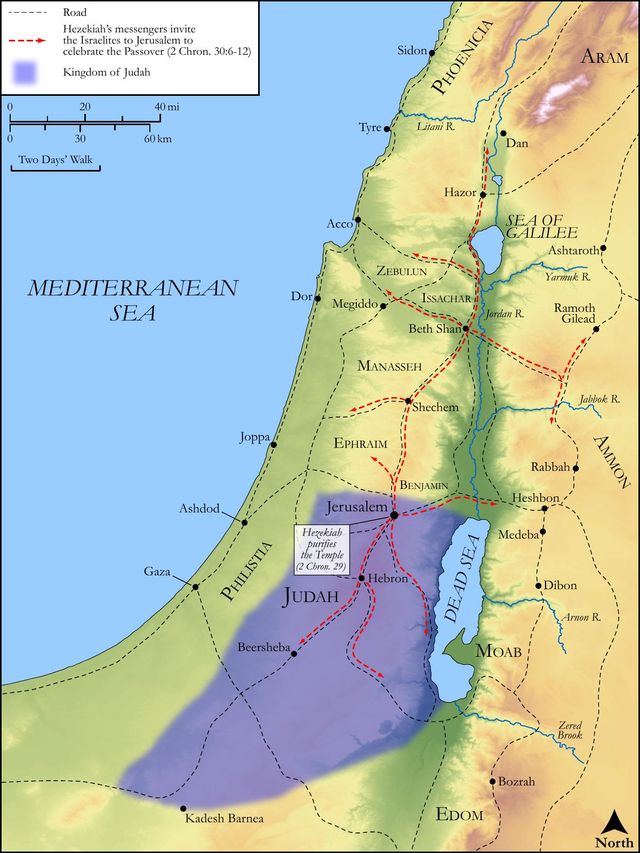
See on the biblical-era map
Study this verse
Public-domain commentary
Matthew Henry
From his Commentary on the Whole Bible. Henry comments on passages, not single verses — this entry covers 2 Chronicles 29:12–19. His two-level outline is real structure in the source text, so it is rendered as structure.
We have here busy work, good work, and needful work, the cleansing of the house of the Lord.
I.The persons employed in this work were the priests and Levites, who should have kept the temple clean, but, not having done that, were concerned to make it clean. Several of the Levites are here named, two of each of the three principal houses, Kohath, Gershon, and Merari (Ch2 29:12), and two of each of the three families of singers, Asaph, Heman, and Jeduthun, Ch2 29:13, Ch2 29:14. We cannot think these are named merely because they were chief in place (for then surely the high priest, or some of the heads of the courses of the priests, would have been mentioned), but because they were more zealous and active than the rest. When God has work to do he will raise up leading men to preside in it. And it is not always that the first in place and rank are most fit for service or most forward to it. These Levites not only bestirred themselves, but gathered their brethren, and quickened them to do according to the commandment of the king by the word of the Lord. Observe, They did according to the king's command, but with an eye to God's word. The king commanded them what was already their duty by the word of God, and, in doing it, they regarded God's word as a rule to them and the king's commandment as a spur to them.
II.The work was cleansing the house of God,
1.From the common dirt it had contracted while it was shut up - dust, and cobwebs, and the rust of the vessels.
2.From the idols and idolatrous altars that were set up in it, which, though kept ever so neat, were a greater pollution to it than if it had been made the common sewer of the city. The priests were none of them mentioned as leading men in this work, yet none but they durst go into the inner part of the house, no, not to cleanse it, which they did, and perhaps the high priest into the holy of holies, to cleanse that. And, though the Levites had the honour to be the leaders in the work, they did not disdain to be servitors to the priests according to their office; for what filth the priests brought into the court the Levites carried to the brook Kidron. Let not men's usefulness, be it ever so eminent, make them forget their place.
III.The expedition with which they did this work was very remarkable.
They began on the first day of the first month, a happy beginning of the new-year, and one that promised a good year. Thus should every year begin with the reformation of what is amiss, and the purging away, by true repentance, of all the defilements contracted the foregoing year. In eight days they cleared and cleansed the temple, and in eight days more the courts of the temple, Ch2 29:17. Let those that do good work learn to rid work and get it done. Let what is amiss be amended quickly.
IV.The report they made of it to Hezekiah was very agreeable, Ch2 29:18, Ch2 29:19.
They gave him an account of what they had done, because it was he that set them on work, boasted not of their own care and pains, nor did they come to him to be paid, but to let him know that all things that had been profaned were now sanctified according to law, and were ready to be used again whenever he pleased. They knew the good king had set his heart upon God's altar, and longed to be attending that, and therefore they insisted most upon the readiness they had put that into - that the vessels for the altar were scoured and brightened. Those vessels which Ahaz, in his transgression, had cast away as vessels in which there was no pleasure, they gathered together, sanctified them, and laid them in their place before the altar. Though the vessels of the sanctuary may be profaned for a while, God will find a time and a way to sanctify them. Neither his ordinances nor his people shall be suffered to fail for ever.
Continue studying 2 Chronicles 29:18 across the web’s major study libraries — every link below opens this exact verse, chapter, or book on the destination site.
Read & Compare
 BibleGatewayThis verse in more than 200 translations and 70 languages.
 Bible.comThe YouVersion reader — hundreds of translations, reading plans, and highlights.
 ESV.orgCrossway's official English Standard Version reader.
 NET BibleThe NET translation with 60,000+ translators' notes on every rendering decision.
 STEP BibleTyndale House's free study tool — original text, vocabulary, and scholarly resources.
 BibliaLogos Bible Software's free web reader.
 USCCBThe New American Bible (Revised Edition) with the U.S. bishops' study notes.
Commentaries
 BibleHub CommentariesDozens of classic commentaries on this verse, gathered on one page.
 StudyLightMore than 100 commentary sets — the largest collection on the web.
 BibleRefPlain-English commentary on what this verse means, verse by verse.
 Enduring WordDavid Guzik's free commentary on this chapter, widely used by Bible teachers.
 Bible Study ToolsVerse commentary alongside Greek and Hebrew study aids.
Original Language & Research
- BibleHub InterlinearThe verse word by word — original language, transliteration, and English.
- BibleHub LexiconEvery word's original-language definition and Strong's entry.
 Blue Letter BibleDeep-study tools — Strong's numbers, concordance, and word studies.
 SefariaThe Hebrew text with Rashi and centuries of Jewish commentary.
Sermons, Hymns & Audio


TrulyRandomVerse is not affiliated with these sites and doesn’t control their content. They’re linked because they’re genuinely useful.
Summary
2 Chronicles 29:18 records the pivotal moment when the Levites and priests, commissioned by King Hezekiah, reported the successful completion of their extensive work in cleansing the defiled Temple of the LORD. This comprehensive purification encompassed the entire sacred edifice, including the central altar of burnt offering and the table for the shewbread, along with all their associated vessels. This report marked a crucial milestone in Hezekiah's audacious and divinely-inspired initiative to restore proper worship and spiritual vitality to Judah after generations of apostasy and neglect.
Context
ShowHideLiterary Context
This verse is situated within the opening narrative of King Hezekiah's reign, specifically detailing his immediate and radical spiritual reforms. Having ascended the throne after his idolatrous father, Ahaz, Hezekiah wasted no time in initiating a national revival. 2 Chronicles 29:3 states that in the very first month of his reign, he opened and repaired the doors of the house of the LORD. He then commanded the Levites and priests to sanctify themselves and cleanse the Temple, a process that took sixteen days, culminating in the cleansing of the inner sanctuary and the altar by the sixteenth day of the first month (2 Chronicles 29:17). Verse 18 is the direct report of this completed task, leading immediately into the restoration of the sacrificial system and the celebration of Passover, signifying a full return to covenant worship and demonstrating the king's commitment to the Mosaic Law.
Historical & Cultural Context
King Hezekiah reigned over Judah from approximately 715-686 BC, a period marked by significant geopolitical turmoil with the rising Assyrian Empire. His father, King Ahaz, had not only tolerated but actively promoted idolatry, even going so far as to shut up the doors of the house of the LORD and erect pagan altars throughout Jerusalem. This had left the Temple in a state of profound defilement and disuse, reflecting the spiritual decay of the nation. The cleansing described in this verse was not merely a physical tidying but a ritual purification essential for restoring the Temple's sanctity and making it fit for God's presence and proper worship, according to Mosaic Law. The "altar of burnt offering" was the primary site for atonement, and the "shewbread table" symbolized God's covenant presence and provision, making their purification paramount for the resumption of national worship.
Key Themes
ShowHideThe passage powerfully articulates several foundational themes. Foremost is Restoration and Revival, as Hezekiah's actions reverse decades of spiritual decline, aiming to bring the nation back into right relationship with God. This restoration hinges on Holiness and Purity, emphasizing the biblical principle that God's dwelling place and instruments of worship must be consecrated and set apart from all defilement, a concept underscored by the meticulous cleansing of "all the house of the LORD" and its sacred furnishings. The diligent work of the Levites and priests highlights Obedience and Diligence in service to God, as they meticulously carried out the king's command, demonstrating commitment to the comprehensive purification. Finally, Hezekiah's decisive and immediate action upon ascending the throne exemplifies Godly Leadership, showcasing how a righteous ruler can inspire and lead a nation toward spiritual transformation, in stark contrast to the apostasy of his predecessors like King Ahaz, whose reign is detailed in 2 Chronicles 28.
Exposition and Analysis
ShowHideKey Word Analysis
ShowHideThis verb (H2891) signifies to be pure, clean, or to purify. In a cultic context, it refers to ritual purification, making something ceremonially fit for sacred use or for approaching God. Its use here emphasizes that the Temple and its vessels were not merely tidied but ritually purified from the defilement accumulated under Ahaz, thereby restoring their sacred function and enabling proper worship to resume. This concept of purification is central to the Old Testament understanding of holiness and the necessity of ritual purity for divine communion.
This noun (H1004) refers to a dwelling or building, but in this context, it specifically denotes the Temple in Jerusalem, the designated dwelling place of God's presence among His people, often referred to as the "house of the LORD." Its defilement under Ahaz represented a profound spiritual crisis, signifying a breach in the covenant relationship. Its cleansing was therefore an act of national repentance and a re-establishment of God's rightful place at the center of Israelite life and worship.
This noun (H7979) refers to a table, specifically here the "shewbread table" (H7979 with H4635, maʻăreketh for shewbread, meaning "arrangement" or "pile of loaves"). This table was one of the key furnishings in the Holy Place of the Temple. The twelve loaves of bread, representing the twelve tribes of Israel, were perpetually set before the LORD, symbolizing God's constant provision for and covenant relationship with His people. Its purification was essential for the restoration of this symbolic communion and God's sustained presence.
Verse Breakdown
ShowHide"Then they went in to Hezekiah the king, and said,"
This opening clause establishes the formal nature of the report. The Levites and priests, having completed the arduous task assigned to them by King Hezekiah, present themselves before the king to deliver an official update. This underscores their accountability to the king's authority and highlights the king's central role in initiating and overseeing this vital spiritual initiative for the nation.
"We have cleansed all the house of the LORD,"
This declaration signifies the comprehensive nature of their work. "All the house" implies that no part of the Temple structure, from its outer courts to its inner sanctum, was overlooked in the purification process. This thoroughness reflects the diligence of the workers and the seriousness with which they approached the task of removing the extensive defilement that had accumulated.
"and the altar of burnt offering, with all the vessels thereof,"
The altar of burnt offering, located in the outer court, was central to Israelite worship as the primary place where sacrifices were made for atonement. Its cleansing, along with its associated tools and implements ("vessels thereof"), was critical for the resumption of the sacrificial system, which was the divinely ordained means of approaching God and seeking forgiveness for sin.
"and the shewbread table, with all the vessels thereof."
The inclusion of the shewbread table, located in the Holy Place, further emphasizes the meticulous and complete nature of the cleansing. This table and its vessels (such as bowls, pitchers, and spoons used in its service) were integral to the daily rituals of the Temple, symbolizing God's presence and His covenant provision. Their purification ensured that all aspects of sacred worship, from atonement to fellowship, could be properly restored.
Literary Devices
ShowHideThe passage employs several potent literary devices that enhance its meaning and impact. Repetition is subtly used through the phrase "with all the vessels thereof," applied to both the altar and the shewbread table. This reiteration emphasizes the exhaustive and meticulous nature of the cleansing, highlighting the Levites' diligence and the comprehensive scope of the restoration, ensuring no sacred implement was left defiled. Symbolism is paramount, as the physical cleansing of the Temple stands as a powerful symbol for the spiritual purification and renewal of the nation. The defiled Temple represented Judah's apostasy and broken covenant, and its meticulous cleansing symbolized their return to covenant faithfulness and a renewed relationship with Yahweh. Furthermore, there is a strong Contrast drawn between the reign of Hezekiah and that of his father, Ahaz. While Ahaz deliberately defiled and shut the Temple, Hezekiah immediately prioritizes its purification and restoration, setting the stage for national revival. The report itself functions as a form of Confirmation, validating the successful execution of the king's divine mandate and the Levites' faithful obedience.
Theological and Thematic Connections
ShowHideThe cleansing of the Temple in 2 Chronicles 29:18 is a profound theological statement about God's holiness and His demand for purity in worship. It underscores the principle that God cannot dwell amidst defilement, and that true communion with Him requires a consecrated space and consecrated people. This event demonstrates God's faithfulness to His covenant, providing a way for His people to return to Him even after severe apostasy, through repentance and diligent efforts to restore proper worship. It prefigures the ultimate purification offered through Christ and sets a precedent for the ongoing need for spiritual cleansing in the lives of believers and the corporate body of Christ, reminding us that God desires a people set apart for His glory.
Reflection and Application
ShowHideThe meticulous cleansing of the Temple by the Levites and priests, as reported in 2 Chronicles 29:18, serves as a powerful metaphor for the ongoing need for spiritual purification in our individual lives and within the corporate body of believers. Just as the physical structure and vessels had accumulated defilement, our hearts, minds, and actions can become cluttered and corrupted by sin, worldly influences, and spiritual neglect. This passage calls us to a diligent and comprehensive self-examination, prompting us to identify and remove anything that hinders our communion with God or defiles our spiritual "temple." It reminds us that genuine worship flows from a place of purity and intentional consecration, requiring us to actively "cleanse" our spiritual altars of prayer, our tables of fellowship and communion with God's Word, and all the "vessels" of our lives that are meant for His service. Furthermore, Hezekiah's leadership highlights the critical role of spiritual authority in initiating and sustaining revival, challenging leaders today to prioritize God's honor and the spiritual well-being of those they lead, inspiring a collective return to holiness and fervent worship.
Questions for Reflection
ShowHideFAQ
ShowHideWhy was the Temple defiled, and what did its cleansing signify?
ShowHideThe Temple became defiled primarily during the reign of King Ahaz, Hezekiah's father. Ahaz was a wicked king who embraced idolatry, even sacrificing his own son to pagan deities and shutting the doors of the house of the LORD. This act of closing the Temple and introducing pagan practices within Judah's borders led to its ritual impurity and disuse, reflecting the nation's spiritual apostasy. The cleansing, therefore, was not just a physical tidying but a profound ritual and spiritual purification. It signified a national repentance, a rejection of idolatry, and a deliberate return to the covenant relationship with Yahweh. It was a necessary step to restore the Temple as a holy space fit for God's presence and for the resumption of proper, acceptable worship according to the Mosaic Law.
What was the significance of the specific items mentioned as cleansed (altar of burnt offering, shewbread table)?
ShowHideThe mention of these specific items underscores the comprehensive nature of the cleansing and their critical importance in Israelite worship. The altar of burnt offering was central to the sacrificial system, where animals were offered for atonement for sin. Its purification was essential for the restoration of the means by which the people could seek forgiveness and reconcile with God. The shewbread table (or "table of the bread of the presence") was located in the Holy Place and held twelve loaves of bread, symbolizing God's perpetual presence among and provision for the twelve tribes of Israel. Its cleansing was vital for restoring the symbolic communion between God and His people, ensuring that all aspects of their covenant relationship, from atonement to fellowship, could be properly observed. These items represented the core functions of the Temple as a place of atonement, communion, and worship, making their purification paramount for the restoration of true worship.
Christ-Centered Fulfillment
ShowHideThe cleansing of the Temple under King Hezekiah, as described in 2 Chronicles 29:18, serves as a powerful Old Testament foreshadowing of the ultimate and perfect cleansing accomplished by Jesus Christ. While Hezekiah's efforts restored a physical temple and a temporal sacrificial system, Jesus, as the true and greater Temple, performed a spiritual and eternal purification. He not only literally cleansed the Temple courts of commercial defilement, declaring it a "house of prayer" (John 2:13-17), but more profoundly, He became the ultimate sacrifice, purifying humanity from the defilement of sin once and for all. The author of Hebrews explains that Christ entered "not into the holy places made with hands, which are copies of the true things, but into heaven itself, now to appear in the presence of God on our behalf" (Hebrews 9:24). His blood, unlike that of bulls and goats, "purifies our conscience from dead works to serve the living God" (Hebrews 9:14). Furthermore, through Christ, believers are now understood to be the "temple of the Holy Spirit" (1 Corinthians 6:19), indwelt by God Himself. This means the call to purity and holiness, once focused on a physical structure, is now an internal reality and an ongoing spiritual discipline for those who are in Christ, continually being "cleansed by the washing of water with the word" (Ephesians 5:26), as they are presented as a "holy and blameless" bride to Christ (Ephesians 5:27).