


1 Kings 2:44
Bible text: King James Version (1769 Blayney text) · Public domain
Bible text: King James Version with Strong's numbers · Public domain
Bible text: Berean Standard Bible · Public domain
Bible text: American Standard Version (1901) · Public domain
Bible text: World English Bible, Messianic edition · Public domain
Bible text: Geneva Bible (1599) · Public domain
Bible text: Young's Literal Translation · Public domain
- וַיֹּאמֶרvai·Yo·merand he saidH559Conj-w ¦ V-Qal-ConsecImperf-3msVerb Qal Consecutive Imperfect 3rd Singular Masculineוַandיֹּאמֶרhe said
- הַמֶּלֶךְha·Me·lekhthe kingH4428Art ¦ N-msNoun Singular Masculine Absoluteהַtheמֶּלֶךְking
- אֶל'eltoH413PrepPreposition
- שִׁמְעִיshim·'IShimeiH8096N-proper-mNoun Proper Masculine
- אַתָּה'a·TahyouH859Pro-2msPronoun Personal 2nd Singular Masculine
- יָדַעְתָּya·Da'·tayou knowH3045V-Qal-Perf-2msVerb Qal Perfect 2nd Singular Masculine
- אֵת'et<obj.>H853DirObjMParticle Object Indicator
- כָּלkolallH3605N-mscNoun Singular Masculine Construct
- הָרָעָהha·ra·'Ahthe evilH7451Art ¦ N-fsNoun Singular Feminine Absoluteהָtheרָעָהevil
- אֲשֶׁר'a·SherwhichH834RelParticle Relative
- יָדַעya·Da'it knowsH3045V-Qal-Perf-3msVerb Qal Perfect 3rd Singular Masculine
- לְבָבְךָle·Va·ve·khayour heartH3824N-msc ¦ 2msNoun Singular Masculine Constructלְבָבְheartךָyour
- אֲשֶׁר'a·SherwhichH834RelParticle Relative
- עָשִׂיתָ'a·Si·tayou didH6213V-Qal-Perf-2msVerb Qal Perfect 2nd Singular Masculine
- לְדָוִדle·da·Vidto DavidH1732Prep-l ¦ N-proper-mNoun Proper MasculineלְtoדָוִדDavid
- אָבִי'a·Vimy fatherH1N-msc ¦ 1csNoun Singular Masculine Constructאָבִfatherיmy
- וְהֵשִׁיבve·he·Shivand he will returnH7725Conj-w ¦ V-Hiphil-ConsecPerf-3msVerb Hiphil Consecutive Perfect 3rd Singular Masculineוְandהֵשִׁיבhe will return
- יְהוָהYah·wehYahwehH3068N-properNoun Proper Title
- אֶת'et<obj.>H853DirObjMParticle Object Indicator
- רָעָתְךָra·'a·te·Khayour evilH7451N-fsc ¦ 2msNoun Singular Feminine Constructרָעָתְevilךָyour
- בְּרֹאשֶׁךָbe·ro·She·khaon your headH7218Prep-b ¦ N-msc ¦ 2msNoun Singular Masculine Constructבְּonרֹאשֶׁheadךָyour
English is a literal word-by-word gloss of the Hebrew, not the KJV's wording. Why?
This is the original text the KJV's translators worked from — each Hebrew word with its own literal English meaning in this verse, prepared by scholars at Tyndale House, Cambridge. The KJV translates whole sentences, not word by word, so its wording differs: one Hebrew word can become several English words, and the KJV may choose “the LORD” where the gloss reads “Yahweh”. Both are faithful — they answer different questions. For the KJV's own rendering, switch to the KJV text.
Details
See on the biblical-era maps
Study this verse
Public-domain commentary
Matthew Henry
From his Commentary on the Whole Bible. Henry comments on passages, not single verses — this entry covers 1 Kings 2:35–46. His two-level outline is real structure in the source text, so it is rendered as structure.
Here is, I. The preferment of Benaiah and Zadok, two faithful friends to Solomon and his government, Kg1 2:35. Joab being put to death, Benaiah was advanced to be general of the forces in his room, and, Abiathar being deposed, Zadok was made high priest in his room, and therein was fulfilled the word of God, when he threatened to cut off the house of Eli (Sa1 2:35), I will raise me up a faithful priest, and will build him a sure house. Though sacred offices may be disgraced, they shall not be destroyed, by the mal-administration of those that are entrusted with them, nor shall God's work ever stand still for want of hands to carry it on. No wonder that he who was a king so immediately of God's making was empowered to make whom he though fit high priest; and he exercised this power with equity, for the ancient right was in Zadok, he being of the family of Eleazar, whereas Eli and his house were of Ithamar.
II.The course that was taken with Shimei.
He is sent for, by a messenger, from his house at Bahurim, expecting perhaps no better than Adonijah's doom, being conscious of his enmity to the house of David; but Solomon knows how to make a difference of crimes and criminals. David had promised Shimei his life for his time. Solomon is not bound by that promise, yet he will not go directly contrary to it.
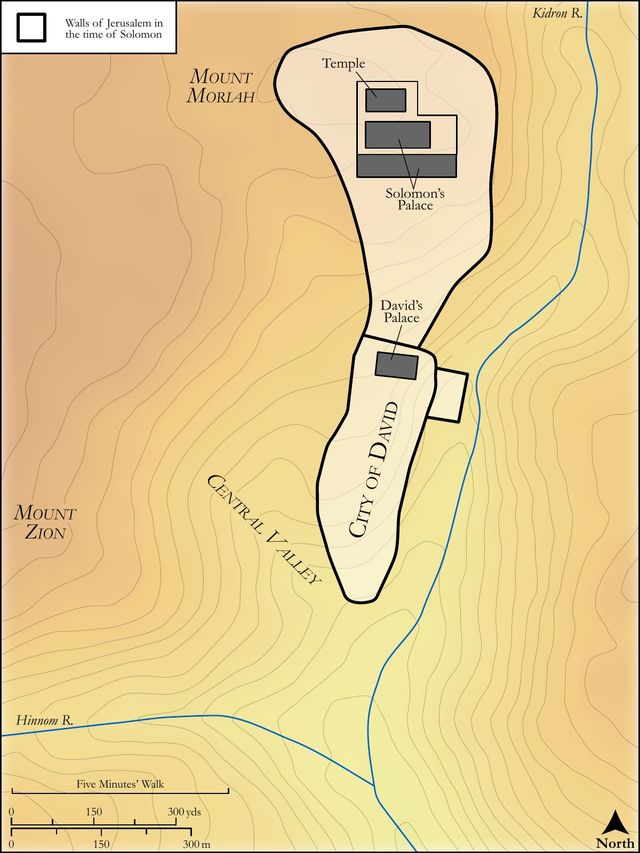
1.He confines him to Jerusalem, and forbids him, upon any pretence whatsoever, to go out of the city any further than the brook Kidron, Kg1 2:36, Kg1 2:37. He would suffer him to continue at his country seat lest he should make mischief among his neighbours, but took him to Jerusalem, where he kept him prisoner at large. This might make Shimei's confinement easy to himself, for Jerusalem was beautiful for situation, the joy of the whole earth, the royal city, the holy city (he had no reason to complain of being shut up in such a paradise); it would also make it the more safe for Solomon, for there he would have him under his eye and be able to watch his motions; and he plainly tells him that if he ever go out of the rules he shall certainly die for it. This was a fair trial of his obedience, and such a test of his loyalty as he had no reason to complain of. He has his life upon easy terms: he shall live if he will but be content to live at Jerusalem.
2.Shimei submits to the confinement, and thankfully takes his life upon those terms. He enters into recognizance (Kg1 2:38), under the penalty of death, not to stir out of Jerusalem, and owns that the saying is good. Even those that perish cannot but own the conditions of pardon and life unexceptionable, so that their blood, like Shimei's, must rest upon their own heads. Shimei promised, with an oath, to keep within his bounds, Kg1 2:42.
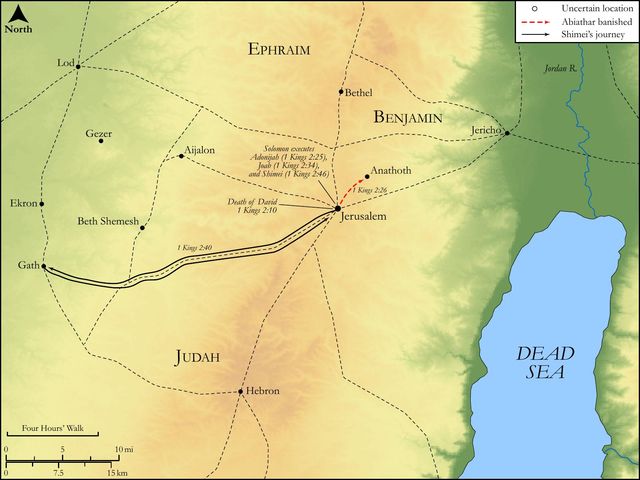
3.Shimei forfeits his recognizance, which was the thing Solomon expected; and God was righteous in suffering him to do it, that he might now suffer for his old sins. Two of his servants (it seems, though he was a prisoner, he lived like himself, well attended) ran from him to the land of the Philistines, Kg1 2:39. Thither he pursued them, and thence brought them back to Jerusalem, Kg1 2:40. For the keeping of it private he saddled his ass himself, probably went in the night, and came home he thought undiscovered. "Seeking his servants," says bishop Hall, "he lost himself; those earthly things either are, or should be, our servants. How commonly do we see men run out of the bounds set by God's law, to hunt after them, till their souls incur a fearful judgment!" 4. Solomon takes the forfeiture. Information is given him that Shimei has transgressed, Kg1 2:41. The king sends for him, and, (1.) charges him with the present crime (Kg1 2:42, Kg1 2:43), that he had put a great contempt upon the authority and wrath both of God and the king, that he had broken the oath of the Lord and disobeyed the commandment of his prince, and by this it appeared what manner of spirit he was of, that he would not be held by the bonds of gratitude or conscience. Had he represented to Solomon the urgency of the occasion, and begged leave to go, perhaps Solomon might have given him leave; but to presume either upon his ignorance or his connivance was to affront him in the highest degree. (2.) He condemns him for his former crime, cursing David, and throwing stones at him in the day of his affliction: The wickedness which thy heart is privy to, Kg1 2:44. There was no need to examine witnesses for the proof of the fact, his own conscience was instead of a thousand witnesses. That wickedness which men's own hearts alone are privy to is enough, if duly considered, to fill them with confusion, in expectation of its return upon their own heads; for if the heart be privy to it, God is greater than the heart and knoweth all things. Others knew of Shimei's cursing David, but Shimei himself knew of the wicked principles of hatred and malice against David which he displayed in cursing him and that his submission was but feigned and forced. (3.) He blessed himself and his government (Kg1 2:45.): King Solomon shall be blessed, notwithstanding Shimei's impotent curses, which perhaps, in fury and despair, he now vented freely: Let them curse, but bless thou. And the throne of David shall be established, by taking away those that would undermine it. It is a comfort, in reference to the enmity of the church's enemies, that, how much soever they rage, it is a vain thing they imagine. Christ's throne is established, and they cannot shake it. (4.) He gives orders for the execution of Shimei immediately, Kg1 2:46. All judgment is committed to the Lord Jesus, and, though he be King of peace, he will be found a King of righteousness; and this will shortly be his word of command concerning all his enemies, that would not have him to reign over them: Bring them forth, and slay them before me; the reproaches of those that blasphemed him will fall on themselves, to their eternal condemnation.
Historical interpretation
Historical reception
1 surviving comment on this verse from the historical church.
You can see here four people who were condemned by Solomon because they were guilty of treason: they all foreshadowed the Jewish nation’s ruin, which would derive from Christ’s unjust killing. Adonijah, who was appointed as king and was killed shortly later, was the first to presage the fall of the Jewish kingdom; then, after the abrogation of the priesthood of Aaron, Abiathar was expelled from his office; and Joab, who had the dignity of captain of the army, was deprived of his life by the leaders of the people and all his military force was destroyed. Finally, Shimei expressed in an even more evident and definitive manner the sin and punishment of the Jews, especially of the inhabitants of Jerusalem who blasphemed Christ and demanded his crucifixion. And that last prayer of Christ, like a supreme commandment, was postponed for four more decades and was not inflicted until the Jews were caught in a new crime when they persecuted the apostles and the other disciples of Christ.
Continue studying 1 Kings 2:44 across the web’s major study libraries — every link below opens this exact verse, chapter, or book on the destination site.
Read & Compare
 BibleGatewayThis verse in more than 200 translations and 70 languages.
 Bible.comThe YouVersion reader — hundreds of translations, reading plans, and highlights.
 ESV.orgCrossway's official English Standard Version reader.
 NET BibleThe NET translation with 60,000+ translators' notes on every rendering decision.
 STEP BibleTyndale House's free study tool — original text, vocabulary, and scholarly resources.
 BibliaLogos Bible Software's free web reader.
 USCCBThe New American Bible (Revised Edition) with the U.S. bishops' study notes.
Commentaries
 BibleHub CommentariesDozens of classic commentaries on this verse, gathered on one page.
 StudyLightMore than 100 commentary sets — the largest collection on the web.
 BibleRefPlain-English commentary on what this verse means, verse by verse.
 Enduring WordDavid Guzik's free commentary on this chapter, widely used by Bible teachers.
 Bible Study ToolsVerse commentary alongside Greek and Hebrew study aids.
Original Language & Research
- BibleHub InterlinearThe verse word by word — original language, transliteration, and English.
- BibleHub LexiconEvery word's original-language definition and Strong's entry.
 Blue Letter BibleDeep-study tools — Strong's numbers, concordance, and word studies.
 SefariaThe Hebrew text with Rashi and centuries of Jewish commentary.
Sermons, Hymns & Audio


TrulyRandomVerse is not affiliated with these sites and doesn’t control their content. They’re linked because they’re genuinely useful.
Summary
In 1 Kings 2:44, King Solomon confronts Shimei, asserting that Shimei's known wickedness against King David, Solomon's father, will now be divinely returned upon his own head. This pronouncement serves as a declaration of retributive justice, underscoring the principle that one's malevolent actions and intentions ultimately rebound upon the perpetrator, particularly in the context of Shimei's repeated disloyalty and his recent violation of a solemn oath to Solomon, thereby solidifying Solomon's reign and upholding the moral order of the kingdom.
Context
ShowHideLiterary Context
This verse is a pivotal moment in the systematic consolidation of King Solomon's power at the outset of his reign, fulfilling the solemn charge given to him by his dying father, David, to deal with those who had previously defied the Davidic dynasty (1 Kings 2:1-9). Prior to this confrontation, Solomon had already decisively dealt with other potential threats to his throne, including Adonijah, Joab, and Abiathar. Shimei's history with the Davidic house is long-standing, marked by his public cursing and stoning of King David during Absalom's rebellion (2 Samuel 16:5-13). Although David had sworn not to kill Shimei at that time, he had left instructions for Solomon to ensure that Shimei's wickedness would not go unpunished (1 Kings 2:8-9). Solomon had initially confined Shimei to Jerusalem under penalty of death if he departed (1 Kings 2:36-38). Shimei's deliberate violation of this oath by traveling to Gath to retrieve runaway servants (1 Kings 2:39-42) provided the immediate and undeniable justification for Solomon's final judgment, culminating in the declaration of divine retribution found in this verse.
Historical & Cultural Context
The ascension of a new monarch in that day was a critical period, frequently involving the elimination of rivals or those who posed a threat to the stability and legitimacy of the new regime. This was not merely personal vendetta but a strategic necessity to secure the throne and prevent future insurrections. In ancient Israel, oaths, especially those sworn before God, held immense legal and spiritual weight; breaking such an oath was considered a grave offense, inviting divine judgment. Shimei's initial actions against David were acts of treason against the Lord's anointed king, and his later violation of an oath to Solomon demonstrated a continued pattern of disloyalty and disregard for authority. Furthermore, the concept of "removing evil" or "blood guilt" from the land was a significant aspect of Israelite kingship, ensuring God's blessing and the purity of the kingdom. Solomon's actions, therefore, are presented within the framework of establishing righteous rule, upholding divine justice, and securing the Davidic covenant in a theocratic monarchy. His judgment against Shimei was a public demonstration of the consequences of defying God's chosen king and His established order.
Key Themes
ShowHideThis verse powerfully contributes to several overarching themes within 1 Kings and the broader biblical narrative. Firstly, it highlights the theme of Divine Justice and Retribution, affirming God's active role as a righteous judge who ensures that wickedness, particularly against His anointed, does not go unpunished indefinitely. Solomon's declaration, "the LORD shall return thy wickedness upon thine own head," emphasizes God's ultimate sovereignty over human affairs and His commitment to upholding His moral order, echoing the principle of sowing and reaping found throughout Scripture, as seen in Job 4:8 and Proverbs 26:27. Secondly, the passage underscores the Consequences of Treachery and Disobedience. Shimei's initial cursing of David and his subsequent breaking of a solemn oath to Solomon illustrate a persistent pattern of disloyalty and disregard for divine and human authority, ultimately leading to his downfall. His fate serves as a stark warning about the lasting impact of one's choices and the severe repercussions of violating sacred commitments. Lastly, the episode showcases Solomon's Wisdom and Authority in consolidating his reign. While severe, Solomon's handling of Shimei is portrayed as a necessary act to secure the kingdom's stability, fulfilling his father's charge and demonstrating his discernment in dealing with those whose hearts harbored ill will against the Davidic dynasty, thereby establishing his rule as described throughout 1 Kings 2.
Exposition and Analysis
ShowHideKey Word Analysis
ShowHideThis term, derived from H7451, is comprehensive, denoting "evil" in its broadest sense, encompassing both natural and moral badness. It refers to malice, mischief, calamity, and moral depravity. In Shimei's context, it specifically points to his malevolent actions and intentions against David, including his public cursing and stoning, and his underlying disloyalty. Solomon's use of "all the wickedness" signifies a full understanding of Shimei's character and accumulated transgressions, not just isolated incidents, highlighting the comprehensive nature of his guilt.
This primitive root means "to know," "to ascertain by seeing," "to perceive," or "to be acquainted with." When Solomon states "thine heart is privy to," he is emphasizing Shimei's internal, self-aware knowledge of his own guilt. It's an appeal to Shimei's conscience, indicating that Shimei himself was fully aware of the depth and nature of his wrongdoing against King David. This underscores the moral culpability that precedes the judgment, as Shimei could not claim ignorance of his own culpability.
This primitive root means "to turn back," "to return," or "to cause to return." In the phrase "the LORD shall return thy wickedness upon thine own head," shûwb signifies the active reversal or redirection of evil. It implies that the harm or malevolence initiated by Shimei will be divinely redirected back to him, ensuring that the consequences are borne by the perpetrator. This highlights the active and just intervention of the Lord in bringing about retribution.
Verse Breakdown
ShowHide"The king said moreover to Shimei"
This opening establishes Solomon's authoritative position and direct engagement. As the newly established king, he is exercising his judicial and executive power, personally addressing a critical lingering threat to the stability of his reign, a matter inherited from his father's final instructions.
"Thou knowest all the wickedness which thine heart is privy to, that thou didst to David my father"
Solomon's accusation is deeply personal and morally incisive. He appeals to Shimei's internal knowledge and self-awareness of his guilt, specifically recalling the profound treachery Shimei committed against King David, the anointed of the Lord. This primarily refers to Shimei's public cursing and assault of David during Absalom's rebellion (2 Samuel 16:5-13), an act of profound disrespect and disloyalty. Solomon emphasizes that Shimei's guilt is not merely perceived by others but is deeply known and acknowledged by Shimei himself within his own conscience.
"therefore the LORD shall return thy wickedness upon thine own head;"
This is the core pronouncement of judgment and divine retribution. Solomon declares that the ultimate consequence for Shimei's accumulated wickedness will come from the Lord Himself. This is not merely human vengeance but a divinely sanctioned act of justice, where the evil Shimei inflicted upon others, particularly the king, will now be justly repaid upon him. It invokes the principle of divine justice, assuring that God's moral order will be upheld and that the perpetrator will bear the full weight of their own actions.
Literary Devices
ShowHideThe passage employs several potent literary devices to convey its message of justice and consequence. Irony is powerfully evident in Shimei's fate: the one who cursed and sought ill for King David ultimately has that "wickedness" returned upon his own head. His attempts to undermine the Davidic dynasty boomerang back to destroy him. There is also an element of foreshadowing, as David's dying instructions to Solomon regarding Shimei (1 Kings 2:8-9) clearly hinted at this eventual outcome, setting the stage for Solomon's decisive action. The phrase "return thy wickedness upon thine own head" is a powerful idiom, a common expression in Hebrew literature that vividly conveys the concept of reaping what one sows or facing the consequences of one's own evil deeds. This idiom serves to emphasize the certainty and justice of the impending retribution. Finally, the narrative showcases Divine Retribution as a thematic and narrative force, portraying God's active involvement in ensuring justice and upholding the moral order, particularly in the context of His covenant with David and the establishment of the kingdom.
Theological and Thematic Connections
ShowHideThis verse profoundly articulates the biblical principle of divine justice and accountability. It underscores that God is not indifferent to human wickedness, particularly treachery against His anointed, and that unrepentant sin ultimately carries severe consequences. Shimei's fate is a vivid illustration of the truth that actions have spiritual and temporal repercussions, and that the evil one sows will eventually be reaped. While Solomon administers the immediate justice, the declaration that "the LORD shall return thy wickedness upon thine own head" elevates the judgment beyond mere human vengeance to a divinely ordained act. This assures believers that God sees all, knows the hidden motives of the heart, and will ultimately bring about righteousness, even if His justice seems delayed. It reinforces the understanding of God as a righteous judge who upholds His moral order in the world, ensuring that no wickedness escapes His notice or His ultimate reckoning.
Reflection and Application
ShowHideThe stark reality of Shimei's demise serves as a potent reminder of the gravity of our words, deeds, and the intentions of our hearts. Solomon's declaration that Shimei "knowest all the wickedness which thine heart is privy to" challenges us to engage in honest self-examination, acknowledging our own hidden sins and unconfessed transgressions. It highlights the futility of outward compliance without inward transformation, as Shimei's initial oath to Solomon proved to be merely superficial. Furthermore, this passage underscores the profound weight of oaths and promises, both to God and to others. Shimei's broken oath sealed his fate, emphasizing the seriousness with which God views faithfulness to one's word. For us, this calls for integrity, sincerity, and reliability in all our commitments, recognizing that our words carry weight before God and others. Ultimately, while we may not face immediate temporal judgment for every misstep, the principle that "the LORD shall return thy wickedness upon thine own head" assures us that God is just and that true righteousness will prevail. This should inspire us to live with a deep sense of accountability before God, trusting in His ultimate justice while striving to align our lives with His righteous standards, knowing that our actions have eternal implications.
Questions for Reflection
ShowHideFAQ
ShowHideWas Solomon's action against Shimei an act of vengeance or justice?
ShowHideWhile the outcome for Shimei was severe, Solomon's action is consistently presented in the biblical narrative as an act of justice rather than mere personal vengeance. Several factors support this view. First, Solomon was fulfilling a specific charge from his dying father, David, who had instructed him to deal with Shimei's past treachery judiciously (1 Kings 2:8-9). David, despite sparing Shimei's life initially, understood the deep-seated malice and potential threat he posed. Second, Shimei's initial offense was not just a personal insult but an act of treason against the Lord's anointed king during a time of national crisis (2 Samuel 16:5-13). Third, Solomon had given Shimei a clear opportunity to live under specific terms (confinement to Jerusalem) and Shimei had sworn a solemn oath to abide by them (1 Kings 2:36-38). Shimei knowingly and willingly broke this oath, sealing his own fate (1 Kings 2:39-42). Solomon's actions were part of consolidating his rightful reign and removing persistent threats to the stability and purity of the Davidic kingdom, ensuring that those who had acted wickedly against God's chosen king would face the consequences, thereby upholding divine justice and establishing peace in the kingdom.
What does "the LORD shall return thy wickedness upon thine own head" mean for believers today?
ShowHideFor believers today, this phrase encapsulates a fundamental truth about God's character and the moral order of the universe: God is just, and there are ultimate consequences for wickedness. It signifies that evil actions inherently carry a boomerang effect, eventually returning upon the perpetrator, whether in this life or the next. For those who are not in Christ, it serves as a stark warning of divine judgment and accountability for sin. However, for believers, this principle takes on a redemptive dimension. While we, too, are prone to wickedness, the good news of the Gospel is that Jesus Christ, the perfect Lamb of God, bore the full weight of our wickedness upon His own head on the cross. He became sin for us, so that we might become the righteousness of God in Him (2 Corinthians 5:21). Therefore, for those who trust in Christ, the ultimate, eternal consequence of their sin has been perfectly satisfied, and they stand forgiven and righteous before God. This truth does not negate the principle of sowing and reaping in daily life (Galatians 6:7), but it assures us that the eternal judgment for our "wickedness" has been fully absorbed by our Savior, offering us freedom from condemnation.
Christ-Centered Fulfillment
ShowHideThe declaration that "the LORD shall return thy wickedness upon thine own head" in 1 Kings 2:44 powerfully foreshadows the ultimate outworking of divine justice, yet it also highlights the profound grace found in Christ. Shimei's fate is a microcosm of humanity's deserved judgment: our own wickedness, of which our hearts are deeply privy, should justly return upon our own heads, leading to eternal separation from God. However, the Gospel reveals a magnificent reversal of this principle. Jesus Christ, the true and greater Son of David, did not have His own wickedness returned upon Him, for He was without sin, perfectly fulfilling all righteousness (Hebrews 4:15). Instead, in an act of unparalleled love and substitutionary atonement, the wickedness of all humanity was laid upon His head. He became the sin offering, the One upon whom the righteous wrath and judgment deserved by us were poured out on the cross (Isaiah 53:6, 2 Corinthians 5:21). Thus, while Shimei justly received the consequences of his own sin, believers in Christ receive the righteousness of God, because our King bore the consequences of our sin in our place, fulfilling the demands of divine justice and offering eternal life to all who believe (Romans 3:23-26). This is the ultimate triumph of God's justice and mercy, where the deserved judgment is satisfied not by the sinner, but by the Savior.