


1 Samuel 25:39
- וַיִּשְׁמַעvai·yish·Ma'and he heardH8085Conj-w ¦ V-Qal-ConsecImperf-3msVerb Qal Consecutive Imperfect 3rd Singular Masculineוַandיִּשְׁמַעhe heard
- דָּוִדda·VidDavidH1732N-proper-mNoun Proper Masculine
- כִּיkithatH3588PrtParticle Conditional
- מֵתmethe had diedH4191V-Qal-Perf-3msVerb Qal Perfect 3rd Singular Masculine
- נָבָלna·ValNabalH5037N-proper-mNoun Proper Masculine
- וַיֹּאמֶרvai·Yo·merand he saidH559Conj-w ¦ V-Qal-ConsecImperf-3msVerb Qal Consecutive Imperfect 3rd Singular Masculineוַandיֹּאמֶרhe said
- בָּרוּךְba·Rukh[be] blessedH1288V-Qal-PassPrtcpl-msVerb Qal Participle Passive Singular Masculine Absolute
- יְהוָהYah·wehYahwehH3068N-properNoun Proper Title
- אֲשֶׁר'a·SherwhoH834RelParticle Relative
- רָבravhe has conductedH7378V-Qal-Perf-3msVerb Qal Perfect 3rd Singular Masculine
- אֶת'et<obj.>H853DirObjMParticle Object Indicator
- רִיבriv[the] case ofH7379N-mscNoun Singular Masculine Construct
- חֶרְפָּתִיcher·pa·Timy disgraceH2781N-fsc ¦ 1csNoun Singular Feminine Constructחֶרְפָּתִdisgraceיmy
- מִיַּדmi·Yadfrom [the] hand ofH3027Prep-m ¦ N-cscNoun Singular common gender Constructמִfromיַּד[the] hand of
- נָבָלna·ValNabalH5037N-proper-mNoun Proper Masculine
- וְאֶתve·'Etand <obj.>H853Conj-w ¦ DirObjMParticle Object Indicatorוְandאֶת<obj.>
- עַבְדּוֹav·Dohis servantH5650N-msc ¦ 3msNoun Singular Masculine Constructעַבְדּservantוֹhis
- חָשַׂךְcha·Sakhhe has restrainedH2820V-Qal-Perf-3msVerb Qal Perfect 3rd Singular Masculine
- מֵרָעָהme·ra·'Ahfrom evilH7451Prep-m ¦ N-fsNoun Singular Feminine Absoluteמֵfromרָעָהevil
- וְאֵתve·'Etand <obj.>H853Conj-w ¦ DirObjMParticle Object Indicatorוְandאֵת<obj.>
- רָעַתra·'At[the] evil ofH7451N-fscNoun Singular Feminine Construct
- נָבָלna·ValNabalH5037N-proper-mNoun Proper Masculine
- הֵשִׁיבhe·Shivhe has turned backH7725V-Hiphil-Perf-3msVerb Hiphil Perfect 3rd Singular Masculine
- יְהוָהYah·wehYahwehH3068N-properNoun Proper Title
- בְּרֹאשׁוֹbe·ro·Shoon his own headH7218Prep-b ¦ N-msc ¦ 3msNoun Singular Masculine Constructבְּonרֹאשׁown headוֹhis
- וַיִּשְׁלַחvai·yish·Lachand he sentH7971Conj-w ¦ V-Qal-ConsecImperf-3msVerb Qal Consecutive Imperfect 3rd Singular Masculineוַandיִּשְׁלַחhe sent
- דָּוִדda·VidDavidH1732N-proper-mNoun Proper Masculine
- וַיְדַבֵּרvay·da·Berand he spokeH1696Conj-w ¦ V-Piel-ConsecImperf-3msVerb Piel Consecutive Imperfect 3rd Singular Masculineוַandיְדַבֵּרhe spoke
- בַּאֲבִיגַיִלba·'a·vi·Ga·yilwith AbigailH26Prep-b ¦ N-proper-fNoun Proper FeminineבַּwithאֲבִיגַיִלAbigail
- לְקַחְתָּהּle·kach·Tahto take herH3947Prep-l ¦ V-Qal-Inf ¦ 3fsVerb Qal Infinitive Constructלְtoקַחְתָּtakeהּher
- לוֹlofor <the> himselfPrep-l ¦ 3msSuffix Personal 3rd Singular Masculineלfor <the>וֹhimself
- לְאִשָּׁהle·'i·Shahto a wifeH802Prep-l ¦ N-fsNoun Singular Feminine Absoluteלְtoאִשָּׁהa wife
English is a literal word-by-word gloss of the Hebrew, not the KJV's wording. Why?
This is the original text the KJV's translators worked from — each Hebrew word with its own literal English meaning in this verse, prepared by scholars at Tyndale House, Cambridge. The KJV translates whole sentences, not word by word, so its wording differs: one Hebrew word can become several English words, and the KJV may choose “the LORD” where the gloss reads “Yahweh”. Both are faithful — they answer different questions. For the KJV's own rendering, switch to the KJV text.
Details
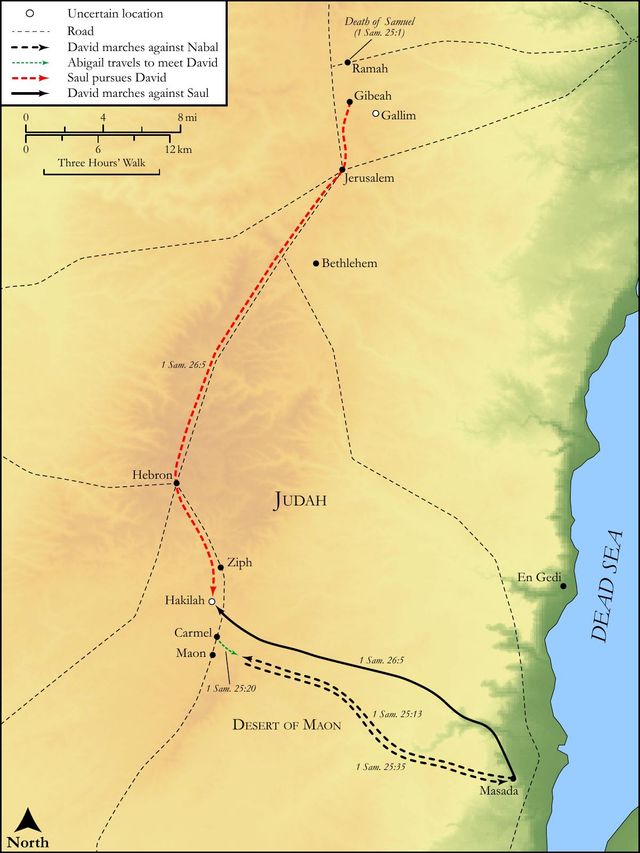
See on the biblical-era map
Study this verse
Public-domain commentary
Matthew Henry
From his Commentary on the Whole Bible. Henry comments on passages, not single verses — this entry covers 1 Samuel 25:36–44. His three-level outline is real structure in the source text, so it is rendered as structure.
We are now to attend Nabal's funeral and Abigail's wedding.
I.Nabal's funeral.
The apostle speaks of some that were twice dead, Jde 1:12. We have hare Nabal thrice dead, though but just now wonderfully rescued from the sword of David and delivered from so great a death; for the preservations of wicked men are but reservations for some further sorer strokes of divine wrath. Here is,
1.Nabal dead drunk, Sa1 25:36. Abigail came home, and, it should seem, he had so many people and so much plenty about him that he neither missed her nor the provisions she took to David; but she found him in the midst of his jollity, little thinking how near he was to ruin by one whom he had foolishly made his enemy. Sinners are often most secure when they are most in danger and destruction is at the door. Observe,
(1.)How extravagant he was in the entertainment of his company: He held a feast like the feast of a king, so magnificent and abundant, though his guests were but his sheep-shearers. This abundance might have been allowed if he had considered what God gave him his estate for, not to look great with, but to do good with. It is very common for those that are most niggardly in any act of piety or charity to be most profuse in gratifying a vain humour or a base lust. A mite is grudged to God and his poor; but, to make a fair show in the flesh, gold is lavished out of the bag. If Nabal had not answered to his name, he would never have been thus secure and jovial, till he had enquired whether he was safe from David's resentments; but (as bishop Hall observes) thus foolish are carnal men, that give themselves over to their pleasures before they have taken any care to make their peace with God.
(2.)How sottish he was in the indulgence of his own brutish appetite: He was very drunk, a sign he was Nabal, a fool, that could not use his plenty without abusing it, could not be pleasant with his friends without making a beast of himself. There is not a surer sign that a man has but little wisdom, nor a surer way to ruin the little he has, than drinking to excess. Nabal, that never thought he could bestow too little in charity, never thought he could bestow too much in luxury. Abigail, finding him in this condition (and probably those about him little better, when the master of the feast set them so bad an example), had enough to do to set the disordered house to-rights a little, but told Nabal nothing of what she had done with reference to David, nothing of his folly in provoking David, of his danger or of his deliverance, for, being drunk, he was as incapable to hear reason as he was to speak it. To give good advice to those that are in drink is to cast pearls before swine; it is better to stay till they are sober.
2.Nabal again dead with melancholy, Sa1 25:37. Next morning, when he had come to himself a little, his wife told him how near to destruction he had brought himself and his family by his own rudeness, and with what difficulty she had interposed to prevent it; and, upon this, his heart died within him and he became as a stone. Some suggest that the expense of the satisfaction made to David, by the present Abigail brought him, broke his heart: it seems rather that the apprehension he now had of the danger he had narrowly escaped put him into a consternation, and seized his spirits so that he could not recover it. He grew sullen, and said little, ashamed of his own folly, put out of countenance by his wife's wisdom. How is he changed! His heart over-night merry with wine, next morning heavy as a stone; so deceitful are carnal pleasures, so transient the laughter of the fool. The end of that mirth is heaviness. Drunkards are sometimes sad when they reflect upon their own folly. Joy in God makes the heart always light. Abigail could never, by her wise reasonings, bring Nabal to repentance; but now, by her faithful reproof, she brings him to despair.
3.Nabal, at last, dead indeed: About ten days after, when he had been kept so long under this pressure and pain, the Lord smote him that he died (Sa1 25:38), and, it should seem, he never held up his head; it is just with God (says bishop Hall) that those who live without grace should die without comfort, nor can we expect better while we go on in our sins. Here is no lamentation made for Nabal. He departed without being lamented. Every one wished that the country might never sustain a greater loss. David, when he heard the news of his death, gave God thanks for it, Sa1 25:39. He blessed God,
(1.)That he had kept him from killing him: Blessed be the lord, who hath kept his servant from evil. He rejoices that Nabal died a natural death and not by his hand. We should take all occasions to mention and magnify God's goodness to us in keeping us from sin.
(2.)That he had taken the work into his own hands, and had vindicated David's honour, and not suffered him to go unpunished who had been abusive to him; hereby his interest would be confirmed, and all would stand in awe of him, as one for whom God fought.
(3.)That he had thereby encouraged him and all others to commit their cause to God, when they are in any way injured, with an assurance that, in his own time, he will redress their wrongs if they sit still and leave the matter to him.
II.Abigail's wedding.
David was so charmed with the beauty of her person, and the uncommon prudence of her conduct and address, that, as soon as was convenient, after he heard she was a widow, he informed her of his attachment to her (Sa1 25:39), not doubting but that she who approved herself so good a wife to so bad a husband as Nabal would much more make a good wife to him, and having taken notice of her respect to him and her confidence of his coming to the throne.
1.He courted by proxy, his affairs, perhaps, not permitting him to come himself.
2.She received the address with great modesty and humility (Sa1 25:41), reckoning herself unworthy of the honour, yet having such a respect for him that she would gladly be one of the poorest servants of his family, to wash the feet of the other servants. None so fit to be preferred as those that can thus humble themselves.
3.She agreed to the proposal, went with his messenger, took a retinue with her agreeable to her quality, and she became his wife, Sa1 25:42. She did not upbraid him with his present distresses, and ask him how he could maintain her, but valued him,
(1.)Because she knew he was a very good man.
(2.)Because she believed he would, in due time, be a very great man. She married him in faith, not questioning but that, though now he had not a house of his own that he durst bring her to, yet God's promise go him would at length be fulfilled. Thus those who join themselves to Christ must be willing now to suffer with him, believing that hereafter they shall reign with him.
Lastly, On this occasion we have some account of David's wives. 1. One that he had lost before he married Abigail, Michal, Saul's daughter, his first, and the wife of his youth, to whom he would have been constant if she would have been so to him, but Saul had given her to another (Sa1 25:44), in token of his displeasure against him and disclaiming the relation of a father-in-law to him. 2. Another that he married besides Abigail (Sa1 25:43), and, as should seem, before her, for she is named first, Sa1 27:3. David was carried away by the corrupt custom of those times; but from the beginning it was not so, nor is it so now that Messias has come, and the times of reformation, Mat 19:4, Mat 19:5. Perhaps Saul's defrauding David of his only rightful wife was the occasion of his running into this irregularity; for, when the knot of conjugal affection is once loosed, it is scarcely ever tied fast again. When David could not keep his first wife he thought that would excuse him if he did not keep to his second. But we deceive ourselves if we think to make others' faults a cloak for our own.
Historical interpretation
Thirteen Centuries of Reception
3 surviving comments on this verse. Each one is dated, so this reads as a timeline rather than a list.
Select a marker to jump to its quote. Markers stagger vertically where authors wrote within a few decades of each other.
Having proved by Holy Scripture that all things are both watched and ruled by God, it remains now for me to show that most things in this world are judged by his divine power. When the holy David had borne the affronts and insults of Nabal from Carmel, because David delayed vengeance, he was avenged at once by the very hand of God. Shortly thereafter, when his enemy had been defeated and killed by the hand of God, David said, “Blessed be the Lord who has judged the cause of my reproach at the hand of Nabal.”
David therefore sent and spoke to Abigail. The Lord sent preachers, so that, with the Synagogue's perfidious leaders destroyed by the sword of the Romans with their followers, they might invite her, in the remnants that remained, to His spiritual marriage.
Blessed be: David praiseth God, on this occasion, not out of joy for the death of Nabal (which would have argued a rancour of heart), but because he saw that God had so visibly taken his cause in hand, in punishing the injury done to him; whilst, by a merciful providence he kept him from revenging himself.
Continue studying 1 Samuel 25:39 across the web’s major study libraries — every link below opens this exact verse, chapter, or book on the destination site.
Read & Compare
 BibleGatewayThis verse in more than 200 translations and 70 languages.
 Bible.comThe YouVersion reader — hundreds of translations, reading plans, and highlights.
 ESV.orgCrossway's official English Standard Version reader.
 NET BibleThe NET translation with 60,000+ translators' notes on every rendering decision.
 STEP BibleTyndale House's free study tool — original text, vocabulary, and scholarly resources.
 BibliaLogos Bible Software's free web reader.
 USCCBThe New American Bible (Revised Edition) with the U.S. bishops' study notes.
Commentaries
 BibleHub CommentariesDozens of classic commentaries on this verse, gathered on one page.
 StudyLightMore than 100 commentary sets — the largest collection on the web.
 BibleRefPlain-English commentary on what this verse means, verse by verse.
 Enduring WordDavid Guzik's free commentary on this chapter, widely used by Bible teachers.
 Bible Study ToolsVerse commentary alongside Greek and Hebrew study aids.
Original Language & Research
- BibleHub InterlinearThe verse word by word — original language, transliteration, and English.
- BibleHub LexiconEvery word's original-language definition and Strong's entry.
 Blue Letter BibleDeep-study tools — Strong's numbers, concordance, and word studies.
 SefariaThe Hebrew text with Rashi and centuries of Jewish commentary.
Sermons, Hymns & Audio


TrulyRandomVerse is not affiliated with these sites and doesn’t control their content. They’re linked because they’re genuinely useful.
Summary
1 Samuel 25:39 captures David's profound theological response to the news of Nabal's death, recognizing it as a direct act of divine justice and providential protection. David's immediate reaction is one of heartfelt blessing to the LORD, acknowledging God's personal intervention in vindicating him from Nabal's grievous insult and, crucially, restraining him from committing a sinful act of vengeance. This divinely orchestrated event not only demonstrates God's active sovereignty in human affairs but also clears the path for David to take Abigail, the wise and discerning woman who averted his wrath, as his wife, signifying both a divine reward for her righteousness and a further step in God's unfolding plan for David's kingship.
Context
ShowHideLiterary Context
This verse serves as the climactic resolution to the dramatic narrative of 1 Samuel 25, a pivotal interlude in David's wilderness years while fleeing King Saul. The preceding narrative establishes David's precarious position as a leader of outlaws who provided protection to Nabal's shepherds in exchange for customary provisions. Nabal, a wealthy but "churlish and evil" man (1 Samuel 25:3), insultingly refused David's request, provoking David's intense anger and his vow to annihilate Nabal and his entire household. It was Nabal's discerning wife, Abigail, who, without her husband's knowledge, intervened with generous provisions and a humble, eloquent appeal, thereby dissuading David from his vengeful course and preventing him from shedding innocent blood (1 Samuel 25:32-34). Upon hearing of Abigail's actions, Nabal suffered a stroke, his "heart died within him, and he became as a stone," dying about ten days later (1 Samuel 25:37-38). Verse 39, therefore, presents David's immediate, Spirit-led interpretation of Nabal's death and his subsequent, divinely-guided decision regarding Abigail, which further solidifies his emerging kingship and moral character.
Historical & Cultural Context
David's situation in 1 Samuel 25 vividly illustrates the realities of life for an outlaw leader in ancient Israel, operating on the fringes of settled society. David and his men functioned as a protective force, offering security to those whose flocks grazed in dangerous wilderness territories, a service for which reciprocal provisions were a customary and expected form of payment. Nabal's refusal was not merely impolite but a profound breach of social contract and a direct insult to David's honor and authority, which in that culture could indeed warrant a violent response to restore one's reputation. The narrative also highlights the patriarchal societal structure, where a woman like Abigail, despite her exceptional wisdom and discernment, had limited formal agency. Yet, through shrewd, respectful, and proactive action, she was able to significantly influence events. Her intervention, though seemingly subversive to herbal's authority, ultimately upheld a higher moral standard and prevented a bloodbath, demonstrating the significant, albeit often indirect, influence women could wield within their households and communities. David's subsequent marriage to Abigail was not only a personal choice but also a strategic move, integrating a woman of great wisdom and a substantial estate into his growing retinue, thereby bolstering his resources and legitimacy as a future king.
Key Themes
ShowHideThis chapter, and particularly this verse, powerfully illustrates several key themes central to the book of Samuel and the broader biblical narrative. Firstly, Divine Justice and Vindication are paramount, as God directly intervenes to right the wrong committed against David, demonstrating His active involvement in the affairs of His anointed. This aligns with the broader theme of God's faithfulness to His covenant promises, even when His chosen instruments (like David) are imperfect. Secondly, God's Preservation from Evil is profoundly evident, not only in protecting David from Nabal's malice but, more significantly, in restraining David from his own sinful impulse for vengeance. Abigail's role as God's instrument in this preservation underscores the theme of Providential Guidance, where God uses unexpected means and individuals to achieve His purposes and protect His servants from sin (Proverbs 16:9). Thirdly, the stark contrast between Nabal's foolishness and Abigail's wisdom highlights the Consequences of Ungodliness versus the Rewards of Discernment. Nabal's "wickedness" leads to his swift demise, while Abigail's humility and foresight are divinely honored, elevating her status and securing her future with the future king (Proverbs 11:2). This narrative further develops the theme of God's Anointed, showing how David, though flawed, is continually shaped and protected by God as he navigates the challenges of his pre-kingship period, preparing him for his destined role.
Exposition and Analysis
ShowHideKey Word Analysis
ShowHideThe Hebrew verb בָּרַךְ (bârak) means "to kneel; by implication to bless God (as an act of adoration), and (vice-versa) man (as a benefit)." In this context, David's utterance, "Blessed be the LORD," is an act of profound adoration and thanksgiving. It signifies David's recognition of God's sovereign power and goodness in orchestrating Nabal's demise and preventing David from sin. It is not merely an expression of relief but a theological declaration that God is worthy of praise for His righteous judgment and protective care.
The Hebrew verb רִיב (rîyb) means "to toss, i.e., grapple; mostly figuratively, to wrangle, i.e., hold a controversy; (by implication) to defend." When David states that the LORD "hath pleaded the cause of my reproach," it conveys the powerful image of God acting as David's advocate, judge, and defender. God did not merely observe the injustice Nabal inflicted upon David but actively engaged in the dispute, taking up David's legal and moral case and bringing about a just resolution on his behalf. This highlights God's personal and active involvement in vindicating His people.
The word חֶרְפָּה (cherpâh) signifies "contumely, disgrace, rebuke, or shame." Nabal's public refusal of hospitality and his contemptuous words were a profound "reproach" against David, a shaming act that threatened his honor and leadership. David's intense anger was a direct response to this deep sense of personal and communal disgrace. God's "pleading" of this cause means He effectively removed this shame, restoring David's dignity and honor through the swift and decisive judgment upon Nabal.
Verse Breakdown
ShowHide"And when David heard that Nabal was dead, he said, Blessed [be] the LORD,"
This opening clause establishes David's immediate and profoundly theological reaction to the news of Nabal's demise. His first response is not one of self-congratulation or vengeful satisfaction, but an outpouring of worship and blessing directed towards the LORD. This demonstrates David's consistent spiritual practice of acknowledging God's sovereign hand in all circumstances, attributing Nabal's death not to chance or natural causes alone, but to divine orchestration and righteous judgment.
"that hath pleaded the cause of my reproach from the hand of Nabal,"
David articulates the specific and deeply personal reason for his praise: God acted as his divine advocate. Nabal's insult was a direct "reproach" against David, a public shaming that threatened his honor and authority. David recognizes that God personally intervened to defend his reputation and right the egregious wrong committed by Nabal, executing justice on David's behalf and vindicating him in the eyes of all. This underscores God's active involvement in the lives of His servants, particularly when they are unjustly treated.
"and hath kept his servant from evil:"
This clause reveals David's profound gratitude for God's preserving grace and moral protection. David had been on the precipice of committing a terrible act of vengeance, intending to slaughter Nabal and his entire household, which would have resulted in significant bloodshed and sin. He recognizes that Nabal's death, orchestrated by God, prevented him from incurring great guilt. This highlights God's providential care, not only in protecting David from external threats but, more significantly, from his own sinful impulses, demonstrating God's commitment to preserving the moral integrity of His chosen one.
"for the LORD hath returned the wickedness of Nabal upon his own head."
This serves as the theological justification for David's praise and the explicit explanation for Nabal's death. It unequivocally states that Nabal's demise was divine retribution. The "wickedness" refers to Nabal's foolishness, arrogance, contempt, and refusal of hospitality. The idiom "returned... upon his own head" signifies that the evil Nabal propagated or intended ultimately recoiled upon him, becoming the direct instrument of his own destruction. This is a clear and powerful demonstration of God's just judgment against the unrighteous.
"And David sent and communed with Abigail, to take her to him to wife."
This final clause describes David's decisive and immediate action following Nabal's death. Having witnessed Abigail's exceptional wisdom, discernment, and her pivotal role in averting his sin, David promptly seeks her hand in marriage. This act serves as a divine reward for Abigail's righteous intervention and a strategically wise move for David, integrating a woman of great character, foresight, and likely considerable resources into his growing retinue, further preparing him for his future kingship and demonstrating God's blessing on his life.
Literary Devices
ShowHideThe passage employs several potent literary devices that enrich its meaning and impact. Irony is profoundly present, as Nabal, whose very name means "fool," ultimately succumbs to the consequences of his own foolishness and churlishness, while Abigail, his wise and discerning wife, is elevated to a position of honor as the wife of a future king. The wealth Nabal hoarded and selfishly refused to share becomes irrelevant upon his death, and his undervalued wife becomes a key figure in David's burgeoning kingdom. Divine Retribution is a central and explicitly stated theme, as David directly attributes Nabal's death to the LORD's action, "returning the wickedness of Nabal upon his own head." This emphasizes God's active and personal role as a just judge in human affairs. Furthermore, the narrative uses Juxtaposition to highlight the stark contrast between Nabal's churlishness, arrogance, and ungodliness, and Abigail's humility, wisdom, and peacemaking spirit. This contrast is further extended to David's initial vengeful impulse versus his ultimate restraint and reliance on divine intervention. The swift transition from Nabal's death to Abigail's marriage also serves as a form of Poetic Justice, where unrighteousness is swiftly punished and righteousness is divinely rewarded, all within the overarching framework of God's sovereign plan for David.
Theological and Thematic Connections
ShowHide1 Samuel 25:39 stands as a powerful testament to God's active and personal involvement in the lives of His people, particularly in matters of justice and preservation. It underscores the biblical principle that vengeance belongs to the LORD, and He will repay (Deuteronomy 32:35). David's recognition that God "pleaded the cause of my reproach" and "kept his servant from evil" illustrates divine vindication and providential grace, preventing His anointed from falling into grievous sin. This narrative serves as a practical demonstration of God's commitment to upholding righteousness and punishing wickedness, often in ways that are swift and unmistakable, reminding believers to trust in God's perfect timing and methods rather than taking matters into their own hands. It highlights that God's justice is not merely punitive but also redemptive, protecting His servants and advancing His purposes through both judgment and blessing.
Reflection and Application
ShowHideThis passage offers profound lessons for contemporary believers, particularly in how we respond to injustice, personal affronts, and the temptation for self-vindication. David's initial furious reaction to Nabal's insult, though culturally understandable, highlights the deeply human tendency to seek immediate revenge when wronged. However, God's intervention, first through Abigail's wise counsel and then through Nabal's death, demonstrates His sovereign ability to bring about justice and protect His servants from their own sinful impulses. This calls us to cultivate patience and profound trust in God's timing and methods, knowing with certainty that He sees every injustice and will ultimately vindicate His own. Furthermore, it reminds us of the profound grace that preserves us from evil, often through unexpected means or the wise counsel of others. We are called to be like Abigail, discerning, humble, and proactive in peacemaking, and like David, quick to acknowledge God's hand in our lives, giving Him praise for His justice and preserving grace, rather than indulging in self-righteous anger or seeking personal vengeance. This narrative encourages a posture of humble reliance on God's perfect justice and providential care in all circumstances.
Questions for Reflection
ShowHideFAQ
ShowHideDoes God still act like this today, bringing swift judgment upon those who wrong His people?
ShowHideWhile the Old Testament often depicts direct and immediate divine retribution, as seen with Nabal, the New Testament reveals a broader and more nuanced understanding of God's justice. God's character as a just judge remains eternally unchanged (Psalm 9:8), but His timing and methods of justice are often extended in the present age, allowing for repentance, or reserved for a future, ultimate judgment (Romans 2:5). Believers are explicitly commanded not to take vengeance into their own hands, but to "leave it to the wrath of God" (Romans 12:19). While God may still intervene providentially in individual lives to protect His servants or bring consequences for wickedness, these acts are not always as visibly dramatic or immediate as Nabal's death. The primary focus for believers in the New Covenant is to trust God's sovereignty, pray for justice, and live righteously, knowing that all wrongs will ultimately be set right, either through repentance and reconciliation or through divine judgment at the appointed time.
Christ-Centered Fulfillment
ShowHide1 Samuel 25:39, while detailing David's experience of divine vindication, powerfully foreshadows the ultimate justice and preservation found in Jesus Christ. David's recognition that the LORD "pleaded the cause of my reproach" points profoundly to Christ as our supreme Advocate and Defender. Just as God intervened to protect David from Nabal's insult and from his own vengeful sin, so too does Christ intercede for us, not merely pleading our cause but fully atoning for our sins on the cross, taking away our reproach and shame before a holy God (Hebrews 7:25; Colossians 2:14). Furthermore, David's acknowledgment that God "kept his servant from evil" finds its ultimate and perfect fulfillment in Christ, who not only delivers us from the power and penalty of sin but also preserves us daily through His Spirit from yielding to temptation and from the schemes of the evil one (Matthew 6:13; John 17:15). Nabal's swift demise as a consequence of his wickedness highlights the inescapable reality of divine judgment, a judgment fully borne by Christ on behalf of all who believe, allowing us to escape the wrath to come and receive eternal life (1 Thessalonians 1:10; John 3:16). Finally, Abigail's elevation from the wife of a fool to the wife of a king, a reward for her wisdom and peacemaking, beautifully illustrates the Church's spiritual union with Christ, the true King, through His wisdom and grace, as we are called to be His spotless bride, adorned with righteousness for His glory (Ephesians 5:25-27; Revelation 19:7-8).