


1 Samuel 24:15
- וְהָיָהve·ha·Yahand he will becomeH1961Conj-w ¦ V-Qal-ConsecPerf-3msVerb Qal Consecutive Perfect 3rd Singular Masculineוְandהָיָהhe will become
- יְהוָהYah·wehYahwehH3068N-properNoun Proper Title
- לְדַיָּןle·dai·Yan<into> a judgeH1781Prep-l ¦ N-msNoun Singular Masculine Absoluteלְ<into>דַיָּןa judge
- וְשָׁפַטve·sha·Fatand he will judgeH8199Conj-w ¦ V-Qal-ConsecPerf-3msVerb Qal Consecutive Perfect 3rd Singular Masculineוְandשָׁפַטhe will judge
- בֵּינִיbei·Nibetween meH996Adj-msc ¦ 1csAdjective Numerical Singular Masculine Constructבֵּינִbetweenיme
- וּבֵינֶךָu·vei·Ne·khaand between youH996Conj-w ¦ Adj-msc ¦ 2msAdjective Numerical Singular Masculine Constructוּandבֵינֶbetweenךָyou
- וְיֵרֶאve·Ye·re'and may he seeH7200Conj-w ¦ V-Qal-Imperf-3msVerb Qal Imperfect 3rd Singular Masculineוְandיֵרֶאmay he see
- וְיָרֵבve·ya·Revand may he conductH7378Conj-w ¦ V-Qal-Imperf-3msVerb Qal Imperfect 3rd Singular Masculineוְandיָרֵבmay he conduct
- אֶת'et<obj.>H853DirObjMParticle Object Indicator
- רִיבִיri·Vimy caseH7379N-msc ¦ 1csNoun Singular Masculine Constructרִיבִcaseיmy
- וְיִשְׁפְּטֵנִיve·yish·pe·Te·niand may he vindicate meH8199Conj-w ¦ V-Qal-ConjImperf-3ms ¦ 1csVerb Qal Conjunction+Imperfect 3rd Singular Masculineוְandיִשְׁפְּטֵmay he vindicateנִיme
- מִיָּדֶךָmi·ya·De·khafrom your handH3027Prep-m ¦ N-csc ¦ 2msNoun Singular common gender Constructמִfromיָּדֶhandךָyour
English is a literal word-by-word gloss of the Hebrew, not the KJV's wording. Why?
This is the original text the KJV's translators worked from — each Hebrew word with its own literal English meaning in this verse, prepared by scholars at Tyndale House, Cambridge. The KJV translates whole sentences, not word by word, so its wording differs: one Hebrew word can become several English words, and the KJV may choose “the LORD” where the gloss reads “Yahweh”. Both are faithful — they answer different questions. For the KJV's own rendering, switch to the KJV text.
Details
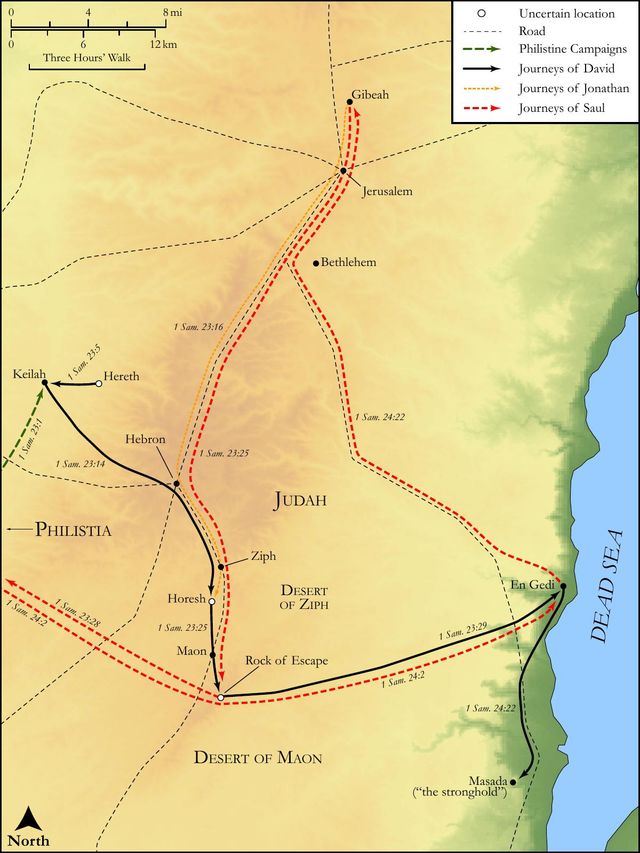
See on the biblical-era map
Study this verse
Public-domain commentary
Matthew Henry
From his Commentary on the Whole Bible. Henry comments on passages, not single verses — this entry covers 1 Samuel 24:9–15. His two-level outline is real structure in the source text, so it is rendered as structure.
We have here David's warm and pathetic speech to Saul, wherein he endeavours to convince him that he did him a great deal of wrong in persecuting him thus and to persuade him therefore to be reconciled.
I.He calls him father (Sa1 24:11), for he was not only, as king, the father of his country, but he was, in particular, his father-in-law.
From a father one may expect compassion and a favourable opinion. For a prince to seek the ruin of any of his good subjects is as unnatural as for a father to seek the ruin of his own children.
II.He lays the blame of his rage against him upon his evil counsellors:
Wherefore hearest thou men's words? Sa1 24:9. It is a piece of respect due to crowned heads, if they do amiss, to charge it upon those about them, who either advised them to it or should have advised them against it. David had reason enough to think that Saul persecuted him purely from his own envy and malice, yet he courteously supposes that others put him on to do it, and made him believe that David was his enemy and sought his hurt. Satan, the great accuser of the brethren, has his agents in all places, and particularly in the courts of those princes that encourage them and give ear to them, who make it their business to represent the people of God as enemies to Caesar and hurtful to kings and provinces, that, being thus dressed up in bear-skins, they may "be baited."
III.He solemnly protests his own innocence, and that he is far from designing any hurt or mischief to Saul:
"There is neither evil nor transgression in my hand, Sa1 24:11. I am not chargeable with any crime, nor conscious of any guilt, and, had I a window in my breast, thou mightest through it see the sincerity of my heart in this protestation: I have not sinned against thee (however I have sinned against God), yet thou huntest my soul," that is, "my life." Perhaps it was about this time that David penned the seventh psalm, concerning the affair of Cush the Benjamite (that is, Saul, as some think), wherein he thus appeals to God (Sa1 24:3-5): If there be iniquity in my hands, then let the enemy persecute my soul and take it, putting in a parenthesis, with reference to the story of this chapter, Yea, I have delivered him that without cause is my enemy.
IV.He produces undeniable evidence to prove the falsehood of the suggestion upon which Saul's malice against him was grounded.
David was charged with seeking Saul's hurt: "See," says he, "yea, see the skirt of thy robe, Sa1 24:11. Let this be a witness for me, and an unexceptionable witness it is; had that been true of which I am accused, I should now have had thy head in my hand and not the skirt of thy robe, for I could as easily have cut off that as this." To corroborate this evidence he shows him,
1.That God's providence had given him opportunity to do it: The lord delivered thee, very surprisingly, to day into my hand, whence many a one would have gathered an intimation that it was the will of God he should now give the determining blow to him whose neck lay so fair for it. When Saul had but a very small advantage against David he cried out, God has delivered him into my hand (Sa1 23:7), and resolved to make the best of that advantage; but David did not so.
2.That his counsellors and those about him had earnestly besought him to do it: Some bade me kill thee. He had blamed Saul for hearkening to men's words and justly; "for," says he, "if I had done so, thou wouldest not have been alive now." 3. That it was upon a good principle that he refused to do it; not because Saul's attendants were at hand, who, it may be, would have avenged his death; no, it was not by the fear of them, but by the fear of God, that he was restrained from it. "He is my lord, and the Lord's anointed, whom I ought to protect, and to whom I owe faith and allegiance, and therefore I said, I will not touch a hair of his head." Such a happy command he had of himself that his nature, in the midst of the greatest provocation, was not suffered to rebel against his principles.
V.He declares it to be his fixed resolution never to be his own avenger:
"The Lord avenge me of thee, that is, deliver me out of thy hand; but, whatever comes of it, my hand shall not be upon thee" (Sa1 24:12), and again (Sa1 24:13), for saith the proverb of the ancients, Wickedness proceedeth from the wicked. The wisdom of the ancients is transmitted to posterity by their proverbial sayings. Many such we receive by tradition from our fathers; and the counsels of common persons are very much directed by this, "As the old saying is." Here is one that was in use in David's time: Wickedness proceedeth from the wicked, that is,
1.Men's own iniquity will ruin them at last, so some understand it. Forward furious men will cut their own throats with their own knives. Give them rope enough, and they will hang themselves. In this sense it comes in very fitly as a reason why his hand should not be upon him.
2.Bad men will do bad things; according as men's principles and dispositions are, so will their actions be. This also agrees very well with the connexion. If David had been a wicked man, as he was represented, he would have done this wicked thing; but he durst not, because of the fear of God. Or thus: Whatever injuries bad men do us (which we are not to wonder at; he that lies among thorns must expect to be scratched), yet we must not return them; never render railing for railing. Though wickedness proceed from the wicked, yet let it not therefore proceed from us by way of retaliation. Though the dog bark at the sheep, the sheep does not bark at the dog. See Isa 32:6-8.
VI.He endeavours to convince Saul that as it was a bad thing, so it was a mean thing, for him to give chase to such an inconsiderable person as he was (Sa1 24:14): Whom does the king of Israel pursue with all this care and force? A dead dog; a flea; one flea, so it is in the Hebrew. It is below so great a king to enter the lists with one that is so unequal a match for him, one of his own servants, bred a poor shepherd, now an exile, neither able nor willing to make any resistance. To conquer him would not be to his honour, to attempt it was his disparagement. If Saul would consult his own reputation, he would slight such an enemy (supposing he were really his enemy) and would think himself in no danger from him. David was so far from aspiring that he was, in his own account, as a dead dog. Mephibosheth thus calls himself, Sa2 9:8. This humble language would have wrought upon Saul if he had had any spark of generosity in him. Satis est prostrsse leoni - Enough for the lion that he has laid his victim low. What credit would it be to Saul to trample upon a dead dog? What pleasure could it be to him to hunt a flea, a single flea, which (as some have observed), if it be sought, is not easily found, if it be found, is not easily caught, and, if it be caught, is a poor prize, especially for a prince. Aquila non captat muscas - The eagle does not dart upon flies. David thinks Saul had no more reason to fear him than to fear a flea-bite.
VII.He once and again appeals to God as the righteous Judge (Sa1 24:12 and Sa1 24:15):
The Lord judge between me and thee. Note, The justice of God is the refuge and comfort of oppressed innocence. If men wrong us, God will right us, at furthest, in the judgment of the great day. With him David leaves his cause, and so rests satisfied, waiting his time to appear for him.
Continue studying 1 Samuel 24:15 across the web’s major study libraries — every link below opens this exact verse, chapter, or book on the destination site.
Read & Compare
 BibleGatewayThis verse in more than 200 translations and 70 languages.
 Bible.comThe YouVersion reader — hundreds of translations, reading plans, and highlights.
 ESV.orgCrossway's official English Standard Version reader.
 NET BibleThe NET translation with 60,000+ translators' notes on every rendering decision.
 STEP BibleTyndale House's free study tool — original text, vocabulary, and scholarly resources.
 BibliaLogos Bible Software's free web reader.
 USCCBThe New American Bible (Revised Edition) with the U.S. bishops' study notes.
Commentaries
 BibleHub CommentariesDozens of classic commentaries on this verse, gathered on one page.
 StudyLightMore than 100 commentary sets — the largest collection on the web.
 BibleRefPlain-English commentary on what this verse means, verse by verse.
 Enduring WordDavid Guzik's free commentary on this chapter, widely used by Bible teachers.
 Bible Study ToolsVerse commentary alongside Greek and Hebrew study aids.
Original Language & Research
- BibleHub InterlinearThe verse word by word — original language, transliteration, and English.
- BibleHub LexiconEvery word's original-language definition and Strong's entry.
 Blue Letter BibleDeep-study tools — Strong's numbers, concordance, and word studies.
 SefariaThe Hebrew text with Rashi and centuries of Jewish commentary.
Sermons, Hymns & Audio


TrulyRandomVerse is not affiliated with these sites and doesn’t control their content. They’re linked because they’re genuinely useful.
Summary
David, having mercifully spared King Saul's life in the cave at Engedi, passionately appeals to God as the ultimate arbiter between himself and the pursuing monarch. This verse encapsulates David's profound trust in divine justice, his unwavering commitment to God's sovereignty, and his principled refusal to take personal vengeance, even when presented with a clear opportunity to eliminate his chief adversary. It is a powerful declaration of innocence and a solemn petition for God to intervene, vindicate David's cause, and deliver him from Saul's relentless hand, demonstrating a deep theological understanding of God's role as the righteous Judge.
Context
ShowHideLiterary Context
This verse serves as the powerful culmination of David's poignant appeal to Saul following the dramatic encounter in the cave of Engedi, as detailed in 1 Samuel 24. Saul, in his relentless and paranoid pursuit of David, unknowingly enters the very cave where David and his men are hiding. Despite his men's urging to seize this providential opportunity to kill Saul, David steadfastly refuses, citing Saul's sacred status as "the LORD's anointed." Instead, David secretly cuts off a corner of Saul's robe, a symbolic act demonstrating his ability to harm Saul but choosing not to. After Saul leaves the cave, David reveals himself, calling out to Saul and demonstrating his profound respect for the king's office and his own innocence by presenting the robe fragment. David's subsequent speech, culminating in this verse, is a heartfelt plea for Saul to recognize his loyalty and for God to intervene as the ultimate judge, thereby resolving the conflict without further bloodshed initiated by David. This act of mercy and profound trust in divine justice stands in stark contrast to Saul's escalating paranoia and vengeful pursuit, setting the stage for the ongoing tension between the two men and highlighting David's moral superiority.
Historical & Cultural Context
In ancient Israel, the concept of divine judgment was foundational to their understanding of justice, governance, and the very nature of God. Kings were seen as God's chosen representatives, and to harm "the LORD's anointed" was considered an affront to God Himself, a violation of sacred covenant. While blood feuds were common in the ancient Near East, where personal vengeance was often expected and practiced to right wrongs, the Mosaic Law, while providing for a system of justice, also laid the groundwork for divine oversight and the eventual prohibition of personal retaliation, reserving ultimate vengeance for God alone (e.g., Deuteronomy 32:35). David's appeal to God as judge reflects this theological understanding, moving beyond tribal retaliation to a higher, divine court. Geographically, Engedi was a rugged wilderness stronghold, a place of refuge for David, highlighting his vulnerable position despite his moral high ground. The interaction reveals the complex dynamics of power, loyalty, and divine anointing within a nascent monarchy, where the lines of authority and divine will were constantly being negotiated.
Key Themes
ShowHideThe passage powerfully underscores several key themes prevalent throughout 1 Samuel and the broader biblical narrative. Central is the theme of Divine Sovereignty and Justice, as David explicitly places his fate and the resolution of the conflict into God's hands, trusting that the Lord will "judge" and "plead [his] cause." This highlights a profound belief that God actively intervenes in human affairs to bring about righteousness and vindicate the innocent. Closely related is the theme of Refusal of Personal Vengeance, a hallmark of David's character in this narrative, contrasting sharply with Saul's vengeful pursuits. David's restraint, even when empowered to act, foreshadows later biblical teachings on overcoming evil with good, as seen in Romans 12:19-21. Furthermore, the passage explores the Nature of True Leadership, demonstrating David's integrity, his reliance on God's timing and methods, and his profound respect for God's anointed, rather than worldly power or cunning. It also touches upon God's Protection and Deliverance for those who trust in Him, as David anticipates God will "deliver me out of thine hand," despite his current perilous situation, illustrating God's faithfulness to those who walk in integrity.
Exposition and Analysis
ShowHideKey Word Analysis
ShowHideThe Hebrew verb שָׁפַט (shâphaṭ, H8199) is a rich term meaning more than simply to make a legal decision. It encompasses the roles of governing, ruling, vindicating, punishing, and bringing about justice. When David asks the LORD to "be judge" and "judge between me and thee," he is not merely asking for an assessment of the situation but for God to actively intervene as the supreme ruler and arbiter, to govern the outcome, and to execute justice by vindicating David and punishing Saul's unrighteous pursuit. It implies a dynamic and active role for God in the affairs of men, encompassing both judicial pronouncement and executive action. This same verb is also used for "deliver" in the KJV text, indicating that David's deliverance from Saul's hand is understood as a judicial act of God, a vindication and setting free.
The Hebrew verb רִיב (rîyb, H7378) refers to engaging in a legal dispute, contending, or striving. David is essentially asking God to act as his advocate or defender in a divine courtroom, to take up his legal case against Saul. This is a petition for God to contend on David's behalf, to argue his innocence, and to demonstrate the righteousness of his actions and the unrighteousness of Saul's. It's a prayer for divine legal representation and intervention, where God Himself will actively champion David's cause against his adversary.
The Hebrew noun יָד (yâd, H3027) literally means "hand," but is used extensively in a figurative sense to denote power, authority, control, or means. When David prays for God to "deliver me out of thine hand," he is asking to be freed from Saul's oppressive power, his destructive control, and his relentless pursuit. It signifies David's complete vulnerability to Saul's physical and political might, and his desperate need for divine intervention to extricate him from a situation where Saul's "hand" threatens his very life and future.
Verse Breakdown
ShowHide"The LORD therefore be judge, and judge between me and thee"
David begins by formally appointing God as the ultimate arbiter in the dispute between himself and Saul. This is a profound declaration of faith, acknowledging God's supreme authority, perfect righteousness, and comprehensive knowledge. It signifies David's surrender of personal retaliation, placing the entire legal and moral dispute into the divine court. He is asking God to discern the truth of the matter, to weigh the actions of both parties, and to render a righteous verdict. The repetition of "judge" emphasizes the certainty and completeness of God's judicial role.
"and see, and plead my cause"
David further specifies God's active role, asking Him not only to judge but also to "see" (implying full knowledge and understanding of the situation, including Saul's unjust actions and David's innocence, from God's omniscient perspective) and to "plead my cause." This is a request for divine advocacy, for God to actively defend David's position and to contend against Saul's accusations and actions on David's behalf. It highlights David's conviction that his cause is just and that God, who sees all, will confirm this and act as his legal champion.
"and deliver me out of thine hand"
The final clause expresses David's ultimate hope and petition: deliverance. He is asking God to rescue him from Saul's power, control, and destructive intentions. As noted in the Key Word Analysis, the Hebrew verb for "deliver" here (H8199, shâphaṭ) implies a judicial act of setting free or vindicating. Thus, David is praying for God not only to declare him innocent but also to actively intervene through a righteous judgment that results in his physical salvation and freedom from Saul's persecution. It underscores David's complete dependence on God for his preservation and vindication.
Literary Devices
ShowHide1 Samuel 24:15 is rich in Rhetorical Appeal, as David directly addresses Saul while simultaneously making a profound appeal to God, demonstrating his integrity before both human and divine audiences. This dual address serves to underscore David's innocence to Saul and to declare his ultimate trust in divine justice. The verse employs powerful Parallelism, particularly in the repetition of "judge" and the series of verbs ("be judge," "judge," "see," "plead," "deliver"), which emphasizes the multi-faceted and comprehensive role David expects God to play in his vindication. There is a strong element of Trust Motif, where David's entire plea is predicated on his unwavering faith in God's active involvement in human affairs and His commitment to justice. Furthermore, the verse functions as a Solemn Oath or Imprecation, a formal invocation of God to settle a dispute, akin to an ancient legal procedure where God is called upon as the supreme witness and enforcer of truth. The language is direct, personal, and emotionally resonant, creating a powerful and memorable declaration of David's character and his profound reliance on the divine.
Theological and Thematic Connections
ShowHideDavid's appeal in 1 Samuel 24:15 resonates deeply with the biblical understanding of God as the righteous Judge of all the earth. It demonstrates a profound theological conviction that ultimate justice does not rest in human hands or retaliatory acts, but in the sovereign will and perfect judgment of the Almighty. This posture of surrendering one's cause to God, rather than seeking personal vengeance, is a recurring theme throughout Scripture, emphasizing trust in God's timing and methods for vindication. David's actions here establish a precedent for righteous conduct in the face of injustice, illustrating that true strength lies not in wielding power for personal gain or retribution, but in humble reliance on divine intervention. This commitment to God's justice foreshadows the New Testament call for believers to forgive and to leave vengeance to the Lord, trusting in His ultimate reckoning, knowing that He will repay.
Reflection and Application
ShowHideDavid's declaration in 1 Samuel 24:15 offers a timeless and profound model for believers facing injustice, false accusation, or relentless opposition. In a world where the impulse for immediate retribution often prevails, David's example calls us to a higher standard: to commit our cause entirely to God. This requires immense faith and self-control, trusting that God sees all, knows all, and will act in His perfect timing to bring about justice and vindication. It challenges us to resist the temptation to take matters into our own hands, to harbor bitterness, or to plot revenge, even when we have the opportunity to "get even." Instead, we are invited to cultivate a heart of integrity, knowing that our blameless conduct before God and others is a powerful testimony to His transforming grace. By surrendering our desire for personal vindication, we free ourselves from the burden of carrying grudges and open the way for God to work on our behalf, demonstrating His faithfulness and righteousness in ways far beyond our own capabilities. This verse encourages us to live with a clear conscience, confident that our ultimate defender and deliverer is the Lord Himself, who will always judge righteously.
Questions for Reflection
ShowHideFAQ
ShowHideWhy did David not kill Saul when he had the chance?
ShowHideDavid explicitly states his reason in 1 Samuel 24:6: "The LORD forbid that I should do this thing unto my master, the LORD's anointed, to stretch forth mine hand against him, seeing he is the anointed of the LORD." David understood that Saul, despite his unrighteous actions and relentless pursuit, was still God's chosen king, divinely appointed and consecrated. To lay a hand on Saul would be to directly oppose God's sovereign choice and His sacred anointing. David believed that if God intended to remove Saul from the throne, God would do so in His own way and time, without David's sinful intervention. This demonstrates David's deep reverence for God's authority and His sacred institutions, even when it meant personal suffering.
Does "The LORD therefore be judge" mean David was passive and did nothing?
ShowHideNo, it does not imply passivity. While David refrained from personal vengeance or violence against Saul, he was far from passive. He actively appealed to Saul, presenting tangible evidence of his innocence (the cut robe fragment), and then made this solemn, public appeal to God. David was actively trusting God to intervene, to "plead his cause," and to "deliver" him through a righteous judgment. This is an act of profound faith and strategic reliance on divine justice, not resignation or apathy. David was active in maintaining his integrity, declaring his innocence, and entrusting the ultimate outcome to God's sovereign hand, demonstrating a mature and godly response to persecution.
Christ-Centered Fulfillment
ShowHideDavid's appeal to God as the ultimate judge and his profound refusal to take vengeance on Saul find their ultimate and most profound fulfillment in the person and work of Jesus Christ. Just as David, the innocent one, was unjustly pursued, slandered, and sought for death, so too was Christ, the perfectly righteous Son of God, relentlessly persecuted, falsely accused, and ultimately crucified by those He came to save. Yet, in the face of unimaginable injustice and suffering, Jesus did not retaliate; He did not call down legions of angels (Matthew 26:53). Instead, He "committed himself to him that judgeth righteously" (1 Peter 2:23), entrusting His cause entirely to the Father. Like David, Christ knew that God would ultimately vindicate Him through the glorious resurrection (Acts 2:24) and exalt Him to the highest place (Philippians 2:9-11). Furthermore, Christ is not only the vindicated innocent but also the appointed Judge of all humanity (John 5:22), the one who will truly "judge between me and thee," perfectly discerning every heart and bringing forth ultimate justice. Thus, David's plea for divine judgment foreshadows the righteous judgment of Christ and serves as a powerful testament to the New Covenant principle that vengeance belongs to the Lord, who will repay (Romans 12:19), and that believers are called to follow Christ's example of suffering righteously and entrusting their vindication to God.