


1 Samuel 24:9
Bible text: King James Version (1769 Blayney text) · Public domain
Bible text: Berean Standard Bible · Public domain
Bible text: American Standard Version (1901) · Public domain
Bible text: World English Bible, Messianic edition · Public domain
Bible text: Geneva Bible (1599) · Public domain
Bible text: Young's Literal Translation · Public domain
- וַיֹּאמֶרvai·Yo·merand he saidH559Conj-w ¦ V-Qal-ConsecImperf-3msVerb Qal Consecutive Imperfect 3rd Singular Masculineוַandיֹּאמֶרhe said
- דָּוִדda·VidDavidH1732N-proper-mNoun Proper Masculine
- לְשָׁאוּלle·sha·'Ulto SaulH7586Prep-l ¦ N-proper-mNoun Proper MasculineלְtoשָׁאוּלSaul
- לָמָּהLa·mah<to> why?H4100Prep-l ¦ InterrogPronoun Interrogativeלָ<to>מָּהwhy?
- תִשְׁמַעtish·Ma'do you listen toH8085V-Qal-Imperf-2msVerb Qal Imperfect 2nd Singular Masculine
- אֶת'et<obj.>H853DirObjMParticle Object Indicator
- דִּבְרֵיdiv·Rei[the] words ofH1697N-mpcNoun Plural Masculine Construct
- אָדָם'a·DamsomeoneH120N-msNoun Singular Masculine Absolute
- לֵאמֹרle·Mor<to> sayingH559Prep-l ¦ V-Qal-InfVerb Qal Infinitive Constructלֵ<to>אמֹרsaying
- הִנֵּהhi·Nehthere!H2009PrtParticle Interjection
- דָוִדda·VidDavidH1732N-proper-mNoun Proper Masculine
- מְבַקֵּשׁme·va·Kesh[is] seekingH1245V-Piel-Prtcpl-msVerb Piel Participle Singular Masculine Absolute
- רָעָתֶךָra·'a·Te·khayour harmH7451N-fsc ¦ 2msNoun Singular Feminine Constructרָעָתֶharmךָyour
English is a literal word-by-word gloss of the Hebrew, not the KJV's wording. Why?
This is the original text the KJV's translators worked from — each Hebrew word with its own literal English meaning in this verse, prepared by scholars at Tyndale House, Cambridge. The KJV translates whole sentences, not word by word, so its wording differs: one Hebrew word can become several English words, and the KJV may choose “the LORD” where the gloss reads “Yahweh”. Both are faithful — they answer different questions. For the KJV's own rendering, switch to the KJV text.
Details
See on the biblical-era map
Study this verse
Public-domain commentary
Matthew Henry
From his Commentary on the Whole Bible. Henry comments on passages, not single verses — this entry covers 1 Samuel 24:9–15. His two-level outline is real structure in the source text, so it is rendered as structure.
We have here David's warm and pathetic speech to Saul, wherein he endeavours to convince him that he did him a great deal of wrong in persecuting him thus and to persuade him therefore to be reconciled.
I.He calls him father (Sa1 24:11), for he was not only, as king, the father of his country, but he was, in particular, his father-in-law.
From a father one may expect compassion and a favourable opinion. For a prince to seek the ruin of any of his good subjects is as unnatural as for a father to seek the ruin of his own children.
II.He lays the blame of his rage against him upon his evil counsellors:
Wherefore hearest thou men's words? Sa1 24:9. It is a piece of respect due to crowned heads, if they do amiss, to charge it upon those about them, who either advised them to it or should have advised them against it. David had reason enough to think that Saul persecuted him purely from his own envy and malice, yet he courteously supposes that others put him on to do it, and made him believe that David was his enemy and sought his hurt. Satan, the great accuser of the brethren, has his agents in all places, and particularly in the courts of those princes that encourage them and give ear to them, who make it their business to represent the people of God as enemies to Caesar and hurtful to kings and provinces, that, being thus dressed up in bear-skins, they may "be baited."
III.He solemnly protests his own innocence, and that he is far from designing any hurt or mischief to Saul:
"There is neither evil nor transgression in my hand, Sa1 24:11. I am not chargeable with any crime, nor conscious of any guilt, and, had I a window in my breast, thou mightest through it see the sincerity of my heart in this protestation: I have not sinned against thee (however I have sinned against God), yet thou huntest my soul," that is, "my life." Perhaps it was about this time that David penned the seventh psalm, concerning the affair of Cush the Benjamite (that is, Saul, as some think), wherein he thus appeals to God (Sa1 24:3-5): If there be iniquity in my hands, then let the enemy persecute my soul and take it, putting in a parenthesis, with reference to the story of this chapter, Yea, I have delivered him that without cause is my enemy.
IV.He produces undeniable evidence to prove the falsehood of the suggestion upon which Saul's malice against him was grounded.
David was charged with seeking Saul's hurt: "See," says he, "yea, see the skirt of thy robe, Sa1 24:11. Let this be a witness for me, and an unexceptionable witness it is; had that been true of which I am accused, I should now have had thy head in my hand and not the skirt of thy robe, for I could as easily have cut off that as this." To corroborate this evidence he shows him,
1.That God's providence had given him opportunity to do it: The lord delivered thee, very surprisingly, to day into my hand, whence many a one would have gathered an intimation that it was the will of God he should now give the determining blow to him whose neck lay so fair for it. When Saul had but a very small advantage against David he cried out, God has delivered him into my hand (Sa1 23:7), and resolved to make the best of that advantage; but David did not so.
2.That his counsellors and those about him had earnestly besought him to do it: Some bade me kill thee. He had blamed Saul for hearkening to men's words and justly; "for," says he, "if I had done so, thou wouldest not have been alive now." 3. That it was upon a good principle that he refused to do it; not because Saul's attendants were at hand, who, it may be, would have avenged his death; no, it was not by the fear of them, but by the fear of God, that he was restrained from it. "He is my lord, and the Lord's anointed, whom I ought to protect, and to whom I owe faith and allegiance, and therefore I said, I will not touch a hair of his head." Such a happy command he had of himself that his nature, in the midst of the greatest provocation, was not suffered to rebel against his principles.
V.He declares it to be his fixed resolution never to be his own avenger:
"The Lord avenge me of thee, that is, deliver me out of thy hand; but, whatever comes of it, my hand shall not be upon thee" (Sa1 24:12), and again (Sa1 24:13), for saith the proverb of the ancients, Wickedness proceedeth from the wicked. The wisdom of the ancients is transmitted to posterity by their proverbial sayings. Many such we receive by tradition from our fathers; and the counsels of common persons are very much directed by this, "As the old saying is." Here is one that was in use in David's time: Wickedness proceedeth from the wicked, that is,
1.Men's own iniquity will ruin them at last, so some understand it. Forward furious men will cut their own throats with their own knives. Give them rope enough, and they will hang themselves. In this sense it comes in very fitly as a reason why his hand should not be upon him.
2.Bad men will do bad things; according as men's principles and dispositions are, so will their actions be. This also agrees very well with the connexion. If David had been a wicked man, as he was represented, he would have done this wicked thing; but he durst not, because of the fear of God. Or thus: Whatever injuries bad men do us (which we are not to wonder at; he that lies among thorns must expect to be scratched), yet we must not return them; never render railing for railing. Though wickedness proceed from the wicked, yet let it not therefore proceed from us by way of retaliation. Though the dog bark at the sheep, the sheep does not bark at the dog. See Isa 32:6-8.
VI.He endeavours to convince Saul that as it was a bad thing, so it was a mean thing, for him to give chase to such an inconsiderable person as he was (Sa1 24:14): Whom does the king of Israel pursue with all this care and force? A dead dog; a flea; one flea, so it is in the Hebrew. It is below so great a king to enter the lists with one that is so unequal a match for him, one of his own servants, bred a poor shepherd, now an exile, neither able nor willing to make any resistance. To conquer him would not be to his honour, to attempt it was his disparagement. If Saul would consult his own reputation, he would slight such an enemy (supposing he were really his enemy) and would think himself in no danger from him. David was so far from aspiring that he was, in his own account, as a dead dog. Mephibosheth thus calls himself, Sa2 9:8. This humble language would have wrought upon Saul if he had had any spark of generosity in him. Satis est prostrsse leoni - Enough for the lion that he has laid his victim low. What credit would it be to Saul to trample upon a dead dog? What pleasure could it be to him to hunt a flea, a single flea, which (as some have observed), if it be sought, is not easily found, if it be found, is not easily caught, and, if it be caught, is a poor prize, especially for a prince. Aquila non captat muscas - The eagle does not dart upon flies. David thinks Saul had no more reason to fear him than to fear a flea-bite.
VII.He once and again appeals to God as the righteous Judge (Sa1 24:12 and Sa1 24:15):
The Lord judge between me and thee. Note, The justice of God is the refuge and comfort of oppressed innocence. If men wrong us, God will right us, at furthest, in the judgment of the great day. With him David leaves his cause, and so rests satisfied, waiting his time to appear for him.
Historical interpretation
Historical reception
3 surviving comments on this verse. Each one is dated, so this reads as a timeline rather than a list.
Select a marker to jump to its quote. Markers stagger vertically where authors wrote within a few decades of each other.
Saul, therefore, came out of the cave unaware of what had happened, wearing the little garment which had been trimmed all around. David came out behind him in self-assurance, and having seized the hill lying above the cave in advance, held out the end [of Saul’s robe] in his hand. This was nothing other than a bloodless trophy against his enemies. And he cried out to Saul in a loud voice and told him about this new and marvelous heroism, which was unstained by the defilement of blood, in which the hero was victorious and the one defeated was saved from death. For David’s excellence is not attested in the fall of his enemy, but the superiority of his power is made clearer in the salvation of his opponent from danger. He had such an excess of confidence that he did not think that his own salvation lay in the destruction of those arrayed against him, but even when those who plotted against him survived he was confident that no one would harm him.But the Word teaches rather by this story that the one who excels in virtue does not fight bravely against those of his own race but fights against the passions. The anger in both men, then, was destroyed by such excellence as David had, in the one, when he destroyed his own wrath by means of reason and quenched the urge to take vengeance, and in the other, when Saul put to death his evil against David because of the clemency which he had experienced. For one can learn from the story itself the kind of things Saul uttered afterwards to the victor when he was submerged in shame for what he had undertaken and demonstrated his spontaneous turning away from evil by his lament and tears.
So what did David reply? “Your servant, my lord the king.” A contest and rivalry then developed as to which one would pay greater respect to the other: one admitted the other to kinship, the other called him lord. What he means is something like this: I am interested in one thing only, your welfare and the progress of virtue. You called me child, and I love and am fond of you if you have me as a servant, provided you set aside your resentment, provided you do not suspect me of any evil or think me to be scheming and warring against you. He fulfilled that apostolic law, note, that bids us excel ourselves in showing one another honor, unlike the general run of people, whose disposition is worse than beasts’ and who cannot bear to be the first to greet their neighbor, having the view that they are shamed and insulted if they share a mere greeting with someone.
When he had offered this excellent sacrifice, then, achieved the victory and omitted nothing needed for a trophy, the cause of the problem, Saul, arose and left the cave, all unaware of what had gone on. “David also left behind him,” looking in the direction of heaven with eyes now free of concern, and more satisfied on that occasion than when he had overthrown Goliath and cut off the savage’s head. It was, in fact, a more conspicuous victory than the former one, the spoils more majestic, the booty more glorious, the trophy more commendable. In the former case he needed a sling, stones and battle line, whereas in this case thought counted for everything, the victory was achieved without weapons, and the trophy was erected without blood being spilt. He returned, therefore, bearing not a savage’s head but resentment mortified and rage unnerved—spoils he deposited not in Jerusalem but in heaven and the city on high.
Continue studying 1 Samuel 24:9 across the web’s major study libraries — every link below opens this exact verse, chapter, or book on the destination site.
Read & Compare
 BibleGatewayThis verse in more than 200 translations and 70 languages.
 Bible.comThe YouVersion reader — hundreds of translations, reading plans, and highlights.
 ESV.orgCrossway's official English Standard Version reader.
 NET BibleThe NET translation with 60,000+ translators' notes on every rendering decision.
 STEP BibleTyndale House's free study tool — original text, vocabulary, and scholarly resources.
 BibliaLogos Bible Software's free web reader.
 USCCBThe New American Bible (Revised Edition) with the U.S. bishops' study notes.
Commentaries
 BibleHub CommentariesDozens of classic commentaries on this verse, gathered on one page.
 StudyLightMore than 100 commentary sets — the largest collection on the web.
 BibleRefPlain-English commentary on what this verse means, verse by verse.
 Enduring WordDavid Guzik's free commentary on this chapter, widely used by Bible teachers.
 Bible Study ToolsVerse commentary alongside Greek and Hebrew study aids.
Original Language & Research
- BibleHub InterlinearThe verse word by word — original language, transliteration, and English.
- BibleHub LexiconEvery word's original-language definition and Strong's entry.
 Blue Letter BibleDeep-study tools — Strong's numbers, concordance, and word studies.
 SefariaThe Hebrew text with Rashi and centuries of Jewish commentary.
Sermons, Hymns & Audio


TrulyRandomVerse is not affiliated with these sites and doesn’t control their content. They’re linked because they’re genuinely useful.
Summary
In 1 Samuel 24:9, David directly confronts King Saul, who has been relentlessly pursuing him, by challenging the malevolent and false accusations that have fueled Saul's paranoia and destructive actions. This pivotal moment occurs immediately after David, having had a clear opportunity to kill Saul in a cave, chose instead to spare his life, demonstrating profound respect for God's anointed king and unwavering personal integrity. David's bold question serves to expose the insidious influence of slander and misinformation from those around Saul, rather than any genuine threat from David himself, as the true root of the king's irrational hostility.
Context
ShowHideLiterary Context
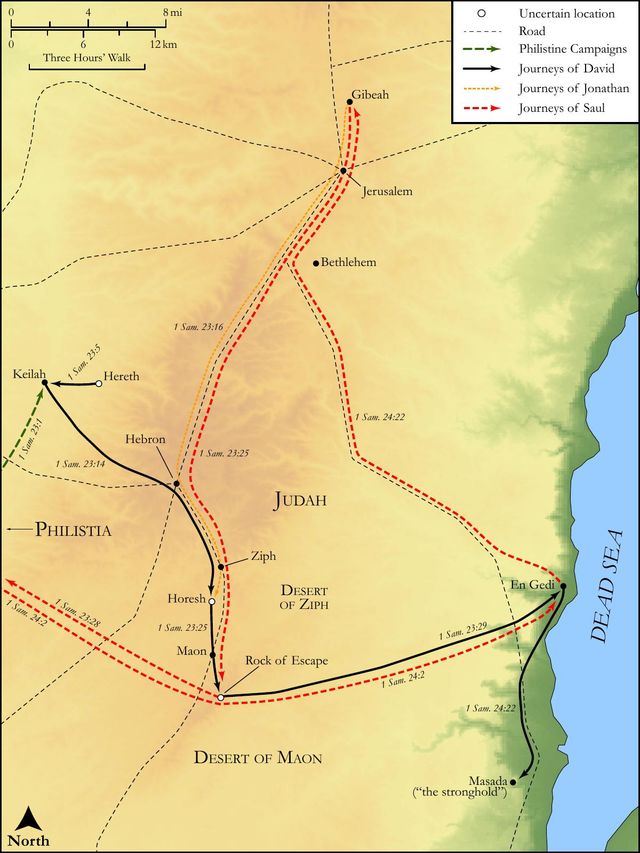
This verse immediately follows one of the most dramatic and significant encounters between David and Saul. David and his men are hiding in a cave at Engedi, a remote wilderness area. Unbeknownst to David, Saul enters the very same cave to relieve himself. David's men urge him to seize this divinely-given opportunity to kill Saul, but David steadfastly refuses, affirming his commitment not to "stretch out my hand against my lord, for he is the Lord's anointed" 1 Samuel 24:6. Instead, David quietly cuts off a corner of Saul's robe, a symbolic act that demonstrates his proximity and power over Saul, yet his profound restraint. After Saul exits the cave, David calls out to him, presenting the piece of cloth as undeniable proof of his innocence and lack of malicious intent. His subsequent question in this verse directly addresses the underlying cause of Saul's relentless pursuit, setting the stage for a powerful, albeit temporary, reconciliation.
Historical & Cultural Context
The historical setting is ancient Israel during the tumultuous period of the transition from a tribal confederacy to a monarchy. Saul, the first king, has been rejected by God due to his disobedience 1 Samuel 15:23, and David has been secretly anointed as his successor 1 Samuel 16:13. This creates an inherent tension, exacerbated by Saul's deep-seated jealousy and paranoia, fueled by an evil spirit 1 Samuel 16:14. In this culture, a king's authority was absolute, and any perceived challenge to it could result in immediate and brutal reprisal. David, though innocent, is a fugitive, constantly on the run from Saul's forces. The concept of "the Lord's anointed" (Hebrew: mashiach YHWH) carried immense weight, signifying a person chosen and set apart by God, whose life was sacred and not to be touched by human hands, even if that person was acting unjustly.
Key Themes
ShowHideThe themes present in 1 Samuel 24:9 are deeply interwoven with the broader narrative of David's rise and Saul's decline. Central is the power of false accusations and slander, which tragically blinds Saul to the truth and drives his destructive pursuit of David. This highlights how easily leaders, and indeed any individual, can be swayed by misinformation and malicious gossip, leading to grave injustices. Another prominent theme is David's unwavering integrity and innocence. Despite being hunted like an animal and having every human reason to retaliate, David consistently maintains his character. He not only refrains from harming Saul but actively seeks to clear his name, demonstrating his true character and commitment to God's will, even under extreme duress. This is powerfully contrasted with Saul's deteriorating moral state. Finally, the verse underscores respect for God's anointing and divine authority. David's steadfast refusal to "stretch out his hand" against Saul, despite Saul's unrighteous actions, serves as a profound example of honoring God's chosen leader, even when that leader is deeply flawed, a principle David reiterates later in the narrative 1 Samuel 26:9.
Exposition and Analysis
ShowHideKey Word Analysis
ShowHideThis primitive root means "to hear intelligently (often with implication of attention, obedience, etc.; causatively, to tell, etc.)." In this context, David is not merely asking if Saul has heard the words physically, but if he has listened to them, believed them, and allowed them to influence his actions. It implies a deeper level of reception and acceptance of the slander as truth, leading to Saul's destructive pursuit. David's question challenges Saul's discernment and judgment, highlighting his failure to truly understand the situation.
Derived from the root "to speak," this noun refers to "a word; by implication, a matter (as spoken of) or thing." Here, it specifically denotes human speech, often implying gossip, slander, or unverified reports, in contrast to divine revelation or objective truth. David emphasizes that Saul's current misguided actions are based on mere human opinion and malicious falsehoods, rather than on any factual basis or divine leading. It highlights the fallibility and potential for corruption in human communication, especially when it is not rooted in truth.
This term signifies "bad or (as noun) evil (natural or moral); adversity, affliction, bad, calamity, harm, mischief." It encompasses not just physical injury but also misfortune, calamity, or ruin. David is emphatically denying any premeditated plot, malicious intent, or desire to cause Saul personal damage, overthrow him violently, or bring about his downfall. The use of this word underscores the severity of the false accusation leveled against David.
Verse Breakdown
ShowHide"And David said to Saul"
This opening clause establishes the direct, personal nature of the confrontation. After a period of hiding and being pursued, David, having just demonstrated his innocence through action (sparing Saul's life and cutting the robe), now chooses to engage Saul verbally. This is not a casual remark but a deliberate, courageous address to the king who seeks his life, signifying a moment of profound moral authority from David.
"Wherefore hearest thou men's words"
This is a rhetorical question, designed to challenge Saul's judgment and expose the irrationality of his actions. David is not asking for information but prompting Saul to consider why he is giving credence to unverified, malicious reports. It implies that Saul's actions are not based on reality or David's true character, but on external, untrustworthy influences, revealing Saul's spiritual and intellectual vulnerability.
"saying, Behold, David seeketh thy hurt?"
This clause reveals the specific content of the "men's words" – the false accusation that David is actively plotting against Saul, seeking his downfall or harm. The exclamation "Behold!" (הִנֵּה, hinneh) emphasizes the direct and accusatory nature of the slander. David directly quotes the false charge, laying it bare before Saul and implicitly inviting him to compare it with David's recent actions and consistent loyalty, thereby highlighting the stark contrast between the lie and the truth.
Literary Devices
ShowHideThe verse effectively employs several literary devices to convey its profound message. A prominent device is the Rhetorical Question, "Wherefore hearest thou men's words, saying, Behold, David seeketh thy hurt?" David is not genuinely seeking an answer but is using the question to highlight the absurdity and injustice of Saul's belief in the slander. It forces Saul to confront the irrational basis of his persecution and the moral bankruptcy of his actions. There is also significant Irony at play: David, the one being hunted as a traitor, has just demonstrated ultimate loyalty by sparing Saul's life, while Saul, the king, is acting on the basis of disloyal "men's words." This stark contrast underscores the moral inversion of their positions. Furthermore, the verse uses Juxtaposition by placing David's proven actions (sparing Saul) directly against the false accusations ("seeketh thy hurt"). This dramatic contrast serves to expose the lie and vindicate David's character, making Saul's continued persecution appear even more irrational and unjust.
Theological and Thematic Connections
ShowHideThis verse powerfully illustrates the destructive nature of slander and the critical importance of discernment, a theme consistently echoed throughout Scripture. Saul's tragic failure to discern truth from falsehood, preferring to believe "men's words" over David's demonstrated loyalty and God's clear anointing, leads him down a path of spiritual and personal ruin. David's response, rooted in integrity and a profound respect for God's anointed, serves as a model for how believers should confront injustice and false accusations. It underscores the divine principle that God will ultimately vindicate the righteous, even when they are unjustly persecuted, and that true spiritual authority is demonstrated not through power grabs, but through humble obedience and trust in God's timing and methods.
Reflection and Application
ShowHideDavid's confrontation with Saul in this verse offers profound lessons for contemporary believers navigating a world often rife with misinformation and personal attacks. It challenges us to examine the sources of our beliefs and the motivations behind the words we hear, especially concerning others. Are we quick to believe rumors or accusations, or do we seek truth, verification, and discernment rooted in God's Word and objective reality? Like Saul, we can become blinded by paranoia or prejudice if we allow "men's words" to dictate our perceptions and actions, rather than relying on objective reality, God's truth, and our own experiences. David's response exemplifies integrity under pressure; he did not retaliate in kind but chose a path of truth and honor, trusting God for vindication. This calls us to maintain our character and principles even when falsely accused or unjustly persecuted, remembering that our ultimate vindication comes from God, not from winning every argument or defending every slight. It encourages us to confront injustice with truth, humility, and a steadfast reliance on God's sovereign plan, knowing that His ways are higher than our ways.
Questions for Reflection
ShowHideFAQ
ShowHideWhy was Saul so quick to believe false accusations about David, despite David's loyalty?
ShowHideSaul's susceptibility to false accusations stemmed from a complex interplay of factors. The Spirit of the Lord had departed from him, and an evil spirit tormented him, leading to deep-seated paranoia, jealousy, and irrational fear of David, whom he perceived as a threat to his throne. David's military successes and soaring popularity, coupled with the prophecy that a neighbor would take Saul's kingdom 1 Samuel 15:28, fed Saul's profound insecurity. In this spiritually and psychologically compromised state, Saul was ripe for manipulation by "men's words"—likely courtiers or rivals of David who sought to gain favor with the king by slandering David. Saul's spiritual decline impaired his judgment, making him unable to discern truth from malicious falsehood, leading him to believe the worst about David despite clear evidence to the contrary, such as David's repeated opportunities to harm Saul but choosing not to 1 Samuel 24:4.
Christ-Centered Fulfillment
ShowHide1 Samuel 24:9, with David's confrontation of Saul regarding false accusations, powerfully foreshadows the ultimate experience of Jesus Christ. David, the innocent one, is slandered and relentlessly pursued by the king, yet he responds with integrity and refuses to harm God's anointed. This mirrors Christ, the true King and the perfectly innocent Son of God, who was relentlessly pursued by those who spread "men's words" against Him, accusing Him of blasphemy, sedition, and seeking to destroy the temple Mark 14:58. Jesus, like David, had every opportunity to exercise His divine power and destroy His accusers and persecutors, yet He chose not to retaliate. Instead, He silently endured the false testimonies and unjust condemnation, fulfilling the prophecy of the suffering servant who "was oppressed and He was afflicted, yet He opened not His mouth" Isaiah 53:7. His response was not one of self-vindication through force, but through humble submission to the Father's will, ultimately offering Himself as the Lamb of God who takes away the sin of the world, even the sin of slander and injustice John 1:29. Thus, David's integrity in the face of false accusations points to the perfect integrity and redemptive suffering of Christ, who bore the ultimate "hurt" for us, not seeking His own, but our eternal good.