


1 Samuel 24:4
Bible text: King James Version (1769 Blayney text) · Public domain
Bible text: King James Version with Strong's numbers · Public domain
Bible text: Berean Standard Bible · Public domain
Bible text: American Standard Version (1901) · Public domain
Bible text: World English Bible, Messianic edition · Public domain
Bible text: Geneva Bible (1599) · Public domain
Bible text: Young's Literal Translation · Public domain
- וַיֹּאמְרוּvai·yo·me·Ruand they saidH559Conj-w ¦ V-Qal-ConsecImperf-3mpVerb Qal Consecutive Imperfect 3rd Plural Masculineוַandיֹּאמְרוּthey said
- אַנְשֵׁי'an·Shei[the] men ofH582N-mpcNoun Plural Masculine Construct
- דָוִדda·VidDavidH1732N-proper-mNoun Proper Masculine
- אֵלָיו'e·Lavto himH413Prep ¦ 3msPreposition Definiteאֵלָיtoוhim
- הִנֵּהhi·Nehhere!H2009PrtParticle Interjection
- הַיּוֹםhai·Yomthe dayH3117Art ¦ N-msNoun Singular Masculine Absoluteהַtheיּוֹםday
- אֲשֶׁר'asherwhichH834RelParticle Relative
- אָמַר'a·Marhe saidH559V-Qal-Perf-3msVerb Qal Perfect 3rd Singular Masculine
- יְהוָהYah·wehYahwehH3068N-properNoun Proper Title
- אֵלֶיךָ'e·Lei·khato youH413Prep ¦ 2msPreposition Definiteאֵלֶיtoךָyou
- הִנֵּהhi·Nehhere!H2009PrtParticle Interjection
- אָנֹכִי'a·no·KhiIH595Pro-1csPronoun Personal 1st Singular common gender
- נֹתֵןno·Ten[am] about to giveH5414V-Qal-Prtcpl-msVerb Qal Participle Singular Masculine Absolute
- אֶת'et<obj.>H853DirObjMParticle Object Indicator
- אֹיִבְךָ'o·ye·vei·khayour enemyH341V-Qal-Prtcpl-ms ¦ 2msVerb Qal Participle Singular Masculine Constructאֹיִבְenemyךָyour
- בְּיָדֶךָbe·ya·De·khain your handH3027Prep-b ¦ N-csc ¦ 2msNoun Singular common gender Constructבְּinיָדֶhandךָyour
- וְעָשִׂיתָve·'a·Si·taand you will doH6213Conj-w ¦ V-Qal-ConsecPerf-2msVerb Qal Consecutive Perfect 2nd Singular Masculineוְandעָשִׂיתָyou will do
- לּוֹloto <the> himPrep-l ¦ 3msSuffix Personal 3rd Singular Masculineלּto <the>וֹhim
- כַּאֲשֶׁרka·'a·Sherjust asH834Prep-k ¦ RelParticle Relativeכַּjustאֲשֶׁרas
- יִטַבyi·Tavit will be goodH3190V-Qal-Imperf-3msVerb Qal Imperfect 3rd Singular Masculine
- בְּעֵינֶיךָbe·'ei·Nei·khain your viewH5869Prep-b ¦ N-fdc ¦ 2msNoun Dual Feminine Constructבְּinעֵינֶיviewךָyour
- וַיָּקָםvai·Ya·komand he aroseH6965Conj-w ¦ V-Qal-ConsecImperf-3msVerb Qal Consecutive Imperfect 3rd Singular Masculineוַandיָּקָםhe arose
- דָּוִדda·VidDavidH1732N-proper-mNoun Proper Masculine
- וַיִּכְרֹתvai·yikh·Rotand he cut offH3772Conj-w ¦ V-Qal-ConsecImperf-3msVerb Qal Consecutive Imperfect 3rd Singular Masculineוַandיִּכְרֹתhe cut off
- אֶת'et<obj.>H853DirObjMParticle Object Indicator
- כְּנַףke·naf[the] skirt ofH3671N-fscNoun Singular Feminine Construct
- הַמְּעִילha·me·'Ilthe robeH4598Art ¦ N-msNoun Singular Masculine Absoluteהַtheמְּעִילrobe
- אֲשֶׁר'a·SherwhichH834RelParticle Relative
- לְשָׁאוּלle·sha·'Ul[belonged] to SaulH7586Prep-l ¦ N-proper-mNoun Proper Masculineלְ[belonged] toשָׁאוּלSaul
- בַּלָּטba·Latin <the> secrecyH3909Prep-b ¦ N-msNoun Singular Masculine Absoluteבַּin <the>לָּטsecrecy
English is a literal word-by-word gloss of the Hebrew, not the KJV's wording. Why?
This is the original text the KJV's translators worked from — each Hebrew word with its own literal English meaning in this verse, prepared by scholars at Tyndale House, Cambridge. The KJV translates whole sentences, not word by word, so its wording differs: one Hebrew word can become several English words, and the KJV may choose “the LORD” where the gloss reads “Yahweh”. Both are faithful — they answer different questions. For the KJV's own rendering, switch to the KJV text.
Details
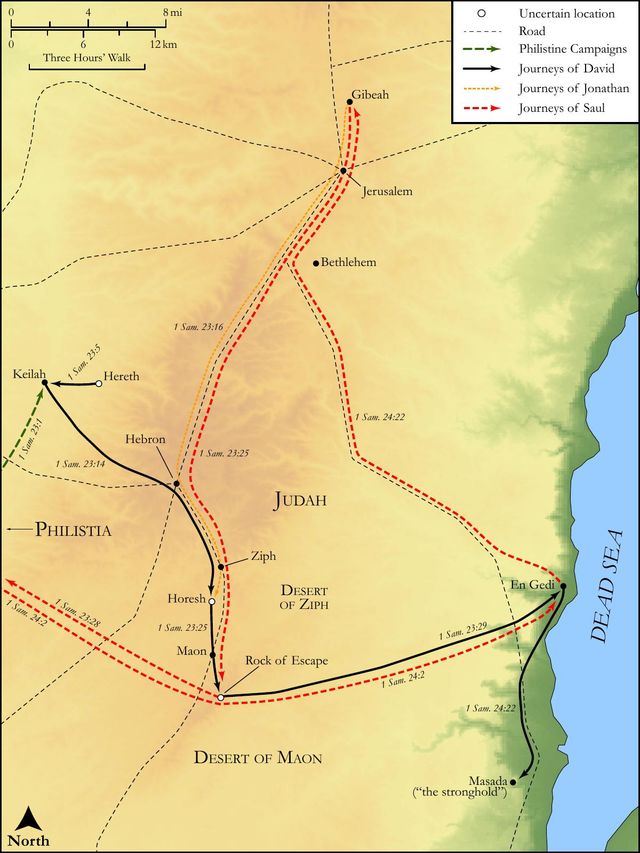
See on the biblical-era map
Study this verse
Public-domain commentary
Matthew Henry
From his Commentary on the Whole Bible. Henry comments on passages, not single verses — this entry covers 1 Samuel 24:1–8. His two-level outline is real structure in the source text, so it is rendered as structure.
Here, I. Saul renews his pursuit of David, Sa1 24:1, Sa1 24:2. No sooner had he come home safely from chasing the Philistines, in which it should seem he had good success, than he enquired after David to do him a mischief, and resolved to have another thrust at him, as if he had been delivered to do all these abominations, Jer 7:10. By the frequent incursions of the Philistines, he might have seen how necessary it was to recall David from his banishment and restore him to his place in the army again; but so far is he from doing this that now more than ever he is exasperated against him, and, hearing that he is in the wilderness of En-gedi, he draws out 3000 choice men, and goes with them at his feet in pursuit of him upon the rocks of the wild goats, where, one would think, David should not have been envied a habitation nor Saul desirous of disturbing him; for what harm could he fear from one who was no better accommodated? But it is not enough for Saul that David is thus cooped up; he cannot be easy while he is alive.
II.Providence brings Saul alone into the same cave wherein David and his men had hidden themselves, Sa1 24:3.
In those countries there were very large caves in the sides of the rocks or mountains, partly natural, but probably much enlarged by art for the sheltering of sheep from the heat of the sun; hence we read of places where the flocks did rest at noon (Sol 1:7), and this cave seems to be spoken of as one of the sheep-cotes. In the sides of this cave David and his men remained, perhaps not all his men, the whole 600, but only some few of his particular friends, the rest being disposed of in similar retirements. Saul, passing by, turned in himself alone, not in search of David (for, supposing him to be an aspiring ambitious man, he thought to find him rather climbing with the wild goats upon the rocks than retiring with the sheep into a cave), but thither he turned aside to cover his feet, that is, to sleep awhile, it being a cool and quiet place, and very refreshing in the heat of the day; probably he ordered his attendants to march before, reserving only a very few to wait for him at the mouth of the cave. Some by the covering of the feet understand the easing of nature, and think that this was Saul's errand into the cave: but the former interpretation is more probable.
III.David's servants stir him up to kill Saul now that he has so fair an opportunity to do it, Sa1 24:4.
They reminded him that this was the day which he had long looked for, and of which God had spoken to him in general when he was anointed to the kingdom, which should put a period to his troubles and open the passage to his advancement. Saul now lay at his mercy, and it was easy to imagine how little mercy he would find with Saul and therefore what little reason he had to show mercy to him. "By all means" (say his servants) "give him the fatal blow now." See how apt we are to misunderstand,
1.The promises of God. God had assured David that he would deliver him from Saul, and his men interpret this as a warrant to destroy Saul.
2.The providences of God. Because it was now in his power to kill him, they concluded he might lawfully do it.
IV.David cut off the skirt of his robe, but soon repented that he had done this:
His heart smote him for it (Sa1 24:5); though it did Saul no real hurt, and served David for a proof that it was in his power to have killed him (Sa1 24:11), yet, because it was an affront to Saul's royal dignity, he wished he had not done it. Note, It is a good thing to have a heart within us smiting us for sins that seem little; it is a sign that conscience is awake and tender, and will be the means of preventing greater sins.
V.He reasons strongly both with himself and with his servants against doing Saul any hurt.
1.He reasons with himself (Sa1 24:6): The Lord forbid that I should do this thing. Note, Sin is a thing which it becomes us to startle at, and to resist the temptations to, not only with resolution, but with a holy indignation. He considered Saul now, not as his enemy, and the only person that stood in the way of his preferment (for then he would be induced to hearken to the temptation), but as God's anointed (that is, the person whom God had appointed to reign as long as he lived, and who, as such, was under the particular protection of the divine law), and as his master, to whom he was obliged to be faithful. Let servants and subjects learn hence to be dutiful and loyal, whatever hardships are put upon them, Pe1 2:18.
2.He reasons with his servants: He suffered them not to rise against Saul, Sa1 24:7. He would not only not do this evil thing himself, but he would not suffer those about him to do it. Thus did he render good for evil to him from whom he had received evil for good, and was herein both a type of Christ, who saved his persecutors, and an example to all Christians not to be overcome of evil, but to overcome evil with good.
VI.He followed Saul out of the cave, and, though he would not take the opportunity to slay him, yet he wisely took the opportunity, if possible, to slay his enmity, by convincing him that he was not such a man as he took him for.
1.Even in showing his head now he testified that he had an honourable opinion of Saul. He had too much reason to believe that, let him say what he would, Saul would immediately be the death of him as soon as he saw him, and yet he bravely lays aside that jealousy, and thinks Saul so much a man of sense as to hear his reasoning when he had so much to say in his own vindication and such fresh and sensible proofs to give of his own integrity.
2.His behaviour was very respectful: He stooped with his face to the earth, and bowed himself, giving honour to whom honour was due, and teaching us to order ourselves lowly and reverently to all our superiors, even to those that have been most injurious to us.
Historical interpretation
Three Centuries of Reception
2 surviving comments on this verse. Each one is dated, so this reads as a timeline rather than a list.
Select a marker to jump to its quote. Markers stagger vertically where authors wrote within a few decades of each other.
When, therefore, he was alone and had removed his robe and laid it down somewhere beside him, the light from the mouth of the cave made him visible to those hidden within the darkness. All of David’s companions wanted to rush upon the enemy and avenge themselves on the one who had come to kill them, since God had given the enemy into the hands of those who were being pursued for slaughter. But David forbade them to attack, considering an assault against their king unlawful. He drew his own sword from its sheath and imperceptibly stood behind Saul. There was no witness to his undertaking against Saul, for the darkness in the cave concealed his appearance and prevented scrutiny of what was happening. When, then, he could have driven his whole sword through Saul’s heart from behind with one blow, he neither touched his body nor was he about to. But he secretly cut off the end of his robe with his sword, so that the garment might be a witness later of his clemency toward Saul and prove the power that he had had to strike a blow against Saul’s body by means of the cut at its end.By this it became obvious that David had been trained in forbearance. When he held the bare sword in his palm, and the body of his enemy lay under his hand, he had the power to kill him, but he conquered his anger with reason, and his power to strike the blow with the fear of God. Not only did he become superior to his own anger, but he also restrained his shield bearer who was eager to murder Saul, addressing him with that saying famous in song, “Destroy not the anointed of the Lord.”
And David's servants said to him: Behold the day, etc. Christ's carnal disciples, still of a servile spirit, said to him when they saw the power of the crucified and the madness of those who crucified: Behold, the time is at hand, of which God the Father spoke to you through the mouth of his holy prophets from of old, that he would make all your enemies a footstool for your feet (Psalm 109). But they said this with their whole heart, although not in words, whomever of them desired the death of those who, releasing a thief, condemned the Savior to death, because it was proven by him who cut off the ear of the servant of the high priest, unwilling for the Lord to drink the cup which the Father gave. It was proven in those who sought fire from heaven to descend upon the impious, not knowing of what spirit they were, for the Son of Man did not come to destroy souls, but to save. But with the appropriate moderation of his piety, he did not completely kill the wicked, but withdrew from them, in no small part, the habit of the kingdom, so that even thus confounded, they might come to the recognition of their madness and correction.
Continue studying 1 Samuel 24:4 across the web’s major study libraries — every link below opens this exact verse, chapter, or book on the destination site.
Read & Compare
 BibleGatewayThis verse in more than 200 translations and 70 languages.
 Bible.comThe YouVersion reader — hundreds of translations, reading plans, and highlights.
 ESV.orgCrossway's official English Standard Version reader.
 NET BibleThe NET translation with 60,000+ translators' notes on every rendering decision.
 STEP BibleTyndale House's free study tool — original text, vocabulary, and scholarly resources.
 BibliaLogos Bible Software's free web reader.
 USCCBThe New American Bible (Revised Edition) with the U.S. bishops' study notes.
Commentaries
 BibleHub CommentariesDozens of classic commentaries on this verse, gathered on one page.
 StudyLightMore than 100 commentary sets — the largest collection on the web.
 BibleRefPlain-English commentary on what this verse means, verse by verse.
 Enduring WordDavid Guzik's free commentary on this chapter, widely used by Bible teachers.
 Bible Study ToolsVerse commentary alongside Greek and Hebrew study aids.
Original Language & Research
- BibleHub InterlinearThe verse word by word — original language, transliteration, and English.
- BibleHub LexiconEvery word's original-language definition and Strong's entry.
 Blue Letter BibleDeep-study tools — Strong's numbers, concordance, and word studies.
 SefariaThe Hebrew text with Rashi and centuries of Jewish commentary.
Sermons, Hymns & Audio


TrulyRandomVerse is not affiliated with these sites and doesn’t control their content. They’re linked because they’re genuinely useful.
Summary
1 Samuel 24:4 presents a profound moral and spiritual test for David, as his loyal men urge him to seize a seemingly providential opportunity to eliminate King Saul, his relentless persecutor. Trapped unknowingly in the same cave as David, Saul's vulnerability is interpreted by David's men as divine permission to act. Faced with immense pressure and apparent justification for vengeance, David chooses a path of remarkable restraint, demonstrating unwavering respect for God's anointing on Saul, even in his fallen state, by merely cutting off a piece of Saul's robe rather than taking his life.
Context
ShowHideLiterary Context
This pivotal verse is situated within a highly dramatic and intense period of David's life, following his anointing by Samuel as the future king of Israel in 1 Samuel 16:13 and his subsequent rise to national prominence. King Saul, consumed by a jealous and malevolent spirit, has become obsessively intent on hunting David down, viewing him as an existential threat to his throne. The narrative of 1 Samuel 24 specifically details Saul's relentless pursuit, which leads him to the wilderness of En-gedi, where David and his 600 men are hiding in a cave. The dramatic irony of Saul entering the very cave where David is concealed, "to cover his feet" (a common euphemism for relieving himself), sets the stage for David's critical moral and spiritual dilemma. David's men interpret this extraordinary coincidence as a direct act of God, fulfilling a perceived divine promise to deliver Saul into David's hands.
Historical & Cultural Context
In ancient Israel, kingship was understood as a sacred institution, with the king being "the LORD's anointed" (מְשִׁיחַ יְהוָה, meshiach Yahweh). To lay hands on the anointed of the Lord, even a disobedient and hostile one like Saul, was considered a grave offense not merely against the individual, but against God Himself, who had established the king's authority. This deeply ingrained cultural and theological understanding profoundly informed David's decision. Furthermore, the "skirt of the robe" (כָּנָף, kanaph) in Hebrew thought was far more than a mere piece of clothing; it often symbolized a person's authority, honor, dignity, and even their very essence or power. To cut off the skirt was therefore a deeply symbolic act, akin to diminishing or "cutting off" a person's authority or kingdom, a subtle yet profound challenge to Saul's reign without resorting to physical violence.
Key Themes
ShowHideThis verse powerfully illuminates several key themes central to the book of Samuel and broader biblical theology. Firstly, it underscores the theme of Divine Sovereignty versus Human Expediency. David's men, though perhaps well-intentioned and suffering, advocate for taking matters into human hands, misinterpreting circumstances as divine permission for immediate, self-serving action, rather than trusting God's perfect timing and method for establishing David's kingship. Secondly, it showcases David's Unwavering Trust and Respect for God's Anointed. Despite Saul's relentless persecution and the immense personal suffering David endured, he consistently refused to harm Saul, upholding the principle that vengeance belongs to the Lord, as seen again in 1 Samuel 26:9. This demonstrates David's profound Integrity and Self-Restraint, contrasting sharply with the prevailing norms of retribution. Finally, the Symbolic Act of cutting the robe foreshadows the eventual transfer of the kingdom from Saul to David, without David needing to commit regicide or usurpation. This echoes the earlier symbolic tearing of Samuel's robe, signifying the tearing of the kingdom from Saul in 1 Samuel 15:27-28.
Exposition and Analysis
ShowHideKey Word Analysis
ShowHideThis Hebrew verb means "to give, put, place, set, allow, appoint." In the context of the men's statement, it carries the strong implication of God actively handing over or surrendering Saul into David's power. Their interpretation suggests a divine mandate for David to act decisively, viewing the situation as a direct fulfillment of a perceived prophecy or promise, thereby justifying any action David might take against Saul.
This word, often translated as "hand," is a primitive term with a vast semantic range, frequently signifying power, control, means, or authority. When the men declare, "I will deliver thine enemy into thine hand," they are not merely speaking of physical proximity but of the complete transfer of power and control over Saul's fate to David. It implies a divine endorsement of David's absolute authority to "do to him as it shall seem good."
While literally meaning "wing" or "extremity," in this context, it refers to the hem or border of a garment. As noted in the historical context, the "skirt" or "hem" was a significant part of one's attire, often symbolizing authority, dignity, and even the wearer's life or power. Cutting it off was not a minor act but a symbolic disempowerment, a tangible representation of David's ability to "cut off" Saul's power or even his life, yet choosing not to.
Verse Breakdown
ShowHide"And the men of David said unto him,"
This opening clause immediately establishes the source of the immense temptation and pressure on David. It is not an external enemy or a random thought, but his own loyal followers, who had suffered alongside him during Saul's relentless pursuit, who are advocating for a course of action that seems logical, expedient, and even divinely sanctioned from a human perspective. Their words carry significant weight, reflecting the common desire for an immediate end to their persecution.
"Behold the day of which the LORD said unto thee, Behold, I will deliver thine enemy into thine hand,"
This is the core of the men's persuasive argument, presenting their interpretation of the extraordinary circumstances as a direct divine confirmation. They claim to recall a specific "word from the LORD" to David, promising the delivery of his enemy. While the exact "word" is not explicitly recorded in prior texts in this specific phrasing, it likely refers to the general understanding that God would establish David's kingdom and deal with his enemies, which the men now believe is being fulfilled in this opportune moment, granting David a divine mandate.
"that thou mayest do to him as it shall seem good unto thee."
This phrase grants David full discretion, implying that whatever action he takes against Saul, including killing him, would be justified and even divinely sanctioned. It highlights the profound moral and spiritual test David faces, as he is given seemingly free rein to act on his own desires for vengeance or self-preservation, with the apparent backing of God's word.
"Then David arose, and cut off the skirt of Saul's robe privily."
This final clause describes David's decisive, yet profoundly restrained, action. Instead of yielding to the counsel of his men and taking Saul's life, David performs a symbolic act. The word "privily" underscores his stealth and the absolute ease with which he could have done more, emphasizing his deliberate and conscious choice of restraint. Cutting the robe serves as tangible proof of his proximity and power over Saul, yet also his resolute refusal to harm God's anointed, even in such a compelling situation.
Literary Devices
ShowHideThe narrative of 1 Samuel 24:4 is rich with literary devices that enhance its theological and dramatic impact. Irony is powerfully present, as Saul, the relentless hunter, unknowingly becomes the vulnerable prey, entering the very lair of his pursued enemy. This situational irony highlights the unexpected turns of divine providence and the precariousness of Saul's position. Symbolism is central to David's act of cutting off the skirt of Saul's robe. This seemingly minor act is laden with profound meaning, representing David's power to "cut off" Saul's life or kingdom, while simultaneously demonstrating his refusal to do so physically. It foreshadows the eventual transfer of authority without bloodshed. Contrast is vividly drawn between the counsel of David's men, who advocate for immediate and decisive action based on a human interpretation of divine will, and David's own profound restraint and unwavering trust in God's timing. This contrast underscores David's unique character and spiritual maturity. Furthermore, the entire scene serves as Foreshadowing, subtly indicating that Saul's kingdom is indeed being "cut off" and will be transferred to David, but not through an act of human violence or usurpation, but through God's sovereign hand and David's patient obedience.
Theological and Thematic Connections
ShowHide1 Samuel 24:4 serves as a profound theological statement on the nature of divine sovereignty, human responsibility, and the character of true leadership. David's refusal to seize an opportunity that seemed divinely ordained, but which would have involved taking vengeance into his own hands and harming God's anointed, demonstrates a deep understanding that God's promises are fulfilled in His way and in His time. It underscores the principle that even when circumstances appear to align perfectly with our desires or perceived divine promises, we are still bound by God's moral law and must trust His method, rather than resorting to expedience or violence. This act of restraint, born out of reverence for God's anointing, sets David apart as a man after God's own heart, willing to suffer injustice rather than compromise his integrity or usurp God's role as judge. It teaches us that true faith often involves patient endurance and a refusal to manipulate situations for personal gain, even when the path of least resistance seems to open up.
Reflection and Application
ShowHideDavid's actions in 1 Samuel 24:4 offer a powerful paradigm for believers navigating difficult circumstances today. We often face "opportunities" that seem to offer a quick resolution to our problems, a chance to get ahead, or even to exact revenge on those who have wronged us. Like David's men, we might interpret such circumstances as God's "delivery" of our enemies or obstacles into our hands, justifying actions that might compromise our integrity or contradict God's clear commands. This passage challenges us to discern between a divinely opened door and a divinely orchestrated test. True faith is not about seizing every perceived advantage, but about waiting patiently on God's perfect timing and method, trusting that He will vindicate His people and fulfill His promises without our resorting to unrighteous means. It calls us to exercise self-restraint, to leave vengeance to the Lord, and to maintain respect for authority, even when that authority is flawed or hostile. David's willingness to suffer injustice rather than compromise his principles reminds us that our character is forged in the crucible of such choices, and that God honors those who honor Him, even when it means enduring hardship and deferring personal gratification for His greater glory.
Questions for Reflection
ShowHideFAQ
ShowHideWhy didn't David kill Saul if God "delivered" him into his hand, as his men suggested?
ShowHideDavid's refusal to kill Saul, despite the urging of his men and the perfect opportunity, stemmed from his deep reverence for God and His anointed. While his men interpreted the situation as a direct fulfillment of a divine promise to "deliver" Saul, David understood that God's promises of kingship would be fulfilled through God's own timing and method, not through human assassination or usurpation of God's judgment. Saul, though disobedient and hostile, was still "the LORD's anointed" (1 Samuel 24:6), and David believed it was not his place to lay a hand on him. This act demonstrated David's profound faith, patience, and commitment to leaving vengeance and the establishment of his kingdom entirely in God's sovereign hands, rather than resorting to violence or expediency.
What was the significance of cutting off the skirt of Saul's robe?
ShowHideCutting off the skirt of Saul's robe was a highly symbolic act. In Israel, the hem or "skirt" of a garment could represent a person's authority, honor, or even their very essence and power. By cutting it, David was tangibly demonstrating that he had been close enough to kill Saul and had the power to do so, yet chose not to. It was a non-violent, yet potent, act of symbolic disempowerment, subtly foreshadowing the transfer of the kingdom from Saul to David. It also served as tangible proof to Saul later that David meant him no harm, despite having had the perfect opportunity to do so, as seen in David's subsequent address to Saul in 1 Samuel 24:8-15. This act was a deliberate choice to assert his presence and power without resorting to bloodshed, respecting Saul's anointing while subtly challenging his authority.
Was David's act of cutting the robe a sin, given his later remorse?
ShowHideDavid's immediate remorse after cutting the robe (1 Samuel 24:5) suggests that even this symbolic act was seen by him as a transgression against the "LORD's anointed." While it was far from the act of murder his men proposed, David's conscience was pricked because he had, in a sense, "laid a hand" on the king's dignity and authority. His remorse highlights his extreme reverence for God's chosen king, even a fallen one. It wasn't a sin in the same category as murder, but it was an act of disrespect towards the office of the king, which David deemed inappropriate for himself. This deep sensitivity to even minor transgressions against God's anointed underscores David's profound piety and his consistent refusal to harm Saul.
Christ-Centered Fulfillment
ShowHide1 Samuel 24:4, with David's remarkable restraint and reverence for God's anointed, finds its ultimate and perfect fulfillment in the person and work of Jesus Christ. David, though a "man after God's own heart," was still a flawed human king, prone to sin. His refusal to seize power by force, instead trusting God's timing and respecting the "LORD's anointed," foreshadows the perfect obedience and non-violent path of the true King, Jesus. Unlike David, who was tempted to take a kingdom by human means, Christ, the ultimate "Anointed One" (Messiah), willingly emptied Himself, taking the form of a servant, rather than asserting His divine prerogative or seizing an earthly throne (Philippians 2:5-8). When tempted in the wilderness, Jesus refused to take the kingdoms of the world by bowing to Satan, choosing instead the path of perfect obedience to the Father (Matthew 4:8-10). He did not fight to establish His kingdom, declaring, "My kingdom is not of this world. If my kingdom were of this world, my servants would have been fighting" (John 18:36). Instead of cutting off the robe of His enemies, He allowed Himself to be stripped and crucified, becoming the suffering servant who "was oppressed, and he was afflicted, yet he opened not his mouth" (Isaiah 53:7). Jesus, the true Lamb of God, willingly submitted to the injustice of human authority and the wrath of God for the sake of humanity, thereby securing a kingdom that is eternal and righteous, not through violence, but through ultimate self-sacrifice and resurrection. He is the perfectly patient King, who will return not as a fugitive, but as the triumphant Lord of Lords, whose reign is established by divine power, not human force (Revelation 19:11-16).