


1 Samuel 24:3
Bible text: King James Version (1769 Blayney text) · Public domain
Bible text: King James Version with Strong's numbers · Public domain
Bible text: Berean Standard Bible · Public domain
Bible text: American Standard Version (1901) · Public domain
Bible text: World English Bible, Messianic edition · Public domain
Bible text: Geneva Bible (1599) · Public domain
Bible text: Young's Literal Translation · Public domain
- וַיָּבֹאVai·ya·vo'and he cameH935Conj-w ¦ V-Qal-ConsecImperf-3msVerb Qal Consecutive Imperfect 3rd Singular Masculineוַandיָּבֹאhe came
- אֶל'eltoH413PrepPreposition
- גִּדְרוֹתgid·Rot[the] folds ofH1448N-fpcNoun Plural Feminine Construct
- הַצֹּאןha·Tzonthe sheepH6629Art ¦ N-csNoun Singular common gender Absoluteהַtheצֹּאןsheep
- עַל'alonH5921PrepPreposition
- הַדֶּרֶךְha·De·rekhthe wayH1870Art ¦ N-csNoun Singular common gender Absoluteהַtheדֶּרֶךְway
- וְשָׁםve·Shamand [was] thereH8033Conj-w ¦ AdvAdverbוְandשָׁם[was] there
- מְעָרָהme·'a·Raha caveH4631N-fsNoun Singular Feminine Absolute
- וַיָּבֹאvai·ya·Vo'and he wentH935Conj-w ¦ V-Qal-ConsecImperf-3msVerb Qal Consecutive Imperfect 3rd Singular Masculineוַandיָּבֹאhe went
- שָׁאוּלsha·'UlSaulH7586N-proper-mNoun Proper Masculine
- לְהָסֵךְle·ha·Sekhto coverH5526Prep-l ¦ V-Hiphil-InfVerb Hiphil Infinitive Constructלְtoהָסֵךְcover
- אֶת'et<obj.>H853DirObjMParticle Object Indicator
- רַגְלָיוrag·Lavhis feetH7272N-fdc ¦ 3msNoun Dual Feminine Constructרַגְלָיfeetוhis
- וְדָוִדve·da·Vidand DavidH1732Conj-w ¦ N-proper-mNoun Proper MasculineוְandדָוִדDavid
- וַאֲנָשָׁיוva·'a·na·Shavand his menH582Conj-w ¦ N-mpc ¦ 3msNoun Plural Masculine Constructוַandאֲנָשָׁיmenוhis
- בְּיַרְכְּתֵיbe·yar·ke·Teiin [the] innermost parts ofH3411Prep-b ¦ N-fdcNoun Dual Feminine Constructבְּinיַרְכְּתֵי[the] innermost parts of
- הַמְּעָרָהha·me·'a·Rahthe caveH4631Art ¦ N-fsNoun Singular Feminine Absoluteהַtheמְּעָרָהcave
- יֹשְׁבִיםyo·she·Vim[were] sittingH3427V-Qal-Prtcpl-mpVerb Qal Participle Plural Masculine Absolute
English is a literal word-by-word gloss of the Hebrew, not the KJV's wording. Why?
This is the original text the KJV's translators worked from — each Hebrew word with its own literal English meaning in this verse, prepared by scholars at Tyndale House, Cambridge. The KJV translates whole sentences, not word by word, so its wording differs: one Hebrew word can become several English words, and the KJV may choose “the LORD” where the gloss reads “Yahweh”. Both are faithful — they answer different questions. For the KJV's own rendering, switch to the KJV text.
Details
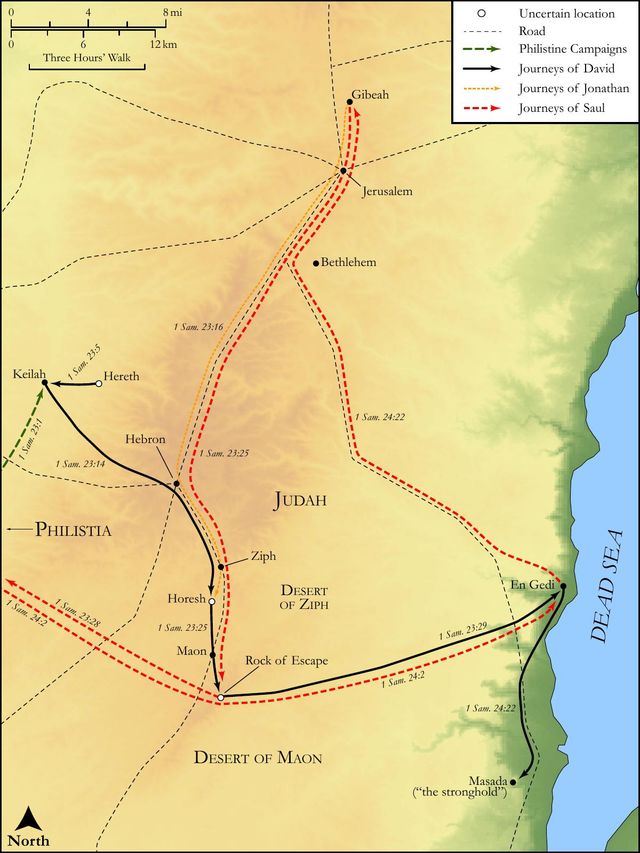
See on the biblical-era map
Study this verse
Public-domain commentary
Matthew Henry
From his Commentary on the Whole Bible. Henry comments on passages, not single verses — this entry covers 1 Samuel 24:1–8. His two-level outline is real structure in the source text, so it is rendered as structure.
Here, I. Saul renews his pursuit of David, Sa1 24:1, Sa1 24:2. No sooner had he come home safely from chasing the Philistines, in which it should seem he had good success, than he enquired after David to do him a mischief, and resolved to have another thrust at him, as if he had been delivered to do all these abominations, Jer 7:10. By the frequent incursions of the Philistines, he might have seen how necessary it was to recall David from his banishment and restore him to his place in the army again; but so far is he from doing this that now more than ever he is exasperated against him, and, hearing that he is in the wilderness of En-gedi, he draws out 3000 choice men, and goes with them at his feet in pursuit of him upon the rocks of the wild goats, where, one would think, David should not have been envied a habitation nor Saul desirous of disturbing him; for what harm could he fear from one who was no better accommodated? But it is not enough for Saul that David is thus cooped up; he cannot be easy while he is alive.
II.Providence brings Saul alone into the same cave wherein David and his men had hidden themselves, Sa1 24:3.
In those countries there were very large caves in the sides of the rocks or mountains, partly natural, but probably much enlarged by art for the sheltering of sheep from the heat of the sun; hence we read of places where the flocks did rest at noon (Sol 1:7), and this cave seems to be spoken of as one of the sheep-cotes. In the sides of this cave David and his men remained, perhaps not all his men, the whole 600, but only some few of his particular friends, the rest being disposed of in similar retirements. Saul, passing by, turned in himself alone, not in search of David (for, supposing him to be an aspiring ambitious man, he thought to find him rather climbing with the wild goats upon the rocks than retiring with the sheep into a cave), but thither he turned aside to cover his feet, that is, to sleep awhile, it being a cool and quiet place, and very refreshing in the heat of the day; probably he ordered his attendants to march before, reserving only a very few to wait for him at the mouth of the cave. Some by the covering of the feet understand the easing of nature, and think that this was Saul's errand into the cave: but the former interpretation is more probable.
III.David's servants stir him up to kill Saul now that he has so fair an opportunity to do it, Sa1 24:4.
They reminded him that this was the day which he had long looked for, and of which God had spoken to him in general when he was anointed to the kingdom, which should put a period to his troubles and open the passage to his advancement. Saul now lay at his mercy, and it was easy to imagine how little mercy he would find with Saul and therefore what little reason he had to show mercy to him. "By all means" (say his servants) "give him the fatal blow now." See how apt we are to misunderstand,
1.The promises of God. God had assured David that he would deliver him from Saul, and his men interpret this as a warrant to destroy Saul.
2.The providences of God. Because it was now in his power to kill him, they concluded he might lawfully do it.
IV.David cut off the skirt of his robe, but soon repented that he had done this:
His heart smote him for it (Sa1 24:5); though it did Saul no real hurt, and served David for a proof that it was in his power to have killed him (Sa1 24:11), yet, because it was an affront to Saul's royal dignity, he wished he had not done it. Note, It is a good thing to have a heart within us smiting us for sins that seem little; it is a sign that conscience is awake and tender, and will be the means of preventing greater sins.
V.He reasons strongly both with himself and with his servants against doing Saul any hurt.
1.He reasons with himself (Sa1 24:6): The Lord forbid that I should do this thing. Note, Sin is a thing which it becomes us to startle at, and to resist the temptations to, not only with resolution, but with a holy indignation. He considered Saul now, not as his enemy, and the only person that stood in the way of his preferment (for then he would be induced to hearken to the temptation), but as God's anointed (that is, the person whom God had appointed to reign as long as he lived, and who, as such, was under the particular protection of the divine law), and as his master, to whom he was obliged to be faithful. Let servants and subjects learn hence to be dutiful and loyal, whatever hardships are put upon them, Pe1 2:18.
2.He reasons with his servants: He suffered them not to rise against Saul, Sa1 24:7. He would not only not do this evil thing himself, but he would not suffer those about him to do it. Thus did he render good for evil to him from whom he had received evil for good, and was herein both a type of Christ, who saved his persecutors, and an example to all Christians not to be overcome of evil, but to overcome evil with good.
VI.He followed Saul out of the cave, and, though he would not take the opportunity to slay him, yet he wisely took the opportunity, if possible, to slay his enmity, by convincing him that he was not such a man as he took him for.
1.Even in showing his head now he testified that he had an honourable opinion of Saul. He had too much reason to believe that, let him say what he would, Saul would immediately be the death of him as soon as he saw him, and yet he bravely lays aside that jealousy, and thinks Saul so much a man of sense as to hear his reasoning when he had so much to say in his own vindication and such fresh and sensible proofs to give of his own integrity.
2.His behaviour was very respectful: He stooped with his face to the earth, and bowed himself, giving honour to whom honour was due, and teaching us to order ourselves lowly and reverently to all our superiors, even to those that have been most injurious to us.
Historical interpretation
Three Centuries of Reception
4 surviving comments on this verse. Each one is dated, so this reads as a timeline rather than a list.
Select a marker to jump to its quote. Markers stagger vertically where authors wrote within a few decades of each other.
Saul, unaware of David’s hiding place, also entered the cave in order to take care of his needs, I presume.… Accordingly, this psalm of David is accepted for certain in the name of the Lord; Saul appears as the devil, and the cave becomes this world. The devil, furthermore, does not discharge any good into this world, but only dung and corruption. Then, too, the cave symbolizes this world because its light is very imperfect when compared with the light of the future world, albeit the Lord, on coming into this world as light, brightens it up considerably. That is why the apostle, in relation to the Father, speaks of him “who is the brightness of his glory.” Now just as David entered the cave in his flight from Saul, the Lord, too, has come into this world and has suffered persecution.
David, as we have said, took on the character of the Lord Savior, and so what was to take place at the Lord’s passion is now recounted of him. David was not to be effaced from the kingdom allotted to him, just as the inscription of the Lord’s title could not be changed. The psalmist added, “When he fled from Saul into the cave.” This incident seems to be very similar in the cases of both David and the Lord. Just as David in fleeing from Saul hid in a cave, so the Lord Savior’s divinity is known to have been hidden within the temple of his body from the unfaithful Jews. In this way the individual events concerning David and Christ are shared by them in this respect.
And there was a cave, etc. This cave is a symbol of the Lord's tomb, whose entrance Saul entered to relieve himself, while the rulers of the kingdom of the Jews, having departed from Pilate, secured the tomb, sealing the stone with guards, in an attempt to block the path of resurrection to the Author of Life. By doing this, they revealed to all the long-conceived and steeped filth of their unfaithful minds. Moreover, the Lord lay hidden in the inner part of the tomb, and his men also hid there—that is, the strong who at that time were to become stronger as his disciples. It is certain that wherever they were in the city of Jerusalem at that time in body, they held with their entire focus and desire the place of the tomb, where they mourned the burial of the only one they loved. Indeed, they hid in the cave because they did not at all want those who had unjustly killed him to know the devotion and love they had for him. Or certainly it is to be understood that David’s men hid with him in the cave, and even rose and came out from the cave with him, according to the Apostle’s statement: "Our old self was crucified with him so that the body of sin might be destroyed, and we might no longer be slaves to sin" (Rom. VI). And as he had previously said: "For as many of us as were baptized into Christ Jesus were baptized into his death. We were therefore buried with him through baptism into death, in order that, just as Christ was raised from the dead through the glory of the Father, we too may walk in newness of life" (Rom. VI).
And he also came to the sheepfolds, etc. In persecuting the great shepherd of the sheep, our Lord Jesus Christ, he also dragged the wicked investigation to the gatherings of his faithful disciples, who offered themselves as sheep to the raging wolves, to see if they could find any reason within them to criticize their master. Hence the saying: "Behold, your disciples do what is not lawful on the Sabbaths," and others (Mark II).
Continue studying 1 Samuel 24:3 across the web’s major study libraries — every link below opens this exact verse, chapter, or book on the destination site.
Read & Compare
 BibleGatewayThis verse in more than 200 translations and 70 languages.
 Bible.comThe YouVersion reader — hundreds of translations, reading plans, and highlights.
 ESV.orgCrossway's official English Standard Version reader.
 NET BibleThe NET translation with 60,000+ translators' notes on every rendering decision.
 STEP BibleTyndale House's free study tool — original text, vocabulary, and scholarly resources.
 BibliaLogos Bible Software's free web reader.
 USCCBThe New American Bible (Revised Edition) with the U.S. bishops' study notes.
Commentaries
 BibleHub CommentariesDozens of classic commentaries on this verse, gathered on one page.
 StudyLightMore than 100 commentary sets — the largest collection on the web.
 BibleRefPlain-English commentary on what this verse means, verse by verse.
 Enduring WordDavid Guzik's free commentary on this chapter, widely used by Bible teachers.
 Bible Study ToolsVerse commentary alongside Greek and Hebrew study aids.
Original Language & Research
- BibleHub InterlinearThe verse word by word — original language, transliteration, and English.
- BibleHub LexiconEvery word's original-language definition and Strong's entry.
 Blue Letter BibleDeep-study tools — Strong's numbers, concordance, and word studies.
 SefariaThe Hebrew text with Rashi and centuries of Jewish commentary.
Sermons, Hymns & Audio


TrulyRandomVerse is not affiliated with these sites and doesn’t control their content. They’re linked because they’re genuinely useful.
Summary
1 Samuel 24:3 masterfully sets the stage for one of the most pivotal encounters in David's life, describing King Saul's unwitting entry into a cave in the wilderness of En-gedi. Unbeknownst to Saul, David and his loyal men are already concealed deep within its recesses, creating a moment of unparalleled vulnerability for the king and an extraordinary opportunity for David. This verse encapsulates the dramatic irony of the situation, highlighting Saul's relentless pursuit culminating in his unexpected exposure to the very man he sought to destroy, thereby laying the groundwork for a profound test of David's character, faith, and his respect for God's divine appointments.
Context
ShowHideLiterary Context
This verse is situated at a critical juncture in the narrative of David's fugitive years, immediately following Saul's renewed and intense pursuit. 1 Samuel 24:1-2 details Saul's mobilization of 3,000 elite soldiers to hunt David in the rugged wilderness of En-gedi, emphasizing the king's obsessive determination. The narrative builds considerable tension as David is constantly on the run, his life perpetually in danger. 1 Samuel 24:3 marks the dramatic turning point, as Saul inadvertently places himself in David's power, setting up the profound moral dilemma that David faces in the subsequent verses, where he famously spares Saul's life (1 Samuel 24:4-7). The entire chapter, 1 Samuel 24, is dedicated to this singular event, serving as a powerful contrast between Saul's unrighteous vengeance and David's righteous restraint, foreshadowing David's character as Israel's future king.
Historical & Cultural Context
The setting, the wilderness of En-gedi, is crucial to understanding the scene. This region, located on the western shore of the Dead Sea, is characterized by its harsh, arid landscape, marked by deep ravines, steep cliffs, and numerous natural caves. These caves were commonly used as shelters by shepherds, travelers, and, as in David's case, fugitives, offering protection from the elements and concealment from enemies. "Sheephcotes by the way" refers to stone enclosures or pens, often constructed near or within natural shelters like caves, where shepherds would gather their flocks for protection. The phrase "to cover his feet" is a well-established ancient Hebrew euphemism for relieving oneself, specifically defecating. This detail signifies a moment of extreme privacy and vulnerability, indicating that Saul was alone, likely disarmed, and completely unaware of any threat. This cultural nuance underscores the depth of Saul's exposed position, making David's hidden presence and subsequent actions all the more remarkable and unexpected from Saul's perspective. The broader political context is Saul's increasingly paranoid and unstable reign, a consequence of his rejection by God and David's anointing as the future king (1 Samuel 16:13).
Key Themes
ShowHideThe incident in the cave at En-gedi is replete with profound theological and narrative themes. Divine Providence is a paramount theme, as God orchestrates this seemingly accidental encounter, placing Saul directly into David's hands. This is presented not as mere coincidence but as a divinely arranged test of David's character and faith. Another central theme is David's Integrity and Respect for God's Anointed. Despite Saul's relentless persecution and repeated attempts on his life, David demonstrates profound reverence for the office of the king and for Saul as "the Lord's anointed." This refusal to take vengeance into his own hands, powerfully articulated in 1 Samuel 24:6, sets David apart from the kings of the nations and highlights his unique moral compass. The theme of Vulnerability and Opportunity is starkly presented; Saul's moment of extreme vulnerability becomes David's unparalleled opportunity to seize power and end his suffering, yet he chooses restraint. Finally, the narrative emphasizes The Test of Patience and Trust in God's Timing. David, though divinely appointed as king, patiently waits for God to remove Saul and elevate him to the throne, rather than resorting to violence or manipulation. This patience is a hallmark of his trust in God's sovereign plan, a theme echoed throughout his life, as seen in Psalm 27:14.
Exposition and Analysis
ShowHideKey Word Analysis
ShowHideThis term (H1448) refers to an "enclosure (especially for flocks)," a "(sheep-) cote (fold), hedge, [or] wall." These were typically stone structures or natural formations augmented with walls, used by shepherds to protect their flocks (H6629, tsôʼn) from predators and the elements. The presence of "sheepcotes by the way" suggests a known, perhaps even frequented, location in the wilderness, making it a plausible spot for someone to seek temporary shelter or privacy. For Saul to enter such a place indicates his need for a secluded spot, reinforcing the unexpected nature of David's hidden presence.
This phrase combines the primitive root H5526 (çâkak), meaning "to entwine as a screen; by implication, to fence in, cover over," and H7272 (regel), meaning "a foot (as used in walking); by implication, a step; by euphemistically the pudenda." Together, "to cover his feet" is a well-established euphemism in Hebrew for relieving oneself, specifically defecating. It signifies a moment of extreme personal vulnerability and privacy. The act implies that Saul had disarmed himself, was alone, and was completely unaware of any impending danger, making David's proximity and the opportunity presented even more profound. This detail is crucial for understanding the depth of Saul's exposed position and the moral weight of David's subsequent decision.
This primitive root (H3427) properly means "to sit down (specifically as judge, in ambush, in quiet); by implication, to dwell, to remain." David and his men were not merely passing through but had taken up residence, "abiding" or "dwelling" in the cave's recesses. This word emphasizes their settled, hidden presence, implying a state of stillness and concealment that allowed them to observe Saul's arrival and vulnerable state without being detected. Their "remaining" transforms a simple cave into a crucible of moral decision for David, presenting him with an unparalleled opportunity to end his persecution.
Verse Breakdown
ShowHide"And he came to the sheepcotes by the way, where [was] a cave"
This clause establishes the setting for the pivotal encounter. Saul, in his relentless pursuit of David, arrives at a common landmark in the wilderness—sheephcotes—which happens to be adjacent to or incorporate a cave. The seemingly mundane detail of "by the way" underscores the natural, unforced arrival of Saul, suggesting divine orchestration rather than human design. The presence of the cave is the crucial element, providing the stage for the hidden drama.
"and Saul went in to cover his feet"
This is the critical action of the verse, revealing Saul's purpose for entering the cave. As a euphemism for relieving himself, it signifies a moment of private vulnerability. Saul enters alone, likely disarmed and relaxed, completely unaware of any threat. This act of seeking solitude and privacy sets up the dramatic irony of the situation, as he is unknowingly walking into the presence of his most feared adversary.
"and David and his men remained in the sides of the cave"
This final clause reveals the astonishing reality: David and his men were already inside the cave, hidden in its deepest recesses (H3411, yᵉrêkâh, meaning "the rear or recess" of the cave, H4631, mᵉʻârâh, "a cavern"). They were not merely passing by but had taken refuge there. Their "remaining" implies a state of stillness and concealment, allowing them to observe Saul's arrival and vulnerable state without being detected. This detail transforms a simple cave into a crucible of moral decision for David, presenting him with an unparalleled opportunity to end his persecution.
Literary Devices
ShowHideThe verse employs several significant literary devices that amplify its dramatic and theological impact. Euphemism is prominently featured in the phrase "to cover his feet," which discreetly conveys Saul's vulnerable act of relieving himself. This polite substitution for a more direct description highlights the intimacy and privacy of the moment, making Saul's unawareness of David's presence all the more striking. Irony pervades the scene: Saul, the powerful king, relentlessly hunting David, unknowingly enters the very hiding place of his quarry and places himself in a position of extreme weakness before him. The hunter becomes the hunted's unwitting prey. The Setting of the cave itself acts as a powerful symbol. It represents both refuge and confinement, a place of hiddenness and unexpected encounter. For David, it is a sanctuary; for Saul, it becomes a trap. This confined space intensifies the personal confrontation and the moral stakes. Furthermore, the verse serves as an act of Foreshadowing, hinting at David's future character as a king who respects divine authority and waits for God's timing, rather than seizing power through violence or treachery.
Theological and Thematic Connections
ShowHideThis pivotal moment in 1 Samuel 24:3 profoundly illustrates God's sovereign hand in human affairs, demonstrating how seemingly random circumstances can be divinely orchestrated to test character and advance His purposes. It underscores the biblical principle that vengeance belongs to the Lord, and that believers are called to trust in God's timing and methods for justice, rather than taking matters into their own hands. David's restraint, born from his deep reverence for God's anointed, sets a powerful precedent for how believers should relate to authority, even when that authority is flawed or persecutory. This narrative emphasizes that true power lies not in physical might or opportunistic action, but in moral integrity and faithful submission to divine will. It is a testament to the fact that God often works in hidden ways, placing His servants in positions where their faith and obedience are profoundly tested, ultimately revealing His faithfulness to His promises and demonstrating His ultimate control over all circumstances.
Reflection and Application
ShowHideThe scene in the cave at En-gedi offers profound lessons for contemporary believers, challenging us to consider how we respond when presented with "easy" opportunities to gain an advantage, especially over those who have wronged us. David's choice to spare Saul, despite the immense personal cost of continued persecution, exemplifies a radical trust in God's justice and sovereignty. In a world that often rewards ruthless ambition and immediate gratification, this narrative calls us to cultivate patience, integrity, and a deep respect for divine authority, even when human authority is corrupt or unjust. It reminds us that our true vindication comes from God, not from our own efforts to exact revenge or manipulate circumstances. We are invited to reflect on whether we truly believe that God is capable of working all things for our good and His glory, even when it means enduring hardship and waiting on His perfect timing. This passage encourages us to surrender our desire for immediate retribution and instead commit to a path of faithful obedience, trusting that God will ultimately set all things right in His perfect way and time.
Questions for Reflection
ShowHideFAQ
ShowHideWhat does "to cover his feet" mean in this context?
ShowHide"To cover his feet" is an ancient Hebrew euphemism for relieving oneself, specifically defecating. It signifies a moment of extreme privacy, vulnerability, and often, a temporary state of being unarmed or relaxed. This detail is crucial because it highlights that King Saul was completely unaware of David's presence in the cave and was in a highly exposed position, making David's subsequent restraint all the more remarkable. It underscores the perfect, divinely orchestrated opportunity David had to eliminate his persecutor without a struggle, a testament to God's sovereign hand in the narrative.
Why didn't David kill Saul when he had the perfect opportunity?
ShowHideDavid chose not to kill Saul primarily out of profound respect for God's anointing on Saul. Despite Saul's unrighteous actions and relentless pursuit, David recognized that Saul was still "the Lord's anointed" (1 Samuel 24:6). David believed that it was not his place to lay a hand on God's chosen king, even if that king was acting unjustly. He trusted that God, in His perfect timing and sovereignty, would remove Saul and establish him as king. This decision demonstrated David's deep faith, integrity, and commitment to letting God be the ultimate judge and vindicator, a principle echoed in Romans 12:19.
What is the significance of the cave in this narrative?
ShowHideThe cave holds multiple layers of significance. Practically, it served as a natural hiding place and shelter for David and his men, common in the rugged wilderness of En-gedi. Symbolically, it represents a place of hiddenness and unexpected encounter. For Saul, it was a place of privacy and vulnerability, a seemingly safe refuge that ironically became a trap. For David, it was a crucible, a place where his character and faith were intensely tested. The darkness and confinement of the cave amplify the tension and the moral weight of David's decision, transforming a simple geographic feature into a stage for a profound theological drama about divine providence and human integrity. It underscores that even in the most obscure and confined spaces, God is at work, orchestrating events for His purposes.
Christ-Centered Fulfillment
ShowHideThe dramatic encounter in the cave at En-gedi, where David spares Saul, serves as a profound foreshadowing of Christ's character and mission. David, though divinely appointed as the next king, endures unjust suffering and persecution at the hands of the reigning, yet rejected, king. He refuses to seize power through violence or by harming God's anointed, choosing instead a path of submission, patience, and trust in divine timing. This mirrors Christ, the true King, who, though possessing all power and authority (Matthew 28:18), willingly subjected Himself to suffering and death at the hands of a corrupt religious and political establishment. Jesus, like David, refused to call down legions of angels to defend Himself (Matthew 26:53), choosing instead the path of self-sacrifice and obedience to His Father's will (Philippians 2:5-8). David's integrity in not touching "the Lord's anointed" points to Christ's perfect integrity, who, "when he was reviled, he did not revile in return; when he suffered, he did not threaten, but continued entrusting himself to him who judges justly" (1 Peter 2:23). Ultimately, David's vindication and ascension to the throne, not by his own hand but by God's, prefigures Christ's resurrection and exaltation, demonstrating that true kingship is established through humble obedience and divine appointment, not through human might or opportunistic violence (Acts 2:36).