


1 Samuel 26:23
Bible text: King James Version (1769 Blayney text) · Public domain
Bible text: King James Version with Strong's numbers · Public domain
Bible text: Berean Standard Bible · Public domain
Bible text: American Standard Version (1901) · Public domain
Bible text: World English Bible, Messianic edition · Public domain
Bible text: Geneva Bible (1599) · Public domain
Bible text: Young's Literal Translation · Public domain
- וַיהוָהva·Yah·wehand YahwehH3068Conj-w ¦ N-properNoun Proper TitleוַandיהוָהYahweh
- יָשִׁיבya·Shivhe will returnH7725V-Hiphil-Imperf-3msVerb Hiphil Imperfect 3rd Singular Masculine
- לָאִישׁla·'Ishto <the> everyoneH376Prep-l ¦ N-msNoun Singular Masculine Absoluteלָto <the>אִישׁeveryone
- אֶת'et<obj.>H853DirObjMParticle Object Indicator
- צִדְקָתוֹtzid·ka·Tohis righteousnessH6666N-fsc ¦ 3msNoun Singular Feminine Constructצִדְקָתrighteousnessוֹhis
- וְאֶתve·'Etand <obj.>H853Conj-w ¦ DirObjMParticle Object Indicatorוְandאֶת<obj.>
- אֱמֻנָתוֹ'e·mu·na·Tohis faithfulnessH530N-fsc ¦ 3msNoun Singular Feminine Constructאֱמֻנָתfaithfulnessוֹhis
- אֲשֶׁר'a·SherthatH834RelParticle Relative
- נְתָנְךָne·ta·ne·Khahe gave youH5414V-Qal-Perf-3ms ¦ 2msVerb Qal Perfect 3rd Singular Masculineנְתָנְhe gaveךָyou
- יְהוָהYah·wehYahwehH3068N-properNoun Proper Title
- הַיּוֹםhai·yOmthis dayH3117Art ¦ N-msNoun Singular Masculine Absoluteהַthisיּוֹםday
- בְּיָדbe·Yadin a handH3027Prep-b ¦ N-csNoun Singular common gender Absoluteבְּinיָדa hand
- וְלֹאve·Lo'and notH3808Conj-w ¦ NegParticle Negativeוְandלֹאnot
- אָבִיתִי'a·Vi·tiI was willingH14V-Qal-Perf-1csVerb Qal Perfect 1st Singular common gender
- לִשְׁלֹחַlish·Lo·achto stretch outH7971Prep-l ¦ V-Qal-InfVerb Qal Infinitive Constructלִtoשְׁלֹחַstretch out
- יָדִיya·Dimy handH3027N-csc ¦ 1csNoun Singular common gender Constructיָדִhandיmy
- בִּמְשִׁיחַbim·Shi·achon [the] [one] anointed ofH4899Prep-b ¦ N-mscNoun Singular Masculine Constructבִּonמְשִׁיחַ[the] [one] anointed of
- יְהוָהYah·wehYahwehH3068N-properNoun Proper Title
English is a literal word-by-word gloss of the Hebrew, not the KJV's wording. Why?
This is the original text the KJV's translators worked from — each Hebrew word with its own literal English meaning in this verse, prepared by scholars at Tyndale House, Cambridge. The KJV translates whole sentences, not word by word, so its wording differs: one Hebrew word can become several English words, and the KJV may choose “the LORD” where the gloss reads “Yahweh”. Both are faithful — they answer different questions. For the KJV's own rendering, switch to the KJV text.
Details
See on the biblical-era map
Study this verse
Public-domain commentary
Matthew Henry
From his Commentary on the Whole Bible. Henry comments on passages, not single verses — this entry covers 1 Samuel 26:21–25. His two-level outline is real structure in the source text, so it is rendered as structure.
Here is, I. Saul's penitent confession of his fault and folly in persecuting David and his promise to do so no more. This second instance of David's respect to him wrought more upon him than the former, and extorted from him better acknowledgements, Sa1 26:21. 1. He owns himself melted and quite overcome by David's kindness to him: "My soul was precious in thy eyes this day, which, I thought, had been odious!" 2. He acknowledges he has done very wrong to persecute him, that he has therein acted against God's law (I have sinned), and against his own interest (I have played the fool), in pursuing him as an enemy who would have been one of his best friends, if he could but have thought so. "Herein (says he) I have erred exceedingly, and wronged both thee and myself." Note, Those that sin play the fool and err exceedingly, those especially that hate and persecute God's people, Job 19:28. 3. He invites him to court again: Return, my son David. Those that have understanding will see it to be their interest to have those about them that behave themselves wisely, as David did, and have God with them. 4. He promises him that he will not persecute him as he has done, but protect him: I will no more do thee harm. We have reason to think, according to the mind he was now in, that he meant as he said, and yet neither his confession nor his promise of amendment came from a principle of true repentance.
II.David's improvement of Saul's convictions and confessions and the evidence he had to produce of his own sincerity.
He desired that one of the footmen might fetch the spear (Sa1 26:22), and then (Sa1 26:23),
1.He appeals to God as judge of the controversy: The Lord render to every man his righteousness. David, by faith, is sure that he will do it because he infallibly knows the true characters of all persons and actions and is inflexibly just to render to every man according to his work, and, by prayer, he desires he would do it. Herein he does, in effect, pray against Saul, who had dealt unrighteously and unfaithfully with him (Give them according to their deeds, Psa 28:4); but he principally intends it as a prayer for himself, that God would protect him in his righteousness and faithfulness, and also reward him, since Saul so ill requited him.
2.He reminds Saul again of the proof he had now given of his respect to him from a principle of loyalty: I would not stretch forth my hand against the Lord's anointed, intimating to Saul that the anointing oil was his protection, for which he was indebted to the Lord and ought to express his gratitude to him (had he been a common person David would not have been so tender of him), perhaps with this further implication, that Saul knew, or had reason to think, David was the Lord's anointed too, and therefore, by the same rule, Saul ought to be as tender of David's life as David had been of his.
3.Not relying much upon Saul's promises, he puts himself under God's protection and begs his favour (Sa1 26:24): "Let my life be much set by in the eyes of the Lord, how light soever thou makest of it." Thus, for his kindness to Saul, he takes God to be his paymaster, which those may with a holy confidence do that do well and suffer for it.
III.Saul's prediction of David's advancement.
He commends him (Sa1 26:25): Blessed be thou, my son David. So strong was the conviction Saul was now under of David's honesty that he was not ashamed to condemn himself and applaud David, even in the hearing of his own soldiers, who could not but blush to think that they had come out so furiously against a man whom their master, when he meets him, caresses thus. He foretels his victories, and his elevation at last: Thou shalt do great things. Note, Those who make conscience of doing that which is truly good may come, by the divine assistance, to do that which is truly great. He adds, "Thou shalt also still prevail, more and more," he means against himself, but is loth to speak that out. The princely qualities which appeared in David - his generosity in sparing Saul, his military authority in reprimanding Abner for sleeping, his care of the public good, and the signal tokens of God's presence with him - convinced Saul that he would certainly be advanced to the throne at last, according to the prophecies concerning him.
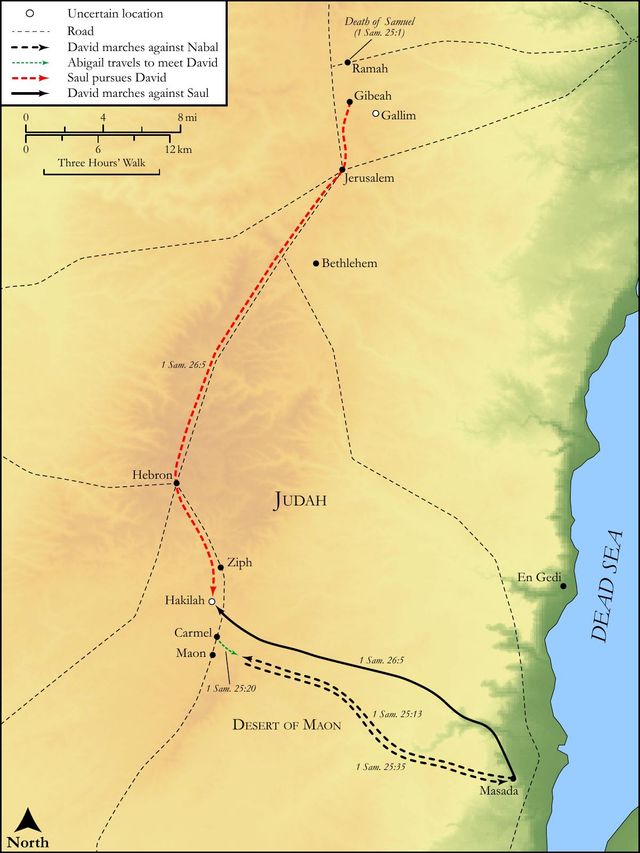
Lastly, A palliative cure being thus made of the wound, they parted friends. Saul returned to Gibeah re infect - without accomplishing his design, and ashamed of the expedition he had made; but David could not take his word so far as to return with him. Those that have once been false are not easily trusted another time. Therefore David went on his way. And, after this parting, it does not appear that ever Saul and David saw one another again.
Historical interpretation
Historical reception
1 surviving comment on this verse from the historical church.
In the case of David also, we read of both good and bad actions. But where David’s strength lay, and what the secret of his success was, is sufficiently plain, not to the blind malevolence with which Faustus assails holy writings and holy men, but to pious discernment, which bows to the divine authority and at the same time judges human conduct correctly. The Manichaeans will find, if they read the Scriptures, that God rebukes David more than Faustus does. But they will read also of the sacrifice of his penitence, of his surpassing gentleness to his merciless and bloodthirsty enemy, whom David, pious as he was brave, dismissed unhurt when now and again he fell into his hands. They will read of his memorable humility under divine chastisement, when the kingly neck was so bowed under the Master’s yoke, that he bore with perfect patience bitter taunts from his enemy, though he was armed and had armed men with him. And when his companion was enraged at such things being said to the king and was on the point of requiting the insult on the head of the scoffer, he mildly restrained him, appealing to the fear of God in support of his own royal order and saying that this bad happened to him as a punishment from God, who had sent the man to curse him.
Continue studying 1 Samuel 26:23 across the web’s major study libraries — every link below opens this exact verse, chapter, or book on the destination site.
Read & Compare
 BibleGatewayThis verse in more than 200 translations and 70 languages.
 Bible.comThe YouVersion reader — hundreds of translations, reading plans, and highlights.
 ESV.orgCrossway's official English Standard Version reader.
 NET BibleThe NET translation with 60,000+ translators' notes on every rendering decision.
 STEP BibleTyndale House's free study tool — original text, vocabulary, and scholarly resources.
 BibliaLogos Bible Software's free web reader.
 USCCBThe New American Bible (Revised Edition) with the U.S. bishops' study notes.
Commentaries
 BibleHub CommentariesDozens of classic commentaries on this verse, gathered on one page.
 StudyLightMore than 100 commentary sets — the largest collection on the web.
 BibleRefPlain-English commentary on what this verse means, verse by verse.
 Enduring WordDavid Guzik's free commentary on this chapter, widely used by Bible teachers.
 Bible Study ToolsVerse commentary alongside Greek and Hebrew study aids.
Original Language & Research
- BibleHub InterlinearThe verse word by word — original language, transliteration, and English.
- BibleHub LexiconEvery word's original-language definition and Strong's entry.
 Blue Letter BibleDeep-study tools — Strong's numbers, concordance, and word studies.
 SefariaThe Hebrew text with Rashi and centuries of Jewish commentary.
Sermons, Hymns & Audio


TrulyRandomVerse is not affiliated with these sites and doesn’t control their content. They’re linked because they’re genuinely useful.
Summary
1 Samuel 26:23 encapsulates David's unwavering trust in God's perfect justice and his profound reverence for divine authority, even when presented with a clear opportunity to eliminate his persecutor, King Saul. This verse serves as a powerful declaration of David's principled refusal to harm "the LORD'S anointed," choosing instead to entrust his vindication and future to God's sovereign hand and righteous judgment, thereby contrasting his character with Saul's vengeful pursuit.
Context
ShowHideLiterary Context
This verse is deeply embedded within the gripping narrative of David's relentless pursuit by King Saul, who, consumed by jealousy and paranoia, seeks to end David's life. It marks the second pivotal instance (the first being in 1 Samuel 24) where David, despite having Saul utterly at his mercy, chooses an extraordinary path of restraint rather than retaliation. In this specific encounter, David, accompanied by his loyal nephew Abishai, daringly infiltrates Saul's sleeping encampment under the cover of night. Instead of striking the vulnerable king, David takes only Saul's spear and water jug – potent symbols of royal authority and life itself – as irrefutable proof of his proximity and forbearance. This audacious act is not an aggression but a profound, non-violent demonstration of David's integrity and his profound respect for God's chosen, albeit fallen, king. Following this, David calls out to Saul from a safe distance, publicly shaming Abner and Saul's elite guard for their dereliction of duty in protecting the king, and then directly addresses Saul, culminating in this profound declaration of his faith and principles.
Historical & Cultural Context
The concept of the "LORD'S anointed" (Hebrew: meshiach Yahweh) was of paramount significance in ancient Israelite society, carrying immense theological and political weight. Kings were not merely secular rulers; they were understood to be divinely chosen, consecrated through the sacred ritual of anointing with oil, which signified a direct appointment by God and endowed them with a unique, sacred status. To physically harm or usurp the king, even a tyrannical or disobedient one, was considered an act of rebellion not merely against the monarch but against God's direct appointment and His sovereign authority. This deeply ingrained cultural and religious understanding profoundly underscored the gravity and radical nature of David's decision. Furthermore, in a society where blood vengeance was a widely accepted and often expected response to perceived wrongs, David's deliberate restraint and his choice to entrust justice to God made his actions all the more remarkable and counter-cultural. The setting in the wilderness of Ziph, a rugged and remote region, further highlights the harsh realities of David's fugitive life, where survival often depended on swift, decisive, and sometimes violent action, making his principled stand even more striking.
Key Themes
ShowHideThis verse powerfully articulates several core themes prevalent throughout the books of Samuel, serving as a theological cornerstone for understanding David's character and God's sovereign plan. It profoundly highlights Divine Sovereignty and Justice, as David explicitly declares his unwavering belief that "the LORD render to every man his righteousness and his faithfulness," thereby entrusting ultimate judgment and vindication entirely to God rather than resorting to personal retaliation. This principle, that vengeance belongs solely to God, is a recurring motif in Scripture, echoed powerfully in passages like Deuteronomy 32:35 and Romans 12:19. The verse also underscores Respect for God-Ordained Authority, even when the authority figure (Saul) is acting in direct opposition to God's will and persecuting the innocent. David's steadfast refusal to harm "the LORD'S anointed" demonstrates a deep reverence for the sacred office itself, irrespective of the occupant's personal failings, a profound respect that would later characterize his own righteous reign. Finally, David's actions exemplify Faithfulness and Integrity, showcasing his unwavering commitment to living by God's principles and patiently waiting on God's perfect timing for his own ascension to the throne, rather than seizing power through violence, treachery, or manipulation. This patient endurance and trust in God's plan are central to David's journey to kingship, as ultimately realized in 2 Samuel 5:3.
Exposition and Analysis
ShowHideKey Word Analysis
ShowHideThis term encompasses far more than mere individual moral uprightness. It refers to a comprehensive standard of justice, integrity, and conformity to a divine norm. When David prays for the LORD to "render to every man his righteousness," he is appealing to God's inherent character as the perfectly just and impartial judge who will ensure that each person receives what is due to them, not merely according to human laws, but according to their actions and their fidelity to His divine covenant. It implies a divine reckoning that rectifies wrongs, rewards uprightness, and brings about divine order.
Derived from a root meaning "to be firm, stable, trustworthy," ʼĕmûwnâh signifies fidelity, steadfastness, and unwavering trustworthiness. David's appeal to God's faithfulness underscores his profound conviction that God will remain true to His promises, His character, and His covenant. It expresses David's belief that God will uphold those who demonstrate fidelity to Him (like David himself) and will deal with those who are unfaithful (like Saul) in accordance with His divine and unchanging order. This word speaks to the reliability and constancy of God's character, providing the very ground for David's trust.
This pivotal term, from which "Messiah" is directly derived, refers to someone consecrated by God for a special, sacred office, typically a king, priest, or prophet, through the ritual of anointing with oil. Saul was specifically designated "the LORD'S anointed" because Samuel had anointed him king at God's explicit command, as recorded in 1 Samuel 10:1. David's refusal to harm Saul was not born of personal affection or fear, but out of a profound, theological reverence for the sacred office and the divine choice that designated Saul as king. He recognized that to strike Saul would be to strike against God's own appointment and prerogative.
Verse Breakdown
ShowHide"The LORD render to every man his righteousness and his faithfulness:"
This opening clause is a profound theological declaration and a prayer, articulating David's deep conviction in God's ultimate sovereignty and justice. He asserts his unwavering belief that God is the supreme arbiter who will unfailingly judge and repay each individual according to their moral conduct, their adherence to His covenant, and their loyalty to Him. David is explicitly entrusting his own vindication, and by implication, Saul's eventual judgment, entirely to God's perfect, righteous, and unwavering hand. This statement underscores David's reliance on divine providence rather than human vengeance.
"for the LORD delivered thee into [my] hand to day,"
Here, David explicitly acknowledges God's sovereign and direct involvement in the immediate situation. He does not view the opportunity to kill Saul as a mere stroke of luck or a coincidence but as a divinely orchestrated moment – a test of his faith and character. This recognition highlights the immense temptation David faced and powerfully underscores the deliberate, principled choice he made against taking advantage of the situation for personal gain, revenge, or to expedite his own ascension to the throne. It emphasizes that David consciously resisted the natural human impulse for retribution, seeing God's hand in both the opportunity and his own restraint.
"but I would not stretch forth mine hand against the LORD'S anointed."
This is the climactic and most pivotal statement of the verse, revealing the very core of David's character, his profound reverence for God, and his understanding of divine authority. Despite Saul's relentless, unjust, and murderous persecution, David adamantly refuses to harm the king because Saul holds a sacred status as God's chosen and consecrated leader. To "stretch forth mine hand" against Saul would have been more than an act of murder; it would have been an act of rebellion against God's established order, a usurpation of God's exclusive prerogative to raise up and depose kings, and an affront to the divine anointing. David's restraint demonstrates extraordinary faith and obedience, prioritizing God's will above his own personal safety or ambition.
Literary Devices
ShowHideThe verse powerfully employs Contrast and Irony to highlight David's character and God's justice. The contrast is stark between Saul's unrighteous and relentless pursuit of David, driven by envy, paranoia, and a desire for vengeance, and David's righteous restraint, driven by profound faith, reverence for God's authority, and a commitment to divine timing. While Saul seeks to violently take David's life, David, when presented with the perfect opportunity, twice refuses to take Saul's. This juxtaposition not only highlights David's moral superiority but also underscores his suitability for kingship, especially when set against Saul's increasingly erratic, disobedient, and unrighteous behavior. The irony lies in the fact that the hunted man (David) twice spares the life of his hunter (Saul), demonstrating a higher moral ground and a deeper understanding of divine justice and sovereignty than the reigning king. Furthermore, the entire scene, culminating in this powerful declaration, functions as a Theological Declaration, where David articulates his worldview firmly rooted in God's ultimate justice and sovereignty, serving as a didactic moment within the narrative that instructs both Saul and the reader about the nature of true leadership and faith.
Theological and Thematic Connections
ShowHide1 Samuel 26:23 is a profound theological statement on divine justice, human responsibility, and the sacred nature of God-ordained authority. David's actions and words demonstrate a radical and exemplary trust in God's perfect timing and His ultimate vindication. He embodies the understanding that vengeance belongs solely to the Lord, and that God, in His perfect righteousness, will unfailingly render to each person according to their deeds and their faithfulness. This profound principle liberates David from the destructive burden of personal retaliation, enabling him to act with extraordinary integrity, mercy, and patience, even towards his mortal enemy. His unwavering respect for "the LORD'S anointed," despite Saul's manifest unworthiness and his active persecution, powerfully highlights the sacredness of God's appointments and the profound gravity of interfering with His sovereign will and established order. This verse thus serves as a powerful testament to the transformative power of living by faith, demonstrating patient endurance, and upholding righteousness even under the most severe and unjust provocation.
Reflection and Application
ShowHideDavid's principled stand in 1 Samuel 26:23 offers timeless and deeply challenging lessons for believers navigating personal conflicts, injustices, and the complexities of human authority. It calls us to cultivate a profound and active trust in God's ultimate justice, reminding us that He sees all, knows all, and will perfectly render to each person according to their righteousness and faithfulness. This divine perspective frees us from the consuming and destructive impulse of revenge, encouraging us instead to extend grace, mercy, and forgiveness even to those who deeply wrong us, knowing with certainty that God is our ultimate vindicator and judge. Furthermore, David's remarkable respect for Saul's office, despite Saul's personal failings and malicious intent, prompts us to critically examine our own attitudes toward authority figures in various spheres of life—whether in government, the church, our workplaces, or even within our families. While we are unequivocally called to speak truth, uphold justice, and stand against evil, David's example teaches us the profound importance of honoring the position or institution, even when the individual occupying it is flawed, corrupt, or acting unjustly, trusting God to deal with their unrighteousness in His perfect timing and according to His sovereign will. This passage is a powerful call to patience, unwavering integrity, and steadfast faith in God's sovereign plan, even when our circumstances seem to demand immediate, self-serving, or retaliatory action.
Questions for Reflection
ShowHideFAQ
ShowHideWhy did David refer to Saul as "the LORD'S anointed" when Saul was clearly acting against God's will?
ShowHideDavid's reference to Saul as "the LORD'S anointed" (Hebrew: meshiach Yahweh) was not an endorsement of Saul's current behavior, his moral character, or his unrighteous actions. Rather, it was a profound recognition of Saul's sacred and divinely appointed office. Saul had been personally chosen and consecrated by God through the prophet Samuel (1 Samuel 10:1) to be the first king of Israel. For David, to lay violent hands on Saul, even in self-defense or as an act of personal justice, would have been an act of rebellion against God's sovereign appointment and an usurpation of divine prerogative. David understood that God alone had the ultimate right to raise up and cast down kings. His respect was for the office and God's ordination of it, not for the man's personal conduct, thereby demonstrating an extraordinary reverence for divine authority and a deep commitment to waiting for God's timing for the transfer of power.
What is the significance of David taking Saul's spear and water cruse?
ShowHideThe act of David taking Saul's spear and water cruse was highly symbolic and served as irrefutable evidence of his forbearance. The spear was not merely a weapon; it was a potent symbol of Saul's royal authority, military power, and kingship, often kept at his head while he slept to signify his readiness for battle and his status as the nation's leader. The water cruse, on the other hand, represented his life, sustenance, and vulnerability. By stealthily taking these items, David demonstrated beyond any doubt that he had been in an intimate position to kill Saul, to strip him of his power, and to end his life, yet he deliberately chose not to. These objects served as undeniable, tangible proof to Saul and his men that David had been within striking distance but had consciously and principledly refrained from harming "the LORD'S anointed." It was a non-violent, yet profoundly powerful, statement of David's innocence, his integrity, and his unwavering respect for God's established order, standing in stark contrast to Saul's murderous intent.
Christ-Centered Fulfillment
ShowHideDavid's extraordinary refusal to "stretch forth mine hand against the LORD'S anointed" in 1 Samuel 26:23 serves as a profound and compelling foreshadowing of the ultimate Anointed One, Jesus Christ, who perfectly embodies divine righteousness and absolute faithfulness. Just as David, the future king, would not usurp God's timing or method for establishing his reign, so too did Jesus, the true King of Kings, steadfastly refuse to seize earthly power through violence, political maneuvering, or self-assertion. Though He possessed infinite power and could have summoned "more than twelve legions of angels" (Matthew 26:53) to defend Himself, Jesus willingly submitted Himself to the Father's perfect will, even to the ignominious and agonizing death on a cross (Philippians 2:8). He did not come into the world to condemn it, but to save it through His self-sacrificial love (John 3:17), thereby demonstrating supreme faithfulness to God's redemptive plan. Indeed, the Father has perfectly "rendered to every man his righteousness and his faithfulness" through Christ's atoning sacrifice, where the perfect righteousness of Christ is graciously imputed to all who believe (2 Corinthians 5:21). Jesus, the spotless Lamb of God, did not "stretch forth His hand" in vengeance or self-preservation, but willingly gave Himself up, trusting God for His vindication, resurrection, and ultimate exaltation (Acts 2:24). David's principled restraint, born of deep reverence for God's anointed, finds its ultimate and perfect fulfillment in Christ's unparalleled self-sacrificial love, His unwavering submission to the divine will, and the establishment of His eternal kingdom, which is "not of this world" (John 18:36).