


1 Samuel 24:7
Bible text: King James Version (1769 Blayney text) · Public domain
Bible text: King James Version with Strong's numbers · Public domain
Bible text: Berean Standard Bible · Public domain
Bible text: American Standard Version (1901) · Public domain
Bible text: World English Bible, Messianic edition · Public domain
Bible text: Geneva Bible (1599) · Public domain
Bible text: Young's Literal Translation · Public domain
- וַיְשַׁסַּעvay·sha·Sa'and he reprimandedH8156Conj-w ¦ V-Piel-ConsecImperf-3msVerb Piel Consecutive Imperfect 3rd Singular Masculineוַandיְשַׁסַּעhe reprimanded
- דָּוִדda·VidDavidH1732N-proper-mNoun Proper Masculine
- אֶת'et<obj.>H853DirObjMParticle Object Indicator
- אֲנָשָׁיו'a·na·Shavhis menH582N-mpc ¦ 3msNoun Plural Masculine Constructאֲנָשָׁיmenוhis
- בַּדְּבָרִיםba·de·va·Rimby the wordsH1697Prep-b ¦ N-mpNoun Plural Masculine Absoluteבַּby theדְּבָרִיםwords
- וְלֹאve·Lo'and notH3808Conj-w ¦ NegParticle Negativeוְandלֹאnot
- נְתָנָםne·ta·Namhe permitted themH5414V-Qal-Perf-3ms ¦ 3mpVerb Qal Perfect 3rd Singular Masculineנְתָנָhe permittedםthem
- לָקוּםla·Kumto rise upH6965Prep-l ¦ V-Qal-InfVerb Qal Infinitive Constructלָtoקוּםrise up
- אֶל'elagainstH413PrepPreposition
- שָׁאוּלsha·'UlSaulH7586N-proper-mNoun Proper Masculine
- וְשָׁאוּלve·sha·'Uland SaulH7586Conj-w ¦ N-proper-mNoun Proper MasculineוְandשָׁאוּלSaul
- קָםkamhe aroseH6965V-Qal-Perf-3msVerb Qal Perfect 3rd Singular Masculine
- מֵהַמְּעָרָהme·ha·me·'a·Rahfrom the caveH4631Prep-m ¦ Art ¦ N-fsNoun Singular Feminine Absoluteמֵfromהַtheמְּעָרָהcave
- וַיֵּלֶךְvai·Ye·lekhand he wentH1980Conj-w ¦ V-Qal-ConsecImperf-3msVerb Qal Consecutive Imperfect 3rd Singular Masculineוַandיֵּלֶךְhe went
- בַּדָּרֶךְba·Da·rekhon the wayH1870Prep-b ¦ N-csNoun Singular common gender Absoluteבַּon theדָּרֶךְway
English is a literal word-by-word gloss of the Hebrew, not the KJV's wording. Why?
This is the original text the KJV's translators worked from — each Hebrew word with its own literal English meaning in this verse, prepared by scholars at Tyndale House, Cambridge. The KJV translates whole sentences, not word by word, so its wording differs: one Hebrew word can become several English words, and the KJV may choose “the LORD” where the gloss reads “Yahweh”. Both are faithful — they answer different questions. For the KJV's own rendering, switch to the KJV text.
Details
See on the biblical-era map
Study this verse
Public-domain commentary
Matthew Henry
From his Commentary on the Whole Bible. Henry comments on passages, not single verses — this entry covers 1 Samuel 24:1–8. His two-level outline is real structure in the source text, so it is rendered as structure.
Here, I. Saul renews his pursuit of David, Sa1 24:1, Sa1 24:2. No sooner had he come home safely from chasing the Philistines, in which it should seem he had good success, than he enquired after David to do him a mischief, and resolved to have another thrust at him, as if he had been delivered to do all these abominations, Jer 7:10. By the frequent incursions of the Philistines, he might have seen how necessary it was to recall David from his banishment and restore him to his place in the army again; but so far is he from doing this that now more than ever he is exasperated against him, and, hearing that he is in the wilderness of En-gedi, he draws out 3000 choice men, and goes with them at his feet in pursuit of him upon the rocks of the wild goats, where, one would think, David should not have been envied a habitation nor Saul desirous of disturbing him; for what harm could he fear from one who was no better accommodated? But it is not enough for Saul that David is thus cooped up; he cannot be easy while he is alive.
II.Providence brings Saul alone into the same cave wherein David and his men had hidden themselves, Sa1 24:3.
In those countries there were very large caves in the sides of the rocks or mountains, partly natural, but probably much enlarged by art for the sheltering of sheep from the heat of the sun; hence we read of places where the flocks did rest at noon (Sol 1:7), and this cave seems to be spoken of as one of the sheep-cotes. In the sides of this cave David and his men remained, perhaps not all his men, the whole 600, but only some few of his particular friends, the rest being disposed of in similar retirements. Saul, passing by, turned in himself alone, not in search of David (for, supposing him to be an aspiring ambitious man, he thought to find him rather climbing with the wild goats upon the rocks than retiring with the sheep into a cave), but thither he turned aside to cover his feet, that is, to sleep awhile, it being a cool and quiet place, and very refreshing in the heat of the day; probably he ordered his attendants to march before, reserving only a very few to wait for him at the mouth of the cave. Some by the covering of the feet understand the easing of nature, and think that this was Saul's errand into the cave: but the former interpretation is more probable.
III.David's servants stir him up to kill Saul now that he has so fair an opportunity to do it, Sa1 24:4.
They reminded him that this was the day which he had long looked for, and of which God had spoken to him in general when he was anointed to the kingdom, which should put a period to his troubles and open the passage to his advancement. Saul now lay at his mercy, and it was easy to imagine how little mercy he would find with Saul and therefore what little reason he had to show mercy to him. "By all means" (say his servants) "give him the fatal blow now." See how apt we are to misunderstand,
1.The promises of God. God had assured David that he would deliver him from Saul, and his men interpret this as a warrant to destroy Saul.
2.The providences of God. Because it was now in his power to kill him, they concluded he might lawfully do it.
IV.David cut off the skirt of his robe, but soon repented that he had done this:
His heart smote him for it (Sa1 24:5); though it did Saul no real hurt, and served David for a proof that it was in his power to have killed him (Sa1 24:11), yet, because it was an affront to Saul's royal dignity, he wished he had not done it. Note, It is a good thing to have a heart within us smiting us for sins that seem little; it is a sign that conscience is awake and tender, and will be the means of preventing greater sins.
V.He reasons strongly both with himself and with his servants against doing Saul any hurt.
1.He reasons with himself (Sa1 24:6): The Lord forbid that I should do this thing. Note, Sin is a thing which it becomes us to startle at, and to resist the temptations to, not only with resolution, but with a holy indignation. He considered Saul now, not as his enemy, and the only person that stood in the way of his preferment (for then he would be induced to hearken to the temptation), but as God's anointed (that is, the person whom God had appointed to reign as long as he lived, and who, as such, was under the particular protection of the divine law), and as his master, to whom he was obliged to be faithful. Let servants and subjects learn hence to be dutiful and loyal, whatever hardships are put upon them, Pe1 2:18.
2.He reasons with his servants: He suffered them not to rise against Saul, Sa1 24:7. He would not only not do this evil thing himself, but he would not suffer those about him to do it. Thus did he render good for evil to him from whom he had received evil for good, and was herein both a type of Christ, who saved his persecutors, and an example to all Christians not to be overcome of evil, but to overcome evil with good.
VI.He followed Saul out of the cave, and, though he would not take the opportunity to slay him, yet he wisely took the opportunity, if possible, to slay his enmity, by convincing him that he was not such a man as he took him for.
1.Even in showing his head now he testified that he had an honourable opinion of Saul. He had too much reason to believe that, let him say what he would, Saul would immediately be the death of him as soon as he saw him, and yet he bravely lays aside that jealousy, and thinks Saul so much a man of sense as to hear his reasoning when he had so much to say in his own vindication and such fresh and sensible proofs to give of his own integrity.
2.His behaviour was very respectful: He stooped with his face to the earth, and bowed himself, giving honour to whom honour was due, and teaching us to order ourselves lowly and reverently to all our superiors, even to those that have been most injurious to us.
Historical interpretation
Three Centuries of Reception
4 surviving comments on this verse. Each one is dated, so this reads as a timeline rather than a list.
Select a marker to jump to its quote. Markers stagger vertically where authors wrote within a few decades of each other.
What a virtuous action that was, when David wished rather to spare the king his enemy, though he could have injured him! How useful, too, it was, for it helped him when he succeeded to the throne. For all learned to be faithful to their king and not to seize the kingdom but to fear and reverence him. Thus what is virtuous was preferred to what was useful, and then usefulness followed on what was virtuous.
It was not without God’s influence, you see, that he [David] succeeded in prevailing over those frenzied men [his soldiers who wished to kill Saul]: the grace of God was found on the inspired man’s lips, adding a sort of inducement to those words. It was, however, no slight contribution that David also made: since he had formed them in the past, consequently in the critical moment he found them ready and willing. It was not as leader of troops, you see, but as priest he commanded them, and that cave was a church on that occasion: like someone appointed as bishop, he delivered a homily to them, and after this homily he offered a kind of remarkable and unusual sacrifice, not sacrificing a calf, not slaying a lamb, but—what was of greater value than these—he offered to God gentleness and clemency, sacrificing irrational resentment, slaying anger and mortifying the limbs that are on the earth. He acted as victim, priest and altar: everything came from him—the thought that offered gentleness and clemency, the clemency and gentleness and the heart in which they were offered.
Moreover, Saul rising from the cave, etc. The keepers of the Lord's tomb, who, having fallen prostrate through fear of the approaching angel and had become like dead men, and fleeing from the tomb, nonetheless continued the evil schemes against the Lord, saying that his disciples had come at night and stolen him away while they were sleeping. Which can also be rightly understood of those who placed guards at the tomb (Matthew XXVIII); who, even though they withdrew from guarding the tomb of the Lord with groans and confusion, nonetheless did not turn away from their intent of persecuting his faith with raging steps. With these both having been driven away from the watch of the tomb, the Lord himself did not delay to gradually reveal the glory of his resurrection, which he had assumed secretly, to his followers. And with this truth confirmed and taught, soon through them thundered the proclamation of free preaching, calling back benignly to the remedy of repentance and his love those who had turned away from him, his persecutors. To those whom he reconciled to himself with the first words of humanity and piety, he diligently taught some of them to look back after him, that is, to repent of their crime against God.
And David restrained his men with his words, etc. And the Lord restrained the severity of his disciples, who wished the impious to perish, by saying: Do not judge, and you will not be judged (Matthew VII). Do not condemn, and you will not be condemned (Luke VI). And elsewhere: For God did not send his Son into the world to judge the world, but that the world might be saved through him (John III), and so on of this kind, and he did not permit them to take immediate vengeance on the wrongdoers, but rather to love the correction of those who amend their ways.
Continue studying 1 Samuel 24:7 across the web’s major study libraries — every link below opens this exact verse, chapter, or book on the destination site.
Read & Compare
 BibleGatewayThis verse in more than 200 translations and 70 languages.
 Bible.comThe YouVersion reader — hundreds of translations, reading plans, and highlights.
 ESV.orgCrossway's official English Standard Version reader.
 NET BibleThe NET translation with 60,000+ translators' notes on every rendering decision.
 STEP BibleTyndale House's free study tool — original text, vocabulary, and scholarly resources.
 BibliaLogos Bible Software's free web reader.
 USCCBThe New American Bible (Revised Edition) with the U.S. bishops' study notes.
Commentaries
 BibleHub CommentariesDozens of classic commentaries on this verse, gathered on one page.
 StudyLightMore than 100 commentary sets — the largest collection on the web.
 BibleRefPlain-English commentary on what this verse means, verse by verse.
 Enduring WordDavid Guzik's free commentary on this chapter, widely used by Bible teachers.
 Bible Study ToolsVerse commentary alongside Greek and Hebrew study aids.
Original Language & Research
- BibleHub InterlinearThe verse word by word — original language, transliteration, and English.
- BibleHub LexiconEvery word's original-language definition and Strong's entry.
 Blue Letter BibleDeep-study tools — Strong's numbers, concordance, and word studies.
 SefariaThe Hebrew text with Rashi and centuries of Jewish commentary.
Sermons, Hymns & Audio


TrulyRandomVerse is not affiliated with these sites and doesn’t control their content. They’re linked because they’re genuinely useful.
Summary
1 Samuel 24:7 captures a pivotal moment in the wilderness of Engedi, where David, despite having a clear opportunity to eliminate his persecutor, King Saul, actively restrains his eager men from harming the Lord's anointed. This verse powerfully illustrates David's profound reverence for God's sovereign choice, his remarkable self-control, and his unwavering trust in divine justice, choosing to wait on God's timing rather than taking vengeance into his own hands. His actions demonstrate a deep spiritual maturity that prioritizes divine principles over personal expediency, setting a profound example of righteous leadership.
Context
ShowHideLiterary Context
This verse is deeply embedded within the dramatic narrative of David's flight from Saul, specifically following the intense encounter in the cave of Engedi. Immediately preceding this verse, David and his men are hiding when Saul, unaware of their presence, enters the very cave to relieve himself. David's men, interpreting this as a divinely provided opportunity, urge him to kill Saul, referencing the Lord's implied promise to deliver his enemy into his hand. However, David, after secretly cutting off a corner of Saul's robe, is immediately conscience-stricken, lamenting that he had "put forth his hand against the Lord's anointed" as recorded in 1 Samuel 24:6. Verse 7 then describes David's decisive intervention, not only preventing himself but also his zealous followers from acting on their vengeful impulses, thereby reinforcing his profound respect for God's established authority and his commitment to a higher moral standard. This pivotal moment underscores David's unique character as a man after God's own heart, contrasting sharply with Saul's increasingly erratic and disobedient behavior.
Historical & Cultural Context
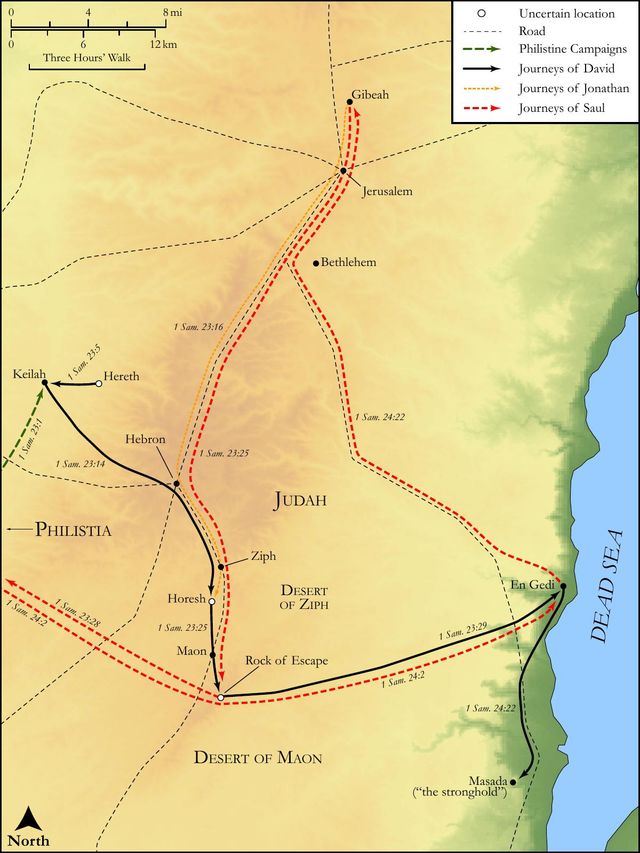
The events unfold in the wilderness of Engedi, a rugged, arid region near the Dead Sea, characterized by numerous caves and difficult terrain, making it an ideal hiding place for David and his 600 men. King Saul, as the reigning monarch, held a divinely sanctioned position, despite God's regret over making him king due to his persistent disobedience, as highlighted in 1 Samuel 15:10-11. The concept of "the Lord's anointed" (Hebrew: mashiaḥ YHWH) was central to ancient Israelite kingship, signifying that the king was God's chosen representative, consecrated by divine appointment. To harm him, even a flawed king like Saul, was considered an act of rebellion against God Himself. David's actions reflect a deep understanding and reverence for this sacred office, even when the office-holder was personally corrupt and actively seeking his life. This context highlights the immense pressure David was under to act, both from his men and the circumstances, making his restraint all the more remarkable and a testament to his profound theological conviction.
Key Themes
ShowHideThis verse powerfully contributes to several overarching themes in 1 Samuel and the broader biblical narrative. Firstly, it underscores the theme of Reverence for God's Anointed, demonstrating David's unwavering respect for God's sovereign choice in Saul, despite Saul's malicious intent. This highlights the sanctity of divine appointments, even when the human vessel is deeply flawed, and the principle that vengeance belongs to God alone, as later affirmed in Romans 12:19. Secondly, it showcases Self-Control and Moral Leadership, as David not only restrains his own hand but also actively "stayed his servants," preventing them from carrying out an act of revenge. This exemplifies strong moral leadership and personal discipline in the face of immense provocation, a stark contrast to Saul's impulsive and disobedient character. Thirdly, David's actions reflect a profound Trust in Divine Justice and Timing, demonstrating his conviction that God would ultimately deal with Saul and establish His own chosen king in His own time, a sentiment echoed in Psalm 37:7. He refused to take matters into his own hands, choosing to wait on the Lord's timing. Finally, it speaks to the theme of Patience and Endurance, underscoring David's remarkable ability to endure Saul's relentless persecution without resorting to violence, a testament to his reliance on God's plan rather than human intervention.
Exposition and Analysis
ShowHideKey Word Analysis
ShowHideThis verb means "to split or tear," but also figuratively "to upbraid" or "to stay" in the sense of holding back or restraining. In this context, it signifies David's forceful and authoritative action to prevent his men from moving forward with their plan to attack Saul. It implies a decisive intervention that effectively halted their vengeful intentions, demonstrating David's immediate and firm control over his eager followers.
This term refers to "a word," but by implication, it can also mean a "matter," "thing," "affair," or "commandment." Here, "these words" refer to David's powerful and conviction-filled declaration in the preceding verse (1 Samuel 24:6) about the sanctity of the Lord's anointed. It highlights that David's restraint was not merely physical but was rooted in a verbal articulation of deep theological principle, conveying authority and moral clarity.
This phrase uses the negative particle with the verb H5414, nâthan, which means "to give," "to allow," or "to permit." Therefore, "suffered them not" means David "did not permit them" or "did not give them leave" to rise against Saul. This reinforces the active and authoritative nature of David's intervention, emphasizing that he not only spoke words of restraint but also actively withheld permission and opportunity for his men to act, demonstrating his firm resolve and the extent of his control.
Verse Breakdown
ShowHide"So David stayed his servants with these words,"
This clause immediately establishes David's proactive and authoritative role in preventing bloodshed. Having just experienced a profound internal conviction after merely cutting Saul's robe, David turns his attention to his eager and vengeful men. The phrase "with these words" refers to his earlier declaration in 1 Samuel 24:6 about the sanctity of "the Lord's anointed." This highlights David's moral conviction and his ability to exert strong, righteous leadership over his followers, even when their natural inclination was towards immediate retaliation. His verbal command was potent enough to halt their intentions.
"and suffered them not to rise against Saul."
This phrase reiterates and strengthens the previous one, emphasizing the complete and decisive prevention of any hostile action. David not only spoke words of restraint but actively ensured that his men did not physically "rise against" or attack Saul. This underscores the depth of David's commitment to honoring God's appointed king, even in the face of extreme provocation and personal danger. His actions here are a testament to his faith that God would ultimately deliver justice without his unlawful intervention, demonstrating a profound trust in divine sovereignty.
"But Saul rose up out of the cave, and went on [his] way."
This concluding clause starkly contrasts David's profound moral struggle and restraint with Saul's complete unawareness and continued pursuit. Saul, entirely oblivious to the mortal danger he had just been in and the remarkable grace extended to him, simply exits the cave and continues his journey. This highlights the divine protection over Saul (due to David's obedience) and the profound irony of the situation: the hunter was unknowingly at the mercy of the hunted, yet was spared by the very man he sought to destroy. It also emphasizes the immediate consequence of David's obedience – Saul's life was preserved, and the narrative of David's patient waiting for God's timing continued.
Literary Devices
ShowHideThe passage is rich in literary devices that enhance its theological and narrative impact. Irony is profoundly present, as Saul, the powerful king, is unknowingly vulnerable in the cave, completely at the mercy of David, the fugitive he relentlessly pursues. This dramatic reversal of power dynamics underscores divine sovereignty at play, where God protects the "anointed" even through the obedience of the one being persecuted. There is also a strong Contrast between David's profound reverence for God's anointed and Saul's unholy obsession with destroying David, as well as between David's self-control and his men's vengeful impulses. The Symbolism of the cave itself is significant; it represents a place of hidden danger, a potential tomb for Saul, but also a crucible for David's character, where his faith, obedience, and moral leadership are tested and proven. David's act of cutting Saul's robe, though regretted, serves as a subtle Foreshadowing of the eventual transfer of the kingdom from Saul to David, a symbolic "cutting off" of Saul's reign, but one that David refuses to hasten by unlawful means, demonstrating his commitment to God's timing.
Theological and Thematic Connections
ShowHide1 Samuel 24:7 powerfully illustrates the biblical principle of respecting God-ordained authority, even when that authority is flawed, abusive, or actively hostile. David's refusal to "put forth his hand against the Lord's anointed" is not merely political pragmatism but a deep theological conviction that vengeance and the removal of a divinely appointed leader belong to God alone. This act of restraint demonstrates a profound trust in God's sovereignty and His perfect timing, affirming that God is capable of bringing about His purposes without human beings resorting to sinful or premature actions. It challenges believers to submit to governing authorities, even imperfect ones, and to trust God to work justice in His way and time, rather than taking matters into their own hands. This principle finds broad application in the Christian life, calling for patience, humility, and faith in God's ultimate justice.
Reflection and Application
ShowHideDavid's actions in 1 Samuel 24:7 provide a timeless model for believers navigating difficult relationships and oppressive circumstances. In a world that often champions immediate retaliation, self-assertion, and taking justice into one's own hands, David's profound restraint stands as a counter-cultural testament to faith. It calls us to exercise self-control and patience, especially when dealing with those in authority, even if they are unjust or misguided. This passage encourages us to trust in God's ultimate sovereignty and His perfect timing to right wrongs, rather than resorting to actions that might violate His principles or bring dishonor to His name. True spiritual leadership, as exemplified by David, often involves demonstrating righteous behavior and guiding others away from sin, even when it is personally costly or unpopular. It reminds us that our battles are ultimately God's, and our role is to obey and wait, trusting that He will vindicate His people and fulfill His promises in His own way. This principle of non-retaliation and trust in divine justice is a cornerstone of Christian ethics, inviting us to reflect Christ's character in our responses to adversity.
Questions for Reflection
ShowHideFAQ
ShowHideWhy didn't David kill Saul if God had delivered him into his hand?
ShowHideWhile David's men interpreted the situation as God "delivering" Saul into David's hand, David understood that God's method of establishing him as king would not involve him unlawfully taking the life of "the Lord's anointed." David's profound reverence for God's sovereign choice meant he would not hasten God's plan through an act of murder or rebellion against the existing, albeit flawed, king. He believed that God, who had appointed Saul, would also remove him in His own time and way, without David having to defile himself or God's sacred institution of kingship. This demonstrated David's deep faith and his commitment to God's moral law, even when it seemed counter-intuitive to his immediate advantage. David's conviction is explicitly stated in 1 Samuel 24:6 and reiterated in 1 Samuel 26:9-11.
Was Saul truly "the Lord's anointed" if he was persecuting David and disobeying God?
ShowHideYes, Saul remained "the Lord's anointed" in terms of his divinely appointed office, even though God had rejected him as king due to his disobedience, as clearly stated in 1 Samuel 15:23. The anointing oil symbolized a sacred, irrevocable consecration to a specific office by God. While God had chosen David to succeed Saul and had withdrawn His Spirit from Saul, Saul still held the position of king, and David recognized the sanctity of that office, regardless of the man occupying it. David's respect was for the office and God's appointment, not for Saul's character or actions. This distinction is crucial for understanding David's profound spiritual maturity and his commitment to God's established order and sovereignty.
Christ-Centered Fulfillment
ShowHideDavid's profound restraint and reverence for "the Lord's anointed" in 1 Samuel 24:7 powerfully foreshadow the ultimate "Anointed One," Jesus Christ, and His perfect submission to the Father's will, even in the face of injustice and suffering. David, though tempted to seize earthly power, refused to put forth his hand against Saul; similarly, Jesus, though possessing all power and authority, willingly submitted to the unjust actions of human authorities and the divine plan of redemption. When Peter attempted to defend Him with a sword in Gethsemane, Jesus commanded, "Put your sword back into its place, for all who take the sword will perish by the sword" (Matthew 26:52). He further declared that He could have called "more than twelve legions of angels" for His defense (Matthew 26:53), but He chose the path of suffering and non-retaliation, trusting the Father's perfect timing and justice. Just as David waited for God to establish his kingdom, Jesus patiently endured the cross, knowing that His ultimate vindication and enthronement would come through resurrection and ascension, not through human rebellion or violence. David's act of sparing Saul, the flawed king, points to Christ's ultimate act of self-sacrifice, where the perfect King allows Himself to be "slain" by sinful humanity, thereby conquering sin and death and establishing an eternal kingdom, fulfilling the very purpose of His anointing as the true Messiah, the Lamb of God who takes away the sin of the world.