


1 Samuel 26:24
Bible text: King James Version (1769 Blayney text) · Public domain
Bible text: King James Version with Strong's numbers · Public domain
Bible text: Berean Standard Bible · Public domain
Bible text: American Standard Version (1901) · Public domain
Bible text: World English Bible, Messianic edition · Public domain
Bible text: Geneva Bible (1599) · Public domain
Bible text: Young's Literal Translation · Public domain
- וְהִנֵּהve·hi·Nehand here!H2009Conj-w ¦ PrtParticle Interjectionוְandהִנֵּהhere!
- כַּאֲשֶׁרka·'a·Sherjust asH834Prep-k ¦ RelParticle Relativeכַּjustאֲשֶׁרas
- גָּדְלָהga·de·Lahit was greatH1431V-Qal-Perf-3fsVerb Qal Perfect 3rd Singular Feminine
- נַפְשְׁךָnaf·she·Khayour lifeH5315N-fsc ¦ 2msNoun Singular Feminine Constructנַפְשְׁlifeךָyour
- הַיּוֹםhai·Yomthe dayH3117Art ¦ N-msNoun Singular Masculine Absoluteהַtheיּוֹםday
- הַזֶּהha·Zeh<the> thisH2088Art ¦ PrtParticle Demonstrativeהַ<the>זֶּהthis
- בְּעֵינָיbe·'ei·Naiin my viewH5869Prep-b ¦ N-fdc ¦ 1csNoun Dual Feminine Constructבְּinעֵינָviewיmy
- כֵּןkensoH3651AdvAdverb
- תִּגְדַּלtig·Dalmay it be greatH1431V-Qal-Imperf-3fsVerb Qal Imperfect 3rd Singular Feminine
- נַפְשִׁיnaf·Shimy lifeH5315N-fsc ¦ 1csNoun Singular Feminine Constructנַפְשִׁlifeיmy
- בְּעֵינֵיbe·'ei·Neiin [the] eyes ofH5869Prep-b ¦ N-fdcNoun Dual Feminine Constructבְּinעֵינֵי[the] eyes of
- יְהוָהYah·wehYahwehH3068N-properNoun Proper Title
- וְיַצִּלֵנִיve·ya·tzi·Le·niand may he deliver meH5337Conj-w ¦ V-Hiphil-Imperf-3ms ¦ 1csVerb Hiphil Imperfect 3rd Singular Masculineוְandיַצִּלֵmay he deliverנִיme
- מִכָּלmi·kolfrom everyH3605Prep-m ¦ N-mscNoun Singular Masculine Constructמִfromכָּלevery
- צָרָהtza·RahtroubleH6869N-fsNoun Singular Feminine Absolute
English is a literal word-by-word gloss of the Hebrew, not the KJV's wording. Why?
This is the original text the KJV's translators worked from — each Hebrew word with its own literal English meaning in this verse, prepared by scholars at Tyndale House, Cambridge. The KJV translates whole sentences, not word by word, so its wording differs: one Hebrew word can become several English words, and the KJV may choose “the LORD” where the gloss reads “Yahweh”. Both are faithful — they answer different questions. For the KJV's own rendering, switch to the KJV text.
Details
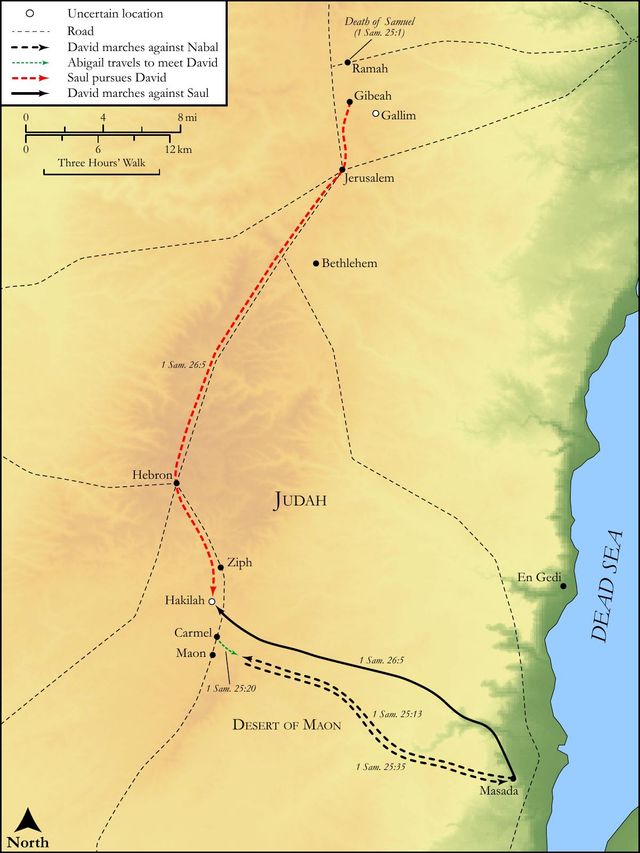
See on the biblical-era map
Study this verse
Public-domain commentary
Matthew Henry
From his Commentary on the Whole Bible. Henry comments on passages, not single verses — this entry covers 1 Samuel 26:21–25. His two-level outline is real structure in the source text, so it is rendered as structure.
Here is, I. Saul's penitent confession of his fault and folly in persecuting David and his promise to do so no more. This second instance of David's respect to him wrought more upon him than the former, and extorted from him better acknowledgements, Sa1 26:21. 1. He owns himself melted and quite overcome by David's kindness to him: "My soul was precious in thy eyes this day, which, I thought, had been odious!" 2. He acknowledges he has done very wrong to persecute him, that he has therein acted against God's law (I have sinned), and against his own interest (I have played the fool), in pursuing him as an enemy who would have been one of his best friends, if he could but have thought so. "Herein (says he) I have erred exceedingly, and wronged both thee and myself." Note, Those that sin play the fool and err exceedingly, those especially that hate and persecute God's people, Job 19:28. 3. He invites him to court again: Return, my son David. Those that have understanding will see it to be their interest to have those about them that behave themselves wisely, as David did, and have God with them. 4. He promises him that he will not persecute him as he has done, but protect him: I will no more do thee harm. We have reason to think, according to the mind he was now in, that he meant as he said, and yet neither his confession nor his promise of amendment came from a principle of true repentance.
II.David's improvement of Saul's convictions and confessions and the evidence he had to produce of his own sincerity.
He desired that one of the footmen might fetch the spear (Sa1 26:22), and then (Sa1 26:23),
1.He appeals to God as judge of the controversy: The Lord render to every man his righteousness. David, by faith, is sure that he will do it because he infallibly knows the true characters of all persons and actions and is inflexibly just to render to every man according to his work, and, by prayer, he desires he would do it. Herein he does, in effect, pray against Saul, who had dealt unrighteously and unfaithfully with him (Give them according to their deeds, Psa 28:4); but he principally intends it as a prayer for himself, that God would protect him in his righteousness and faithfulness, and also reward him, since Saul so ill requited him.
2.He reminds Saul again of the proof he had now given of his respect to him from a principle of loyalty: I would not stretch forth my hand against the Lord's anointed, intimating to Saul that the anointing oil was his protection, for which he was indebted to the Lord and ought to express his gratitude to him (had he been a common person David would not have been so tender of him), perhaps with this further implication, that Saul knew, or had reason to think, David was the Lord's anointed too, and therefore, by the same rule, Saul ought to be as tender of David's life as David had been of his.
3.Not relying much upon Saul's promises, he puts himself under God's protection and begs his favour (Sa1 26:24): "Let my life be much set by in the eyes of the Lord, how light soever thou makest of it." Thus, for his kindness to Saul, he takes God to be his paymaster, which those may with a holy confidence do that do well and suffer for it.
III.Saul's prediction of David's advancement.
He commends him (Sa1 26:25): Blessed be thou, my son David. So strong was the conviction Saul was now under of David's honesty that he was not ashamed to condemn himself and applaud David, even in the hearing of his own soldiers, who could not but blush to think that they had come out so furiously against a man whom their master, when he meets him, caresses thus. He foretels his victories, and his elevation at last: Thou shalt do great things. Note, Those who make conscience of doing that which is truly good may come, by the divine assistance, to do that which is truly great. He adds, "Thou shalt also still prevail, more and more," he means against himself, but is loth to speak that out. The princely qualities which appeared in David - his generosity in sparing Saul, his military authority in reprimanding Abner for sleeping, his care of the public good, and the signal tokens of God's presence with him - convinced Saul that he would certainly be advanced to the throne at last, according to the prophecies concerning him.
Lastly, A palliative cure being thus made of the wound, they parted friends. Saul returned to Gibeah re infect - without accomplishing his design, and ashamed of the expedition he had made; but David could not take his word so far as to return with him. Those that have once been false are not easily trusted another time. Therefore David went on his way. And, after this parting, it does not appear that ever Saul and David saw one another again.
Continue studying 1 Samuel 26:24 across the web’s major study libraries — every link below opens this exact verse, chapter, or book on the destination site.
Read & Compare
 BibleGatewayThis verse in more than 200 translations and 70 languages.
 Bible.comThe YouVersion reader — hundreds of translations, reading plans, and highlights.
 ESV.orgCrossway's official English Standard Version reader.
 NET BibleThe NET translation with 60,000+ translators' notes on every rendering decision.
 STEP BibleTyndale House's free study tool — original text, vocabulary, and scholarly resources.
 BibliaLogos Bible Software's free web reader.
 USCCBThe New American Bible (Revised Edition) with the U.S. bishops' study notes.
Commentaries
 BibleHub CommentariesDozens of classic commentaries on this verse, gathered on one page.
 StudyLightMore than 100 commentary sets — the largest collection on the web.
 BibleRefPlain-English commentary on what this verse means, verse by verse.
 Enduring WordDavid Guzik's free commentary on this chapter, widely used by Bible teachers.
 Bible Study ToolsVerse commentary alongside Greek and Hebrew study aids.
Original Language & Research
- BibleHub InterlinearThe verse word by word — original language, transliteration, and English.
- BibleHub LexiconEvery word's original-language definition and Strong's entry.
 Blue Letter BibleDeep-study tools — Strong's numbers, concordance, and word studies.
 SefariaThe Hebrew text with Rashi and centuries of Jewish commentary.
Sermons, Hymns & Audio


TrulyRandomVerse is not affiliated with these sites and doesn’t control their content. They’re linked because they’re genuinely useful.
Summary
This verse captures David's profound appeal to King Saul after the second instance of David sparing Saul's life. It articulates David's unwavering faith in divine justice, his commitment to honoring God's anointed, and his deep trust that the Lord would reciprocate his mercy by preserving his own life amidst relentless persecution. David's plea serves as a testament to his righteous character and his reliance on God for ultimate deliverance from all distress.
CONTEXT
ShowHideLiterary Context:
This powerful declaration from David is situated within the latter half of 1 Samuel, a period marked by Saul's tragic decline and David's providential rise. Specifically, 1 Samuel 26 recounts the second of two pivotal encounters where David had a clear opportunity to kill King Saul but chose not to. The immediate preceding narrative describes David's stealthy infiltration of Saul's camp at night, accompanied by Abishai, where they found Saul asleep. Abishai's eager proposal to strike Saul down is met with David's resolute refusal, emphasizing Saul's status as "the LORD's anointed" (1 Samuel 24:6). David instead took Saul's spear and water jug as proof of his proximity and mercy. Verse 24 follows David's morning call to Abner and Saul, where he presents these items as undeniable evidence of his loyalty and integrity, contrasting his actions with Saul's unjust pursuit. It forms part of David's final, heartfelt appeal to Saul, urging him to recognize the futility and sinfulness of his relentless hunt, effectively marking a turning point before David's eventual departure into Philistine territory.
Historical & Cultural Context:
The historical backdrop for 1 Samuel 26 is the early Israelite monarchy, a time when the nation was transitioning from a tribal confederacy to a centralized kingdom. Kingship was understood as a divine appointment, and the king, though human, was seen as God's representative. To harm the king, especially "the LORD's anointed" (Hebrew: mashiach YHWH), was considered a grave offense against God himself, as seen in David's reaction to the Amalekite who claimed to have killed Saul (2 Samuel 1:14-16). The concept of divine retribution and justice was deeply ingrained in Israelite thought; it was believed that God would defend the righteous and punish the wicked. David's nomadic existence, fleeing Saul, also highlights the precariousness of life for those outside the king's favor, often relying on the wilderness for refuge and experiencing constant threat. The taking of a spear and water jug was a symbolic act, demonstrating not only access and the power to take life, but also a deliberate choice of mercy, a powerful cultural statement of non-aggression and profound respect for the sleeping king's vulnerability and the sanctity of his office. This act would have been widely understood as a clear declaration of David's innocent intentions.
Key Themes:
This verse powerfully contributes to several overarching themes within 1 Samuel and David's narrative. Firstly, it underscores the theme of Reverence for God's Anointed, even when that anointed one is acting unjustly. David's consistent refusal to harm Saul (1 Samuel 24:6) demonstrates a profound respect for God's sovereign choice and the sanctity of the office, rather than the character of the man. Secondly, it highlights Trust in Divine Justice and Providence. David's expectation that the Lord would "set by" his life mirrors his own valuing of Saul's life, reflecting a deep conviction that God sees and rewards righteous actions, a principle often articulated in the Psalms (e.g., Psalm 18:20). This theme is crucial in understanding David's character development. Finally, the plea for deliverance from "all tribulation" emphasizes the theme of God as Protector and Deliverer. Despite his own capabilities and the opportunities to take matters into his own hands, David consistently relies on God for his safety and vindication, acknowledging his complete dependence on divine intervention amidst relentless persecution, a recurring motif throughout David's life as depicted in the Psalms, where he frequently cries out for rescue (e.g., Psalm 34:19).
Exposition and Analysis
ShowHideKey Word Analysis
ShowHideThis word (H5315) is a broad term meaning "a breathing creature," "vitality," "soul," or "self." In this context, it refers to the very essence of a person's existence, their being, or their physical life. When David speaks of Saul's "life" and his own "life," he is referring to their physical existence and well-being, emphasizing the preciousness of human life itself, which he has preserved for Saul and hopes God will preserve for him.
This word (H1431) is a primitive root meaning "to be (causatively make) large" or "great." While it can mean to grow or magnify, in this specific construction ("much set by"), it conveys the sense of being highly esteemed, valued, or considered great/important. David's use of gâdal here signifies that he regarded Saul's life with immense value and importance, and he prays that the Lord would likewise consider his own life to be of great worth and importance, worthy of preservation. This implies a divine reciprocity based on David's righteous actions.
This word (H6869) means "tightness," and figuratively, "trouble," "adversity," "affliction," or "distress." It encompasses the comprehensive nature of the difficult circumstances David was enduring: the relentless pursuit by Saul, the constant threat to his life, the displacement from his home, and the emotional toll of being unjustly persecuted. David's plea to be delivered from "all tribulation" signifies his desire for complete and comprehensive relief from the immense pressures and dangers he faced, acknowledging the pervasive nature of his suffering and his dependence on God for rescue.
Verse Breakdown
ShowHide"And, behold, as thy life was much set by this day in mine eyes"
David begins by drawing a direct parallel between his merciful action and his expectation of divine reciprocity. The interjection "behold" (Hebrew: hinneh) serves to draw immediate and emphatic attention to the profound truth he is about to declare. He reminds Saul that he, David, has just demonstrated an extraordinary act of valuing Saul's life, holding it as precious and refraining from taking it, despite having the perfect opportunity and Saul's malicious intent. This serves as a powerful rhetorical point, highlighting David's integrity, loyalty, and contrasting it sharply with Saul's irrational and murderous pursuit. It's a statement of fact and a moral challenge to Saul.
"so let my life be much set by in the eyes of the LORD"
This is the core of David's prayer and declaration of faith, forming a direct appeal to divine justice. Building on the preceding clause, David expresses his profound trust that just as he honored God's anointed and valued Saul's life, God Himself would honor, value, and preserve David's life. It is not a demand, but a humble yet confident appeal to God's righteous character and His commitment to those who walk in integrity. David is not asking for Saul's favor, but for God's, believing that God sees his righteous actions and will respond in kind, demonstrating His providential care.
"and let him deliver me out of all tribulation"
This final clause is a heartfelt and comprehensive prayer for deliverance, revealing David's complete reliance on God. David acknowledges the pervasive and multifaceted nature of his suffering ("all tribulation"), which includes not only Saul's immediate threat but all forms of distress, danger, and affliction he faced as a fugitive. By entrusting his deliverance to God ("let him deliver me"), David demonstrates his consistent posture of dependence on divine intervention, rather than relying on his own strength or seeking vengeance. This plea is for ongoing divine protection and ultimate vindication from every form of adversity.
Literary Devices
ShowHideThe verse employs several powerful literary devices that enhance its meaning and impact. Foremost is Parallelism, specifically a form of comparative parallelism or analogy, where David draws a direct link between his valuing of Saul's life and his hope that the Lord will likewise value his own. The structure "as X, so Y" ("as thy life was much set by... so let my life be much set by...") is a clear example of this, establishing a moral and spiritual reciprocity. The phrase "much set by" functions as a key repetition that emphasizes the concept of valuing life, amplifying its significance and underscoring David's consistent principle. The entire verse also functions as a prayer, a direct address to God (implicitly, as the subject of "let him deliver") within the context of a dialogue with Saul, revealing David's inner disposition and unwavering reliance on divine justice. Finally, there is a strong element of irony present, as David, the innocent party being unjustly pursued, demonstrates greater respect for God's anointed and a more righteous character than the anointed king himself, Saul, who is actively seeking to harm the one God has chosen. This highlights the moral inversion of their roles.
Theological and Thematic Connections
ShowHide1 Samuel 26:24 encapsulates profound theological truths concerning divine justice, human responsibility, and God's providential care. David's actions reflect an understanding that vengeance belongs to the Lord, not to humans, even when wronged. His trust that God would "set by" his life demonstrates a deep conviction in God's active observation of human conduct and His commitment to rewarding faithfulness and integrity. This verse underscores the principle that those who honor God and His appointed authorities, even in challenging circumstances, can confidently appeal to His righteous judgment and expect His protection. It highlights the spiritual discipline of entrusting one's vindication and deliverance entirely to God, rather than resorting to self-help or retaliation, a hallmark of true faith.
Reflection and Application
ShowHideDavid's prayer in 1 Samuel 26:24 offers a timeless model for believers navigating personal adversity and injustice. In a world that often encourages immediate retaliation or self-preservation at any cost, David's response to Saul stands as a powerful testament to radical trust in God's sovereignty and justice. He chose to honor God's anointed, even when that individual was his persecutor, demonstrating a profound spiritual maturity that prioritized divine principles over personal vengeance. This challenges us to examine our own reactions when we are wronged, betrayed, or unjustly treated. Do we take matters into our own hands, seeking to right perceived wrongs through our own efforts, or do we, like David, entrust our lives, our reputation, and our vindication to the Lord? His plea for deliverance from "all tribulation" reminds us that it is not weakness but profound faith to acknowledge our struggles and bring them transparently before God, confident that He sees, He cares, and He is capable of delivering us from every form of distress, whether physical, emotional, or spiritual. This verse calls us to cultivate a life of integrity, mercy, and unwavering dependence on God, trusting that our faithfulness, even in suffering, is "much set by" in His eyes, and that He will ultimately act on our behalf.
Questions for Reflection
ShowHideFAQ
ShowHideWhy did David spare Saul's life a second time, even after Saul continued to pursue him?
ShowHideDavid spared Saul's life a second time, as recorded in 1 Samuel 26, primarily out of profound reverence for God's anointed. David consistently refused to lay a hand on "the LORD's anointed" (1 Samuel 24:6), understanding that Saul's kingship, though flawed and marked by divine rejection, was still divinely ordained in its office. To harm Saul would be to usurp God's prerogative to remove or judge His chosen leader. David believed that God alone had the right to deal with Saul, and he trusted in divine justice to vindicate himself and deal with Saul in His own timing. This action also served as a powerful demonstration of David's integrity and loyalty, contrasting sharply with Saul's irrational paranoia and malice. David's consistent mercy highlighted his righteous character and his unwavering faith that God would ultimately deliver him and establish his own kingdom without him having to resort to violence against God's chosen.
What does "much set by" mean in this context?
ShowHideThe phrase "much set by" translates the Hebrew word gâdal (H1431), which in this specific construction means "precious," "esteemed," "highly valued," or "honored." When David says Saul's life was "much set by" in his eyes, he means he regarded Saul's life as sacred and valuable, not something he would casually take, despite the provocation and the threat Saul posed to him. By then praying that his own life would be "much set by in the eyes of the LORD," David expresses his deep trust that God would likewise consider his life precious and worthy of preservation, in light of his righteous actions and his honoring of God's anointed. It signifies a reciprocal valuing: because David valued what God valued (Saul's life as king), he trusted God to value David's life in return, demonstrating His faithfulness to those who are faithful to Him.
Christ-Centered Fulfillment
ShowHideDavid's actions and prayer in 1 Samuel 26:24 find their ultimate and perfect fulfillment in Jesus Christ. David, though righteous in his actions towards Saul, was still a sinner who needed deliverance, and his trust in God's vindication foreshadows the perfect submission of the Son. Jesus, the true and greater David, likewise faced relentless persecution and unjust accusations, yet He never retaliated or sought personal vengeance. Instead, He perfectly embodied the principle of entrusting Himself to Him who judges righteously, as articulated in 1 Peter 2:23. When given the opportunity to call down legions of angels (Matthew 26:53), Jesus willingly surrendered His life, not for His own preservation from death, but as the ultimate sacrifice for the "tribulation" of humanity – the burden of sin and its eternal consequences. His life was indeed "much set by" in the eyes of the Father, not because of His own righteous acts (for He was perfectly righteous), but because He was the beloved Son, chosen to accomplish salvation. The Father's ultimate "deliverance" of Jesus was not from death, but through death, raising Him from the grave (Acts 2:24) and exalting Him to His right hand (Philippians 2:9-11). Thus, David's prayer for deliverance from tribulation points to the Lamb of God who, through His own suffering, delivers all who believe from the ultimate tribulation of sin and eternal death, offering eternal life and peace (John 3:16) and the promise of deliverance from all future tribulation for His followers (Revelation 7:14).