


2 Thessalonians 3:2
- καὶkaiandG2532CONJConjunction
- ἵναinathatG2443CONJConjunction
- ῥυσθῶμενrhusthōmenwe may be deliveredG4506V-APS-1PVerb Aorist Passive Subjunctive 1st Plural
- ἀπὸapofromG575PREPPreposition
- τῶνtōn<the>G3588T-GPMDefinite article Genitive Plural Masculine
- ἀτόπωνatopōnperverseG824A-GPMAdjective Genitive Plural Masculine
- καὶkaiandG2532CONJConjunction
- πονηρῶνponērōnevilG4190A-GPMAdjective Genitive Plural Masculine
- ἀνθρώπων·anthrōpōnmenG444N-GPMNoun Genitive Plural Masculine
- οὐounotG3756PRT-NNegative Particle Negative
- γὰρgarforG1063CONJConjunction
- πάντωνpantōnall [are]G3956A-GPMAdjective Genitive Plural Masculine
- ἡhēof theG3588T-NSFDefinite article Nominative Singular Feminine
- πίστιςpistisfaithG4102N-NSFNoun Nominative Singular Feminine
English is a literal word-by-word gloss of the Greek, not the KJV's wording. Why?
This is the original text the KJV's translators worked from — each Greek word with its own literal English meaning in this verse, prepared by scholars at Tyndale House, Cambridge. The KJV translates whole sentences, not word by word, so its wording differs: one Greek word can become several English words, and the KJV may choose “charity” where the gloss reads “love”. Both are faithful — they answer different questions. For the KJV's own rendering, switch to the KJV text.
Details
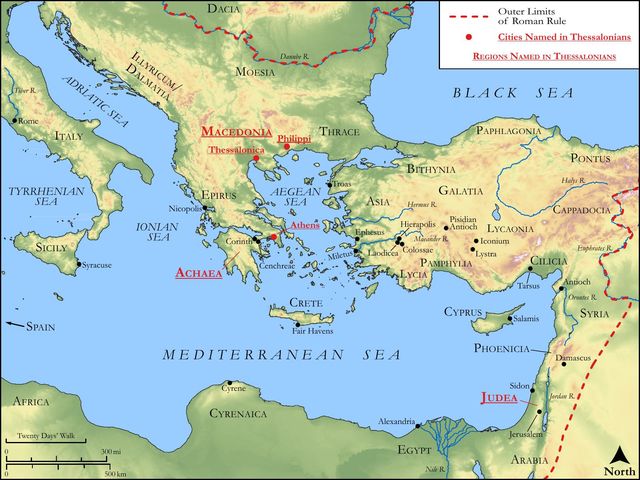
See on the biblical-era map

Study this verse
Public-domain commentary
Matthew Henry
From his Commentary on the Whole Bible. Henry comments on passages, not single verses — this entry covers 2 Thessalonians 3:1–5. His three-level outline is real structure in the source text, so it is rendered as structure.
In these words observe,
I.The apostle desires the prayers of his friends:
Finally, brethren, pray for us, Th2 3:1. He always remembered them in his prayers, and would not have them forget him and his fellow-labourers, but bear them on their hearts at the throne of grace. Note,
1.This is one way by which the communion of saints is kept us, not only by their praying together, or with one another, but by their praying for one another when they are absent one from another. And thus those who are at great distance may meet together at the throne of grace; and thus those who are not capable of doing or receiving any other kindness may yet this way do and receive real and very great kindness.
2.It is the duty of people to pray for their ministers; and not only for their own pastors, but also for all good and faithful ministers. And,
3.Ministers need, and therefore should desire, the prayers of their people. How remarkable is the humility, and how engaging the example, of this great apostle, who was so mighty in prayer himself, and yet despised not the prayers of the meanest Christian, but desired an interest in them. Observe, further, what they are desired and directed to pray for; namely,
(1.)For the success of the gospel ministry: That the word of the Lord may have free course, and be glorified, Th2 3:1. This was the great thing that Paul was most solicitous about. He was more solicitous that God's name might be sanctified, his kingdom advanced, and his will done, than he was about his own daily bread. He desired that the word of the Lord might run (so it is in the original), that it might get ground, that the interest of religion in the world might go forward and not backward, and not only go forward, but go apace. All the forces of hell were then, and still are, more or less, raised and mustered to oppose the word of the Lord, to hinder its publication and success. We should pray, therefore, that oppositions may be removed, that so the gospel, may have free course to the ears, the hearts, and the consciences of men, that it may be glorified in the conviction and conversion of sinners, the confutation, of gainsayers, and the holy conversation of the saints. God, who magnified the law, and made it honourable, will glorify the gospel, and make that honourable, and so will glorify his own name; and good ministers and good Christians may very well be contented to be little, to be any thing, to be nothing, if Christ be magnified and his gospel be glorified. Paul was now at Athens, or, as some think, at Corinth, and would have the Thessalonians pray that he might have as good success there as he had at Thessalonica, that it might be as well with others even as it was with them. Note, If ministers have been successful in one place, they should desire to be successful in every place where they may preach the gospel.
(2.)For the safety of gospel ministers. He asks their prayers, nor for preferment, but for preservation: That we may be delivered from unreasonable and wicked men, Th2 3:2. Note, Those who are enemies to the preaching of the gospel, and persecutors of the faithful preachers of it, are unreasonable and wicked men. They act against all the rules and laws of reason and religion, and are guilty of the greatest absurdity and impiety. Not only in the principles of atheism and infidelity, but also in the practice of the vice and immorality, and especially in persecution, there is the greatest absurdity in the world, as well as impiety. There is need of the spiritual protection, as well as the assistance, of godly and faithful ministers, for these are as the standard-bearers, who are most struck at; and therefore all who wish well to the interest of Christ in the world should pray for them. For all men have not faith; that is, many do not believe the gospel; they will not embrace it themselves, and no wonder if such are restless and malicious in their endeavours to oppose the gospel, decry the ministry, and disgrace the ministers of the word; and too many have not common faith or honesty; there is no confidence that we can safely put in them, and we should pray to be delivered from those who have no conscience nor honour, who never regard what they say or do. We may sometimes be in as much or more danger from false and pretended friends as from open and avowed enemies.
II.He encourages them to trust in God.
We should not only pray to God for his grace, but also place our trust and confidence in his grace, and humbly expect what we pray for. Observe,
1.What the good is which we may expect from the grace of God - establishment, and preservation from evil; and the best Christians stand in need of these benefits.
(1.)That God would establish them. This the apostle had prayed for on their behalf (Th2 2:17), and now he encourages them to expect this favour. We stand no longer than God holds us up; unless he hold up our goings in his paths, our feet will slide, and we shall fall.
(2.)That God will keep them from evil. We have as much need of the grace of God for our perseverance to the end as for the beginning of the good work. The evil of sin is the greatest evil, but there are other evils which God will also preserve his saints from - the evil that is in the world, yea, from all evil, to his heavenly kingdom.
2.What encouragement we have to depend upon the grace of God: The Lord is faithful. He is faithful to his promises, and is the Lord who cannot lie, who will not alter the thing that has gone out of his mouth. When once the promise therefore is made, performance is sure and certain. He is faithful to his relation, a faithful God and a faithful friend; we may depend upon his filling up all the relations he stands in to his people. Let it be our care to be true and faithful in our promises, and to the relations we stand in to this faithful God. He adds,
3.A further ground of hope that God would do this for them, seeing they did and would do the things they were commanded, Th2 3:4. The apostle had this confidence in them, and this was founded upon his confidence in God; for there is otherwise no confidence in man. Their obedience is described by doing what he and his fellow-labourers had commanded them, which was no other thing than the commandments of the Lord; for the apostles themselves had no further commission than to teach men to observe and to do what the Lord had commanded, Mat 28:20. And as the experience the apostle had of their obedience for the time past was one ground of his confidence that they would do the things commanded them for the time to come, so this is one ground to hope that whatsoever we ask of God we shall receive of him, because we keep his commandments, and do those things that are pleasing in his sight, Jo1 3:22.
III.He makes a short prayer for them, Th2 3:5.
It is a prayer for spiritual blessings. Two things of the greatest importance the apostle prays for: - 1. That their hearts may be brought into the love of God, to be in love with God as the most excellent and amiable Being, the best of all beings; and this is not only most reasonable and necessary in order to our happiness, but is our happiness itself; it is a great part of the happiness of heaven itself, where this love shall be made perfect. We can never attain to this unless God by his grace direct our hearts aright, for our love is apt to go astray after other things. Note, We sustain a great deal of damage by misplacing our affections; it is our sin and our misery that we place our affections upon wrong objects. If God directs our love aright upon himself, the rest of the affections will thereby be rectified. 2. That a patient waiting for Christ may be joined with this love of God. There is no true love of God without faith in Jesus Christ. We must wait for Christ, which supposes our faith in him, that we believe he came once in flesh and will come again in glory: and we must expect this second coming of Christ, and be careful to get ready for it; there must be a patient waiting, enduring with courage and constancy all that we may meet with in the mean time: and we have need of patience, and need of divine grace to exercise Christian patience, the patience of Christ (as some read the word), patience for Christ's sake and after Christ's example.
Historical interpretation
Two Centuries of Reception
5 surviving comments on this verse. Each one is dated, so this reads as a timeline rather than a list.
Select a marker to jump to its quote. Markers stagger vertically where authors wrote within a few decades of each other.
If, then, the blessed (apostle) delivered these things with a pious caution, which could be easily known by all, as he perceived in the spirit that "all men have not faith"
"And that we may be delivered from unreasonable and evil men; for all have not faith."
This is the manner of one showing also his dangers as to which especially he besought them. "From unreasonable and evil men," he says, "for all have not faith." Thus he is speaking of those who contradict the Preaching, who oppose and contend against the doctrines. For this he has intimated by saying, "For all men have not faith." And here he seems to me not to glance at dangers, but at the men who contradicted and hindered his word, as did Alexander the coppersmith. For he says, "he greatly withstood our words." That is, there are some to whom it is given. As if he were speaking of a paternal inheritance, that "it is not for all to serve in the Palace." And at the same time he also excites them, as already having such ground of confidence as to be able both to deliver their Teacher from dangers, and to facilitate his preaching.
Then, therefore, they afterwards marveled at the fact that they saw him ascending and they rejoiced that he went up to heaven, for the precedence of the Head is the hope of the members. Moreover, they heard the angelic message, “men of Galilee, why do you stand looking up to heaven? This Jesus … shall come in the same way as you have seen him going up to heaven.” What is the significance of “he will come in the same way”? He will come in that same form, so that the Scripture may be fulfilled, “They shall look upon him whom they have pierced.” He shall come to men; he shall come as a Man; but he shall come as the God-Man. He shall come as true God and true Man to make men like God. He has ascended as Judge of heaven; he has expressed himself as Herald of heaven. Let us stand justified so that we may not fear the judgment that is to come. As a matter of fact, he did ascend; those who announced it to us witnessed it. The people who did not see it believed; still some incredulous persons mocked, “for not all have faith.”
For a man swollen with pride in comparison to another might say, “My faith distinguishes me,” or “my justice” or whatever. It is to prevent such ideas that the good teacher asks, “But what do you have that you have not received?” Did you not receive it from him who chose to distinguish you from another? It was he who chose to give you what another did not receive. “But if you have received, why do you glory as if you had not received it?” Now I ask, is the apostle concerned here with anything else than that “He who glories should glory in the Lord”? But nothing is so contrary to this sentiment than for anyone to glory in his own merits as if he and not the grace of God were responsible for them. I refer to that grace that distinguishes the good from the wicked, not one which is common to the good and the wicked. On this premise the grace by which we are living and rational creatures, and thus distinguished from beasts, would be enmeshed in nature. The grace by which the beautiful are distinguished from the ugly, or the intelligent from the stupid, is a grace that perceives nature. But that person whose pride the apostle was trying to restrain was not puffing himself up in comparison to the beasts, nor in comparison to the gifts of nature that might exist even in the worst of men. Rather, he was puffed up because he attributed some good thing which pertained to the morally good life to himself and not to God. Thus, he deserved to hear the rebuke, “For who distinguishes you? Or what do you have that you have not received?” For though the ability to possess faith belongs to our nature, is that also true of the actual possession of faith? “For not all men have faith,” although all men have the possibility of having faith.
For the crafty Tempter, the Devil, delights greatly in wounding the hearts of men as when he can poison their unwary minds with errors that are opposed to Gospel Truth, we must strive by the mighty teaching of the Holy Spirit to prevent Christian knowledge from being perverted by the Devil’s falsehoods.
Continue studying 2 Thessalonians 3:2 across the web’s major study libraries — every link below opens this exact verse, chapter, or book on the destination site.
Read & Compare
 BibleGatewayThis verse in more than 200 translations and 70 languages.
 Bible.comThe YouVersion reader — hundreds of translations, reading plans, and highlights.
 ESV.orgCrossway's official English Standard Version reader.
 NET BibleThe NET translation with 60,000+ translators' notes on every rendering decision.
 STEP BibleTyndale House's free study tool — original text, vocabulary, and scholarly resources.
 BibliaLogos Bible Software's free web reader.
 USCCBThe New American Bible (Revised Edition) with the U.S. bishops' study notes.
Commentaries
 BibleHub CommentariesDozens of classic commentaries on this verse, gathered on one page.
 StudyLightMore than 100 commentary sets — the largest collection on the web.
 BibleRefPlain-English commentary on what this verse means, verse by verse.
 Enduring WordDavid Guzik's free commentary on this chapter, widely used by Bible teachers.
 Bible Study ToolsVerse commentary alongside Greek and Hebrew study aids.
Original Language & Research
- BibleHub InterlinearThe verse word by word — original language, transliteration, and English.
- BibleHub LexiconEvery word's original-language definition and Strong's entry.
 Blue Letter BibleDeep-study tools — Strong's numbers, concordance, and word studies.
 CNTR CollationThe earliest Greek manuscripts of this verse, collated letter by letter.
Sermons, Hymns & Audio


TrulyRandomVerse is not affiliated with these sites and doesn’t control their content. They’re linked because they’re genuinely useful.
Summary
In 2 Thessalonians 3:2, the Apostle Paul articulates a fervent prayer request to the Thessalonian believers, seeking divine protection and deliverance from individuals characterized as "unreasonable and wicked." This petition is immediately followed by a profound theological explanation: "for all men have not faith." This verse encapsulates Paul's realistic understanding of the challenges inherent in gospel ministry, acknowledging the pervasive spiritual resistance and hostility that stems from unbelief, and underscores the necessity of God's sovereign intervention for the safety and success of His servants.
Context
ShowHideLiterary Context
This verse is nestled within the concluding remarks of Paul's second letter to the Thessalonians, a letter primarily aimed at correcting misunderstandings about the Lord's return and addressing issues of idleness within the community. Chapter 3 begins with Paul's direct request for prayer, specifically for the swift and glorious spread of "the word of the Lord" 2 Thessalonians 3:1. Verse 2 then specifies the nature of the obstacles to this spread—hostile individuals—and explains the root cause of their opposition. This personal prayer request serves as a transition from theological instruction to practical pastoral concerns, emphasizing the mutual dependence and spiritual solidarity between Paul and the Thessalonian church. It also sets the stage for Paul's subsequent instructions regarding church discipline and diligent work in the remainder of the chapter.
Historical & Cultural Context
Paul's ministry was consistently marked by significant opposition, a reality well-known to the Thessalonians themselves. During his initial visit to Thessalonica, Paul and his companions faced violent resistance from a mob incited by envious Jews Acts 17:5-9. This historical backdrop illuminates the very real dangers Paul encountered. The Roman Empire, while generally tolerant of various religions, became hostile to Christianity as it grew and challenged imperial cults and traditional social structures. Paul's travels often put him at risk from both Jewish antagonists who rejected his message and Gentile authorities or mobs who perceived his teachings as disruptive. His request for deliverance was not a hypothetical concern but a daily reality, reflecting the precarious position of early Christian missionaries operating in a world largely antagonistic to their message.
Key Themes
ShowHideThe verse contributes to several overarching themes in 2 Thessalonians and Paul's broader theology. Firstly, it highlights the necessity of prayer, demonstrating Paul's dependence on God and the intercession of the church for the advancement of the Gospel and the safety of its messengers 2 Thessalonians 3:1. Secondly, it underscores the reality of spiritual opposition and the inherent conflict between the kingdom of God and the forces of darkness. Paul consistently recognized that the spread of the Gospel would inevitably provoke hostility from those unwilling to submit to its truth Ephesians 6:12. Finally, the verse profoundly addresses the nature and consequences of unbelief. The statement "for all men have not faith" serves as a foundational explanation for the existence of "unreasonable and wicked men," revealing that a lack of saving faith is not merely intellectual disagreement but a spiritual condition that can manifest in active hostility and moral depravity, a theme echoed in John 3:19-20.
Exposition and Analysis
ShowHideKey Word Analysis
ShowHideThis term literally means "out of place." In this context, it conveys something improper, injurious, or wicked. It describes actions or behaviors that are absurd, morally perverse, and contrary to reason or justice. It suggests a fundamental disorder or deviation from what is right and fitting, indicating a deep-seated spiritual and moral misalignment.
This word signifies evil, morally corrupt, or malignant. It points to a harmful effect or influence, distinguishing it from mere badness (kakos) by emphasizing active malevolence and culpability. These are individuals whose character and actions are not merely flawed but actively destructive and hostile, often driven by a deliberate opposition to God's will and people.
This term denotes persuasion, credence, or moral conviction. In a theological sense, it refers specifically to reliance upon Christ for salvation and constancy in such a profession. Paul's use here implies not just intellectual assent but a profound spiritual trust and commitment to God's truth, the absence of which explains the "unreasonable and wicked" behavior.
Verse Breakdown
ShowHide"And that we may be delivered from unreasonable and wicked men:"
This clause expresses Paul's urgent and specific prayer request. The verb "delivered" (G4506, rhýomai) implies being rescued or drawn away from danger, suggesting a divine intervention to protect Paul and his companions from the active malice of certain individuals. These "unreasonable" (morally perverse, out of place) and "wicked" (actively evil, harmful) men represent a tangible threat to their safety and ministry, highlighting the real-world dangers faced by those proclaiming the Gospel.
"for all [men] have not faith."
This second clause provides the theological rationale for the existence and behavior of the "unreasonable and wicked men." The conjunction "for" (G1063, gár) introduces an explanation. Paul asserts a universal truth: not everyone possesses saving faith (G4102, pístis). This lack of faith is presented as the root cause of their hostility and moral depravity, explaining why some individuals actively oppose the Gospel and its messengers. It underscores that spiritual opposition is not random but stems from a fundamental spiritual condition of unbelief.
Literary Devices
ShowHidePaul employs several literary devices in this concise verse. There is clear Contrast between the desire for deliverance and the reality of those who lack faith, establishing a dichotomy between those who embrace the Gospel and those who oppose it. The verse itself functions as a Supplication or Prayer Request, an appeal to God for protection, highlighting Paul's dependence on divine power rather than human strength. Furthermore, the conjunction "for" introduces a Causal Clause, providing a theological explanation for the preceding request. This structure reveals Paul's logical and theological reasoning, connecting the practical need for deliverance to the spiritual reality of widespread unbelief.
Theological and Thematic Connections
ShowHideThis verse profoundly connects to the broader biblical narrative of spiritual warfare and the nature of humanity's fallen state. It underscores that opposition to God's truth and His people is not merely a sociological phenomenon but a spiritual one, rooted in a fundamental rejection of faith. The "unreasonable and wicked men" are not just disagreeable; their actions are a manifestation of a heart alienated from God, incapable of receiving spiritual truth without divine intervention. Paul's prayer for deliverance is a recognition that only God can truly protect His servants from such deep-seated hostility, while simultaneously affirming the sovereignty of God over human resistance. This passage serves as a sober reminder that while the Gospel is good news, it also provokes a decisive response, revealing the spiritual condition of the hearer.
Reflection and Application
ShowHidePaul's prayer in 2 Thessalonians 3:2 offers profound guidance for believers today. It teaches us that opposition is an expected part of Christian life and ministry, not an anomaly. When we encounter hostility, rejection, or even persecution for our faith, this verse reminds us that such responses often stem from a deep-seated lack of faith, rather than merely intellectual disagreement. This understanding can foster compassion and a renewed commitment to prayer, both for our own protection and for the spiritual awakening of those who oppose the truth. It encourages us to maintain a posture of dependence on God, acknowledging that our safety and the effectiveness of our witness are ultimately in His hands. In a world increasingly polarized, where Christian values are often challenged, this verse calls us to persevere in proclaiming the Gospel, trusting that God will deliver us from evil and empower us to continue His work, even amidst spiritual darkness.
Questions for Reflection
ShowHideFAQ
ShowHideWho are the "unreasonable and wicked men" Paul refers to?
ShowHideThe "unreasonable and wicked men" (Greek: átopos and ponērós) likely refer to those who actively opposed Paul's ministry and the spread of the Gospel. This could include Jewish antagonists who rejected Jesus as the Messiah and incited mobs against Paul (as seen in Acts 17:5-9), as well as Gentile individuals or groups whose actions were morally perverse, harmful, or disruptive to the Christian community. They are characterized by their active malice and hostility, stemming from a fundamental spiritual rejection of God's truth.
What does "for all men have not faith" mean in this context?
ShowHideThis phrase serves as Paul's explanation for the existence of "unreasonable and wicked men." It means that not everyone possesses saving faith—the spiritual conviction and reliance upon Christ that leads to salvation. This lack of faith is presented as the root cause of their hostility and moral depravity. It's not merely an intellectual disagreement but a spiritual condition that manifests in opposition to God and His people, underscoring the biblical truth that true faith is not universal but a divine gift Ephesians 2:8-9.
Christ-Centered Fulfillment
ShowHidePaul's prayer for deliverance from "unreasonable and wicked men" finds its ultimate fulfillment and deepest meaning in the person and work of Jesus Christ. Jesus Himself faced the most profound opposition from those who "had not faith," as evidenced by His own people who "did not receive him" John 1:11. He endured the ultimate wickedness of humanity, culminating in His crucifixion, yet through His resurrection, God delivered Him from the power of death and the grasp of evil men. Christ's victory over sin, death, and the demonic powers Colossians 2:15 provides the foundation for our own hope of deliverance. Furthermore, Jesus is the very "author and perfecter of our faith" Hebrews 12:2, meaning that the faith which "all men have not" is precisely what He provides. Believers are delivered from the power of "unreasonable and wicked" forces not by their own strength, but by being united with Christ, who has already overcome the world's tribulation John 16:33, ensuring ultimate triumph for those who trust in Him.