


2 Thessalonians 3:3
Bible text: King James Version (1769 Blayney text) · Public domain
Bible text: Berean Standard Bible · Public domain
Bible text: American Standard Version (1901) · Public domain
Bible text: World English Bible, Messianic edition · Public domain
Bible text: Geneva Bible (1599) · Public domain
Bible text: Young's Literal Translation · Public domain
- πιστὸςpistosfaithfulG4103A-NSMAdjective Nominative Singular Masculine
- δέdehoweverG1161CONJConjunction
- ἐστινestinisG1510V-PAI-3SVerb Present Active Indicative 3rd Singular
- ὁhotheG3588T-NSMDefinite article Nominative Singular Masculine
- κύριοςkuriosLordG2962N-NSM-TNoun Nominative Singular Masculine Title
- ὃςhoswhoG3739R-NSMRelative pronoun Nominative Singular Masculine
- στηρίξειstērixeiwill strengthenG4741V-FAI-3SVerb Future Active Indicative 3rd Singular
- ὑμᾶςhumasyouG4771P-2APPersonal pronoun Accusative 2nd Plural
- καὶkaiandG2532CONJConjunction
- φυλάξειphulaxeiHe will keep [you]G5442V-FAI-3SVerb Future Active Indicative 3rd Singular
- ἀπὸapofromG575PREPPreposition
- τοῦtou<the>G3588T-GSMDefinite article Genitive Singular Masculine
- πονηροῦponērouevilG4190A-GSMAdjective Genitive Singular Masculine
English is a literal word-by-word gloss of the Greek, not the KJV's wording. Why?
This is the original text the KJV's translators worked from — each Greek word with its own literal English meaning in this verse, prepared by scholars at Tyndale House, Cambridge. The KJV translates whole sentences, not word by word, so its wording differs: one Greek word can become several English words, and the KJV may choose “charity” where the gloss reads “love”. Both are faithful — they answer different questions. For the KJV's own rendering, switch to the KJV text.
Details
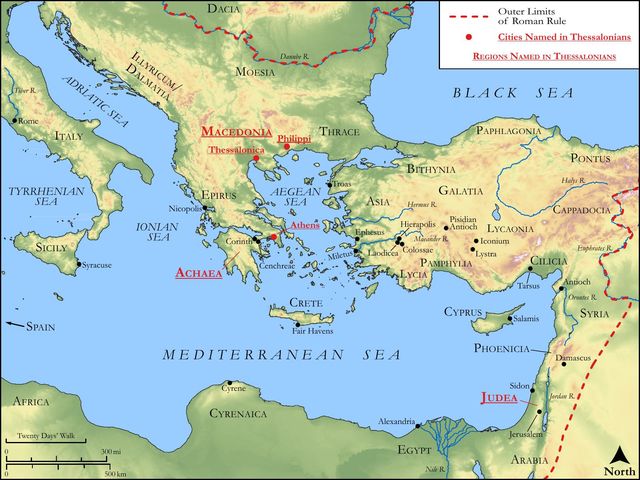
See on the biblical-era maps

Study this verse
Public-domain commentary
Matthew Henry
From his Commentary on the Whole Bible. Henry comments on passages, not single verses — this entry covers 2 Thessalonians 3:1–5. His three-level outline is real structure in the source text, so it is rendered as structure.
In these words observe,
I.The apostle desires the prayers of his friends:
Finally, brethren, pray for us, Th2 3:1. He always remembered them in his prayers, and would not have them forget him and his fellow-labourers, but bear them on their hearts at the throne of grace. Note,
1.This is one way by which the communion of saints is kept us, not only by their praying together, or with one another, but by their praying for one another when they are absent one from another. And thus those who are at great distance may meet together at the throne of grace; and thus those who are not capable of doing or receiving any other kindness may yet this way do and receive real and very great kindness.
2.It is the duty of people to pray for their ministers; and not only for their own pastors, but also for all good and faithful ministers. And,
3.Ministers need, and therefore should desire, the prayers of their people. How remarkable is the humility, and how engaging the example, of this great apostle, who was so mighty in prayer himself, and yet despised not the prayers of the meanest Christian, but desired an interest in them. Observe, further, what they are desired and directed to pray for; namely,
(1.)For the success of the gospel ministry: That the word of the Lord may have free course, and be glorified, Th2 3:1. This was the great thing that Paul was most solicitous about. He was more solicitous that God's name might be sanctified, his kingdom advanced, and his will done, than he was about his own daily bread. He desired that the word of the Lord might run (so it is in the original), that it might get ground, that the interest of religion in the world might go forward and not backward, and not only go forward, but go apace. All the forces of hell were then, and still are, more or less, raised and mustered to oppose the word of the Lord, to hinder its publication and success. We should pray, therefore, that oppositions may be removed, that so the gospel, may have free course to the ears, the hearts, and the consciences of men, that it may be glorified in the conviction and conversion of sinners, the confutation, of gainsayers, and the holy conversation of the saints. God, who magnified the law, and made it honourable, will glorify the gospel, and make that honourable, and so will glorify his own name; and good ministers and good Christians may very well be contented to be little, to be any thing, to be nothing, if Christ be magnified and his gospel be glorified. Paul was now at Athens, or, as some think, at Corinth, and would have the Thessalonians pray that he might have as good success there as he had at Thessalonica, that it might be as well with others even as it was with them. Note, If ministers have been successful in one place, they should desire to be successful in every place where they may preach the gospel.
(2.)For the safety of gospel ministers. He asks their prayers, nor for preferment, but for preservation: That we may be delivered from unreasonable and wicked men, Th2 3:2. Note, Those who are enemies to the preaching of the gospel, and persecutors of the faithful preachers of it, are unreasonable and wicked men. They act against all the rules and laws of reason and religion, and are guilty of the greatest absurdity and impiety. Not only in the principles of atheism and infidelity, but also in the practice of the vice and immorality, and especially in persecution, there is the greatest absurdity in the world, as well as impiety. There is need of the spiritual protection, as well as the assistance, of godly and faithful ministers, for these are as the standard-bearers, who are most struck at; and therefore all who wish well to the interest of Christ in the world should pray for them. For all men have not faith; that is, many do not believe the gospel; they will not embrace it themselves, and no wonder if such are restless and malicious in their endeavours to oppose the gospel, decry the ministry, and disgrace the ministers of the word; and too many have not common faith or honesty; there is no confidence that we can safely put in them, and we should pray to be delivered from those who have no conscience nor honour, who never regard what they say or do. We may sometimes be in as much or more danger from false and pretended friends as from open and avowed enemies.
II.He encourages them to trust in God.
We should not only pray to God for his grace, but also place our trust and confidence in his grace, and humbly expect what we pray for. Observe,
1.What the good is which we may expect from the grace of God - establishment, and preservation from evil; and the best Christians stand in need of these benefits.
(1.)That God would establish them. This the apostle had prayed for on their behalf (Th2 2:17), and now he encourages them to expect this favour. We stand no longer than God holds us up; unless he hold up our goings in his paths, our feet will slide, and we shall fall.
(2.)That God will keep them from evil. We have as much need of the grace of God for our perseverance to the end as for the beginning of the good work. The evil of sin is the greatest evil, but there are other evils which God will also preserve his saints from - the evil that is in the world, yea, from all evil, to his heavenly kingdom.
2.What encouragement we have to depend upon the grace of God: The Lord is faithful. He is faithful to his promises, and is the Lord who cannot lie, who will not alter the thing that has gone out of his mouth. When once the promise therefore is made, performance is sure and certain. He is faithful to his relation, a faithful God and a faithful friend; we may depend upon his filling up all the relations he stands in to his people. Let it be our care to be true and faithful in our promises, and to the relations we stand in to this faithful God. He adds,
3.A further ground of hope that God would do this for them, seeing they did and would do the things they were commanded, Th2 3:4. The apostle had this confidence in them, and this was founded upon his confidence in God; for there is otherwise no confidence in man. Their obedience is described by doing what he and his fellow-labourers had commanded them, which was no other thing than the commandments of the Lord; for the apostles themselves had no further commission than to teach men to observe and to do what the Lord had commanded, Mat 28:20. And as the experience the apostle had of their obedience for the time past was one ground of his confidence that they would do the things commanded them for the time to come, so this is one ground to hope that whatsoever we ask of God we shall receive of him, because we keep his commandments, and do those things that are pleasing in his sight, Jo1 3:22.
III.He makes a short prayer for them, Th2 3:5.
It is a prayer for spiritual blessings. Two things of the greatest importance the apostle prays for: - 1. That their hearts may be brought into the love of God, to be in love with God as the most excellent and amiable Being, the best of all beings; and this is not only most reasonable and necessary in order to our happiness, but is our happiness itself; it is a great part of the happiness of heaven itself, where this love shall be made perfect. We can never attain to this unless God by his grace direct our hearts aright, for our love is apt to go astray after other things. Note, We sustain a great deal of damage by misplacing our affections; it is our sin and our misery that we place our affections upon wrong objects. If God directs our love aright upon himself, the rest of the affections will thereby be rectified. 2. That a patient waiting for Christ may be joined with this love of God. There is no true love of God without faith in Jesus Christ. We must wait for Christ, which supposes our faith in him, that we believe he came once in flesh and will come again in glory: and we must expect this second coming of Christ, and be careful to get ready for it; there must be a patient waiting, enduring with courage and constancy all that we may meet with in the mean time: and we have need of patience, and need of divine grace to exercise Christian patience, the patience of Christ (as some read the word), patience for Christ's sake and after Christ's example.
Historical interpretation
Nine Centuries of Reception
2 surviving comments on this verse. Each one is dated, so this reads as a timeline rather than a list.
Select a marker to jump to its quote. Markers stagger vertically where authors wrote within a few decades of each other.
"But the Lord is faithful, who shall stablish you, and guard you from the evil one. And we have confidence in the Lord touching you that ye both do and will do the things which we command you. And the Lord direct your hearts into the love of God, and into the patience of Christ."
Neither ought we, having committed everything to the prayers of the Saints, to be idle ourselves, and run into wickedness, and to lay hold of nothing; nor again when working good to despise that succor. For great indeed are the things which prayer for us can effect, but it is when we ourselves also work. For this reason Paul also, praying for them, and again giving them assurance from the promise, says, "But the Lord is faithful, who shall stablish you, and guard you from the evil one" For if He has chosen you to salvation, He does not deceive you, nor suffer you utterly to perish. But that should themselves sleep, see how he also demands cooperation from them, saying, "And we have confidence in the Lord touching you, that ye both do and will do the things which we command you." "The Lord" indeed, he says, "is faithful," and having promised to save will certainly save; but as He promised. And how did He promise? If we be willing, and hear Him; not simply hearing, nor like stocks and stones, being inactive.
And he has well introduced the words, "We have confidence in the Lord," that is, we trust to His lovingkindness. Again he brings them down, making everything depend thereupon. For if he had said, We have confidence in you, the commendation indeed was great, but it would not have taught them to make all things dependent upon God. And if he had said, We have confidence in the Lord, that He will preserve you, and had not added "as touching you," and, "that ye do and will do the things which we command you," he would have made them more slothful, by casting everything upon the power of God. For it becomes us indeed to cast everything upon Him, yet working also ourselves, embarked in the labors and the conflicts. And he shows that even if our virtue alone were sufficient to save, yet nevertheless it ought to be persevering, and to abide with us until we come to our latest breath.
"But the Lord," he says, "direct your hearts into the love of God, and the patience of Christ."
Again he commends them, and prays, showing his concern for them. For when he is about to enter upon reproof, he previously smooths down their minds, by saying, "I am confident that ye will hear," and by requesting prayers from them, and by again invoking upon them infinite blessings.
"But the Lord," he says, "direct your hearts into the love of God." For there are many things that turn us aside from love, and there are many paths that draw us away from thence. In the first place the path of Mammon, laying, as it were, certain shameless hands upon our soul, and tenaciously holding it in its grasp, draws and drags us thence even against our will. Then vainglory and often afflictions and temptations, turn us aside. For this reason we need, as a certain wind, the assistance of God, that our sail may be impelled, as by some strong wind, to the love of God.
"And into the patience of Christ," he says. What is "into the patience"? That we should endure even as He endured, or that we should do those things, or that with patience also we should wait for Him, that is, that we should be prepared. For since He has promised many things, and Himself is coming to judge the quick and the dead, let us wait for Him, and let us be patient. But wherever he speaks of patience, he of course implies affliction. For this is to love God; to endure, and not to be troubled.
But God is faithful: That is, He always fulfills His promises.
He will strengthen you: That is, against the deceptions of the false apostles.
and he will guard you from evil: Especially while under persecution and tyrrany.
Continue studying 2 Thessalonians 3:3 across the web’s major study libraries — every link below opens this exact verse, chapter, or book on the destination site.
Read & Compare
 BibleGatewayThis verse in more than 200 translations and 70 languages.
 Bible.comThe YouVersion reader — hundreds of translations, reading plans, and highlights.
 ESV.orgCrossway's official English Standard Version reader.
 NET BibleThe NET translation with 60,000+ translators' notes on every rendering decision.
 STEP BibleTyndale House's free study tool — original text, vocabulary, and scholarly resources.
 BibliaLogos Bible Software's free web reader.
 USCCBThe New American Bible (Revised Edition) with the U.S. bishops' study notes.
Commentaries
 BibleHub CommentariesDozens of classic commentaries on this verse, gathered on one page.
 StudyLightMore than 100 commentary sets — the largest collection on the web.
 BibleRefPlain-English commentary on what this verse means, verse by verse.
 Enduring WordDavid Guzik's free commentary on this chapter, widely used by Bible teachers.
 Bible Study ToolsVerse commentary alongside Greek and Hebrew study aids.
Original Language & Research
- BibleHub InterlinearThe verse word by word — original language, transliteration, and English.
- BibleHub LexiconEvery word's original-language definition and Strong's entry.
 Blue Letter BibleDeep-study tools — Strong's numbers, concordance, and word studies.
 CNTR CollationThe earliest Greek manuscripts of this verse, collated letter by letter.
Sermons, Hymns & Audio


TrulyRandomVerse is not affiliated with these sites and doesn’t control their content. They’re linked because they’re genuinely useful.
Summary
Second Thessalonians 3:3 offers profound assurance, anchoring believers in the unwavering character of God. Amidst the challenges, persecutions, and internal struggles faced by the Thessalonian church, Paul declares that the Lord Himself is utterly trustworthy and committed to His people. This faithfulness is manifested in two specific promises: first, God will establish or strengthen believers in their faith and resolve; and second, He will guard them from the pervasive influence and destructive power of evil, whether understood as moral corruption or the direct assault of the Evil One. This verse serves as a powerful reminder that the believer's security and perseverance rest not on human strength, but on the steadfast nature and protective power of the sovereign Lord.
Context
ShowHideLiterary Context
This verse appears near the conclusion of Paul's second epistle to the Thessalonians, following his earnest request for prayer for himself and his companions (2 Thessalonians 3:1-2). Paul transitions from human agency and prayer to divine sovereignty, grounding his confidence in God's character. The preceding chapters have addressed various issues: the believers' endurance through persecution (2 Thessalonians 1:4), the clarification of eschatological teachings regarding the Day of the Lord and the Man of Lawlessness (2 Thessalonians 2:1-12), and warnings against idleness and disorderly conduct (2 Thessalonians 3:6-12). In this immediate context, verse 3 serves as a theological anchor, providing a counter-balance to the potential anxieties arising from these challenges. It assures the community that despite the presence of "unreasonable and wicked men" (2 Thessalonians 3:2), God remains faithful to His people.
Historical & Cultural Context
The Thessalonian church was a relatively young community facing significant external pressure and internal disruption. They experienced persecution from both Jewish and Gentile populations, as evidenced by Paul's earlier letter (1 Thessalonians 2:14-16). Furthermore, there was confusion and anxiety regarding the timing of Christ's return, leading some to cease working, believing the Day of the Lord had already arrived or was so imminent that daily responsibilities were obsolete. In this environment, the concept of God's faithfulness and protection was not merely a theological abstraction but a vital source of comfort and stability. Believers needed assurance that they would be preserved amidst societal hostility and doctrinal confusion. Among the Greeks and Romans, with their pantheon of often capricious gods, the declaration of a "faithful" and "steadfast" Lord would have been particularly striking and reassuring to a fledgling Christian community.
Key Themes
ShowHideThe central theme of 2 Thessalonians 3:3 is the unwavering faithfulness of God. This foundational truth undergirds all divine promises and actions. It speaks to God's reliability and His commitment to His covenant people. Closely related is the theme of divine preservation and establishment. God is not merely a distant observer but an active participant in the lives of His followers, promising to "stablish" them—to strengthen, confirm, and make them firm in their faith and resolve, particularly in the face of trials and false teachings. This establishment extends to their moral and spiritual integrity. Finally, the verse highlights protection from evil. This protection encompasses both moral corruption and the malevolent influence of "the evil one," Satan. In a world where spiritual forces were understood to be active, the promise of divine guardianship against such pervasive evil would have been profoundly encouraging, echoing the prayer of Jesus for His disciples to be kept from the evil one (John 17:15).
Exposition and Analysis
ShowHideKey Word Analysis
ShowHideThis word, derived from the verb meaning "to persuade" or "to trust," describes God's inherent character as utterly trustworthy, reliable, and true to His word and promises. It signifies His unwavering constancy and integrity. When applied to God, as here, it means He is dependable and will always fulfill what He has declared.
Meaning "to set fast," "to make stable," "to strengthen," or "to confirm," this verb conveys the idea of God actively providing inner stability and resilience. It implies a divine work of strengthening the believer's resolve, character, and faith, ensuring they remain firm and unshakeable, especially when facing opposition or doubt. It is not merely a passive state but an active, ongoing process initiated and sustained by God.
This term carries a dual meaning that is significant for interpretation. It can refer to evil in a general sense—moral wickedness, harmful influences, or calamitous circumstances. However, especially in the New Testament and often with the definite article (as here, tou ponērou), it frequently refers to "the evil one," meaning Satan or the devil. Given Paul's frequent references to spiritual warfare and the schemes of the devil in his letters (e.g., Ephesians 6:11), the interpretation of protection from Satan's direct influence and attacks is highly plausible and widely accepted by scholars.
Verse Breakdown
ShowHide"But the Lord is faithful"
This opening clause immediately establishes the foundation of the entire promise: God's immutable character. The conjunction "But" (G1161, dé) contrasts with the "unreasonable and wicked men" mentioned in the preceding verse (2 Thessalonians 3:2), highlighting that while human faithfulness may waver, God's never does. "The Lord" (G2962, kýrios) refers to God, specifically Christ in a New Testament context, emphasizing His supreme authority and mastery. His faithfulness is the bedrock upon which all divine promises and the believer's security are built.
"who shall stablish you"
Building on God's faithfulness, this phrase articulates the first specific action God will take. The pronoun "who" (G3739, hós) links this action directly to "the Lord." To "stablish" (G4741, stērízō) means to make firm, strengthen, or confirm. This speaks to God's active role in fortifying believers against spiritual, emotional, and doctrinal instability. It implies an internal work of grace that enables them to stand firm in their faith, convictions, and conduct, particularly in the face of external pressures or internal doubts.
"and keep [you] from evil"
This is the second specific promise, connected by the conjunction "and" (G2532, kaí). To "keep" (G5442, phylássō) means to watch over, guard, or preserve. The preposition "from" (G575, apó) indicates separation or distance. As discussed in the Key Word Analysis, "evil" (G4190, ponērós) likely refers to "the evil one," Satan, and his destructive influence, schemes, and temptations. Thus, God promises to actively guard believers from the malevolent power and corrupting effects of the devil, protecting their spiritual integrity and ensuring their perseverance.
Literary Devices
ShowHideThe verse employs several literary devices to convey its powerful message. There is a clear Contrast established by the initial "But" (G1161, dé), setting God's unwavering faithfulness against the unfaithfulness and wickedness of certain people mentioned in the previous verse (2 Thessalonians 3:2). This contrast serves to magnify God's reliability. The verse also functions as a strong Affirmation or Declaration of Assurance, providing a definitive statement of divine action and character. The two main verbs, "stablish" and "keep," exhibit a form of Parallelism, describing complementary aspects of God's protective and strengthening work. While not strict synonymous or antithetical parallelism, they work in tandem to convey the comprehensive nature of God's care. Furthermore, the ambiguity of "evil" (ponērós) allows for a rich Double Entendre or Polysemy, encompassing both general moral corruption and the specific person of the devil, thereby broadening the scope of God's promised protection.
Theological and Thematic Connections
ShowHideThe profound truth of God's faithfulness articulated in 2 Thessalonians 3:3 is a cornerstone of biblical theology. It assures believers that God is not capricious or unreliable, but steadfast in His character and commitments. This faithfulness is the basis for His covenant with humanity, His promises of salvation, and His ongoing preservation of His people. It speaks to His immutability and His unwavering love. The promise to "stablish" believers highlights divine sovereignty in sanctification, emphasizing that spiritual growth and perseverance are not solely dependent on human effort but are actively sustained by God's power. The protection from "evil" underscores the reality of spiritual warfare and God's ultimate victory over the forces of darkness, providing comfort and confidence in a world fraught with moral and spiritual dangers. This verse reminds us that our ultimate security rests in the character and power of the Lord, who is both able and willing to complete the work He has begun in us.
Reflection and Application
ShowHideIn a world characterized by instability, uncertainty, and pervasive evil, 2 Thessalonians 3:3 stands as an unshakeable anchor for the believer's soul. It calls us to shift our gaze from the fluctuating circumstances around us or the deficiencies within us, to the unchanging character of God. When doubts assail our minds, when temptations press in, or when the weight of the world feels overwhelming, this verse reminds us that our security is not in our own strength or wisdom, but in the Lord's unwavering faithfulness. We are encouraged to lean into His promised establishment, trusting that He will fortify our faith, strengthen our resolve, and confirm us in our walk with Him. Furthermore, the assurance of His protection from evil empowers us to face spiritual battles with confidence, knowing that the One who is in us is greater than the one who is in the world (1 John 4:4). This truth invites us to live not in fear, but in the freedom and peace that come from resting in God's sovereign care, actively cooperating with His work in our lives, and walking in obedience to His Word.
Questions for Reflection
ShowHideFAQ
ShowHideWhat does it mean for the Lord to "stablish" believers?
ShowHideTo "stablish" (Greek, stērízō) means to set fast, make stable, strengthen, or confirm. In the context of 2 Thessalonians 3:3, it means that God actively works to fortify believers in their faith, character, and spiritual resolve. This is not merely a passive state but an ongoing divine process that provides inner stability and resilience, enabling them to stand firm against trials, false teachings, and the pressures of the world. It speaks to God's commitment to ensuring their perseverance and growth in holiness.
Does "evil" in this verse refer to general wickedness or "the evil one"?
ShowHideThe Greek word for "evil" (ponērós) in 2 Thessalonians 3:3 is often used with the definite article (tou ponērou), which strongly suggests a personal entity: "the evil one," or Satan. While it can encompass general moral evil and harmful influences, the broader biblical context, especially in Paul's letters, frequently refers to the devil as a real adversary (e.g., Ephesians 6:11-12). Jesus Himself prayed for His disciples to be "kept from the evil one" in John 17:15. Therefore, the most robust interpretation is that God promises to guard believers specifically from the direct influence, temptations, and destructive schemes of Satan.
How does this verse relate to human responsibility in spiritual growth?
ShowHideWhile 2 Thessalonians 3:3 powerfully emphasizes God's sovereign work in establishing and protecting believers, it does not negate human responsibility. Rather, it provides the secure foundation upon which human effort can be effectively built. Believers are called to "stand firm" (2 Thessalonians 2:15) and to "work with their own hands" (2 Thessalonians 3:10-12), but their ability to do so, especially in the face of adversity, is empowered by God's faithfulness. This verse assures us that as we strive to obey and grow, God is actively at work within us, providing the strength and protection necessary for perseverance. It's a partnership where God provides the ultimate security and power, enabling our responsive obedience.
Christ-Centered Fulfillment
ShowHideThe faithfulness of the Lord, His power to establish, and His promise to keep believers from evil find their ultimate and most profound fulfillment in the person and work of Jesus Christ. He is the very embodiment of God's faithfulness, the "Amen, the faithful and true witness" (Revelation 3:14). Through His atoning death on the cross, Christ disarmed the powers of evil and delivered us from the dominion of darkness (Colossians 1:13-14). His resurrection is the ultimate "stablishing" act, confirming His victory over sin and death, and providing the basis for our own spiritual establishment and new life (Romans 4:25). Furthermore, Jesus, as our High Priest, intercedes for us, praying for our protection from the evil one (John 17:15), and assuring us that no one can snatch us out of His hand or the Father's hand (John 10:28-29). The Holy Spirit, sent by Christ, indwells believers, empowering them to stand firm and equipping them with the spiritual armor needed to resist the devil (Ephesians 6:10-18). Thus, 2 Thessalonians 3:3 is a Christ-centered promise: it is through Christ that God's faithfulness is perfectly demonstrated, through His finished work that we are established, and through His ongoing intercession and the Spirit's power that we are kept from evil.