


Romans 4:25
Bible text: King James Version (1769 Blayney text) · Public domain
Bible text: Berean Standard Bible · Public domain
Bible text: American Standard Version (1901) · Public domain
Bible text: World English Bible, Messianic edition · Public domain
Bible text: Geneva Bible (1599) · Public domain
Bible text: Young's Literal Translation · Public domain
- ὃςhoswhoG3739R-NSMRelative pronoun Nominative Singular Masculine
- παρεδόθηparedothēwas delivered overG3860V-API-3SVerb Aorist Passive Indicative 3rd Singular
- διὰdiaforG1223PREPPreposition
- τὰtatheG3588T-APNDefinite article Accusative Plural Neuter
- παραπτώματαparaptōmatatrespassesG3900N-APNNoun Accusative Plural Neuter
- ἡμῶνhēmōnof usG3165P-1GPPersonal pronoun Genitive 1st Plural
- καὶkaiandG2532CONJConjunction
- ἠγέρθηēgerthēwas raisedG1453V-API-3SVerb Aorist Passive Indicative 3rd Singular
- διὰdiaforG1223PREPPreposition
- τὴνtēntheG3588T-ASFDefinite article Accusative Singular Feminine
- δικαίωσινdikaiōsinjustificationG1347N-ASFNoun Accusative Singular Feminine
- ἡμῶνhēmōnof usG3165P-1GPPersonal pronoun Genitive 1st Plural
English is a literal word-by-word gloss of the Greek, not the KJV's wording. Why?
This is the original text the KJV's translators worked from — each Greek word with its own literal English meaning in this verse, prepared by scholars at Tyndale House, Cambridge. The KJV translates whole sentences, not word by word, so its wording differs: one Greek word can become several English words, and the KJV may choose “charity” where the gloss reads “love”. Both are faithful — they answer different questions. For the KJV's own rendering, switch to the KJV text.
Details
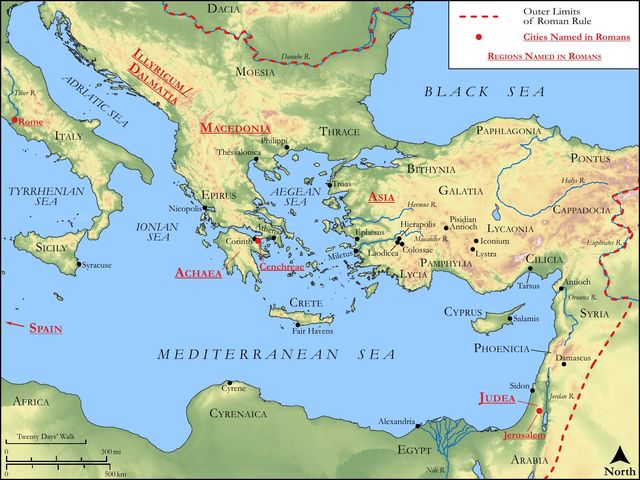
See on the biblical-era maps

Study this verse
Public-domain commentary
Matthew Henry
From his Commentary on the Whole Bible. Henry comments on passages, not single verses — this entry covers Romans 4:23–25. His two-level outline is real structure in the source text, so it is rendered as structure.
In the close of the chapter, he applies all to us; and, having abundantly proved that Abraham was justified by faith, he here concludes that his justification was to be the pattern or sampler of ours: It was not written for his sake alone. It was not intended only for an historical commendation of Abraham, or a relation of something peculiar to him (as some antipaedobaptists will needs understand that circumcision was a seal of the righteousness of the faith, Rom 4:11, only to Abraham himself, and no other); no, the scripture did not intend hereby to describe some singular way of justification that belonged to Abraham as his prerogative. The accounts we have of the Old Testament saints were not intended for histories only, barely to inform and divert us, but for precedents to direct us, for ensamples (Co1 10:11) for our learning, Rom 15:4. And this particularly concerning Abraham was written for us also, to assure us what that righteousness is which God requireth and accepteth to our salvation, - for us also, that are man and vile, that come so far short of Abraham in privileges and performances, us Gentiles as well as the Jews, for the blessing of Abraham comes upon the Gentiles through Christ, - for us on whom the ends of the world are come, as well as for the patriarchs; for the grace of God is the same yesterday, today, and for ever. His application of it is but short. Only we may observe,
I.Our common privilege; it shall be imputed to us, that is, righteousness shall.
The gospel way of justification is by an imputed righteousness, mellei logizesthai - it shall be imputed; he uses a future verb, to signify the continuation of this mercy in the church, that as it is the same now so it will be while God has a church in the world, and there are any of the children of men to be justified; for there is a fountain opened that is inexhaustible.
II.Our common duty, the condition of this privilege, and that is believing.
The proper object of this believing is a divine revelation. The revelation to Abraham was concerning a Christ to come; the revelation to us is concerning a Christ already come, which difference in the revelation does not alter the case. Abraham believed the power of God in raising up an Isaac from the dead womb of Sarah; we are to believe the same power exerted in a higher instance, the resurrection of Christ from the dead. The resurrection of Isaac was in a figure (Heb 11:19); the resurrection of Christ was real. Now we are to believe on him that raised up Christ; not only believe his power, that he could do it, but depend upon his grace in raising up Christ as our surety; so he explains it, Rom 4:25, where we have a brief account of the meaning of Christ's death and resurrection, which are the two main hinges on which the door of salvation turns.
1.He was delivered for our offences. God the Father delivered him, he delivered up himself as a sacrifice for sin. He died indeed as a malefactor, because he died for sin; but it was not his own sin, but the sins of the people. He died to make atonement for our sins, to expiate our guilt, to satisfy divine justice.
2.He was raised again for our justification, for the perfecting and completing of our justification. By the merit of his death he paid our debt, in his resurrection he took out our acquittance. When he was buried he lay a prisoner in execution for our debt, which as a surety he had undertaken to pay; on the third day an angel was sent to roll away the stone, and so to discharge the prisoner, which was the greatest assurance possible that divine justice was satisfied, the debt paid, or else he would never have released the prisoner: and therefore the apostle puts a special emphasis on Christ's resurrection; it is Christ that died, yea, rather that has risen again, Rom 8:34. So that upon the whole matter it is very evident that we are not justified by the merit of our own works, but by a fiducial obediential dependence upon Jesus Christ and his righteousness, as the condition on our part of our right to impunity and salvation, which was the truth that Paul in this and the foregoing chapter had been fixing as the great spring and foundation of all our comfort.
Historical interpretation
Two Centuries of Reception
6 surviving comments on this verse. Each one is dated, so this reads as a timeline rather than a list.
Select a marker to jump to its quote. Markers stagger vertically where authors wrote within a few decades of each other.
The apostle also knows what kind of God he has ascribed to us, when he writes: "If God spared not His own Son, but gave Him up for us, how did He not with Him also give us all things? " You see how divine Wisdom has murdered even her own proper, first-born and only Son, who is certainly about to live, nay, to bring back the others also into life. I can say with the Wisdom of God; It is Christ who gave Himself up for our offences. Already has Wisdom butchered herself also.
Paul says this in order to show that we ought to hate and reject the things for which Christ died. For if we believe that he was sacrificed for our sins, how can we not consider every sin to be alien and hostile to us, considering that our Lord was handed over to death because of it?…If we have risen together with Christ, who is our justification, and we now walk in newness of life and live according to righteousness, then Christ has risen for the purpose of our justification. But if we have not yet cast off the old man with all his works but instead live in unrighteousness, I dare to suggest that Christ has not yet risen for our justification, nor has he been sacrificed for our sins.
Those who were baptized before Christ’s passion received only the remission of their sins.… But after the resurrection both those who were baptized before and those who were baptized after were all justified by the set form of faith in the Trinity, and they received the Holy Spirit, who is the sign of believers that they are children of God.… For by the Savior’s passion death is vanquished. Once it was dominant because of sin, but it does not dare to hang on to those who have been justified by God.
After saying many great things of Abraham, and his faith, and righteousness, and honor before God, lest the hearer should say, What is this to us, for it is he that was justified? he places us close to the Patriarch again. So great is the power of spiritual words. For of one of the Gentiles, one who was recently come near, one who had done no work, he not only says that he is in nothing inferior to the Jew who believes (i.e. as a Jew), but not even to the Patriarch, but rather, if one must give utterance to the wondrous truth, even much greater. For so noble is our birth, that his faith is but the type of ours. And he does not say, If it was reckoned unto him, it is probable it will be also to us, that he might not make it matter of syllogism. But he speaks in authentic words of the divine law, and makes the whole a declaration of the Scripture. For why was it written, he says, save to make us see that we also were justified in this way? For it is the same God Whom we have believed, and upon the same matters, if it be not in the case of the same persons. And after speaking of our faith, he also mentions God's unspeakable love towards man, which he ever presents on all sides, bringing the Cross before us.
See how after mentioning the cause of His death, he makes the same cause likewise a demonstration of the resurrection. For why, he means, was He crucified? Not for any sin of His own. And this is plain from the Resurrection. For if He were a sinner, how should He have risen? But if He rose, it is quite plain that He was not a sinner. But if He was not a sinner, how came He to be crucified?-For others,-and if for others, then surely he rose again. Now to prevent your saying, How, when liable for so great sins, came we to be justified? he points out One that blotteth out all sins, that both from Abraham's faith, whereby he was justified, and from the Saviour's Passion, whereby we were freed from our sins, he might confirm what he had said. And after mentioning His Death, he speaks also of His Resurrection. For the purpose of His dying was not that He might hold us liable to punishment and in condemnation, but that He might do good unto us. For for this cause He both died and rose again, that He might make us righteous.
Christ wiped away our sins by his death, and, rising again in the same state as the one in which he died, he appeared to believers in order to confirm their righteousness.
Christ underwent suffering for our sins in order to pay our debt and so that his resurrection might prefigure the general resurrection of us all.
Continue studying Romans 4:25 across the web’s major study libraries — every link below opens this exact verse, chapter, or book on the destination site.
Read & Compare
 BibleGatewayThis verse in more than 200 translations and 70 languages.
 Bible.comThe YouVersion reader — hundreds of translations, reading plans, and highlights.
 ESV.orgCrossway's official English Standard Version reader.
 NET BibleThe NET translation with 60,000+ translators' notes on every rendering decision.
 STEP BibleTyndale House's free study tool — original text, vocabulary, and scholarly resources.
 BibliaLogos Bible Software's free web reader.
 USCCBThe New American Bible (Revised Edition) with the U.S. bishops' study notes.
Commentaries
 BibleHub CommentariesDozens of classic commentaries on this verse, gathered on one page.
 StudyLightMore than 100 commentary sets — the largest collection on the web.
 BibleRefPlain-English commentary on what this verse means, verse by verse.
 Enduring WordDavid Guzik's free commentary on this chapter, widely used by Bible teachers.
 Bible Study ToolsVerse commentary alongside Greek and Hebrew study aids.
Original Language & Research
- BibleHub InterlinearThe verse word by word — original language, transliteration, and English.
- BibleHub LexiconEvery word's original-language definition and Strong's entry.
 Blue Letter BibleDeep-study tools — Strong's numbers, concordance, and word studies.
 CNTR CollationThe earliest Greek manuscripts of this verse, collated letter by letter.
Sermons, Hymns & Audio


TrulyRandomVerse is not affiliated with these sites and doesn’t control their content. They’re linked because they’re genuinely useful.
Summary
Romans 4:25 serves as a profound theological summation, encapsulating the twin pillars of Christ's redemptive work: His death as the atoning sacrifice for humanity's transgressions and His resurrection as the divine validation that secures our righteous standing before God. This verse provides the ultimate ground for Paul's preceding argument in Romans 4, demonstrating that the justification God credits to believers by faith, exemplified by Abraham, is entirely predicated on the finished work of Jesus Christ.
Context
ShowHideLiterary Context
Romans 4:25 functions as the climactic conclusion to Paul's intricate theological argument in Romans 3 and 4 concerning justification by faith. Having established in Romans 3:21-26 that God's righteousness is revealed through faith in Jesus Christ, apart from the Law, Paul then uses Abraham in Romans 4 as the quintessential Old Testament example. Abraham's faith was "counted to him as righteousness" (Romans 4:3), not his works or circumcision. This verse, Romans 4:25, then clarifies how this imputation of righteousness is made possible for believers—through the specific actions of Christ's death and resurrection, connecting the historical reality of Abraham's faith to the saving work of the Messiah. It seamlessly bridges the Old Testament pattern of faith with the New Testament fulfillment in Christ.
Historical & Cultural Context
Paul wrote to a diverse church in Rome, comprising both Jewish and Gentile believers, grappling with questions of identity, the role of the Mosaic Law, and the nature of salvation. For Jewish believers, Abraham was the revered patriarch, and the Law was central to their covenant identity. Paul's argument that Abraham was justified by faith before the Law and circumcision (Romans 4:9-10) was revolutionary. For Gentiles, the concept of a legal declaration of "justification" (Latin: iustificatio) would resonate with Roman legal practices, where a verdict of "not guilty" or "righteous" was pronounced. The cultural backdrop also includes the widespread practice of sacrifice for appeasing deities, which would make the concept of Christ being "delivered for our offences" comprehensible, though Paul redefines it within a monotheistic, substitutionary framework.
Key Themes
ShowHideThis verse powerfully articulates several core themes central to Paul's theology in Romans. Firstly, it underscores the theme of Substitutionary Atonement, where Christ's death is explicitly stated as being "for our offences," meaning He bore the penalty due to us. Secondly, it highlights the theme of Justification by Faith, not as a mere intellectual assent, but as a divine declaration of righteousness made possible by Christ's completed work, specifically His resurrection. The resurrection is not just proof of His deity, but the necessary act that validates His sacrifice and enables our new standing before God. Thirdly, it reinforces the theme of God's Righteousness, demonstrating how God can remain just while justifying the ungodly, precisely because Christ has satisfied the demands of His holy justice. This dual emphasis on Christ's death and resurrection is foundational to the gospel message and the believer's assurance, as seen throughout Paul's letters, such as in 1 Corinthians 15:3-4.
Exposition and Analysis
ShowHideKey Word Analysis
ShowHideThis word (G3860) means "to surrender, i.e. yield up, intrust, transmit." In this context, it carries the profound theological weight of Christ being "handed over" or "given up." It can imply betrayal, but here, it primarily signifies a sovereign act of divine will, where God Himself "delivered" His Son, or Christ "delivered" Himself, into death for a specific purpose. This act is not accidental but purposeful, underscoring the intentionality of the atonement.
This term (G3900) denotes "a side-slip (lapse or deviation), i.e. (unintentional) error or (wilful) transgression." It encompasses a broad range of human failings, from accidental missteps to deliberate acts of rebellion against God's law. The use of the plural "offences" emphasizes the multitude and totality of human sin that necessitated Christ's atoning death.
Derived from the verb "to justify," this noun (G1347) specifically means "acquittal (for Christ's sake)." It refers to the act of being declared righteous or innocent in a legal sense. It is not an internal transformation of character at this point, but a forensic declaration by God, where the believer is pronounced "not guilty" and "righteous" based on Christ's work. This legal declaration is made possible by Christ's resurrection, which validates His sacrifice and opens the way for believers to receive this righteous standing.
Verse Breakdown
ShowHide"Who was delivered for our offences"
This clause highlights the atoning work of Jesus Christ on the cross. The "Who" refers directly to Jesus. His being "delivered" signifies a purposeful act, a divine handing over to death. The phrase "for our offences" (Greek: diá ta paráptōmata hēmōn) indicates the cause or reason for His delivery. It means "because of our transgressions" or "on account of our sins." Christ's death was therefore a substitutionary act, bearing the penalty and consequence of humanity's sin.
"and was raised again for our justification"
This second clause reveals the equally crucial role of Christ's resurrection. The resurrection is not merely a historical event but a theological necessity for our justification. The phrase "for our justification" (Greek: diá tēn dikaiōsin hēmōn) here indicates the purpose or result of His resurrection. His resurrection signifies God's acceptance of His sacrifice as complete and sufficient payment for sin. It is the divine declaration that the debt is paid, the power of death is broken, and therefore, those who believe in Him can now be declared righteous (justified) in God's sight. Without the resurrection, the sacrifice would be incomplete, and there would be no basis for our acquittal.
Literary Devices
ShowHideRomans 4:25 employs several powerful literary devices. Parallelism is evident in the balanced structure of the two clauses, each beginning with a past-tense verb describing Christ's action ("delivered," "raised again") followed by a causal phrase ("for our offences," "for our justification"). This creates a rhythmic and memorable statement. Furthermore, the verse utilizes Antithesis, contrasting "our offences" (sin, death, condemnation) with "our justification" (righteousness, life, acquittal). This stark opposition highlights the radical transformation brought about by Christ's work. The repeated use of the preposition "for" (Greek: diá) functions as Causal Language, emphasizing the direct link between Christ's actions and the specific outcomes for believers, underscoring both the reason for His death and the purpose of His resurrection.
Theological and Thematic Connections
ShowHideRomans 4:25 is a theological cornerstone, linking the historical events of Christ's passion and resurrection directly to the believer's salvation. It profoundly articulates the ordo salutis (order of salvation), emphasizing that justification is not earned but received through faith in the complete work of Christ. His death addresses the problem of our sin, satisfying God's righteous demands, while His resurrection secures our new standing, demonstrating the efficacy of His sacrifice and His triumph over death. This verse underscores that salvation is a holistic work of God, grounded in the person and work of Jesus, providing a sure foundation for the believer's hope and assurance. It connects to the broader biblical narrative of God's covenant faithfulness, fulfilling the promises made to Abraham through the ultimate Seed.
Reflection and Application
ShowHideRomans 4:25 offers profound assurance and freedom to the believer. It unequivocally declares that our standing before God is not based on our performance, adherence to rules, or personal merit, but entirely on the completed work of Jesus Christ. His death fully paid the penalty for our "offences," removing the barrier of sin, and His resurrection secured our "justification," declaring us righteous in God's sight. This means that the guilt and power of sin have been decisively dealt with, and we are now in a right relationship with our Creator. This truth should lead to deep gratitude, humble worship, and an unshakeable confidence in God's grace. It frees us from the burden of trying to earn God's favor and empowers us to live in response to His boundless love, walking in the newness of life that His resurrection provides.
Questions for Reflection
ShowHideFAQ
ShowHideWhat is the significance of the word "delivered" in this verse?
ShowHideThe word "delivered" (Greek: paradídōmi) is highly significant. It implies a purposeful handing over, not merely an accidental occurrence. While it can carry connotations of betrayal (as when Judas "delivered" Jesus), in this theological context, it points to the sovereign plan of God. It means that Jesus was intentionally "given up" or "handed over" to death. This highlights the voluntary nature of Christ's sacrifice and the divine initiative behind the atonement. God Himself "delivered" His Son, and Christ "delivered" Himself, for the specific purpose of dealing with human sin, as seen in passages like John 3:16 and Galatians 2:20.
How does Christ's resurrection lead to our justification?
ShowHideChrist's resurrection is absolutely crucial for our justification because it serves as God's divine declaration that Jesus's atoning sacrifice for sin was fully accepted and completely sufficient. If Christ had only died, His sacrifice might have been seen as incomplete, or insufficient to overcome the power of sin and death. However, His resurrection demonstrates that the debt of sin has been fully paid, the power of death has been broken, and God's justice has been satisfied. Because He rose, He lives to intercede for us (Romans 8:34), and we are united with Him in His new life. Our justification, therefore, is not merely the forgiveness of sins, but a positive declaration of righteousness, made possible because Christ's resurrection confirms His victory over all that stood against us. As 1 Corinthians 15:17 states, "if Christ has not been raised, your faith is futile and you are still in your sins."
Christ-Centered Fulfillment
ShowHideRomans 4:25 stands as a powerful testament to the Christ-centered nature of God's redemptive plan, revealing how the Old Testament promises find their ultimate fulfillment in Jesus. The "who" of the verse is unequivocally Jesus Christ, the promised Messiah, whose life, death, and resurrection are the very bedrock of our salvation. He is the Lamb of God "delivered" for "our offences," echoing the sacrificial system of the Old Covenant, yet providing a once-for-all, perfect sacrifice that truly takes away sin (Hebrews 9:26). Furthermore, His being "raised again for our justification" demonstrates His triumph over sin and death, fulfilling prophecies of a resurrected Messiah (Psalm 16:10). This verse beautifully connects the forensic declaration of righteousness, exemplified by Abraham's faith, to the historical reality of Christ's finished work. It reveals that the righteousness credited to believers is not an abstract concept but a concrete reality grounded in the person of Jesus, who became sin for us so that in Him we might become the righteousness of God (2 Corinthians 5:21). Thus, Romans 4:25 is not merely about a doctrine; it is about the living Christ, the source and substance of our justification.