


Romans 4:11
- καὶkaiAndG2532CONJConjunction
- σημεῖονsēmeion[the] signG4592N-ASNNoun Accusative Singular Neuter
- ἔλαβενelabenhe receivedG2983V-2AAI-3SVerb 2nd Aorist Active Indicative 3rd Singular
- περιτομῆςperitomēsof circumcisionG4061N-GSFNoun Genitive Singular Feminine
- σφραγῖδαsphragidaa sealG4973N-ASFNoun Accusative Singular Feminine
- τῆςtēsof theG3588T-GSFDefinite article Genitive Singular Feminine
- δικαιοσύνηςdikaiosunēsrighteousnessG1343N-GSFNoun Genitive Singular Feminine
- τῆςtēsof theG3588T-GSFDefinite article Genitive Singular Feminine
- πίστεωςpisteōsfaithG4102N-GSFNoun Genitive Singular Feminine
- τῆςtēsthat [he had]G3588T-GSFDefinite article Genitive Singular Feminine
- ἐνen[while] inG1722PREPPreposition
- τῇtēatheG3588T-DSFDefinite article Dative Singular Feminine
- ἀκροβυστίᾳ·akrobustiauncircumcisionG203N-DSFNoun Dative Singular Feminine
- εἰςeisforG1519PREPPreposition
- τὸtotheG3588T-ASNDefinite article Accusative Singular Neuter
- εἶναιeinaito beG1511V-PANVerb Present Active Infinitive
- αὐτὸνautonhimG846P-ASMPersonal pronoun Accusative Singular Masculine
- πατέραpaterafatherG3962N-ASMNoun Accusative Singular Masculine
- πάντωνpantōnof allG3956A-GPMAdjective Genitive Plural Masculine
- τῶνtōnthoseG3588T-GPMDefinite article Genitive Plural Masculine
- πιστευόντωνpisteuontōnbelievingG4100V-PAP-GPMVerb Present Active Participle Genitive Plural Masculine
- δι᾽di᾽inG1223PREPPreposition
- ἀκροβυστίαςakrobustiasuncircumcisionG203N-GSFNoun Genitive Singular Feminine
- εἰςeisforG1519PREPPreposition
- τὸto<the>G3588T-ASNDefinite article Accusative Singular Neuter
- λογισθῆναιlogisthēnaito be creditedG3049V-APNVerb Aorist Passive Infinitive
- καὶkaialsoG2532CONJConjunction
- αὐτοῖςautoisto themG846P-DPMPersonal pronoun Dative Plural Masculine
- τὴνtēntheG3588T-ASFDefinite article Accusative Singular Feminine
- δικαιοσύνηνdikaiosunēnrighteousnessG1343N-ASFNoun Accusative Singular Feminine
English is a literal word-by-word gloss of the Greek, not the KJV's wording. Why?
This is the original text the KJV's translators worked from — each Greek word with its own literal English meaning in this verse, prepared by scholars at Tyndale House, Cambridge. The KJV translates whole sentences, not word by word, so its wording differs: one Greek word can become several English words, and the KJV may choose “charity” where the gloss reads “love”. Both are faithful — they answer different questions. For the KJV's own rendering, switch to the KJV text.
Details
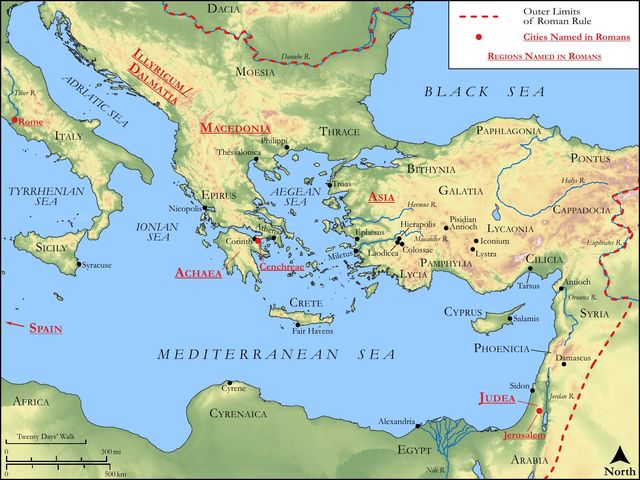
See on the biblical-era maps

Study this verse
Public-domain commentary
Matthew Henry
From his Commentary on the Whole Bible. Henry comments on passages, not single verses — this entry covers Romans 4:9–16. His four-level outline is real structure in the source text, so it is rendered as structure.
St. Paul observes in this paragraph when and why Abraham was thus justified; for he has several things to remark upon that. It was before he was circumcised, and before the giving of the law; and there was a reason for both.
I.It was before he was circumcised, Rom 4:10.
His faith was counted to him for righteousness while he was in uncircumcision. It was imputed, Gen 15:6, and he was not circumcised till ch. 17. Abraham is expressly said to be justified by faith fourteen years, some say twenty-five years, before he was circumcised. Now this the apostle takes notice of in answer to the question (Rom 4:9), Cometh this blessedness then on the circumcision only, or on the uncircumcision also? Abraham was pardoned and accepted in uncircumcision, a circumstance which, as it might silence the fears of the poor uncircumcised Gentiles, so it might lower the pride and conceitedness of the Jews, who gloried in their circumcision, as if they had the monopoly of all happiness. Here are two reasons why Abraham was justified by faith in uncircumcision: -
1.That circumcision might be a seal of the righteousness of faith, Rom 4:11. The tenour of the covenants must first be settled before the seal can be annexed. Sealing supposes a previous bargain, which is confirmed and ratified by that ceremony. After Abraham's justification by faith had continued several years only a grant by parole, for the confirmation of Abraham's faith God was pleased to appoint a sealing ordinance, and Abraham received it; though it was a bloody ordinance, yet he submitted to it, and even received it as a special favour, the sign of circumcision, etc. Now we may hence observe,
(1.)The nature of sacraments in general: they are signs and seals - signs to represent and instruct, seals to ratify and confirm. They are signs of absolute grace and favour; they are seals of the conditional promises; nay, they are mutual seals: God does in the sacraments seal to us to be to us a God, and we do therein seal to him to be to him a people.
(2.)The nature of circumcision in particular: it was the initiating sacrament of the Old Testament; and it is here said to be,
[1.]A sign - a sign of that original corruption which we are all born with, and which is cut off by spiritual circumcision, - a commemorating sign of God's covenant with Abraham, - a distinguishing sign between Jews and Gentiles, - a sign of admission into the visible church, - a sign prefiguring baptism, which comes in the room of circumcision, now under the gospel, when (the blood of Christ being shed) all bloody ordinances are abolished; it was an outward and sensible sign of an inward and spiritual grace signified thereby.
[2.]A seal of the righteousness of the faith. In general, it was a seal of the covenant of grace, particularly of justification by faith - the covenant of grace, called the righteousness which is of faith (Rom 10:6), and it refers to an Old Testament promise, Deu 30:12. Now if infants were then capable of receiving a seal of the covenant of grace, which proves that they then were within the verge of that covenant, how they come to be now cast out of the covenant and incapable of the seal, and by what severe sentence they were thus rejected and incapacitated, those are concerned to make out that not only reject, but nullify and reproach, the baptism of the seed of believers.
2.That he might be the father of all those that believe. Not but that there were those that were justified by faith before Abraham; but of Abraham first it is particularly observed, and in him commenced a much clearer and fuller dispensation of the covenant of grace than any that had been before extant; and there he is called the father of all that believe, because he was so eminent a believer, and so eminently justified by faith, as Jabal was the father of shepherds and Jubal of musicians, Gen 4:20, Gen 4:21. The father of all those that believe; that is, a standing pattern of faith, as parents are examples to their children; and a standing precedent of justification by faith, as the liberties, privileges, honours, and estates, of the fathers descend to their children. Abraham was the father of believers, because to him particularly the magna charta was renewed.
(1.)The father of believing Gentiles, though they be not circumcised. Zaccheus, a publican, if he believe, is reckoned a son of Abraham, Luk 19:9. Abraham being himself uncircumcised when he was justified by faith, uncircumcision can never be a bar. Thus were the doubts and fears of the poor Gentiles anticipated and no room left to question but that righteousness might be imputed to them also, Col 3:11; Gal 5:6.
(2.)The father of believing Jews, not merely as circumcised, and of the seed of Abraham according to the flesh, but because believers, because they are not of the circumcision only (that is, are not only circumcised), but walk in the steps of that faith - have not only the sign, but the thing signified - not only are of Abraham's family, but follow the example of Abraham's faith. See here who are the genuine children and lawful successors of those that were the church's fathers: not those that sit in their chairs, and bear their names, but those that tread in their steps; this is the line of succession, which holds, notwithstanding interruptions. It seems, then, those were most loud and forward to call Abraham father that had least title to the honours and privileges of his children. Thus those have most reason to call Christ Father, not that bear his name in being Christians in profession, but that tread in his steps.
II.It was before the giving of the law, Rom 4:13-16.
The former observation is levelled against those that confined justification to the circumcision, this against those that expected it by the law; now the promise was made to Abraham long before the law. Compare Gal 3:17, Gal 3:18. Now observe,
1.What that promise was - that he should be the heir of the world, that is, of the land of Canaan, the choicest spot of ground in the world, - or the father of many nations of the world, who sprang from him, besides the Israelites, - or the heir of the comforts of the life which now is. The meek are said to inherit the earth, and the world is theirs. Though Abraham had so little of the world in possession, yet he was heir of it all. Or, rather, it points at Christ, the seed here mentioned; compare Gal 3:16, To thy seed, which is Christ. Now Christ is the heir of the world, the ends of the earth are his possession, and it is in him that Abraham was so. And it refers to that promise (Gen 12:3), In thee shall all the families of the earth be blessed.
2.How it was made to him: Not through the law, but through the righteousness of faith. Not through the law, for that was not yet given: but it was upon that believing which was counted to him for righteousness; it was upon his trusting God, in his leaving his own country when God commanded him, Heb 11:8. Now, being by faith, it could not be by the law, which he proves by the opposition there is between them (Rom 4:14, Rom 4:15): If those who are of the law be heirs; that is, those, and those only, and they by virtue of the law (the Jews did, and still do, boast that they are the rightful heirs of the world, because to them the law was given), then faith is made void; for, if it were requisite to an interest in the promise that there should be a perfect performance of the whole law, then the promise can never take its effect, nor is it to any purpose for us to depend upon it, since the way to life by perfect obedience to the law, and spotless sinless innocency, is wholly blocked up, and the law in itself opens no other way. This he proves, Rom 4:15. The law worketh wrath - wrath in us to God; it irritates and provokes that carnal mind which is enmity to God, as the damming up of a stream makes it swell - wrath in God against us. It works this, that is, it discovers it, or our breach of the law works it. Now it is certain that we can never expect the inheritance by a law that worketh wrath. How the law works wrath he shows very concisely in the latter part of the verse: Where no law is there is no transgression, an acknowledged maxim, which implies, Where there is a law there is transgression and that transgression is provoking, and so the law worketh wrath.
3.Why the promise was made to him by faith; for three reasons, Rom 4:16.
(1.)That it might be by grace, that grace might have the honour of it; by grace, and not by the law; by grace, and not of debt, nor of merit; that Grace, grace, might be cried to every stone, especially to the top-stone, in this building. Faith hath particular reference to grace granting, as grace hath reference to faith receiving. By grace, and therefore through faith, Eph 2:8. For God will have every crown thrown at the feet of grace, free grace, and every song in heaven sung to that tune, Not unto us, O Lord, not unto us, but unto thy name be the praise.
(2.)That the promise might be sure. The first covenant, being a covenant of works, was not sure: but, through man's failure, the benefits designed by it were cut off; and therefore, the more effectually to ascertain and ensure the conveyance of the new covenant, there is another way found out, not by works (were it so, the promise would not be sure, because of the continual frailty and infirmity of the flesh), but by faith, which receives all from Christ, and acts in a continual dependence upon him, as the great trustee of our salvation, and in whose keeping it is safe. The covenant is therefore sure, because it is so well ordered in all things, Sa2 23:5.
(3.)That it might be sure to all the seed. If it had been by the law, it had been limited to the Jews, to whom pertained the glory, and the covenants, and the giving of the law (Rom 9:4); but therefore it was by faith that Gentiles as well as Jews might become interested in it, the spiritual as well as the natural seed of faithful Abraham. God would contrive the promise in such a way as might make it most extensive, to comprehend all true believers, that circumcision and uncircumcision might break no squares; and for this (Rom 4:17) he refers us to Gen 17:5, where the reason of the change of his name from Abram - a high father, to Abraham - the high father of a multitude, is thus rendered: For a father of many nations have I made thee; that is, all believers, both before and since the coming of Christ in the flesh, should take Abraham for their pattern, and call him father. The Jews say Abraham was the father of all proselytes to the Jewish religion. Behold, he is the father of all the world, which are gathered under the wings of the Divine Majesty. - Maimonides.
Historical interpretation
Eleven Centuries of Reception
11 surviving comments on this verse. Each one is dated, so this reads as a timeline rather than a list.
Select a marker to jump to its quote. Markers stagger vertically where authors wrote within a few decades of each other.
For albeit it is subsequently that he is called "a father of many nations," still it is of those (nations) who, as the fruit of the "faith" which precedes digamy, had to be accounted "sons of Abraham."
For, albeit comeliness is not to be censured, as being a bodily happiness, as being an additional outlay of the divine plastic art, as being a kind of goodly garment of the soul; yet it is to be feared, just on account of the injuriousness and violence of suitors: which (injuriousness and violence) even the father of the faith, Abraham, greatly feared in regard of his own wife's grace; and Isaac, by falsely representing Rebecca as his sister, purchased safety by insult!
But you Jews say that Abraham was circumcised. Yes, but he pleased God before his circumcision, and he did not yet observe the sabbath. For he had accepted circumcision as a sign for that time, not as a prerogative title to salvation.
But how are we children of faith? and of whose faith, if not Abraham's? For since "Abraham believed God, and it was accounted to him for righteousness; " since, also, he deserved for that reason to be called "the father of many nations," whilst we, who are even more like him in believing in God, are thereby justified as Abraham was, and thereby also obtain life-since the just lives by his faith,-it therefore happens that, as he in the previous passage called us "sons of Abraham," since he is in faith our (common) father, so here also he named us "children of faith," for it was owing to his faith that it was promised that Abraham should be the father of (many) nations.
Abraham received circumcision as a sign of the righteousness of faith. For believing that he would have a son, he received the sign of the thing which he believed, that it might be known that he was justified because of what he believed. Circumcision has no special value; it is just a sign. The children of Abraham received this sign so that it would be known that they were the children of him who had received this sign because he believed in God and so that they would imitate their father’s faith and believe in Jesus, who was promised to Abraham. Isaac was born as a type of Christ, for the nations are not blessed in Isaac but in Christ, “for there is no other name under heaven given among men by which we must be saved,” says the apostle Peter.
See you how he shows the Jews to be as it were of the class of parasites (i.e. guests), rather than those in uncircumcision, and that these were added to the others? For if he was justified and crowned while in uncircumcision, the Jews came in afterwards, Abraham is then the father first of the uncircumcised, which through faith appertain to him, and then of those in the circumcision. For he is a forefather of two lines. See you faith lightening up? for till it came the patriarch was not justified. See you the uncircumcision offering no hindrance? for he was uncircumcised, yet was not hindered from being justified. The circumcision therefore is behind the faith. And why wonder that it is behind the faith, when it is even behind the uncircumcision. Nor is it behind faith only, but very far inferior to it, even so far as the sign is to the reality of which it is the sign; for instance, as the seal is to the soldier. And why, he says, did he want a seal then? He did not want it himself. For what purpose then did he receive it? With a view to his being the father alike of them that believe in uncircumcision and in circumcision. But not of those in circumcision absolutely: wherefore he goes on to say, "To them who are not of the circumcision only." For if to the uncircumcised, it is not in that he is uncircumcised that he is their father, although justified in uncircumcision; but in that they imitated his faith; much less is it owing to circumcision that he is the forefather of those in the state of circumcision, unless faith also be added.
Paul taught us both that Abraham received circumcision as a sign and that while he was still uncircumcised he gave evidence of righteousness arising from faith.
In case anyone says that Abraham was circumcised unnecessarily, Paul argues that it is the sign or seal of an existing righteousness, not of growth in an unfolding righteousness. This righteousness was so perfect that it deserved a seal, for something that is full is always sealed.
Circumcision was given for these three reasons: First, to be a sign of faith; second, to mark out the race of Abraham, and third, to be a sign and symbol of good and wise behavior. It was not given in order to produce righteousness but as a sign and seal of the righteousness which was Abraham’s by faith.
Thou seest how the holy Virgin has surpassed even the perfection of the patriarchs, and how she confirms the covenant which was made with Abraham by God, when He said, "This is the covenant which I shall establish between me and thee."
Having showed that the blessing of forgiveness of sins is obtained not only in circumcision but also in uncircumcision on the ground that Abraham was justified when he was still uncircumcised [n. 339], the Apostle now responds to an objection. For someone could say: If Abraham was justified before circumcision, then he was circumcised without reason and for no purpose. To exclude this objection, he first states that circumcision was not the cause but the sign of righteousness; secondly, he shows what he obtains from this sign, there [v. 11b; n. 344] at that he might be the father; thirdly, how he obtains it, there [v. 12b; n. 345] at who are not merely. 342. In regard to the first he does two things. First, he states that circumcision is a sign: "You shall be circumcised in the flesh of your foreskin and it shall be a sign of the covenant between you and me" (Gen 17:10). Secondly, he shows what it is a sign of, saying: a seal of the justice of faith, i.e., the justice that comes through faith, which faith is in uncircumcision, i.e., which Abraham had while he was still uncircumcised. 176 21 Aquinas elucidates the meaning of signaculum, which can mean the signet impressing a seal, by pointing to a sigillo, the seal impressed by a signet. As in Latin, however, but the signet and the impression made by the signet can be called the "seal." This makes translation difficult. 343. "Seal" is said in two ways. In one way, a seal [or signet] is a visible sign possessing a likeness to the thing signified, as in Ez (28:12): "You were the signet of perfection, full of wisdom." Circumcision had this visible likeness to Abraham’s faith. First, in regard to what he believed. For Abraham believed that his seed would be multiplied; hence, it was fitting to receive its sign in the organ of reproduction. Secondly, in regard to the effect of his faith, namely, the removal of fault, and this is signified by the removal of superfluous skin. In another way, "seal" [signaculum] means a sign hiding something which is to be revealed to friends, as is clear in the case of a sigillo:21 "Worthy art thou, who wast slain, to take the scroll and to open its seals" (Rev 6:9). Hence, the secret of the incarnation of Christ from the seed of Abraham was enclosed under the seal of circumcision. 344. Then he shows what follows from what has been said. For Abraham, still uncircumcised, was justified by faith and later received circumcision. From this he obtains the honor of being the father not only of the circumcised but also of uncircumcised believers. And this is what he says: The purpose was to make him father, i.e., from the foregoing it comes about that Abraham is the father, of all who believe without being circumcised, i.e., who are in the state of uncircumcision. Or Abraham is the father through uncircumcision, i.e., in virtue of what he had in uncircumcision, namely, that it be reckoned to them also as righteousness, namely, the fact that they believe, just as it was reckoned to Abraham. The power of this fatherhood is indicated in Mt (3:9): "God is able from these stones to raise up children to 177 Abraham." And likewise the father of the circumcised, who derive their origin from him: "Abraham is our father" (Jn 8:39). 345. Then he shows the manner in which he is the father even of the uncircumcised, namely, by imitation. And this is what he says: That he might be the father not merely of the circumcised but also of those who follow the example of the faith which our father Abraham had before he was circumcised, i.e., which Abraham had, while he was still uncircumcised: "If you were Abraham’s children, you would do what Abraham did" (Jn 8:39). 346. Since we are speaking of circumcision, it is fitting to consider three things about it, namely, why it was instituted [n. 347], what power it had [n. 349] and why it was changed [n. 350]. 347. In regard to the first it should be noted that circumcision, just as the other ceremonies of the Law, was instituted for two purposes. First, for divine worship, for which men were disposed in accordance with these ceremonies. In keeping with this, circumcision had three reasons for being instituted, the first of which was to signify the faith and obedience by which Abraham submitted to God, so that those who accepted the circumcision of Abraham should observe his faith and obedience. For it is stated in Heb 11: "By faith Abraham was circumcised." Hence, circumcision was instituted to signify his faith in future descendants, as has been stated. The second reason was to express in a bodily sign something that was to occur spiritually, namely, just as superfluous skin was removed from the organ of reproduction, which is the chief servant of concupiscence, so every superfluous desire should be 178 removed from man’s heart, as Jer (4:4) says: "Circumcise yourself to the Lord, remove the foreskin of your hearts." The third reason was to distinguish the people worshiping God from all other people. This is why God commanded circumcision for the children of Israel, who were to dwell among the other nations after first living alone and uncircumcised in the desert. 348. The other purpose of circumcision and all the ceremonies is based on a relation to Christ, to whom they are compared as the figure to the reality and as the members to the body: "These are only a shadow of what is to come, but the body belongs to Christ" (Col 2:17). Accordingly, by bodily circumcision is signified the spiritual circumcision to be accomplished by Christ: first in the soul, inasmuch as it is through him that concupiscence and the effects [reatus] of sin are removed by Christ: "In him," namely, Christ, "also you were circumcised with a circumcision made without hands, by putting off the body of flesh in the circumcision of Christ" (Col 2:11). Secondly, in regard to the body, namely, when in the resurrection all possibility of suffering and death is removed from the bodies of the elect. Hence, circumcision took place on the eighth day, because it signified the eighth era. For the seventh is the era of those who are at rest in Christ, while the other six are the eras during which the world runs its course. Again, circumcision was done with knives of stone (Jos 5:2) to signify that spiritual circumcision was to be effected by the Rock, who is Christ, as stated in 1 Cor (10:4). However, it was not the general practice to use a knife made of stone. 349. In regard to the second question, namely, what power circumcision had, it should be noted that, as the Gloss [of Lombard, col. 1372] says here—the quotation is 179 taken from Bede—"During the Law, circumcision offered the same curative help against the wound of original sin as baptism is wont to give in the era of revealed grace." This shows that the power of circumcision extended to the removal of original sin. However, some say that grace was not conferred in circumcision; for without righteousness God’s grace cannot be present. But the Apostle says in Gal (2:21): "If justification were through the law, then Christ died to no purpose." And we can argue in the same way: If justifying grace were through circumcision, Christ died to no purpose. But this cannot be, for sin is never forgiven without grace: "Justified by his grace we have peace with God (Rom 5:1). Therefore, others say that grace was conferred in circumcision to produce privative effects, namely, to remove guilt, but not positive effects, namely, the work of righteousness. But this does not seem fitting either, for the positive effects of any form precede in the order of nature the privative effects; for example, light does not expel darkness except by illuminating. Similarly, grace expels guilt by producing righteousness. But if the prior is removed, the subsequent is removed. Therefore, it is better to say that ex opere operato circumcision did not have effective power either to remove guilt or to produce righteousness. It was merely a sign of righteousness, as the Apostle says here. But through faith in Christ, of which circumcision was a sign, it removed original sin and conferred the help of grace to act righteously. 350. In regard to the third question, it is clear from what has been said, why circumcision had to be changed. For it was a sign of something to come. But the same 180 sign does not suit the present, past and future. Therefore, baptism, as the sign of present grace, produces a more copious and more beneficial effect of grace, because the closer the agent is in time and place, the more effectively it works. 351. Then [n. 323] when he says, For not through the law, he explains his statement that circumcision or any work of the Law did not justify in virtue of a divine promise. In regard to this he does two things: first, he states his proposition; secondly, he proves it, there [v. 14; n. 354] at If it is the adherents of the law. 352. First, therefore, the Apostle accepts on the authority of Genesis the promise made to Abraham and his seed that they should inherit the world, i.e., that all the nations of the world would be blessed in him: "By you all the families of the earth shall be blessed" (Gen 12:3). He says, and to his seed, because even though this promise was not to be fulfilled in him, it was to be fulfilled in his descendants: "By your seed shall all the nations of the earth be blessed" (Gen 23:18). But this seed is principally understood as Christ: "Now the promises were made to Abraham and to his seed. It does not say, ‘and to seeds,’ referring to many, but referring to one" (Gal 3:16), because in the one in whom it is to be fulfilled Ps 2 (v.8) it is shown that he would inherit the world: "Ask of me and I will make the nations your heritage." Secondarily, it is fulfilled in those who through Christ’s grace are spiritually the seed of Abraham: "The children of the promise are reckoned as descendants" (Rom 181 9:8). Through Christ they inherit the world, inasmuch as all things are for the glory of the elect: "All are yours and you are Christ’s" (1 Cor 3:22). 353. In regard to this promise he denies one thing and asserts another. He denies that such a promise came through the law. This is not said on account of the promise itself, because at the time of the promise the Law had not been given, but in reference to the fulfillment of the promise, so that the sense is that such a promise was not made to Abraham as something to be fulfilled through the Law, because, as it says in Heb (7:19): "The law made nothing perfect." What he asserts is that such a promise was to be fulfilled through the righteousness of faith, because "the saints through faith conquered kingdoms" (Heb 11:33). 354. Then when he says If it is (v.14) he proves his statement: first, in regard to the denial that the promise is to be fulfilled through, the Law; secondly, in regard to the assertion that it is to be fulfilled through the righteousness of faith, there [v. 16; n. 359] at Therefore it is of faith. In regard to the first he presents this argument: If the promise made to Abraham were to be fulfilled through the Law, Abraham’s faith believing the promise would be null, because the promise made to him would be abolished. But this is not fitting. Therefore, the first. In regard to this he does two things: first he presents a conditional statement; secondly, he proves it, there [v. 15; n. 356] at For the law. The destruction of the consequent is manifest. 182 355. He says first, therefore, that the promise was not made through the Law. For if it is the adherents of the law who are to be the heirs, i.e., if, in order to share in the promised inheritance, it is required that one obtain this from observing the Law, faith is null, i.e., the faith by which Abraham believed God promising Gen (c. 15) as been made futile. But this is not in keeping with what has been stated in 1 Cor (15:17): "If Christ has not been raised, your faith is futile and you are still in your sins." Why it is futile is shown when he adds, and the promise is abolished, i.e., emptied, because it does not produce its effect. But this is contrary to what is stated in Heb (11:11): "She considered him faithful who had promised" and to what is stated in this chapter (v.21): "Fully convinced that God was able to do what he had promised." 356. Then when he says For the law (v. 15) he proves the conditional statement through the effect or result of the Law. First, he proposes the effect or result of the Law; secondly, he proves it, there [v. 15b; n. 358] at For where there is no law. 357. He proves the conditional thus: If a promise is to be fulfilled through something which prevents its fulfillment, such a promise is void and the faith of believers futile. But the Law prevents one from obtaining the inheritance, for the law brings wrath; therefore, if the promise is to be fulfilled through the Law, faith is null and the promise is void. Now the Law is said to bring wrath, i.e., vengeance, because through the Law men were made deserving of God’s vengeance: "Great is the wrath of the Lord that is kindled against us, because our fathers have not obeyed the words of this book," i.e., of the Law (2 Kg 22:13). 183 But someone might suppose that the Law brings wrath as far as legal ceremonies observed in the era of grace are concerned, in line with Gal (5:2): "If you receive circumcision, Christ will be of no advantage to you." However, what is stated here refers even to moral precepts, not because they command something which makes its observers deserving of God’s wrath, but because the Law commands and does not confer the grace to fulfill, according to 2 Cor (3:6): "The letter kills, but the Spirit gives life," namely, because "the Spirit helps us inwardly in our weakness" (Rom 8:26). 358. Then when he says For where there is no law (v.15b) he shows how it brings wrath, saying: But where there is no law, there is no transgression, because even though a person, with no law given, could sin by commission against what is naturally just, he is not called a transgressor, unless he violates a law: "I looked at the transgressors with disgust, because they did not keep thy commands" (Ps 119:158). Yet every sinner can be called a transgressor, inasmuch as he transgresses the natural law: "I have accounted all the sinners of the earth transgressors" (Ps 119:119). However, it is more grievous to transgress at once the law of nature and the written law than the law of nature alone. Hence, the Law having been given without the help of grace, transgression increased and deserved greater wrath.
Continue studying Romans 4:11 across the web’s major study libraries — every link below opens this exact verse, chapter, or book on the destination site.
Read & Compare
 BibleGatewayThis verse in more than 200 translations and 70 languages.
 Bible.comThe YouVersion reader — hundreds of translations, reading plans, and highlights.
 ESV.orgCrossway's official English Standard Version reader.
 NET BibleThe NET translation with 60,000+ translators' notes on every rendering decision.
 STEP BibleTyndale House's free study tool — original text, vocabulary, and scholarly resources.
 BibliaLogos Bible Software's free web reader.
 USCCBThe New American Bible (Revised Edition) with the U.S. bishops' study notes.
Commentaries
 BibleHub CommentariesDozens of classic commentaries on this verse, gathered on one page.
 StudyLightMore than 100 commentary sets — the largest collection on the web.
 BibleRefPlain-English commentary on what this verse means, verse by verse.
 Enduring WordDavid Guzik's free commentary on this chapter, widely used by Bible teachers.
 Bible Study ToolsVerse commentary alongside Greek and Hebrew study aids.
Original Language & Research
- BibleHub InterlinearThe verse word by word — original language, transliteration, and English.
- BibleHub LexiconEvery word's original-language definition and Strong's entry.
 Blue Letter BibleDeep-study tools — Strong's numbers, concordance, and word studies.
 CNTR CollationThe earliest Greek manuscripts of this verse, collated letter by letter.
Sermons, Hymns & Audio


TrulyRandomVerse is not affiliated with these sites and doesn’t control their content. They’re linked because they’re genuinely useful.
Summary
Romans 4:11 profoundly articulates the theological significance of Abraham's circumcision, clarifying that it was not the basis of his righteousness but rather a visible sign and seal of the righteousness he had already received by faith while still uncircumcised. This divinely orchestrated sequence established Abraham as the spiritual progenitor of all believers, both Jew and Gentile, demonstrating that God's method of justification has always been by faith, leading to the imputation of righteousness to all who believe, regardless of their ethnic or ritualistic background.
Context
ShowHideLiterary Context
Romans 4 is a pivotal chapter in Paul's argument for justification by faith, building upon the foundational declaration in Romans 3:21-26 that God's righteousness is revealed apart from the law, through faith in Jesus Christ. Having established the universal need for righteousness and God's provision for it, Paul turns to Abraham, a figure revered by both Jews and Gentiles, to demonstrate that this principle of justification by faith is not a new invention but has always been God's way. The immediate preceding verses, Romans 4:1-10, meticulously detail how Abraham was credited with righteousness before any works of the law or even the institution of circumcision, specifically referencing Genesis 15:6. Verse 11, therefore, serves to explain why Abraham was circumcised and the true meaning of that act in light of his prior justification.
Historical & Cultural Context
In Paul's time, circumcision was the preeminent sign of Jewish identity and covenant membership, often viewed by many Jews as a prerequisite for salvation or a mark of superior standing before God. Gentiles, by contrast, were "uncircumcised" and considered outside the covenant. The historical context of Abraham's life is crucial: he was declared righteous in Genesis 15 but was not circumcised until Genesis 17, approximately 14 years later. This chronological gap is central to Paul's argument. Culturally, the debate over whether Gentile converts needed to be circumcised to be part of the Christian community was a major contention in the early church, as evidenced by the Jerusalem Council in Acts 15. Paul's argument in Romans 4 directly addresses this tension, asserting that physical rites do not confer righteousness, but faith does.
Key Themes
ShowHideThis verse significantly contributes to several overarching themes in Romans and the broader Pauline corpus. The primary theme is Justification by Faith, emphasizing that a right standing with God is a gracious gift received through belief, not through adherence to legalistic requirements or ethnic markers. Closely related is the theme of Imputed Righteousness, where God credits or "reckons" righteousness to believers, rather than it being earned. The verse also develops the theme of Abraham as the Father of All Believers, expanding his role beyond a merely ethnic patriarch to a spiritual father whose faith provides a pattern for all, Jew and Gentile, who believe. Finally, it redefines the role of Circumcision, shifting its understanding from a salvific act to a Sign and Seal of an already existing spiritual reality, thereby undermining the exclusivity of Jewish claims to salvation based on ritual.
Exposition and Analysis
ShowHideKey Word Analysis
ShowHideAn indication, especially ceremonially or supernaturally. Here, circumcision functions as a visible indicator or symbol, pointing to the spiritual reality of Abraham's righteousness by faith. It's not the cause, but the pointer.
A signet (as fencing in or protecting from misappropriation); by implication, the stamp impressed (as a mark of privacy, or genuineness), literally or figuratively. A seal authenticates, confirms, or guarantees something. Circumcision served to validate and confirm the righteousness Abraham already possessed, much like a signature on a document or a seal on a letter confirms its authenticity.
The prepuce; by implication, an uncircumcised (i.e. gentile, figuratively, unregenerate) state or person. This word is crucial for Paul's argument, highlighting that Abraham's righteousness was credited to him while he was in a state culturally and ritually identified with Gentiles. This underscores the universality of salvation by faith, available to all, regardless of their physical or ethnic status.
To take an inventory, i.e. estimate (literally or figuratively); to count, reckon, or credit to someone's account. This term is central to Paul's doctrine of justification. It means that God graciously credits or attributes righteousness to believers, not because they have earned it, but because of their faith, just as He did for Abraham.
Verse Breakdown
ShowHide"And he received the sign of circumcision,"
This clause states the historical fact that Abraham underwent circumcision, establishing its place within the narrative of his life. It emphasizes that circumcision was something "received," an external act, rather than an internal state or earned merit.
"a seal of the righteousness of the faith which [he had yet] being uncircumcised:"
This is the theological core of the verse. Circumcision is defined as a "seal" – an authenticating mark – of the "righteousness of faith." Crucially, this righteousness was possessed by Abraham before he was circumcised, while he was still "uncircumcised." This sequence demonstrates that faith, not circumcision, was the source of his righteousness.
"that he might be the father of all them that believe, though they be not circumcised;"
This clause explains the divine purpose behind the timing of Abraham's justification and subsequent circumcision. By being justified while uncircumcised, Abraham became a spiritual father not only to circumcised Jews but also to Gentiles ("them that believe, though they be not circumcised"). This establishes a universal lineage of faith, transcending ethnic and ritual boundaries.
"that righteousness might be imputed unto them also:"
This final clause reiterates the ultimate goal and outcome: that righteousness would be credited ("imputed") to all who believe, whether Jew or Gentile, just as it was to Abraham. It underscores the consistent method of God's salvation across all people groups and throughout history – through faith, leading to a gracious declaration of righteousness.
Literary Devices
ShowHidePaul employs several literary devices to convey his profound theological argument. Symbolism is paramount, as circumcision is reinterpreted from a mere physical act to a sign pointing to a spiritual reality and a seal authenticating that reality. This redefinition is crucial for his argument against legalism. The use of Antithesis is also evident, contrasting Abraham's state of being "uncircumcised" when he received righteousness with his later "circumcision," highlighting that the former, not the latter, was the condition for justification. Furthermore, the verse functions as a Purpose Clause (indicated by "that he might be" and "that righteousness might be imputed"), revealing God's overarching intention for Abraham's life to serve as a paradigm for universal salvation through faith.
Theological and Thematic Connections
ShowHideRomans 4:11 is a cornerstone of Pauline theology, asserting that God's method of salvation has always been consistent: by grace through faith, apart from works of the law. It dismantles the notion that physical rites or ethnic lineage are prerequisites for a right standing with God, demonstrating that Abraham, the patriarch of Israel, was himself justified by faith before the institution of circumcision or the Mosaic Law. This truth liberates believers from the burden of earning salvation through human effort and unites all who believe—Jew and Gentile—under the same spiritual fatherhood of Abraham, emphasizing the universal scope of God's redemptive plan.
Reflection and Application
ShowHideRomans 4:11 offers profound assurance and a clear call to understand the true nature of our relationship with God. It reminds us that our standing before God is not based on our performance, our religious rituals, our heritage, or any external marker, but solely on our faith in Him. Just as Abraham's faith was credited as righteousness, so too is ours. This truth should liberate us from striving to earn God's favor and instead lead us to rest in the finished work of Christ, received by faith. It also challenges any sense of spiritual elitism, reminding us that all believers, regardless of background, are united in Christ as children of Abraham by faith. This should foster humility, unity, and a profound gratitude for God's impartial grace.
Questions for Reflection
ShowHideFAQ
ShowHideWhat is the difference between "sign" and "seal" in this verse?
ShowHideIn Romans 4:11, Paul uses "sign" (Greek: sēmeîon) and "seal" (Greek: sphragís) to explain the dual function of circumcision for Abraham. A sign points to something, acting as a visible indicator or symbol of an underlying reality. Circumcision was a sign that pointed to Abraham's covenant relationship with God and the righteousness he possessed. A seal, on the other hand, authenticates, confirms, or guarantees something already existing. It's like a stamp of approval or a mark of ownership. For Abraham, circumcision served as a seal that authenticated and confirmed the righteousness that God had already credited to him by faith, before he was circumcised. It wasn't the cause of his righteousness, but its divine validation.
Christ-Centered Fulfillment
ShowHideRomans 4:11, while focusing on Abraham, powerfully foreshadows the ultimate fulfillment of God's redemptive plan in Jesus Christ. Abraham's justification by faith, while uncircumcised, prefigures the universal reach of the Gospel, which breaks down the dividing wall between Jew and Gentile, making salvation accessible to all who believe, regardless of their ethnic or ritualistic background (Ephesians 2:14-18). Jesus Christ is the true "seed" of Abraham (Galatians 3:16), through whom all the nations of the earth are blessed. He is the one in whom the "righteousness of faith" is perfectly embodied and offered. Our faith is not merely in a principle, but in the person and work of Christ—His atoning death and resurrection—through which God "imputes" or credits His perfect righteousness to us (2 Corinthians 5:21). Thus, Abraham's experience serves as a divinely inspired blueprint, pointing to the greater reality that in Christ, the spiritual family of God is defined not by physical lineage or external rites, but by a shared faith in the Lamb of God, who takes away the sin of the world (John 1:29).