


Galatians 1:4
- τοῦtouthe [One who]G3588T-GSMDefinite article Genitive Singular Masculine
- δόντοςdontoshaving givenG1325V-2AAP-GSMVerb 2nd Aorist Active Participle Genitive Singular Masculine
- ἑαυτὸνhe'autonHimselfG1438F-3ASMReflexive pronoun Accusative 3rd Singular Masculine
- ὑπὲρhuperforG5228PREPPreposition
- τῶνtōntheG3588T-GPFDefinite article Genitive Plural Feminine
- ἁμαρτιῶνhamartiōnsinsG266N-GPFNoun Genitive Plural Feminine
- ἡμῶνhēmōnof usG3165P-1GPPersonal pronoun Genitive 1st Plural
- ὅπωςhopōsso thatG3704CONJConjunction
- ἐξέληταιexelētaiHe may deliverG1807V-2AMS-3SVerb 2nd Aorist Middle Subjunctive 3rd Singular
- ἡμᾶςhēmasusG3165P-1APPersonal pronoun Accusative 1st Plural
- ἐκekout ofG1537PREPPreposition
- τοῦtoutheG3588T-GSMDefinite article Genitive Singular Masculine
- αἰῶνοςaiōnosageG165N-GSMNoun Genitive Singular Masculine
- τοῦtouof whichG3588T-GSMDefinite article Genitive Singular Masculine
- ἐνεστῶτοςenestōtoshaving come presentlyG1764V-RAP-GSMVerb Perfect Active Participle Genitive Singular Masculine
- πονηροῦponērouevilG4190A-GSMAdjective Genitive Singular Masculine
- κατὰkataaccording toG2596PREPPreposition
- τὸtotheG3588T-ASNDefinite article Accusative Singular Neuter
- θέλημαthelēmawillG2307N-ASNNoun Accusative Singular Neuter
- τοῦtouof theG3588T-GSMDefinite article Genitive Singular Masculine
- θεοῦtheouGodG2316N-GSM-TNoun Genitive Singular Masculine Title
- καὶkaiandG2532CONJConjunction
- πατρὸςpatrosFatherG3962N-GSM-TNoun Genitive Singular Masculine Title
- ἡμῶνhēmōnof usG3165P-1GPPersonal pronoun Genitive 1st Plural
English is a literal word-by-word gloss of the Greek, not the KJV's wording. Why?
This is the original text the KJV's translators worked from — each Greek word with its own literal English meaning in this verse, prepared by scholars at Tyndale House, Cambridge. The KJV translates whole sentences, not word by word, so its wording differs: one Greek word can become several English words, and the KJV may choose “charity” where the gloss reads “love”. Both are faithful — they answer different questions. For the KJV's own rendering, switch to the KJV text.
Details
See on the biblical-era map

Study this verse
Public-domain commentary
Matthew Henry
From his Commentary on the Whole Bible. Henry comments on passages, not single verses — this entry covers Galatians 1:1–5. His two-level outline is real structure in the source text, so it is rendered as structure.
In these verses we have the preface or introduction to the epistle, where observe,
I.The person or persons from whom this epistle is sent - from Paul an apostle, etc., and all the brethren that were with him.
1.The epistle is sent from Paul; he only was the penman of it. And, because there were some among the Galatians who endeavoured to lessen his character and authority, in the front of it he gives a general account both of his office and of the manner in which he was called to it, which afterwards, in this and the following chapter, he enlarges more upon. As to his office, he was an apostle. He is not afraid to style himself so, though his enemies would scarcely allow him this title: and, to let them see that he did not assume this character without just ground, he acquaints them how he was called to this dignity and office, and assures them that his commission to it was wholly divine, for he was an apostle, not of man, neither by man; he had not the common call of an ordinary minister, but an extraordinary call from heaven to this office. He neither received his qualification for it, nor his designation to it, by the mediation of men, but had both the one and the other directly from above; for he was an apostle by Jesus Christ, he had his instructions and commission immediately from him, and consequently from God the Father, who was one with him in respect of his divine nature, and who had appointed him, as Mediator, to be the apostle and high priest of our profession, and as such to authorize others to this office. He adds, Who raised him from the dead, both to acquaint us that herein God the Father gave a public testimony to Christ's being his Son and the promised Messiah, and also that, as his call to the apostleship was immediately from Christ, so it was after his resurrection from the dead, and when he had entered upon his exalted state; so that he had reason to look upon himself, not only as standing upon a level with the other apostles, but as in some sort preferred above them; for, whereas they were called by him when on earth, he had his call from him when in heaven. Thus does the apostle, being constrained to it by his adversaries, magnify his office, which shows that though men should by no means be proud of any authority they are possessed of, yet at certain times and upon certain occasions it may become needful to assert it. But,
2.He joins all the brethren that were with him in the inscription of the epistle, and writes in their name as well as his own. By the brethren that were with him may be understood either the Christians in common of that place where he now was, or such as were employed as ministers of the gospel. These, notwithstanding his own superior character and attainments, he is ready to own as his brethren; and, though he alone wrote the epistle, yet he joins them with himself in the inscription of it. Herein, as he shows his own great modesty and humility, and how remote he was from an assuming temper, so he might do this to dispose these churches to a greater regard to what he wrote, since hereby it would appear that he had their concurrence with him in the doctrine which he had preached, and was now about to confirm, and that it was no other than what was both published and professed by others as well as himself.
II.To whom this epistle is sent - to the churches of Galatia.
There were several churches at that time in this country, and it should seem that all of them were more or less corrupted through the arts of those seducers who had crept in among them; and therefore Paul, on whom came daily the care of all the churches, being deeply affected with their state, and concerned for their recovery to the faith and establishment in it, writes this epistle to them. He directs it to all of them, as being all more or less concerned in the matter of it; and he gives them the name of churches, though they had done enough to forfeit it, for corrupt churches are never allowed to be churches: no doubt there were some among them who still continued in the faith, and he was not without hope that others might be recovered to it.
III.The apostolical benediction, Gal 1:3.
Herein the apostle, and the brethren who were with him, wish these churches grace and peace from God the Father, and from the Lord Jesus Christ. This is the usual blessing wherewith he blesses the churches in the name of the Lord - grace and peace. Grace includes God's good-will towards us and his good work upon us; and peace implies in it all that inward comfort, or outward prosperity, which is really needful for us; and they come from God the Father as the fountain, through Jesus Christ as the channel of conveyance. Both these the apostle wishes for these Christians. But we may observe, First grace, and then peace, for there can be no true peace without grace. Having mentioned the Lord Jesus Christ, he cannot pass without enlarging upon his love; and therefore adds (Gal 1:4), Who gave himself for our sins, that he might deliver, etc. Jesus Christ gave himself for our sins, as a great sacrifice to make atonement for us; this the justice of God required, and to this he freely submitted for our sakes. One great end hereof was to deliver us from this present evil world; not only to redeem us from the wrath of God, and the curse of the law, but also to recover us from the corruption that is in the world through lust, and to rescue us from the vicious practices and customs of it, unto which we are naturally enslaved; and possibly also to set us free from the Mosaic constitution, for so aiōn houtos is used, Co1 2:6, Co1 2:8. From this we may note,
1.This present world is an evil world: it has become so by the sin of man, and it is so on account of the sin and sorrow with which it abounds and the many snares and temptations to which we are exposed as long as we continue in it. But,
2.Jesus Christ has died to deliver us from this present evil world, not presently to remove his people out of it, but to rescue them from the power of it, to keep them from the evil of it, and in due time to possess them of another and better world. This, the apostle informs us, he has done according to the will of God and our Father. In offering up himself a sacrifice for this end and purpose, he acted by the appointment of the Father, as well as with his own free consent; and therefore we have the greatest reason to depend upon the efficacy and acceptableness of what he has done and suffered for us; yea, hence we have encouragement to look upon God as our Father, for thus the apostle here represents him: as he is the Father of our Lord Jesus, so in and through him he is also the Father of all true believers, as our blessed Saviour himself acquaints us (Joh 20:17), when he tells his disciples that he was ascending to his Father and their Father.
The apostle, having thus taken notice of the great love wherewith Christ hath loved us, concludes this preface with a solemn ascription of praise and glory to him (Gal 1:5): To whom be glory for ever and ever. Amen. Intimating that on this account he is justly entitled to our highest esteem and regard. Or this doxology may be considered as referring both to God the Father and our Lord Jesus Christ, from whom he had just before been wishing grace and peace. They are both the proper objects of our worship and adoration, and all honour and glory are perpetually due to them, both on account of their own infinite excellences, and also on account of the blessings we receive from them.
Historical interpretation
Four Centuries of Reception
11 surviving comments on this verse. Each one is dated, so this reads as a timeline rather than a list.
Select a marker to jump to its quote. Markers stagger vertically where authors wrote within a few decades of each other.
Now Christ by atoning for our transgressions not only gave us life but also made us his own, so that we might be called children of God, made so through faith. What a great error it is, therefore, to go under the law again after receiving grace.
For when the human race was held in the dominion of the devil, the Savior offered himself to the willing devil, so that deceiving him by the power of his virtue—for the devil wanted to take possession of one whom he was unable to hold—he could carry off those whom the devil was detaining by a false right.
"Who gave himself for our sins."
Thus it appears, that the ministry which He undertook was free and uncompelled; that He was delivered up by Himself, not by another. Let not therefore the words of John, "that the Father gave His only-begotten Son" for us, lead you to derogate from the dignity of the Only-begotten, or to infer therefrom that He is only human. For the Father is said to have given Him, not as implying that the Son's ministry was a servile one, but to teach us that it seemed good to the Father, as Paul too has shown in the immediate context: "according to the will of our God, and Father." He says not "by the command," but "according to the will," for inasmuch as there is an unity of will in the Father and the Son, that which the Son wills, the Father wills also.
"For our sins," says the Apostle; we had pierced ourselves with ten thousand evils, and had deserved the gravest punishment; and the Law not only did not deliver us, but it even condemned us, making sin more manifest, without the power to release us from it, or to stay the anger of God. But the Son of God made this impossibility possible for he remitted our sins, He restored us from enmity to the condition of friends, He freely bestowed on us numberless other blessings.
"That He might deliver us out of this present evil world."
Another class of heretics seize upon these words of Paul, and pervert his testimony to an accusation of the present life. Lo, say they, he has called this present world evil, and pray tell me what does "world" mean but time measured by days and seasons? Is then the distinction of days and the course of the sun evil? no one would assert this even if he be carried away to the extreme of unreasonableness. "But" they say, "it is not the 'time,' but the present 'life,' which he hath called evil." Now the words themselves do not in fact say this; but the heretics do not rest in the words, and frame their charge from them, but propose to themselves a new mode of interpretation. At least therefore they must allow us to produce our interpretation, and the rather in that it is both pious and rational. We assert then that evil cannot be the cause of good, yet that the present life is productive of a thousand prizes and rewards.
Miserable, wretched man! what is it thou sayest? Is this life evil, wherein we have learnt to know God, and meditate on things to come, and have become angels instead of men, and take part in the choirs of the heavenly powers? What other proof do we need of an evil and depraved mind?
"Why then," they say, "does Paul call the present life evil?" In calling the present world evil, he has accommodated himself to our usage, who are wont to say, "I have had a bad day," thereby complaining not of the time itself, but of actions or circumstances. And so Paul in complaining of evil principles of action has used these customary forms of speech; and he shows that Christ hath both delivered us from our offences, and secured us for the future. The first he has declared in the words, "Who gave Himself for our sins;" and by adding, "that He might deliver us out of this present evil world," he has pronounced our future safety. For neither of these did the Law avail, but grace was sufficient for both.
"According to the will of our God and Father."
Since they were terrified by their notion that by deserting that old Law and adhering to the new, they should disobey God, who gave the Law, he corrects their error, and says, that this seemed good to the Father also: and not simply "the Father," but "our Father," which he does in order to affect them by showing that Christ has made His Father our Father.
Neither did the Son give himself without the Father’s will, nor did the Father give up the Son without the Son’s will.… The Son gave himself, that he himself, as righteousness, might do away with the unrighteousness in us. Wisdom gave itself that it might oust foolishness.
(Verse 4) He gave himself for our sins, that he might deliver us from this present evil world, according to the will of God and our Father, to whom be glory for ever and ever. Amen. Neither did the Son give himself for our sins without the will of the Father, nor did the Father deliver the Son without the Son's will; but this is the will of the Son, to fulfill the will of the Father, as he himself speaks in the psalm: 'I desired to do your will, O my God' (Psalm 40:8). But the Son gave Himself, in order to overthrow the injustice that was in us with justice itself. Wisdom offered itself in order to conquer ignorance. Holiness and strength presented themselves in order to eliminate impurity and weakness. And in this way, not only in the future age according to the promised hope in which we believe, but also here in the present age, He has freed us: while we have died together with Christ, we are transformed into a new way of thinking, and we are not of this world, from which we are rightly not loved. The question is how the present age is called evil. For heretics often take advantage of this, asserting that one is the creator of light and the future age, another of darkness and the present. But we say, that it is not so much the age itself, which runs day and night, years and months, that is called evil, but rather the things that happen in the age: how it is said to be sufficient for its own evil (Matthew VI): and the days of Jacob are said to be few and evil (Genesis XLVII). Not that the period of time in which Jacob lived was bad, but that the things he endured through various trials tested him. Finally, during the time he served for his wives and struggled with many difficulties (Gen. XXIX), Esau was at rest, and so the same period of time was good for some and bad for others; and it would not be written in Ecclesiastes: Do not say that my former days (were better) than these (Eccles. VII, 11), unless in comparison to the bad. Where John says: The whole world is set in evil (1 John 5:19). Not that the world itself is evil, but that evil things happen in the world because of humans. Let us eat and drink, they say, for tomorrow we will die (Isaiah 22:17). And the Apostle himself says: Redeeming the time, because the days are evil (Ephesians 5:16). Even the fields and forests are defamed, when they are full of robberies, not because the earth and woods sin, but because they have also drawn infamy to the places of murder. We detest both the sword by which human blood is shed and the cup in which poison has been mixed, not the sword or the cup themselves, but those who have misused them. Thus, this world, which is a span of time, is not inherently good or evil, but is called such by those who are in it. Therefore, the delusions and fables of Valentinius, who invented thirty aeons based on the mention of ages in the Scriptures, are to be despised. He claimed that they are beings and that he produced as many aeons as the Aeneas's sow produced litters, using squares and octads, decades and duodecades. Also to be sought is what is the difference between saeculum and saeculum saeculi, or saecula saeculorum, and where it is placed for a brief span of time, where it is placed for eternity: because in Hebrew saeculum, that is, Olam (), where the letter Vav is added, signifies eternity, but when it is written without Vav it signifies the fiftieth year, which they call Jubilee. For this reason, that Hebrew who, because of his wife and children, loving his Lord, willingly subjects himself to perpetual servitude, is commanded to serve forever (Exod. XXI), that is, until the fiftieth year. Both the Moabites and the Ammonites (Deuteronomy XXIII) are not allowed to enter the Church of the Lord until the fifteenth generation and even forever: because every hard condition of the Jubilee was solved by His coming. Some say that the same sense exists in the ages of ages as in the holy of holies, in the heavens of heavens, in the works of works, in the Songs of Songs: and they have the same difference as the heavens have from those who belong to the heavens, and as the holy things which are holier than the comparison of the holy things, and as the works which are better than the comparison of the works, and as the Songs which excel among all the Songs: in the same way, they say, the ages have the same relationship to the comparison of ages. Therefore, they have determined that the present age should be counted from the time when the heavens and the earth were created, and it will continue until the end of the world, when Christ will judge all things. They also recall the past and advance to a higher level, debating about past and future ages, whether they have been good or bad, or will be in the future. They delve into such deep questions that they have even written books and countless volumes on this subject. But as for the conclusion of the prologue of Paul in the Hebrew language: Amen (), the Seventy translated it as γένοιτο, that is, let it be done. Aquila rendered it as πεπιστωμένος, truly or faithfully. This is also constantly embraced in the Gospel by the Savior, affirming his own words by Amen.
By “the evil age” he does not mean the elements, as the Manichaeans portentously assert, but the present life, that is, this secular human way of living, in which sin has made a home. For, being enveloped in a mortal nature, some of us venture on the greater sins, some on the lesser. But when we make the transition to that immortal life, and are free from our present corruption and have put on incorruption, we shall be made able to conquer sin.… Yet the present age as such is not vile, but vileness is the enterprise of some who live in it.
He did not speak about the time, but pronounced the present life to be evil.
We have incurred innumerable evils, and have become responsible for the last punishment; for the law not only has not led anyone to reconciliation, but, to condemnation, and besides, it is incapable of emancipating anyone, or putting an end to God’s wrath, when it reveals sin; whereas the Son of God, not only has made possible what was impossible, but also has remitted sins and has placed enemies to the position of friends.
Continue studying Galatians 1:4 across the web’s major study libraries — every link below opens this exact verse, chapter, or book on the destination site.
Read & Compare
 BibleGatewayThis verse in more than 200 translations and 70 languages.
 Bible.comThe YouVersion reader — hundreds of translations, reading plans, and highlights.
 ESV.orgCrossway's official English Standard Version reader.
 NET BibleThe NET translation with 60,000+ translators' notes on every rendering decision.
 STEP BibleTyndale House's free study tool — original text, vocabulary, and scholarly resources.
 BibliaLogos Bible Software's free web reader.
 USCCBThe New American Bible (Revised Edition) with the U.S. bishops' study notes.
Commentaries
 BibleHub CommentariesDozens of classic commentaries on this verse, gathered on one page.
 StudyLightMore than 100 commentary sets — the largest collection on the web.
 BibleRefPlain-English commentary on what this verse means, verse by verse.
 Enduring WordDavid Guzik's free commentary on this chapter, widely used by Bible teachers.
 Bible Study ToolsVerse commentary alongside Greek and Hebrew study aids.
Original Language & Research
- BibleHub InterlinearThe verse word by word — original language, transliteration, and English.
- BibleHub LexiconEvery word's original-language definition and Strong's entry.
 Blue Letter BibleDeep-study tools — Strong's numbers, concordance, and word studies.
 CNTR CollationThe earliest Greek manuscripts of this verse, collated letter by letter.
Sermons, Hymns & Audio


TrulyRandomVerse is not affiliated with these sites and doesn’t control their content. They’re linked because they’re genuinely useful.
Summary
Galatians 1:4 encapsulates the very heart of the gospel Paul defends: Jesus Christ's voluntary, substitutionary sacrifice for our sins, orchestrated by the sovereign will of God the Father, with the explicit purpose of delivering believers from the pervasive influence and dominion of the present evil age. This foundational truth stands in stark contrast to any false gospel that would add human works or legalistic requirements to the finished work of Christ, asserting the divine origin and complete efficacy of God's redemptive plan.
Context
ShowHideLiterary Context
Galatians 1:4 is embedded within Paul's opening salutation (Galatians 1:1-5), which immediately deviates from his typical practice of including a lengthy thanksgiving. Instead, Paul launches directly into a defense of the gospel, expressing astonishment that the Galatian churches are so quickly deserting the true message for a "different gospel" (Galatians 1:6). This verse, therefore, serves as a concise, yet potent, summary of the authentic gospel that Paul preached—a gospel centered entirely on Christ's redemptive work, not human effort. It establishes the theological bedrock upon which Paul will build his entire argument against the Judaizers who were advocating for circumcision and adherence to the Law as necessary for salvation. By stating the purpose of Christ's death so clearly at the outset, Paul sets the stage for his subsequent arguments regarding justification by faith alone, apart from works of the Law.
Historical & Cultural Context
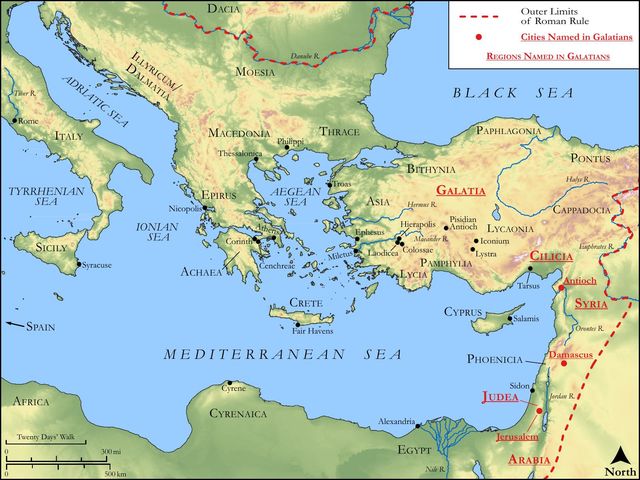
The churches in Galatia (likely located in the Roman province of Galatia, encompassing cities like Iconium, Lystra, and Derbe) were facing a significant theological crisis. Jewish Christians, often referred to as "Judaizers," had infiltrated these congregations, teaching that Gentile believers needed to be circumcised and observe aspects of the Mosaic Law in addition to believing in Christ to be truly saved. This teaching directly contradicted Paul's gospel of salvation by grace through faith. The "present evil world" (G165, aiṓn) refers not merely to the physical planet, but to the prevailing spiritual and moral order of the age, characterized by sin, idolatry, and rebellion against God, often under the dominion of spiritual forces. This concept was deeply rooted in Jewish eschatology, which anticipated a "Messianic age" or "age to come" that would replace the current evil age. The Judaizers' emphasis on the Law was a way of attempting to navigate or even escape this evil age through human effort, whereas Paul asserts that deliverance comes solely through Christ's work.
Key Themes
ShowHideThis verse introduces several pivotal themes that permeate the entire letter to the Galatians. Firstly, the Sovereignty of God is paramount, as Christ's redemptive act is explicitly stated to be "according to the will of God and our Father," underscoring that salvation is God's initiative and plan, not a human contrivance. This theme directly counters any notion that human works could contribute to or initiate salvation. Secondly, the theme of Justification by Grace Through Faith is implicitly yet powerfully present; the emphasis on Christ "giving himself for our sins" highlights a completed, substitutionary work that leaves no room for human merit. This concept is further developed in passages like Galatians 2:16 and Galatians 3:10-14. Thirdly, the verse introduces the Radical Deliverance that salvation brings, freeing believers "from this present evil world." This liberation is not merely from the penalty of sin but from its power and the world's corrupting influence, leading to a transformed life that no longer conforms to worldly patterns, as seen in Galatians 5:16-25.
Exposition and Analysis
ShowHideKey Word Analysis
ShowHideThis verb signifies a deliberate, voluntary, and complete act of giving or bestowing. In the context of Christ, it emphasizes His willing self-sacrifice, not a coerced or accidental event. It speaks to the active agency of Jesus in His atonement, highlighting the intentionality behind His offering Himself.
This reflexive pronoun underscores the personal and unique nature of Christ's sacrifice. He gave Himself—His very being, His life—as the payment for sin. This highlights the substitutionary aspect of the atonement, where no other sacrifice or human effort could suffice.
This word means "to tear out," "to pluck out," "to rescue," or "to release." It conveys a sense of forceful removal from a dangerous or ensnaring situation. The implication is that humanity is trapped within the "present evil world," and only a powerful, external intervention (Christ's work) can extract them from its grip and dominion.
While sometimes referring to the physical earth, here aiṓn denotes an "age" or "epoch." When qualified by "present" and "evil," it refers to the current spiritual and moral system or order of things, characterized by sin, rebellion against God, and the dominion of evil forces. It signifies the prevailing ethos and values that stand in opposition to God's kingdom, from which believers are rescued.
Verse Breakdown
ShowHide"Who gave himself for our sins"
This clause identifies Jesus Christ as the subject and His central act of redemption. The phrase "gave himself" signifies a voluntary, self-sacrificial offering, emphasizing His active participation in the atonement. The preposition "for" (G5228, hypér) denotes "on behalf of" or "instead of," clearly indicating a substitutionary act. Christ bore the penalty and consequences of "our sins," which refers to the collective transgressions and rebellion of humanity against God, highlighting the propitiatory nature of His death. This is the foundation of the gospel: a divine exchange where Christ takes our sin upon Himself.
"that he might deliver us from this present evil world"
This clause states the primary purpose and effect of Christ's self-giving. The verb "deliver" (G1807, exairéō) implies a powerful rescue or liberation from a state of bondage. The object of this deliverance is "this present evil world" (G1764 enístēmi "present" + G4190 ponērós "evil" + G165 aiṓn "world/age"). This "world" is not merely a geographical location but the spiritual and moral system of the current age, characterized by its opposition to God, its values, and its dominion over unredeemed humanity. Christ's work liberates believers from its power, influence, and condemnation, enabling them to live a new life.
"according to the will of God and our Father"
This final clause underscores the divine origin and authority of Christ's redemptive work. It clarifies that this entire plan—Christ's sacrifice and our deliverance—is not an arbitrary event or a human invention, but is fully aligned with and executed "according to the will" (G2307, thélēma) of the sovereign God. The addition "and our Father" highlights the intimate, relational aspect of God's will, emphasizing His loving, paternal disposition towards humanity in orchestrating this salvation. This divine intentionality provides ultimate assurance of the gospel's truth and efficacy.
Literary Devices
ShowHidePaul employs several literary devices to convey his urgent message. The verse functions as a powerful Summary Statement or Thesis Statement for the entire letter, succinctly encapsulating the core of the gospel he defends. The phrase "gave himself" is a form of Sacrificial Language, evoking Old Testament concepts of atonement and sacrifice, but here elevated to the ultimate, perfect offering. The contrast between "our sins" and "this present evil world" highlights the dual nature of Christ's deliverance: from the Guilt of Sin and the Dominion of Sinful Systems. The phrase "evil world" uses Descriptive Adjectives to characterize the spiritual reality from which believers are rescued, emphasizing its corrupting influence. Finally, the concluding phrase "according to the will of God and our Father" serves as an Authoritative Declaration, grounding the entire redemptive act in divine sovereignty and purpose, thereby lending indisputable weight to Paul's gospel.
Theological and Thematic Connections
ShowHideGalatians 1:4 is a concise theological powerhouse, encapsulating the essence of God's redemptive plan. It firmly establishes the substitutionary atonement of Christ as the sole means of salvation, emphasizing that His self-giving was not merely an act of love, but a purposeful deliverance from the pervasive spiritual and moral corruption of the fallen world. This deliverance is not a result of human merit or adherence to legal codes, but flows entirely from the sovereign, loving will of God the Father. The verse thus sets the stage for Paul's robust defense of justification by faith alone, highlighting the complete sufficiency of Christ's work and the radical transformation it brings, freeing believers from both the penalty and the power of sin, and from the dominion of an anti-God world system.
Reflection and Application
ShowHideGalatians 1:4 invites profound reflection on the nature of our salvation and its implications for daily living. The truth that Christ "gave himself for our sins" should evoke deep gratitude and humility, reminding us that our standing before God is entirely dependent on His finished work, not our own. This liberates us from the burden of trying to earn God's favor or achieve righteousness through legalistic efforts, allowing us to rest in His grace. Furthermore, the purpose of this sacrifice—"that he might deliver us from this present evil world"—challenges us to critically examine our lives. Are we truly living as those delivered from the world's values, priorities, and systems? This deliverance calls us to a counter-cultural existence, where our allegiance is to Christ alone, and our lives reflect the values of His kingdom. It prompts us to discern and resist the subtle and overt influences of the "evil world" in our thoughts, actions, and desires, living instead in conformity to the will of God.
Questions for Reflection
ShowHideFAQ
ShowHideWhat does "this present evil world" refer to in Galatians 1:4?
ShowHideIn Galatians 1:4, "this present evil world" (Greek: aiōn) refers not to the physical planet Earth, but to the prevailing spiritual and moral system or "age" that is characterized by sin, rebellion against God, and opposition to His will. It encompasses the values, philosophies, structures, and influences that are contrary to God's kingdom and are under the dominion of spiritual darkness. Paul uses this phrase to describe the corrupting environment from which Christ's sacrifice delivers believers, enabling them to live according to God's purposes rather than the world's dictates. This concept is distinct from the "age to come," which is ushered in by Christ's redemptive work and will be fully realized at His return. The purpose of Christ's death was to rescue believers from the power and condemnation of this fallen system, as also seen in 1 John 2:15-17.
Christ-Centered Fulfillment
ShowHideGalatians 1:4 finds its profound Christ-centered fulfillment in the person and work of Jesus as the ultimate and perfect sacrifice, fulfilling God's eternal redemptive plan. His "giving himself for our sins" is the very essence of the gospel, echoing the prophetic imagery of the suffering servant in Isaiah 53:5-6, who was "pierced for our transgressions." This voluntary act, driven by divine love, serves as the singular means by which humanity is reconciled to God, establishing a new covenant in His blood, as Jesus Himself declared at the Last Supper (Luke 22:20). Furthermore, Christ's deliverance "from this present evil world" foreshadows His ultimate victory over sin, death, and the powers of darkness (Colossians 2:15). Through His resurrection and ascension, He inaugurated the "age to come," enabling believers to live in newness of life, no longer enslaved to the corrupting influences of the fallen world but empowered by the Holy Spirit to live according to God's will (Romans 6:4). Thus, Galatians 1:4 points directly to Jesus as the Lamb of God who takes away the sin of the world and the victorious King who delivers His people from all evil, all "according to the will of God and our Father," revealing the triune God's unified purpose in salvation history.