


Galatians 1:5
Bible text: King James Version (1769 Blayney text) · Public domain
Bible text: Berean Standard Bible · Public domain
Bible text: American Standard Version (1901) · Public domain
Bible text: World English Bible, Messianic edition · Public domain
Bible text: Geneva Bible (1599) · Public domain
Bible text: Young's Literal Translation · Public domain
- ᾧhōto whom [be]G3739R-DSMRelative pronoun Dative Singular Masculine
- ἡhētheG3588T-NSFDefinite article Nominative Singular Feminine
- δόξαdoxagloryG1391N-NSFNoun Nominative Singular Feminine
- εἰςeistoG1519PREPPreposition
- τοὺςtoustheG3588T-APMDefinite article Accusative Plural Masculine
- αἰῶναςaiōnasagesG165N-APMNoun Accusative Plural Masculine
- τῶνtōnof theG3588T-GPMDefinite article Genitive Plural Masculine
- αἰώνωνaiōnōnagesG165N-GPMNoun Genitive Plural Masculine
- ἀμήνamēnAmenG281INJ-HEBInterjection
English is a literal word-by-word gloss of the Greek, not the KJV's wording. Why?
This is the original text the KJV's translators worked from — each Greek word with its own literal English meaning in this verse, prepared by scholars at Tyndale House, Cambridge. The KJV translates whole sentences, not word by word, so its wording differs: one Greek word can become several English words, and the KJV may choose “charity” where the gloss reads “love”. Both are faithful — they answer different questions. For the KJV's own rendering, switch to the KJV text.
Details
See on the biblical-era maps

Study this verse
Public-domain commentary
Matthew Henry
From his Commentary on the Whole Bible. Henry comments on passages, not single verses — this entry covers Galatians 1:1–5. His two-level outline is real structure in the source text, so it is rendered as structure.
In these verses we have the preface or introduction to the epistle, where observe,
I.The person or persons from whom this epistle is sent - from Paul an apostle, etc., and all the brethren that were with him.
1.The epistle is sent from Paul; he only was the penman of it. And, because there were some among the Galatians who endeavoured to lessen his character and authority, in the front of it he gives a general account both of his office and of the manner in which he was called to it, which afterwards, in this and the following chapter, he enlarges more upon. As to his office, he was an apostle. He is not afraid to style himself so, though his enemies would scarcely allow him this title: and, to let them see that he did not assume this character without just ground, he acquaints them how he was called to this dignity and office, and assures them that his commission to it was wholly divine, for he was an apostle, not of man, neither by man; he had not the common call of an ordinary minister, but an extraordinary call from heaven to this office. He neither received his qualification for it, nor his designation to it, by the mediation of men, but had both the one and the other directly from above; for he was an apostle by Jesus Christ, he had his instructions and commission immediately from him, and consequently from God the Father, who was one with him in respect of his divine nature, and who had appointed him, as Mediator, to be the apostle and high priest of our profession, and as such to authorize others to this office. He adds, Who raised him from the dead, both to acquaint us that herein God the Father gave a public testimony to Christ's being his Son and the promised Messiah, and also that, as his call to the apostleship was immediately from Christ, so it was after his resurrection from the dead, and when he had entered upon his exalted state; so that he had reason to look upon himself, not only as standing upon a level with the other apostles, but as in some sort preferred above them; for, whereas they were called by him when on earth, he had his call from him when in heaven. Thus does the apostle, being constrained to it by his adversaries, magnify his office, which shows that though men should by no means be proud of any authority they are possessed of, yet at certain times and upon certain occasions it may become needful to assert it. But,
2.He joins all the brethren that were with him in the inscription of the epistle, and writes in their name as well as his own. By the brethren that were with him may be understood either the Christians in common of that place where he now was, or such as were employed as ministers of the gospel. These, notwithstanding his own superior character and attainments, he is ready to own as his brethren; and, though he alone wrote the epistle, yet he joins them with himself in the inscription of it. Herein, as he shows his own great modesty and humility, and how remote he was from an assuming temper, so he might do this to dispose these churches to a greater regard to what he wrote, since hereby it would appear that he had their concurrence with him in the doctrine which he had preached, and was now about to confirm, and that it was no other than what was both published and professed by others as well as himself.
II.To whom this epistle is sent - to the churches of Galatia.
There were several churches at that time in this country, and it should seem that all of them were more or less corrupted through the arts of those seducers who had crept in among them; and therefore Paul, on whom came daily the care of all the churches, being deeply affected with their state, and concerned for their recovery to the faith and establishment in it, writes this epistle to them. He directs it to all of them, as being all more or less concerned in the matter of it; and he gives them the name of churches, though they had done enough to forfeit it, for corrupt churches are never allowed to be churches: no doubt there were some among them who still continued in the faith, and he was not without hope that others might be recovered to it.
III.The apostolical benediction, Gal 1:3.
Herein the apostle, and the brethren who were with him, wish these churches grace and peace from God the Father, and from the Lord Jesus Christ. This is the usual blessing wherewith he blesses the churches in the name of the Lord - grace and peace. Grace includes God's good-will towards us and his good work upon us; and peace implies in it all that inward comfort, or outward prosperity, which is really needful for us; and they come from God the Father as the fountain, through Jesus Christ as the channel of conveyance. Both these the apostle wishes for these Christians. But we may observe, First grace, and then peace, for there can be no true peace without grace. Having mentioned the Lord Jesus Christ, he cannot pass without enlarging upon his love; and therefore adds (Gal 1:4), Who gave himself for our sins, that he might deliver, etc. Jesus Christ gave himself for our sins, as a great sacrifice to make atonement for us; this the justice of God required, and to this he freely submitted for our sakes. One great end hereof was to deliver us from this present evil world; not only to redeem us from the wrath of God, and the curse of the law, but also to recover us from the corruption that is in the world through lust, and to rescue us from the vicious practices and customs of it, unto which we are naturally enslaved; and possibly also to set us free from the Mosaic constitution, for so aiōn houtos is used, Co1 2:6, Co1 2:8. From this we may note,
1.This present world is an evil world: it has become so by the sin of man, and it is so on account of the sin and sorrow with which it abounds and the many snares and temptations to which we are exposed as long as we continue in it. But,
2.Jesus Christ has died to deliver us from this present evil world, not presently to remove his people out of it, but to rescue them from the power of it, to keep them from the evil of it, and in due time to possess them of another and better world. This, the apostle informs us, he has done according to the will of God and our Father. In offering up himself a sacrifice for this end and purpose, he acted by the appointment of the Father, as well as with his own free consent; and therefore we have the greatest reason to depend upon the efficacy and acceptableness of what he has done and suffered for us; yea, hence we have encouragement to look upon God as our Father, for thus the apostle here represents him: as he is the Father of our Lord Jesus, so in and through him he is also the Father of all true believers, as our blessed Saviour himself acquaints us (Joh 20:17), when he tells his disciples that he was ascending to his Father and their Father.
The apostle, having thus taken notice of the great love wherewith Christ hath loved us, concludes this preface with a solemn ascription of praise and glory to him (Gal 1:5): To whom be glory for ever and ever. Amen. Intimating that on this account he is justly entitled to our highest esteem and regard. Or this doxology may be considered as referring both to God the Father and our Lord Jesus Christ, from whom he had just before been wishing grace and peace. They are both the proper objects of our worship and adoration, and all honour and glory are perpetually due to them, both on account of their own infinite excellences, and also on account of the blessings we receive from them.
Historical interpretation
Three Centuries of Reception
3 surviving comments on this verse. Each one is dated, so this reads as a timeline rather than a list.
Select a marker to jump to its quote. Markers stagger vertically where authors wrote within a few decades of each other.
"To whom be the glory for ever and ever. Amen."
This too is new and unusual, for we never find the word, "Amen" placed at the beginning of an Epistle, but a good way on; here, however he has it in his beginning, to show that what he had already said contained a sufficient charge against the Galatians, and that his argument was complete, for a manifest offence does not require an elaborate crimination. Having spoken of the Cross, and Resurrection, of redemption from sin and security for the future, of the purpose of the Father, and the will of the Son, of grace and peace and His whole gift, he concludes with an ascription of praise.
Another reason for it is the exceeding astonishment into which he was thrown by the magnitude of the gift, the superabundance of the grace, the consideration who we were, and what God had wrought, and that at once and in a single moment of time. Unable to express this in words, he breaks out into a doxology, sending up for the whole world an eulogium, not indeed worthy of the subject, but such as was possible to him. Hence too he proceeds to use more vehement language; as if greatly kindled by a sense of the Divine benefits, for having said, "To whom be the glory for ever and ever, Amen," he commences with a more severe reproof.
How much more, therefore, ought men not to claim the credit for themselves if they perform any good work, when the very Son of God in the Gospel said that he sought not his own glory. Nor had he come to do his own will but the will of him who sent him! This will and glory of the Father the apostle now commemorates, that he also, by the example of the Lord who sent him, may indicate that he seeks not his own glory or the performance of his own will in the preaching of the gospel, just as he says a little later, “if I were to please men, I should not be a servant of Christ.”
He refers to the evil deeds, to the distorted free choice.
Continue studying Galatians 1:5 across the web’s major study libraries — every link below opens this exact verse, chapter, or book on the destination site.
Read & Compare
 BibleGatewayThis verse in more than 200 translations and 70 languages.
 Bible.comThe YouVersion reader — hundreds of translations, reading plans, and highlights.
 ESV.orgCrossway's official English Standard Version reader.
 NET BibleThe NET translation with 60,000+ translators' notes on every rendering decision.
 STEP BibleTyndale House's free study tool — original text, vocabulary, and scholarly resources.
 BibliaLogos Bible Software's free web reader.
 USCCBThe New American Bible (Revised Edition) with the U.S. bishops' study notes.
Commentaries
 BibleHub CommentariesDozens of classic commentaries on this verse, gathered on one page.
 StudyLightMore than 100 commentary sets — the largest collection on the web.
 BibleRefPlain-English commentary on what this verse means, verse by verse.
 Enduring WordDavid Guzik's free commentary on this chapter, widely used by Bible teachers.
 Bible Study ToolsVerse commentary alongside Greek and Hebrew study aids.
Original Language & Research
- BibleHub InterlinearThe verse word by word — original language, transliteration, and English.
- BibleHub LexiconEvery word's original-language definition and Strong's entry.
 Blue Letter BibleDeep-study tools — Strong's numbers, concordance, and word studies.
 CNTR CollationThe earliest Greek manuscripts of this verse, collated letter by letter.
Sermons, Hymns & Audio


TrulyRandomVerse is not affiliated with these sites and doesn’t control their content. They’re linked because they’re genuinely useful.
Summary
Galatians 1:5 serves as a profound doxology, an emphatic declaration of God's eternal worthiness of praise and honor. Following Paul's assertion of the divine origin of the Gospel and Christ's redemptive work, this verse directs all glory to God the Father, acknowledging His sovereign will and ultimate authority in the plan of salvation. It encapsulates Paul's deep reverence and gratitude, sealing his foundational theological statements with an outburst of worship.
Context
ShowHideLiterary Context
This verse concludes Paul's opening salutation and introductory remarks in his letter to the Galatians. Immediately preceding it, Galatians 1:4 states that Jesus Christ "gave himself for our sins, that he might deliver us from this present evil world, according to the will of God and our Father." The "whom" in Galatians 1:5 directly refers to "God and our Father" from the preceding verse, making it clear that the glory is ascribed to Him for orchestrating and accomplishing this mighty act of deliverance through His Son. This doxology sets a tone of divine authority and grace from the very outset of the letter, grounding Paul's subsequent arguments about the true Gospel in God's ultimate sovereignty. It functions as a theological exclamation mark, emphasizing that the entire redemptive narrative, from Christ's sacrifice to the deliverance of believers, flows from and returns glory to God.
Historical & Cultural Context
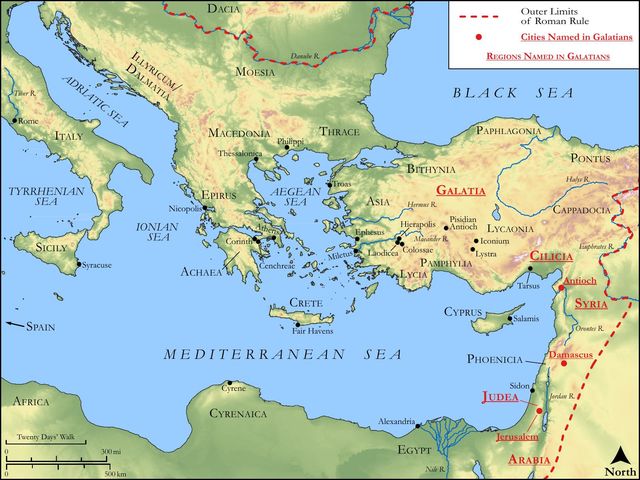
Paul is writing to the churches in Galatia, a region in Asia Minor, to address a severe theological crisis. False teachers, often referred to as "Judaizers," had infiltrated these churches, advocating for a gospel that required Gentile converts to observe aspects of the Mosaic Law, such as circumcision, in addition to faith in Christ. This challenged the core of Paul's gospel of justification by faith alone. In this opening, Paul asserts his apostolic authority, emphasizing that his commission and the Gospel he preaches are "not of men, neither by man, but by Jesus Christ, and God the Father" (Galatians 1:1). The doxology in Galatians 1:5 serves to underscore the divine origin and unchangeable nature of the true Gospel, implicitly contrasting it with the human-made additions of the false teachers. It grounds the entire discussion in God's ultimate plan and purpose, setting the stage for Paul's vigorous defense of grace.
Key Themes
ShowHideGalatians 1:5 contributes significantly to several overarching themes in the letter. Firstly, it highlights the divine origin and authority of the Gospel, emphasizing that salvation is entirely God's initiative, "according to the will of God and our Father" (Galatians 1:4). This stands in stark contrast to any human attempts to earn salvation through works of the Law. Secondly, it stresses God's sovereignty and ultimate purpose in redemption, affirming that all aspects of salvation are orchestrated by Him, leading to His ultimate glory. This theme is foundational to Paul's argument for justification by faith, as seen in later chapters where he contrasts the Law with God's promise to Abraham (Galatians 3:6-9). Finally, the doxology reflects the theme of worship and adoration, reminding believers that the proper response to God's gracious acts of deliverance is to ascribe all honor and praise to Him eternally. This sets a precedent for the freedom and joy found in Christ, which is a major theme throughout the letter, culminating in the call to "stand fast therefore in the liberty wherewith Christ hath made us free" (Galatians 5:1).
Exposition and Analysis
ShowHideKey Word Analysis
ShowHideFrom the base of δοκέω, this word signifies "glory" as something very apparent, encompassing dignity, honor, praise, and worship. In the context of God, it refers to His inherent majesty, splendor, and supreme worthiness. The ascription of "glory" to God acknowledges His intrinsic excellence and the visible manifestation of His attributes, particularly His power and grace demonstrated in the work of salvation.
Properly meaning "an age," this term extends to signify perpetuity or eternity. When used in the plural, as in "for ever and ever" (literally "unto the ages of ages"), it forms a superlative idiom emphasizing boundless and unending duration. It conveys the idea that God's glory is not confined to any temporal period but extends throughout all time and into eternity without end, reflecting His eternal nature.
Of Hebrew origin, this word properly means "firm" or "trustworthy." As an adverb or interjection, it functions as a solemn affirmation, meaning "so be it," "truly," or "let it be affirmed." In this doxology, "Amen" serves as a powerful and heartfelt confirmation of the preceding statement, sealing the declaration of God's eternal glory with conviction and agreement from the speaker and inviting similar affirmation from the hearers.
Verse Breakdown
ShowHide"To whom be glory"
This phrase directs the highest honor, praise, and majesty to "God and our Father" (from Galatians 1:4). It is an act of worship, acknowledging God's supreme worthiness and inherent splendor, particularly in light of His sovereign will in providing salvation through Christ. The use of the subjunctive "be" (ἔστω) expresses a wish or prayer, indicating a fervent desire that God indeed receive this unending praise.
"for ever and ever"
This powerful Greek idiom (εἰς τοὺς αἰῶνας τῶν αἰώνων, literally "unto the ages of the ages") is a superlative expression emphasizing the boundless and unending nature of God's glory. It signifies perpetuity and eternity, indicating that God's praise is not limited by time but extends throughout all future ages without cessation. It underscores the eternal duration of His reign and the everlasting nature of His redemptive work.
"Amen."
This concluding word serves as a solemn and emphatic affirmation of the entire doxology. It is a transliteration of a Hebrew word meaning "so be it" or "truly." Here, it functions as a heartfelt declaration of agreement and conviction, sealing the statement of God's eternal glory with a definitive and resounding "Yes!" It invites the reader or hearer to join in this declaration of truth and adoration.
Literary Devices
ShowHideGalatians 1:5 employs several literary devices to convey its profound theological message. Primarily, it functions as a Doxology, which is a liturgical expression of praise to God, often found at the conclusion of a prayer, hymn, or theological statement. This doxology serves as a natural and fitting culmination to Paul's opening assertion of God's sovereign role in salvation. The phrase "for ever and ever" utilizes Hyperbole or a strong Idiom to convey the concept of eternity. While literally meaning "unto the ages of ages," it is a superlative expression designed to emphasize boundless and unending duration, far beyond any finite measure of time. This linguistic emphasis underscores the infinite nature of God's glory. Finally, the concluding word "Amen" acts as a powerful Affirmation or Solemn Declaration, lending finality and conviction to the entire statement. It is a performative utterance that not only expresses agreement but also calls for it, sealing the truth of God's eternal worthiness of praise.
Theological and Thematic Connections
ShowHideGalatians 1:5 stands as a powerful testament to the biblical truth that all glory belongs to God alone. It encapsulates the theological principle of soli Deo gloria—glory to God alone—which is a cornerstone of Christian theology. This doxology is not merely a polite closing but a deeply theological statement affirming God's ultimate sovereignty as the initiator, sustainer, and perfecter of salvation. Because salvation is entirely "according to the will of God and our Father" (Galatians 1:4), all praise and honor for this miraculous deliverance must be directed to Him, eternally. This perspective counters any human-centered theology that might attribute salvation to human effort or merit, firmly rooting it in divine grace.
Reflection and Application
ShowHideGalatians 1:5 calls believers to cultivate a continuous and profound attitude of worship and thanksgiving, recognizing that God's plan of salvation is entirely His doing, and therefore, all credit and adoration belong to Him. This verse serves as a vital reminder that our ultimate purpose is to bring glory to God, not just in grand gestures, but in the everyday acknowledgment of His sovereign grace and love demonstrated through Christ's sacrifice. In a world that often seeks to glorify self or human achievements, this doxology reorients our perspective, directing our gaze and our praise to the one who is truly worthy. It encourages us to live lives that reflect His glory, understanding that our deliverance from this "present evil world" (Galatians 1:4) is a testament to His power and faithfulness, prompting an eternal response of "Amen!" from our hearts.
Questions for Reflection
ShowHideFAQ
ShowHideWhy does Paul conclude his opening remarks with a doxology?
ShowHidePaul concludes his opening remarks with a doxology in Galatians 1:5 for several profound reasons. Firstly, it is a natural and fitting response to the magnificent truth he has just declared in Galatians 1:4—that Jesus Christ "gave himself for our sins, that he might deliver us from this present evil world, according to the will of God and our Father." The sheer wonder of God's redemptive plan elicits an outburst of praise. Secondly, it immediately establishes the divine authority and origin of the Gospel he is about to defend. By directing all glory to God, Paul underscores that the Gospel is not a human invention but God's sovereign work. This sets the theological foundation for his entire letter, emphasizing that salvation is by God's grace alone, through faith alone, to God's glory alone. It also serves to counter the human-centered legalism of the false teachers, redirecting all focus and credit to the Almighty.
Christ-Centered Fulfillment
ShowHideWhile Galatians 1:5 directly attributes glory to God the Father, its Christ-centered fulfillment is profound, as the Father's glory is most fully revealed and realized through the person and work of Jesus Christ. The "whom" in this verse refers to "God and our Father" (Galatians 1:4), but it is through the Son that the Father's will is accomplished and His glory made manifest. Jesus Christ, as the "radiance of God's glory and the exact representation of His being" (Hebrews 1:3), perfectly embodies and reveals the divine splendor to which this doxology points. His self-sacrifice "for our sins" (Galatians 1:4) is the ultimate demonstration of God's love and power, and it is through this redemptive act that God receives eternal glory. The "ever and ever" speaks to the eternal nature of God's glory, a glory that Christ shares as the eternal Word who was "with God and was God" (John 1:1). Ultimately, the Father is glorified as He exalts His Son, Jesus, to whom "every knee should bow, of things in heaven, and things in earth, and things under the earth; And that every tongue should confess that Jesus Christ is Lord, to the glory of God the Father" (Philippians 2:10-11). Thus, the eternal glory ascribed in Galatians 1:5 is intrinsically tied to the saving work and eternal reign of Christ, the Lamb of God who is "worthy to receive power, and riches, and wisdom, and strength, and honour, and glory, and blessing" (Revelation 5:12).