


1 Peter 5:11
Bible text: King James Version (1769 Blayney text) · Public domain
Bible text: Berean Standard Bible · Public domain
Bible text: American Standard Version (1901) · Public domain
Bible text: World English Bible, Messianic edition · Public domain
Bible text: Geneva Bible (1599) · Public domain
Bible text: Young's Literal Translation · Public domain
- αὐτῷautōTo Him [be]G846P-DSMPersonal pronoun Dative Singular Masculine
- ἡhētheG3588T-NSFDefinite article Nominative Singular Feminine
- δόξαdoxagloryG1391N-NSFNoun Nominative Singular Feminine
- καὶkaiandG2532CONJConjunction
- τὸtotheG3588T-NSNDefinite article Nominative Singular Neuter
- κράτοςkratospowerG2904N-NSNNoun Nominative Singular Neuter
- εἰςeistoG1519PREPPreposition
- τοὺςtoustheG3588T-APMDefinite article Accusative Plural Masculine
- αἰῶναςaiōnasagesG165N-APMNoun Accusative Plural Masculine
- τῶνtōnof theG3588T-GPMDefinite article Genitive Plural Masculine
- αἰώνωνaiōnōnagesG165N-GPMNoun Genitive Plural Masculine
- ἀμήνamēnAmenG281INJ-HEBInterjection
English is a literal word-by-word gloss of the Greek, not the KJV's wording. Why?
This is the original text the KJV's translators worked from — each Greek word with its own literal English meaning in this verse, prepared by scholars at Tyndale House, Cambridge. The KJV translates whole sentences, not word by word, so its wording differs: one Greek word can become several English words, and the KJV may choose “charity” where the gloss reads “love”. Both are faithful — they answer different questions. For the KJV's own rendering, switch to the KJV text.
Details
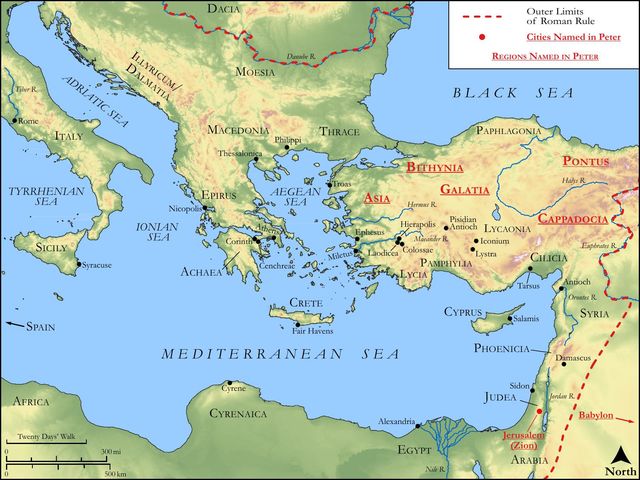
See on the biblical-era maps

Study this verse
Public-domain commentary
Matthew Henry
From his Commentary on the Whole Bible. Henry comments on passages, not single verses — this entry covers 1 Peter 5:10–14. His three-level outline is real structure in the source text, so it is rendered as structure.
We come now to the conclusion of this epistle, which,
I.The apostle begins with a most weighty prayer, which he addresses to God as the God of all grace, the author and finisher of every heavenly gift and quality, acknowledging, on their behalf, that God had already called them to be partakers of that eternal glory, which, being his own, he had promised and settled upon them, through the merit and intercession of Jesus Christ. Observe,
1.What he prays for on their account; not that they might be excused from sufferings, but that their sufferings might be moderate and short, and, after they had suffered awhile, that God would restore them to a settled and peaceable condition, and perfect his work in them - that he would establish them against wavering, either in faith or duty, that he would strengthen those who were weak, and settle them upon Christ the foundation, so firmly that their union with him might be indissoluble and everlasting. Learn,
(1.)All grace is from God; it is he who restrains, converts, comforts, and saves men by his grace.
(2.)All who are called into a state of grace are called to partake of eternal glory and happiness.
(3.)Those who are called to be heirs of eternal life through Jesus Christ must, nevertheless, suffer in this world, but their sufferings will be but for a little while.
(4.)The perfecting, establishing, strengthening, and settling, of good people in grace, and their perseverance therein, is so difficult a work, that only the God of all grace can accomplish it; and therefore he is earnestly to be sought unto by continual prayer, and dependence upon his promises.
2.His doxology, Pe1 5:11. From this doxology we may learn that those who have obtained grace from the God of all grace should and will ascribe glory, dominion, and power, to him for ever and ever.
II.He recapitulates the design of his writing this epistle to them (Pe1 5:12), which was,
1.To testify, and in the strongest terms to assure them, that the doctrine of salvation, which he had explained and they had embraced, was the true account of the grace of God, foretold by the prophets and published by Jesus Christ.
2.To exhort them earnestly that, as they had embraced the gospel, they would continue stedfast in it, notwithstanding the arts of seducers, or the persecutions of enemies.
(1.)The main thing that ministers ought to aim at in their labours is to convince their people of the certainty and excellency of the Christian religion; this the apostles did exhort and testify with all their might.
(2.)A firm persuasion that we are in the true way to heaven will be the best motive to stand fast, and persevere therein.
III.He recommends Silvanus, the person by whom he sent them this brief epistle, as a brother whom he esteemed faithful and friendly to them, and hoped they would account him so, though he was a ministers of the uncircumcision. Observe, An honourable esteem of the ministers of religion tends much to the success of their labours. When we are convinced they are faithful, we shall profit more by their ministerial services. The prejudices that some of these Jews might have against Silvanus, as a minister of the Gentiles, would soon wear off when they were once convinced that he was a faithful brother.
IV.He closes with salutations and a solemn benediction. Observe,
1.Peter, being at Babylon in Assyria, when he wrote this epistle (whither he travelled, as the apostle of the circumcision, to visit that church, which was the chief of the dispersion), sends the salutation of that church to the other churches to whom he wrote (Pe1 5:13), telling them that God had elected or chosen the Christians at Babylon out of the world, to be his church, and to partake of eternal salvation through Christ Jesus, together with them and all other faithful Christians, Pe1 1:2. In this salutation he particularly joins Mark the evangelist, who was then with him, and who was his son in a spiritual sense, being begotten by him to Christianity. Observe, All the churches of Jesus Christ ought to have a most affectionate concern one for another; they should love and pray for one another, and be as helpful one to another as they possibly can.
2.He exhorts them to fervent love and charity one towards another, and to express this by giving the kiss of peace (Pe1 5:14), according to the common custom of those times and countries, and so concludes with a benediction, which he confines to those that are in Christ Jesus, united to him by faith and sound members of his mystical body. The blessing he pronounces upon them is peace, by which he means all necessary good, all manner of prosperity; to this he adds his amen, in token of his earnest desire and undoubted expectation that the blessing of peace would be the portion of all the faithful.
Historical interpretation
Four Centuries of Reception
2 surviving comments on this verse. Each one is dated, so this reads as a timeline rather than a list.
Select a marker to jump to its quote. Markers stagger vertically where authors wrote within a few decades of each other.
It is ultimately the role of the Father and of the Son to proclaim the mystery of faith, because the glory and power belong to them, although they condescend to make use of us and of our preaching.
But the God of all grace, who has called us to His eternal glory by Christ Jesus, after you have suffered a little while, will Himself restore, establish, strengthen, and settle you. To Him be glory and dominion forever and ever. Amen.
And beginning the letter, Peter said that the Father, for the sake of the Son, have mercy on us, and now concluding, he teaches to call the same Father through the Son: for this is their aim to preach the mystery, although they do this with exhortation.
Continue studying 1 Peter 5:11 across the web’s major study libraries — every link below opens this exact verse, chapter, or book on the destination site.
Read & Compare
 BibleGatewayThis verse in more than 200 translations and 70 languages.
 Bible.comThe YouVersion reader — hundreds of translations, reading plans, and highlights.
 ESV.orgCrossway's official English Standard Version reader.
 NET BibleThe NET translation with 60,000+ translators' notes on every rendering decision.
 STEP BibleTyndale House's free study tool — original text, vocabulary, and scholarly resources.
 BibliaLogos Bible Software's free web reader.
 USCCBThe New American Bible (Revised Edition) with the U.S. bishops' study notes.
Commentaries
 BibleHub CommentariesDozens of classic commentaries on this verse, gathered on one page.
 StudyLightMore than 100 commentary sets — the largest collection on the web.
 BibleRefPlain-English commentary on what this verse means, verse by verse.
 Enduring WordDavid Guzik's free commentary on this chapter, widely used by Bible teachers.
 Bible Study ToolsVerse commentary alongside Greek and Hebrew study aids.
Original Language & Research
- BibleHub InterlinearThe verse word by word — original language, transliteration, and English.
- BibleHub LexiconEvery word's original-language definition and Strong's entry.
 Blue Letter BibleDeep-study tools — Strong's numbers, concordance, and word studies.
 CNTR CollationThe earliest Greek manuscripts of this verse, collated letter by letter.
Sermons, Hymns & Audio


TrulyRandomVerse is not affiliated with these sites and doesn’t control their content. They’re linked because they’re genuinely useful.
Summary
1 Peter 5:11 serves as a potent doxology, a formal declaration of praise, concluding the theological core of Peter's first epistle. Following a profound promise of God's restoration and strengthening after suffering, this verse directs all honor, power, and authority back to God, affirming His eternal sovereignty and ultimate triumph. It encapsulates the letter's message of hope and endurance, reminding believers that despite present trials, God remains supreme, worthy of unending adoration and trust.
Context
ShowHideLiterary Context
This verse immediately follows 1 Peter 5:10, which promises that "the God of all grace, who hath called us unto his eternal glory by Christ Jesus, after that ye have suffered a while, shall himself make you perfect, stablish, strengthen, settle you." The doxology of verse 11 is thus a natural and climactic response to this assurance of divine faithfulness and restorative power. It acts as a theological summation, redirecting the focus from the believer's suffering and God's intervention back to God's inherent worthiness of all praise. It also follows Peter's exhortations to humility (1 Peter 5:5-7), vigilance against the devil (1 Peter 5:8-9), and reliance on God's sustaining grace, reinforcing the ultimate source of strength and victory.
Historical & Cultural Context
Peter's first epistle was addressed to "elect exiles of the Dispersion" in various Roman provinces of Asia Minor (1 Peter 1:1). These early Christians were likely experiencing social ostracism, slander, and perhaps even official persecution, as hinted by references to "fiery trials" and suffering "for the name of Christ" (1 Peter 4:12-16). In such a context, a doxology like 1 Peter 5:11 served not merely as a formal closing but as a vital theological anchor, reminding a beleaguered community of God's unwavering control and ultimate victory, a stark contrast to the temporal powers that opposed them. The use of doxologies was a common practice in both Jewish and early Christian worship and literature, serving to affirm God's majesty and solidify communal faith.
Key Themes
ShowHide1 Peter 5:11 powerfully reinforces several key themes woven throughout the epistle. The primary theme is Divine Sovereignty and Glory, emphasizing that despite the chaos and suffering in the world, God remains the ultimate authority, to whom all honor is due. This doxology underscores the theme of Endurance Through Suffering, by pivoting from the promise of God's active intervention in the lives of suffering believers (1 Peter 5:10) to an affirmation of His eternal power, thereby providing a foundation for their hope. Furthermore, it highlights Eschatological Hope, as the phrase "for ever and ever" points to the unending nature of God's reign and the ultimate, eternal glory awaiting believers, a hope Peter introduces early in the letter (1 Peter 1:3-5). This concluding praise also exemplifies Apostolic Doxology, a common feature in New Testament epistles, serving as a final, faith-affirming declaration that encapsulates the letter's central theological message.
Exposition and Analysis
ShowHideKey Word Analysis
ShowHideFrom the base of δοκέω, this term signifies God's inherent majesty, splendor, renown, and honor. It encompasses His divine nature, His radiant presence, and all that makes Him worthy of praise and worship. In this context, it is an attribution of His intrinsic worth and magnificent character.
Perhaps a primary word, krátos denotes vigor, active strength, might, or ruling power. It is not merely passive power but suggests God's effective, manifest, and unchallenged authority. It implies His ability to exert control, to overcome all opposition, and to achieve His purposes with decisive power.
Of Hebrew origin, this word properly means "firm" or "trustworthy." As an adverb, it means "surely" or "truly," and as an interjection, "so be it." In this doxology, "Amen" serves as a strong affirmation of the truth and certainty of the preceding declaration, sealing the praise with conviction and expressing the communal assent of the readers.
Verse Breakdown
ShowHide"To him [be] glory"
This phrase directs all honor, majesty, and inherent worth to God. It is an act of worship, acknowledging God as the supreme being whose very nature is glorious and deserving of all praise. The implied "be" indicates a wish or a declaration that glory is perpetually and rightly ascribed to Him.
"and dominion"
Following "glory," this adds the attribution of ultimate power, authority, and sovereign rule to God. It declares that God possesses and exercises absolute control over all creation, circumstances, and events, reinforcing His unchallengeable might and active governance.
"for ever and ever"
This temporal phrase emphasizes the eternal and unending nature of God's glory and dominion. It signifies that His reign is not bound by time, extending infinitely into the past and future. It is a declaration of His timeless existence and perpetual worthiness of adoration, offering a profound sense of security and ultimate hope.
"Amen."
This concluding word serves as a solemn affirmation, expressing profound agreement and conviction regarding the truth and certainty of the preceding doxology. It is a communal "so be it," sealing the declaration of God's eternal glory and dominion with a resounding "truth" or "verily."
Literary Devices
ShowHide1 Peter 5:11 is a powerful example of a Doxology, a formal literary device used to express praise and glory to God. It is a concise and elevated statement of worship, often found at the conclusion of biblical books or sections, serving to summarize the theological thrust and direct the reader's attention to God's ultimate sovereignty. The phrase "for ever and ever" employs Hyperbole and Emphasis, not in the sense of exaggeration, but to underscore the infinite and unending nature of God's attributes, reinforcing the concept of His eternal reign. The entire verse also functions as an Apostrophe, a direct address to God, even though He is referred to in the third person ("To him"), as it is a declaration of praise directed towards His being. The structure of the verse, with its parallel attribution of "glory and dominion," also exhibits a form of Parallelism, enhancing its poetic and theological impact.
Theological and Thematic Connections
ShowHideThis doxology in 1 Peter 5:11 is profoundly theological, affirming God's absolute sovereignty and inherent worth. It serves as a powerful reminder that all things ultimately exist for God's glory and that His dominion is eternal and unchallengeable. In the face of suffering and earthly trials, this declaration provides a steadfast anchor, assuring believers that God's power will ultimately prevail over all evil and that His purposes will be fulfilled. It calls believers to a posture of perpetual worship, recognizing that God's character and authority are the ultimate realities, transcending all temporal circumstances. This understanding fosters both humility and profound trust, knowing that the "God of all grace" is also the God of all power and glory.
Reflection and Application
ShowHide1 Peter 5:11 offers a profound call to worship and a powerful source of spiritual resilience for believers in every generation. In a world often characterized by instability, suffering, and the apparent triumph of evil, this verse anchors our hope in the unshakeable reality of God's eternal glory and dominion. It compels us to lift our gaze beyond our immediate circumstances and fix it upon the One who is sovereign over all. This doxology reminds us that our struggles are temporary, but God's reign is everlasting. It cultivates a spirit of humility, prompting us to surrender our anxieties and entrust our lives to His all-powerful hand. Embracing this truth transforms our perspective, enabling us to find peace in His control, courage in His strength, and joy in His unfading glory, even amidst the most challenging trials. It inspires us to live lives that reflect His glory, knowing that our ultimate purpose is to magnify His name "for ever and ever."
Questions for Reflection
ShowHideFAQ
ShowHideWhy does Peter conclude his epistle with such a strong declaration of God's glory?
ShowHidePeter concludes his epistle with this powerful doxology in 1 Peter 5:11 to provide a theological anchor and a climactic affirmation of faith for his suffering readers. After exhorting them to endure trials, resist the devil, and trust in God's restorative grace (1 Peter 5:8-10), Peter redirects all praise and authority to God. This serves as a reminder that despite their present difficulties, God remains ultimately sovereign, His power is eternal, and His glory is the ultimate reality. It shifts the focus from human weakness and temporary suffering to divine strength and everlasting triumph, providing a powerful source of hope and encouragement.
What is the significance of "for ever and ever" in this verse?
ShowHideThe phrase "for ever and ever" (Greek: eis tous aiōnas tōn aiōnōn, literally "unto the ages of the ages") is a superlative expression emphasizing the eternal and unending nature of God's glory and dominion. It signifies that God's reign is not limited by time or circumstance; it extends infinitely into the past, present, and future. This phrase highlights God's timeless existence and His perpetual worthiness of adoration. For believers facing temporal persecutions, it provides a crucial eternal perspective, assuring them that God's ultimate victory and their future glory with Him are secure and everlasting, far outweighing any present suffering (2 Corinthians 4:17-18).
Christ-Centered Fulfillment
ShowHideWhile 1 Peter 5:11 directly attributes "glory and dominion" to God, its Christ-centered fulfillment is profound, as the New Testament consistently portrays Jesus Christ as the ultimate revelation and embodiment of God's glory and power. It is through Christ that God's eternal dominion is fully manifested and exercised. The Father has granted all authority to the Son (Matthew 28:18), and it is at the name of Jesus that "every knee should bow, of things in heaven, and things in earth, and things under the earth; and that every tongue should confess that Jesus Christ is Lord, to the glory of God the Father" (Philippians 2:10-11). Christ is the "radiance of God's glory and the exact representation of his being, sustaining all things by his powerful word" (Hebrews 1:3). Therefore, the eternal glory and dominion ascribed to God in this doxology are perfectly and eternally shared by, and revealed through, the Son, Jesus Christ, who is the Lamb who was slain, worthy to receive "power, and riches, and wisdom, and strength, and honour, and glory, and blessing" (Revelation 5:12). Thus, this doxology ultimately points to the Triune God, whose eternal glory and dominion are perfectly revealed in the person and work of Jesus Christ, the one through whom believers are called to "eternal glory" (1 Peter 5:10).