


Romans 4:3
Bible text: King James Version (1769 Blayney text) · Public domain
Bible text: Berean Standard Bible · Public domain
Bible text: American Standard Version (1901) · Public domain
Bible text: World English Bible, Messianic edition · Public domain
Bible text: Geneva Bible (1599) · Public domain
Bible text: Young's Literal Translation · Public domain
- τίtiWhatG5101I-ASNInterrogative pronoun Accusative Singular Neuter
- γὰρgarforG1063CONJConjunction
- ἡhētheG3588T-NSFDefinite article Nominative Singular Feminine
- γραφὴgraphēScriptureG1124N-NSFNoun Nominative Singular Feminine
- λέγει;legeisays?G3004V-PAI-3SVerb Present Active Indicative 3rd Singular
- ἐπίστευσενepisteusenBelievedG4100V-AAI-3SVerb Aorist Active Indicative 3rd Singular
- δὲdethenG1161CONJConjunction
- ἈβραὰμAbraamAbrahamG11N-NSM-PNoun Nominative Singular Masculine Individual
- τῷtō<the>G3588T-DSMDefinite article Dative Singular Masculine
- θεῷtheōin GodG2316N-DSM-TNoun Dative Singular Masculine Title
- καὶkaiandG2532CONJConjunction
- ἐλογίσθηelogisthēit was reckonedG3049V-API-3SVerb Aorist Passive Indicative 3rd Singular
- αὐτῷautōto himG846P-DSMPersonal pronoun Dative Singular Masculine
- εἰςeisforG1519PREPPreposition
- δικαιοσύνηνdikaiosunēnrighteousnessG1343N-ASFNoun Accusative Singular Feminine
English is a literal word-by-word gloss of the Greek, not the KJV's wording. Why?
This is the original text the KJV's translators worked from — each Greek word with its own literal English meaning in this verse, prepared by scholars at Tyndale House, Cambridge. The KJV translates whole sentences, not word by word, so its wording differs: one Greek word can become several English words, and the KJV may choose “charity” where the gloss reads “love”. Both are faithful — they answer different questions. For the KJV's own rendering, switch to the KJV text.
Details
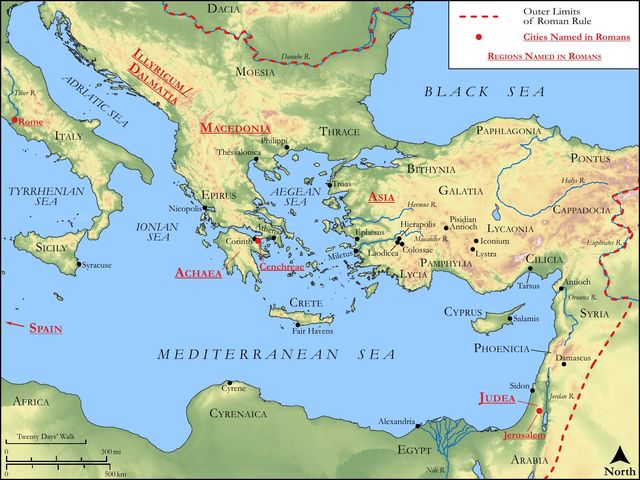
See on the biblical-era maps

Study this verse
Public-domain commentary
Matthew Henry
From his Commentary on the Whole Bible. Henry comments on passages, not single verses — this entry covers Romans 4:1–8. His two-level outline is real structure in the source text, so it is rendered as structure.
Here the apostle proves that Abraham was justified not by works, but by faith. Those that of all men contended most vigorously for a share in righteousness by the privileges they enjoyed, and the works they performed, were the Jews, and therefore he appeals to the case of Abraham their father, and puts his own name to the relation, being a Hebrew of the Hebrews: Abraham our father. Now surely his prerogative must needs be as great as theirs who claim it as his seed according to the flesh. Now what has he found? All the world is seeking; but, while the most are wearying themselves for very vanity, none can be truly reckoned to have found, but those who are justified before God; and thus Abraham, like a wise merchant, seeking goodly pearls, found this one pearl of great price. What has he found, kata sarka - as pertaining to the flesh, that is, by circumcision and his external privileges and performances? These the apostle calls flesh, Phi 3:3. Now what did he get by these? Was he justified by them? Was it the merit of his works that recommended him to God's acceptance? No, by no means, which he proves by several arguments.
I.If he had been justified by works, room would have been left for boasting, which must for ever be excluded.
If so, he hath whereof to glory (Rom 4:2), which is not to be allowed. "But," might the Jews say, "was not his name made great (Gen 12:2), and then might not he glory?" Yes, but not before God; he might deserve well of men, but he could never merit of God. Paul himself had whereof to glory before men, and we have him sometimes glorying in it, yet with humility; but nothing to glory in before God, Co1 4:4; Phi 3:8, Phi 3:9. So Abraham. Observe, He takes it for granted that man must not pretend to glory in any thing before God; no, not Abraham, as great and as good a man as he was; and therefore he fetches an argument from it: it would be absurd for him that glorieth to glory in any but the Lord.
II.It is expressly said that Abraham's faith was counted to him for righteousness.
What saith the scripture? Rom 4:3. In all controversies in religion this must be our question, What saith the scripture? It is not what this great man, and the other good man, say, but What saith the scripture? Ask counsel at this Abel, and so end the matter, Sa2 2:18. To the law, and to the testimony (Isa 8:20), thither is the last appeal. Now the scripture saith that Abraham believed, and this was counted to him for righteousness (Gen 15:6); therefore he had not whereof to glory before God, it being purely of free grace that it was so imputed, and having not in itself any of the formal nature of a righteousness, further than as God himself was graciously pleased so to count it to him. It is mentioned in Genesis, upon occasion of a very signal and remarkable act of faith concerning the promised seed, and is the more observable in that it followed upon a grievous conflict he had had with unbelief; his faith was now a victorious faith, newly returned from the battle. It is not the perfect faith that is required to justification (there may be acceptable faith where there are remainders of unbelief), but the prevailing faith, the faith that has the upper hand of unbelief.
III.If he had been justified by faith, the reward would have been of debt, and not of grace, which is not to be imagined.
This is his argument (Rom 4:4, Rom 4:5): Abraham's reward was God himself; so he had told him but just before (Gen 15:1), I am thy exceeding great reward. Now, if Abraham had merited this by the perfection of his obedience, it had not been an act of grace in God, but Abraham might have demanded it with as much confidence as ever any labourer in the vineyard demanded the penny he had earned. But this cannot be; it is impossible for man, much more guilty man, to make God a debtor to him, Rom 11:35. No, God will have free grace to have all the glory, grace for grace's sake, Joh 1:16. And therefore to him that worketh not - that can pretend to no such merit, nor show any worth or value in his work, which may answer such a reward, but disclaiming any such pretension casts himself wholly upon the free grace of God in Christ, by a lively, active, obedient faith - to such a one faith is counted for righteousness, is accepted of God as the qualification required in all those that shall be pardoned and saved. Him that justifieth the ungodly, that is, him that was before ungodly. His former ungodliness was no bar to his justification upon his believing: ton asebē - that ungodly one, that is, Abraham, who, before his conversion, it should seem, was carried down the stream of the Chaldean idolatry, Jos 24:2. No room therefore is left for despair; though God clears not the impenitent guilty, yet through Christ he justifies the ungodly.
IV.He further illustrates this by a passage out of the Psalms, where David speaks of the remission of sins, the prime branch of justification, as constituting the happiness and blessedness of a man, pronouncing blessed, not the man who has no sin, or none which deserved death (for then, while man is so sinful, and God so righteous, where would be the blessed man?) but the man to whom the Lord imputeth not sin, who though he cannot plead, Not guilty, pleads the act of indemnity, and his plea is allowed. It is quoted from Psa 32:1, Psa 32:2, where observe,
1.The nature of forgiveness. It is the remission of a debt or a crime; it is the covering of sin, as a filthy thing, as the nakedness and shame of the soul. God is said to cast sin behind his back, to hide his face from it, which, and the like expressions, imply that the ground of our blessedness is not our innocency, or our not having sinned (a thing is, and is filthy, though covered; justification does not make the sin not to have been, or not to have been sin), but God's not laying it to our charge, as it follows here: it is God's not imputing sin (Rom 4:8), which makes it wholly a gracious act of God, not dealing with us in strict justice as we have deserved, not entering into judgment, not marking iniquities, all which being purely acts of grace, the acceptance and the reward cannot be expected as debts; and therefore Paul infers (Rom 4:6) that it is the imputing of righteousness without works.
2.The blessedness of it: Blessed are they. When it is said, Blessed are the undefiled in the way, blessed is the man that walketh not in the counsel of the wicked, etc., the design is to show the characters of those that are blessed; but when it is said, Blessed are those whose iniquities are forgiven, the design is to show what that blessedness is, and what the ground and foundation of it. Pardoned people are the only blessed people. The sentiments of the world are, Those are happy that have a clear estate, and are out of debt to man; but the sentence of the word is, Those are happy that have their debts to God discharged. O how much therefore is it our interest to make it sure to ourselves that our sins are pardoned! For this is the foundation of all other benefits. So and so I will do for them; for I will be merciful, Heb 8:12.
Historical interpretation
Two Centuries of Reception
10 surviving comments on this verse. Each one is dated, so this reads as a timeline rather than a list.
Select a marker to jump to its quote. Markers stagger vertically where authors wrote within a few decades of each other.
What is intended? "Abraham believed God, and it was imputed unto him for righteousness.".
Vain, too, is
Abraham believed that God was the maker of heaven and earth, the only true God, and he also believed that God would make his seed as numerous as the stars of heaven.
But if he was not, how did he straightway believe, as it were naturally? And if he was elect, their hypothesis is done away with, in as much as even previous to the coming of the Lord an election was found, and that saved: "For it was reckoned to him for righteousness.".
And on learning the way of truth, let us walk on the right way, without turning till we attain to what we desire: It was therefore with reason that the king of the Romans (his name was Numa), being a Pythagorean, first of all men, erected a temple to Faith and Peace. "And to Abraham, on believing, righteousness was reckoned."
Accordingly it is patience which is both subsequent and antecedent to faith. In short, Abraham believed God, and was accredited by Him with righteousness; but it was patience which proved his faith, when he was bidden to immolate his son, with a view to (I would not say the temptation, but) the typical attestation of his faith.
Was Abraham justified just because he had the faith to believe that he would be given a son? Or was it also because of all the other things which he had believed previously?… Before this point, Abraham had believed in part but not perfectly. Now, however, all the parts of his earlier faith are gathered together to make a perfect whole, by which he is justified.
Paul revealed that Abraham had glory before God not because he was circumcised nor because he abstained from evil, but because he believed in God. For that reason he was justified, and he would receive the reward of praise in the future.
I do not demand a reason from Christ. If I am convinced by reason, I deny faith. Abraham believed God. Let us also believe, so that we who are the heirs of his race may likewise be heirs of his faith.
The Master proclaimed that Abraham was just because he outran the weakness of his human nature. He strained with his whole mind toward the power of him who had made the promise.
"For what saith the Scripture? Abraham believed in God, and it was counted unto him for righteousness."
After mentioning the Scripture above he goes on to secure also the judgment of the speakers, and shows that justification took place in the uncircumcision. Then from these grounds he solves another objection which is starting up. For if when in uncircumcision, one might say he was justified, to what purpose was the circumcision brought in? "He received it," he says, "a sign and seal of the righteousness that was by the faith, which he had being yet uncircumcised."
Abraham’s faith was so great that his earlier sins were all forgiven him, and righteousness was counted as credit for every one of them by faith alone. Later he was on fire with such love for God that he piled one good work on top of another. Therefore he has glory in God’s eyes.
Continue studying Romans 4:3 across the web’s major study libraries — every link below opens this exact verse, chapter, or book on the destination site.
Read & Compare
 BibleGatewayThis verse in more than 200 translations and 70 languages.
 Bible.comThe YouVersion reader — hundreds of translations, reading plans, and highlights.
 ESV.orgCrossway's official English Standard Version reader.
 NET BibleThe NET translation with 60,000+ translators' notes on every rendering decision.
 STEP BibleTyndale House's free study tool — original text, vocabulary, and scholarly resources.
 BibliaLogos Bible Software's free web reader.
 USCCBThe New American Bible (Revised Edition) with the U.S. bishops' study notes.
Commentaries
 BibleHub CommentariesDozens of classic commentaries on this verse, gathered on one page.
 StudyLightMore than 100 commentary sets — the largest collection on the web.
 BibleRefPlain-English commentary on what this verse means, verse by verse.
 Enduring WordDavid Guzik's free commentary on this chapter, widely used by Bible teachers.
 Bible Study ToolsVerse commentary alongside Greek and Hebrew study aids.
Original Language & Research
- BibleHub InterlinearThe verse word by word — original language, transliteration, and English.
- BibleHub LexiconEvery word's original-language definition and Strong's entry.
 Blue Letter BibleDeep-study tools — Strong's numbers, concordance, and word studies.
 CNTR CollationThe earliest Greek manuscripts of this verse, collated letter by letter.
Sermons, Hymns & Audio


TrulyRandomVerse is not affiliated with these sites and doesn’t control their content. They’re linked because they’re genuinely useful.
Summary
Romans 4:3 stands as a foundational text for the doctrine of justification by faith, asserting that Abraham's belief in God was the basis upon which he was declared righteous. Paul quotes Genesis 15:6 to demonstrate that God's method of crediting righteousness to humanity through faith, rather than works of the law, is not a new concept but was established with the patriarch Abraham, long before the Mosaic Law was given. This verse encapsulates the core argument that salvation is a gift received by trust, not earned by human effort.
Context
ShowHideLiterary Context
Romans 4:3 is strategically placed within Paul's broader argument in the book of Romans concerning the nature of righteousness and salvation. Having established in Romans 1-3 that all humanity, both Jew and Gentile, is under the condemnation of sin and that righteousness is revealed through faith in Jesus Christ apart from the law, Paul now turns to Abraham as the quintessential Old Testament example. Chapter 4 serves to prove that justification by faith is not a novel concept introduced by Christ, but rather God's consistent method of relating to humanity from the very beginning. Paul directly quotes Genesis 15:6 to underscore that Abraham, the revered father of the Jewish nation, was made right with God through faith, not through circumcision or adherence to the Law, which came centuries later. This preempts any Jewish objection that salvation is exclusive to those under the Mosaic covenant.
Historical & Cultural Context
The audience in Rome consisted of both Jewish and Gentile Christians. For the Jewish believers, Abraham was the revered patriarch, the father of their nation, and the recipient of God's covenant promises. There was a strong cultural emphasis on the Mosaic Law and circumcision as markers of identity and means of righteousness before God. Paul's argument directly challenges this prevailing understanding by demonstrating that Abraham's righteousness predated the Law and circumcision. By appealing to Abraham, Paul uses a figure universally respected by his Jewish audience to validate his radical claim that righteousness comes through faith alone. This historical context highlights the revolutionary nature of Paul's teaching for those accustomed to a works-based understanding of their relationship with God.
Key Themes
ShowHideThis verse is central to several key theological themes woven throughout Romans. The most prominent is Justification by Faith, which posits that a right standing before God is granted not through human merit or adherence to legal codes, but solely through trust in God and His promises. Abraham serves as the Prime Example of Faith, illustrating that God's covenant relationship with humanity has always been predicated on belief, a principle that transcends specific dispensations like the Mosaic Law. Furthermore, the concept of Imputed Righteousness is crucial here; the phrase "it was counted unto him for righteousness" signifies that righteousness is not earned or inherent but is rather attributed or credited to an individual by God. This is distinct from righteousness gained through works, which would be deserved. This theme is further developed in Romans 5:1, where Paul explains the peace and access believers have through this imputed righteousness. Lastly, Paul's direct quotation from Genesis underscores the Authority and Consistency of Scripture, demonstrating that the Old Testament itself testifies to the truth of justification by faith, providing a continuous theological thread from Abraham to Christ.
Exposition and Analysis
ShowHideKey Word Analysis
ShowHideMeaning "to have faith (in, upon, or with respect to, a person or thing), i.e. credit; by implication, to entrust (especially one's spiritual well-being to Christ)." This word signifies more than mere intellectual assent; it implies a deep trust, reliance, and commitment. Abraham's belief was an active, personal trust in God's character and His seemingly impossible promise of a son in his old age, and through that son, a multitude of descendants.
Meaning "to take an inventory, i.e. estimate (literally or figuratively):--conclude, (ac-)count (of), + despise, esteem, impute, lay, number, reason, reckon, suppose, think (on)." This is a crucial accounting or legal term. It means to credit, reckon, or impute. It indicates that righteousness was not inherent in Abraham or earned by him, but was formally attributed or assigned to his account by God.
Meaning "equity (of character or act); specially (Christian) justification:--righteousness." In this context, it refers to a right standing or acquittal before God. It is the state of being declared just or innocent in God's sight, not based on one's own merit, but on God's gracious declaration.
Verse Breakdown
ShowHide"For what saith the scripture?"
Paul opens with a rhetorical question, immediately appealing to the ultimate authority of the Old Testament Scriptures. This sets the stage for his argument, grounding it firmly in divine revelation rather than human reasoning or tradition. It implies that the answer is readily available and universally accepted among those who honor the sacred texts.
"Abraham believed God,"
This clause presents the pivotal action. Abraham's belief was directed towards God Himself, specifically in the context of God's promise of a son and a vast lineage (Genesis 15:1-5). This was not a belief in a set of doctrines, but a personal, active trust in the character and word of the living God, even when circumstances seemed to contradict the promise.
"and it was counted unto him for righteousness."
This is the profound consequence of Abraham's belief. The "it" refers to his act of believing. God "counted" or "reckoned" this belief to Abraham as righteousness. This signifies a divine declaration, an imputation of a right standing, rather than an achievement of perfect moral behavior. Abraham was declared righteous because of his faith, not because of his works or inherent perfection. The preposition "for" (Greek eis, G1519) indicates the purpose or result: his faith served as the basis for his being credited with righteousness.
Literary Devices
ShowHidePaul's use of Rhetorical Question ("For what saith the scripture?") immediately engages the reader and directs attention to the authoritative source of his argument. This is followed by a direct Quotation from Genesis 15:6, lending immense weight and undeniable biblical support to his theological assertion. The phrase "counted unto him for righteousness" employs a powerful Metaphor drawn from the realms of accounting or legal declaration. The verb logízomai (counted/reckoned) functions as an Accounting Metaphor, portraying God as crediting or imputing righteousness to Abraham's spiritual "account" due to his faith. This legal or financial imagery underscores that righteousness is a divinely declared status, not an earned merit, highlighting the gracious nature of God's justification.
Theological and Thematic Connections
ShowHideRomans 4:3 is a cornerstone for understanding the doctrine of justification by faith, demonstrating that God's method of declaring humanity righteous has always been consistent, from Abraham to the present day. It decisively refutes the idea that righteousness can be earned through human effort, legal obedience, or religious rituals. Instead, it posits that a right standing before God is a gracious gift, freely given to those who, like Abraham, place their trust in God's promises and character. This foundational truth liberates believers from the burden of striving for self-righteousness and anchors their hope in God's faithfulness.
Reflection and Application
ShowHideThis verse offers profound comfort and clarity for every believer. It assures us that our standing before God is not precarious, dependent on our fluctuating performance or adherence to an impossible standard of perfection. Instead, it is secured by a divine declaration based on faith. Just as Abraham's belief, despite his imperfections, was credited as righteousness, so too is the righteousness of Christ imputed to us when we place our faith in Him. This truth should cultivate deep humility, recognizing that our salvation is entirely a gift, and boundless gratitude for God's incredible grace. It frees us from the exhausting treadmill of trying to earn God's favor and empowers us to live out of a secure identity as His beloved, justified children. Our good works then become a joyful overflow of this received righteousness, not a means to attain it.
Questions for Reflection
ShowHideFAQ
ShowHideWhat is the significance of Paul quoting Genesis 15:6 here?
ShowHidePaul's quotation of Genesis 15:6 is profoundly significant because it grounds his argument for justification by faith firmly in the Old Testament, the very scriptures revered by his Jewish audience. By demonstrating that Abraham, the revered patriarch and father of the Jewish nation, was declared righteous by God because of his faith—long before the Mosaic Law was given or circumcision was commanded—Paul proves that God's method of salvation has always been through faith, not works. This shows consistency in God's plan across dispensations and validates the Christian message of salvation through faith in Christ, proving it is not a new or foreign concept, but a continuation of God's original design. It dismantles the argument that righteousness comes through adherence to the Law, highlighting that even the Law's progenitor was justified by faith.
Christ-Centered Fulfillment
ShowHideRomans 4:3 finds its ultimate Christ-centered fulfillment in demonstrating that Abraham's faith was a prototype for the faith that would be placed in Jesus Christ. Abraham believed God's promise of a seed through whom all nations would be blessed (Genesis 12:3), a promise that ultimately pointed to Christ. Just as Abraham's faith was "counted unto him for righteousness," so too is righteousness now counted to all who believe in the resurrected Christ. Paul explicitly connects this in Romans 4:24-25, stating that righteousness will be "imputed to us who believe in him who raised from the dead Jesus our Lord, who was delivered up for our trespasses and raised for our justification." Christ is the perfect embodiment of the righteousness that is imputed to us; His sinless life and atoning death are the basis for our justification, received not through our works, but through faith in Him. Thus, Abraham's experience serves as a clear Old Testament witness to the New Testament truth that salvation is a gracious gift, freely given through faith in the Lamb of God, who takes away the sin of the world (John 1:29).