


Romans 4:4
Bible text: King James Version (1769 Blayney text) · Public domain
Bible text: Berean Standard Bible · Public domain
Bible text: American Standard Version (1901) · Public domain
Bible text: World English Bible, Messianic edition · Public domain
Bible text: Geneva Bible (1599) · Public domain
Bible text: Young's Literal Translation · Public domain
- τῷtōTo the [one]G3588T-DSMDefinite article Dative Singular Masculine
- δὲdenowG1161CONJConjunction
- ἐργαζομένῳergazomenōworkingG2038V-PNP-DSMVerb Present Middle Or Passive Deponent Participle Dative Singular Masculine
- ὁhotheG3588T-NSMDefinite article Nominative Singular Masculine
- μισθὸςmisthosrewardG3408N-NSMNoun Nominative Singular Masculine
- οὐounotG3756PRT-NNegative Particle Negative
- λογίζεταιlogizetaiis reckonedG3049V-PNI-3SVerb Present Middle Or Passive Deponent Indicative 3rd Singular
- κατὰkataaccording toG2596PREPPreposition
- χάρινcharingraceG5485N-ASFNoun Accusative Singular Feminine
- ἀλλὰallabutG235CONJConjunction
- κατὰkataaccording toG2596PREPPreposition
- τόto<the>G3588T-ASNDefinite article Accusative Singular Neuter
- ὀφείλημα·opheilēmadebtG3783N-ASNNoun Accusative Singular Neuter
English is a literal word-by-word gloss of the Greek, not the KJV's wording. Why?
This is the original text the KJV's translators worked from — each Greek word with its own literal English meaning in this verse, prepared by scholars at Tyndale House, Cambridge. The KJV translates whole sentences, not word by word, so its wording differs: one Greek word can become several English words, and the KJV may choose “charity” where the gloss reads “love”. Both are faithful — they answer different questions. For the KJV's own rendering, switch to the KJV text.
Details
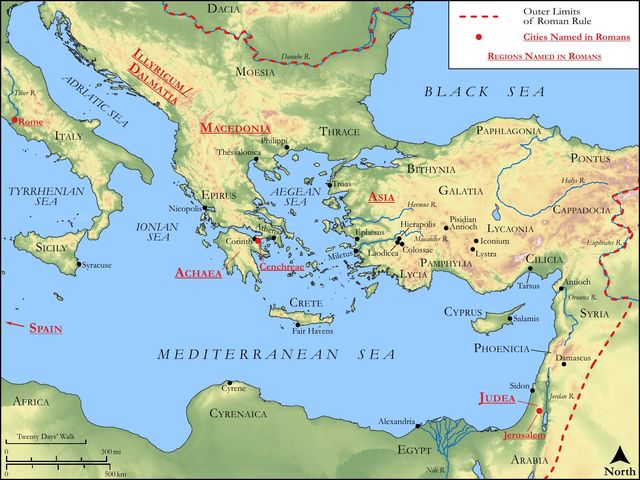
See on the biblical-era maps

Study this verse
Public-domain commentary
Matthew Henry
From his Commentary on the Whole Bible. Henry comments on passages, not single verses — this entry covers Romans 4:1–8. His two-level outline is real structure in the source text, so it is rendered as structure.
Here the apostle proves that Abraham was justified not by works, but by faith. Those that of all men contended most vigorously for a share in righteousness by the privileges they enjoyed, and the works they performed, were the Jews, and therefore he appeals to the case of Abraham their father, and puts his own name to the relation, being a Hebrew of the Hebrews: Abraham our father. Now surely his prerogative must needs be as great as theirs who claim it as his seed according to the flesh. Now what has he found? All the world is seeking; but, while the most are wearying themselves for very vanity, none can be truly reckoned to have found, but those who are justified before God; and thus Abraham, like a wise merchant, seeking goodly pearls, found this one pearl of great price. What has he found, kata sarka - as pertaining to the flesh, that is, by circumcision and his external privileges and performances? These the apostle calls flesh, Phi 3:3. Now what did he get by these? Was he justified by them? Was it the merit of his works that recommended him to God's acceptance? No, by no means, which he proves by several arguments.
I.If he had been justified by works, room would have been left for boasting, which must for ever be excluded.
If so, he hath whereof to glory (Rom 4:2), which is not to be allowed. "But," might the Jews say, "was not his name made great (Gen 12:2), and then might not he glory?" Yes, but not before God; he might deserve well of men, but he could never merit of God. Paul himself had whereof to glory before men, and we have him sometimes glorying in it, yet with humility; but nothing to glory in before God, Co1 4:4; Phi 3:8, Phi 3:9. So Abraham. Observe, He takes it for granted that man must not pretend to glory in any thing before God; no, not Abraham, as great and as good a man as he was; and therefore he fetches an argument from it: it would be absurd for him that glorieth to glory in any but the Lord.
II.It is expressly said that Abraham's faith was counted to him for righteousness.
What saith the scripture? Rom 4:3. In all controversies in religion this must be our question, What saith the scripture? It is not what this great man, and the other good man, say, but What saith the scripture? Ask counsel at this Abel, and so end the matter, Sa2 2:18. To the law, and to the testimony (Isa 8:20), thither is the last appeal. Now the scripture saith that Abraham believed, and this was counted to him for righteousness (Gen 15:6); therefore he had not whereof to glory before God, it being purely of free grace that it was so imputed, and having not in itself any of the formal nature of a righteousness, further than as God himself was graciously pleased so to count it to him. It is mentioned in Genesis, upon occasion of a very signal and remarkable act of faith concerning the promised seed, and is the more observable in that it followed upon a grievous conflict he had had with unbelief; his faith was now a victorious faith, newly returned from the battle. It is not the perfect faith that is required to justification (there may be acceptable faith where there are remainders of unbelief), but the prevailing faith, the faith that has the upper hand of unbelief.
III.If he had been justified by faith, the reward would have been of debt, and not of grace, which is not to be imagined.
This is his argument (Rom 4:4, Rom 4:5): Abraham's reward was God himself; so he had told him but just before (Gen 15:1), I am thy exceeding great reward. Now, if Abraham had merited this by the perfection of his obedience, it had not been an act of grace in God, but Abraham might have demanded it with as much confidence as ever any labourer in the vineyard demanded the penny he had earned. But this cannot be; it is impossible for man, much more guilty man, to make God a debtor to him, Rom 11:35. No, God will have free grace to have all the glory, grace for grace's sake, Joh 1:16. And therefore to him that worketh not - that can pretend to no such merit, nor show any worth or value in his work, which may answer such a reward, but disclaiming any such pretension casts himself wholly upon the free grace of God in Christ, by a lively, active, obedient faith - to such a one faith is counted for righteousness, is accepted of God as the qualification required in all those that shall be pardoned and saved. Him that justifieth the ungodly, that is, him that was before ungodly. His former ungodliness was no bar to his justification upon his believing: ton asebē - that ungodly one, that is, Abraham, who, before his conversion, it should seem, was carried down the stream of the Chaldean idolatry, Jos 24:2. No room therefore is left for despair; though God clears not the impenitent guilty, yet through Christ he justifies the ungodly.
IV.He further illustrates this by a passage out of the Psalms, where David speaks of the remission of sins, the prime branch of justification, as constituting the happiness and blessedness of a man, pronouncing blessed, not the man who has no sin, or none which deserved death (for then, while man is so sinful, and God so righteous, where would be the blessed man?) but the man to whom the Lord imputeth not sin, who though he cannot plead, Not guilty, pleads the act of indemnity, and his plea is allowed. It is quoted from Psa 32:1, Psa 32:2, where observe,
1.The nature of forgiveness. It is the remission of a debt or a crime; it is the covering of sin, as a filthy thing, as the nakedness and shame of the soul. God is said to cast sin behind his back, to hide his face from it, which, and the like expressions, imply that the ground of our blessedness is not our innocency, or our not having sinned (a thing is, and is filthy, though covered; justification does not make the sin not to have been, or not to have been sin), but God's not laying it to our charge, as it follows here: it is God's not imputing sin (Rom 4:8), which makes it wholly a gracious act of God, not dealing with us in strict justice as we have deserved, not entering into judgment, not marking iniquities, all which being purely acts of grace, the acceptance and the reward cannot be expected as debts; and therefore Paul infers (Rom 4:6) that it is the imputing of righteousness without works.
2.The blessedness of it: Blessed are they. When it is said, Blessed are the undefiled in the way, blessed is the man that walketh not in the counsel of the wicked, etc., the design is to show the characters of those that are blessed; but when it is said, Blessed are those whose iniquities are forgiven, the design is to show what that blessedness is, and what the ground and foundation of it. Pardoned people are the only blessed people. The sentiments of the world are, Those are happy that have a clear estate, and are out of debt to man; but the sentence of the word is, Those are happy that have their debts to God discharged. O how much therefore is it our interest to make it sure to ourselves that our sins are pardoned! For this is the foundation of all other benefits. So and so I will do for them; for I will be merciful, Heb 8:12.
Historical interpretation
Two Centuries of Reception
5 surviving comments on this verse. Each one is dated, so this reads as a timeline rather than a list.
Select a marker to jump to its quote. Markers stagger vertically where authors wrote within a few decades of each other.
Faith relies on the grace of the justifier. Works rely on the justice of the rewarder. When I consider the greatness of Paul’s speech, by which he says that the worker receives what is due to him, I can hardly persuade myself that there is any deed which could claim a reward from God as its due.… Therefore, it seems that Paul is really referring here to evil deeds, of which Scripture frequently says that they get their due reward.
No merit is imputed for reward to the man who is subject to the law—either to the law of works, i.e., of Moses, or to the law of nature. For he who is obliged to keep the law is a debtor. A necessity is imposed upon him by the law to keep it whether he wants to or not, so as not to be guilty, as Paul says in another passage: “Those who resist will incur judgment.” On the other hand, to believe or not to believe is a matter of choice. No one can be required to accept something which is offered as a gift. But he is invited to receive it. He is not forced but persuaded. He believes what he does not see but hopes for. This is what glorifies God.
Then is not this last the greatest? he means. By no means: for it is to the believer that it is reckoned. But it would not have been reckoned, unless there were something that he contributed himself. And so he too hath God for his debtor, and debtor too for no common things, but great and high ones. For to show his high-mindedness and spiritual understanding, he does not say "to him that believeth" merely.
Paul was speaking here of the way wages are given. But God gave by grace, because he gave to sinners so that by faith they might live justly, that is, do good works. Thus the good works which we do after we have received grace are not to be attributed to us but rather to him who has justified us by his grace. For if God had wanted to give us our due reward, he would have given us the punishment due to sinners.
The doer of righteousness expects a reward, but justification by faith is the gift of the God of all.
Continue studying Romans 4:4 across the web’s major study libraries — every link below opens this exact verse, chapter, or book on the destination site.
Read & Compare
 BibleGatewayThis verse in more than 200 translations and 70 languages.
 Bible.comThe YouVersion reader — hundreds of translations, reading plans, and highlights.
 ESV.orgCrossway's official English Standard Version reader.
 NET BibleThe NET translation with 60,000+ translators' notes on every rendering decision.
 STEP BibleTyndale House's free study tool — original text, vocabulary, and scholarly resources.
 BibliaLogos Bible Software's free web reader.
 USCCBThe New American Bible (Revised Edition) with the U.S. bishops' study notes.
Commentaries
 BibleHub CommentariesDozens of classic commentaries on this verse, gathered on one page.
 StudyLightMore than 100 commentary sets — the largest collection on the web.
 BibleRefPlain-English commentary on what this verse means, verse by verse.
 Enduring WordDavid Guzik's free commentary on this chapter, widely used by Bible teachers.
 Bible Study ToolsVerse commentary alongside Greek and Hebrew study aids.
Original Language & Research
- BibleHub InterlinearThe verse word by word — original language, transliteration, and English.
- BibleHub LexiconEvery word's original-language definition and Strong's entry.
 Blue Letter BibleDeep-study tools — Strong's numbers, concordance, and word studies.
 CNTR CollationThe earliest Greek manuscripts of this verse, collated letter by letter.
Sermons, Hymns & Audio


TrulyRandomVerse is not affiliated with these sites and doesn’t control their content. They’re linked because they’re genuinely useful.
Summary
Romans 4:4 presents a foundational principle in Paul's argument for justification by faith, asserting that a reward given for work is a matter of obligation, not a gift of unmerited favor. This verse sharply contrasts human effort with divine grace, establishing that if righteousness were earned through deeds, it would be a wage owed, thereby precluding it from being a free gift. It sets the stage for understanding how Abraham's righteousness was credited to him by faith, highlighting the essential difference between a system of merit and God's gracious provision of salvation.
Context
ShowHideLiterary Context
Romans 4:4 is situated within Paul's extensive theological exposition on justification by faith, which begins in Romans 3. Following his declaration that all, both Jews and Gentiles, are under the power of sin and cannot be justified by works of the law (Romans 3:9-20), Paul introduces God's righteousness revealed through faith in Jesus Christ (Romans 3:21-26). Chapter 4 then serves as a crucial Old Testament proof-text, using Abraham and David as prime examples to demonstrate that righteousness has always been reckoned by faith apart from works. Verse 4 specifically articulates the logical consequence of a works-based system, setting up the contrast with God's method of reckoning righteousness as a gift of grace, as seen in Abraham's experience in Romans 4:1-3.
Historical & Cultural Context
In the Greco-Roman world, and particularly within Jewish thought of Paul's time, the concept of earning one's standing or reward through diligent work and adherence to established laws or traditions was deeply ingrained. For many Jews, righteousness was inextricably linked to obedience to the Mosaic Law, including circumcision and dietary laws. They believed that by performing the commandments, they accumulated merit before God, thereby earning their salvation or a favorable standing. Paul's argument directly challenges this prevailing understanding, drawing on the Jewish scriptures themselves to redefine the basis of a right relationship with God. The legal and economic metaphors of "debt," "reward," and "reckoned" would have been readily understood by his audience, making his theological point about grace versus works powerfully clear.
Key Themes
ShowHideThis verse is pivotal in developing several key themes in Romans. Foremost is the contrast between works and grace as the basis for justification. Paul meticulously dismantles the idea that human effort can earn divine favor, asserting that if it could, it would transform grace into a mere transaction of debt. This leads directly to the theme of justification by faith alone, which is the central thesis of Romans. By demonstrating that Abraham was justified not by his actions but by his belief (Romans 4:3), Paul underscores that God's righteousness is a gift freely given, not a wage earned. The verse also implicitly touches upon the theme of God's sovereignty and generosity, as He is the one who graciously bestows righteousness, rather than being compelled to reward human performance.
Exposition and Analysis
ShowHideKey Word Analysis
ShowHideThis word signifies to toil, labor, or perform a task, implying an activity undertaken to achieve a specific outcome or earn a wage. In the context of Romans 4:4, it refers to human effort or deeds performed with the expectation of earning a reward or merit from God. Paul uses it to describe a system where one's actions create an obligation for payment.
An accounting term meaning to compute, calculate, or credit something to an account. Paul uses this word throughout Romans 4 to describe how God attributes righteousness. Here, it denotes the act of God formally assigning a status or reward. The critical distinction Paul makes is how God reckons: either as a debt owed for work or as a gift of grace.
This term denotes unmerited favor, a gift given freely without any expectation of return or prior deserving. It emphasizes the benevolent and gratuitous nature of God's action. In this verse, it stands in direct opposition to "debt," highlighting that salvation, when given by grace, cannot simultaneously be a payment for work.
This word refers to something owed, an obligation, or a payment that is due. It carries the connotation of a contractual agreement where work performed necessitates a corresponding payment. Paul uses it to illustrate that if righteousness were earned through works, God would be obligated to grant it, thereby stripping it of its character as a free and undeserved gift.
Verse Breakdown
ShowHide"Now to him that worketh"
This phrase introduces the hypothetical scenario of someone performing labor or deeds. It sets up the premise that if a person engages in work, there is a natural and expected consequence: a reward. This "working" refers to human effort, particularly in the context of seeking to earn divine favor or righteousness through obedience to the law or good deeds.
"is the reward not reckoned of grace"
This is the core assertion of the verse. Paul states that when a reward is given for work, it is fundamentally not considered a matter of grace. "Reckoned" (or "credited") here implies a formal accounting. If something is earned, it cannot simultaneously be a gift of unmerited favor. The nature of the transaction changes from a gracious bestowal to a deserved payment.
"but of debt"
This clause completes the antithesis. If a reward is not of grace when work is involved, then it must be "of debt." This means the reward is an obligation, something that is owed to the worker as a just payment for their labor. Paul uses this to highlight that a system based on works places God in the position of an employer who owes wages, rather than a sovereign giver of unmerited favor.
Literary Devices
ShowHidePaul masterfully employs Antithesis in Romans 4:4, creating a stark contrast between two mutually exclusive concepts: "grace" and "debt." By juxtaposing "not reckoned of grace, but of debt," he underscores that a reward for work cannot simultaneously be a gift; it must be an obligation. This rhetorical device powerfully clarifies his theological point that justification cannot be earned. Furthermore, the verse uses a Metaphor drawn from the world of commerce and accounting. The terms "worketh," "reward," "reckoned," and "debt" evoke the familiar transaction of an employer paying an employee. This commercial metaphor helps the reader understand the nature of the relationship Paul is describing: if salvation were based on human performance, it would be a contractual obligation, not a free act of divine benevolence.
Theological and Thematic Connections
ShowHideRomans 4:4 is a cornerstone for understanding the New Testament's doctrine of justification by grace through faith. It unequivocally states that any "reward" for human effort is a matter of obligation, not a gift. This principle directly challenges any system of salvation based on merit, legalistic adherence, or human performance. It underscores that if our standing with God were earned, it would strip God's act of its gracious character and place Him in our debt. Instead, Paul argues that God's righteousness is freely imputed to those who believe, not as a wage for work, but as an unmerited gift, thereby glorifying God's boundless grace and sovereignty in salvation.
Reflection and Application
ShowHideThis verse serves as a crucial reminder of the true nature of our salvation and our relationship with God. In a world that often values achievement, merit, and earning one's way, Romans 4:4 stands as a profound counter-cultural truth. It shatters any illusion that we can earn God's favor or merit eternal life through our good deeds, religious observances, or moral uprightness. If we could earn it, salvation would be a wage, and God would be obligated to us. But because it is a gift of grace, it is entirely unmerited and freely given, received solely through faith. This truth should humble us deeply, stripping away any pride in our own efforts and replacing it with profound gratitude for God's lavish, undeserved love. It liberates us from the burden of performance-based religion, allowing us to rest in the finished work of Christ and live lives of joyful obedience, not out of a desire to earn, but out of a heart transformed by grace.
Questions for Reflection
ShowHideFAQ
ShowHideWhat does "reckoned of grace, but of debt" mean in simple terms?
ShowHideIn simple terms, this verse explains that there are two fundamentally different ways to receive something. If you work for something, like a job, the payment you receive is a "debt" owed to you; you've earned it, and your employer is obligated to pay you. This is not a gift. However, if something is given to you freely, without you having earned it, that's "grace." Paul is arguing that our standing with God (our righteousness) is not like a wage we've earned through our "work" or good deeds. If it were, God would owe it to us, and it wouldn't be a gift. Instead, our righteousness is given to us purely by God's "grace," meaning it's a free, unmerited gift, not something we've earned or that God owes us. This idea is central to the concept of justification by faith, as seen in Romans 3:24.
Christ-Centered Fulfillment
ShowHideRomans 4:4 finds its ultimate Christ-centered fulfillment in the person and work of Jesus Christ, who perfectly embodies and secures the "grace" that Paul contrasts with "debt." Because humanity is utterly incapable of performing enough "work" to earn righteousness or place God in "debt" to provide salvation, God Himself, in His infinite grace, provided the solution through His Son. Jesus did not come to earn a reward for Himself, but to perfectly fulfill the law and offer Himself as the spotless Lamb, taking upon Himself the "debt" of our sin. His obedience, sacrifice, and resurrection are the basis upon which God can "reckon" righteousness to believers, not as something we've earned, but as a free gift of divine favor. This is the profound truth that "God made him who had no sin to be sin for us, so that in him we might become the righteousness of God" (2 Corinthians 5:21). Therefore, the "reward" of eternal life and a right standing with God is not a wage we earned, but a glorious inheritance bestowed upon us solely through faith in Christ's finished work (Romans 6:23). His death paid our "debt," and His life offers us "grace" beyond measure, making God's unmerited favor the sole foundation of our salvation (Ephesians 1:7).