


New Testament · Pauline Epistles · Book 45 of 66
Romans
Paul’s letter to the church at Rome, setting out the gospel in which the righteousness of God is revealed, for Jew and Gentile alike, by faith.
- 16 chapters
- 433 verses
- About 43 minutes to read
- Letters to the Churches, c. AD 48–96
Paul writes to a church he had long purposed to visit. His theme comes at once: “I am not ashamed of the gospel of Christ: for it is the power of God unto salvation to every one that believeth; to the Jew first, and also to the Greek. For therein is the righteousness of God revealed from faith to faith: as it is written, The just shall live by faith” (Romans 1:16–17).
The argument runs in order. Jews and Gentiles are proved “all under sin” (3:9), and “by the deeds of the law there shall no flesh be justified” (3:20). The righteousness of God comes instead “by faith of Jesus Christ unto all and upon all them that believe” (3:22), as it came to Abraham before he was circumcised. The justified have peace with God, are dead to sin and walk after the Spirit, and nothing “shall be able to separate us from the love of God, which is in Christ Jesus our Lord” (8:39). Chapters 9–11 show that God’s word to Israel has not failed, and the last chapters draw out what follows “by the mercies of God” (12:1).
For I am not ashamed of the gospel of Christ: for it is the power of God unto salvation to every one that believeth; to the Jew first, and also to the Greek.
Romans 1:16 KJV
Before you read
- Who wrote it
- Paul, “called to be an apostle, separated unto the gospel of God” (1:1). Tertius, “who wrote this epistle,” sends his own greeting (16:22): Paul dictated, and Tertius wrote.
- When it was written
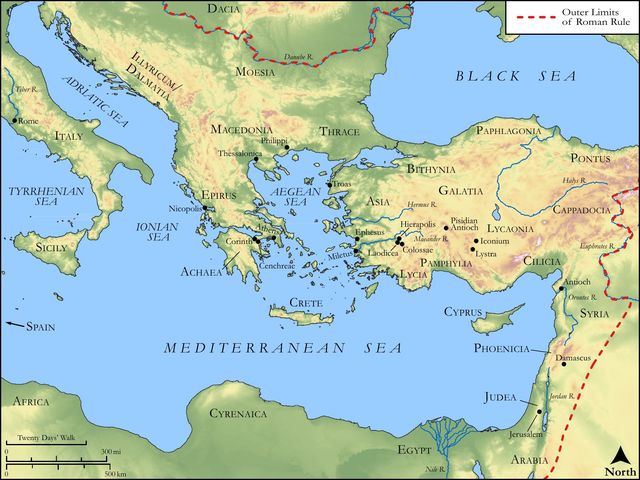
- No year is given. Paul has preached from Jerusalem to Illyricum (15:19), and is now taking the gift of Macedonia and Achaia to Jerusalem (15:25–26). Phebe of Cenchrea and Gaius his host (16:1; 16:23) point to Corinth (1 Corinthians 1:14), and Acts places three months in Greece before that journey (Acts 20:2–3).
- To whom
- “To all that be in Rome, beloved of God, called to be saints” (1:7). Paul writes as “the apostle of the Gentiles” to Gentiles among them (11:13), and greets many by name, his kinsmen among them. Priscilla and Aquila (16:3) had once left Rome when Claudius “commanded all Jews to depart from Rome” (Acts 18:2).
How Romans is laid out
8 movements · 68 passages · 433 verses
The gospel of God
1:1–17 · 17 verses
Paul, a servant of Jesus Christ, greets the saints at Rome with the gospel promised by the prophets, concerning God’s Son, of the seed of David and declared the Son of God by the resurrection. He thanks God for their faith, spoken of throughout the world, and has often purposed to come. His theme: the gospel “is the power of God unto salvation to every one that believeth.”
All under sin
1:18–3:20 · 64 verses
“The wrath of God is revealed from heaven” against men who hold the truth in unrighteousness. Knowing God by what he made, the Gentiles worshipped the creature, and God gave them up. The man who judges them does the same things, and the Jew who rests in the law breaks it. Every mouth is stopped, and by the law is the knowledge of sin.
7 passages
Righteousness through faith
3:21–4:25 · 36 verses
Now the righteousness of God is manifested without the law, by faith of Jesus Christ, for all who believe. They are justified freely by his grace in Christ Jesus, whom God set forth to be a propitiation through faith in his blood. Boasting is excluded. Abraham believed God, and it was counted to him for righteousness before he was circumcised: he is the father of every believer.
Peace with God
Chapter 5 · 21 verses
Justified by faith, believers have peace with God and rejoice in hope of his glory. Christ died for the ungodly, and those justified by his blood shall be saved from wrath through him. As by one man sin entered into the world, and death by sin, so by the obedience of one shall many be made righteous. Where sin abounded, grace did much more abound.
Dead to sin and the law
Chapters 6–7 · 48 verses
Shall we continue in sin, that grace may abound? God forbid. The baptized were buried with Christ into death, to walk in newness of life, and free from sin they serve righteousness. Believers are dead to the law by the body of Christ. The law is holy, but sin, using the commandment, deceived and slew. A cry for deliverance is answered with thanks to God through Jesus Christ.
No condemnation
Chapter 8 · 39 verses
“There is therefore now no condemnation to them which are in Christ Jesus.” What the law could not do, God did by sending his own Son. By the Spirit of adoption believers cry, Abba, Father, and the Spirit helps their infirmities while the whole creation groans. Those God foreknew he predestinated, called, justified and glorified, and nothing can separate them from the love of God in Christ Jesus.
Has God cast away his people?
Chapters 9–11 · 90 verses
Paul sorrows for Israel, of whom Christ came. God’s word has not failed, for they are not all Israel which are of Israel, and he has mercy on whom he will. Israel sought righteousness by works and stumbled at the stone in Sion. A remnant remains, the Gentiles are graffed into the olive tree, and so all Israel shall be saved. It ends in praise of God’s wisdom.
16 passages
- 9:1–5 Paul's Deep Sorrow for Israel
- 9:6–13 God's Faithfulness and Sovereign Election
- 9:14–24 The Justice of God's Sovereign Choice
- 9:25–29 Scriptural Proof of God's Plan
- 9:30–33 The Reason for Israel's Failure
- 10:1–3 Paul's Concern for Israel's Salvation
- 10:4–5 Christ: The End of the Law
- 10:6–10 The Righteousness of Faith
- 10:11–13 Salvation is Universal
- 10:14–17 The Necessity of Preaching
- 10:18–21 Israel's Culpability Confirmed
- 11:1–10 God Has Not Rejected Israel
- 11:11–16 Israel’s Stumble and Gentile Salvation
- 11:17–24 The Olive Tree Analogy
- 11:25–32 The Mystery of Israel’s Restoration
- 11:33–36 Doxology: Praise to God’s Wisdom
A living sacrifice
Chapters 12–16 · 118 verses
By the mercies of God, believers present their bodies a living sacrifice and serve as members of one body. Love is without dissimulation and overcomes evil with good, every soul is subject to the higher powers, and love is the fulfilling of the law. The strong receive the weak, as Christ received them. Paul plans to visit Rome on his way to Spain, sends greetings, and ends with a doxology.
The words Romans turns on
Faith, righteousness and justify gather in chapters 3–4, the first two again in 10; sin fills 6–7, law 2 and 7, and Spirit chapter 8.
What Romans teaches
dikaióō · justify
Just, and the justifier
The argument turns at 3:21: “But now the righteousness of God without the law is manifested.” Sinners are “justified freely by his grace through the redemption that is in Christ Jesus: Whom God hath set forth to be a propitiation through faith in his blood” (3:24–25). Christ is the propitiation, and God himself sets him forth: men do not offer it to him. The word, hilastērion, is the one Hebrews uses for the mercy seat over the ark (Hebrews 9:5), where the blood of the sin offering was sprinkled (Leviticus 16:15). God had passed over “sins that are past, through the forbearance of God” (3:25). The cross declares that he did so justly, “that he might be just, and the justifier of him which believeth in Jesus” (3:26). Those “justified by his blood” are “saved from wrath through him” (5:9).
logízomai · counted
Counted for righteousness
Chapter 4 proves the point from Abraham: “Abraham believed God, and it was counted unto him for righteousness” (4:3), quoting Genesis 15:6. The word is a reckoning. To him that works, the reward is “not reckoned of grace, but of debt” (4:4); but to him “that worketh not, but believeth on him that justifieth the ungodly, his faith is counted for righteousness” (4:5). David’s blessing in Psalm 32:1–2 follows: “Blessed is the man to whom the Lord will not impute sin” (4:8). Abraham was counted righteous while uncircumcised, “that he might be the father of all them that believe” (4:11). It was “not written for his sake alone,” but for all who believe on him that raised up Jesus, “Who was delivered for our offences, and was raised again for our justification” (4:23–25).
nómos · law
The law is holy
Romans never makes the law the fault. “Do we then make void the law through faith? God forbid: yea, we establish the law” (3:31). By the law is “the knowledge of sin” (3:20), and it “entered, that the offence might abound” (5:20). So “the law is holy, and the commandment holy, and just, and good” (7:12); the fault is sin, which “by the commandment might become exceeding sinful” (7:13). The Fathers read the man of 7:14–25 two ways. Diodorus heard Paul describing the common lot of mankind, which he sees in himself
; Augustine heard one who is now under grace but still battling against his own lust
. Either way the answer is the same: what the law “could not do, in that it was weak through the flesh,” God did, “sending his own Son” (8:3).
Israḗl · Israel
All Israel
Chapters 9–11 ask whether God’s word to Israel has failed. Paul answers: “Not as though the word of God hath taken none effect. For they are not all Israel, which are of Israel” (9:6). The promise ran through Isaac, and through Jacob rather than Esau. Israel sought righteousness “by the works of the law” and stumbled (9:32), yet there is “a remnant according to the election of grace” (11:5). Blindness in part has happened “until the fulness of the Gentiles be come in. And so all Israel shall be saved” (11:25–26). The Fathers read that phrase two ways. Cyril of Alexandria held that Israel will be saved in its own time and will be called at the end, after the calling of the Gentiles
. Theodoret took it as all those who believe
, whether Jews by nature or Gentiles related to Israel by faith.
Christ in Romans
Romans opens on the gospel God “had promised afore by his prophets in the holy scriptures,” concerning his Son, “which was made of the seed of David according to the flesh; And declared to be the Son of God with power, according to the spirit of holiness, by the resurrection from the dead” (1:2–4). It closes on the mystery that “now is made manifest, and by the scriptures of the prophets” is made known to all nations (16:26).
Between, Paul reads the Scriptures as speaking of Christ. Adam “is the figure of him that was to come” (5:14): “as by one man’s disobedience many were made sinners, so by the obedience of one shall many be made righteous” (5:19). Augustine called Adam the type of Christ but in reverse
. The stone laid in Sion is Christ: Israel stumbled at it, and “whosoever believeth on him shall not be ashamed” (9:33). In Psalm 69:9 Paul hears Christ speak: “The reproaches of them that reproached thee fell on me” (15:3). And Christ is the “root of Jesse” (Isaiah 11:10) in whom “shall the Gentiles trust” (15:12).
- Abraham believed God
- Isaac the child of promise
- Jacob chosen before birth
- … Matthew 1:2–6
- David of his seed, according to the flesh
- … Matthew 1:6–16
- Christ, God blessed for ever
People
By how many verses name them
- AbrahamSon of Terah; a brother of Nahor, Haran and Sarah9
- EsaiasA son of Amoz; father of Shear-jashub, Maher-shalal-hash-baz5
- MosesSon of Amram and Jochebed; a brother of Aaron and Miriam; husband of Zipporah4
- DavidSon of Jesse3
- JacobSon of Isaac and Rebekah; a brother of Esau3
- IsaacA son of Abraham and Sarah2
- SaraDaughter of Terah; a sister of Abraham, Nahor and Haran; wife of Abraham; mother of Isaac2
- AdamHusband of Eve; father of Cain, Abel and Seth1
43 more are named.
Places
12 named
- JerusalemWhere Paul takes the gift for the poor saints4
- RomeHome of the saints Paul writes to, and longs to visit2
- SpainWhere Paul means to go next, by way of Rome2
- SionWhere the stumblingstone is laid, and whence the Deliverer comes2
- AchaiaJoined with Macedonia in the gift for Jerusalem1
- Asia1
- CenchreaPhebe’s church; she is commended to the saints at Rome1
- Gomorrha1
Where Romans reaches
The passages it leans on, and the ones that lean on it
Habakkuk 2:4 Romans 1:17 Galatians 3:11
“The just shall live by faith”: Habakkuk’s word states the letter’s theme, and Galatians argues from it the same way.
Genesis 15:6 Romans 4:3 Galatians 3:6
Abraham believed, and it was counted to him for righteousness: the text chapter 4 expounds, used again in Galatians.
David’s blessing on the man whose sin is covered, read as righteousness counted without works.
Leviticus 16:15 Romans 3:25 Hebrews 9:5
Blood sprinkled on the mercy seat: Romans calls Christ the propitiation by the word Hebrews uses for that seat.
Isaiah 28:16 Romans 9:33 1 Peter 2:6
The stone laid in Sion: Israel stumbled at it, and whoever believes on him shall not be ashamed.
Books Romans links to most
The Church Fathers on Romans
2,755 quotations from 62 writers before AD 800 · the ten most quoted, in date order
- Irenaeus202
- Clement215
- Tertullian220
- Origen253
- Cyprian258
- Ambrosiaster384
- Chrysostom407
- Pelagius418
- Augustine430
- Theodoret458
Augustine on 3:21: the righteousness of God is the righteousness God gives.
The righteousness of God is not that by which God is righteous but that with which he clothes man when he justifies the ungodly. To this the Law and the Prophets bear witness.
Ambrosiaster on 3:24, “justified freely by his grace.”
They are justified freely because they have not done anything nor given anything in return, but by faith alone they have been made holy by the gift of God.
Irenaeus on Christ, “the end of the law.”
How is Christ the end of the law if he is not also the cause of it? For he who has brought in the end also created the beginning.
Origen on the living sacrifice of 12:1.
The divine Word wants you to offer your flesh to God in purity, with the understanding of your reason.
Keep studying
Articles