


1 Corinthians 1:14
- εὐχαριστῶeucharistōI thankG2168V-PAI-1SVerb Present Active Indicative 1st Singular
- τῷtō<the>G3588T-DSMDefinite article Dative Singular Masculine
- θεῷtheōGodG2316N-DSM-TNoun Dative Singular Masculine Title
- ὅτιhotithatG3754CONJConjunction
- οὐδέναoudenano [one]G3762A-ASMAdjective Accusative Singular Masculine
- ὑμῶνhumōnof youG4771P-2GPPersonal pronoun Genitive 2nd Plural
- ἐβάπτισαebaptisaI baptizedG907V-AAI-1SVerb Aorist Active Indicative 1st Singular
- εἰeionlyG1487CONDConjunction
- μὴmēexceptG3361PRT-NNegative Particle Negative
- ΚρίσπονKrisponCrispusG2921N-ASM-PNoun Accusative Singular Masculine Individual
- καὶkaiandG2532CONJConjunction
- ΓάϊονGaionGaiusG1050N-ASM-PNoun Accusative Singular Masculine Individual
English is a literal word-by-word gloss of the Greek, not the KJV's wording. Why?
This is the original text the KJV's translators worked from — each Greek word with its own literal English meaning in this verse, prepared by scholars at Tyndale House, Cambridge. The KJV translates whole sentences, not word by word, so its wording differs: one Greek word can become several English words, and the KJV may choose “charity” where the gloss reads “love”. Both are faithful — they answer different questions. For the KJV's own rendering, switch to the KJV text.
Details
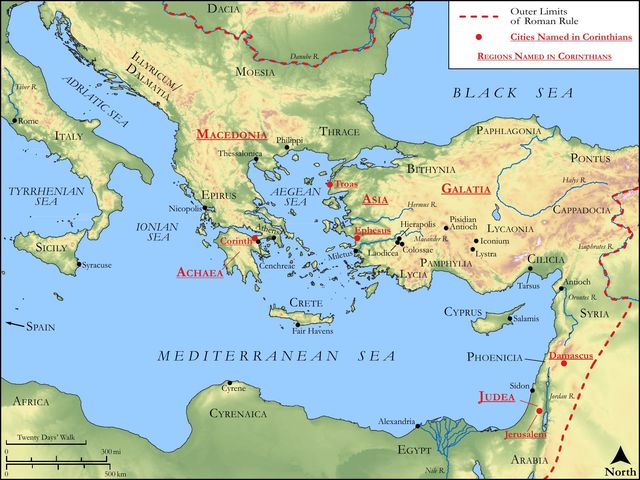
See on the biblical-era map

Study this verse
Public-domain commentary
Matthew Henry
From his Commentary on the Whole Bible. Henry comments on passages, not single verses — this entry covers 1 Corinthians 1:14–16.
Here the apostle gives an account of his ministry among them. He thanks God he had baptized but a few among them, Crispus, who had been a ruler of a synagogue at Corinth (Act 18:8), Gaius, and the household of Stephanas, besides whom, he says, he did not remember that he had baptized any. But how was this a proper matter for thankfulness? Was it not a part of the apostolical commission to baptize all nations? And could Paul give thanks to God for his own neglect of duty? He is not to be understood in such a sense as if he were thankful for not having baptized at all, but for not having done it in present circumstances, lest it should have had this very bad construction put upon it - that he had baptized in his own name, made disciples for himself, or set himself up as the head of a sect. He left it to other ministers to baptize, while he set himself to more useful work, and filled up his time with preaching the gospel. This, he thought, was more his business, because the more important business of the two. He had assistants that could baptize, when none could discharge the other part of his office so well as himself. In this sense he says, Christ sent him not to baptize, but to preach the gospel - not so much to baptize as to preach. Note, Ministers should consider themselves sent and set apart more especially to that service in which Christ will be most honoured and the salvation of souls promoted, and for which they are best fitted, though no part of their duty is to be neglected. The principal business Paul did among them was to preach the gospel (Co1 1:17), the cross (Co1 1:18), Christ crucified, Co1 1:23. Ministers are the soldiers of Christ, and are to erect and display the banner of the cross. He did not preach his own fancy, but the gospel - the glad tidings of peace, and reconciliation to God, through the mediation of a crucified Redeemer. This is the sum and substance of the gospel. Christ crucified is the foundation of all our joys. By his death we live. This is what Paul preached, what all ministers should preach, and what all the saints live upon.
Historical interpretation
Two Centuries of Reception
4 surviving comments on this verse. Each one is dated, so this reads as a timeline rather than a list.
Select a marker to jump to its quote. Markers stagger vertically where authors wrote within a few decades of each other.
But they roll back an objection from that apostle himself, in that he said, "For Christ sent me not to baptize; " , as if by this argument baptism were done away! For if so, why did he baptize Gaius, and Crispus, and the house of Stephanas? However, even if Christ had not sent him to baptize, yet He had given other apostles the precept to baptize. But these words were written to the Corinthians in regard of the circumstances of that particular time; seeing that schisms and dissensions were agitated among them, while one attributes everything to Paul, another to Apollos. For which reason the "peace-making" apostle, for fear he should seem to claim all gifts for himself, says that he had been sent "not to baptize, but to preach." For preaching is the prior thing, baptizing the posterior. Therefore the preaching came first: but I think baptizing withal was lawful to him to whom preaching was.
For I offer you withal, for your investigation, this very question: Whether there were in the first Epistle others, too, who "wholly saddened" the apostle by "acting disorderly," and "were wholly saddened" by him, through incurring (his) "rebuke," according to the sense of the second Epistle; of whom some particular one may in that (second Epistle) have received pardon. Direct we, moreover, our attention to the entire first Epistle, written (that I may so say) as a whole, not with ink, but with gall; swelling, indignant, disdainful, comminatory, invidious, and shaped through (a series of) individual charges, with an eye to certain individuals who were, as it were, the proprietors of those charges? For so had schisms, and emulations, and discussions, and presumptions, and elations, and contentions required, that they should be laden with invidiousness, and rebuffed with curt reproof, and filed down by haughtiness, and deterred by austerity. And what kind of invidiousness is the pungency of humility? "To God I give thanks that I have baptized none of you, except Crispus and Gaius, lest any say that I have baptized in mine own name."
These Corinthians were like the Novatianists and the Donatists of today, who claim baptism for themselves and do not recognize anybody else’s. Those who are so baptized glory in the names of Novatian and Donatus, having been deprived of the name of Christ. Crispus and Gaius are called as witnesses, because although they were baptized by Paul, they never suggested that he should be given any glory because of it.
"I thank God that I baptized none of you but Crispus and Gaius." "Why are you elate at having baptized, when I for my part even give thanks that I have not done so!" Thus saying, by a kind of divine art he does away with their swelling pride upon this point; not with the efficacy of the baptism, (God forbid,) but with the folly of those who were puffed up at having been baptizers: first, by showing that the Gift is not theirs; and, secondly, by thanking God therefore. For Baptism truly is a great thing: but its greatness is not the work of the person baptizing, but of Him who is invoked in the Baptism: since to baptize is nothing as regards man's labor, but is much less than preaching the Gospel. Yea, again I say, great indeed is Baptism, and without baptism it is impossible to obtain the kingdom. Still a man of no singular excellence is able to baptize, but to preach the Gospel there is need of great labor.
He states also the reason, why he giveth thanks that he had baptized no one. What then is this reason? "Lest anyone should say that ye were baptized into my own name." Why, did he mean that they said this in those other cases? Not at all; but, "I fear," saith he, "lest the disease should proceed even to that. For if, when insignificant persons and of little worth baptize, a heresy ariseth, had I, the first announcer of Baptism, baptized many, it was likely that they forming a party, would not only call themselves by my name, but also ascribe the Baptism to me." For if from the inferiors so great an evil arose, from those of higher order it would perhaps have gone on to something far more grievous.
Continue studying 1 Corinthians 1:14 across the web’s major study libraries — every link below opens this exact verse, chapter, or book on the destination site.
Read & Compare
 BibleGatewayThis verse in more than 200 translations and 70 languages.
 Bible.comThe YouVersion reader — hundreds of translations, reading plans, and highlights.
 ESV.orgCrossway's official English Standard Version reader.
 NET BibleThe NET translation with 60,000+ translators' notes on every rendering decision.
 STEP BibleTyndale House's free study tool — original text, vocabulary, and scholarly resources.
 BibliaLogos Bible Software's free web reader.
 USCCBThe New American Bible (Revised Edition) with the U.S. bishops' study notes.
Commentaries
 BibleHub CommentariesDozens of classic commentaries on this verse, gathered on one page.
 StudyLightMore than 100 commentary sets — the largest collection on the web.
 BibleRefPlain-English commentary on what this verse means, verse by verse.
 Enduring WordDavid Guzik's free commentary on this chapter, widely used by Bible teachers.
 Bible Study ToolsVerse commentary alongside Greek and Hebrew study aids.
Original Language & Research
- BibleHub InterlinearThe verse word by word — original language, transliteration, and English.
- BibleHub LexiconEvery word's original-language definition and Strong's entry.
 Blue Letter BibleDeep-study tools — Strong's numbers, concordance, and word studies.
 CNTR CollationThe earliest Greek manuscripts of this verse, collated letter by letter.
Sermons, Hymns & Audio


TrulyRandomVerse is not affiliated with these sites and doesn’t control their content. They’re linked because they’re genuinely useful.
Summary
In 1 Corinthians 1:14, the Apostle Paul expresses gratitude to God that he personally baptized only a select few individuals within the Corinthian church—specifically Crispus and Gaius. This seemingly counter-intuitive statement is a crucial rhetorical move within his broader argument against the severe factionalism and personality cults that were fragmenting the Corinthian community, underscoring his desire to prevent any believer from claiming allegiance to a human leader rather than to Christ alone.
Context
ShowHideLiterary Context
This verse is situated at the very beginning of Paul's first letter to the Corinthians, immediately following his opening salutation and a brief thanksgiving. The core issue Paul addresses in this initial section (1 Corinthians 1:10-17) is the deep-seated divisions plaguing the church in Corinth. Believers were aligning themselves with different spiritual leaders, proclaiming, "I am of Paul; and I of Apollos; and I of Cephas; and I of Christ" (1 Corinthians 1:12). Paul's statement about his baptismal practice directly serves to dismantle these human-centered allegiances, emphasizing that Christ, not any human minister, is the central figure of their faith and the source of their unity. He continues this line of thought by asking, "Is Christ divided? was Paul crucified for you? or were ye baptized in the name of Paul?" (1 Corinthians 1:13), setting the stage for his explanation in verse 14.
Historical & Cultural Context
Corinth was a prominent Roman colony, a bustling port city known for its wealth, diverse population, and a reputation for moral laxity. Its cosmopolitan nature meant a confluence of various philosophical schools, religious cults, and social hierarchies. This environment likely contributed to the Corinthians' tendency to elevate human wisdom and charismatic leaders, mirroring the philosophical schools of the day where disciples would identify strongly with their teachers. Within the early church, baptism was the public rite of initiation into the Christian community, signifying a new identity in Christ. However, in Corinth, some were apparently misconstruing this act as a mark of allegiance to the baptizer, rather than to Christ. Paul's statement directly confronts this cultural inclination to form exclusive groups around prominent figures, redirecting their focus to the singular authority of Christ.
Key Themes
ShowHideThis verse powerfully contributes to several overarching themes in 1 Corinthians. It highlights the critical theme of Unity in Christ, stressing that the church's identity and cohesion must be rooted exclusively in Jesus, not in human personalities or the circumstances of their conversion or baptism. It also underscores Apostolic Humility and Focus, as Paul demonstrates his unwavering commitment to glorifying Christ above himself. His primary mission, as he clarifies later, was "not to baptize, but to preach the gospel" (1 Corinthians 1:17), which further reinforces that the power lies in the message of the cross, not in the messenger or the ritual. Furthermore, it subtly illuminates the Nature and Purpose of Baptism, affirming its importance as an ordinance while simultaneously clarifying that its efficacy and meaning derive from Christ's work, not from the human administrator.
Exposition and Analysis
ShowHideKey Word Analysis
ShowHideThis word signifies to be grateful or to express gratitude. Paul's use of "I thank God" is not an expression of disdain for baptism itself, but rather a profound relief and gratitude to God that his personal involvement in the baptism of most Corinthians was limited. This limitation served to prevent the very divisions he was addressing, ensuring that no one could claim to be "baptized in Paul's name." His thanks are directed to God for providentially orchestrating circumstances that minimized the potential for human-centered allegiance.
This term means to immerse, submerge, or make fully wet, specifically referring to the ceremonial ablution of Christian baptism in the New Testament. It signifies identification with Christ's death, burial, and resurrection. Paul's statement here is not a devaluation of the ordinance of baptism, which he clearly taught and practiced, but a clarification of its proper focus. The act of baptism is significant, but its significance lies in the one into whom one is baptized (Christ), not in the one who performs the baptism.
This word means "not even one," "none," or "nobody." Paul's emphatic declaration that he baptized "none of you" (with the stated exceptions) highlights the rarity of his personal involvement in baptism among the Corinthians. This strong negative serves to underscore his point: if he had baptized many, it would have inadvertently fueled the very factionalism he was condemning, as people might have boasted of being "Paul's converts" or "Paul's baptized."
Verse Breakdown
ShowHide"I thank God"
Paul begins with an expression of profound gratitude, indicating that the following statement is not a casual remark but a divinely guided realization. His thankfulness is rooted in God's providential oversight, which prevented a situation that could have exacerbated the divisions in Corinth.
"that I baptized none of you"
This clause reveals the specific reason for Paul's gratitude. He is thankful that he did not personally baptize the vast majority of the Corinthian believers. This was not a neglect of duty, as baptism was typically performed by others in his missionary team (e.g., Silas, Timothy, or local leaders). Paul's primary calling, as he states in 1 Corinthians 1:17, was to preach the gospel, not primarily to administer baptism.
"but Crispus and Gaius;"
Paul immediately qualifies his sweeping statement by naming two specific individuals whom he did personally baptize. Crispus was the chief ruler of the synagogue in Corinth who, along with his household, believed in the Lord (Acts 18:8). Gaius was a prominent and hospitable member of the Corinthian church, later identified as Paul's host and the host of the whole church in Rome (Romans 16:23). By naming these two, Paul maintains his integrity and accuracy while still emphasizing the general truth that his personal involvement in baptism was minimal.
Literary Devices
ShowHidePaul employs Irony in this verse, expressing gratitude for not having performed a significant ministerial act (baptism) for most of the Corinthian believers. This is not a slight against baptism, but a rhetorical strategy to highlight the absurdity of the Corinthians' factionalism. He uses Understatement by listing only two individuals, thereby emphasizing the rarity of his personal baptisms and reinforcing his main point that his role was not to create a personal following through baptism. The verse also demonstrates Apostolic Humility, as Paul deliberately deflects any potential glory or allegiance from himself, ensuring that all focus remains on Christ.
Theological and Thematic Connections
ShowHidePaul's gratitude for not having baptized most of the Corinthians serves as a powerful theological statement about the nature of Christian identity and unity. It underscores that allegiance is to Christ alone, not to human ministers, and that the power of the gospel resides in the message of the cross, not in the one who delivers it or the one who performs the rite of baptism. This passage challenges any tendency to elevate human instruments above the divine source of salvation, reminding believers that their common ground is Christ, who is not divided. The efficacy of baptism comes from Christ's work, not from the baptizer, ensuring that no one can boast in human wisdom or human connection, but only in the Lord.
Reflection and Application
ShowHidePaul's seemingly unusual statement in 1 Corinthians 1:14 offers profound lessons for believers and the church today. It calls us to critically examine where our allegiances truly lie. Are we, perhaps subtly, placing more emphasis on a particular pastor, denomination, theological tradition, or even the circumstances of our conversion, than on the singular, unifying person of Jesus Christ? The Corinthian error of forming personality cults around spiritual leaders remains a perennial temptation. This verse challenges us to cultivate a deep humility, both as leaders and as congregants, ensuring that the glory for any spiritual work is always directed to God alone. It reminds us that true Christian unity is found not in uniformity of practice or adherence to human figures, but in a shared, unwavering commitment to Christ and His gospel. Our identity is "in Christ," not "in Paul" or "in Apollos."
Questions for Reflection
ShowHideFAQ
ShowHideWhy was Paul thankful that he baptized so few people?
ShowHidePaul was thankful that he baptized only a few individuals (Crispus and Gaius) because it prevented the Corinthians from using his name as a banner for division. The Corinthian church was plagued by factions, with members aligning themselves with different leaders, saying, "I am of Paul; and I of Apollos; and I of Cephas" (1 Corinthians 1:12). If Paul had personally baptized many of them, it could have inadvertently fueled this problem, leading some to boast, "I was baptized by Paul," and thus elevate a human minister above Christ. Paul's primary mission was to preach the gospel, not to baptize (1 Corinthians 1:17), and his limited involvement in baptism ensured that the focus remained on Christ, not on the human agent.
Christ-Centered Fulfillment
ShowHidePaul's statement in 1 Corinthians 1:14 powerfully foreshadows and reinforces the Christ-centered nature of the New Covenant. By expressing gratitude for not being the primary baptizer, Paul subtly yet profoundly redirects all glory and allegiance away from human instruments and squarely onto Jesus Christ. This aligns with the New Testament's consistent emphasis that salvation, justification, and spiritual identity are found exclusively in Christ, not in human works, rituals, or the authority of any human leader. The very act of baptism, while commanded by Christ (Matthew 28:19), derives its meaning and power from identification with Christ's death and resurrection (Romans 6:3-4). Paul's concern was to ensure that the Corinthians understood that they were "baptized into Christ Jesus" (Romans 6:3), not into Paul, Apollos, or Cephas. This truth is foundational to the unity of the body of Christ, where there is "one Lord, one faith, one baptism" (Ephesians 4:5), all centered on the person and work of the resurrected Christ, who alone is the head of the church (Colossians 1:18).