


1 Thessalonians 5:18
Bible text: King James Version (1769 Blayney text) · Public domain
Bible text: Berean Standard Bible · Public domain
Bible text: American Standard Version (1901) · Public domain
Bible text: World English Bible, Messianic edition · Public domain
Bible text: Geneva Bible (1599) · Public domain
Bible text: Young's Literal Translation · Public domain
- ἐνenInG1722PREPPreposition
- παντὶpantieverythingG3956A-DSNAdjective Dative Singular Neuter
- εὐχαριστεῖτε·eucharisteitedo give thanksG2168V-PAM-2PVerb Present Active Imperative 2nd Plural
- τοῦτοtoutothisG3778D-NSNDemonstrative pronoun Nominative Singular Neuter
- γὰρgarforG1063CONJConjunction
- θέλημαthelēma[is the] willG2307N-NSNNoun Nominative Singular Neuter
- θεοῦtheouof GodG2316N-GSM-TNoun Genitive Singular Masculine Title
- ἐνeninG1722PREPPreposition
- ΧριστῷChristōChristG5547N-DSM-TNoun Dative Singular Masculine Title
- ἸησοῦIēsouJesusG2424N-DSM-PNoun Dative Singular Masculine Individual
- εἰςeistowardG1519PREPPreposition
- ὑμᾶςhumasyouG4771P-2APPersonal pronoun Accusative 2nd Plural
English is a literal word-by-word gloss of the Greek, not the KJV's wording. Why?
This is the original text the KJV's translators worked from — each Greek word with its own literal English meaning in this verse, prepared by scholars at Tyndale House, Cambridge. The KJV translates whole sentences, not word by word, so its wording differs: one Greek word can become several English words, and the KJV may choose “charity” where the gloss reads “love”. Both are faithful — they answer different questions. For the KJV's own rendering, switch to the KJV text.
Details
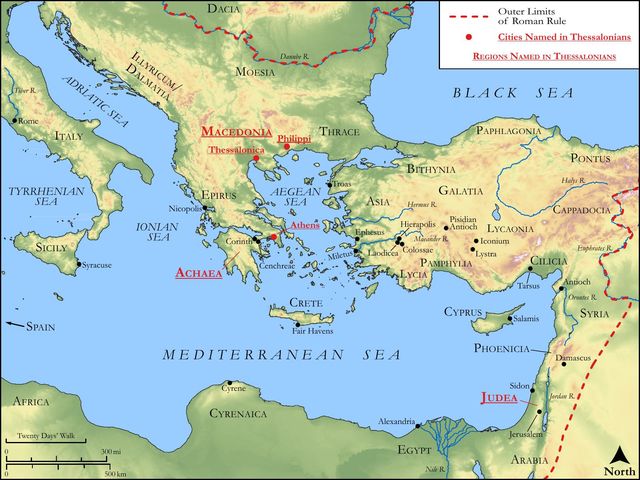
See on the biblical-era maps

Study this verse
Public-domain commentary
Matthew Henry
From his Commentary on the Whole Bible. Henry comments on passages, not single verses — this entry covers 1 Thessalonians 5:16–22.
Here we have divers short exhortations, that will not burden our memories, but will be of great use to direct the motions of our hearts and lives; for the duties are of great importance, and we may observe how they are connected together, and have a dependence upon one another. 1. Rejoice evermore, Th1 5:16. This must be understood of spiritual joy; for we must rejoice in our creature-comforts as if we rejoiced not, and must not expect to live many years, and rejoice in them all; but, if we do rejoice in God, we may do that evermore. In him our joy will be full; and it is our fault if we have not a continual feast. If we are sorrowful upon any worldly account, yet still we may always rejoice, Co2 6:10. Note, A religious life is a pleasant life, it is a life of constant joy. 2. Pray without ceasing, Th1 5:17. Note, The way to rejoice evermore is to pray without ceasing. We should rejoice more if we prayed more. We should keep up stated times for prayer, and continue instant in prayer. We should pray always, and not faint: pray without weariness, and continue in prayer, till we come to that world where prayer shall be swallowed up in praise. The meaning is not that men should do nothing but pray, but that nothing else we do should hinder prayer in its proper season. Prayer will help forward and not hinder all other lawful business, and every good work. 3. In every thing give thanks, Th1 5:18. If we pray without ceasing, we shall not want matter for thanksgiving in every thing. As we must in every thing make our requests known to God by supplications, so we must not omit thanksgiving, Phi 4:6. We should be thankful in every condition, even in adversity as well as prosperity. It is never so bad with us but it might be worse. If we have ever so much occasion to make our humble complaints to God, we never can have any reason to complain of God, and have always much reason to praise and give thanks: the apostle says, This is the will of God in Christ Jesus concerning us, that we give thanks, seeing God is reconciled to us in Christ Jesus; in him, through him, and for his sake, he allows us to rejoice evermore, and appoints us in every thing to give thanks. It is pleasing to God. 4. Quench not the Spirit (Th1 5:19), for it is this Spirit of grace and supplication that helpeth our infirmities, that assisteth us in our prayers and thanksgivings. Christians are said to be baptized with the Holy Ghost and with fire. He worketh as fire, by enlightening, enlivening, and purifying the souls of men. We must be careful not to quench this holy fire. As fire is put out by withdrawing fuel, so we quench the Spirit if we do not stir up our spirits, and all that is within us, to comply with the motions of the good Spirit; and as fire is quenched by pouring water, or putting a great quantity of dirt upon it, so we must be careful not to quench the Holy Spirit by indulging carnal lusts and affections, or minding only earthly things. 5. Despise not prophesyings (Th1 5:20); for, if we neglect the means of grace, we forfeit the Spirit of grace. By prophesyings here we are to understand the preaching of the word, the interpreting and applying of the scriptures; and this we must not despise, but should prize and value, because it is the ordinance of God, appointed of him for our furtherance and increase in knowledge and grace, in holiness and comfort. We must not despise preaching, though it be plain, and not with enticing words of men's wisdom, and though we be told no more than what we knew before. It is useful, and many times needful, to have our minds stirred up, our affections and resolutions excited, to those things that we knew before to be our interest and our duty. 6. Prove all things, but hold fast that which is good, Th1 5:21. This is a needful caution, to prove all things; for, though we must put a value on preaching, we must not take things upon trust from the preacher, but try them by the law and the testimony. We must search the scriptures, whether what they say be true or not. We must not believe every spirit, but must try the spirits. But we must not be always trying, always unsettled; no, at length we must be settled, and hold fast that which is good. When we are satisfied that any thing is right, and true, and good, we must hold it fast, and not let it go, whatever opposition or whatever persecution we meet with for the sake thereof. Note, The doctrines of human infallibility, implicit faith, and blind obedience, are not the doctrines of the Bible. Every Christian has and ought to have, the judgment of discretion, and should have his senses exercised in discerning between good and evil, truth and falsehood, Heb 5:13, Heb 5:14. And proving all things must be in order to holding fast that which is good. We must not always be seekers, or fluctuating in our minds, like children tossed to and fro with every wind of doctrine. 7. Abstain from all appearance of evil, Th1 5:22. This is a good means to prevent our being deceived with false doctrines, or unsettled in our faith; for our Saviour has told us (Joh 7:17), If a man will do his will, he shall know of the doctrine whether it be of God. Corrupt affections indulged in the heart, and evil practices allowed of in the life, will greatly tend to promote fatal errors in the mind; whereas purity of heart, and integrity of life, will dispose men to receive the truth in the love of it. We should therefore abstain from evil, and all appearances of evil, from sin, and that which looks like sin, leads to it, and borders upon it. He who is not shy of the appearances of sin, who shuns not the occasions of sin, and who avoids not the temptations and approaches to sin, will not long abstain from the actual commission of sin.
Historical interpretation
Six Centuries of Reception
11 surviving comments on this verse. Each one is dated, so this reads as a timeline rather than a list.
Select a marker to jump to its quote. Markers stagger vertically where authors wrote within a few decades of each other.
If equanimity be the contention, you have Lycurgus choosing death by self-starvation, because the Lacons had made some emendation of his laws: the Christian, even when he is condemned, gives thanks. If the comparison be made in regard to trustworthiness, Anaxagoras denied the deposit of his enemies: the Christian is noted for his fidelity even among those who are not of his religion.
For no one is going to turn away from sin and start behaving righteously unless he thinks about what he is doing. Not until he has been straightened out by practicing godly behavior will he actually possess the reward of faith: the crown of righteousness that Paul possessed, having fought the good fight. That crown is laid up not just for Paul but for all who are like him in this respect. This sort of meditation and exercise in godliness should be familiar to us, as it was to the saints of old. It should be especially so in the season when the divine word calls upon us to keep the feast. For what, after all, is the feast but continual worship of God, recognition of godliness and unceasing prayer all done from the heart in full agreement with each other? St. Paul, wanting us to be so inclined, urges us, “Always rejoice, pray without ceasing, give thanks in all things.”
Then, because he [David] had been delivered from great danger, he sent up this prayer of thanksgiving to God who had rescued him. “I will bless the Lord at all times.” Having escaped death, as if he were setting up norms for his life, he molded his soul to an exact manner of living, so that he ceased at no time from praise but referred the beginning of affairs, great and small, to God. “I will not think,” he says, “that anything was done through my diligence nor happened through spontaneous chance, but, ‘I will bless the Lord at all times,’ not only in prosperity of life, but also in precarious times.” The apostle, learning from this, says, “Rejoice always. Pray without ceasing. In all things give thanks.”
For prayer and psalmody, however, as also, indeed, for some other duties, every hour is suitable, that, while our hands are busy at their tasks, we may praise God sometimes with the tongue (when this is possible, or, rather, when it is conducive to edification); or, if not, with the heart.… Thus we acquire a recollected spirit—when in every action we beg from God the success of our labors and satisfy our debt of gratitude to him who gave us the power to do the work, and when, as has been said, we keep before our minds the aim of pleasing him. If this is not the case, how can there be consistency in the words of the apostle bidding us to “pray without ceasing,” with those other words, “we worked night and day.”
"Pray without ceasing; In every thing giving thanks: for this is the will of God."
Always to give thanks, this is a mark of a philosophic soul. Hast thou suffered any evil? But if thou wilt, it is no evil. Give thanks to God, and the evil is changed into good. Say thou also as Job said, "Blessed be the name of the Lord for ever." (Job i. 21) For tell me, what such great thing hast thou suffered? Has disease befallen thee? Yet it is nothing strange. For our body is mortal, and liable to suffer. Has a want of possessions overtaken thee? But these also are things to be acquired, and again to be lost, and that abide here. But is it plots and false accusations of enemies? But it is not we that are injured by these, but they who are the authors of them. "For the soul," he says, "that sinneth, itself shall also die." (Ezek. xviii. 4) And he has not sinned who suffers the evil, but he who has done the evil.
Most appropriately have we all this day sung together, “Blessed be the Lord God of Israel, who only does wondrous things.”For marvelous, and beyond all expectation, are the things which have happened. A whole city, and so great a population, when just about to be overwhelmed—to sink under the waves, and to be utterly and instantly destroyed—he has entirely rescued from shipwreck in a single moment of time! Let us give thanks, then, not only that God has calmed the tempest but that he permitted it to take place. Not only did he rescue us from shipwreck, but he allowed us to fall into such distress and permitted such an extreme peril to hang over us. Thus also Paul bids us “in every thing give thanks.” But when he says, “In every thing give thanks,” he means not only in our deliverance from evils but also at the time when we suffer those evils.
When the mind is freed from lust, established in tranquility and does not waver in its intention toward the one supreme good, the monk will fulfill the precept of St. Paul, “Pray without ceasing,” and “In every place lifting up holy hands without wrath and controversy.” By purity of heart the mind is drawn away from earthly feelings and is reformed in the likeness of an angelic spirit. Then, whatever thought the mind receives, whatever it considers, whatever it does, will be a prayer of true purity and sincerity.
The brothers told this story: We once visited some hermits, and after the usual prayer we exchanged greetings and sat down. After we had talked with them, we got ready to go, and asked once again for prayers to be said. But one of the hermits said to us, ‘What, haven’t you prayed already?’ We said: ‘Yes, abba, when we came in, we prayed, and since then we have been talking.’ He said, ‘I may be wrong, brothers; but one of you, while he was sitting and talking with you, offered a hundred and three prayers.’ With these words he prayed, and sent us away.
A brother asked one of the hermits, ‘If I happen to over-sleep, and am late for the hour of prayer, I am ashamed that others will hear me praying so late, and so I become reluctant to keep the rule of prayer.’ He said, ‘If ever you oversleep in the morning, get up when you wake, shut the door and the windows, and say your psalms. For it is written, “The day is thine and the night is thine” (Ps. 74:16). God is glorified whatever time it is.’
“Sing with jubilation to God, all the earth.” The prophet was troubled for the faithful people in case they believe they are to serve the Lord with gloomy anxiety, so he began at once with jubilation, for ministering to the Lord with happiness of mind constitutes the perfect devotion of the just man. As Paul warns us, “Always rejoice: pray without ceasing: in all things give thanks.”
Why did Paul say, “Pray and do not grow weary”? As long as he is a servant, he indeed prays; but once born of the Spirit in the world of prayer, he is a son of God, and he has authority over riches, being an heir; thus he does not merely ask.
Continue studying 1 Thessalonians 5:18 across the web’s major study libraries — every link below opens this exact verse, chapter, or book on the destination site.
Read & Compare
 BibleGatewayThis verse in more than 200 translations and 70 languages.
 Bible.comThe YouVersion reader — hundreds of translations, reading plans, and highlights.
 ESV.orgCrossway's official English Standard Version reader.
 NET BibleThe NET translation with 60,000+ translators' notes on every rendering decision.
 STEP BibleTyndale House's free study tool — original text, vocabulary, and scholarly resources.
 BibliaLogos Bible Software's free web reader.
 USCCBThe New American Bible (Revised Edition) with the U.S. bishops' study notes.
Commentaries
 BibleHub CommentariesDozens of classic commentaries on this verse, gathered on one page.
 StudyLightMore than 100 commentary sets — the largest collection on the web.
 BibleRefPlain-English commentary on what this verse means, verse by verse.
 Enduring WordDavid Guzik's free commentary on this chapter, widely used by Bible teachers.
 Bible Study ToolsVerse commentary alongside Greek and Hebrew study aids.
Original Language & Research
- BibleHub InterlinearThe verse word by word — original language, transliteration, and English.
- BibleHub LexiconEvery word's original-language definition and Strong's entry.
 Blue Letter BibleDeep-study tools — Strong's numbers, concordance, and word studies.
 CNTR CollationThe earliest Greek manuscripts of this verse, collated letter by letter.
Sermons, Hymns & Audio


TrulyRandomVerse is not affiliated with these sites and doesn’t control their content. They’re linked because they’re genuinely useful.
Summary
First Thessalonians 5:18 is a profound exhortation from the Apostle Paul, urging believers to cultivate a pervasive attitude of gratitude in all circumstances. This verse anchors the practice of thanksgiving not merely as a beneficial spiritual discipline but as a direct expression of God's sovereign and loving will for those who are united with Him "in Christ Jesus." It underscores that gratitude is an essential characteristic of the Christian life, empowered by one's relationship with Christ and foundational to living in accordance with divine purpose.
Context
ShowHideLiterary Context
First Thessalonians, likely one of Paul's earliest epistles, concludes with a series of practical commands for Christian living in chapter 5. Verse 18 is part of a powerful triad of imperatives found in 1 Thessalonians 5:16-18, which states, "Rejoice evermore. Pray without ceasing. In every thing give thanks." These three commands are presented as foundational and continuous spiritual postures for believers, emphasizing an unceasing disposition of joy, constant communion with God, and pervasive gratitude, irrespective of external circumstances. The preceding verses address the return of Christ and the importance of sober living, while the subsequent verses offer further practical instructions on spiritual discernment, respect for leaders, and mutual encouragement within the community.
Historical & Cultural Context
The church in Thessalonica was relatively young, composed of both Jewish and Gentile converts, and faced significant challenges. They were experiencing persecution from both their Jewish countrymen and the pagan society, as evidenced in 1 Thessalonians 1:6. This persecution, combined with internal misunderstandings about eschatology (the study of end times) and the nature of Christian living, necessitated Paul's encouragement. In a world where gratitude often depended on favorable outcomes or the appeasement of gods, Paul's command to give thanks "in every thing" would have been counter-cultural, challenging them to find their source of stability and joy in God alone, rather than in their fluctuating circumstances.
Key Themes
ShowHideThis verse significantly contributes to several key themes woven throughout First Thessalonians. It reinforces the theme of Christian Conduct and Holiness, demonstrating how a life "in Christ" should manifest itself in practical, daily living, even amidst adversity. It highlights God's Sovereign Will, presenting thanksgiving as a direct expression of alignment with divine purpose for believers. Furthermore, it underscores the theme of Endurance and Hope in Suffering, by providing a spiritual discipline—gratitude—that enables believers to maintain faith and perspective even when facing trials. This theme is consistent with Paul's broader teaching on suffering, as seen in passages like Romans 5:3-5. Finally, the phrase "in Christ Jesus" emphasizes the Christ-Centered Nature of Christian Life, indicating that true gratitude is not a human effort but a divinely empowered response rooted in one's union with Christ.
Exposition and Analysis
ShowHideKey Word Analysis
ShowHideThis verb, G2168, means "to be grateful, i.e. (actively) to express gratitude (towards)." It is the root of the English word "Eucharist," highlighting its connection to a profound act of grace and blessing. The term combines eu (good, well) and charis (grace, favor), signifying that thanksgiving is a response to the "good grace" or "good favor" of God, acknowledging His unmerited kindness and goodness in all circumstances.
G2307 refers to "a determination (properly, the thing), i.e. (actively) choice (specially, purpose, decree; abstractly, volition) or (passively) inclination." In this context, it denotes God's active purpose and decree for believers. It is not merely a suggestion or a preference but a divine mandate, indicating that gratitude is an essential and non-negotiable aspect of living in alignment with God's design for His children.
A primary preposition, denotes a "fixed position (in place, time or state), and (by implication) instrumentality (medially or constructively)." Its repetition in the verse ("In every thing" and "in Christ Jesus") is crucial. In "in every thing," it signifies the sphere or context within which thanksgiving is to occur, not necessarily the object for which one is thankful. In "in Christ Jesus," it denotes the sphere of salvation and spiritual union, indicating that this divine will and the capacity to fulfill it are found exclusively within the believer's relationship with Christ.
Verse Breakdown
ShowHide"In every thing give thanks:"
This opening clause sets the scope of the command: gratitude is to be practiced universally, not selectively. The Greek preposition en ("in") indicates that thanksgiving is to be a consistent posture within all circumstances, rather than being contingent upon favorable outcomes. It implies a recognition of God's sovereignty and presence even amidst trials, allowing believers to find reasons for gratitude regardless of their immediate situation. This is a call to a disposition of heart that transcends fleeting emotions or external conditions.
"for this is the will of God"
The conjunction "for" (Greek, gár) introduces the divine rationale and authority behind the command. The practice of giving thanks in all things is explicitly declared to be God's direct "will" or purpose. This elevates thanksgiving from a mere suggestion or a good practice to a divinely ordained mandate, signifying its essential role in the life of a believer who seeks to live in obedience and alignment with God's desires.
"in Christ Jesus concerning you."
This final phrase specifies the context and recipients of this divine will. The command is specifically for those who are "in Christ Jesus," highlighting that this is a truth and an expectation for believers who are united with Him through faith. The phrase "concerning you" (Greek, eis hymâs) further personalizes the command, making it clear that this is God's particular design and purpose for each individual believer. It implies that the capacity and motivation to give thanks in all things are empowered by one's relationship with Christ, who provides the ultimate hope, perspective, and strength needed to face life's challenges with gratitude.
Literary Devices
ShowHideThe verse employs several significant literary devices. Emphasis is achieved through the repetition of the preposition "in" (Greek, en), first defining the scope ("in every thing") and then the spiritual sphere ("in Christ Jesus"). This repetition underscores both the universality of the command and its Christ-centered foundation. Conciseness is evident in the verse's compact structure, delivering a profound theological truth and practical command in a few powerful words. This brevity makes the command memorable and impactful. The verse also functions as a Divine Mandate, presented as a clear and authoritative statement of God's will, leaving no room for ambiguity regarding the importance of gratitude. Finally, the phrase "in Christ Jesus" serves as a form of Metonymy or Synecdoche, where "Christ Jesus" represents the entire redemptive work, spiritual union, and empowering presence of the Savior, which enables believers to fulfill this challenging command.
Theological and Thematic Connections
ShowHideFirst Thessalonians 5:18 profoundly shapes our understanding of Christian life by establishing gratitude as a non-negotiable aspect of God's will for His people. It teaches that thanksgiving is not merely a response to blessings but a fundamental posture of faith that acknowledges God's sovereignty and goodness even amidst adversity. This perspective transforms suffering into an arena for spiritual growth and deeper reliance on God, demonstrating that true joy and peace are rooted in Him, not in fleeting circumstances. The verse also highlights the transformative power of being "in Christ Jesus," implying that our union with Him provides both the divine mandate and the spiritual enablement to live a life characterized by continuous gratitude. This gratitude, therefore, becomes a testament to the believer's trust in God's ultimate plan and His unfailing love.
Reflection and Application
ShowHideFirst Thessalonians 5:18 challenges believers to cultivate a lifestyle of gratitude that transcends transient feelings or favorable conditions. It calls for a deliberate choice to acknowledge God's presence, goodness, and ultimate control in every situation. This is not a call to be thankful for evil or suffering, but to be thankful in the midst of it, recognizing God's enduring faithfulness and redemptive purposes. Practically, this involves consciously seeking out reasons to be thankful, even in the smallest blessings or amidst significant challenges, and making thanksgiving a regular part of prayer, worship, and daily reflection. Embracing this command fosters a deeper relationship with God, builds spiritual resilience, and enables us to experience His peace even when the world around us is chaotic. It transforms our perspective, shifting our focus from what we lack or what is wrong to what God has provided and what He is accomplishing, thereby revealing the depth of our trust in His sovereign and loving will.
Questions for Reflection
ShowHideFAQ
ShowHideDoes "in every thing give thanks" mean we should be thankful for evil or suffering?
ShowHideNo, the verse does not command us to be thankful for evil, sin, or suffering. Instead, the Greek preposition "in" (G1722, en) indicates that believers are to maintain an attitude of gratitude within every circumstance. This means that even when facing trials, pain, or injustice, we can still find reasons to give thanks to God. We give thanks for His presence, His faithfulness, His sovereignty, His promise to work all things for good (Romans 8:28), and the ultimate hope we have in Christ. It's about recognizing God's enduring goodness and control over all situations, rather than being grateful for the negative events themselves.
Why is giving thanks considered "the will of God"?
ShowHideGiving thanks is the will of God because it reflects a heart that trusts in His sovereignty, goodness, and wisdom, regardless of circumstances. It demonstrates our dependence on Him and acknowledges His rightful place as the Giver of all good things. This posture of gratitude aligns us with God's design for humanity, which is to live in joyful communion and worship of Him. When we give thanks, we are actively participating in His purpose for our lives, which is to glorify Him and find our deepest satisfaction in Him. It is an essential aspect of living out our identity "in Christ Jesus," as it cultivates a spirit of contentment and peace that transcends worldly conditions, as also seen in Philippians 4:6-7.
Christ-Centered Fulfillment
ShowHideThe command to "give thanks in every thing" finds its ultimate fulfillment and enablement in Christ Jesus. It is not a legalistic burden but a liberating truth made possible by our union with Him. In the Old Testament, thanksgiving was often linked to deliverance and blessings, but Christ's redemptive work provides a new, eternal basis for gratitude that transcends earthly circumstances. Through His life, death, and resurrection, Jesus became the ultimate expression of God's grace, enabling us to approach God with thanksgiving even amidst suffering, knowing that He has overcome the world (John 16:33). Our ability to give thanks in all things is a direct result of the Holy Spirit's work within us, a Spirit given to those who are "in Christ" (Romans 8:9-11). Furthermore, Christ Himself modeled a life of gratitude, even in the face of immense suffering, giving thanks before breaking bread at the Last Supper (Matthew 26:26-27) and before raising Lazarus from the dead (John 11:41). Thus, living a life of pervasive thanksgiving is a Christ-like attribute, a testament to the transforming power of the Gospel, and a foretaste of the eternal worship we will offer Him in glory (Revelation 7:12).