


1 Corinthians 14:18
Bible text: King James Version (1769 Blayney text) · Public domain
Bible text: Berean Standard Bible · Public domain
Bible text: American Standard Version (1901) · Public domain
Bible text: World English Bible, Messianic edition · Public domain
Bible text: Geneva Bible (1599) · Public domain
Bible text: Young's Literal Translation · Public domain
- ΕὐχαριστῶEucharistōI thankG2168V-PAI-1SVerb Present Active Indicative 1st Singular
- τῷtōtheG3588T-DSMDefinite article Dative Singular Masculine
- θεῷtheōGodG2316N-DSM-TNoun Dative Singular Masculine Title
- μουmouof mineG3165P-1GSPersonal pronoun Genitive 1st Singular
- πάντωνpantōnthan allG3956A-GPMAdjective Genitive Plural Masculine
- ὑμῶνhumōnof youG4771P-2GPPersonal pronoun Genitive 2nd Plural
- μᾶλλονmallonmoreG3123ADVAdverb
- γλώσσαιςglōssaisin tonguesG1100N-DPFNoun Dative Plural Feminine
- λαλῶ·lalōspeakingG2980V-PAI-1SVerb Present Active Indicative 1st Singular
English is a literal word-by-word gloss of the Greek, not the KJV's wording. Why?
This is the original text the KJV's translators worked from — each Greek word with its own literal English meaning in this verse, prepared by scholars at Tyndale House, Cambridge. The KJV translates whole sentences, not word by word, so its wording differs: one Greek word can become several English words, and the KJV may choose “charity” where the gloss reads “love”. Both are faithful — they answer different questions. For the KJV's own rendering, switch to the KJV text.
Details
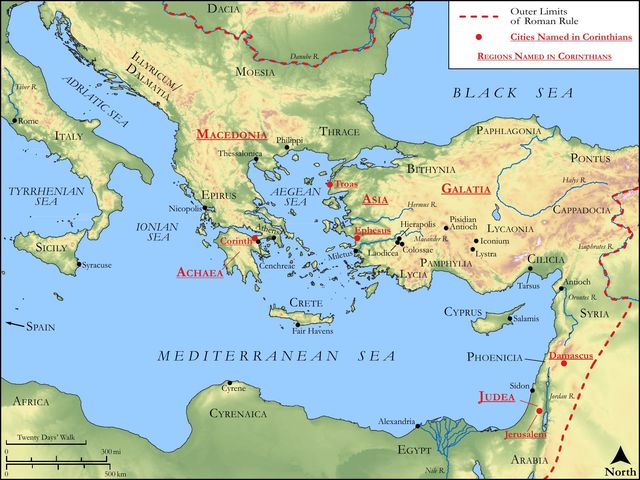
See on the biblical-era maps

Study this verse
Public-domain commentary
Matthew Henry
From his Commentary on the Whole Bible. Henry comments on passages, not single verses — this entry covers 1 Corinthians 14:15–20. His three-level outline is real structure in the source text, so it is rendered as structure.
The apostle here sums up the argument hitherto, and,
I.Directs them how they should sing and pray in public (Co1 14:15):
What is it then? I will pray with the spirit, and I will pray with the understanding also. I will sing with the spirit, etc. He does not forbid their praying or singing under a divine afflatus, or when they were inspired for this purpose, or had such a spiritual gift communicated to them; but he would have them perform both so as to be understood by others, that others might join with them. Note, Public worship should be performed so as to be understood.
II.He enforces the argument with several reasons.
1.That otherwise the unlearned could not say Amen to their prayers or thanksgivings, could not join in the worship, for they did not understand it, Co1 14:16. He who fills up or occupies the place of the unlearned, that is, as the ancients interpret it, the body of the people, who, in most Christian assemblies, are illiterate; how should they say Amen to prayers in an unknown tongue? How should they declare their consent and concurrence? This is saying Amen, So be it. God grant the thing we have requested; or, We join in the confession that has been made of sin, and in the acknowledgment that has been made of divine mercies and favours. This is the import of saying Amen. All should say Amen inwardly; and it is not improper to testify this inward concurrence in public prayers and devotions, by an audible Amen. The ancient Christians said Amen aloud. Vide Just. Mart. apol. 2. prop fin. Now, how should the people say Amen to what they did not understand? Note, There can be no concurrence in those prayers that are not understood. The intention of public devotions is therefore entirely destroyed if they are performed in an unknown tongue. He who performs may pray well, and give thanks well, but not in that time and place, because others are not, cannot be, edified (Co1 14:17) by what they understand not.
2.He alleges his own example, to make the greater impression, concerning which observe,
(1.)That he did not come behind any of them in this spiritual gift: "I thank my God, I speak with tongues more than you all (Co1 14:18); not only more than any single person among you, but more than all together." It was not envy at their better furniture that made Paul depreciate what they so highly valued and so much vaunted of; he surpassed them all in this very gift of tongues, and did not vilify their gift because he had it not. This spirit of envy is too common in the world. But the apostle took care to guard against this misconstruction of his purpose, by letting them know there was more ground for them to envy him upon this head than for him to envy them. Note, When we beat down men's unreasonable value for themselves, or any of their possessions or attainments, we should let them see, if possible, that this does not proceed from an envious and grudging spirit. We miss our aim if they can fairly give our conduct this invidious turn. Paul could not be justly censured, nor suspected for any such principle in this whole argument. He spoke more language than they all. Yet,
(2.)He had rather speak five words with understanding, that is, so as to be understood, and instruct and edify others, than ten thousand words in an unknown tongue, Co1 14:19. He was so far from valuing himself upon talking languages, or making ostentation of his talents of this kind, that he had rather speak five intelligible words, to benefit others, than make a thousand, ten thousand fine discourses, that would do no one else any good, because they did not understand them. Note, A truly Christian minister will value himself much more upon doing the least spiritual good to men's souls than upon procuring the greatest applause and commendation to himself. This is true grandeur and nobleness of spirit; it is acting up to his character; it is approving himself the servant of Christ, and not a vassal to his own pride and vanity.
3.He adds a plain intimation that the fondness then discovered for this gift was but too plain an indication of the immaturity of their judgment: Brethren, be not children in understanding; in malice be you children, but in understanding be men, Co1 14:20. Children are apt to be struck with novelty and strange appearances. They are taken with an outward show, without enquiring into the true nature and worth of things. Do not you act like them, and prefer noise and show to worth and substance; show a greater ripeness of judgment, and act a more manly part; be like children in nothing but an innocent and inoffensive disposition. A double rebuke is couched in this passage, both of their pride upon account of their gifts, and their arrogance and haughtiness towards each other, and the contests and quarrels proceeding from them. Note, Christians should be harmless and inoffensive as children, void of all guile and malice; but should have wisdom and knowledge that are ripe and mature. They should not be unskilful in the word of righteousness (Heb 5:13), though they should be unskilful in all the arts of mischief.
Historical interpretation
Historical reception
1 surviving comment on this verse from the historical church.
Further, because he had run down the possessors of this gift, as though they had no such great thing; that he might not seem to hold them cheap, as being himself destitute of it, see what he saith: "I thank God, speaking with tongues more than ye all."
And this he doth also in another place intending, namely, to take away the advantages of Judaism and to show that henceforth they are nothing, he begins by declaring that himself had been endowed with them, yea, and that in very great excess; and then he calls them "loss," thus saying, "If any man thinketh to have confidence in the flesh, I more: circumcised the eighth day, of the stock of Israel, of the tribe of Benjamin, a Hebrew of Hebrews; as touching the law, a Pharisee; as touching zeal, persecuting the Church; as touching the righteousness which is the law, found blameless." And then, having signified himself to have the advantage of all, he saith, "Howbeit what things were gain to me, those have I counted loss for Christ." So also he doth here, saying, "I speak with tongues more than ye all." Do not ye therefore glory as though ye only had the gift. For I also possess it, yea more than ye.
Continue studying 1 Corinthians 14:18 across the web’s major study libraries — every link below opens this exact verse, chapter, or book on the destination site.
Read & Compare
 BibleGatewayThis verse in more than 200 translations and 70 languages.
 Bible.comThe YouVersion reader — hundreds of translations, reading plans, and highlights.
 ESV.orgCrossway's official English Standard Version reader.
 NET BibleThe NET translation with 60,000+ translators' notes on every rendering decision.
 STEP BibleTyndale House's free study tool — original text, vocabulary, and scholarly resources.
 BibliaLogos Bible Software's free web reader.
 USCCBThe New American Bible (Revised Edition) with the U.S. bishops' study notes.
Commentaries
 BibleHub CommentariesDozens of classic commentaries on this verse, gathered on one page.
 StudyLightMore than 100 commentary sets — the largest collection on the web.
 BibleRefPlain-English commentary on what this verse means, verse by verse.
 Enduring WordDavid Guzik's free commentary on this chapter, widely used by Bible teachers.
 Bible Study ToolsVerse commentary alongside Greek and Hebrew study aids.
Original Language & Research
- BibleHub InterlinearThe verse word by word — original language, transliteration, and English.
- BibleHub LexiconEvery word's original-language definition and Strong's entry.
 Blue Letter BibleDeep-study tools — Strong's numbers, concordance, and word studies.
 CNTR CollationThe earliest Greek manuscripts of this verse, collated letter by letter.
Sermons, Hymns & Audio


TrulyRandomVerse is not affiliated with these sites and doesn’t control their content. They’re linked because they’re genuinely useful.
Summary
In 1 Corinthians 14:18, the Apostle Paul makes a deeply personal declaration regarding his own extensive experience with the spiritual gift of speaking in tongues. This statement serves as a strategic and authoritative preface to his detailed instructions concerning the proper use and regulation of spiritual gifts within the chaotic Corinthian church, establishing his credibility as one who intimately understands the very phenomena he is seeking to order.
Context
ShowHideLiterary Context
This verse is situated within Paul's profound and practical discourse on spiritual gifts in 1 Corinthians 12-14. Having established the unity of the Spirit in the diversity of gifts in 1 Corinthians 12 and exalted love as the "most excellent way" in the pivotal 1 Corinthians 13, Paul transitions in 1 Corinthians 14 to the practical application and regulation of these gifts within the corporate gathering. The Corinthian church was experiencing significant disorder, particularly regarding the public exercise of tongues without interpretation, leading to confusion and a lack of edification. Paul's personal testimony in verse 18 immediately precedes his detailed instructions on prioritizing prophecy (which is understandable and edifying) over uninterpreted tongues in public worship, underscoring that his guidance comes from a place of personal experience, not ignorance or opposition to the gift itself.
Historical & Cultural Context
The city of Corinth was a bustling, cosmopolitan hub known for its diverse religious practices, including various forms of ecstatic utterances associated with pagan cults. This environment likely influenced the Corinthian believers, who may have brought pre-Christian understandings of spiritual experiences into the church, leading to an emphasis on sensational or individualistic displays of gifts, particularly tongues. There was a strong cultural emphasis on public display and personal status, which could have contributed to the misuse of spiritual gifts for self-aggrandizement rather than communal benefit. Paul's letter addresses a church struggling with internal divisions, moral laxity, and a misunderstanding of Christian liberty and corporate worship. His instructions are designed to bring order, promote genuine spiritual growth, and distinguish Christian charismatic expression from pagan ecstatic practices, ensuring that all activities contribute to the edification of the body of Christ.
Key Themes
ShowHidePaul's statement in 1 Corinthians 14:18 contributes to several overarching themes in 1 Corinthians. Firstly, it reinforces the theme of legitimacy and authenticity of spiritual gifts, affirming that tongues, when properly understood and exercised, are indeed a divine endowment. Secondly, it lays the groundwork for the theme of order and edification in corporate worship, as Paul's personal proficiency allows him to speak authoritatively about the necessity of regulating the gift for the common good, as articulated in 1 Corinthians 14:26. Thirdly, it subtly highlights the theme of humility and self-control in the exercise of powerful spiritual gifts, contrasting his personal practice with the Corinthians' potentially disorderly public displays. Paul models that even profound spiritual experiences should be submitted to the principles of love and order, ensuring that all things are done "decently and in order" as he concludes in 1 Corinthians 14:40.
Exposition and Analysis
ShowHideKey Word Analysis
ShowHideThis verb (G2168) means "to be grateful" or "to express gratitude." Paul's opening "I thank my God" indicates a profound sense of divine enablement and blessing for his gift of tongues. It frames his subsequent statement not as a boast, but as an expression of gratitude to God for the spiritual endowment he possesses.
The verb (G2980) means "to talk" or "to utter words." In the context of spiritual gifts, it refers to the act of vocalizing inspired utterances. Here, it specifically denotes the act of speaking in tongues, emphasizing the verbal and audible nature of the gift Paul is describing.
This noun (G1100) literally means "tongue," but in this context, it refers to a language, specifically one naturally unacquired by the speaker. This can denote either a known human language (as seen at Pentecost in Acts 2:4) or a divinely inspired, non-human utterance, often referred to as "heavenly languages" or "angelic tongues" (1 Corinthians 13:1). Paul's usage throughout 1 Corinthians 14 suggests he is primarily referring to utterances not naturally understood by the hearers without interpretation.
Verse Breakdown
ShowHide"I thank my God"
Paul begins with an expression of profound gratitude to God. This opening phrase immediately sets a humble and reverent tone, indicating that his ability to speak in tongues is a divine gift, not a personal achievement. It also preempts any accusation of boasting, framing his subsequent statement as a testimony to God's grace.
"I speak with tongues"
This clause is a direct and unequivocal personal affirmation. Paul declares his active and ongoing practice of the spiritual gift of glossolalia. This statement is crucial for establishing his credibility and authority to address the Corinthian church's issues with the gift, demonstrating that he speaks from personal, extensive experience rather than theoretical knowledge or prejudice against the gift itself.
"more than ye all"
This emphatic comparative phrase highlights the extraordinary extent of Paul's personal experience with speaking in tongues. While not necessarily a literal, quantifiable boast, it conveys that his practice of the gift was more frequent or profound than that of any single individual or even the collective experience of the Corinthians. This establishes his unique position to provide authoritative instruction on the gift's proper use, as he understands its power and potential more deeply than those he is addressing.
Literary Devices
ShowHidePaul employs several significant Literary Devices in this concise declaration. Firstly, it functions as a powerful Personal Testimony, where Paul directly asserts his own spiritual experience. This personal disclosure serves to establish his Ethos or credibility; he is not an outsider condemning a practice he does not understand, but an authoritative apostle who himself possesses the gift in abundance. This lends significant weight to his subsequent instructions. The phrase "more than ye all" can be interpreted as a form of Hyperbole or Emphasis, not necessarily a literal count, but a rhetorical device to underscore the vastness of his personal engagement with the gift. This emphasis serves to disarm potential critics who might accuse him of downplaying the gift because he lacked it. By affirming his own proficiency, Paul strategically positions himself as a knowledgeable guide, enabling him to transition seamlessly into his detailed regulations for the gift's proper use without being perceived as dismissive of its spiritual value.
Theological and Thematic Connections
ShowHidePaul's personal declaration in 1 Corinthians 14:18 underscores a vital theological truth: spiritual gifts are genuinely bestowed by God for His purposes, and their value is not diminished by their misuse. Paul, a paragon of apostolic ministry, possessed this gift in abundance, demonstrating that it was a legitimate manifestation of the Holy Spirit's power. His experience serves as a foundational example that while personal spiritual experiences can be deeply enriching for the individual (as he implies in 1 Corinthians 14:4), the ultimate measure of a gift's value in a communal setting is its contribution to the edification and order of the entire body of Christ. This verse thus connects to the broader biblical understanding of divine empowerment for service and the Spirit's distribution of diverse gifts for the common good.
Reflection and Application
ShowHidePaul's statement in 1 Corinthians 14:18 offers profound insights for believers today. It reminds us that spiritual gifts are real, diverse, and divinely given, and that personal spiritual experiences can be a legitimate and enriching part of our walk with God. However, Paul's subsequent instructions in 1 Corinthians 14, following this personal declaration, emphasize that the exercise of these gifts, especially in public worship, must always be governed by the principles of love, order, and edification. Our personal spiritual practices, no matter how profound, should never detract from the clarity, understanding, and spiritual growth of the wider community. This verse challenges us to cultivate our individual gifts with gratitude, but always with a discerning heart that prioritizes the health and building up of the church, ensuring that all we do contributes to the common good and glorifies God.
Questions for Reflection
ShowHideFAQ
ShowHideIs Paul boasting when he says he speaks with tongues more than anyone else?
ShowHideWhile the phrasing "more than ye all" might sound like boasting, Paul's intent is not self-aggrandizement. Instead, it serves a strategic rhetorical purpose. By declaring his extensive personal experience with tongues, Paul establishes his credibility and authority to speak on the subject. He is not an outsider condemning a gift he doesn't possess, but an apostle who intimately understands its power and potential. This personal testimony disarms potential critics and lends weight to his subsequent instructions on the proper, orderly, and edifying use of spiritual gifts within the church, particularly in public worship (see 1 Corinthians 14:26-33). His opening "I thank my God" further frames his statement as gratitude for a divine gift, not a personal achievement.
Does this verse encourage speaking in tongues in private?
ShowHideYes, implicitly. Paul's statement, "I speak with tongues more than ye all," coupled with his later distinction between speaking in tongues for personal edification and speaking in tongues for public edification with interpretation (1 Corinthians 14:2-4), strongly suggests that much of his extensive practice of tongues occurred in private devotion. In private, the gift of tongues can be a powerful means of personal prayer, worship, and spiritual edification, as it allows the spirit to communicate directly with God without the need for human understanding or interpretation. Paul encourages this personal use while strictly regulating its public exercise.
What kind of "tongues" is Paul referring to here?
ShowHideThe Greek word "glōssa" (G1100), translated as "tongues," refers to languages. In the New Testament, it can refer to known human languages (as seen at Pentecost in Acts 2:4-11) or to divinely inspired utterances that are not naturally understood by human hearers, sometimes referred to as "heavenly" or "angelic" languages (1 Corinthians 13:1). Given Paul's emphasis throughout 1 Corinthians 14 on the need for interpretation for public understanding and edification, he is primarily referring to utterances that are unintelligible to the audience without a supernatural interpretation, whether they are unknown human languages or non-human spiritual utterances.
Christ-Centered Fulfillment
ShowHide1 Corinthians 14:18, while a personal statement from Paul, finds its ultimate Christ-centered fulfillment in the person and work of Jesus Christ, who is the source and embodiment of all spiritual gifts. Christ Himself is the ultimate "Word" of God, the perfect and complete divine utterance (John 1:1 and John 1:14). All spiritual gifts, including the gift of tongues, flow from His ascension and the subsequent outpouring of the Holy Spirit (Ephesians 4:7-8, where Christ "gave gifts to men"). Therefore, Paul's abundant experience with tongues points to the reality of the Spirit's empowering presence, which is a direct result of Christ's finished work on the cross and His exaltation. The purpose of all gifts, as Paul meticulously explains in 1 Corinthians, is to build up the church, which is the body of Christ (Colossians 1:18). Thus, Paul's personal gift, and indeed all spiritual gifts, are ultimately meant to draw believers into deeper communion with Christ and to equip them for His service, reflecting His glory and extending His kingdom.