


Colossians 3:15
Bible text: King James Version (1769 Blayney text) · Public domain
Bible text: King James Version with Strong's numbers · Public domain
Bible text: Berean Standard Bible · Public domain
Bible text: American Standard Version (1901) · Public domain
Bible text: World English Bible, Messianic edition · Public domain
Bible text: Geneva Bible (1599) · Public domain
Bible text: Young's Literal Translation · Public domain
- καὶkaiAndG2532CONJConjunction
- ἡhētheG3588T-NSFDefinite article Nominative Singular Feminine
- εἰρήνηeirēnēpeaceG1515N-NSFNoun Nominative Singular Feminine
- τοῦtou<the>G3588T-GSMDefinite article Genitive Singular Masculine
- ΧριστοῦChristoufrom ChristG5547N-GSM-TNoun Genitive Singular Masculine Title
- βραβευέτωbrabeuetōshould ruleG1018V-PAM-3SVerb Present Active Imperative 3rd Singular
- ἐνeninG1722PREPPreposition
- ταῖςtaistheG3588T-DPFDefinite article Dative Plural Feminine
- καρδίαιςkardiaisheartsG2588N-DPFNoun Dative Plural Feminine
- ὑμῶνhumōnof youG4771P-2GPPersonal pronoun Genitive 2nd Plural
- εἰςeistoG1519PREPPreposition
- ἣνhēnwhichG3739R-ASFRelative pronoun Accusative Singular Feminine
- καὶkaialsoG2532CONJConjunction
- ἐκλήθητεeklēthēteyou were calledG2564V-API-2PVerb Aorist Passive Indicative 2nd Plural
- ἐνeninG1722PREPPreposition
- ἑνὶhenioneG1520A-DSNAdjective Dative Singular Neuter
- σώματι·sōmatibodyG4983N-DSNNoun Dative Singular Neuter
- καὶkaiAndG2532CONJConjunction
- εὐχάριστοιeucharistoithankfulG2170A-NPMAdjective Nominative Plural Masculine
- γίνεσθεginesthedo beG1096V-PNM-2PVerb Present Middle Or Passive Deponent Imperative 2nd Plural
English is a literal word-by-word gloss of the Greek, not the KJV's wording. Why?
This is the original text the KJV's translators worked from — each Greek word with its own literal English meaning in this verse, prepared by scholars at Tyndale House, Cambridge. The KJV translates whole sentences, not word by word, so its wording differs: one Greek word can become several English words, and the KJV may choose “charity” where the gloss reads “love”. Both are faithful — they answer different questions. For the KJV's own rendering, switch to the KJV text.
Details
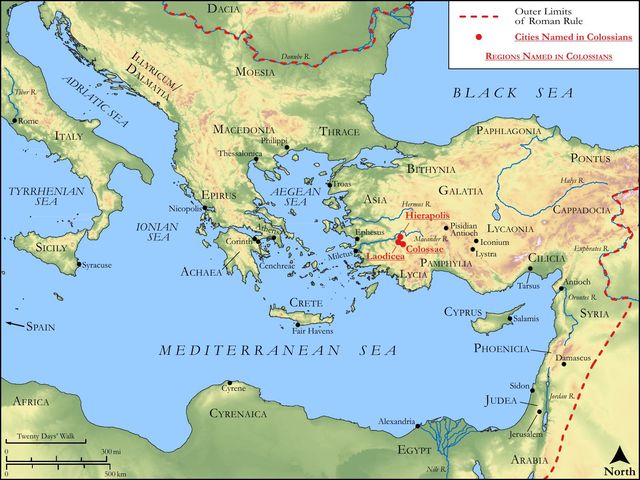
See on the biblical-era maps

Study this verse
Public-domain commentary
Matthew Henry
From his Commentary on the Whole Bible. Henry comments on passages, not single verses — this entry covers Colossians 3:12–17. His three-level outline is real structure in the source text, so it is rendered as structure.
The apostle proceeds to exhort to mutual love and compassion: Put on therefore bowels of mercy, Col 3:12. We must not only put off anger and wrath (as Col 3:8), but we must put on compassion and kindness; not only cease to do evil, but learn to do well; not only not do hurt to any, but do what good we can to all.
I.The argument here used to enforce the exhortation is very affecting: Put on, as the elect of God, holy and beloved. Observe,
1.Those who are holy are the elect of God; and those who are the elect of God, and holy, are beloved - beloved of God, and ought to be so of all men.
2.Those who are the elect of God, holy and beloved, ought to conduct themselves in every thing as becomes them, and so as not to lose the credit of their holiness, nor the comfort of their being chosen and beloved. It becomes those who are holy towards God to be lowly and loving towards all men. Observe, What we must put on in particular.
(1.)Compassion towards the miserable: Bowels of mercy, the tenderest mercies. Those who owe so much to mercy ought to be merciful to all who are proper objects of mercy. Be you merciful, as your Father is merciful, Luk 6:36.
(2.)Kindness towards our friends, and those who love us. A courteous disposition becomes the elect of God; for the design of the gospel is not only to soften the minds of men, but to sweeten them, and to promote friendship among men as well as reconciliation with God.
(3.)Humbleness of mind, in submission to those above us, and condescension to those below us. There must not only be a humble demeanour, but a humble mind. Learn of me, for I am meek and lowly in heart, Mat 11:29.
(4.)Meekness towards those who have provoked us, or been any way injurious to us. We must not be transported into any indecency by our resentment of indignities and neglects: but must prudently bridle our own anger, and patiently bear the anger of others.
(5.)Long-suffering towards those who continue to provoke us. Charity suffereth long, as well as is kind, Co1 13:4. Many can bear a short provocation who are weary of bearing when it grows long. But we must suffer long both the injuries of men and the rebukes of divine Providence. If God is long-suffering to us, under all our provocations of him, we should exercise long-suffering to others in like cases.
(6.)Mutual forbearance, in consideration of the infirmities and deficiencies under which we all labour: Forbearing one another. We have all of us something which needs to be borne with, and this is a good reason why we should bear with others in what is disagreeable to us. We need the same good turn from others which we are bound to show them.
(7.)A readiness to forgive injuries: Forgiving one another, if any man have a quarrel against any. While we are in this world, where there is so much corruption in our hearts, and so much occasion of difference and contention, quarrels will sometimes happen, even among the elect of God, who are holy and beloved, as Paul and Barnabas had a sharp contention, which parted them asunder one from the other (Act 15:39), and Paul and Peter, Gal 2:14. But it is our duty to forgive one another in such cases; not to bear any grudge, but put up with the affront and pass it by. And the reason is: Even as Christ forgave you, so also do you. The consideration that we are forgiven by Christ so many offences is a good reason why we should forgive others. It is an argument of the divinity of Christ that he had power on earth to forgive sins; and it is a branch of his example which we are obliged to follow, if we ourselves would be forgiven. Forgive us our trespasses, as we forgive those who trespass against us, Mat 6:12.
II.In order to all this, we are exhorted here to several things:
- 1. To clothe ourselves with love (Col 3:14): Above all things put on charity: epi pasi di toutois - over all things. Let this be the upper garment, the robe, the livery, the mark of our dignity and distinction. Or, Let this be principal and chief, as the whole sum and abstract of the second table. Add to faith virtue, and to brotherly-kindness charity, Pe2 1:5-7. He lays the foundation in faith, and the top-stone in charity, which is the bond of perfectness, the cement and centre of all happy society. Christian unity consists of unanimity and mutual love. 2. To submit ourselves to the government of the peace of God (Col 3:15): Let the peace of God rule in your hearts, that is, God's being at peace with you, and the comfortable sense of his acceptance and favour: or, a disposition to peace among yourselves, a peaceable spirit, that keeps the peace, and makes peace. This is called the peace of God, because it is of his working in all who are his. The kingdom of God is righteousness and peace, Rom 14:17. "Let this peace rule in your heart - prevail and govern there, or as an umpire decide all matters of difference among you." - To which you are called in one body. We are called to this peace, to peace with God as our privilege and peace with our brethren as our duty. Being united in one body, we are called to be at peace one with another, as the members of the natural body; for we are the body of Christ, and members in particular, Co1 12:27. To preserve in us this peaceable disposition, we must be thankful. The work of thanksgiving to God is such a sweet and pleasant work that it will help to make us sweet and pleasant towards all men. "Instead of envying one another upon account of any particular favours and excellence, be thankful for his mercies, which are common to all of you." 3. To let the word of Christ dwell in us richly, Col 3:16. The gospel is the word of Christ, which has come to us; but that is not enough, it must dwell in us, or keep house - enoikeitō, not as a servant in a family, who is under another's control, but as a master, who has a right to prescribe to and direct all under his roof. We must take our instructions and directions from it, and our portion of meat and strength, of grace and comfort, in due season, as from the master of the household. It must dwell in us; that is, be always ready and at hand to us in every thing, and have its due influence and use. We must be familiarly acquainted with it, and know it for our good, Job 5:27. It must dwell in us richly: not only keep house in our hearts, but keep a good house. Many have the word of Christ dwelling in them, but it dwells in them but poorly; it has no mighty force and influence upon them. Then the soul prospers when the word of God dwells in us richly, when we have abundance of it in us, and are full of the scriptures and of the grace of Christ. And this in all wisdom. The proper office of wisdom is to apply what we know to ourselves, for our own direction. The word of Christ must dwell in us, not in all notion and speculation, to make us doctors, but in all wisdom, to make us good Christians, and enable us to conduct ourselves in every thing as becomes Wisdom's children. 4. To teach and admonish one another. This would contribute very much to our furtherance in all grace; for we sharpen ourselves by quickening others, and improve our knowledge by communicating it for their edification. We must admonish one another in psalms and hymns. Observe, Singing of psalms is a gospel ordinance: psalmois kai humnois kai ōdais - the Psalms of David, and spiritual hymns and odes, collected out of the scripture, and suited to special occasions, instead of their lewd and profane songs in their idolatrous worship. Religious poesy seems countenanced by these expressions and is capable of great edification. But, when we sing psalms, we make no melody unless we sing with grace in our hearts, unless we are suitably affected with what we sing and go along in it with true devotion and understanding. Singing of psalms is a teaching ordinance as well as a praising ordinance; and we are not only to quicken and encourage ourselves, but to teach and admonish one another, mutually excite our affections, and convey instructions. 5. All must be done in the name of Christ (Col 3:17): And whatsoever you do in word or deed, do all in the name of the Lord Jesus, according to his command and in compliance with his authority, by strength derived from him, with an eye to his glory, and depending upon his merit for the acceptance of what is good and the pardon of what is amiss, Giving thanks to God and the Father by him. Observe, (1.) We must give thanks in all things; whatsoever we do, we must still give thanks, Eph 5:20, Giving thanks always for all things. (2.) The Lord Jesus must be the Mediator of our praises as well as of our prayers. We give thanks to God and the Father in the name of the Lord Jesus Christ, Eph 5:20. Those who do all things in Christ's name will never want matter of thanksgiving to God, even the Father.
Historical interpretation
Historical reception
2 surviving comments on this verse. Each one is dated, so this reads as a timeline rather than a list.
"And be ye thankful." For this is to be thankful, and very effectively, to deal with his fellow-servants as God doth with himself, to submit himself to the Master, to obey; to express his gratitude for all things, even though one insult him, or beat him.
For in truth he that confesses thanks due to God for what he suffers, will not revenge himself on him that has done him wrong, since he at least that takes revenge, acknowledges no gratitude. But let not us follow him (that exacted) the hundred pence, lest we hear, "Thou wicked servant," for nothing is worse than this ingratitude. So that they who revenge are ungrateful.
"And let the peace of God rule in your hearts, to the which also ye were called in one body; and be ye thankful."
"The peace of God." This is that which is fixed and steadfast. If on man's account indeed thou hast peace, it quickly comes to dissolution, but if on God's account, never. Although he had spoken of love universally, yet again he comes to the particular. For there is a love too which is immoderate; for instance, when out of much love one makes accusations without reason, and is engaged in contentions, and contracts aversions. Not this, saith he, not this do I desire; not overdoing things, but as God made peace with you, so do ye also make it. How made He peace? Of His own will, not having received anything of you. What is this? "Let the peace of God rule in your hearts." If two thoughts are fighting together, set not anger, set not spitefulness to hold the prize, but peace; for instance, suppose one to have been insulted unjustly; of the insult are born two thoughts, the one bidding him to revenge, the other to endure; and these wrestle with one another: if the Peace of God stand forward as umpire, it bestows the prize on that which bids endure, and puts the other to shame. How? by persuading him that God is Peace, that He hath made peace with us. Not without reason he shows the great struggle there is in the matter. Let not anger, he saith, act as umpire, let not contentiousness, let not human peace, for human peace cometh of avenging, of suffering no dreadful ill. But not this do I intend, he saith, but that which He Himself left.
He hath represented an arena within, in the thoughts, and a contest, and a wrestling, and an umpire. Then again, exhortation, "to the which ye were called," he saith, that is, for the which ye were called. He has reminded them of how many good things peace is the cause; on account of this He called thee, for this He called thee, so as to receive a worthy prize. For wherefore made He us "one body"? Was it not that she might rule? Was it not that we might have occasion of being at peace? Wherefore are we all one body? and now are we one body? Because of peace we are one body, and because we are one body, we are at peace.
Continue studying Colossians 3:15 across the web’s major study libraries — every link below opens this exact verse, chapter, or book on the destination site.
Read & Compare
 BibleGatewayThis verse in more than 200 translations and 70 languages.
 Bible.comThe YouVersion reader — hundreds of translations, reading plans, and highlights.
 ESV.orgCrossway's official English Standard Version reader.
 NET BibleThe NET translation with 60,000+ translators' notes on every rendering decision.
 STEP BibleTyndale House's free study tool — original text, vocabulary, and scholarly resources.
 BibliaLogos Bible Software's free web reader.
 USCCBThe New American Bible (Revised Edition) with the U.S. bishops' study notes.
Commentaries
 BibleHub CommentariesDozens of classic commentaries on this verse, gathered on one page.
 StudyLightMore than 100 commentary sets — the largest collection on the web.
 BibleRefPlain-English commentary on what this verse means, verse by verse.
 Enduring WordDavid Guzik's free commentary on this chapter, widely used by Bible teachers.
 Bible Study ToolsVerse commentary alongside Greek and Hebrew study aids.
Original Language & Research
- BibleHub InterlinearThe verse word by word — original language, transliteration, and English.
- BibleHub LexiconEvery word's original-language definition and Strong's entry.
 Blue Letter BibleDeep-study tools — Strong's numbers, concordance, and word studies.
 CNTR CollationThe earliest Greek manuscripts of this verse, collated letter by letter.
Sermons, Hymns & Audio


TrulyRandomVerse is not affiliated with these sites and doesn’t control their content. They’re linked because they’re genuinely useful.
Summary
Colossians 3:15 offers a profound exhortation for believers to allow the divine peace of God to govern their inner lives, acting as the ultimate arbiter in their hearts. This peace is intrinsically linked to their calling as members of the unified body of Christ, underscoring the importance of harmony and mutual understanding within the community. The verse concludes with a direct command to cultivate a spirit of thankfulness, presenting gratitude as both a natural outflow of a peace-filled heart and an essential discipline for Christian living.
Context
ShowHideLiterary Context
Colossians 3:15 is situated within the practical, ethical section of Paul's letter to the Colossians, following his theological exposition of Christ's supremacy and the believer's new identity in Him. Chapters 1-2 establish the foundational truth that believers have been raised with Christ and are complete in Him, warning against false philosophies and legalistic practices. Chapter 3 then transitions into the practical outworking of this new life, urging believers to "put off" the old self with its sinful behaviors (e.g., anger, malice, slander, lying, as seen in Colossians 3:8-9) and "put on" the new self, characterized by virtues such as compassion, kindness, humility, meekness, and patience (Colossians 3:12). The culmination of these virtues is love, which "binds everything together in perfect harmony" (Colossians 3:14). Colossians 3:15 then introduces peace and thankfulness as essential elements that sustain this new life and foster unity within the Christian community, setting the stage for further instructions on household relationships and work ethics in the subsequent verses.
Historical & Cultural Context
The church in Colossae faced unique challenges from a syncretistic philosophy, often referred to as the "Colossian heresy." This teaching combined elements of Jewish legalism (e.g., dietary laws, observance of festivals), Gnostic-like mysticism (e.g., worship of angels, secret knowledge), and asceticism (e.g., severe self-denial). This blend of ideas threatened to undermine the sufficiency and supremacy of Christ. Paul's emphasis on the "peace of God" and "one body" directly counters the divisive and prideful tendencies that such false teachings could engender. In a society where social hierarchies and divisions were prevalent, the concept of being "called in one body" would have been revolutionary, emphasizing the radical equality and unity found in Christ, transcending ethnic, social, or gender distinctions, as highlighted in Galatians 3:28. The call to thankfulness also served as an antidote to the anxiety and spiritual emptiness that false teachings often produced, reorienting believers to God's goodness and provision in Christ.
Key Themes
ShowHideColossians 3:15 contributes significantly to several overarching themes in the letter. Firstly, it reinforces the theme of Christian Living and Transformation, detailing the practical implications of a life "hidden with Christ in God" (Colossians 3:3). The peace of God is presented not merely as a feeling but as an active principle guiding transformed behavior. Secondly, the verse strongly emphasizes Unity in the Body of Christ. By reminding believers that they are "called in one body," Paul underscores the corporate nature of their faith and the necessity of harmonious relationships within the church, a concept central to his ecclesiology, as seen in Ephesians 4:1-6). Thirdly, Gratitude and Worship emerge as a vital theme. Thankfulness is not an optional add-on but a commanded response to God's grace and a fundamental posture of the believer, echoing Paul's consistent exhortations to give thanks in all circumstances (1 Thessalonians 5:18). Finally, the verse subtly points to the Supremacy of Christ, as it is His peace that rules, and it is in Him that the body finds its unity.
Exposition and Analysis
ShowHideKey Word Analysis
ShowHideFrom the same root as the word for "prize" (βραβεῖον), this verb means "to arbitrate" or "to govern." It is a term drawn from the athletic arena, referring to the umpire or judge who presides over a contest and awards the prize. In this context, it vividly portrays the peace of God not as a passive feeling, but as an active, authoritative force that acts as the decisive arbiter in the hearts of believers, determining what is acceptable or not and guiding them towards spiritual victory and proper conduct.
Probably from a primary verb meaning "to join," this word signifies peace in both a literal and figurative sense, encompassing prosperity, quietness, and rest. It denotes a state of wholeness, well-being, and harmony, both internally and externally. When applied to God, it refers to the profound tranquility and reconciliation that comes from Him, surpassing human understanding and guarding the heart and mind in Christ Jesus (Philippians 4:7).
This adjective is derived from "eu" (good, well) and a derivative of "charizomai" (to show favor, give graciously). It means "well-favored" or, by implication, "grateful." It describes a disposition of gratitude and appreciation, acknowledging God's goodness and provision. It implies a conscious and active recognition of blessings, fostering a spirit of praise and contentment.
Verse Breakdown
ShowHide"And let the peace of God rule in your hearts"
This is a powerful imperative, urging believers to actively allow God's peace to function as the ultimate authority and arbiter within their inner being. This peace, which originates from God Himself, is to be the decisive factor that settles disputes, guides decisions, and resolves conflicts within the believer's thoughts, emotions, and intentions. It is a call to surrender internal turmoil and anxieties to the divine tranquility that God provides, enabling a life of spiritual order and alignment with His will.
"to the which also ye are called in one body"
This clause provides the foundational reason and context for the preceding command. Believers are called to peace because they have been united by God into a single spiritual entity—the church, the body of Christ. The peace that rules in individual hearts is essential for maintaining harmony and preventing discord within this corporate body. Their shared calling into one unified community necessitates that individual members prioritize and foster peace, recognizing their interconnectedness and interdependence.
"and be ye thankful"
This is a direct, concluding imperative. It is both a natural consequence of a heart ruled by God's peace and a distinct command. Gratitude is presented as an indispensable characteristic of the Christian life, a continuous posture of acknowledging God's sovereignty, goodness, and constant provision. This thankfulness is not conditional on circumstances but is a fundamental response to the grace received through Christ, fostering contentment, humility, and a positive orientation towards God and life.
Literary Devices
ShowHidePaul employs several Literary Devices to convey his message with impact. The most prominent is Metaphor, where the "peace of God" is likened to an umpire or arbiter (brabeúō). This vivid imagery, drawn from the athletic world, transforms peace from a passive feeling into an active, authoritative force that makes decisions and resolves conflicts within the believer's heart, guiding them towards spiritual victory. The verse also utilizes Imperative Mood ("let... rule," "be ye thankful"), which conveys direct commands, emphasizing the volitional and active nature of the believer's responsibility in cultivating peace and gratitude. Furthermore, the phrase "in your hearts" uses Synecdoche, where "hearts" represents the entirety of the inner person—thoughts, emotions, will, and conscience—underscoring that God's peace is meant to permeate and govern the deepest parts of one's being.
Theological and Thematic Connections
ShowHideColossians 3:15 stands as a powerful testament to the transformative power of the gospel, connecting the internal state of the believer to the corporate life of the church. The "peace of God" is not merely the absence of conflict but a profound spiritual wholeness that stems from reconciliation with God through Christ. This divine peace, when allowed to govern the heart, naturally leads to harmony within the community, as individual members, freed from self-centeredness and division, are able to function as a unified body. The command to be thankful completes this picture, recognizing that all peace and unity are gifts from God, eliciting a continuous response of gratitude and worship. This holistic vision of peace, unity, and gratitude reflects the very nature of God and the purpose of His redemptive work.
Reflection and Application
ShowHideFor the modern believer, Colossians 3:15 offers vital guidance for navigating the complexities of daily life and fostering healthy Christian community. It challenges us to actively surrender our anxieties, internal conflicts, and decision-making processes to the discerning guidance of God's peace. This means cultivating an inner sensitivity to the presence or absence of divine peace as a spiritual indicator, allowing it to be the "umpire" in our hearts, directing our thoughts, words, and actions. Furthermore, recognizing our calling into "one body" compels us to prioritize unity and harmony in our relationships within the church, understanding that personal peace contributes directly to the collective well-being and witness of the community. Finally, the command to "be ye thankful" serves as a powerful antidote to discontentment and anxiety, urging us to intentionally cultivate a spirit of gratitude in all circumstances, acknowledging God's unfailing goodness and provision. This verse calls us to a life characterized by intentional peace, relational unity, and continuous gratitude, reflecting the transformed nature of those who are in Christ.
Questions for Reflection
ShowHideFAQ
ShowHideWhat does it mean for the "peace of God" to "rule" in our hearts?
ShowHideThe Greek word translated "rule" (brabeúō) comes from the athletic world and refers to an umpire or arbiter who presides over a contest and awards the prize. Therefore, for the peace of God to "rule" in our hearts means it should act as the decisive authority, the ultimate umpire, in our inner lives. When faced with choices, conflicts, or anxieties, the presence or absence of God's peace should be the guiding factor that determines our response and directs our decisions. It's not a passive feeling but an active, discerning presence that helps us align with God's will and maintain spiritual order, just as an umpire ensures fair play and adherence to rules in a game. This peace helps us discern what aligns with God's will and what does not, leading us towards spiritual wholeness and right conduct.
How does the concept of being "called in one body" relate to the peace of God?
ShowHideThe phrase "called in one body" refers to the church, the collective body of believers united in Christ. The peace of God is crucial for maintaining harmony and preventing discord within this spiritual organism. Just as different parts of a physical body work together in peace, so too should members of the church function in unity, avoiding strife and promoting mutual understanding. Paul emphasizes that believers are called into this unity by God Himself (Ephesians 4:4-6). Therefore, individual peace in the heart is not merely for personal well-being but is essential for fostering collective peace and preventing division within the church, enabling it to fulfill its mission effectively.
Why is thankfulness so strongly commanded in this verse?
ShowHideThe instruction "and be ye thankful" is a direct command that serves as both a natural outflow of a heart ruled by God's peace and a fundamental aspect of the Christian life. Gratitude is essential because it reorients our focus from our circumstances or desires to God's sovereignty, goodness, and constant provision. A thankful heart cultivates contentment, humility, and a positive outlook, even amidst challenges, as it acknowledges God's faithfulness. It is a powerful antidote to anxiety, discontentment, and grumbling, fostering a spirit of praise and worship. Furthermore, thankfulness is a recognition of the immense grace and blessings received in Christ, making it a fitting response to the peace and unity that God provides. It is a posture that aligns us with God's will, as seen in 1 Thessalonians 5:18.
Christ-Centered Fulfillment
ShowHideColossians 3:15 finds its ultimate fulfillment and enablement in the person and work of Jesus Christ. It is through Christ that we receive the "peace of God," for He Himself "is our peace" (Ephesians 2:14), having broken down the dividing wall of hostility between God and humanity, and between Jew and Gentile, through His cross (Ephesians 2:16). The peace that rules in our hearts is a direct result of our reconciliation with God, made possible by Christ's atoning sacrifice. Furthermore, the unity of the "one body" is established and sustained by Christ, who is the head of the church (Colossians 1:18). Believers are called into this singular body because they are all united in Him, sharing one Spirit and one hope (Ephesians 4:4-6). Finally, the command to "be ye thankful" is profoundly Christ-centered. Our deepest and most enduring reason for gratitude stems from God's "unspeakable gift" of His Son (2 Corinthians 9:15). Every blessing, including peace and unity, flows from His finished work, making Christ the ultimate object and source of our thankfulness. Thus, Colossians 3:15 is not merely a set of ethical commands but a description of the Spirit-empowered life made possible by our union with Christ.