


New Testament · Acts · Book 44 of 66
Acts
The second account written to Theophilus: the ascended Christ pours out the Holy Ghost, and his witnesses, Peter first and then Paul, carry the gospel from Jerusalem to Rome.
- 28 chapters
- 1,007 verses
- About 1.8 hours to read
- The Early Church, c. AD 30–62
Acts opens by looking back to “the former treatise”, which told “of all that Jesus began both to do and teach” (1:1). This second account tells what he went on doing after he was taken up, by the Holy Ghost and through the men he had chosen. Before he ascends he gives the book its course: “ye shall be witnesses unto me both in Jerusalem, and in all Judaea, and in Samaria, and unto the uttermost part of the earth” (1:8). The witness begins at Pentecost in Jerusalem, is carried into Judaea and Samaria by persecution, and goes with Paul through Asia and Greece to Rome.
The book marks its stages with brief reports of growth: “the word of God increased” (6:7), “the word of God grew and multiplied” (12:24), “So mightily grew the word of God and prevailed” (19:20). Peter leads the first half and Paul the second; both are arrested, tried and delivered. It ends not with the verdict on Paul’s appeal but with Paul in Rome, preaching “with all confidence, no man forbidding him” (28:31).
But ye shall receive power, after that the Holy Ghost is come upon you: and ye shall be witnesses unto me both in Jerusalem, and in all Judaea, and in Samaria, and unto the uttermost part of the earth.
Acts 1:8 KJV
Before you read
- Who wrote it
- Not named; traditionally Luke. The writer addresses Theophilus again and calls the Gospel “the former treatise” (1:1; Luke 1:3), and from 16:10 he travels with Paul as “we”. Paul names “Luke, the beloved physician” (Colossians 4:14), and Irenaeus cites Stephen’s speech as what
Luke also has recorded
. - When it was written
- No date is given. It was written after the Gospel (1:1), and it stops with Paul “two whole years in his own hired house” at Rome (28:30), without recording the outcome of his appeal to Caesar.
- When it happens
- From “the mount called Olivet” (1:12) to Rome, over about thirty years: Jerusalem, then Judaea, Samaria and Syria, then Cyprus, Galatia, Asia, Macedonia and Achaia, and by sea to Italy.
- To whom
- Theophilus (1:1), the “most excellent Theophilus” to whom the Gospel was written, “That thou mightest know the certainty of those things, wherein thou hast been instructed” (Luke 1:3–4).
- About the text
- The KJV prints the eunuch’s confession before his baptism: “I believe that Jesus Christ is the Son of God” (8:37). Faithful Christians differ on whether the verse stood in the text as first written.
Those who receive the verse as part of the text Philip asks for faith before he baptizes, and the eunuch confesses it. Cyprian, in the third century, quotes Philip’s answer,
If thou believest with all thine heart, thou mayest
. Bede found the verse in a Greek copy and judged that his Latin had lost it,later omitted due to the fault of the scribes
.Grounds Acts 8:37Cyprian 258 · Treatise XII Three Books of Testimonies Against the JewsBede 735 · Commentary on Acts
How Acts is laid out
8 movements · 136 passages · 1,007 verses
The Spirit poured out
Chapters 1–2 · 73 verses
For forty days the risen Lord speaks of the kingdom of God; then he charges the apostles to wait in Jerusalem and is taken up from Olivet. Matthias is chosen in place of Judas. At Pentecost the Holy Ghost comes with a rushing wind and tongues as of fire. Peter preaches Jesus crucified, raised and made “both Lord and Christ,” and about three thousand are baptized.
10 passages
- 1:1–5 The Risen Christ Instructs His Apostles
- 1:6–11 The Ascension
- 1:12–14 Waiting and Praying in the Upper Room
- 1:15–26 The Selection of Matthias
- 2:1–13 The Coming of the Holy Spirit
- 2:14–15 Peter Addresses the Crowd
- 2:16–21 Fulfillment of Joel's Prophecy
- 2:22–36 The Resurrection and Exaltation of Jesus
- 2:37–41 Response, Repentance, and Baptism
- 2:42–47 The Fellowship of Believers
Witness in Jerusalem
3:1–6:7 · 112 verses
Peter heals a man lame from birth at the temple gate and preaches in Solomon’s porch. The council arrests Peter and John and forbids them to speak in Jesus’ name; they answer that God must be obeyed. Ananias and Sapphira lie to the Holy Ghost and die. An angel frees the apostles, who are then beaten. Seven are chosen to serve, and the word of God increases.
14 passages
- 3:1–11 The Healing of the Lame Man
- 3:12–16 Peter Preaches in Solomon's Portico
- 3:17–21 Call to Repentance and Restoration
- 3:22–26 Jesus the Fulfillment of Prophecy
- 4:1–4 Peter and John Arrested
- 4:5–12 Trial Before the Sanhedrin
- 4:13–22 The Council’s Dilemma and Threat
- 4:23–31 The Believers Pray for Boldness
- 4:32–37 Unity and Generosity in the Church
- 5:1–11 Ananias and Sapphira Lie to the Holy Spirit
- 5:12–16 Apostolic Signs and Church Growth
- 5:17–28 Apostles Arrested and Miraculously Freed
- 5:29–42 Obedience to God, Not Men
- 6:1–7 The Appointment of the Seven
Stephen, Samaria and Saul
6:8–9:31 · 139 verses
Stephen, charged with speaking against the temple and the law, answers with Israel’s history and is stoned while Saul consents. Persecution scatters the church; Philip preaches Christ in Samaria and baptizes an Ethiopian eunuch on the Gaza road. The risen Jesus stops Saul near Damascus, and Saul preaches him in the synagogues as the Son of God. The churches have rest.
16 passages
- 6:8–15 Stephen's Ministry and Opposition
- 7:1–8 Stephen's Defense Begins: God's Covenant with Abraham
- 7:9–16 The Betrayal of Joseph
- 7:17–29 The Birth and Calling of Moses
- 7:30–36 Moses at the Burning Bush
- 7:37–43 Israel Rejects God's Prophets
- 7:44–50 The True Tabernacle vs. the Temple
- 7:51–53 Stephen Accuses the Council
- 7:54–60 The Stoning of Stephen
- 8:1–3 Persecution Scatters the Church
- 8:4–13 Philip Preaches in Samaria
- 8:14–25 Apostolic Confirmation and Simon Magus
- 8:26–40 Philip and the Ethiopian Eunuch
- 9:1–9 The Conversion of Saul
- 9:10–19 Ananias Ministers to Saul
- 9:20–31 Saul Preaches and Escapes
The Gentiles receive the word
9:32–12:25 · 115 verses
Peter heals Aeneas and raises Dorcas. A vision prepares him for Cornelius, a centurion at Caesarea, and the Holy Ghost falls on Gentiles while Peter is speaking; Jerusalem hears and glorifies God. At Antioch the disciples are first called Christians. Herod kills James and imprisons Peter, whom an angel frees; Herod is struck down, and the word grows.
16 passages
- 9:32–35 Peter Heals Aeneas at Lydda
- 9:36–43 Peter Raises Dorcas at Joppa
- 10:1–8 Cornelius's Vision in Caesarea
- 10:9–16 Peter's Vision of the Unclean Animals
- 10:17–23 Interpreting the Vision and Meeting Messengers
- 10:24–33 Peter Arrives at Cornelius's House
- 10:34–43 Peter's Sermon to Cornelius
- 10:44–48 The Holy Spirit Falls on the Gentiles
- 11:1–18 Peter Defends Ministry to Gentiles
- 11:19–26 The Gospel Spreads to Antioch
- 11:27–30 Famine Relief Sent to Judea
- 12:1–5 Herod Persecutes the Church
- 12:6–11 Peter's Miraculous Deliverance
- 12:12–19 Peter Reaches the Praying Community
- 12:20–23 The Death of Herod Agrippa I
- 12:24–25 The Word of God Grows
Sent out from Antioch
13:1–16:5 · 126 verses
The Holy Ghost separates Barnabas and Saul for the work. They preach in Cyprus, Pisidia and Lycaonia, to the Jews first and then to the Gentiles, and Paul is stoned at Lystra. At Jerusalem the apostles and elders decide that Gentile believers need not be circumcised. Paul and Barnabas part over Mark; Paul goes on with Silas and Timothy, and the churches increase daily.
15 passages
- 13:1–3 Commissioning of Barnabas and Saul
- 13:4–13 Ministry in Cyprus and Sergius Paulus
- 13:14–41 Paul's Sermon in Pisidian Antioch
- 13:42–52 Rejection by Jews, Turning to Gentiles
- 14:1–7 Preaching and Persecution in Iconium
- 14:8–18 Miracle and Mistaken Identity in Lystra
- 14:19–20 Paul is Stoned and Revived
- 14:21–25 The Return Journey and Strengthening the Churches
- 14:26–28 Reporting Back to Antioch
- 15:1–5 Conflict in Antioch: The Need for the Law
- 15:6–12 The Jerusalem Council Convenes
- 15:13–21 James's Judgment and Apostolic Decree
- 15:22–35 The Apostolic Letter is Dispatched
- 15:36–41 Paul and Barnabas Separate
- 16:1–5 Timothy Joins the Mission
Come over into Macedonia
16:6–19:20 · 117 verses
Forbidden by the Holy Ghost to preach in Asia, Paul sees in a vision a man of Macedonia asking for help, and crosses to Philippi, where Lydia and the jailer’s household believe. He reasons at Thessalonica and Berea, declares the unknown God at Athens, and stays a year and six months at Corinth. At Ephesus he teaches two years, and those who used curious arts burn their books.
17 passages
- 16:6–10 The Holy Spirit Directs
- 16:11–15 The Gospel Reaches Europe
- 16:16–24 Paul and Silas in Prison
- 16:25–34 The Philippian Jailer Saved
- 16:35–40 Paul Demands Roman Justice
- 17:1–9 Paul and Silas Preach in Thessalonica
- 17:10–15 The Ministry in Berea
- 17:16–21 Paul in Athens: Confronting Idolatry
- 17:22–31 Paul's Sermon on Mars Hill
- 17:32–34 The Mixed Response to Paul’s Sermon
- 18:1–11 Paul Begins Ministry in Corinth
- 18:12–17 The Trial Before Proconsul Gallio
- 18:18–23 Paul Returns to Antioch
- 18:24–28 The Ministry of Apollos
- 19:1–7 Paul Encounters John's Disciples
- 19:8–10 Ministry in Ephesus and the Hall of Tyrannus
- 19:11–20 Miracles and the Sons of Sceva
Bound for Jerusalem
19:21–26:32 · 250 verses
Paul purposes to go to Jerusalem and then to Rome. After the silversmiths’ riot at Ephesus he raises Eutychus at Troas, charges the Ephesian elders at Miletus, and goes up despite warnings. Seized in the temple, he makes his defence before the crowd, the council and Felix, appeals to Caesar before Festus, and answers King Agrippa.
8 chapters
- 19 Paul Encounters John's Disciples
- 20 Paul Travels to Macedonia and Greece
- 21 The Journey to Jerusalem Continues
- 22 Paul's Defense and Jewish Credentials
- 23 Paul Before the Sanhedrin
- 24 Tertullus Presents the Case Against Paul
- 25 Festus Assumes Office and Meets Jewish Leaders
- 26 Paul Addresses King Agrippa
Unhindered in Rome
Chapters 27–28 · 75 verses
Paul sails for Rome as a prisoner. A storm drives the ship fourteen days, but God has given Paul all that sail with him, and all come safe to land on Melita, where he shakes off a viper and heals the sick. At Rome he testifies the kingdom of God to the Jews, and for two years he preaches, no man forbidding him.
10 passages
- 27:1–8 Paul Begins the Voyage to Rome
- 27:9–12 Paul Warns Against Sailing
- 27:13–20 The Voyage Encounters a Great Storm
- 27:21–26 Paul’s Vision and Divine Assurance
- 27:27–38 Preparing for Shipwreck
- 27:39–44 Shipwreck and Survival
- 28:1–10 Paul Shipwrecked on Malta
- 28:11–16 Journey to Rome
- 28:17–29 Paul Meets with Roman Jewish Leaders
- 28:30–31 The Gospel Unhindered in Rome
The words Acts turns on
What the apostles carry: witness to the resurrection, the word preached in Jesus’ name by the Spirit, to Israel and the Gentiles.
- μάρτυς mártyswitness; in 22:20, martyr13 verses
- ἀνάστασις anástasisresurrection, a rising again11 verses
- λόγος lógosword; the message preached64 verses
- ὄνομα ónomaname; the person and authority named59 verses
- πνεῦμα pneûmaspirit, breath, wind; the Holy Ghost68 verses
- ἔθνος éthnosnation; the Gentiles44 verses
What Acts teaches
mártys · witness
Witnesses of the resurrection
The apostles’ office is to bear witness to what they saw. One is chosen in Judas’s place “to be a witness with us of his resurrection” (1:22), and the sermons return to the same claim: “This Jesus hath God raised up, whereof we all are witnesses” (2:32). God showed the risen Christ “Not to all the people, but unto witnesses chosen before of God, even to us, who did eat and drink with him after he rose from the dead” (10:41). Paul, who saw him on the Damascus road, is made “a minister and a witness” (26:16). The word is mártys, and the witness could cost a life: Paul confesses that he stood by “when the blood of thy martyr Stephen was shed” (22:20).
pneûma · Spirit
The promise of the Father
The apostles are told to “wait for the promise of the Father” (1:4), and at Pentecost Peter names it: the exalted Christ, “having received of the Father the promise of the Holy Ghost, he hath shed forth this” (2:33). The Spirit falls on Samaria, on Cornelius’s house and on about twelve disciples at Ephesus (8:17; 10:44; 19:6). Samaria, where the Spirit came after baptism through the apostles’ hands, is read three ways. Cyprian saw the rite of his own day, in which the baptized by our prayers and by the imposition of hands obtain the Holy Spirit
. Chrysostom held that they already had the Spirit of remission of sins: but the Spirit of miracles they had not received
. Pentecostal Christians hear in Paul’s question, “Have ye received the Holy Ghost since ye believed?” (19:2), a gift that may follow faith.
ónoma · name
None other name
Peter heals the lame man with the words “In the name of Jesus Christ of Nazareth rise up and walk” (3:6), and explains that “his name through faith in his name hath made this man strong” (3:16). The council asks, “By what power, or by what name, have ye done this?” (4:7), and is told there is “none other name under heaven given among men, whereby we must be saved” (4:12). The name is the person himself, with his authority. The rulers forbid the apostles to speak “in this name” (4:17), and the beaten apostles depart “rejoicing that they were counted worthy to suffer shame for his name” (5:41). Saul, who once did “many things contrary to the name of Jesus of Nazareth” (26:9), becomes a chosen vessel “to bear my name before the Gentiles” (9:15).
éthnos · Gentiles
To the Gentiles also
God brings the Gentiles in, and the church follows. Peter, sent to Cornelius by a vision, confesses that “God is no respecter of persons” (10:34), and the believing Jews with him are astonished “because that on the Gentiles also was poured out the gift of the Holy Ghost” (10:45). When men from Judaea teach, “Except ye be circumcised after the manner of Moses, ye cannot be saved” (15:1), the council at Jerusalem answers from what God had done: he “put no difference between us and them, purifying their hearts by faith” (15:9). Chrysostom gives Peter’s sense: From faith alone, he says, they obtained the same gifts.
James adds Amos, where “all the Gentiles, upon whom my name is called” seek the Lord (15:17), and the book closes on it: “the salvation of God is sent unto the Gentiles” (28:28).
Christ in Acts
The first verse calls the Gospel an account of what “Jesus began both to do and teach” (1:1), and Acts shows him still at work from heaven. Exalted to the right hand of God, he “hath shed forth this, which ye now see and hear” (2:33). Stephen sees him “standing on the right hand of God” (7:56). He stops Saul on the road: “I am Jesus whom thou persecutest” (9:5). In Jerusalem by night “the Lord stood by him” and sent Paul on to bear witness at Rome (23:11).
The apostles preach him from the Scriptures. He is the Holy One whom God would not suffer “to see corruption” (2:27), the prophet like Moses (3:22), the stone “set at nought of you builders” (4:11), and the lamb of Isaiah 53:7, from which Philip “preached unto him Jesus” (8:35). Paul tells the elders of Ephesus that God purchased the church “with his own blood” (20:28), and Tertullian named that price: The blood of God.
- God “chose our fathers”
- Forty years in the wilderness
- Samuel the prophet, after the judges
- Saul the son of Cis
- David the son of Jesse
- “a Saviour, Jesus”
People
By how many verses name them
- Paul150
- PeterSon of Jona (Matthew 16:17); a brother of Andrew57
- BarnabasA Levite of Cyprus (Acts 4:36); Mark was his sister's son (Colossians 4:10)23
- MosesSon of Amram and Jochebed; a brother of Aaron and Miriam; husband of Zipporah19
- Philip16
- Silas13
- AgrippaSon of Herod Agrippa I12
- Festus12
113 more are named.
Places
101 named
- JerusalemWhere the Spirit comes, the witness begins, and Paul is seized57
- CaesareaWhere Cornelius heard Peter, and Paul was held two years16
- AntiochWhere disciples were first called Christians, and Paul was sent out13
- DamascusWhere the risen Lord stopped Saul, and Saul first preached Christ13
- EgyptJoseph’s rise and Israel’s bondage, in Stephen’s speech13
- JudaeaThe second circle of the witness, after Jerusalem13
- AsiaThe province round Ephesus; first forbidden, then all heard the word12
- JoppaWhere Peter raised Dorcas and saw the sheet let down10
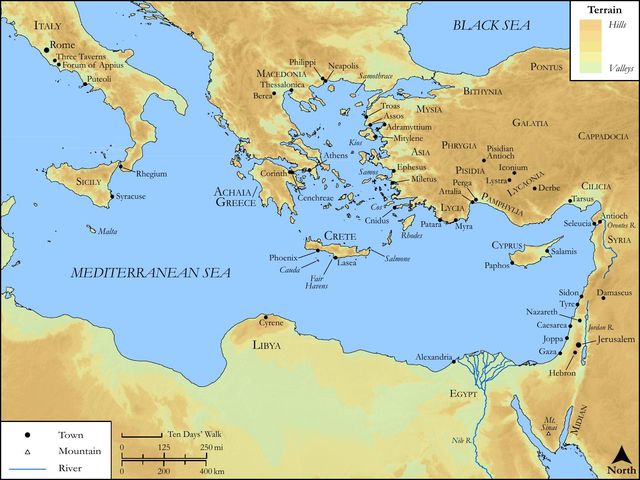
Where Acts reaches
The passages it leans on, and the ones that lean on it
Both books are written to Theophilus; Acts calls the Gospel “the former treatise.”
Peter explains Pentecost from Joel: “this is that which was spoken by the prophet Joel.”
Acts 7:59–60 Luke 23:46 Luke 23:34
Stephen commits his spirit to the Lord Jesus and prays for his killers, as Jesus did on the cross.
The eunuch reads of the lamb led to the slaughter; Philip “began at the same scripture, and preached unto him Jesus.”
Paul’s last word to the Jews at Rome is Isaiah’s commission, and the salvation of God goes to the Gentiles.
Books Acts links to most
The Church Fathers on Acts
2,551 quotations from 62 writers before AD 800 · the ten most quoted, in date order
- Irenaeus202
- Tertullian220
- Origen253
- Cyprian258
- Ammonius300
- Chrysostom407
- Augustine430
- Arator544
- Cassiodorus585
- Bede735
Leo the Great set Pentecost beside Sinai: the law and the Spirit, each given fifty days after the lamb.
To the Hebrew people, now freed from Egypt, the law was given on Mount Sinai fifty days after the immolation of the paschal lamb. Similarly, after the passion of Christ in which the true Lamb of God was killed, just fifty days after his resurrection, the Holy Spirit fell upon the apostles and the whole group of believers.
Cyril of Jerusalem on Simon, who offered money for the gift to men who had given up their goods.
He offered money to people without possessions, and that too after seeing people bring the price of what they sold and lay it at the feet of the apostles. He did not realize that they who trod underfoot the wealth offered for the sustenance of the poor would surely never sell him the power of the Holy Spirit for a price.
Augustine on Peter’s word at the council: saved by grace, not by the law of Moses.
Why did he say this, unless they were saved through the grace of our Lord, Jesus Christ, not through the law of Moses? Through the law there came not healing but the knowledge of sin …
Chrysostom on the book’s last words: Paul spoke not only with boldness but unhindered.
for it is possible to speak with boldness, yet hindered. His boldness nothing checked: but in fact he also spoke unhindered.
Keep studying
Articles