


Acts 10:44
Bible text: King James Version (1769 Blayney text) · Public domain
Bible text: Berean Standard Bible · Public domain
Bible text: American Standard Version (1901) · Public domain
Bible text: World English Bible, Messianic edition · Public domain
Bible text: Geneva Bible (1599) · Public domain
Bible text: Young's Literal Translation · Public domain
- ἜτιEtiStillG2089ADVAdverb
- λαλοῦντοςlalountoswhen is speakingG2980V-PAP-GSMVerb Present Active Participle Genitive Singular Masculine
- τοῦtou<the>G3588T-GSMDefinite article Genitive Singular Masculine
- ΠέτρουPetrouPeterG4074N-GSM-PNoun Genitive Singular Masculine Individual
- τὰta<the>G3588T-APNDefinite article Accusative Plural Neuter
- ῥήματαrhēmatadeclarationsG4487N-APNNoun Accusative Plural Neuter
- ταῦταtautatheseG3778D-APNDemonstrative pronoun Accusative Plural Neuter
- ἐπέπεσενepepesenfellG1968V-2AAI-3SVerb 2nd Aorist Active Indicative 3rd Singular
- τὸtotheG3588T-NSNDefinite article Nominative Singular Neuter
- πνεῦμαpneumaSpiritG4151N-NSNNoun Nominative Singular Neuter
- τὸto<the>G3588T-NSNDefinite article Nominative Singular Neuter
- ἅγιονhagionHolyG40A-NSNAdjective Nominative Singular Neuter
- ἐπὶepiuponG1909PREPPreposition
- πάνταςpantasallG3956A-APMAdjective Accusative Plural Masculine
- τοὺςtousthoseG3588T-APMDefinite article Accusative Plural Masculine
- ἀκούονταςakouontashearingG191V-PAP-APMVerb Present Active Participle Accusative Plural Masculine
- τὸνtontheG3588T-ASMDefinite article Accusative Singular Masculine
- λόγονlogonwordG3056N-ASMNoun Accusative Singular Masculine
English is a literal word-by-word gloss of the Greek, not the KJV's wording. Why?
This is the original text the KJV's translators worked from — each Greek word with its own literal English meaning in this verse, prepared by scholars at Tyndale House, Cambridge. The KJV translates whole sentences, not word by word, so its wording differs: one Greek word can become several English words, and the KJV may choose “charity” where the gloss reads “love”. Both are faithful — they answer different questions. For the KJV's own rendering, switch to the KJV text.
Details
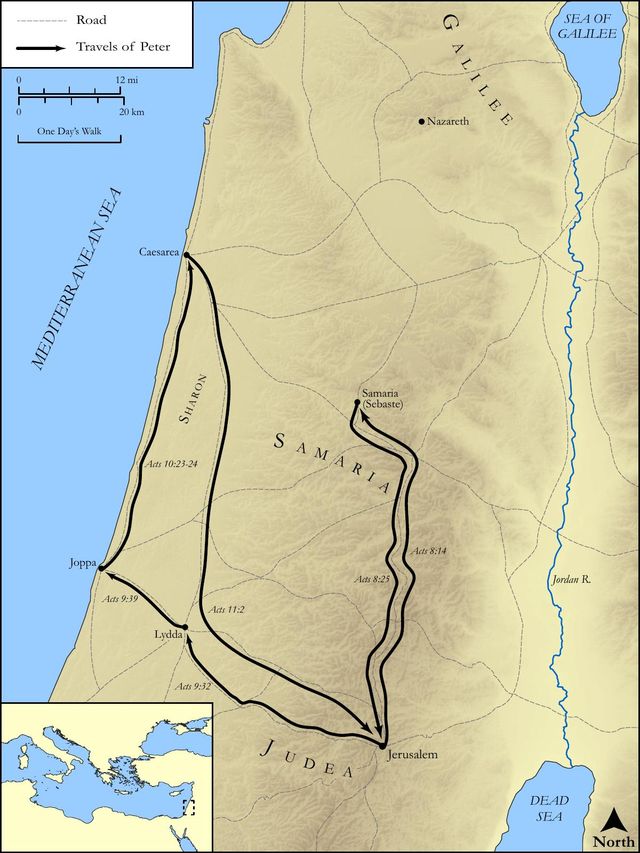
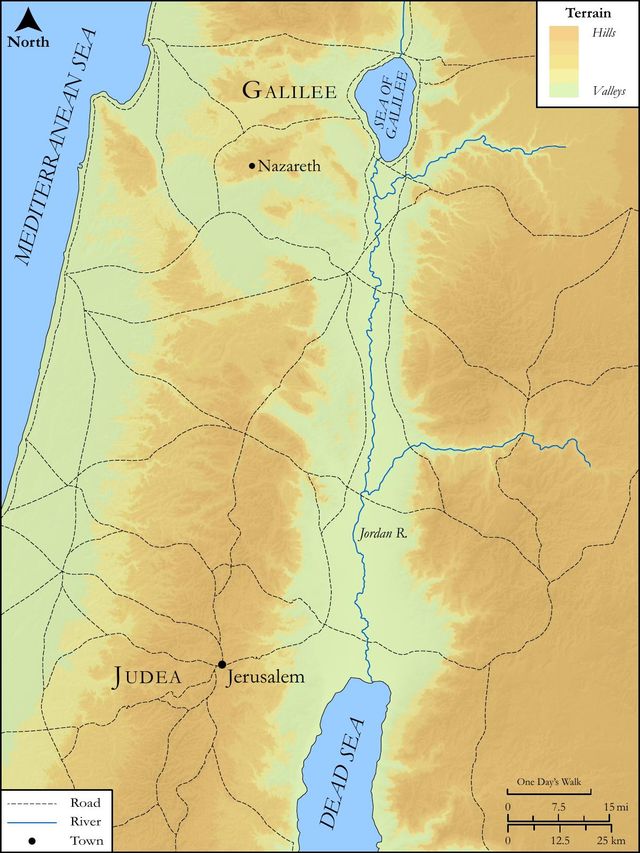
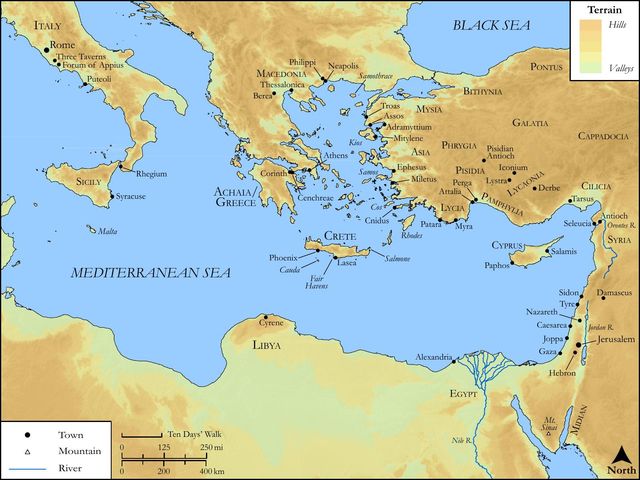
See on the biblical-era maps
Study this verse
Public-domain commentary
Matthew Henry
From his Commentary on the Whole Bible. Henry comments on passages, not single verses — this entry covers Acts 10:44–48. His two-level outline is real structure in the source text, so it is rendered as structure.
We have here the issue and effect of Peter's sermon to Cornelius and his friends. He did not labour in vain among them, but they were all brought home to Christ. Here we have,
I.God's owning Peter's word, by conferring the Holy Ghost upon the hearers of it, and immediately upon the hearing of it (Act 10:44):
While Peter was yet speaking these words, and perhaps designed to say more, he was happily superseded by visible indications that the Holy Ghost, even in his miraculous gifts and powers, fell on all those who heard the word, even as he did on the apostles at first; so Peter saith, Act 11:15. Therefore some think it was with a rushing mighty wind, and in cloven tongues, as that was. Observe,
1.When the Holy Ghost fell upon them - while Peter was preaching. Thus God bore witness to what he said, and accompanied it with a divine power. Thus were the signs of an apostle wrought among them, Co2 12:12. Though Peter could not give the Holy Ghost, yet the Holy Ghost being given along with the word of Peter, by this it appeared he was sent of God. The Holy Ghost fell upon others after they were baptized, for their confirmation; but upon these Gentiles before they were baptized: as Abraham was justified by faith, being yet in uncircumcision, to show that God is not tied to a method, nor confines himself to external signs. The Holy Ghost fell upon those that were neither circumcised nor baptized; for it is the Spirit that quickeneth, the flesh profiteth nothing.
2.How it appeared that the Holy Ghost had fallen upon them (Act 10:46): They spoke with tongues which they never learned, perhaps the Hebrew, the holy tongue; as the preachers were enabled to speak the vulgar tongues, that they might communicate the doctrine of Christ to the hearers, so, probably, the hearers were immediately taught the sacred tongue, that they might examine the proofs which the preachers produced out of the Old Testament in the original. Or their being enabled to speak with tongues intimated that they were all designed for ministers, and by this first descent of the Spirit upon them were qualified to preach the gospel to others, which they did but now receive themselves. But, observe, when they spoke with tongues, they magnified God, they spoke of Christ and the benefits of redemption, which Peter had been preaching to the glory of God. Thus did they on whom the Holy Ghost first descended, Act 2:11. Note, Whatever gift we are endued with, we ought to honour God with it, and particularly the gift of speaking, and all the improvements of it.
3.What impression it made upon the believing Jews that were present (Act 10:45): Those of the circumcision who believed were astonished - those six that came along with Peter; it surprised them exceedingly, and perhaps gave them some uneasiness, because upon the Gentiles also was poured out the gift of the Holy Ghost, which they thought had been appropriated to their own nation. Had they understood the scriptures of the Old Testament, which pointed at this, it would not have been such an astonishment to them; but by our mistaken notions of things we create difficulties to ourselves in the methods of divine providence and grace.
II.Peter's owning God's work in baptizing those on whom the Holy Ghost fell. Observe,
1.Though they had received the Holy Ghost, yet it was requisite they should be baptized; though God is not tied to instituted ordinances, we are; and no extraordinary gifts set us above them, but rather oblige us so much the more to conform to them. Some in our days would have argued "These are baptized with the Holy Ghost and therefore what need have they to be baptized with water? It is below them." No; it is not below them, while water-baptism is an ordinance of Christ, and the door of admission into the visible church, and a seal of the new covenant.
2.Though they were Gentiles, yet, having received the Holy Ghost, they might be admitted to baptism (Act 10:47): Can any man, though ever so rigid a Jew, forbid water, that these should not be baptized, who have received the Holy Ghost as well as we? The argument is conclusive; can we deny the sign to those who have received the thing signified? Are not those on whom God has bestowed the grace of the covenant plainly entitled to the seals of the covenant? Surely those that have received the Spirit as well as we ought to receive baptism as well as we; for it becomes us to follow God's indications, and to take those into communion with us whom he hath taken into communion with himself. God hath promised to pour his Spirit upon the seed of the faithful, upon their offspring; and who then can forbid water, that they should not be baptized, who have received the promise of the Holy Ghost as well as we? Now it appears why the Spirit was given them before they were baptized - because otherwise Peter could not have persuaded himself to baptize them, any more than to have preached to them, if he had not been ordered to do it by a vision; at least he could not have avoided the censure of those of the circumcision that believed. Thus is there one unusual step of divine grace taken after another to bring the Gentiles into the church. How well is it for us that the grace of a good God is so much more extensive than the charity of some good men!
3.Peter did not baptize them himself, but commanded them to be baptized, Act 10:48. It is probable that some of the brethren who came with him did it by his order, and that he declined it for the same reason that Paul did - lest those that were baptized by him should think the better of themselves for it, or he should seem to have baptized in his own name, Co1 1:15. the apostles received the commission to go and disciple all nations by baptism. But is was to prayer and the ministry of the word that they were to give themselves. And Paul says that he was sent, not to baptize but to preach, which was the more noble and excellent work. The business of baptizing was therefore ordinarily devolved upon the inferior ministers; these acted by the orders of the apostles, who might therefore be said to do it. Qui per alterum facit, per seipsum facere dicitur - What a man does by another, he may be said to do by himself.
III.Their owning both Peter's word and God's work in their desire for further advantage by Peter's ministry:
They prayed him to tarry certain days. They could not press him to reside constantly among them - they knew that he had work to do in other places, and that for the present he was expected at Jerusalem; yet they were not willing he should go away immediately, but earnestly begged he would stay for some time among them, that they might be further instructed by him in the things pertaining to the kingdom of God. Note,
1.Those who have some acquaintance with Christ cannot but covet more.
2.Even those that have received the Holy Ghost must see their need of the ministry of the word.
Historical interpretation
Five Centuries of Reception
5 surviving comments on this verse. Each one is dated, so this reads as a timeline rather than a list.
Select a marker to jump to its quote. Markers stagger vertically where authors wrote within a few decades of each other.
Thereafter He prescribed to fasts a law-that they are to be performed "without sadness: " for why should what is salutary be sad? He taught likewise that fasts are to be the weapons for battling with the more direful demons: for what wonder if the same operation is the instrument of the iniquitous spirit's egress as of the Holy Spirit's ingress? Finally, granting that upon the centurion Cornelius, even before baptism, the honourable gift of the Holy Spirit, together with the gift of prophecy besides, had hastened to descend, we see that his fasts had been heard, I think, moreover, that the apostle too, in the Second of Corinthians, among his labours, and perils, and hardships, after "hunger and thirst," enumerates "fasts" also "very many"
Do you want to know that it is not just Jesus alone in his speaking who transmits the Holy Spirit to his hearers, but that everyone who speaks God’s word in his name actually hands on the Spirit of God to those who listen? See then, how in the Acts of the Apostles, when Peter is speaking to Cornelius, Cornelius himself and those with him were filled with the Holy Spirit. Hence, if you speak God’s word and do so faithfully with a pure conscience, it can come about that while you are speaking the fire of the Holy Spirit will inflame the hearts of your hearers and immediately make them warm and eager to carry out all you are teaching in order to implement what they have learned.
He does not say that Peter was astonished, but, "They of the circumcision:" since he knew what was in preparation. And yet they ought to have marvelled at this, how they themselves had believed. When they heard that they had believed, they were not astonished, but when God gave them the Spirit.
Observe God's providential management. He does not suffer the speech to be finished, nor the baptism to take place upon a command of Peter, but, when He has made it evident how admirable their state of mind is, and a beginning is made of the work of teaching, and they have believed that assuredly baptism is the remission of sins, then forthwith comes the Spirit upon them. Now this is done by God's so disposing it as to provide for Peter a mighty ground of justification. And it is not simply that the Spirit came upon them, but, "they spake with tongues:" which was the thing that astonished those who had come together.
While Peter was still speaking these words, the Holy Spirit fell upon all who heard the word. Then they asked him to stay with them for some days. Lest it be doubted that baptism should be given to the Gentiles, it was confirmed by the testimony of the Holy Spirit, which customarily sanctifies the waters of the font, in a new order of precedence, which it never happened with the Jews, as occurred once for the testimony of the Gentiles' faith.
Continue studying Acts 10:44 across the web’s major study libraries — every link below opens this exact verse, chapter, or book on the destination site.
Read & Compare
 BibleGatewayThis verse in more than 200 translations and 70 languages.
 Bible.comThe YouVersion reader — hundreds of translations, reading plans, and highlights.
 ESV.orgCrossway's official English Standard Version reader.
 NET BibleThe NET translation with 60,000+ translators' notes on every rendering decision.
 STEP BibleTyndale House's free study tool — original text, vocabulary, and scholarly resources.
 BibliaLogos Bible Software's free web reader.
 USCCBThe New American Bible (Revised Edition) with the U.S. bishops' study notes.
Commentaries
 BibleHub CommentariesDozens of classic commentaries on this verse, gathered on one page.
 StudyLightMore than 100 commentary sets — the largest collection on the web.
 BibleRefPlain-English commentary on what this verse means, verse by verse.
 Enduring WordDavid Guzik's free commentary on this chapter, widely used by Bible teachers.
 Bible Study ToolsVerse commentary alongside Greek and Hebrew study aids.
Original Language & Research
- BibleHub InterlinearThe verse word by word — original language, transliteration, and English.
- BibleHub LexiconEvery word's original-language definition and Strong's entry.
 Blue Letter BibleDeep-study tools — Strong's numbers, concordance, and word studies.
 CNTR CollationThe earliest Greek manuscripts of this verse, collated letter by letter.
Sermons, Hymns & Audio


TrulyRandomVerse is not affiliated with these sites and doesn’t control their content. They’re linked because they’re genuinely useful.
Summary
Acts 10:44 records a watershed moment in early Christian history, where the Holy Spirit sovereignly descended upon Cornelius's household and other Gentiles who had gathered to hear Peter preach the Gospel. This unprecedented outpouring, occurring even before water baptism, unequivocally demonstrated God's radical impartiality and His intention to include all peoples—Jew and Gentile—into the new covenant community through faith in Jesus Christ, thereby shattering long-standing ethnic and religious barriers.
Context
ShowHideLiterary Context
This pivotal verse occurs at the climax of a transformative narrative in Acts 10. Prior to Peter's arrival, both he and Cornelius experienced divine visions. Peter's vision in Joppa challenged his deeply ingrained Jewish dietary and social prejudices, preparing him to accept Gentiles. Simultaneously, Cornelius, a devout Roman centurion, received an angelic directive to send for Peter. Upon Peter's arrival in Caesarea, he explicitly acknowledged his former reluctance to associate with Gentiles, stating, "God hath shewed me that I should not call any man common or unclean" (Acts 10:28). As Peter preached the good news of Jesus Christ—His life, death, resurrection, and the forgiveness of sins through His name—the Holy Spirit dramatically interrupted his sermon, falling upon all the Gentile listeners, thus validating their faith and God's acceptance of them.
Historical & Cultural Context
The first-century Jewish world was characterized by strict adherence to the Mosaic Law, which fostered a profound separation between Jews and Gentiles. Gentiles were often considered "unclean" and outside the covenant promises of God. This division was not merely religious but also deeply social and cultural, manifesting in practices like dietary laws and prohibitions against close association. For a devout Jew like Peter to enter a Gentile home, let alone share a meal or fellowship, was a significant violation of established norms. The Roman Empire, while diverse, maintained its own social hierarchies, with centurions like Cornelius holding positions of authority. The spontaneous outpouring of the Holy Spirit on Gentiles, akin to the Jewish experience at Pentecost, was a revolutionary event that directly challenged these ingrained prejudices and laid the theological groundwork for the church's universal mission, demonstrating God's impartiality in salvation.
Key Themes
ShowHideActs 10:44 powerfully contributes to several overarching themes in the book of Acts and broader biblical theology. Firstly, it underscores Divine Initiative, demonstrating that the expansion of the Gospel to the Gentiles was not a human strategy but a sovereign act of God. The Spirit's descent was unprompted by Peter or the Gentiles, signifying God's direct intervention. Secondly, it highlights the radical Inclusion of Gentiles, definitively breaking down the "middle wall of partition" (Ephesians 2:14) between Jew and Gentile. This event proved that salvation and the Spirit's indwelling were for all who believed, regardless of ethnic background or prior adherence to the Law. Thirdly, it showcases the Holy Spirit's Impartiality, reinforcing Peter's earlier realization that "God is no respecter of persons" (Acts 10:34). The experience mirrored the Jewish Pentecost (Acts 2:4), providing undeniable evidence of God's equal acceptance. Finally, it emphasizes Salvation by Faith, as the Spirit's coming before water baptism confirmed that their faith in Christ was genuine and acceptable to God, signifying that salvation is received through belief, not by ritual or external adherence to laws.
Exposition and Analysis
ShowHideKey Word Analysis
ShowHideThis verb, G1968, signifies a sudden, powerful, and overwhelming descent or embrace. Its use here emphasizes the divine, undeniable, and unsolicited nature of the Holy Spirit's coming. It was not a gradual process or a humanly orchestrated event, but a direct, forceful act of God, demonstrating His sovereign power and initiative in bestowing His Spirit.
This primary verb means "to hear" in various senses, including to give audience, to come to the ears, or to understand. In this context, it highlights the active reception of Peter's message. The Gentiles were not merely present; they were actively listening and engaging with the preached "word," indicating an openness and receptivity that prepared their hearts for the Spirit's work.
This term refers to something said, a topic, or reasoning. Here, it specifically denotes the Gospel message that Peter was proclaiming—the divine expression of God's truth concerning Jesus Christ. The Spirit's descent immediately upon the hearing of this "word" underscores the centrality of the preached Gospel as the vehicle through which faith is ignited and God's grace is received. It is the power of God's message that prepares hearts for His Spirit.
Verse Breakdown
ShowHide"While Peter yet spake these words"
This clause highlights the immediacy and divine timing of the event. The Holy Spirit's descent was not a response to a completed sermon, a prayer of dedication, or a ritual, but occurred mid-sentence, interrupting Peter's discourse. This emphasizes God's sovereign initiative and the Spirit's independent action, demonstrating that the outpouring was entirely God's doing, not contingent on human completion or performance.
"the Holy Ghost fell on all them"
This is the central action of the verse, describing the dramatic, undeniable manifestation of the Holy Spirit. The phrase "fell on" (from epipíptō) conveys a sudden, powerful, and overwhelming descent, similar to the experience at Pentecost. The crucial detail "on all them" signifies the universal scope of this outpouring, encompassing every Gentile listener present, underscoring God's impartiality and radical inclusion.
"which heard the word"
This final phrase identifies the recipients and the catalyst for the Spirit's coming. It was those who were actively listening to and receiving Peter's proclamation of the Gospel ("the word") upon whom the Spirit fell. This connection between hearing the Gospel and receiving the Spirit underscores the vital role of the preached Word in God's redemptive plan and confirms that their faith in Christ, ignited by the message, was genuine and acceptable to God.
Literary Devices
ShowHideActs 10:44 is rich with literary significance. The most prominent device is Dramatic Irony, as the Holy Spirit falls while Peter is still speaking, before he can even finish his sermon or consider the implications of baptizing Gentiles. This highlights God's sovereign timing and His direct intervention, surpassing human plans and prejudices. There is also powerful Symbolism in the "falling" of the Holy Spirit, which represents a tangible, undeniable manifestation of divine presence, power, and anointing, mirroring the Pentecost event for the Jews. The narrative employs Immediacy and Suddenness through the phrase "While Peter yet spake," creating a sense of awe and emphasizing the unexpected, miraculous nature of the event. Furthermore, the scene presents a clear Parallelism or Typology with the Day of Pentecost in Acts 2, establishing this event as the "Gentile Pentecost" and underscoring the universal scope of God's new covenant.
Theological and Thematic Connections
ShowHideActs 10:44 stands as a theological cornerstone, unequivocally demonstrating God's universal redemptive plan and the universal reach of the Gospel. It shatters the long-held Jewish notion of exclusive divine favor, revealing that salvation and the indwelling Holy Spirit are extended to all who believe, regardless of ethnic or social background. This event confirms that the New Covenant is not bound by ethnic identity or adherence to the Mosaic Law, but by faith in Jesus Christ. It underscores the Spirit's role in validating genuine faith and empowering believers, serving as God's seal of acceptance for Gentiles, just as He did for Jews. This moment profoundly shaped the early church's understanding of its mission, propelling it beyond its Jewish origins to embrace a global vision.
Reflection and Application
ShowHideActs 10:44 remains profoundly relevant for believers today, challenging our predispositions and expanding our understanding of God's boundless grace. It serves as a powerful reminder that God's love and salvation are not limited by human-made distinctions—whether racial, socio-economic, or cultural. We are called to dismantle any walls of prejudice within our hearts and communities, embracing all people as potential recipients of God's transforming power. The passage also highlights the enduring power of the preached Word; when the Gospel is proclaimed faithfully, the Holy Spirit is active, convicting hearts and drawing people to Christ. Furthermore, it reassures us that the Holy Spirit's indwelling is a gift received by faith, empowering us for witness, sanctification, and unity in the diverse body of Christ. This divine interruption in Peter's sermon reminds us that God's work often transcends our expectations and methods, calling us to remain flexible and open to His surprising movements in the world.
Questions for Reflection
ShowHideFAQ
ShowHideWhy did the Holy Spirit fall before water baptism in this instance?
ShowHideThe Holy Spirit's descent before water baptism in Acts 10:44 is crucial because it served as God's undeniable validation of the Gentiles' faith and acceptance into the new covenant community. In the Jewish context, water baptism was a public declaration of repentance and identification with the community. For these Gentiles, receiving the Spirit, an experience previously associated with Jewish believers at Pentecost, was God's direct and visible sign that their faith in Christ was genuine and that they were fully accepted by Him, without needing to first convert to Judaism or adhere to its ceremonial laws. This immediate outpouring demonstrated that salvation is by grace through faith alone, not by ritual or ethnic identity, providing irrefutable proof to Peter and the accompanying Jewish believers that God had indeed "granted to the Gentiles also repentance unto life" (Acts 11:18).
Christ-Centered Fulfillment
ShowHideActs 10:44 is a profound Christ-centered fulfillment, demonstrating the expansive reach of God's redemptive plan inaugurated through Jesus. The Holy Spirit, promised by Christ as the "Comforter" and "Spirit of truth" (John 14:16-17), is poured out universally, signifying that Christ's atoning work on the cross was for all humanity, not exclusively for Israel. Jesus' death broke down the "middle wall of partition" (Ephesians 2:14) that separated Jew and Gentile, creating "one new man" in Himself (Ephesians 2:15). The Spirit's descent on Cornelius's household is the tangible evidence that Christ's Lordship extends to "all" (Acts 10:36), and that salvation through His name is available to "whosoever believeth in him" (Acts 10:43). This event underscores that in Christ, there is "neither Jew nor Gentile, neither slave nor free, nor is there male and female, for you are all one in Christ Jesus" (Galatians 3:28), fulfilling the ancient prophecies of a Messiah who would be a light to the Gentiles and bring salvation to the ends of the earth (Isaiah 49:6). The Holy Spirit, poured out by the ascended Christ, is the seal of this new, unified, and global community, empowered to bear witness to His universal reign.