


Acts 1:12
Bible text: King James Version (1769 Blayney text) · Public domain
Bible text: Berean Standard Bible · Public domain
Bible text: American Standard Version (1901) · Public domain
Bible text: World English Bible, Messianic edition · Public domain
Bible text: Geneva Bible (1599) · Public domain
Bible text: Young's Literal Translation · Public domain
- ΤότεToteThenG5119ADVAdverb
- ὑπέστρεψανhupestrepsanthey returnedG5290V-AAI-3PVerb Aorist Active Indicative 3rd Plural
- εἰςeistoG1519PREPPreposition
- ἸερουσαλὴμIerousalēmJerusalemG2419N-ASF-LNoun Accusative Singular Feminine Location
- ἀπὸapofromG575PREPPreposition
- ὄρουςorous[the] mountG3735N-GSNNoun Genitive Singular Neuter
- τοῦtouwhichG3588T-GSNDefinite article Genitive Singular Neuter
- καλουμένουkaloumenouis being calledG2564V-PPP-GSNVerb Present Passive Participle Genitive Singular Neuter
- ἘλαιῶνοςElaiōnosOlivetG1638N-GSM-LNoun Genitive Singular Masculine Location
- ὅhowhichG3739R-NSNRelative pronoun Nominative Singular Neuter
- ἐστινestinisG1510V-PAI-3SVerb Present Active Indicative 3rd Singular
- ἐγγὺςengusnearG1451PREPPreposition
- ἸερουσαλὴμIerousalēmJerusalemG2419N-GSF-LNoun Genitive Singular Feminine Location
- σαββάτουsabbatoua Sabbath day’sG4521N-GSNNoun Genitive Singular Neuter
- ἔχονechonholdingG2192V-PAP-NSNVerb Present Active Participle Nominative Singular Neuter
- ὁδόνhodonjourneyG3598N-ASFNoun Accusative Singular Feminine
English is a literal word-by-word gloss of the Greek, not the KJV's wording. Why?
This is the original text the KJV's translators worked from — each Greek word with its own literal English meaning in this verse, prepared by scholars at Tyndale House, Cambridge. The KJV translates whole sentences, not word by word, so its wording differs: one Greek word can become several English words, and the KJV may choose “charity” where the gloss reads “love”. Both are faithful — they answer different questions. For the KJV's own rendering, switch to the KJV text.
Details
See on the biblical-era maps
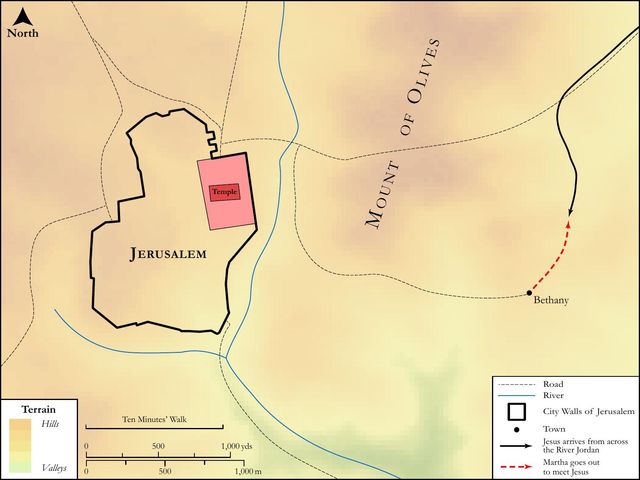
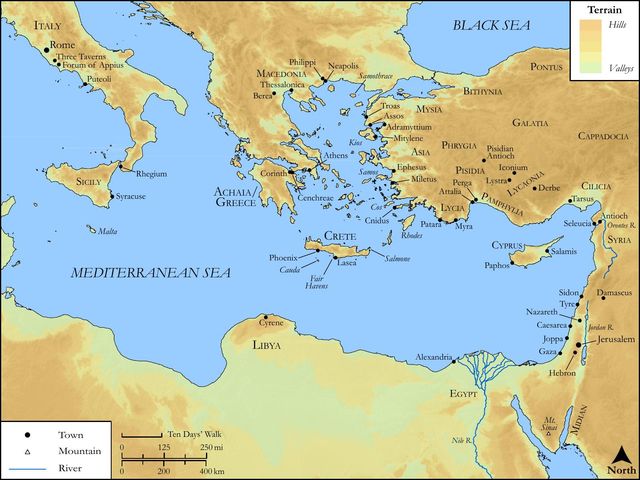
Study this verse
Public-domain commentary
Matthew Henry
From his Commentary on the Whole Bible. Henry comments on passages, not single verses — this entry covers Acts 1:12–14. His two-level outline is real structure in the source text, so it is rendered as structure.
We are here told, I. Whence Christ ascended - from the mount of Olives (Act 1:12), from that part of it where the town of Bethany stood, Luk 24:50. There he began his sufferings (Luk 22:39), and therefore there he rolled away the reproach of them by his glorious ascension, and thus showed that his passion and his ascension had the same reference and tendency. Thus would he enter upon his kingdom in the sight of Jerusalem, and of those undutiful ungrateful citizens of his that would not have him to reign over them. It was prophesied of him (Zac 14:4), That his feet should stand upon the mount of Olives, which is before Jerusalem, should stand last there; and presently it follows, The mount of Olives shall cleave in two. From the mount of Olives he ascended who is the good olive-tree, whence we receive the unction, Zac 4:12; Rom 11:24. This mount is here said to be near Jerusalem, a sabbath day's journey from it, that is, a little way; no further than devout people used to walk out on a sabbath evening, after the public worship was over, for meditation. Some reckon it a thousand paces, others two thousand cubits; some seven furlongs, others eight. Bethany indeed was fifteen furlongs from Jerusalem (Joh 11:18), but that part of the mount of Olives which was next to Jerusalem, whence Christ began to ride in triumph, was but seven or eight furlongs off. The Chaldee paraphrast on Ruth 1 says, We are commanded to keep the sabbaths and the holy days, so as not to go above two thousand cubits, which they build upon Jos 3:4, where, in their march through Jordan, the space between them and the ark was to be two thousand cubits. God had not then thus limited them, but they limited themselves; and thus far it is a rule to us, not to journey on the sabbath any more than in order to the sabbath work; and as far as is necessary to this we are not only allowed, but enjoined, Kg2 4:23.
II.Whither the disciples returned:
They came to Jerusalem, according to their Master's appointment, though there they were in the midst of enemies; but it should seem that though immediately after Christ's resurrection they were watched, and were in fear of the Jews, yet after it was known that they were gone into Galilee no notice was taken of their return to Jerusalem, nor any further search made for them. God can find out hiding-places for his people in the midst of their enemies, and so influence Saul that he shall not seek for David any more. At Jerusalem they went up into an upper room, and there abode; not that they all lodged and dieted together in one room, but there they assembled every day, and spent time together in religious exercises, in expectation of the descent of the Spirit. Divers conjectures the learned have about this upper room. Some think it was one of the upper rooms in the temple; but it cannot be thought that the chief priests, who had the letting of these rooms, would suffer Christ's disciples constantly to reside in any of them. It was said indeed, by the same historian, that they were continually in the temple (Luk 24:53), but that was in the courts of the temple, at the hours of prayer, where they could not be hindered from attending; but, it should seem, this upper room was in a private house. Mr. Gregory, of Oxford, is of this opinion, and quotes a Syriac scholiast upon this place, who says that it was the same upper room in which they had eaten the passover; and though that was called anōgeon, this huperōon, both may signify the same. "Whether," says he, "it was in the house of St. John the evangelist, as Euodius delivered, or that of Mary the mother of John Mark, as others have collected, cannot be certain." Notes, ch. 12.
III.Who the disciples were, that kept together.
The eleven apostles are here named (Act 1:13), so is Mary the mother of our Lord (Act 1:14), and it is the last time that ever any mention is made of her in the scriptures. There were others that are here said to be the brethren of our Lord, his kinsmen according to the flesh; and, to make up the hundred and twenty spoken of (Act 1:15), we may suppose that all or most of the seventy disciples were with them, that were associates with the apostles, and were employed as evangelists.
IV.How they spent their time: They all continued with one accord in prayer and supplication. Observe,
1.They prayed, and made supplication. All God's people are praying people, and give themselves to prayer. It was now a time of trouble and danger with the disciples of Christ; they were as sheep in the midst of wolves; and, Is any afflicted? Let him pray; this will silence cares and fears. They had new work before them, great work, and, before they entered upon it, they were instant in prayer to God for his presence with them in it. Before they were first sent forth Christ spent time in prayer for them, and now they spent time in prayer for themselves. They were waiting for the descent of the Spirit upon them, and therefore abounded thus in prayer. The Spirit descended upon our Saviour when he was praying, Luk 3:21. Those are in the best frame to receive spiritual blessings that are in a praying frame. Christ had promised now shortly to send the Holy Ghost; now this promise was not to supersede prayer, but to quicken and encourage it. God will be enquired of for promised mercies, and the nearer the performance seems to be the more earnest we should be in prayer for it.
2.They continued in prayer, spent much time in it, more than ordinary, prayed frequently, and were long in prayer. They never missed an hour of prayer; they resolved to persevere herein till the Holy Ghost came, according to the promise, to pray, and not to faint. It is said (Luk 24:53), They were praising and blessing God; here, They continued in prayer and supplication; for as praise for the promise is a decent way of begging for the performance, and praise for former mercy of begging further mercy, so, in seeking to God, we give him the glory of the mercy and grace which we have found in him.
3.They did this with one accord. This intimates that they were together in holy love, and that there was no quarrel nor discord among them; and those who so keep the unity of the Spirit in the bond of peace are best prepared to receive the comforts of the Holy Ghost. It also intimates their worthy concurrence in the supplications that were made; though but one spoke, they all prayed, and if, when two agree to ask, it shall be done for them, much more when many agree in the same petition. See Mat 18:19.
Historical interpretation
Eleven Centuries of Reception
4 surviving comments on this verse. Each one is dated, so this reads as a timeline rather than a list.
Select a marker to jump to its quote. Markers stagger vertically where authors wrote within a few decades of each other.
"Then Returned They," it is said: namely, when they had heard. For they could not have borne it, if the angel had not referred them to another Coming. It seems to me, that it was also on a sabbath-day that these things took place; for he would not thus have specified the distance, saying, "from the mount called Olivet, which is from Jerusalem a sabbath day's journey," unless they were then going on the sabbath-day a certain definite distance.
So that there was no long way to go, to be a cause of alarm to them while yet trembling and fearful.
Then they returned to Jerusalem from the mount called Olivet. Our Lord and Savior, having conquered the prince of darkness, leads the faithful to a place of peace and light. Rightly he ascended the mount of blessing, promising the holy Spirit, whose anointing teaches us about everything.
He is near Jerusalem, having the distance of a Sabbath journey. According to history, it indicates that the Mount of Olives is separated by about a mile from the city of Jerusalem. For on the Sabbath, according to the law, it was not permitted to go more than a thousand paces. But according to allegory, whoever will be worthy to contemplate within the glory of the Lord ascending to the Father and to be enriched with the promise of the Holy Spirit, this one enters the city of eternal peace by the journey of the Sabbath. And for him, according to Isaiah, there will be a Sabbath from the Sabbath, because whoever here has ceased from perverse work will there rest in celestial recompense. But on the other hand, whoever in this age, as if through the time of six days, has neglected to work for salvation, during that time of perpetual rest, will be excluded from the boundaries of blessed Jerusalem, despising that Gospel: "Pray that your flight may not be in winter or on the Sabbath."
That is nearly two miles.
Continue studying Acts 1:12 across the web’s major study libraries — every link below opens this exact verse, chapter, or book on the destination site.
Read & Compare
 BibleGatewayThis verse in more than 200 translations and 70 languages.
 Bible.comThe YouVersion reader — hundreds of translations, reading plans, and highlights.
 ESV.orgCrossway's official English Standard Version reader.
 NET BibleThe NET translation with 60,000+ translators' notes on every rendering decision.
 STEP BibleTyndale House's free study tool — original text, vocabulary, and scholarly resources.
 BibliaLogos Bible Software's free web reader.
 USCCBThe New American Bible (Revised Edition) with the U.S. bishops' study notes.
Commentaries
 BibleHub CommentariesDozens of classic commentaries on this verse, gathered on one page.
 StudyLightMore than 100 commentary sets — the largest collection on the web.
 BibleRefPlain-English commentary on what this verse means, verse by verse.
 Enduring WordDavid Guzik's free commentary on this chapter, widely used by Bible teachers.
 Bible Study ToolsVerse commentary alongside Greek and Hebrew study aids.
Original Language & Research
- BibleHub InterlinearThe verse word by word — original language, transliteration, and English.
- BibleHub LexiconEvery word's original-language definition and Strong's entry.
 Blue Letter BibleDeep-study tools — Strong's numbers, concordance, and word studies.
 CNTR CollationThe earliest Greek manuscripts of this verse, collated letter by letter.
Sermons, Hymns & Audio


TrulyRandomVerse is not affiliated with these sites and doesn’t control their content. They’re linked because they’re genuinely useful.
Summary
Acts 1:12 describes the immediate actions of the apostles following Jesus' ascension, as they returned to Jerusalem from the Mount of Olives. This verse provides crucial geographical and temporal context, precisely locating the disciples and specifying the distance of their journey, thereby setting the stage for their period of waiting, prayer, and the subsequent outpouring of the Holy Spirit, which would empower the nascent Christian church.
Context
ShowHideLiterary Context
Acts 1:12 immediately follows the profound event of Jesus' ascension into heaven, as described in Acts 1:9-11. Having just witnessed their Lord taken up from them, and after receiving a promise from two angelic figures that Jesus would return in the same way, the disciples' next logical step was to obey Jesus' prior command to remain in Jerusalem until they received the promised Holy Spirit (as stated in Acts 1:4). This verse serves as a transition, moving the narrative from the miraculous departure of Christ to the practical, obedient actions of His followers as they prepare for the next phase of God's redemptive plan. It directly precedes the gathering of the apostles and other believers in Jerusalem for prayer and the selection of Matthias to replace Judas, detailed in Acts 1:13-26.
Historical & Cultural Context
The Mount of Olives, or Olivet, was a significant location for Jesus and His disciples, frequently serving as a place for teaching, prayer, and retreat, particularly during the Passover season. It was from this very mount that Jesus ascended, making it a sacred and memorable site for the apostles. The phrase "a sabbath day's journey" is a precise measurement rooted deeply in Jewish law and tradition, indicating the maximum distance one was permitted to travel on the Sabbath without violating the Mosaic law. This distance was traditionally understood to be approximately 2,000 cubits, or about 0.6 to 0.7 miles (roughly 1 kilometer). This detail not only grounds Luke's narrative in verifiable geographical and cultural realities but also underscores the Jewish identity of the early Christian community, who still adhered to many aspects of the Law even as they awaited the new covenant's full manifestation.
Key Themes
ShowHideThis verse contributes to several overarching themes in Acts and the broader New Testament. Firstly, it highlights Obedience and Expectation, as the disciples' immediate return to Jerusalem demonstrates their unwavering commitment to Jesus' final instructions, trusting that His commands would lead them to the promised empowerment of the Holy Spirit. Secondly, Luke's characteristic Geographical and Historical Precision is evident, as the specific mention of the Mount of Olives and the "sabbath day's journey" serves to authenticate the events, emphasizing their reality and historical grounding. This meticulous detail is a hallmark of Luke's writing, seen throughout both his Gospel and Acts, such as his precise dating in Luke 3:1-2. Finally, Acts 1:12 signifies a crucial Transition and Preparation. The departure of Jesus' physical presence marked the end of one era and the beginning of another—the age of the Church, empowered by the Holy Spirit to fulfill the Great Commission and spread the Gospel from Jerusalem to the ends of the earth. The disciples' return to Jerusalem was a preparatory step for this monumental shift.
Exposition and Analysis
ShowHideKey Word Analysis
ShowHideFrom the root words hypó (under) and stréphō (to turn), this verb means "to turn under (behind), i.e., to return (literally or figuratively)." In Acts 1:12, it signifies a physical turning back or going back to a previous location. It implies a deliberate, purposeful movement, indicating the disciples' immediate and obedient response to Jesus' command to wait in Jerusalem.
Derived from elaía (olive tree), this term specifically refers to "an olive-orchard," and by special usage, "the Mount of Olives." This name directly links the location to the abundant olive groves on its slopes. Its mention here is not merely geographical but carries significant theological weight, as it was a frequent site of Jesus' teaching, prayer, and His final ascension.
This phrase combines sábbaton (Sabbath, a day of weekly repose) and hodós (a road, journey, or distance). Together, they refer to the specific, legally defined distance (approximately 2,000 cubits or 0.6-0.7 miles) that Jewish law permitted one to travel on the Sabbath. The inclusion of this detail by Luke underscores the precise proximity of the Mount of Olives to Jerusalem and highlights the Jewish context in which the early Christian community operated, adhering to its customs even in this pivotal moment.
Verse Breakdown
ShowHide"Then returned they unto Jerusalem"
This clause marks the immediate and decisive action of the apostles following the ascension. The adverb "Then" (G5119, tóte) indicates a sequential and prompt response. Their return to Jerusalem was not a casual decision but an act of direct obedience to Jesus' command to wait in the city for the promise of the Holy Spirit, as given in Acts 1:4. It signifies their intentional gathering in the designated place for the next phase of God's plan.
"from the mount called Olivet"
This specifies the precise point of departure. The Mount of Olives was the location of Jesus' ascension (Acts 1:9). Naming this mount serves as a geographical anchor, confirming the setting of the preceding event and providing a clear reference point for the reader. It also carries symbolic weight, as the Mount of Olives was a place of significant events in Jesus' ministry, including His Olivet Discourse and His agony in Gethsemane.
"which is from Jerusalem a sabbath day's journey"
This final clause provides a precise measurement of the distance between the Mount of Olives and Jerusalem. The "sabbath day's journey" was a well-understood legal limit in Jewish tradition for travel on the Sabbath, approximately 2,000 cubits or just under a mile. Luke's inclusion of this detail demonstrates his meticulous attention to historical and geographical accuracy, grounding the narrative in verifiable facts. It also subtly reinforces the Jewish context of the early church, whose members were still living within the parameters of Jewish law and custom.
Literary Devices
ShowHideLuke employs several literary devices in Acts 1:12 to enhance the narrative's clarity and impact. Geographical Precision is a prominent feature, as Luke meticulously names "Jerusalem" and "the mount called Olivet" and even quantifies the distance with "a sabbath day's journey." This detail grounds the extraordinary events (like the ascension) in verifiable, mundane reality, lending credibility to the narrative. The phrase "Then returned they" acts as a Transitional Marker, signaling a shift from the climactic event of the ascension to the subsequent actions of the disciples, preparing the reader for the period of waiting and the coming of the Holy Spirit. Furthermore, the specific mention of "a sabbath day's journey" functions as a Cultural Allusion, directly referencing a Jewish legal custom. This detail not only provides an accurate measurement but also subtly emphasizes the Jewish identity and adherence to tradition within the early Christian community.
Theological and Thematic Connections
ShowHideActs 1:12, while seemingly a simple geographical detail, carries significant theological weight. It underscores the theme of divine direction and human obedience. The disciples' immediate return to Jerusalem demonstrates their faithful response to Jesus' final command to wait for the Holy Spirit. This act of obedience positions them in the place where God's next great move would occur, highlighting that spiritual empowerment often follows obedient waiting and gathering in community. The precise geographical details also serve to emphasize the tangible reality of the events—Jesus' ascension was not a myth but a historical occurrence with a specific location and immediate, verifiable consequences for His followers. This verse sets the stage for the fulfillment of prophecies regarding the outpouring of the Spirit from Jerusalem, marking the transition from Christ's earthly ministry to the Spirit-empowered mission of the Church.
Reflection and Application
ShowHideActs 1:12, though brief, offers profound lessons for believers today. The disciples' immediate and obedient return to Jerusalem after witnessing the awe-inspiring ascension of Jesus is a powerful example of faithful response to divine instruction. They did not linger in wonder or despair but moved purposefully to the place where Jesus had commanded them to wait. This teaches us the vital importance of obedience to God's Word, even when the full picture of His plan is not yet clear. Their subsequent period of waiting, unity, and prayer in Jerusalem (as seen in Acts 1:14) reminds us that spiritual growth and empowerment often involve seasons of patient anticipation for God's perfect timing and provision. We are called to gather, pray, and wait on the Lord, trusting that He will equip us for His purposes. Moreover, the emphasis on community and gathering in Jerusalem highlights the indispensable role of the local church as the place where believers unite, encourage one another, and collectively seek God's presence and power for mission.
Questions for Reflection
ShowHideFAQ
ShowHideWhat is the significance of the Mount of Olives in this verse?
ShowHideThe Mount of Olives is highly significant because it was the precise location from which Jesus ascended into heaven, as described in Acts 1:9-11. It was a familiar place for Jesus and His disciples, often used for teaching and prayer (e.g., Luke 21:37). Its mention here grounds the extraordinary event of the ascension in a specific, verifiable geographical location, lending historical credibility to the narrative. Furthermore, it holds prophetic significance, as some traditions suggest it will be the site of Jesus' return (Zechariah 14:4).
What does "a sabbath day's journey" mean, and why is it mentioned?
ShowHide"A sabbath day's journey" refers to a specific distance, approximately 2,000 cubits (about 0.6 to 0.7 miles or 1 kilometer), that Jewish law permitted one to travel on the Sabbath without violating its regulations. This limit was based on interpretations of Old Testament passages concerning the distance the ark of the covenant was carried and the space between the camp and the tabernacle. Luke includes this detail to provide precise geographical context, indicating the close proximity of the Mount of Olives to Jerusalem. It also highlights Luke's meticulous attention to detail and underscores the Jewish cultural and legal framework within which the early Christian community lived and operated, even as they awaited the new covenant's full manifestation.
Christ-Centered Fulfillment
ShowHideActs 1:12, though focused on the disciples' actions, is deeply Christ-centered in its implications. The return to Jerusalem from the Mount of Olives is a direct response to Christ's final command to wait for the Holy Spirit (as recorded in Acts 1:4). This act of obedience positions the disciples in the very city where Christ's redemptive work culminated in His death, resurrection, and ascension, and where the Spirit was promised to be poured out. The Mount of Olives itself is laden with Christological significance, being the place of Jesus' profound teachings (the Olivet Discourse), His agony in Gethsemane (Matthew 26:36-46), and ultimately, His glorious ascension, marking the transition to His heavenly reign. The disciples' journey back to Jerusalem is a step towards the fulfillment of Christ's promise to send the Helper, the Holy Spirit, who would empower them to continue His mission (as prophesied in John 14:16-17). Thus, this verse is not merely a geographical note but a crucial link in the unfolding of God's redemptive plan, moving from Christ's physical presence to His spiritual presence through the Church, empowered by the Spirit, to bear witness to Him "in Jerusalem, and in all Judea and Samaria, and to the ends of the earth" (Acts 1:8).