


Acts 1:13
Bible text: King James Version (1769 Blayney text) · Public domain
Bible text: King James Version with Strong's numbers · Public domain
Bible text: Berean Standard Bible · Public domain
Bible text: American Standard Version (1901) · Public domain
Bible text: World English Bible, Messianic edition · Public domain
Bible text: Geneva Bible (1599) · Public domain
Bible text: Young's Literal Translation · Public domain
- καὶkaiAndG2532CONJConjunction
- ὅτεhotewhenG3753CONJConjunction
- εἰσῆλθονeisēlthonthey had enteredG1525V-2AAI-3PVerb 2nd Aorist Active Indicative 3rd Plural
- εἰςeisintoG1519PREPPreposition
- τὸtotheG3588T-ASNDefinite article Accusative Singular Neuter
- ὑπερῷονhuperōonupper roomG5253N-ASNNoun Accusative Singular Neuter
- ἀνέβησανanebēsanthey went upG305V-2AAI-3PVerb 2nd Aorist Active Indicative 3rd Plural
- οὗhouwhereG3757ADVAdverb
- ἦσανēsanthey wereG1510V-IAI-3PVerb Imperfect Active Indicative 3rd Plural
- καταμένοντεςkatamenontesstayingG2650V-PAP-NPMVerb Present Active Participle Nominative Plural Masculine
- ὅho<the>G3588T-NSMDefinite article Nominative Singular Masculine
- τεtebothG5037CONJConjunction
- ΠέτροςPetrosPeterG4074N-NSM-PNoun Nominative Singular Masculine Individual
- καὶkaiandG2532CONJConjunction
- ἸωάννηςIōannēsJohnG2491N-NSM-PNoun Nominative Singular Masculine Individual
- καὶkaiandG2532CONJConjunction
- ἸάκωβοςIakōbosJamesG2385N-NSM-PNoun Nominative Singular Masculine Individual
- καὶkaiandG2532CONJConjunction
- ἈνδρέαςAndreasAndrewG406N-NSM-PNoun Nominative Singular Masculine Individual
- ΦίλιπποςPhilipposPhilipG5376N-NSM-PNoun Nominative Singular Masculine Individual
- καὶkaiandG2532CONJConjunction
- ΘωμᾶςThōmasThomasG2381N-NSM-PNoun Nominative Singular Masculine Individual
- ΒαρθολομαῖοςBartholomaiosBartholomewG918N-NSM-PNoun Nominative Singular Masculine Individual
- καὶkaiandG2532CONJConjunction
- ΜαθθαῖοςMaththaiosMatthewG3156N-NSM-PNoun Nominative Singular Masculine Individual
- ἸάκωβοςIakōbosJames [son]G2385N-NSM-PNoun Nominative Singular Masculine Individual
- ἉλφαίουHalphaiouof AlphaeusG256N-GSM-PNoun Genitive Singular Masculine Individual
- καὶkaiandG2532CONJConjunction
- ΣίμωνSimōnSimonG4613N-NSM-PNoun Nominative Singular Masculine Individual
- ὁhotheG3588T-NSMDefinite article Nominative Singular Masculine
- ζηλωτὴςzēlōtēsZealotG2208N-NSM-TNoun Nominative Singular Masculine Title
- καὶkaiandG2532CONJConjunction
- ἸούδαςIoudasJudas [son]G2455N-NSM-PNoun Nominative Singular Masculine Individual
- ἸακώβουIakōbouof JamesG2385N-GSM-PNoun Genitive Singular Masculine Individual
English is a literal word-by-word gloss of the Greek, not the KJV's wording. Why?
This is the original text the KJV's translators worked from — each Greek word with its own literal English meaning in this verse, prepared by scholars at Tyndale House, Cambridge. The KJV translates whole sentences, not word by word, so its wording differs: one Greek word can become several English words, and the KJV may choose “charity” where the gloss reads “love”. Both are faithful — they answer different questions. For the KJV's own rendering, switch to the KJV text.
Details
See on the biblical-era maps
Study this verse
Public-domain commentary
Matthew Henry
From his Commentary on the Whole Bible. Henry comments on passages, not single verses — this entry covers Acts 1:12–14. His two-level outline is real structure in the source text, so it is rendered as structure.
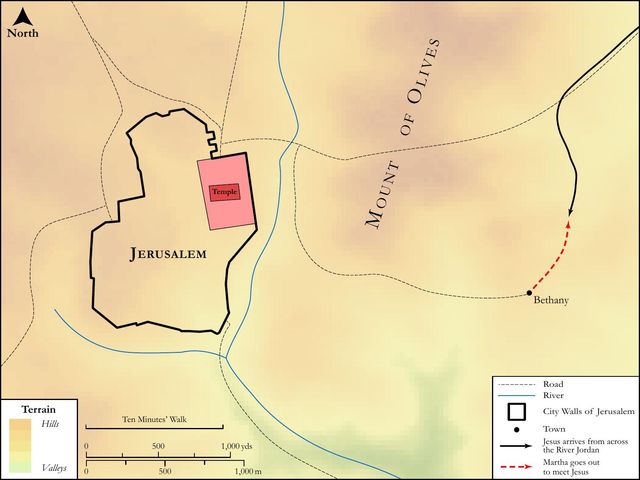
We are here told, I. Whence Christ ascended - from the mount of Olives (Act 1:12), from that part of it where the town of Bethany stood, Luk 24:50. There he began his sufferings (Luk 22:39), and therefore there he rolled away the reproach of them by his glorious ascension, and thus showed that his passion and his ascension had the same reference and tendency. Thus would he enter upon his kingdom in the sight of Jerusalem, and of those undutiful ungrateful citizens of his that would not have him to reign over them. It was prophesied of him (Zac 14:4), That his feet should stand upon the mount of Olives, which is before Jerusalem, should stand last there; and presently it follows, The mount of Olives shall cleave in two. From the mount of Olives he ascended who is the good olive-tree, whence we receive the unction, Zac 4:12; Rom 11:24. This mount is here said to be near Jerusalem, a sabbath day's journey from it, that is, a little way; no further than devout people used to walk out on a sabbath evening, after the public worship was over, for meditation. Some reckon it a thousand paces, others two thousand cubits; some seven furlongs, others eight. Bethany indeed was fifteen furlongs from Jerusalem (Joh 11:18), but that part of the mount of Olives which was next to Jerusalem, whence Christ began to ride in triumph, was but seven or eight furlongs off. The Chaldee paraphrast on Ruth 1 says, We are commanded to keep the sabbaths and the holy days, so as not to go above two thousand cubits, which they build upon Jos 3:4, where, in their march through Jordan, the space between them and the ark was to be two thousand cubits. God had not then thus limited them, but they limited themselves; and thus far it is a rule to us, not to journey on the sabbath any more than in order to the sabbath work; and as far as is necessary to this we are not only allowed, but enjoined, Kg2 4:23.
II.Whither the disciples returned:
They came to Jerusalem, according to their Master's appointment, though there they were in the midst of enemies; but it should seem that though immediately after Christ's resurrection they were watched, and were in fear of the Jews, yet after it was known that they were gone into Galilee no notice was taken of their return to Jerusalem, nor any further search made for them. God can find out hiding-places for his people in the midst of their enemies, and so influence Saul that he shall not seek for David any more. At Jerusalem they went up into an upper room, and there abode; not that they all lodged and dieted together in one room, but there they assembled every day, and spent time together in religious exercises, in expectation of the descent of the Spirit. Divers conjectures the learned have about this upper room. Some think it was one of the upper rooms in the temple; but it cannot be thought that the chief priests, who had the letting of these rooms, would suffer Christ's disciples constantly to reside in any of them. It was said indeed, by the same historian, that they were continually in the temple (Luk 24:53), but that was in the courts of the temple, at the hours of prayer, where they could not be hindered from attending; but, it should seem, this upper room was in a private house. Mr. Gregory, of Oxford, is of this opinion, and quotes a Syriac scholiast upon this place, who says that it was the same upper room in which they had eaten the passover; and though that was called anōgeon, this huperōon, both may signify the same. "Whether," says he, "it was in the house of St. John the evangelist, as Euodius delivered, or that of Mary the mother of John Mark, as others have collected, cannot be certain." Notes, ch. 12.
III.Who the disciples were, that kept together.
The eleven apostles are here named (Act 1:13), so is Mary the mother of our Lord (Act 1:14), and it is the last time that ever any mention is made of her in the scriptures. There were others that are here said to be the brethren of our Lord, his kinsmen according to the flesh; and, to make up the hundred and twenty spoken of (Act 1:15), we may suppose that all or most of the seventy disciples were with them, that were associates with the apostles, and were employed as evangelists.
IV.How they spent their time: They all continued with one accord in prayer and supplication. Observe,
1.They prayed, and made supplication. All God's people are praying people, and give themselves to prayer. It was now a time of trouble and danger with the disciples of Christ; they were as sheep in the midst of wolves; and, Is any afflicted? Let him pray; this will silence cares and fears. They had new work before them, great work, and, before they entered upon it, they were instant in prayer to God for his presence with them in it. Before they were first sent forth Christ spent time in prayer for them, and now they spent time in prayer for themselves. They were waiting for the descent of the Spirit upon them, and therefore abounded thus in prayer. The Spirit descended upon our Saviour when he was praying, Luk 3:21. Those are in the best frame to receive spiritual blessings that are in a praying frame. Christ had promised now shortly to send the Holy Ghost; now this promise was not to supersede prayer, but to quicken and encourage it. God will be enquired of for promised mercies, and the nearer the performance seems to be the more earnest we should be in prayer for it.
2.They continued in prayer, spent much time in it, more than ordinary, prayed frequently, and were long in prayer. They never missed an hour of prayer; they resolved to persevere herein till the Holy Ghost came, according to the promise, to pray, and not to faint. It is said (Luk 24:53), They were praising and blessing God; here, They continued in prayer and supplication; for as praise for the promise is a decent way of begging for the performance, and praise for former mercy of begging further mercy, so, in seeking to God, we give him the glory of the mercy and grace which we have found in him.
3.They did this with one accord. This intimates that they were together in holy love, and that there was no quarrel nor discord among them; and those who so keep the unity of the Spirit in the bond of peace are best prepared to receive the comforts of the Holy Ghost. It also intimates their worthy concurrence in the supplications that were made; though but one spoke, they all prayed, and if, when two agree to ask, it shall be done for them, much more when many agree in the same petition. See Mat 18:19.
Historical interpretation
Three Centuries of Reception
5 surviving comments on this verse. Each one is dated, so this reads as a timeline rather than a list.
Select a marker to jump to its quote. Markers stagger vertically where authors wrote within a few decades of each other.
"And when they were come in," it says, "they went up into an upper room, where they were making their abode:" so they then remained in Jerusalem after the Resurrection: "both Peter, and James, and John:" no longer is only the latter together with his brother mentioned, but together with Peter the two: "and Andrew, and Philip, and Thomas, Bartholomew, and Matthew, and James (the son) of Alphaeus, and Simon Zelotes, and Judas, (the brother) of James." He has done well to mention the disciples: for since one had betrayed Christ, and another had been unbelieving, he thereby shows that, except the first, all of them were preserved.
They durst not appear in the town. They also did well to go up into an upper room, as it became less easy to arrest them at once.
[Daniel 6:10] "Now when Daniel learned of it, that is, of the law which had been enacted, he entered his house, and with the windows in his upper room opened up in the direction of Jerusalem, he continued to bow his knees three times a day and worshipped, and made confession before his God just as he was previously accustomed to do." We must quickly draw from our memory and bring together from all of Holy Scripture all the passages where we have read of domata, which mean in Latin either "walled enclosures" (menia) or "beds" or "sun-terraces," and also the references to anogaia, that is, "upper rooms." For after all, our Lord celebrated the passover in an upper room (Mark 14:15, Luke 22:12), and in the Acts of the Apostles the Holy Spirit came upon the one hundred and twenty souls of believers while they were in an upper room (Acts 1:13). And so Daniel in this case, despising the king's commands and reposing his confidence in God, does not offer his prayers in some obscure spot, but in a lofty place, and opens up his windows towards Jerusalem, from whence he looked for the peace . He prays, moreover, according to God's behest, and also according to what Solomon had said when he admonished the people that they should pray in the direction of the Temple. Furthermore, there are three times in the day when we should bow our knees unto God, and the tradition of the Church understands them to be the third hour, the sixth hour, and the ninth hour. Lastly, it was at the third hour that the Holy Spirit descended upon the Apostles (Acts 2:15) . It was at the sixth hour that Peter, purposing to eat, ascended to the upper room for prayer (Acts 10:9). It was at the ninth hour that Peter and John were on their way to the Temple (Acts 3:1).
James of Alphaeus, and Simon the Zealot, and Judas of James. Some think that there were two apostles called James, namely James of Zebedee and James of Alphaeus, and that the third James, the brother of the Lord, was not an apostle but the bishop of Jerusalem. That is by no means true, but according to the faith of the Gospels, it should be known that this same James, the son of Alphaeus and an apostle, was in charge of Jerusalem, who was called the brother of the Lord, because he was the son of the Lord’s maternal aunt, of whom John the evangelist mentions. However, he says, “standing by the cross of Jesus were his mother, and his mother’s sister, Mary of Clopas” (John 19). Naming this Mary of Clopas from her father or family. For how could the brother of the Lord be said to be not an apostle but the third James, when Paul also names him an apostle: “But I saw none of the other apostles except James, the brother of the Lord” (Galatians 1)? And the evangelist Mark calls him the same, not the third but the other, saying: “There were also women looking on from afar, among whom were Mary Magdalene, and Mary the mother of James the Younger and Joses, and Salome” (Mark 15). For since "greater" and "lesser" usually provide a distinction not among three but between two, the lesser James is called the son of Alphaeus, in distinction from the greater who was the son of Zebedee. Read the book of blessed Jerome against Helvidius. However, Simon the Zealot is the one who is written in the Gospels as the Canaanite. For Cana interprets as zeal. He was from a village in Galilee, Cana, where the Lord turned water into wine, and after his brother James, he ruled the Church of Jerusalem and at the age of one hundred and twenty ascended the cross under Trajan. He is declared to be according to the flesh a cousin of the Savior, because Hegesippus testified that his father Clopas was the brother of Joseph. And Judas of James, that is, the brother of James, is the same as the one called Thaddeus in the Gospels, and he was sent to Edessa to Abgarus, the king of Osroene, as ecclesiastical history tells. It continues:
And when they had entered the upper room, they went up where they were staying. For in Greek the order of words is also placed thus: And when they had gone into the upper room, they went up where they were staying—Peter and John, and Andrew and James. In Greek the order of names is thus: Peter and Andrew, and James and John, and Simon the Zealot, and Judas the son of James. Histories recount concerning these, in which the passions of the apostles are contained, and many deem them apocryphal, that they preached in Persia, and there were killed by the priests of the temples in the city of Suanir, and they underwent glorious martyrdom. The Book of Martyrology, which is titled with the name and preface of blessed Jerome, although Jerome himself was not the author but the translator, and Eusebius is narrated to have been the author, affirms this as well. Further, Isidore believes that this Simon is the one who ruled the Church of Jerusalem after James the brother of the Lord, and was crowned with martyrdom of the cross under Trajan, being a hundred and twenty years old, whom we also followed formerly in the first book of the Acts of the Apostles, not examining what he wrote scrupulously, but simply listening to his words, believing that he learned these things from certain ancient histories. We dare not deny this even now, especially since he who wrote the aforementioned passions of the apostles has most certainly revealed that he wrote uncertain and false things. For he says that the eunuch of Candace, whom Philip baptized in Judea, was in Ethiopia at the time when Matthew was teaching there and helped him in his teaching, while it is manifest that Candace is the name not of a man, but of a woman, that is, not of the eunuch, but of his mistress, namely the queen of the Ethiopians, who, as we have learned from ancient records, were all commonly called thus in olden times. I wrote in the same work, following Jerome's commentary, and concerning Judas the brother of James, who was also called Thaddaeus, that he was sent to Abgar, king of Osroene, as ecclesiastical history has handed down; but afterward, examining the ecclesiastical history itself more diligently, I found it not written there that Thaddaeus the apostle, one of the twelve, but Thaddaeus one of the seventy disciples, was sent to heal the aforementioned king. I do not think an error should be imputed to me, where, following the authority of great doctors, I believed without doubt what I found in their small works should be accepted.
And when they had entered the upper room, they went up where they were staying. It designates a place on high, because they had already ascended from earthly conversation of the Sabbath to the higher realms of knowledge and virtue.
Continue studying Acts 1:13 across the web’s major study libraries — every link below opens this exact verse, chapter, or book on the destination site.
Read & Compare
 BibleGatewayThis verse in more than 200 translations and 70 languages.
 Bible.comThe YouVersion reader — hundreds of translations, reading plans, and highlights.
 ESV.orgCrossway's official English Standard Version reader.
 NET BibleThe NET translation with 60,000+ translators' notes on every rendering decision.
 STEP BibleTyndale House's free study tool — original text, vocabulary, and scholarly resources.
 BibliaLogos Bible Software's free web reader.
 USCCBThe New American Bible (Revised Edition) with the U.S. bishops' study notes.
Commentaries
 BibleHub CommentariesDozens of classic commentaries on this verse, gathered on one page.
 StudyLightMore than 100 commentary sets — the largest collection on the web.
 BibleRefPlain-English commentary on what this verse means, verse by verse.
 Enduring WordDavid Guzik's free commentary on this chapter, widely used by Bible teachers.
 Bible Study ToolsVerse commentary alongside Greek and Hebrew study aids.
Original Language & Research
- BibleHub InterlinearThe verse word by word — original language, transliteration, and English.
- BibleHub LexiconEvery word's original-language definition and Strong's entry.
 Blue Letter BibleDeep-study tools — Strong's numbers, concordance, and word studies.
 CNTR CollationThe earliest Greek manuscripts of this verse, collated letter by letter.
Sermons, Hymns & Audio


TrulyRandomVerse is not affiliated with these sites and doesn’t control their content. They’re linked because they’re genuinely useful.
Summary
Acts 1:13 provides a precise account of the eleven apostles' immediate actions following Jesus' ascension, detailing their return to Jerusalem and their designated gathering place in an "upper room." This verse is pivotal as it establishes the setting and identifies the core group of Christ's followers who, in obedience to His command, would wait together in prayer and anticipation for the promised outpouring of the Holy Spirit, thereby setting the stage for the birth and empowerment of the early church.
Context
ShowHideLiterary Context
Acts 1:13 immediately follows the dramatic account of Jesus' ascension into heaven, as described in Acts 1:9-11. Having witnessed their Lord taken up from them, the disciples were then addressed by two angels who confirmed Jesus' future return. Prior to His ascension, Jesus had given His disciples specific instructions to remain in Jerusalem and wait for "the promise of the Father," which He identified as the baptism with the Holy Spirit (Acts 1:4-5). Thus, this verse depicts the disciples' direct obedience to these final commands, transitioning from the awe of Christ's departure to the active, communal waiting for divine empowerment that would enable them to fulfill the Great Commission outlined in Acts 1:8. It marks the crucial period between Christ's physical presence and the Spirit's empowering indwelling.
Historical & Cultural Context
The disciples' return to Jerusalem from the Mount of Olives, a short distance away (traditionally about a Sabbath day's journey), placed them back in the spiritual and cultural heart of Judaism. The "upper room" (Greek: hyperōion) was a common feature in larger Jewish homes, typically a spacious, private chamber on an upper floor, often used for prayer, study, or special gatherings. It is highly probable, though not explicitly stated, that this was the same upper room where Jesus had shared the Last Supper with His disciples (Luke 22:12) and where He had appeared to them after His resurrection (John 20:19). This setting provided a secure and intimate space for the nascent community of believers to gather, pray, and await the fulfillment of God's promise, away from the immediate scrutiny of the Jewish authorities, during a time of intense anticipation leading up to the Jewish feast of Pentecost.
Key Themes
ShowHideActs 1:13 contributes significantly to several key themes within the book of Acts and the broader New Testament narrative. Firstly, it highlights Obedience and Waiting, as the disciples faithfully follow Jesus' instruction to remain in Jerusalem and await the Spirit, demonstrating that divine empowerment often follows a period of patient, prayerful anticipation. Secondly, the explicit listing of the eleven apostles underscores Apostolic Continuity and Authority. This core group, chosen and commissioned by Christ, represents the foundational leadership of the early church, ready to receive the Spirit's power to bear witness to Jesus. The absence of Judas Iscariot is notable, setting the stage for the selection of his replacement in Acts 1:15-26. Finally, the gathering of these individuals in one place emphasizes Unity and Fellowship, a characteristic that would become a hallmark of the early Christian community (Acts 2:42), demonstrating their shared purpose and collective commitment to Christ's mission.
Exposition and Analysis
ShowHideKey Word Analysis
ShowHideFrom eis (to or into) and érchomai (to come or go), this verb signifies entering, often implying purpose or destination. In Acts 1:13, it describes the disciples' purposeful entry into Jerusalem after leaving the Mount of Olives, underscoring their direct obedience to Jesus' command to return to the city and wait.
This term refers to a "higher part of the house," specifically an apartment on the third story or an upper chamber. Such rooms were often spacious and private, making them ideal for meetings, prayer, and communal living. Its mention here designates a specific, significant location that would become the spiritual epicenter for the early church's initial formation and empowerment.
Derived from katá (down, fully) and ménō (to stay, remain), this verb means "to stay fully" or "reside." It conveys a sense of settled presence and continuous dwelling, indicating that the apostles were not merely visiting the upper room but were establishing it as their base of operations during this crucial period of waiting and communal life.
Verse Breakdown
ShowHide"And when they were come in, they went up into an upper room"
This opening clause describes the immediate post-ascension actions of the disciples. Having returned to Jerusalem from the Mount of Olives, their first collective act is to seek out and ascend to a specific "upper room." This highlights their intentionality and obedience to Jesus' command to wait in the city. The act of "going up" suggests a deliberate movement to a private, elevated space suitable for their purpose.
"where abode both Peter, and James, and John, and Andrew, Philip, and Thomas, Bartholomew, and Matthew"
This part of the verse specifies the location as a place of residence or prolonged stay ("abode") and begins the enumeration of the apostles present. The list starts with Peter, James, and John, often considered the inner circle of Jesus' disciples, followed by Andrew, Philip, Thomas, Bartholomew, and Matthew. This list is significant as it confirms the presence of the core apostolic leadership, minus Judas Iscariot, emphasizing their collective unity and shared commitment.
"James [the son] of Alphaeus, and Simon Zelotes, and Judas [the brother] of James."
The enumeration concludes with the remaining three apostles: James, son of Alphaeus (distinguishing him from James, son of Zebedee), Simon the Zealot, and Judas, brother of James (often identified as Jude, the author of the epistle). This complete roster of the eleven remaining apostles underscores the continuity of the apostolic band and their unified presence in anticipation of the Holy Spirit, setting the stage for the Spirit's empowerment of these specific individuals for their future mission.
Literary Devices
ShowHideThe primary literary device employed in Acts 1:13 is Enumeration, specifically a detailed list of the eleven apostles. This serves to emphasize the collective identity and unified presence of Jesus' chosen witnesses. By naming each individual, Luke reinforces the historical accuracy of his account and highlights the continuity of the apostolic leadership from Jesus' ministry into the early church. The inclusion of the Setting ("an upper room") also functions as a literary device, providing a specific and significant backdrop for the unfolding events. This particular location, likely known to early readers, symbolizes a place of spiritual retreat, communal gathering, and divine encounter, foreshadowing its role in the Pentecost event and establishing it as a foundational space for the nascent Christian community.
Theological and Thematic Connections
ShowHideActs 1:13 is more than a mere roster of names and a description of a location; it is a profound theological statement about the nature of the early church and its reliance on divine power. The gathering of the apostles in unity and obedience in the "upper room" signifies the essential posture of the church awaiting God's promised empowerment. Their collective presence underscores the importance of communal fellowship and prayer as foundational elements for receiving and stewarding the Holy Spirit's anointing. This scene portrays the church in its embryonic stage, a community defined by its shared faith in the ascended Christ and its active, patient anticipation of the Spirit, who would transform them from a group of disciples into empowered witnesses. This period of waiting was not passive, but a time of spiritual preparation, prayer, and strengthening of bonds, essential for the monumental task of spreading the Gospel that lay ahead.
Reflection and Application
ShowHideActs 1:13 offers timeless lessons for believers today, emphasizing the profound importance of communal gathering, focused prayer, and patient waiting on God's timing. In a world that often prizes immediate action and individual achievement, the disciples' example reminds us that true spiritual power and direction often emerge from a posture of collective humility and dependence on God. Their unity in the upper room, despite their diverse backgrounds and past failings, serves as a powerful model for the church: when believers gather in one accord, seeking God's face and His will, they create an environment conducive to divine visitation and empowerment. This verse challenges us to consider our own "upper rooms"—spaces and times dedicated to prayer, fellowship, and spiritual preparation—and to cultivate a spirit of active waiting, trusting that God's promises will be fulfilled in His perfect timing, enabling us to participate in His ongoing mission in the world.
Questions for Reflection
ShowHideFAQ
ShowHideWho were the specific individuals listed in Acts 1:13, and why is their presence significant?
ShowHideActs 1:13 lists the eleven apostles who remained after Judas Iscariot's betrayal and death. They are: Peter, James (son of Zebedee), John, Andrew, Philip, Thomas, Bartholomew, Matthew, James (son of Alphaeus), Simon the Zealot, and Judas (the brother of James). Their presence is highly significant because they represent the core group of individuals personally chosen and trained by Jesus to be His witnesses. Their gathering in the upper room signifies the continuity of Christ's chosen leadership and their collective obedience to His final command to wait for the Holy Spirit. This unified group would form the foundational leadership of the early church, empowered by the Spirit to spread the Gospel, as described in Acts 1:8.
What was the significance of the "upper room" (hyperōion) as a gathering place?
ShowHideThe "upper room" (Greek: hyperōion) was a common feature in ancient Middle Eastern homes, typically a spacious, private chamber on an upper floor, often used for quiet reflection, prayer, or special gatherings. Its significance in Acts 1:13 is multi-faceted. It provided a secure and intimate space for the disciples to gather consistently for prayer and fellowship during the crucial period between Jesus' ascension and the outpouring of the Holy Spirit. While not explicitly stated, it is widely believed to be the same room where Jesus instituted the Last Supper (Luke 22:12) and where He appeared to His disciples after His resurrection (John 20:19). This continuity makes it a profoundly sacred and symbolic space, becoming the spiritual birthplace of the church on the Day of Pentecost (Acts 2:1). It highlights the importance of dedicated spaces for communal worship and spiritual preparation.
Christ-Centered Fulfillment
ShowHideActs 1:13, though seemingly a simple listing of names and a location, is deeply Christ-centered in its implications. The disciples' presence in the upper room is a direct act of obedience to Christ's command to wait for the Spirit (Luke 24:49). Their gathering signifies their continued reliance on and commitment to their ascended Lord, even in His physical absence. This waiting period is not a void, but a crucial bridge, orchestrated by Christ, connecting His earthly ministry to His ongoing ministry through the Holy Spirit. The Spirit, whom they are waiting for, is the "Spirit of Christ" (Romans 8:9), sent by the Father at Christ's request (John 14:16). The unity of the apostles in this shared space reflects Christ's High Priestly prayer for His followers' unity (John 17:20-23), a unity essential for the church to effectively bear witness to Him (Acts 1:8). Thus, Acts 1:13 portrays the church in its nascent form, awaiting the empowering presence of Christ's Spirit to continue His redemptive work in the world.