


Acts 2:1
Bible text: King James Version (1769 Blayney text) · Public domain
Bible text: Berean Standard Bible · Public domain
Bible text: American Standard Version (1901) · Public domain
Bible text: World English Bible, Messianic edition · Public domain
Bible text: Geneva Bible (1599) · Public domain
Bible text: Young's Literal Translation · Public domain
- ΚαὶKaiAndG2532CONJConjunction
- ἐνenduringG1722PREPPreposition
- τῷtōtheG3588T-DSNDefinite article Dative Singular Neuter
- συμπληροῦσθαιsumplērousthaiarriving ofG4845V-PPNVerb Present Passive Infinitive
- τὴνtēntheG3588T-ASFDefinite article Accusative Singular Feminine
- ἡμέρανhēmerandayG2250N-ASFNoun Accusative Singular Feminine
- τῆςtēs<the>G3588T-GSFDefinite article Genitive Singular Feminine
- πεντηκοστῆςpentēkostēsof PentecostG4005N-GSFNoun Genitive Singular Feminine
- ἦσανēsanthey wereG1510V-IAI-3PVerb Imperfect Active Indicative 3rd Plural
- πάντεςpantesallG3956A-NPMAdjective Nominative Plural Masculine
- ὁμοῦhomoutogetherG3674ADVAdverb
- ἐπὶepiinG1909PREPPreposition
- τὸtotheG3588T-ASNDefinite article Accusative Singular Neuter
- αὐτόautoone [place]G846P-ASNPersonal pronoun Accusative Singular Neuter
English is a literal word-by-word gloss of the Greek, not the KJV's wording. Why?
This is the original text the KJV's translators worked from — each Greek word with its own literal English meaning in this verse, prepared by scholars at Tyndale House, Cambridge. The KJV translates whole sentences, not word by word, so its wording differs: one Greek word can become several English words, and the KJV may choose “charity” where the gloss reads “love”. Both are faithful — they answer different questions. For the KJV's own rendering, switch to the KJV text.
Details
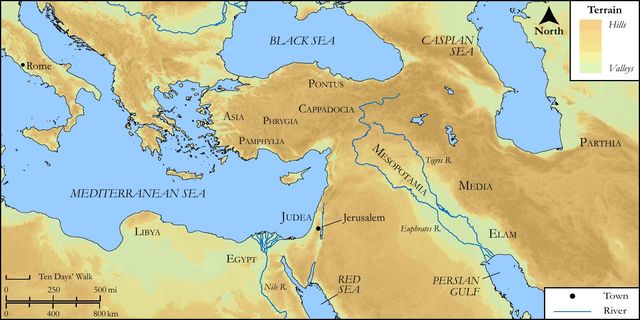
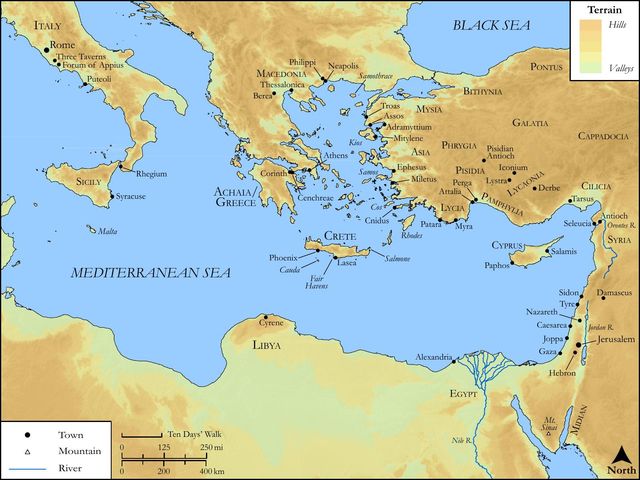
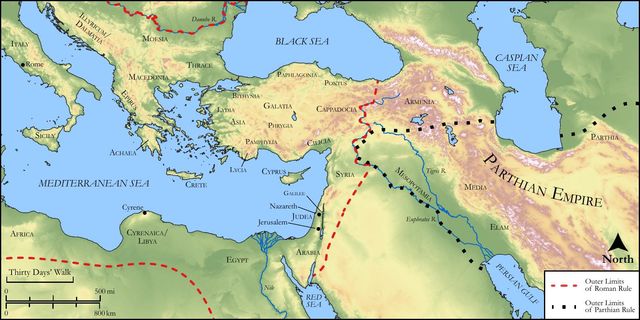
See on the biblical-era maps
Study this verse
Public-domain commentary
Matthew Henry
From his Commentary on the Whole Bible. Henry comments on passages, not single verses — this entry covers Acts 2:1–4. His four-level outline is real structure in the source text, so it is rendered as structure.
We have here an account of the descent of the Holy Ghost upon the disciples of Christ. Observe,
I.When, and where, this was done, which are particularly noted, for the greater certainty of the thing.
1.It was when the day of pentecost was fully come, in which there seems to be a reference to the manner of the expression in the institution of this feast, where it is said (Lev 23:15), You shall count unto you seven sabbaths complete, from the day of the offering of the first-fruits, which was the next day but one after the passover, the sixteenth day of the month Abib, which was the day that Christ arose. This day was fully come, that is, the night preceding, with a part of the day, was fully past.
(1.)The Holy Ghost came down at the time of a solemn feast, because there was then a great concourse of people to Jerusalem from all parts of the country, and the proselytes from other countries, which would make it the more public, and the fame of it to be spread the sooner and further, which would contribute much to the propagating of the gospel into all nations. Thus now, as before at the passover, the Jewish feasts served to toll the bell for gospel services and entertainments.
(2.)This feast of pentecost was kept in remembrance of the giving of the law upon mount Sinai, whence the incorporating of the Jewish church was to be dated, which Dr. Lightfoot reckons to be just one thousand four hundred and forty-seven years before this. Fitly, therefore, is the Holy Ghost given at that feast, in fire and in tongues, for the promulgation of the evangelical law, not as that to one nation, but to every creature.
(3.)This feast of pentecost happened on the first day of the week, which was an additional honour put on that day, and a confirmation of it to be the Christian sabbath, the day which the Lord hath made, to be a standing memorial in his church of those two great blessings - the resurrection of Christ, and the pouring out of the Spirit, both on that day of the week. This serves not only to justify us in observing that day under the style and title of the Lord's day, but to direct us in the sanctifying of it to give God praise particularly for those two great blessings; every Lord's day in the year, I think, there should be a full and particular notice taken in our prayers and praises of these two, as there is by some churches of the one once a year, upon Easter-day, and of the other once a year, upon Whit-sunday. Oh! that we may do it with suitable affections!
2.It was when they were all with one accord in one place. What place it was we are not told particularly, whether in the temple, where they attended at public times (Luk 24:53), or whether in their own upper room, where they met at other times. But it was at Jerusalem, because this had been the place which God chose, to put his name there, and the prophecy was that thence the word of the Lord should go forth to all nations, Isa 2:3. It was now the place of the general rendezvous of all devout people: here God had promised to meet them and bless them; here therefore he meets them with this blessing of blessings. Though Jerusalem had done the utmost dishonour imaginable to Christ, yet he did this honour to Jerusalem, to teach his remnant in all places; he had this in Jerusalem. Here the disciples were in one place, and they were not as yet so many but that one place, and no large one, would hold them all. And here they were with one accord. We cannot forget how often, while their Master was with them, there were strifes among them, who should be the greatest; but now all these strifes were at an end, we hear no more of them. What they had received already of the Holy Ghost, when Christ breathed on them, had in a good measure rectified the mistakes upon which those contests were grounded, and had disposed them to holy love. They had prayed more together of late than usual (Act 1:14), and this made them love one another better. By his grace he thus prepared them for the gift of the Holy Ghost; for that blessed dove comes not where there is noise and clamour, but moves upon the face of the still waters, not the rugged ones. Would we have the Spirit poured out upon us from on high? Let us be all of one accord, and, notwithstanding variety of sentiments and interests, as no doubt there was among those disciples, let us agree to love one another; for, where brethren dwell together in unity, there it is that the Lord commands his blessing.
II.How, and in what manner, the Holy Ghost came upon them.
We often read in the old Testament of God's coming down in a cloud; as when he took possession first of the tabernacle, and afterwards of the temple, which intimates the darkness of that dispensation. And Christ went up to heaven in a cloud, to intimate how much we are kept in the dark concerning the upper world. But the Holy Ghost did not descend in a cloud; for he was to dispel and scatter the clouds that overspread men's minds, and to bring light into the world.
1.Here is an audible summons given them to awaken their expectations of something great, Act 2:2. It is here said,
(1.)That it came suddenly, did not rise gradually, as common winds do, but was at the height immediately. It came sooner than they expected, and startled even those that were now together waiting, and probably employed in some religious exercises.
(2.)It was a sound from heaven, like a thunder-clap, Rev 6:1. God is said to bring the winds out of his treasuries (Psa 135:7), and to gather them in his hands, Pro 30:4. From him this sound came, like the voice of one crying, Prepare ye the way of the Lord.
(3.)It was the sound of a wind, for the way of the Spirit is like that of the wind (Joh 3:3), thou hearest the sound thereof, but canst not tell whence it comes nor whither it goes. When the Spirit of life is to enter into the dry bones, the prophet is told to prophecy unto the wind: Come from the four winds, O breath, Eze 37:9. And though it was not in the wind that the Lord came to Elijah, yet this prepared him to receive his discovery of himself in the still small voice, Kg1 19:11, Kg1 19:12. God's way is in the whirlwind and the storm (Nah 1:3), and out of the whirlwind he spoke to Job.
(4.)It was a rushing mighty wind; it was strong and violent, and came not only with a great noise, but with great force, as if it would bear down all before it. This was to signify the powerful influences and operations of the Spirit of God upon the minds of men, and thereby upon the world, that they should be mighty through God, to the casting down of imaginations.
(5.)It filled not only the room, but all the house where they were sitting. Probably it alarmed the whole city, but, to show that it was supernatural, presently fixed upon that particular house: as some think the wind that was sent to arrest Jonah affected only the ship that he was in (Jon 1:4), and as the wise men's star stood over the house where the child was. This would direct the people who observed it whither to go to enquire the meaning of it. This wind filling the house would strike an awe upon the disciples, and help to put them into a very serious, reverent, and composed frame, for the receiving of the Holy Ghost. Thus the convictions of the Spirit make way for his comforts; and the rough blasts of that blessed wind prepare the soul for its soft and gentle gales.
2.Here is a visible sign of the gift they were to receive. They saw cloven tongues, like as of fire (Act 2:3), and it sat - ekathise, not they sat, those cloven tongues, but he, that is the Spirit (signified thereby), rested upon each of them, as he is said to rest upon the prophets of old. Or, as Dr. Hammond describes it, "There was an appearance of something like flaming fire lighting on every one of them, which divided asunder, and so formed the resemblance of tongues, with that part of them that was next their heads divided or cloven." The flame of a candle is somewhat like a tongue; and there is a meteor which naturalists call ignis lambens - a gentle flame, not a devouring fire; such was this. Observe,
(1.)There was an outward sensible sign, for the confirming of the faith of the disciples themselves, and for the convincing of others. Thus the prophets of old had frequently their first mission confirmed by signs, that all Israel might know them to be established prophets.
(2.)The sign given was fire, that John Baptist's saying concerning Christ might be fulfilled, He shall baptize you with the Holy Ghost and with fire; with the Holy Ghost as with fire. They were now, in the feast of pentecost, celebrating the memorial of the giving of the law upon mount Sinai; and as that was given in fire, and therefore is called a fiery law, so is the gospel. Ezekiel's mission was confirmed by a vision of burning coals of fire (Eze 1:13), and Isaiah's by a coal of fire touching his lips, Isa 6:7. The Spirit, like fire, melts the heart, separates and burns up the dross, and kindles pious and devout affections in the soul, in which, as in the fire upon the altar, the spiritual sacrifices are offered up. This is that fire which Christ came to send upon the earth. Luk 12:49.
(3.)This fire appeared in cloven tongues. The operations of the Spirit were many; that of speaking with divers tongues was one, and was singled out to be the first indication of the gift of the Holy Ghost, and to that this sign had a reference.
[1.]They were tongues; for from the Spirit we have the word of God, and by him Christ would speak to the world, and he gave the Spirit to the disciples, not only to endue them with knowledge, but to endue them with a power to publish and proclaim to the world what they knew; for the dispensation of the Spirit is given to every man to profit withal.
[2.]These tongues were cloven, to signify that God would hereby divide unto all nations the knowledge of his grace, as he is said to have divided to them by his providence the light of the heavenly bodies, Deu 4:19. The tongues were divided, and yet they still continued all of one accord; for there may be a sincere unity of affections where yet there is a diversity of expression. Dr. Lightfoot observes that the dividing of tongues at Babel was the casting off of the heathen; for when they had lost the language in which alone God was spoken of and preached, they utterly lost the knowledge of God and religion, and fell into idolatry. But now, after above two thousand years, God, by another dividing of tongues, restores the knowledge of himself to the nations.
(4.)This fire sat upon them for some time, to denote the constant residence of the Holy Ghost with them. The prophetic gifts of old were conferred sparingly and but at some times, but the disciples of Christ had the gifts of the Spirit always with them, though the sign, we may suppose, soon disappeared. Whether these flames of fire passed from one to another, or whether there were as many flames as there were persons, is not certain. But they must be strong and bright flames that would be visible in the day-light, as it now was, for the day was fully come.
III.What was the immediate effect of this?
1.They were all filled with the Holy Ghost, more plentifully and powerfully than they were before. They were filled with the graces of the Spirit, and were more than ever under his sanctifying influences - were now holy, and heavenly, and spiritual, more weaned from this world and better acquainted with the other. They were more filled with the comforts of the Spirit, rejoiced more than ever in the love of Christ and the hope of heaven, and in it all their griefs and fears were swallowed up. They were also, for the proof of this, filled with the gifts of the Holy Ghost, which are especially meant here; they were endued with miraculous powers for the furtherance of the gospel. It seems evident to me that not only the twelve apostles, but all the hundred and twenty disciples were filled with the Holy Ghost alike at this time - all the seventy disciples, who were apostolic men, and employed in the same work, and all the rest too that were to preach the gospel; for it is said expressly (Eph 4:8, Eph 4:11), When Christ ascended on high (which refers to this, Act 2:33), he gave gifts unto men, not only some apostles (such were the twelve), but some prophets and some evangelists (such were many of the seventy disciples, itinerant preachers), and some pastors and teachers settled in particular churches, as we may suppose some of these afterwards were. The all here must refer to the all that were together, Act 2:1; Act 1:14, Act 1:15.
2.They began to speak with other tongues, besides their native language, though they had never learned any other. They spoke not matters of common conversation, but the word of God, and the praises of his name, as the Spirit gave them utterance, or gave them to speak apophthengesthai - apophthegms, substantial and weighty sayings, worthy to be had in remembrance. It is probable that it was not only one that was enabled to speak one language, and another another (as it was with the several families that were dispersed from Babel), but that every one was enabled to speak divers languages, as he should have occasion to use them. And we may suppose that they understood not only themselves but one another too, which the builders of Babel did not, Gen 11:7. They did not speak here and there a word of another tongue, or stammer out some broken sentences, but spoke it as readily, properly, and elegantly, as if it had been their mother-tongue; for whatever was produced by miracle was the best of the kind. They spoke not from any previous thought or meditation, but as the Spirit gave them utterance; he furnished them with the matter as well as the language. Now this was,
(1.)A very great miracle; it was a miracle upon the mind (and so had most of the nature of a gospel miracle), for in the mind words are framed. They had not only never learned these languages, but had never learned any foreign tongue, which might have facilitated these; nay, for aught that appears, they had never so much as heard these languages spoken, nor had any idea of them. They were neither scholars nor travellers, nor had had any opportunity of learning languages either by books or conversation. Peter indeed was forward enough to speak in his own tongue, but the rest of them were no spokesmen, nor were they quick of apprehension; yet now not only the heart of the rash understands knowledge, but the tongue of the stammerers is ready to speak eloquently, Isa 32:4. When Moses complained, I am slow of speech, God said, I will be with thy mouth, and Aaron shall be thy spokesman. But he did more for these messengers of his: he that made man's mouth new-made theirs.
(2.)A very proper, needful, and serviceable miracle. The language the disciples spoke was Syriac, a dialect of the Hebrew; so that it was necessary that they should be endued with the gift, for the understanding both of the original Hebrew of the Old Testament, in which it was written, and of the original Greek of the New Testament, in which it was to be written. But this was not all; they were commissioned to preach the gospel to every creature, to disciple all nations. But here is an insuperable difficulty at the threshold. How shall they master the several languages so as to speak intelligibly to all nations? It will be the work of a man's life to learn their languages. And therefore, to prove that Christ could give authority to preach to the nations, he gives ability to preach to them in their own language. And it should seem that this was the accomplishment of that promise which Christ made to his disciples (Joh 14:12), Greater works than these shall you do. For this may well be reckoned, all things considered, a greater work than the miraculous cures Christ wrought. Christ himself did not speak with other tongues, nor did he enable his disciples to do so while he was with them: but it was the first effect of the pouring out of the Spirit upon them. And archbishop Tillotson thinks it probable that if the conversion of infidels to Christianity were now sincerely and vigorously attempted, by men of honest minds, God would extraordinarily countenance such an attempt with all fitting assistance, as he did the first publication of the gospel.
Historical interpretation
Six Centuries of Reception
10 surviving comments on this verse. Each one is dated, so this reads as a timeline rather than a list.
Select a marker to jump to its quote. Markers stagger vertically where authors wrote within a few decades of each other.
Further: since in the self-same commentary of Luke the third hour is demonstrated as an hour of prayer, about which hour it was that they who had received the initiatory gift of the Holy Spirit were held for drunkards; and the sixth, at which Peter went up on the roof; and the ninth, at which they entered the temple: why should we not understand that, with absolutely perfect indifference, we must pray always, and everywhere, and at every time; yet still that these three hours, as being more marked in things human-(hours) which divide the day, which distinguish businesses, which re-echo in the public ear-have likewise ever been of special solemnity in divine prayers? A persuasion which is sanctioned also by the corroborative fact of Daniel praying thrice in the day; of course, through exception of certain stated hours, no other, moreover, than the more marked and subsequently apostolic (hours)-the third, the sixth, the ninth.
The first infusion of the Holy Spirit into the congregated disciples took place at "the third hour." Peter, on the day on which he experienced the vision of Universal Community, (exhibited) in that small vessel, had ascended into the more lofty parts of the house, for prayer's sake "at the sixth hour.
When the blessed apostles
were gathered together
the place shook
and the scent of Paradise,
having recognized its home,
poured forth its perfumes,
delighting the heralds
by whom
the guests are instructed
and come to his banquet;
eagerly he awaits their arrival
for he is the Lover of mankind.
Dost thou perceive the type? What is this Pentecost? The time when the sickle was to be put to the harvest, and the ingathering was made. See now the reality, when the time was come to put in the sickle of the word: for here, as the sickle, keen-edged, came the Spirit down. For hear the words of Christ: "Lift up your eyes," He said, "and look on the fields, for they are white already to harvest." And again, "The harvest truly is great, but the laborers are few." But as the first-fruits of this harvest, He himself took our nature, and bore it up on high. Himself first put in the sickle. Therefore also He calls the Word the Seed. "When," it says, "the day of Pentecost was fully come": that is, when at the Pentecost, while about it, in short. For it was essential that the present events likewise should take place during the feast, that those who had witnessed the crucifixion of Christ, might also behold these.
Fifty days are reckoned from the celebration of the Passover (which, as Moses ordered, was accomplished by slaying the lamb, a type to signify the future passion of the Lord) to the day on which Moses received the law on tablets written by the finger of God. Likewise, when fifty days had passed from the slaying and resurrection of him who was led as a lamb to the slaughter, the finger of God, that is, the Holy Spirit filled the believers gathered in one place.
To the Hebrew people, now freed from Egypt, the law was given on Mount Sinai fifty days after the immolation of the paschal lamb. Similarly, after the passion of Christ in which the true Lamb of God was killed, just fifty days after his resurrection, the Holy Spirit fell upon the apostles and the whole group of believers. Thus the earnest Christian may easily perceive that the beginnings of the Old Covenant were at the service of the beginnings of the gospel and that the same Spirit who instituted the first established the Second Covenant.
"When the days of the Pentecost were accomplished, they were all together in one place," etc. When fifty days had passed, as the Lord Christ had promised them, there was suddenly a mighty sound from heaven as the Holy Ghost came, and heavenly fire appeared above the heads of all who were sitting in the house, and they began to speak the tongues of various nations. As the news spread, men from various peoples who had gathered in Jerusalem came and wondered at them who, being Galileans, spoke of the wonderful works of God in the tongues of the peoples. Some, looking at the phenomenon reasonably, thought rightly that it had been granted by a gift of God; others, stupidly mocking, rather ascribed it to drunkenness.
And when the days of Pentecost were completed, they were all together in the same place. Some Codices incorrectly have, Pentecosten. For Pentecoste in the nominative case means fiftieth; Pentecostes in the genitive, fiftieth's; Pentecosten in the accusative, fiftieth. However, no rule of speech allows us to say Pentecosten, when it should be said: When the fiftieth day was completed; or certainly as it is read in Greek in the singular number: And when the fiftieth day was completed. But truly in the prayers of the same day, it should be said: And celebrating the most sacred day of Pentecost, that is, the fiftieth. From the usage of this word, it is thought by some who do not know the Greek language that the solemnity of this day should also be called Pentecosten in the nominative case.
And when the days of Pentecost were completed, they were all together in the same place. This is in the upper room, which they are said to have ascended. For whoever desires to be filled with the Holy Spirit must necessarily transcend the dwelling of the flesh through the contemplation of the mind. Just as the forty days during which the Lord conversed with His disciples after His resurrection signify the Church's journey in this world with the risen Christ, so the fiftieth day, on which the Holy Spirit is received, fittingly expresses the perfection of blessed rest, by which the labor of the temporal Church will be rewarded with eternal denarius. For the number forty itself, when computed by its equal parts, adds that denarius and makes fifty. The half of the number forty is twenty, a quarter is ten, a fifth is eight, an eighth is five, a tenth is four, a twentieth is two, a fortieth is one. Twenty, ten, eight, five, four, two, and one make fifty. The figure of this calculation is easily evident, because the present conflict generates for us the eternal joy of the jubilee, as the Apostle says: For our momentary and light affliction works for us an eternal weight of glory beyond all measure (II Cor. IV). Our true blessedness, however, is the eternal vision of the most high and blessed Trinity, wherein we glory in the immortality of both body and soul. For we consist of the four well-known qualities of the body. In the inner man, we are commanded to love God with all our heart, all our soul, and all our mind. And this is the perfect denarius of life, to rejoice in the present vision of divine glory. It is to be noted historically that among the ancients, the day of Pentecost, that is, the fiftieth day on which the law was given, was counted from the slaughter of the lamb. However, as the blessed Augustine explains, the fiftieth day here is counted not from the Lord's Passion, but from His resurrection, on which the Holy Spirit was sent. He, by the return of the old sign's example, most manifestly consecrated the Lord's day by His coming. At that same point in time, He showed that the true Pascha is to be celebrated on the Lord's day. For just as here, so also there God appeared in the vision of fire, as Exodus says: And Mount Sinai was altogether on a smoke because the Lord descended upon it in fire (Exod. XIX).
The Law was given on Mount Sinai, the Spirit on Mount Sion, the Law on an elevated place in the mountain, the Spirit in an upper room.
Continue studying Acts 2:1 across the web’s major study libraries — every link below opens this exact verse, chapter, or book on the destination site.
Read & Compare
 BibleGatewayThis verse in more than 200 translations and 70 languages.
 Bible.comThe YouVersion reader — hundreds of translations, reading plans, and highlights.
 ESV.orgCrossway's official English Standard Version reader.
 NET BibleThe NET translation with 60,000+ translators' notes on every rendering decision.
 STEP BibleTyndale House's free study tool — original text, vocabulary, and scholarly resources.
 BibliaLogos Bible Software's free web reader.
 USCCBThe New American Bible (Revised Edition) with the U.S. bishops' study notes.
Commentaries
 BibleHub CommentariesDozens of classic commentaries on this verse, gathered on one page.
 StudyLightMore than 100 commentary sets — the largest collection on the web.
 BibleRefPlain-English commentary on what this verse means, verse by verse.
 Enduring WordDavid Guzik's free commentary on this chapter, widely used by Bible teachers.
 Bible Study ToolsVerse commentary alongside Greek and Hebrew study aids.
Original Language & Research
- BibleHub InterlinearThe verse word by word — original language, transliteration, and English.
- BibleHub LexiconEvery word's original-language definition and Strong's entry.
 Blue Letter BibleDeep-study tools — Strong's numbers, concordance, and word studies.
 CNTR CollationThe earliest Greek manuscripts of this verse, collated letter by letter.
Sermons, Hymns & Audio


TrulyRandomVerse is not affiliated with these sites and doesn’t control their content. They’re linked because they’re genuinely useful.
Summary
Acts 2:1 introduces the pivotal moment of the Holy Spirit's outpouring, marking the birth of the Christian church and the inauguration of the New Covenant. This verse precisely sets the stage, highlighting the divine timing of the event on the Day of Pentecost and emphasizing the unified state of the early believers as they awaited God's promised empowerment. It underscores the culmination of God's redemptive plan, transitioning from the Old Covenant's shadows to the Spirit-filled reality of the new age.
Context
ShowHideLiterary Context
Acts 2:1 serves as the climactic fulfillment of the promises made in the preceding chapter. Following Jesus' ascension, the disciples were instructed to wait in Jerusalem for the "promise of the Father" (Acts 1:4), which Jesus identified as being "baptized with the Holy Spirit" (Acts 1:5). The disciples, numbering about 120, had gathered consistently in prayer and supplication (Acts 1:14) and had just selected Matthias to replace Judas Iscariot (Acts 1:15-26). This verse, therefore, marks the dramatic answer to their obedient waiting and collective anticipation, setting the stage for the powerful events of Peter's sermon, the conversion of thousands, and the rapid expansion of the early church described throughout the rest of Acts 2.
Historical & Cultural Context
The "Day of Pentecost" (Shavuot in Hebrew) was one of the three annual pilgrimage festivals for Jews, requiring all males to travel to Jerusalem. Occurring fifty days after Passover, it was originally an agricultural festival celebrating the firstfruits of the wheat harvest (Leviticus 23:15-17). By the first century, it had also become associated with the commemoration of God's giving of the Law (Torah) to Moses on Mount Sinai, an event that occurred approximately fifty days after the Exodus from Egypt. The presence of devout Jews "from every nation under heaven" (Acts 2:5) in Jerusalem for this festival provided a divinely orchestrated global audience for the Spirit's outpouring and the subsequent proclamation of the Gospel. This confluence of Jewish tradition and divine timing underscores the significance of the event.
Key Themes
ShowHideThis verse powerfully introduces several foundational themes that resonate throughout the book of Acts and Christian theology. The concept of Divine Timing and Fulfillment is paramount, as the Spirit's arrival on Pentecost signifies God's precise orchestration of salvation history, fulfilling Old Testament prophecies and Jesus' promises, particularly those found in Luke 24:49 and Acts 1:8. The theme of Unity and Accord is also central, highlighted by the phrase "with one accord" (Greek: homothymadón). This spiritual unanimity and shared purpose among the believers was crucial, demonstrating that the corporate presence and readiness of the community were prerequisites for the corporate outpouring of the Spirit. Finally, the verse subtly introduces the theme of Empowerment for Mission, as the Spirit's arrival was not merely for personal experience but to equip the disciples to be Christ's witnesses "to the ends of the earth" (Acts 1:8).
Exposition and Analysis
ShowHideKey Word Analysis
ShowHideDerived from the Greek word for "fiftieth," this term refers to the Jewish festival of Shavuot, celebrated on the fiftieth day after Passover. Its significance here is profound, marking the precise, divinely appointed moment for the Holy Spirit's descent, paralleling the giving of the Law at Sinai fifty days after the Exodus, thus establishing a new covenant.
This verb means "to implenish completely" or "to accomplish" in a passive sense, indicating something that "is complete." Its use here emphasizes that the Day of Pentecost had not merely arrived, but had reached its divinely appointed and perfect culmination, signifying that all preparatory conditions were met for God's grand act.
An adverb meaning "unanimously" or "with one mind." This powerful term, frequently used in Acts, describes the deep spiritual unity, shared purpose, and harmonious disposition of the early believers. It implies not just physical proximity but a profound agreement in spirit and intention, essential for the corporate reception of the Holy Spirit.
Verse Breakdown
ShowHide"And when the day of Pentecost was fully come"
This clause establishes the precise timing of the event, linking it to a significant Jewish festival. The phrase "fully come" underscores that this was not a random occurrence but a divinely orchestrated moment, the culmination of God's redemptive plan and the fulfillment of Old Testament prophecies and Jesus' promises regarding the Holy Spirit.
"they were all with one accord"
This highlights the spiritual state of the believers. "They all" refers to the approximately 120 disciples mentioned in Acts 1:15, encompassing apostles, women, and Jesus' family. The crucial phrase "with one accord" (Greek: homothymadón) signifies their profound unity, shared purpose, and spiritual harmony. This unanimity was a vital precondition for the corporate outpouring of the Spirit.
"in one place"
This indicates their physical gathering. While the exact location is debated (an upper room or a temple court), their collective presence in a single location further emphasizes their unity and readiness. This physical gathering facilitated the corporate experience of the Spirit's descent, demonstrating the communal nature of the church's birth.
Literary Devices
ShowHideLuke, as a skilled historian and theologian, employs several literary devices in this concise verse. The primary device is Divine Timing, where the specific mention of "the day of Pentecost" underscores God's sovereign control over history and the precise fulfillment of His promises. The phrase "was fully come" acts as a form of Culmination, indicating that this event was the preordained and perfect moment for the Spirit's arrival, drawing a clear line from Old Testament prophecy to New Testament fulfillment. Furthermore, the emphasis on "all with one accord in one place" highlights Unity as a foundational characteristic of the nascent church, serving as a Prerequisite for the Spirit's corporate outpouring. This collective posture is not merely descriptive but prescriptive, suggesting that communal harmony is essential for experiencing God's presence and power.
Theological and Thematic Connections
ShowHideActs 2:1 marks a profound theological shift, signifying the transition from the Old Covenant era, characterized by the Law given at Sinai (commemorated by Pentecost), to the New Covenant, defined by the indwelling and empowering presence of the Holy Spirit. This event is the inauguration of the Church as the new temple of God, where God's presence now dwells not in a physical building, but within His gathered people. The Spirit's descent on a diverse group of believers, united in purpose, signals the universal scope of God's salvation and the breaking down of barriers, preparing the way for the Gospel to be proclaimed to all nations. This divine empowerment enables believers to live out the new covenant, fulfilling the Law's righteous requirements not through external adherence, but through internal transformation and Spirit-led obedience.
Reflection and Application
ShowHideActs 2:1 offers profound lessons for contemporary believers and the Church. The emphasis on divine timing reminds us that God's plans unfold according to His perfect schedule, calling for patient waiting and faithful perseverance rather than anxious striving. Just as the early disciples were "with one accord," unity remains a vital prerequisite for the Church's health, spiritual vitality, and effective mission. Disagreements and divisions hinder the Spirit's work and dim the Church's witness. Therefore, actively pursuing spiritual harmony, shared purpose, and mutual submission within our communities is not merely optional but essential for experiencing God's corporate blessing and power. This verse encourages us to gather intentionally, pray fervently, and seek genuine unity, knowing that God delights to pour out His Spirit where His people are ready and united in heart and mind.
Questions for Reflection
ShowHideFAQ
ShowHideWhat is the significance of the Day of Pentecost in Acts 2:1?
ShowHideThe Day of Pentecost is profoundly significant because it marks the fulfillment of Jesus' promise to send the Holy Spirit (Luke 24:49; Acts 1:8) and the inauguration of the Christian Church. Historically, Pentecost was a Jewish harvest festival commemorating the giving of the Law at Mount Sinai. In Acts 2, it takes on new meaning as the day God poured out His Spirit, establishing the New Covenant, where God's law is written on hearts by the Spirit, and empowering believers for global witness. It signifies a new era of God's direct indwelling presence within His people.
Christ-Centered Fulfillment
ShowHideActs 2:1, while seemingly a simple statement of timing and location, points powerfully to the Christ-centered fulfillment of God's redemptive plan. The Day of Pentecost, originally commemorating the giving of the Law at Sinai, now becomes the day of the Spirit's outpouring, demonstrating that Christ's finished work on the cross and His resurrection have inaugurated a new covenant. Jesus, as the ascended Lord, is the one who sends the Holy Spirit (John 16:7), fulfilling His promise to His disciples. The "one accord" of the believers in "one place" foreshadows the unity of the Church, which is the body of Christ (Ephesians 4:4-6), empowered by His Spirit to continue His mission in the world. Thus, Pentecost is not merely an event but the direct consequence of Christ's triumph, signifying His continued presence and power through His Spirit in His Church, making believers His witnesses "to the ends of the earth" (Acts 1:8).