


Acts 1:14
Bible text: King James Version (1769 Blayney text) · Public domain
Bible text: King James Version with Strong's numbers · Public domain
Bible text: Berean Standard Bible · Public domain
Bible text: American Standard Version (1901) · Public domain
Bible text: World English Bible, Messianic edition · Public domain
Bible text: Geneva Bible (1599) · Public domain
Bible text: Young's Literal Translation · Public domain
- ΟὗτοιHoutoiTheseG3778D-NPMDemonstrative pronoun Nominative Plural Masculine
- πάντεςpantesallG3956A-NPMAdjective Nominative Plural Masculine
- ἦσανēsanwereG1510V-IAI-3PVerb Imperfect Active Indicative 3rd Plural
- προσκαρτεροῦντεςproskarterountessteadfastly continuingG4342V-PAP-NPMVerb Present Active Participle Nominative Plural Masculine
- ὁμοθυμαδὸνhomothumadonwith one accordG3661ADVAdverb
- τῇtēa<the>G3588T-DSFDefinite article Dative Singular Feminine
- προσευχῇproseuchēain prayerG4335N-DSFNoun Dative Singular Feminine
- καὶkaiandG2532CONJConjunction
- τῇtēa<the>G3588T-DSFDefinite article Dative Singular Feminine
- δεήσειdeēseiin supplicationG1162N-DSFNoun Dative Singular Feminine
- σὺνsunwith theG4862PREPPreposition
- γυναιξὶνgunaixin[the] womenG1135N-DPFNoun Dative Plural Feminine
- καὶkaiandG2532CONJConjunction
- ΜαριὰμMariamMaryG3137N-DSF-PNoun Dative Singular Feminine Individual
- τῇtēawith theG3588T-DSFDefinite article Dative Singular Feminine
- μητρὶmētrimotherG3384N-DSFNoun Dative Singular Feminine
- τοῦtou<the>G3588T-GSMDefinite article Genitive Singular Masculine
- ἸησοῦIēsouof JesusG2424N-GSM-PNoun Genitive Singular Masculine Individual
- καὶkaiandG2532CONJConjunction
- σὺνsunwithG4862PREPPreposition
- τοῖςtoistheG3588T-DPMDefinite article Dative Plural Masculine
- ἀδελφοῖςadelphoisbrothersG80N-DPMNoun Dative Plural Masculine
- αὐτοῦautouof HimG846P-GSMPersonal pronoun Genitive Singular Masculine
English is a literal word-by-word gloss of the Greek, not the KJV's wording. Why?
This is the original text the KJV's translators worked from — each Greek word with its own literal English meaning in this verse, prepared by scholars at Tyndale House, Cambridge. The KJV translates whole sentences, not word by word, so its wording differs: one Greek word can become several English words, and the KJV may choose “charity” where the gloss reads “love”. Both are faithful — they answer different questions. For the KJV's own rendering, switch to the KJV text.
Details
See on the biblical-era maps
Study this verse
Public-domain commentary
Matthew Henry
From his Commentary on the Whole Bible. Henry comments on passages, not single verses — this entry covers Acts 1:12–14. His two-level outline is real structure in the source text, so it is rendered as structure.
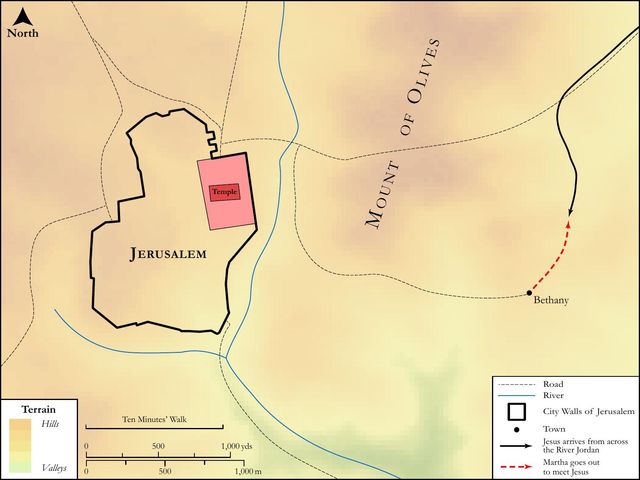
We are here told, I. Whence Christ ascended - from the mount of Olives (Act 1:12), from that part of it where the town of Bethany stood, Luk 24:50. There he began his sufferings (Luk 22:39), and therefore there he rolled away the reproach of them by his glorious ascension, and thus showed that his passion and his ascension had the same reference and tendency. Thus would he enter upon his kingdom in the sight of Jerusalem, and of those undutiful ungrateful citizens of his that would not have him to reign over them. It was prophesied of him (Zac 14:4), That his feet should stand upon the mount of Olives, which is before Jerusalem, should stand last there; and presently it follows, The mount of Olives shall cleave in two. From the mount of Olives he ascended who is the good olive-tree, whence we receive the unction, Zac 4:12; Rom 11:24. This mount is here said to be near Jerusalem, a sabbath day's journey from it, that is, a little way; no further than devout people used to walk out on a sabbath evening, after the public worship was over, for meditation. Some reckon it a thousand paces, others two thousand cubits; some seven furlongs, others eight. Bethany indeed was fifteen furlongs from Jerusalem (Joh 11:18), but that part of the mount of Olives which was next to Jerusalem, whence Christ began to ride in triumph, was but seven or eight furlongs off. The Chaldee paraphrast on Ruth 1 says, We are commanded to keep the sabbaths and the holy days, so as not to go above two thousand cubits, which they build upon Jos 3:4, where, in their march through Jordan, the space between them and the ark was to be two thousand cubits. God had not then thus limited them, but they limited themselves; and thus far it is a rule to us, not to journey on the sabbath any more than in order to the sabbath work; and as far as is necessary to this we are not only allowed, but enjoined, Kg2 4:23.
II.Whither the disciples returned:
They came to Jerusalem, according to their Master's appointment, though there they were in the midst of enemies; but it should seem that though immediately after Christ's resurrection they were watched, and were in fear of the Jews, yet after it was known that they were gone into Galilee no notice was taken of their return to Jerusalem, nor any further search made for them. God can find out hiding-places for his people in the midst of their enemies, and so influence Saul that he shall not seek for David any more. At Jerusalem they went up into an upper room, and there abode; not that they all lodged and dieted together in one room, but there they assembled every day, and spent time together in religious exercises, in expectation of the descent of the Spirit. Divers conjectures the learned have about this upper room. Some think it was one of the upper rooms in the temple; but it cannot be thought that the chief priests, who had the letting of these rooms, would suffer Christ's disciples constantly to reside in any of them. It was said indeed, by the same historian, that they were continually in the temple (Luk 24:53), but that was in the courts of the temple, at the hours of prayer, where they could not be hindered from attending; but, it should seem, this upper room was in a private house. Mr. Gregory, of Oxford, is of this opinion, and quotes a Syriac scholiast upon this place, who says that it was the same upper room in which they had eaten the passover; and though that was called anōgeon, this huperōon, both may signify the same. "Whether," says he, "it was in the house of St. John the evangelist, as Euodius delivered, or that of Mary the mother of John Mark, as others have collected, cannot be certain." Notes, ch. 12.
III.Who the disciples were, that kept together.
The eleven apostles are here named (Act 1:13), so is Mary the mother of our Lord (Act 1:14), and it is the last time that ever any mention is made of her in the scriptures. There were others that are here said to be the brethren of our Lord, his kinsmen according to the flesh; and, to make up the hundred and twenty spoken of (Act 1:15), we may suppose that all or most of the seventy disciples were with them, that were associates with the apostles, and were employed as evangelists.
IV.How they spent their time: They all continued with one accord in prayer and supplication. Observe,
1.They prayed, and made supplication. All God's people are praying people, and give themselves to prayer. It was now a time of trouble and danger with the disciples of Christ; they were as sheep in the midst of wolves; and, Is any afflicted? Let him pray; this will silence cares and fears. They had new work before them, great work, and, before they entered upon it, they were instant in prayer to God for his presence with them in it. Before they were first sent forth Christ spent time in prayer for them, and now they spent time in prayer for themselves. They were waiting for the descent of the Spirit upon them, and therefore abounded thus in prayer. The Spirit descended upon our Saviour when he was praying, Luk 3:21. Those are in the best frame to receive spiritual blessings that are in a praying frame. Christ had promised now shortly to send the Holy Ghost; now this promise was not to supersede prayer, but to quicken and encourage it. God will be enquired of for promised mercies, and the nearer the performance seems to be the more earnest we should be in prayer for it.
2.They continued in prayer, spent much time in it, more than ordinary, prayed frequently, and were long in prayer. They never missed an hour of prayer; they resolved to persevere herein till the Holy Ghost came, according to the promise, to pray, and not to faint. It is said (Luk 24:53), They were praising and blessing God; here, They continued in prayer and supplication; for as praise for the promise is a decent way of begging for the performance, and praise for former mercy of begging further mercy, so, in seeking to God, we give him the glory of the mercy and grace which we have found in him.
3.They did this with one accord. This intimates that they were together in holy love, and that there was no quarrel nor discord among them; and those who so keep the unity of the Spirit in the bond of peace are best prepared to receive the comforts of the Holy Ghost. It also intimates their worthy concurrence in the supplications that were made; though but one spoke, they all prayed, and if, when two agree to ask, it shall be done for them, much more when many agree in the same petition. See Mat 18:19.
Historical interpretation
Five Centuries of Reception
6 surviving comments on this verse. Each one is dated, so this reads as a timeline rather than a list.
Select a marker to jump to its quote. Markers stagger vertically where authors wrote within a few decades of each other.
"Blessed," says He, "are the peacemakers; for they shall be called the sons of God." [Matthew 5:9] It behooves the sons of God to be peacemakers, gentle in heart, simple in speech, agreeing in affection, faithfully linked to one another in the bonds of unanimity.
This unanimity formerly prevailed among the apostles; and thus the new assembly of believers, keeping the Lord's commandments, maintained its charity. Divine Scripture proves this, when it says, "But the multitude of them which believed were of one heart and of one soul." [Acts 4:32] And again: "These all continued with one mind in prayer with the women, and Mary the mother of Jesus, and with His brethren." [Acts 1:14] And thus they prayed with effectual prayers; thus they were able with confidence to obtain whatever they asked from the Lord's mercy.
Before all things, the Teacher of peace and the Master of unity would not have prayer to be made singly and individually, as for one who prays to pray for himself alone. For we say not "My Father, which art in heaven," nor "Give me this day my daily bread; "nor does each one ask that only his own debt should be forgiven him; nor does he request for himself alone that he may not be led into temptation, and delivered from evil. Our prayer is public and common; and when we pray, we pray not for one, but for the whole people, because we the whole people are one. The God of peace and the Teacher of concord, who taught unity, willed that one should thus pray for all, even as He Himself bore us all in one... Thus also we find that the apostles, with the disciples, prayed after the Lord's ascension: "They all," says the Scripture, "continued with one accord in prayer, with the women, and Mary who was the mother of Jesus, and with His brethren." [Acts 1:14] They continued with one accord in prayer, declaring both by the urgency and by the agreement of their praying, that God, "who makes men to dwell of one mind in a house," only admits into the divine and eternal home those among whom prayer is unanimous.
"These were all continuing with one accord in prayer together with the women." For this is a powerful weapon in temptations; and to this they had been trained. "Continuing with one accord." Good. Besides, the present temptation directed them to this: for they exceedingly feared the Jews. "With the women," it is said: for he had said that they had followed Him: "and with Mary the mother of Jesus." How then is it said, that "that disciple" took her to his own home, at that time? But then the Lord had brought them together again, and so returned.
"And they continued," it is said, "with one accord in prayer." Do you see how watchful they were? "Continuing in prayer," and "with one accord," as it were with one soul, continuing therein: two things reported in their praise.
"And Mary the Mother of Jesus and His brethren." Now Joseph perhaps was dead: for it is not to be supposed that when the brethren had become believers, Joseph believed not; he who in fact had believed before any. Certain it is that we nowhere find him looking upon Christ as man merely.
They sought by a swift path, with which it was possible to go a mile on their sabbath, the well-known walls where Mary, the gateway of God, the virgin mother of her Creator, formed by her own son, was sitting at a religious gathering. The second virgin put to flight the woes of Eve’s crime; there is no harm done to the sex; she restored what the first took away. Let grief not raise up complaints or vex mourning hearts with groaning over the old law; these very forms of wickedness and crime rather cause delight at this bargain, and a better lot comes to the redeemed world from the fall. The person, not the nature [of a woman], caused ruin; in those days [of Eve] a pregnant woman [brought forth] peril. In these [of Mary] one grew great to bring forth God, the one begetting mortal things and the other bearing divine—she through whom the Mediator came forth into the world and carried actual flesh to the heavens.
All these were continually devoting themselves with one accord to prayer. Those who patiently continue in prayer are those who await the arrival of the Holy Spirit. For the Holy Spirit of discipline flees from deceit (Wisdom 1). Therefore, whoever desires to receive the promised gifts of the Holy Spirit must persist diligently in prayers steeped in fraternal love.
With the women and Mary the mother of Jesus, and his brothers. It says brothers of Jesus, not of Mary. For in Greek there is a clear distinction where it is written not αὐτῆς but αὐτοῦ, which without any doubt is a masculine pronoun among them. Blessed Luke took care to inform readers that the brothers of the Lord were participants in his faith at that time, about whom it was previously said before his passion: "Neither did his brothers believe in him."
Continue studying Acts 1:14 across the web’s major study libraries — every link below opens this exact verse, chapter, or book on the destination site.
Read & Compare
 BibleGatewayThis verse in more than 200 translations and 70 languages.
 Bible.comThe YouVersion reader — hundreds of translations, reading plans, and highlights.
 ESV.orgCrossway's official English Standard Version reader.
 NET BibleThe NET translation with 60,000+ translators' notes on every rendering decision.
 STEP BibleTyndale House's free study tool — original text, vocabulary, and scholarly resources.
 BibliaLogos Bible Software's free web reader.
 USCCBThe New American Bible (Revised Edition) with the U.S. bishops' study notes.
Commentaries
 BibleHub CommentariesDozens of classic commentaries on this verse, gathered on one page.
 StudyLightMore than 100 commentary sets — the largest collection on the web.
 BibleRefPlain-English commentary on what this verse means, verse by verse.
 Enduring WordDavid Guzik's free commentary on this chapter, widely used by Bible teachers.
 Bible Study ToolsVerse commentary alongside Greek and Hebrew study aids.
Original Language & Research
- BibleHub InterlinearThe verse word by word — original language, transliteration, and English.
- BibleHub LexiconEvery word's original-language definition and Strong's entry.
 Blue Letter BibleDeep-study tools — Strong's numbers, concordance, and word studies.
 CNTR CollationThe earliest Greek manuscripts of this verse, collated letter by letter.
Sermons, Hymns & Audio


TrulyRandomVerse is not affiliated with these sites and doesn’t control their content. They’re linked because they’re genuinely useful.
Summary
Acts 1:14 provides a pivotal snapshot of the early Christian community in the crucial period between Jesus's ascension and the outpouring of the Holy Spirit at Pentecost. It describes a diverse group of disciples—including the apostles, various women, Mary the mother of Jesus, and Jesus's own half-brothers—who were united in purpose and continuously devoted to prayer and supplication. This verse highlights their obedient and expectant waiting for the promised Holy Spirit, underscoring the foundational role of unity and persistent prayer in the nascent church.
Context
ShowHideLiterary Context
Acts 1:14 immediately follows the account of Jesus's ascension into heaven and His final instructions to His disciples to wait in Jerusalem for the promise of the Father, the Holy Spirit (Acts 1:4-8). Verses 12-13 describe the disciples' return from the Mount of Olives to Jerusalem and their gathering in an "upper room." This verse then specifies the composition of this gathered group and their primary activity. It sets the stage for the dramatic events of Pentecost in Acts 2, where the same group, still "with one accord," receives the Holy Spirit, empowering them for their global mission. Thus, Acts 1:14 serves as a bridge, illustrating the obedient and unified preparation that preceded the birth of the church.
Historical & Cultural Context
The setting is Jerusalem, a city deeply significant to Jewish faith and the birthplace of Christianity. The "upper room" (likely a large room in a private house, possibly the same one where the Last Supper occurred) served as a common gathering place for early believers. In Jewish culture, prayer was a central aspect of daily life, often performed at specific times. The inclusion of women in this core group, praying alongside men, highlights the inclusive nature of Jesus's ministry and the early church. The mention of Jesus's brothers is particularly significant, as they had previously been skeptical of His claims (John 7:5). Their presence here signifies a profound transformation, likely due to post-resurrection appearances of Jesus, such as the one to James (1 Corinthians 15:7). This gathering represents a unique, transitional period, as the disciples awaited the promised divine empowerment to fulfill the Great Commission.
Key Themes
ShowHideThis verse encapsulates several critical themes foundational to the book of Acts and the life of the early church. Firstly, unity is paramount, emphasized by the phrase "with one accord" (Greek: homothymadón), which recurs throughout Acts to describe the cohesive spirit of the believers, particularly at momentous occasions like Pentecost (Acts 2:1). Secondly, persistent prayer and supplication are highlighted as the primary activity of the waiting community, demonstrating their absolute dependence on God for the fulfillment of His promises and for guidance in their nascent mission. This theme underscores prayer as the engine of the early church's spiritual vitality and outward expansion. Thirdly, the verse subtly introduces the theme of inclusion and transformation, as it explicitly mentions women, Mary, and Jesus's previously unbelieving brothers, showcasing the broad appeal and transformative power of the resurrected Christ, bringing diverse individuals into a unified body of believers.
Exposition and Analysis
ShowHideKey Word Analysis
ShowHideThis verb signifies an earnest, diligent, and persistent devotion to an activity or person. It implies not merely waiting, but actively and assiduously attending to something, remaining steadfast and constant. In this context, it describes the disciples' unwavering commitment to prayer, indicating a deep, sustained engagement rather than a casual or intermittent practice.
This adverb is a compound word meaning "with one passion" or "with one mind." It denotes a profound unanimity, a shared purpose, and a harmonious spirit among a group. It's more than mere agreement; it speaks to a singular, collective will and emotional unity, which was crucial for the early church's spiritual cohesion and effectiveness.
While "prayer" (proseuchḗ) is a more general term for communion with God, "supplication" specifically refers to a petition or an earnest request, often born out of a sense of need or urgency. Its inclusion alongside "prayer" suggests that the disciples were not only engaged in general worship and communion but were also making specific, heartfelt requests to God, likely for the promised Holy Spirit and guidance.
Verse Breakdown
ShowHide"These all continued"
This phrase refers to the apostles mentioned in Acts 1:13 and the broader group of disciples who had returned to Jerusalem after Jesus's ascension. The verb "continued" (proskarteréō) emphasizes their persistent, unwavering, and devoted engagement in the activity that follows, indicating a sustained commitment rather than a fleeting moment.
"with one accord"
This crucial phrase (homothymadón) highlights the remarkable unity and unanimity among this diverse group of believers. It signifies that they were not merely in the same place but were united in mind, purpose, and spirit, sharing a common passion and expectation. This spiritual harmony was foundational for their collective waiting and subsequent reception of the Holy Spirit.
"in prayer and supplication"
This specifies the primary activity of the gathered disciples. "Prayer" (proseuchḗ) encompasses general worship, communion, and adoration, while "supplication" (déēsis) denotes specific, earnest petitions or requests, often arising from a sense of need. Together, they describe a comprehensive and fervent engagement with God, reflecting their dependence on Him for the fulfillment of His promises.
"with the women"
This inclusion is significant, indicating that female disciples were an integral and active part of the early Christian community, participating fully in its spiritual life and corporate activities, including prayer. Their presence underscores the inclusive nature of the new covenant community.
"and Mary the mother of Jesus"
The specific mention of Mary marks her final appearance in the biblical narrative. Her presence among the praying disciples shows her continued devotion to Jesus and her participation in the nascent church, not as an object of worship, but as a faithful follower awaiting the Spirit alongside others.
"and with his brethren"
This is a profoundly significant detail. Jesus's half-brothers (such as James and Jude) had previously not believed in Him during His earthly ministry (John 7:5). Their presence here, united in prayer with the apostles, testifies to the transformative power of Jesus's resurrection and post-resurrection appearances, bringing them from skepticism to fervent faith and active participation in the early Christian movement.
Literary Devices
ShowHideThe verse employs Inclusion by meticulously listing the diverse composition of the early community (apostles, women, Mary, Jesus's brethren), emphasizing the broad and inclusive nature of the nascent church. The phrase "with one accord" functions as a powerful Leitmotif in Acts, recurring frequently to underscore the essential unity of the believers, particularly before significant spiritual breakthroughs. This repetition highlights the theological importance of harmony for the church's mission. Furthermore, the detailed description of their persistent "prayer and supplication" serves as a form of Emphasis, drawing the reader's attention to the foundational spiritual discipline that prepared the disciples for the outpouring of the Holy Spirit and the subsequent growth of the church.
Theological and Thematic Connections
ShowHideActs 1:14 powerfully illustrates the critical role of corporate unity and persistent prayer in the life of the early church, serving as a model for believers throughout history. The "one accord" (homothymadón) signifies not merely external agreement but a deep spiritual harmony and shared purpose, essential for the community to receive divine empowerment and fulfill its mission. Their continuous devotion to prayer and supplication demonstrates profound dependence on God and expectant waiting for His promised intervention. This verse underscores that spiritual breakthroughs and the advancement of God's kingdom are often preceded by a unified, prayerful posture from His people, highlighting the divine-human partnership in redemptive history.
Reflection and Application
ShowHideActs 1:14 offers profound insights for contemporary believers, emphasizing that the spiritual vitality and effectiveness of the church today, much like the early church, are deeply intertwined with unity and persistent prayer. In a world often characterized by division and distraction, the call to be "with one accord" in prayer and supplication serves as a powerful reminder of our corporate identity and shared mission in Christ. It challenges us to move beyond superficial agreement to a genuine unity of spirit and purpose, where individual desires are submitted to the collective pursuit of God's will. Furthermore, the disciples' expectant waiting, marked by active prayer rather than passive idleness, teaches us that true dependence on God involves diligent seeking and fervent petition. This verse compels us to examine our own lives and our church communities: Are we truly united in heart and mind? Is prayer a consistent, earnest, and collective priority? The transformative presence of Jesus's brothers also reminds us that God's grace can reach and change even the most skeptical hearts, encouraging us to pray for and welcome all into the community of faith.
Questions for Reflection
ShowHideFAQ
ShowHideWhat is the significance of "with one accord" in this verse and in Acts?
ShowHideThe phrase "with one accord" (Greek: homothymadón) is highly significant, appearing 10 times in the book of Acts, more than any other New Testament book. It describes a profound spiritual unity, a unanimity of mind, purpose, and passion among the believers. It's not just about being in the same place or agreeing on a few points, but about a shared heart and soul, a collective will directed towards God. This unity was foundational for the early church's spiritual power and effectiveness, enabling them to receive the Holy Spirit together (Acts 2:1) and to face persecution with boldness (Acts 4:24). It highlights that God often moves powerfully when His people are united in spirit and purpose.
Why is Mary, the mother of Jesus, mentioned here, and what is the significance of her inclusion?
ShowHideMary's mention in Acts 1:14 is noteworthy as it is her final appearance in the biblical narrative. Her inclusion emphasizes her continued role as a faithful disciple of Jesus, now joining the broader community of believers in prayer and expectant waiting for the Holy Spirit. It shows her as an integral part of the nascent church, not elevated above others, but participating alongside the apostles, other women, and Jesus's brothers. This underscores the universal reach of the early Christian community and Mary's personal devotion to the resurrected Christ, demonstrating her full integration into the body of believers.
Who are "his brethren" mentioned in this verse, and why is their presence significant?
ShowHide"His brethren" refers to Jesus's half-brothers, children of Mary and Joseph born after Jesus. The New Testament mentions James, Joseph, Simon, and Judas (Matthew 13:55). During Jesus's earthly ministry, they did not believe in Him (John 7:5). Their presence here, united in prayer with the disciples, is profoundly significant because it testifies to the transformative power of Jesus's resurrection. It is believed that Jesus's post-resurrection appearance to James (1 Corinthians 15:7) was instrumental in their conversion. Their inclusion highlights that even those closest to Jesus, who initially doubted, were brought to fervent faith and became active participants in the early church, with James later becoming a prominent leader in Jerusalem (Acts 15:13).
Christ-Centered Fulfillment
ShowHideActs 1:14, depicting the unified and prayerful waiting of the early disciples, finds its ultimate Christ-centered fulfillment in several profound ways. Their obedience to "continue" in Jerusalem was a direct response to Jesus's command to wait for the promised Holy Spirit (Acts 1:4-5), a promise first articulated by Christ Himself (Luke 24:49). The unity "with one accord" among this diverse group, including those who once disbelieved, is a testament to the reconciling and transforming power of the resurrected Christ, who breaks down barriers and creates one new humanity in Himself (Ephesians 2:14-16). Their persistent "prayer and supplication" was a corporate echo of Christ's own life of prayer and His ongoing intercession for His disciples (John 17; Romans 8:34), as they awaited the very Spirit of Christ to indwell and empower them for the mission He had commissioned (Romans 8:9). Thus, this scene is not merely a historical record but a living illustration of the church as Christ's body, united in Him, dependent on Him, and empowered by His Spirit to continue His redemptive work in the world.