


Colossians 4:2
Bible text: King James Version (1769 Blayney text) · Public domain
Bible text: Berean Standard Bible · Public domain
Bible text: American Standard Version (1901) · Public domain
Bible text: World English Bible, Messianic edition · Public domain
Bible text: Geneva Bible (1599) · Public domain
Bible text: Young's Literal Translation · Public domain
- ΤῇTēa<the>G3588T-DSFDefinite article Dative Singular Feminine
- προσευχῇproseuchēaIn prayerG4335N-DSFNoun Dative Singular Feminine
- προσκαρτερεῖτεproskartereitedo continue steadfastlyG4342V-PAM-2PVerb Present Active Imperative 2nd Plural
- γρηγοροῦντεςgrēgorounteswatchingG1127V-PAP-NPMVerb Present Active Participle Nominative Plural Masculine
- ἐνeninG1722PREPPreposition
- αὐτῇautēaitG846P-DSFPersonal pronoun Dative Singular Feminine
- ἐνenwithG1722PREPPreposition
- εὐχαριστίᾳ·eucharistiathanksgivingG2169N-DSFNoun Dative Singular Feminine
English is a literal word-by-word gloss of the Greek, not the KJV's wording. Why?
This is the original text the KJV's translators worked from — each Greek word with its own literal English meaning in this verse, prepared by scholars at Tyndale House, Cambridge. The KJV translates whole sentences, not word by word, so its wording differs: one Greek word can become several English words, and the KJV may choose “charity” where the gloss reads “love”. Both are faithful — they answer different questions. For the KJV's own rendering, switch to the KJV text.
Details
See on the biblical-era maps
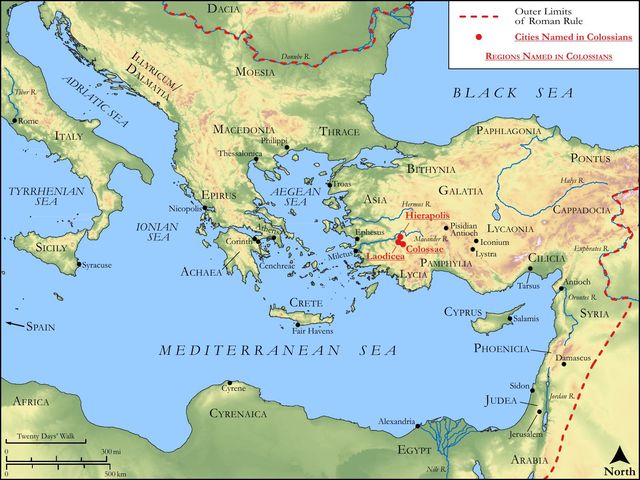

Study this verse
Public-domain commentary
Matthew Henry
From his Commentary on the Whole Bible. Henry comments on passages, not single verses — this entry covers Colossians 4:2–4.
If this be considered as connected with the foregoing verse, then we may observe that it is part of the duty which masters owe their servants to pray with them, and to pray daily with them, or continue in prayer. They must not only do justly and kindly by them, but act a Christian and religious part, and be concerned for their souls as well as their bodies: "As parts of your charge, and under your influence, be concerned for the blessing of God upon them, as well as the success of your affairs in their hands." And this is the duty of every one - to continue in prayer. "Keep up your constant times of prayer, without being diverted from it by other business; keep your hearts close to the duty, without wandering or deadness, and even to the end of it: Watching the same." Christians should lay hold of all opportunities for prayer, and choose the fittest seasons, which are least liable to disturbance from other things, and keep their minds lively in the duty, and in suitable frames. - With thanksgiving, or solemn acknowledgment of the mercies received. Thanksgiving must have a part in every prayer. - Withal praying also for us, Col 4:3. The people must pray particularly for their ministers, and bear them upon their hearts at all times at the throne of grace. As if he had said, "Do not forget us, whenever you pray for yourselves," Eph 6:19; Th1 5:25; Heb 13:18. That God would open to us a door of utterance, that is, either afford opportunity to preach the gospel (so he says, a great door and effectual is opened to me, Co1 16:9), or else give me ability and courage, and enable me with freedom and faithfulness; so Eph 6:19, And for me, that utterance may be given to me, that I may open my mouth boldly, to speak the mystery of Christ, for which I am also in bonds; that is, either the deepest doctrines of the gospel with plainness, of which Christ is the principal subject (he calls it the mystery of the gospel, Eph 6:19), or else he means the preaching of the gospel to the Gentile world, which he calls the mystery hidden from ages (Col 1:26) and the mystery of Christ, Eph 3:4. For this he was now in bonds. He was a prisoner at Rome, by the violent opposition of the malicious Jews. He would have them pray for him, that he might not be discouraged in his work, nor driven from it by his sufferings: "That I may make it manifest, as I ought to speak, Col 4:4. That I may make this mystery known to those who have not heard of it, and make it plain to their understanding, in such a manner as I ought to do." He had been particular in telling them what he prayed for on their behalf, ch. 1. Here he tells them particularly what he would have them pray for on his behalf. Paul knew as well as any man how to speak; and yet he begged their prayers for him, that he might be taught to speak. The best and most eminent Christians need the prayers of meaner Christians, and are not above asking them. The chief speakers need prayer, that God would give them a door of utterance, and that they may speak as they ought to speak.
Historical interpretation
Three Centuries of Reception
7 surviving comments on this verse. Each one is dated, so this reads as a timeline rather than a list.
Select a marker to jump to its quote. Markers stagger vertically where authors wrote within a few decades of each other.
Let your speech be always with grace, seasoned with salt, that ye may know how ye ought to answer every man.".
"Continue in prayer, watching therein with thanksgiving."
Further: since in the self-same commentary of Luke the third hour is demonstrated as an hour of prayer, about which hour it was that they who had received the initiatory gift of the Holy Spirit were held for drunkards; and the sixth, at which Peter went up on the roof; and the ninth, at which they entered the temple: why should we not understand that, with absolutely perfect indifference, we must pray always, and everywhere, and at every time; yet still that these three hours, as being more marked in things human-(hours) which divide the day, which distinguish businesses, which re-echo in the public ear-have likewise ever been of special solemnity in divine prayers? A persuasion which is sanctioned also by the corroborative fact of Daniel praying thrice in the day; of course, through exception of certain stated hours, no other, moreover, than the more marked and subsequently apostolic (hours)-the third, the sixth, the ninth.
That we are to be urgent in prayers. In the Epistle of Paul to the Colossians: "Be instant in prayer, and watch therein." Also in the first Psalm: "But in the law of the Lord is his will, and in His law will he meditate day and night."
Let us urgently pray and groan with continual petitions. For know, beloved brethren, that I was not long ago reproached with this also in a vision, that we were sleepy in our prayers, and did not pray with watchfulness; and undoubtedly God, who "rebukes whom He loves, when He rebukes, rebukes that He may amend, amends that He may preserve. Let us therefore strike off and break away from the bonds of sleep, and pray with urgency and watchfulness, as the Apostle Paul bids us, saying, "Continue in prayer, and watch in the same." For the apostles also ceased not to pray day and night; and the Lord also Himself, the teacher of our discipline, and the way of our example, frequently and watch-fully prayed, as we read in the Gospel: "He went out into a mountain to pray, and continued all night in prayer to God." And assuredly what He prayed for, He prayed for on our behalf, since He was not a sinner, but bore the sins of others. But He so prayed for us, that in another place we read, "And the Lord said to Peter, Behold, Satan has desired to sift you as wheat: but I have prayed for thee, that thy faith fail not." But if for us and for our sins He both laboured and watched and prayed, how much more ought we to be instant in prayers; and, first of all, to pray and to entreat the Lord Himself, and then through Him, to make satisfaction to God the Father! We have an advocate and an intercessor for our sins, Jesus Christ the Lord and our God, if only we repent of our sins past, and confess and acknowledge our sins, whereby we now offend the Lord, and for the time to come engage to walk in His ways, and to fear His commandments. The Father corrects and protects us, if we still stand fast in the faith both in afflictions and perplexities, that is to say, cling closely to His Christ; as it is written, "Who shall separate us from the love of Christ? Shall tribulation, or distress, or persecution, or famine or nakedness, or peril, or sword? None of these things can separate believers, nothing can tear away those who are clinging to His body and blood. Persecution of that kind is an examination and searching out of the heart. God wills us to be sifted and proved, as He has always proved His people; and yet in His trials help has never at any time been wanting to believers.
For, since continuing in prayers frequently makes persons listless, therefore he saith, "watching," that is, sober, not wandering. For the devil knoweth, he knoweth, how great a good prayer is; therefore he presseth heavily. And Paul also knoweth how careless many are when they pray, wherefore he saith, "continue" in prayer, as of somewhat laborious, "watching therein with thanksgiving." For let this, he saith, be your work, to give thanks in your prayers both for the seen and the unseen, and for His benefits to the willing and unwilling, and for the kingdom, and for hell, and for tribulation, and for refreshment. For thus is the custom of the Saints to pray, and to give thanks for the common benefits of all.
I know a certain holy man who prayeth thus. He used to say nothing before these words, but thus, "We give Thee thanks for all Thy benefits bestowed upon us the unworthy, from the first day until the present, for what we know, and what we know not, for the seen, for the unseen, for those in deed, those in word, those with our wills, those against our wills, for all that have been bestowed upon the unworthy, even us; for tribulations, for refreshments, for hell, for punishment, for the kingdom of heaven. We beseech Thee to keep our soul holy, having a pure conscience; an end worthy of thy lovingkindness. Thou that lovedst us so as to give Thy Only-Begotten for us, grant us to become worthy of Thy love; give us wisdom in Thy word, and in Thy fear. Only-Begotten Christ, inspire the strength that is from Thee. Thou that gavest The Only-Begotten for us, and hast sent Thy Holy Spirit for the remission of our sins, if in aught we have wilfully or unwillingly transgressed, pardon, and impute it not. Remember all that call upon Thy Name in truth; remember all that wish us well, or the contrary, for we are all men." Then having added the Prayer of the Faithful, he there ended; having made that prayer, as a certain crowning part, and a binding together for all. For many benefits doth God bestow upon us even against our wills; many also, yea more, without our knowledge even. For when we pray for one thing, and He doeth to us the reverse, it is plain that He doeth us good even when we know it not.
When the blessed apostle was reminding us of the importance of prayer, he also reminded us at the same time about being watchful: “Be persistent in prayer,” he said, “being watchful in it.” Impure love, brothers and sisters, compels those who are possessed by it to keep awake; the shameless person watches, in order to seduce; the evildoer, in order to harm; the drunkard, to drink; the bandit, to slay; the selfindulgent, to spend; the miser, to hoard; the thief, to steal; the robber, to smash and grab. How much more, therefore, ought love to remain awake in holy and harmless people, if iniquity can extort wakefulness from the criminal and the corrupt? Sermons j.
This seems to indicate that the people of God did not fight with the hand or weapons so much as with the voice and tongue, that is, they poured forth prayer to God, and thus overcame their adversaries. Therefore, you, too, if you want to be victorious, listen to the apostle say, “Be assiduous in prayer, being wakeful.” This is the most glorious fight of the Christian, not to presume upon his own strength but always to implore the assistance of God.
Continue studying Colossians 4:2 across the web’s major study libraries — every link below opens this exact verse, chapter, or book on the destination site.
Read & Compare
 BibleGatewayThis verse in more than 200 translations and 70 languages.
 Bible.comThe YouVersion reader — hundreds of translations, reading plans, and highlights.
 ESV.orgCrossway's official English Standard Version reader.
 NET BibleThe NET translation with 60,000+ translators' notes on every rendering decision.
 STEP BibleTyndale House's free study tool — original text, vocabulary, and scholarly resources.
 BibliaLogos Bible Software's free web reader.
 USCCBThe New American Bible (Revised Edition) with the U.S. bishops' study notes.
Commentaries
 BibleHub CommentariesDozens of classic commentaries on this verse, gathered on one page.
 StudyLightMore than 100 commentary sets — the largest collection on the web.
 BibleRefPlain-English commentary on what this verse means, verse by verse.
 Enduring WordDavid Guzik's free commentary on this chapter, widely used by Bible teachers.
 Bible Study ToolsVerse commentary alongside Greek and Hebrew study aids.
Original Language & Research
- BibleHub InterlinearThe verse word by word — original language, transliteration, and English.
- BibleHub LexiconEvery word's original-language definition and Strong's entry.
 Blue Letter BibleDeep-study tools — Strong's numbers, concordance, and word studies.
 CNTR CollationThe earliest Greek manuscripts of this verse, collated letter by letter.
Sermons, Hymns & Audio


TrulyRandomVerse is not affiliated with these sites and doesn’t control their content. They’re linked because they’re genuinely useful.
Summary
Colossians 4:2 serves as a foundational exhortation from the Apostle Paul, urging believers in Colossae to maintain a steadfast and vigilant commitment to prayer, always accompanied by a spirit of profound gratitude. This verse, positioned within Paul's practical instructions for Christian living, underscores prayer not as an occasional activity but as a continuous, alert, and thankful engagement with God, essential for spiritual vitality and discernment in a world rife with challenges and false teachings.
Context
ShowHideLiterary Context
Colossians 4:2 is strategically placed at the beginning of Paul's concluding practical exhortations and personal greetings to the church in Colossae. Having established the absolute supremacy and sufficiency of Christ in the first two chapters, particularly in passages like Colossians 1:15-20 and Colossians 2:8-10, Paul then transitioned in chapter 3 to the practical outworking of this theological truth: putting off the old self and putting on the new, Christ-like self. Chapter 4 begins with specific instructions for masters and slaves, then broadens to general Christian conduct, opening with the paramount importance of prayer. This placement signals that a robust, Christ-centered life, lived out in various relationships and circumstances, is fundamentally sustained by persistent and watchful prayer.
Historical & Cultural Context
The church in Colossae faced unique challenges, primarily the pervasive influence of a syncretistic philosophy that combined elements of Gnosticism, Jewish legalism, and asceticism (as seen in Colossians 2:16-23). This "Colossian heresy" diminished Christ's supremacy, emphasized human regulations, and promoted mystical experiences over the finished work of Christ. In such an environment, Paul's call to "continue in prayer" and "watch" was not merely a general spiritual discipline but a vital defense mechanism. Persistent prayer fostered dependence on God, strengthened discernment against deceptive teachings, and anchored believers in the truth of the gospel. Furthermore, early Christian communities, often overlooked or facing persecution within the Roman Empire, relied heavily on corporate and individual prayer for strength, unity, and divine intervention.
Key Themes
ShowHideColossians 4:2 encapsulates several crucial themes central to Paul's theology and the Christian life. Firstly, it emphasizes Perseverance and Steadfastness in one's devotion to God through prayer, echoing Paul's consistent call for believers to be "instant in prayer" as seen in Romans 12:12. This is not a sporadic activity but a continuous posture of reliance. Secondly, the theme of Vigilance and Spiritual Alertness is paramount. To "watch" in prayer implies being spiritually awake to the schemes of the enemy, the needs of the world, and the promptings of the Holy Spirit, a concept Jesus Himself taught in Matthew 26:41. This vigilance is crucial for discerning truth from error, especially in the context of the Colossian heresy. Lastly, the inclusion of Thanksgiving highlights the essential posture of gratitude in approaching God. It transforms prayer from a mere list of requests into an act of worship and acknowledgment of God's goodness and sovereignty, a theme Paul reiterates in Philippians 4:6.
Exposition and Analysis
ShowHideKey Word Analysis
ShowHideThis verb signifies to "be earnest towards," "to persevere," "be constantly diligent," or "to attend assiduously." It implies an unwavering commitment and persistent devotion to an activity, not just occasional engagement. In the context of prayer, it means to be steadfast, to persist without giving up, reflecting a deep-seated commitment to communion with God.
Derived from a word meaning "to keep awake," this term means "to be vigilant," "to be watchful," or "to be alert." It carries a strong connotation of spiritual wakefulness, being attentive to spiritual realities, dangers, and opportunities. It's the opposite of spiritual slumber or apathy, urging believers to be keenly aware and prepared in their prayer life.
This noun denotes "gratitude" or, actively, "grateful language (to God, as an act of worship)." It refers to the expression of thankfulness, acknowledging God's goodness, grace, and provision. Its inclusion emphasizes that prayer is not solely about petition but also about worship and recognizing God's character and blessings.
Verse Breakdown
ShowHide"Continue in prayer"
This imperative command calls believers to a disciplined and consistent prayer life. It implies persistence, endurance, and a sustained commitment rather than sporadic or reactive engagement. Prayer is to be a continuous thread woven into the fabric of daily existence, reflecting an ongoing dependence on and communion with God.
"and watch in the same"
This phrase adds a crucial dimension to the call for persistent prayer. To "watch" means to be spiritually alert, vigilant, and mindful within the context of one's prayer. It suggests an active, discerning posture—being attentive to God's leading, sensitive to spiritual dangers, and aware of opportunities for intercession or spiritual warfare. It guards against rote or thoughtless prayer.
"with thanksgiving"
This final clause specifies the essential attitude that must accompany persistent and watchful prayer. It mandates that all prayer should be permeated with gratitude, acknowledging God's character, His past faithfulness, and His present provisions. Thanksgiving elevates prayer beyond mere petition, transforming it into an act of worship and trust, fostering a spirit of contentment and joy even amidst challenges.
Literary Devices
ShowHidePaul employs several effective literary devices in this concise exhortation. The primary device is the Imperative Mood, as "Continue" and "watch" are direct commands, conveying the non-negotiable nature of these spiritual disciplines. There is also clear Parallelism in the structure "Continue in prayer, and watch in the same," linking the concepts of persistence and vigilance as inseparable aspects of a healthy prayer life. The term "watch" functions as a Metaphor for spiritual alertness, drawing on the imagery of a sentry or guard who remains awake and attentive to potential threats or changes. Finally, the phrase "with thanksgiving" acts as an Inclusion, highlighting gratitude not as an optional addition but as an integral, transformative element that must characterize all prayer.
Theological and Thematic Connections
ShowHideColossians 4:2 powerfully underscores the theological truth that prayer is not merely a human activity but a divine invitation and a vital means of grace. It connects the believer to God's sovereignty, recognizing that while God is omniscient, He chooses to work through the prayers of His people. This verse implicitly links prayer to spiritual warfare, as "watching" implies an awareness of the unseen battles and the need for divine strength to stand firm. Furthermore, the emphasis on thanksgiving elevates prayer beyond a transactional exchange, rooting it in worship and an acknowledgment of God's inherent goodness and faithfulness, regardless of circumstances. It is a holistic picture of prayer as communion, dependence, discernment, and devotion.
Reflection and Application
ShowHideColossians 4:2 offers a timeless blueprint for a vibrant and effective prayer life, challenging believers to move beyond sporadic requests to a consistent, intentional, and grateful communion with God. To "continue in prayer" means to cultivate a habit of regular, persistent engagement, weaving prayer into the fabric of our daily routines and responses to life. This isn't about lengthy, performative prayers, but about a heart continually oriented towards God, acknowledging His presence and seeking His will. Simultaneously, to "watch" in prayer calls for spiritual discernment and alertness, prompting us to be mindful of the spiritual realities at play, the needs of those around us, and the subtle promptings of the Holy Spirit. This vigilance helps us pray effectively and strategically, rather than passively. Finally, the command to pray "with thanksgiving" transforms our perspective, shifting our focus from what we lack to what God has already provided, fostering a spirit of contentment and trust that deepens our faith and joy, even in the midst of trials.
Questions for Reflection
ShowHideFAQ
ShowHideWhat does it mean to "continue in prayer"?
ShowHideTo "continue in prayer" (Greek: proskarteréō) means to be steadfastly devoted, to persevere, and to give constant attention to prayer. It implies that prayer is not an occasional activity reserved for crises but a continuous, committed practice that forms an integral part of a believer's life. It's about maintaining an ongoing conversation and dependence on God, reflecting a sustained relationship rather than sporadic requests. This aligns with other Pauline exhortations, such as to "pray without ceasing" found in 1 Thessalonians 5:17.
How does "watching" relate to prayer in this verse?
ShowHideTo "watch" (Greek: grēgoreúō) in prayer means to be spiritually alert, vigilant, and awake. It implies an active, discerning posture where one is mindful of spiritual realities, potential dangers, and opportunities for God's intervention. This vigilance guards against spiritual complacency and ensures that prayer is focused and intentional, not merely a rote exercise. It echoes Jesus's instruction to His disciples to "watch and pray" in Matthew 26:41, emphasizing the need for spiritual readiness against temptation and spiritual opposition.
Why is "thanksgiving" so important in prayer, according to this verse?
ShowHideThe inclusion of "with thanksgiving" (Greek: eucharistía) is crucial because it transforms the nature of prayer. It means approaching God with a heart full of gratitude for His character, His past faithfulness, and His present provisions, rather than solely focusing on petitions or complaints. Thanksgiving shifts our perspective from what we lack to what God has already given, fostering trust, joy, and a deeper appreciation for His sovereignty and goodness. It guards against a self-centered or demanding approach to God and aligns with Paul's broader teaching in Philippians 4:6 that our anxieties should be met with prayer and thanksgiving.
Christ-Centered Fulfillment
ShowHideColossians 4:2, while a direct command to believers, finds its ultimate pattern and power in Christ. Jesus Himself perfectly exemplified a life of continuous, watchful, and thankful prayer. He frequently "withdrew himself into the wilderness, and prayed" (Luke 5:16), demonstrating consistent communion with the Father. His agony in Gethsemane, where He urged His disciples to "watch and pray" (Luke 22:46), underscores the vigilance required in the face of spiritual battle. Furthermore, Jesus's life was marked by profound thanksgiving, from blessing meals to thanking the Father for hearing Him (John 11:41). Beyond being our example, Christ is the very ground of our ability to pray effectively. Through His finished work on the cross, He has opened the way for us to "come boldly unto the throne of grace" (Hebrews 4:16). Moreover, the resurrected Christ "ever liveth to make intercession for them" (Hebrews 7:25), and the Holy Spirit, sent by Christ, "helpeth our infirmities" in prayer (Romans 8:26). Thus, our continuation, watching, and thanksgiving in prayer are not merely human efforts but a participation in Christ's ongoing redemptive work, empowered by His Spirit, and offered through His mediation, culminating in gratitude for His "unspeakable gift" (2 Corinthians 9:15).