


Acts 9:5
Bible text: King James Version (1769 Blayney text) · Public domain
Bible text: King James Version with Strong's numbers · Public domain
Bible text: Berean Standard Bible · Public domain
Bible text: American Standard Version (1901) · Public domain
Bible text: World English Bible, Messianic edition · Public domain
Bible text: Geneva Bible (1599) · Public domain
Bible text: Young's Literal Translation · Public domain
- εἶπενeipenHe saidG2036V-2AAI-3SVerb 2nd Aorist Active Indicative 3rd Singular
- δέ·dethenG1161CONJConjunction
- τίςtisWhoG5101I-NSMInterrogative pronoun Nominative Singular Masculine
- εἶeiare YouG1510V-PAI-2SVerb Present Active Indicative 2nd Singular
- κύριε;kurieLord?G2962N-VSM-TNoun Vocative Singular Masculine Person Gentilic
- ὁho<the>G3588T-NSMDefinite article Nominative Singular Masculine
- δέdeAnd [He said]G1161CONJConjunction
- κύριοςkuriosLordG2962N-NSM-TNoun Nominative Singular Masculine Title
- εἶπεν·eipensaidG2036V-2AAI-3SVerb 2nd Aorist Active Indicative 3rd Singular
- ἐγώegōI myselfG1473P-1NSPersonal pronoun Nominative 1st Singular
- εἰμιeimiamG1510V-PAI-1SVerb Present Active Indicative 1st Singular
- ἸησοῦςIēsousJesusG2424N-NSM-PNoun Nominative Singular Masculine Individual
- ὃνhonwhomG3739R-ASMRelative pronoun Accusative Singular Masculine
- σὺsuyou yourselfG4771P-2NSPersonal pronoun Nominative 2nd Singular
- διώκειςdiōkeisare persecutingG1377V-PAI-2SVerb Present Active Indicative 2nd Singular
- σκληρόνsklēronhardG4642A-NSNAdjective Nominative Singular Neuter
- σοιsoito youG4771P-2DSPersonal pronoun Dative 2nd Singular
- πρὸςprostoG4314PREPPreposition
- κέντραkentrastingersG2759N-APNNoun Accusative Plural Neuter
- λακτίζειν·laktizeinto kickG2979V-PANVerb Present Active Infinitive
English is a literal word-by-word gloss of the Greek, not the KJV's wording. Why?
This is the original text the KJV's translators worked from — each Greek word with its own literal English meaning in this verse, prepared by scholars at Tyndale House, Cambridge. The KJV translates whole sentences, not word by word, so its wording differs: one Greek word can become several English words, and the KJV may choose “charity” where the gloss reads “love”. Both are faithful — they answer different questions. For the KJV's own rendering, switch to the KJV text.
Details
See on the biblical-era maps
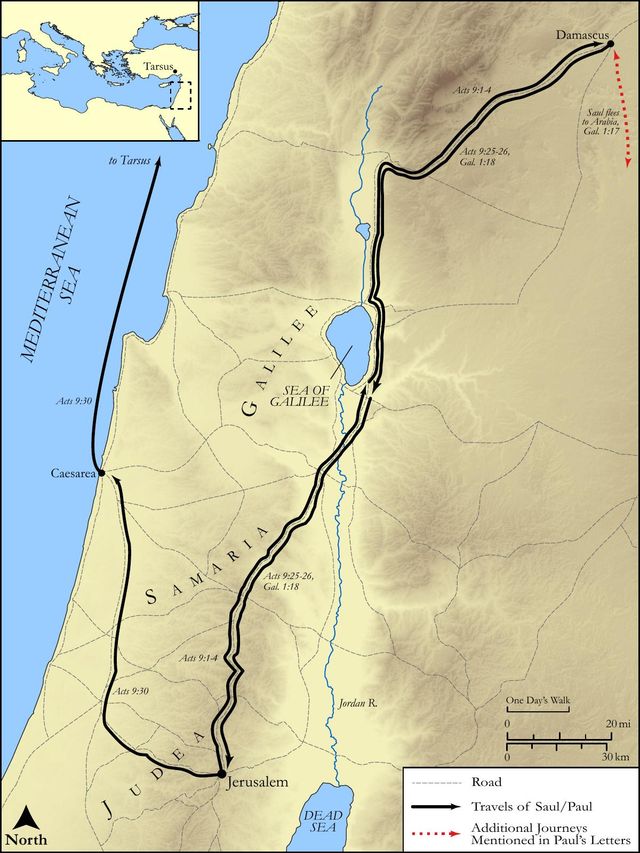
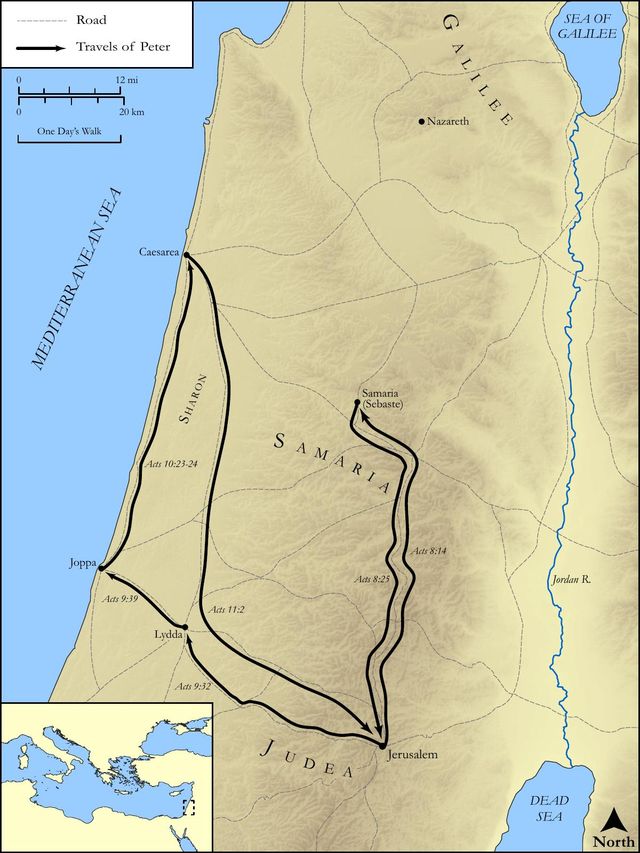
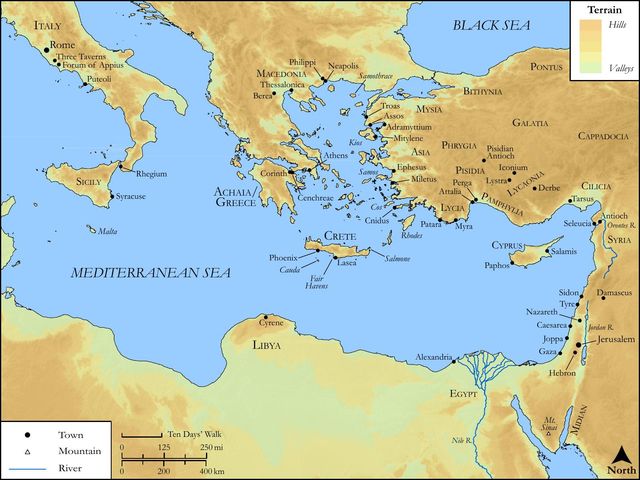
Study this verse
Public-domain commentary
Matthew Henry
From his Commentary on the Whole Bible. Henry comments on passages, not single verses — this entry covers Acts 9:1–9. His four-level outline is real structure in the source text, so it is rendered as structure.
We found mention made of Saul twice or thrice in the story of Stephen, for the sacred penman longed to come to his story; and now we are come to it, not quite taking leave of Peter but from henceforward being mostly taken up with Paul the apostle of the Gentiles, as Peter was of the circumcision. His name in Hebrew was Saul - desired, though as remarkably little in stature as his namesake king Saul was tall and stately; one of the ancients calls him, Homo tricubitalis - but four feet and a half in height; his Roman name which he went by among the citizens of Rome was Paul - little. He was born in Tarsus, a city of Cilicia, a free city of the Romans, and himself a freeman of that city. His father and mother were both native Jews; therefore he calls himself a Hebrew of the Hebrews; he was of the tribe of Benjamin, which adhered to Judah. His education was in the schools of Tarsus first, which was a little Athens for learning; there he acquainted himself with the philosophy and poetry of the Greeks. Thence he was sent to the university at Jerusalem, to study divinity and the Jewish law. His tutor was Gamaliel, an eminent Pharisee. He had extraordinary natural parts, and improved mightily in learning. He had likewise a handicraft trade (being bred to tent-making), which was common with those among the Jews who were bred scholars (as Dr. Lightfoot saith), for the earning of their maintenance, and the avoiding of idleness. This is the young man on whom the grace of God wrought this mighty change here recorded, about a year after the ascension of Christ, or little more. We are here told,
I.How bad he was, how very bad, before his conversion; just before he was an inveterate enemy to Christianity, did his utmost to root it out, by persecuting all that embraced it. In other respects he was well enough, as touching the righteousness which is of the law, blameless, a man of no ill morals, but a blasphemer of Christ, a persecutor of Christians, and injurious to both, Ti1 1:13. And so ill informed was his conscience that he thought he ought to do what he did against the name of Christ (Act 26:9) and that he did God service in it, as was foretold, Joh 16:2. Here we have,
1.His general enmity and rage against the Christian religion (Act 9:1): He yet breathed out threatenings and slaughter against the disciples of the Lord. The persons persecuted were the disciples of the Lord; because they were so, under that character he hated and persecuted them. The matter of the persecution was threatenings and slaughter. There is persecution in threatenings (Act 4:17, Act 4:21); they terrify and break the spirit: and though we say, Threatened folks live long, yet those whom Saul threatened, if he prevailed not thereby to frighten them from Christ, he slew them, he persecuted them to death, Act 22:4. His breathing out threatenings and slaughter intimates that it was natural to him, and his constant business. He even breathed in this as in his element. He breathed it out with heat and vehemence; his very breath, like that of some venomous creatures, was pestilential. He breathed death to the Christians, wherever he came; he puffed at them in his pride (Psa 12:4, Psa 12:5), spit his venom at them in his rage. Saul yet breathing thus intimates,
(1.)That he still persisted in it; not satisfied with the blood of those he had slain, he still cries, Give, give.
(2.)That he should shortly be of another mine; as yet he breathes out threatenings and slaughter, but he has not long to live such a life as this, that breath will be stopped shortly.
2.His particular design upon the Christians at Damascus; thither was the gospel now lately carried by those that fled from the persecution at Stephen's death, and thought to be safe and quiet there, and were connived at by those in power there: but Saul cannot be easy if he knows a Christian is quiet; and therefore, hearing that the Christians in Damascus were so, he resolves to give them disturbance. In order to this, he applies to the high priest for a commission (Act 9:1) to go to Damascus, Act 9:2. The high priest needed not to be stirred up to persecute the Christians, he was forward enough to do it; but it seems the young persecutor drove more furiously than the old one. Leaders in sin are the worst of sinners; and the proselytes which the scribes and Pharisees make often prove seven times more the children of hell than themselves. He saith (Act 22:5) that this commission was had from the whole estate of the elders: and proud enough this furious bigot was to have a commission directed to him, with the seal of the great sanhedrim affixed to it. Now the commission was to empower him to enquire among the synagogues, or congregations, of the Jews that were at Damascus, whether there were any that belonged to them that inclined to favour this new sect or heresy, that believed in Christ; and if he found any such, whether men or women, to bring them up prisoners to Jerusalem, to be proceeded against according to law by the great council there. Observe,
(1.)The Christians are here said to be those of this way; those of the way, so it is in the original. Perhaps the Christians sometimes called themselves so, from Christ the Way; or, because they looked on themselves as but in the way, and not yet at home; or, the enemies thus represented it as a way by itself, a by-way, a party, a faction.
(2.)The high priest and sanhedrim claimed a power over the Jews in all countries, and had a deference paid to their authority in matters of religion, by all their synagogues, even those that were not of the jurisdiction of the civil government of the Jewish nation. And such a sovereignty the Roman pontiff now claims as the Jewish pontiff then did, though he has not so much to show for it.
(3.)By this commission, all that worshipped God in the way that they called heresy, though agreeing exactly with the original institutes even of the Jewish church, whether they were men or women, were to be prosecuted. Even the weaker sex, who in a case of this nature might deserve excuse, or at least compassion, shall find neither with Saul any more than they do with the popish persecutors.
(4.)He was ordered to bring them all bound to Jerusalem as criminals of the first magnitude, which, as it would be the more likely to terrify them, so it would be to magnify Saul, as having the command of the forces that were to carry them up, and opportunity of breathing out threatenings and slaughter. Thus was Saul employed when the grace of God wrought that great change in him. Let not us then despair of renewing grace for the conversion of the greatest sinners, nor let such despair of the pardoning mercy of God for the greatest sin; for Paul himself obtained mercy, that he might be a monument, Ti1 1:13.
II.How suddenly and strangely a blessed change was wrought in him, not in the use of any ordinary means, but by miracles. The conversion of Paul is one of the wonders of the church. Here is,
1.The place and time of it: As he journeyed, he came near to Damascus; and there, Christ met with him.
(1.)He was in the way, travelling upon his journey; not in the temple, nor in the synagogue, nor in the meeting of the Christians, but by the way. The work of conversion is not tied to the church, though ordinarily public administrations are made use of. Some are reclaimed in slumberings on the bed (Job 33:15-17), and some in travelling upon the road alone: Thoughts are as free, and there is as good an opportunity of communing with our own hearts there, as upon the bed; and there the Spirit may set in with us, for that wind blows where it listeth. Some observe that Saul was spoken to abroad in the open air that there might be no suspicion of imposture, nor of a trick put upon him in it.
(2.)He was near Damascus, almost at his journey's end, ready to enter the city, the chief city of Syria. Some observe that he who was to be the apostle of the Gentiles was converted to the faith of Christ in a Gentile country. Damascus had been infamous for persecuting God's people formerly - they threshed Gilead with threshing instruments of iron (Amo 1:3), and now it was likely to be so again.
(3.)He was in a wicked way, pursuing his design against the Christians at Damascus, and pleasing himself with the thought that he should devour this new-born child of Christianity there. Note, Sometimes the grace of God works upon sinners when they are at the worst, and hotly engaged in the most desperate sinful pursuits, which is much for the glory both of God's pity and of his power.
(4.)The cruel edict and decree he had with him drew near to be put in execution; and now it was happily prevented, which may be considered,
[1.]As a great kindness to the poor saints at Damascus, who had notice of his coming, as appears by what Ananias said (Act 9:13, Act 9:14), and were apprehensive of their danger from him, and trembled as poor lambs at the approach of a ravening wolf; Saul's conversion was their security for the present. Christ has many ways of delivering the godly out of temptation, and sometimes does it by a change wrought in their persecutors, either restraining their wrathful spirits (Psa 76:10) and mollifying them for a time, as the Old Testament Saul, who relented towards David more than once (Sa1 24:16; Sa1 26:21), or renewing their spirits, and fixing upon them durable impressions, as upon the New Testament Saul here.
[2.]It was also a very great mercy to Saul himself to be hindered from executing his wicked design, in which if he had now proceeded, perhaps it had been the filling up of the measure of his iniquity. Note, It is to be valued as a signal token of the divine favour if God, either by the inward operations of his grace or the outward occurrences of his providence, prevent us from prosecuting and executing a sinful purpose, Sa1 25:32.
2.The appearance of Christ to him in his glory. Here it is only said that there shone round about him a light from heaven; but it appears from what follows (Act 9:17) that the Lord Jesus was in this light, and appeared to him by the way. He saw that just One (Act 22:14), and see Act 26:13. Whether he saw him at a distance, as Stephen saw him, in the heavens, or nearer in the air, is not certain. It is not inconsistent with what is said of the heavens receiving Christ till the end of time (Act 3:21) to suppose that he did, upon such an extraordinary occasion as this, make a personal visit, but a very short one, to this lower world; it was necessary to Paul's being an apostle that he should see the Lord, and so he did, Co1 9:1; Co1 15:8.
(1.)This light shone upon him suddenly - exaiphnēs, when Paul never thought of any such thing, and without any previous warning. Christ's manifestations of himself to poor souls are many times sudden and very surprising, and he anticipates them with the blessings of his goodness. This the disciples that Christ called to himself found. Or ever I was aware, Sol 6:12.
(2.)It was a light from Heaven, the fountain of light, from the God of heaven, the Father of lights. It was a light above the brightness of the sun (Act 26:13), for it was visible at mid-day, and outshone the sun in his meridian strength and lustre, Isa 24:23.
(3.)It shone round about him, not in his face only, but on every side of him; let him turn which way he will, he finds himself surrounded with the discoveries of it. And this was designed not only to startle him, and awaken his attention (for well may he expect to hear when he is thus made to see something very extraordinary), but to signify the enlightening of his understanding with the knowledge of Christ. The devil comes to the soul in darkness; by this he gets and keeps possession of it. But Christ comes to the soul in light, for he is himself the light of the world, bright and glorious to us, as light. The first thing in this new creation, as in that of the world, is light, Co2 4:6. Hence all Christians are said to be children of the light and of the day, Eph 5:8.
3.The arresting of Saul, and his detachment: He fell to the earth, Act 9:4. Some think that he was on foot, and that this light, which perhaps was accompanied with a thunderclap, so terrified him that he could not keep his feet, but fell upon his face, usually a posture of adoration, but here of astonishment. It is probable that he was mounted, as Balaam, when he went to curse Israel, and perhaps better mounted than he; for Saul was now in a public post, was in haste, and the journey was long, so that it is not likely he should travel on foot. The sudden light would frighten the beast he rode on, and make it throw him; and it was God's good providence that his body got no hurt by the fall: but angels had a particular charge concerning him, to keep all his bones, so that not one of them was broken. It appears (Act 26:14) that all that were with him fell to the earth as well as he, but the design was upon him. This may be considered,
(1.)As the effect of Christ's appearing to him, and of the light which shone round about him. Note, Christ's manifestations of himself to poor souls are humbling; they lay them very low, in mean thoughts of themselves, and a humble submission to the will of God. Now mine eyes see thee, saith Job, I abhor myself. I saw the Lord, saith Isaiah, sitting upon a throne, and I said, Woe is me, for I am undone.
(2.)As a step towards this intended advancement. He is designed not only to be a Christian, but to be a minister, an apostle, a great apostle, and therefore he must thus be cast down. Note, Those whom Christ designs for the greatest honours are commonly first laid low. Those who are designed to excel in knowledge and grace are commonly laid low first, in a sense of their own ignorance and sinfulness. Those whom God will employ are first struck with a sense of their unworthiness to be employed.
4.The arraigning of Saul. Being by the fall taken into custody, and as it were set to the bar, he heard a voice saying to him (and it was distinguishing, to him only, for though those that were with him heard a sound, Act 9:7, yet they knew not the words, Act 22:9), Saul, Saul, why persecutest thou me? Observe here,
(1.)Saul not only saw a light from heaven, but heard a voice from heaven; wherever the glory of God was seen, the word of God was heard (Exo 20:18); and to Moses (Num 7:89); and to the prophets. God's manifestations of himself were never dumb shows, for he magnifies his word above all his name, and what was seen was alway designed to make way for what was said. Saul heard a voice. Note, Faith comes by hearing; hence the Spirit is said to be received by the hearing of faith, Gal 3:2. The voice he heard was the voice of Christ. When he saw that just One, he heard the voice of his mouth, Act 22:14. Note, The word we hear is likely to profit us when we hear it as the voice of Christ, Th1 2:13. It is the voice of my beloved; no voice but his can reach the heart. Seeing and hearing are the two learning senses; Christ here, by both these doors, entered into Saul's heart.
(2.)What he heard was very awakening.
[1.]He was called by his name, and that doubled: Saul, Saul. Some think, in calling him Saul, he hints at that great persecutor of David whose name he bore. He was indeed a second Saul, and such an enemy to the Son of David as the other was to David. Calling him by his name intimates the particular regard that Christ had to him: I have surnamed thee, though thou hast not known me, Isa 45:4 See Exo 33:12. His calling him by name brought the conviction home to his conscience, and put it past dispute to whom the voice spoke this. Note, What God speaks in general is then likely to do us good when we apply it to ourselves, and insert our own names into the precepts and promises which are expressed generally, as if God spoke to us by name, and when he saith, Ho, every one, he had said, Ho, such a one: Samuel, Samuel; Saul, Saul. The doubling of it, Saul, Saul, intimates, First, The deep sleep that Saul was in; he needed to be called again and again, as Jer 22:29, O earth, earth, earth. Secondly, The tender concern that the blessed Jesus had for him, and for his recovery. He speaks as one in earnest; it is like Martha, Martha (Luk 10:41), or Simon, Simon (Luk 22:31), or O Jerusalem, Jerusalem, Mat 23:37. He speaks to him as to one in imminent danger, at the pit's brink, and just ready to drop in: "Saul, Saul, dost thou know whither thou art going, or what thou art doing?"
[2.]The charge exhibited against him is, Why persecutest thou me? Observe here, First, Before Saul was made a saint, he was made to see himself a sinner, a great sinner, a sinner against Christ. Now he was made to see that evil in himself which he never saw before; sin revived and he died. Note, A humbling conviction of sin is the first step towards a saving conversion from sin. Secondly, He is convinced of one particular sin, which he was most notoriously guilty of, and had justified himself in, and thereby way is made for his conviction of all the rest. Thirdly, The sin he is convinced of is persecution: Why persecutest thou me? It is a very affectionate expostulation, enough to melt a heart of stone. Observe, 1. The person sinning: "It is thou; thou, that art not one of the ignorant, rude, unthinking crowd, that will run down any thing they hear put into an ill name, but thou that hast had a liberal learned education, has good parts and accomplishments, hast the knowledge of the scriptures, which, if duly considered, would show thee the folly of it. It is worse in thee than in another." 2. The person sinned against: "It is I, who never did thee any harm, who came from heaven to earth to do thee good, who was not long since crucified for thee; and was not that enough, but must I afresh be crucified by thee?" 3. The kind and continuance of the sin. It was persecution, and he was at this time engaged in it: "Not only thou hast persecuted, but thou persecutest, thou persistest in it." He was not at this time hauling any to prison, nor killing them; but this was the errand he came upon to Damascus; he was now projecting it, and pleasing himself with the thought of it. Note, Those that are designing mischief are, in God's account, doing mischief. 4. The question put to him upon it: "Why dost thou do it?" (1.) It is complaining language. "Why dealest thou thus unjustly, thus unkindly, with my disciples?" Christ never complained so much of those who persecuted him in his own person as he did here of those who persecuted him in his followers. He complains of it as it was Saul's sin: "Why art thou such an enemy to thyself, to thy God?" Note, The sins of sinners are a very grievous burden to the Lord Jesus. He is grieved for them (Mar 3:5), he is pressed under them, Amo 2:13. (2.) It is convincing language: "Why dost thou thus: Canst thou give any good reason for it?" Note, It is good for us often to ask ourselves why we do so and so, that we may discern what an unreasonable thing sin is: and of all sins none so unreasonable, so unaccountable, as the sin of persecuting the disciples of Christ, especially when it is discovered to be, as certainly it is, persecuting Christ. Those have no knowledge who eat up God's people, Psa 14:4. Why persecutest thou me? He thought he was persecuting only a company of poor, weak, silly people, that were an offence and eye-sore to the Pharisees, little imagining that is was one in heaven that he was all this while insulting; for surely, if he had known, he would not have persecuted the Lord of glory. Note, Those who persecute the saints persecute Christ himself, and he takes what is done against them as done against himself, and accordingly will be the judgment in the great day, Mat 25:45.
5.Saul's question upon his indictment, and the reply to it, Act 9:5.
(1.)He makes enquiry concerning Christ: Who art thou, Lord? He gives no direct answer to the charge preferred against him, being convicted by his own conscience, and self-condemned. If God contend with us for our sins, we are not able to answer for one of a thousand, especially such a one as the sin of persecution. Convictions of sin, when they are set home with power upon the conscience, will silence all excuses and self-justifications. Though I were righteous, yet would I not answer. But he desires to know who is his judge; the compellation is respectful: Lord. He who had been a blasphemer of Christ's name now speaks to him as his Lord. The question is proper: Who art thou? This implies his present unacquaintedness with Christ; he knew not his voice as his own sheep do, but he desired to be acquainted with him; he is convinced by this light which encloses him that it is one from heaven that speaks to him, and he has a veneration for every thing that appears to him to come from heaven; and therefore, Lord, who art thou? What is thy name? Jdg 13:17; Gen 32:29. Note, there is some hope of people when they begin to enquire after Jesus Christ.
(2.)He has an answer immediately, in which we have,
[1.]Christ's gracious revelation of himself to him. He is always ready to answer the serious enquiries of those who covet an acquaintance with him: I am Jesus whom thou persecutest. The name of Jesus was not unknown to him; his heart had risen against it many a time, and gladly would he bury it in oblivion. He knew it was the name that he persecuted, but little did he think to hear it from heaven, or from the midst of such a glory as now shone round about him. Note, Christ brings souls into fellowship with himself by manifesting himself to them. He said, First, I am Jesus, a Saviour; I am Jesus of Nazareth, so it is, Act 22:8. Saul used to call him so when he blasphemed him: "I am that very Jesus whom thou usedst to call in scorn Jesus of Nazareth." And he would show that now that he is in his glory he is not ashamed of his humiliation. Secondly, "I am that Jesus whom thou persecutest, and therefore it will be at thy peril if thou persist in this wicked course." There is nothing more effectual to awaken and humble the soul than to see sin to be against Christ, an affront to him, and a contradiction to his designs.
[2.]His gentle reproof of him: It is hard for thee to kick against the pricks, or goads - to spurn at the spur. It is hard, it is in itself an absurd and evil thing, and will be of fatal consequence to him that does it. Those kick at the goad that stifle and smother the convictions of conscience, that rebel against God's truths and laws, that quarrel with his providences, and that persecute and oppose his ministers, because they reprove them, and their words are as goads and as nails. Those that revolt more and more when they are stricken by the word or rod of God, that are enraged at reproofs and fly in the face of their reprovers, kick against the pricks and will have a great deal to answer for.
6.His surrender of himself to the Lord Jesus at length, Act 9:6. See here,
(1.)The frame and temper he was in, when Christ had been dealing with him.
[1.]He trembled, as one in a great fright. Note, Strong convictions, set home by the blessed Spirit, will make an awakened soul to tremble. How can those choose but tremble that are made to see the eternal God provoked against them, the whole creation at war with them, and their own souls upon the brink of ruin!
[2.]He was astonished, was filled with amazement, as one brought into a new world, that knew not where he was. Note, The convincing, converting, work of Christ is astonishing to the awakened soul, and fills it with admiration. "What is this that God has done with me, and what will he do?"
(2.)His address to Jesus Christ, when he was in this frame: Lord, what wilt thou have me to do? This may be taken,
[1.]As a serious request for Christ's teachings: "Lord, I see I have hitherto been out of the way; thou hast shown me my error, set me to rights; thou hast discovered sin to me, discover to me the way to pardon and peace." It is like that, Men and brethren, what must we do? Note, A serious desire to be instructed by Christ in the way of salvation is an evidence of a good work begun in the soul. Or,
[2.]As a sincere resignation of himself to the direction and government of the Lord Jesus. This was the first word that grace spoke in Paul, and with this began a spiritual life: Lord Jesus, What wilt thou have me to do? Did not he know what he had to do? Had he not his commission in his pocket? And what had he to do but to execute it? No, he had done enough of this work already, and resolves now to change his master, and employ himself better. Now it is not, What will the high priest and the elders have me to do? What will my own wicked appetites and passions have me to do? But, What wilt thou have me to do? The great change in conversion is wrought upon the will, and consists in the resignation of that to the will of Christ.
(3.)The general direction Christ gave him, in answer to this: Arise, go into the city of Damascus, which thou art now near to, and it shall be told thee what thou must do. It is encouragement enough to have further instruction promised him, but,
[1.]He must not have it yet; it shall be told him shortly what he must do, but, for the present, he must pause upon what has been said to him, and improve that. Let him consider awhile what he has done in persecuting Christ, and be deeply humbled for that, and then he shall be told what he has further to do.
[2.]He must not have it in this way, by a voice from heaven, for it is plain that he cannot bear it; he trembles, and is astonished. He shall be told therefore what he must do by a man like himself, whose terror shall not make him afraid, nor his hand be heavy upon him, which Israel desired at mount Sinai. Or, it is an intimation that Christ would take some other time to manifest himself further to him, when he was more composed, and this fright pretty well over. Christ manifests himself to his people by degrees; and both what he does and would he have them to do, though they know not now, they shall know hereafter.
7.How far his fellow travellers were affected with this, and what impression it made upon them. They fell to the earth, as he did, but rose without being bidden, which he did not, but lay still till it was said to him, Arise; for he lay under a heavier load than any of them did; but when they were up,
(1.)They stood speechless, as men in confusion, and that was all, Act 9:7. They were going on the same wicked errand that Paul was, and perhaps, to the best of their power, were as spiteful as he; yet we do not find that any of them were converted, though they saw the light, and were struck down and struck dumb by it. No external means will of themselves work a change in the soul, without the Spirit and grace of God, which distinguish between some and others; among these that journeyed together, one is taken, and the others left. They stood speechless; none of them said, Who art thou, Lord? or, What wilt thou have me to do? as Paul did, but none of God's children are born dumb.
(2.)They heard a voice, but saw no man; they heard Paul speak, but saw not him to whom he spoke, nor heard distinctly what was said to him: which reconciles it with what is said of this matter, Act 22:9, where it is said, They saw the light and were afraid (which they might do and yet see no man in the light, as Paul did), and that they heard not the voice of him that spoke to Paul, so as to understand what he said, though they did hear a confused noise. Thus those who came hither to be the instruments of Paul's rage against the church serve for witnesses of the power of God over him.
8.What condition Saul was in after this, Act 9:8, Act 9:9.
(1.)He arose from the earth, when Christ commanded him, but probably not without help, the vision had made him so faint and weak, I will not say like Belshazzar, when the joints of his loins were loosed and his knees smote one against another, but like Daniel, when upon the sight of a vision no strength remained in him, Dan 10:16-17.
(2.)When his eyes were opened, he found that his sight was gone, and he saw no man, none of the men that were with him, and began now to be busy about him. It was not so much this glaring light that, by dazzling his eyes, had dimmed them - Nimium sensibile laedit sensum; for then those with him would have lost their sight too; but it was a sight of Christ, whom the rest saw not, that had this effect upon him. Thus a believing sight of the glory of God in the face of Christ dazzles the eyes to all things here below. Christ, in order to the further discovery of himself and his gospel to Paul, took him off from the sight of other things, which he must look off, that he may look unto Jesus, and to him only.
(3.)They led him by the hand into Damascus; whether to a public house, or to some friend's house, is not certain; but thus he who thought to have led the disciples of Christ prisoners and captives to Jerusalem was himself led a prisoner and a captive to Christ into Damascus. He was thus taught what need he had of the grace of Christ to lead his soul (being naturally blind and apt to mistake) into all truth.
(4.)He lay without sight, and without food, neither did eat nor drink for three days, Act 9:9. I do not think, as some do, that now he had his rapture into the third heavens, which he speaks of, 2 Cor. 12. So far from this that we have reason to think he was all this time rather in the belly of hell, suffering God's terrors for his sins, which were now set in order before him: he was in the dark concerning his own spiritual state, and was so wounded in spirit for sin that he could relish neither meat nor drink.
Historical interpretation
Five Centuries of Reception
3 surviving comments on this verse. Each one is dated, so this reads as a timeline rather than a list.
Select a marker to jump to its quote. Markers stagger vertically where authors wrote within a few decades of each other.
For consider what glory it is to set aside the lusts of this life, and to oppose a mind withdrawn from all commerce with nature and the world, to all the opposition of the adversary, and to have no dread of the cruelty of the torturer; that a man should be animated by the suffering whereby he might be believed to be destroyed, and should take to himself, as an enhancement of his strength, that which the punisher thinks will aggravate his torments. For although the hook, springing forth from the stiffening ribs, is put back again into the wound, and with the repeated strokes of the whip the returning lash is drawn away with the rent portions of the flesh; still he stands immoveable, the stronger for his sufferings, revolving only this in his mind, that in that brutality of the executioners Christ Himself is suffering more in proportion to what he suffers. For since, if he should deny the Lord, he would incur guilt on His behalf for whom he ought to have overcome, it is essential that He should be seen to bear all things to whom the victory is due, even in the suffering.
And he said, Who art Thou Lord? thus in the first place confessing himself His servant. And the Lord said, I am Jesus, whom thou persecutest: think not thy warring is with men.
I am Jesus, whom you are persecuting. He did not say: I am God, I am the Son of God, but he says: Accept the weakness of my humility and lay down the scales of your pride.
Continue studying Acts 9:5 across the web’s major study libraries — every link below opens this exact verse, chapter, or book on the destination site.
Read & Compare
 BibleGatewayThis verse in more than 200 translations and 70 languages.
 Bible.comThe YouVersion reader — hundreds of translations, reading plans, and highlights.
 ESV.orgCrossway's official English Standard Version reader.
 NET BibleThe NET translation with 60,000+ translators' notes on every rendering decision.
 STEP BibleTyndale House's free study tool — original text, vocabulary, and scholarly resources.
 BibliaLogos Bible Software's free web reader.
 USCCBThe New American Bible (Revised Edition) with the U.S. bishops' study notes.
Commentaries
 BibleHub CommentariesDozens of classic commentaries on this verse, gathered on one page.
 StudyLightMore than 100 commentary sets — the largest collection on the web.
 BibleRefPlain-English commentary on what this verse means, verse by verse.
 Enduring WordDavid Guzik's free commentary on this chapter, widely used by Bible teachers.
 Bible Study ToolsVerse commentary alongside Greek and Hebrew study aids.
Original Language & Research
- BibleHub InterlinearThe verse word by word — original language, transliteration, and English.
- BibleHub LexiconEvery word's original-language definition and Strong's entry.
 Blue Letter BibleDeep-study tools — Strong's numbers, concordance, and word studies.
 CNTR CollationThe earliest Greek manuscripts of this verse, collated letter by letter.
Sermons, Hymns & Audio


TrulyRandomVerse is not affiliated with these sites and doesn’t control their content. They’re linked because they’re genuinely useful.
Summary
Acts 9:5 records the dramatic and life-altering encounter between the resurrected Jesus Christ and Saul of Tarsus on the road to Damascus. This pivotal moment, marked by a blinding light and an audible voice, reveals Jesus' direct identification with His persecuted followers and issues a profound warning against resisting divine will, setting the stage for Saul's radical conversion into the Apostle Paul, a foundational figure in the early Christian church.
Context
ShowHideLiterary Context
This verse is the climax of Saul's initial confrontation with the risen Christ, immediately following the blinding light and the voice from heaven described in Acts 9:3-4. Prior to this, Saul is introduced as a zealous persecutor of the church, "breathing out threatenings and slaughter against the disciples of the Lord" (Acts 9:1). His journey to Damascus was explicitly for the purpose of arresting Christians and bringing them back to Jerusalem for punishment. The question "Who art thou, Lord?" signifies Saul's immediate recognition of a divine, authoritative presence, even if he doesn't yet grasp its identity, and his subsequent obedience to the voice's command to enter the city marks the beginning of his transformation.
Historical & Cultural Context
Saul was a Pharisee, a highly educated and devout Jew of the strictest sect, fervently committed to the Mosaic Law and traditional Judaism. From his perspective, the burgeoning Christian movement, which proclaimed a crucified Messiah and challenged the established religious order, was a dangerous heresy that needed to be eradicated. Damascus, a major city in Syria, had a significant Jewish population and, consequently, a growing community of Jewish believers in Jesus. The Roman Empire, while generally tolerant of diverse religions, would have viewed internal Jewish disputes with a degree of detachment unless they threatened civil order. The idiom "to kick against the pricks" (or goads) was a common Greek proverb, found in classical literature (e.g., Aeschylus, Euripides), referring to the futility and self-inflicted pain of resisting an irresistible force, particularly divine will or fate. This proverb would have been culturally familiar to a Hellenized Jew like Saul.
Key Themes
ShowHideActs 9:5 powerfully contributes to several overarching themes in the book of Acts and broader New Testament theology. Firstly, it underscores the theme of Divine Sovereignty and Initiative, demonstrating that God actively intervenes in human affairs, even in the lives of His opponents, to accomplish His purposes. Secondly, it introduces the profound theme of Christ's Identification with His Church, as Jesus declares that persecuting His followers is equivalent to persecuting Him directly. This idea becomes a cornerstone of Paul's later theology, emphasizing the intimate union between Christ and believers, often articulated through the metaphor of the church as the Body of Christ. Thirdly, the "kick against the pricks" idiom highlights the Futility of Resisting God's Will, illustrating that opposition to divine truth or purpose is not only pointless but ultimately self-destructive, a concept echoed in passages like Psalm 2:4-5.
Exposition and Analysis
ShowHideKey Word Analysis
ShowHideIn Saul's initial question, "Who art thou, Lord?", this term (G2962) signifies a respectful address to an authoritative figure, acknowledging a superior presence, possibly divine, but not necessarily identifying Jesus as the Messiah. However, when Jesus uses "the Lord" (G2962) to identify Himself, it shifts to denote supreme authority and mastery, asserting His divine identity and control over Saul's life and actions.
This verb (G1377) describes Saul's intense and aggressive pursuit of Christians, aiming to harass, oppress, and ultimately eliminate them. The word implies a relentless and hostile chase, driven by a conviction that he was stamping out a dangerous heresy. Jesus' use of this word directly links Saul's actions against believers to an attack against Himself, highlighting the profound unity between Christ and His church.
This noun (G2759) refers to a sharp-pointed stick or goad used by farmers to prod or guide oxen. Figuratively, it denotes a painful stimulus or a divine impulse that one resists. The imagery conveys the idea that Saul's opposition to Christ and His followers was not only futile but also causing him internal spiritual distress or "pricks" of conscience, as he was fighting against the very truth he was meant to embrace.
Verse Breakdown
ShowHide"And he said, Who art thou, Lord?"
Saul's immediate response to the blinding light and the authoritative voice is a question that acknowledges a superior, possibly divine, presence. The term "Lord" (kýrios) here indicates respect and an implicit recognition of authority, rather than a full understanding of Jesus' identity as the Messiah. It reflects his bewilderment and perhaps a dawning realization that he is confronting something beyond human power.
"And the Lord said, I am Jesus whom thou persecutest:"
This is the core revelation. The voice identifies itself as "Jesus," the very person whose followers Saul is relentlessly pursuing. This statement profoundly connects the persecuted church with Christ Himself, establishing a theological principle that became central to Paul's later writings: an attack on His disciples is an attack on the Lord. This direct, personal identification shatters Saul's previous understanding and purpose.
"[it is] hard for thee to kick against the pricks."
This proverbial statement, likely a common Greek idiom, uses the imagery of an ox stubbornly resisting the goad of its driver. "Hard" (sklērós) implies difficulty, pain, and futility. Jesus reveals that Saul's zealous persecution of Christians was not only futile but also self-damaging, causing him spiritual anguish or internal conflict as he fought against God's will. It suggests that Saul may have already been experiencing a degree of inner turmoil or conviction, making his resistance increasingly painful and unsustainable.
Literary Devices
ShowHideThe passage employs several potent Literary Devices. The most prominent is Metaphor, specifically the agricultural idiom "to kick against the pricks." This vivid image of an ox resisting a goad powerfully conveys the futility and self-inflicted pain of opposing a superior, irresistible force, in this case, the divine will of God. It serves as a Foreshadowing of Saul's inevitable defeat and transformation. The direct, confrontational Dialogue between Jesus and Saul is also a key device, creating dramatic tension and highlighting the personal nature of God's intervention. The use of Irony is also present: Saul, believing he is serving God by persecuting Christians, is confronted by God Himself, who reveals that Saul is actually persecuting Him. This dramatic reversal underscores the profound misunderstanding and misdirection of Saul's zeal.
Theological and Thematic Connections
ShowHideActs 9:5 lays a foundational theological truth: the profound unity between Christ and His people. Jesus' direct declaration, "I am Jesus whom thou persecutest," reveals that persecution against His followers is a direct assault on Him. This concept is revolutionary for Saul and becomes a cornerstone of Paul's later understanding of the church as the Body of Christ, where believers are intimately connected to their Head. It underscores the spiritual reality that Christ is not distant from His suffering church but intimately identifies with their experiences, taking their persecution as His own. This divine solidarity elevates the status of believers and provides immense comfort and meaning to their suffering.
Reflection and Application
ShowHideThe encounter in Acts 9:5 serves as a powerful reminder of God's sovereign ability to intervene in even the most hardened hearts and redirect lives towards His divine purpose. For us today, it prompts deep introspection: are there areas in our lives where we are "kicking against the pricks"? Are we stubbornly resisting God's gentle prodding, His revealed truth, or His call to a particular path? Such resistance, though seemingly an assertion of our will, ultimately leads to self-inflicted pain and hinders our spiritual growth. Furthermore, Jesus' identification with His persecuted church challenges us to re-evaluate how we treat others, especially those within the body of Christ and the lowly. Our actions towards them are, in a very real sense, actions towards Christ Himself. This verse calls us to humility, openness to divine revelation, and a compassionate identification with all who bear the name of Christ, recognizing His presence in them.
Questions for Reflection
ShowHideFAQ
ShowHideWhat does the phrase "it is hard for thee to kick against the pricks" mean?
ShowHideThis is an ancient Greek proverb, likely familiar to Saul, that uses an agricultural metaphor. "Pricks" (or goads) were sharp sticks used by farmers to prod and guide oxen. An ox that stubbornly "kicked against the pricks" would only hurt itself more, as the goad would dig deeper into its flesh. Jesus uses this idiom to convey that Saul's relentless persecution of Christians was not only futile in resisting God's ultimate plan but was also causing him internal pain, spiritual distress, or a gnawing sense of conviction. He was fighting against divine truth and purpose, and this resistance was self-damaging. It suggests that Saul's conscience may have already been "pricked" by the truth he was suppressing, making his opposition increasingly difficult and personally costly.
Christ-Centered Fulfillment
ShowHideActs 9:5 is profoundly Christ-centered, not merely as an encounter with the historical Jesus, but as a revelation of His ongoing, living reality as the resurrected Lord. Jesus' declaration, "I am Jesus whom thou persecutest," unveils a fundamental truth about His identity and His intimate relationship with His people. This is not merely a statement of personal identity but a theological cornerstone, revealing that the suffering of His followers is His suffering, and their persecution is His persecution. This concept foreshadows Paul's later, extensive theological development of the church as the Body of Christ, where Christ is the Head and believers are His members, inextricably linked. The "pricks" Saul was kicking against were not just the individual believers, but the very divine will and purpose embodied in the risen Christ and His new covenant community. Jesus' intervention here demonstrates His active sovereignty over all things, even over those who vehemently oppose Him, proving that His redemptive plan cannot be thwarted. This sovereign power, displayed in the conversion of His chief persecutor, points to the ultimate triumph of the Lamb of God, who, having been crucified and raised, now reigns as Lord, drawing all people to Himself, even those who initially resist His grace. This encounter is a powerful testament to the transformative power of the gospel and the boundless mercy of Christ, who pursues even His enemies to make them His most devoted servants.