


Acts 3:21
Bible text: King James Version (1769 Blayney text) · Public domain
Bible text: King James Version with Strong's numbers · Public domain
Bible text: Berean Standard Bible · Public domain
Bible text: American Standard Version (1901) · Public domain
Bible text: World English Bible, Messianic edition · Public domain
Bible text: Geneva Bible (1599) · Public domain
Bible text: Young's Literal Translation · Public domain
- ὃνhonwhomG3739R-ASMRelative pronoun Accusative Singular Masculine
- δεῖdeiit behoovesG1163V-PAI-3SVerb Present Active Indicative 3rd Singular
- οὐρανὸνouranonheavenG3772N-ASMNoun Accusative Singular Masculine
- μὲνmenindeedG3303PRTParticle or Disjunctive
- δέξασθαιdexasthaito receiveG1209V-ADNVerb Aorist Middle Deponent Infinitive
- ἄχριachriuntilG891PREPPreposition
- χρόνωνchronōn[the] timesG5550N-GPMNoun Genitive Plural Masculine
- ἀποκαταστάσεωςapokatastaseōsof restorationG605N-GSFNoun Genitive Singular Feminine
- πάντωνpantōnof all thingsG3956A-GPNAdjective Genitive Plural Neuter
- ὧνhōnof whichG3739R-GPNRelative pronoun Genitive Plural Neuter
- ἐλάλησενelalēsenspokeG2980V-AAI-3SVerb Aorist Active Indicative 3rd Singular
- ὁho<the>G3588T-NSMDefinite article Nominative Singular Masculine
- θεὸςtheosGodG2316N-NSM-TNoun Nominative Singular Masculine Title
- διὰdiathroughG1223PREPPreposition
- στόματοςstomatos[the] mouthG4750N-GSNNoun Genitive Singular Neuter
- πάντωνpantōnof allG3956A-GPMAdjective Genitive Plural Masculine
- τῶνtōntheG3588T-GPMDefinite article Genitive Plural Masculine
- ἁγίωνhagiōnholyG40A-GPMAdjective Genitive Plural Masculine
- ἀπ᾽ap᾽fromG575PREPPreposition
- αἰῶνοςaiōnos[the] ageG165N-GSMNoun Genitive Singular Masculine
- αὐτοῦautouof HimG846P-GSMPersonal pronoun Genitive Singular Masculine
- προφητῶνprophētōnprophetsG4396N-GPMNoun Genitive Plural Masculine
English is a literal word-by-word gloss of the Greek, not the KJV's wording. Why?
This is the original text the KJV's translators worked from — each Greek word with its own literal English meaning in this verse, prepared by scholars at Tyndale House, Cambridge. The KJV translates whole sentences, not word by word, so its wording differs: one Greek word can become several English words, and the KJV may choose “charity” where the gloss reads “love”. Both are faithful — they answer different questions. For the KJV's own rendering, switch to the KJV text.
Details
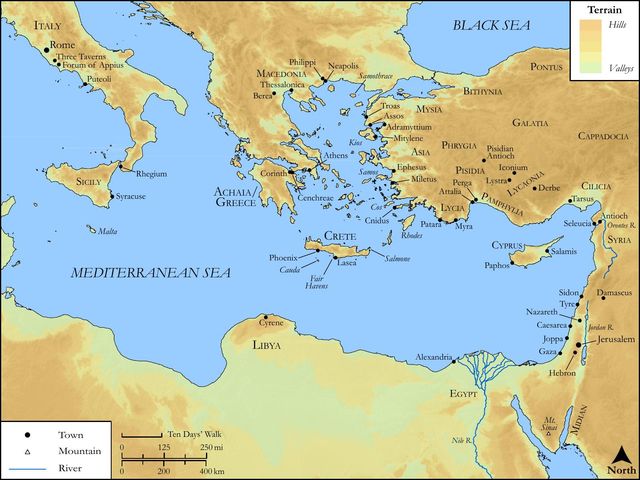
See on the biblical-era map
Study this verse
Public-domain commentary
Matthew Henry
From his Commentary on the Whole Bible. Henry comments on passages, not single verses — this entry covers Acts 3:12–26. His four-level outline is real structure in the source text, so it is rendered as structure.
We have here the sermon which Peter preached after he had cured the lame man. When Peter saw it. 1. When he saw the people got together in a crowd, he took that opportunity to preach Christ to them, especially the temple being the place of their concourse, and Solomon's porch there: let them come and hear a more excellent wisdom than Solomon's, for, behold, a greater than Solomon is here preached. 2. When he saw the people affected with the miracle, and filed with admiration, then he sowed the gospel seed in the ground which was thus broken up, and prepared to receive it. 3. When he saw the people ready to adore him and John, he stepped in immediately, and diverted their respect from them, that it might be directed to Christ only; to this he answered presently, as Paul and Barnabas at Lystra. See ch. xiv. 14, 15. In the sermon,
I.He humbly disclaims the honour of the miracle as not due to them, who were only the ministers of Christ, or instruments in his hand for the doing of it. The doctrines they preached were not of their own invention, nor were the seals of it their own, but his whose the doctrines were. He addresses himself to them as men of Israel, men to whom pertained, not only the law and the promises, but the gospel and the performances, and who were nearly interested in the present dispensation. Two things he asks them:—1. Why they were so surprised at the miracle itself: Why marvel you at this? It was indeed marvellous, and they justly wondered at it, but it was not more than what Christ had done many a time, and they had not duly regarded it, nor been affected with it. It was but a little before that Christ had raised Lazarus from the dead; and why should this then seem so strange? Note, Stupid people think that strange now which might have been familiar to them if it had not been their own fault. Christ had lately risen from the dead himself; why did they not marvel at this? why were they not convinced by this? 2. Why they gave so much of the praise of it to them, who were only the instruments of it: Why look you so earnestly on us? (1.) It was certain that they had made this man to walk, by which it appeared that the apostles not only were sent of God, but were sent to be blessings to the world, benefactors to mankind, and were sent to heal sick and distempered souls, that were spiritually lame and impotent, to set broken bones, and make them rejoice. (2.) Yet they did not do it by any power or holiness of their own. It was not done by any might of their own, any skill they had in physic or surgery, nor any virtue in their word: the power they did it by was wholly derived from Christ. Nor was it done by any merit of their own; the power which Christ gave them to do it they had not deserved: it was not by their own holiness; for, as they were weak things, so they were foolish things, that Christ chose to employ; Peter was a sinful man. What holiness had Judas? Yet he wrought miracles in Christ's name. What holiness any of them had it was wrought in them, and they could not pretend to merit by it. (3.) It was the people's fault that they attributed it to their power and holiness, and accordingly looked at them. Note, The instruments of God's favour to us, though they must be respected, must not be idolized; we must take heed of reckoning that to be done by the instrument which God is the author of. (4.) It was the praise of Peter and John that they would not take the honour of this miracle to themselves, but carefully transmitted it to Christ. Useful men must see to it that they be very humble. Not unto us, O Lord, not unto us, but to thy name give glory. Every crown must be cast at the feet of Christ; not I, but the grace of God with me.
II.He preaches Christ to them; this was his business, that he might lead them into obedience to Christ.
1.He preaches Christ, as the true Messiah promised to the fathers (v. 13); for,
(1.)He is Jesus the Son of God; though they had lately condemned Christ as a blasphemer for saying that he was the Son of God, yet Peter avows it: he is his Son Jesus; to him dear as a Son; to us, Jesus, a Saviour.
(2.)God hath glorified him, in raising him up to be king, priest, and prophet, of his church; he glorified him in his life and in his death, as well as in his resurrection and ascension.
(3.)He hath glorified him as the God of our fathers, whom he names with respect (for they were great names with the men of Israel, and justly), the God of Abraham, of Isaac, and of Jacob. God sent him into the world, pursuant to the promises made to those patriarchs, that in their seed the families of the earth should be blessed, and the covenant made with them, that God would be a God to them, and their seed. The apostles call the patriarchs their fathers, and God the God of those patriarchs from whom the Jews were descended, to intimate to them that they had no evil design upon the Jewish nation (that they should look upon them with a jealous eye), but had a value and concern for it, and were hereby well-wishers to it; and the gospel they preached was the revelation of the mind and will of the God of Abraham. See ch. xxvi. 7, 22; Luke i. 72, 73.
2.He charges them flatly and plainly with the murder of this Jesus, as he had done before. (1.) "You delivered him up to your chief priests and elders, the representative body of the nation; and you of the common people were influenced by them to clamour against him, as if he had been a public grievance." (2.) "You denied him, and you disowned him, would not have him then to be your king, could not look upon him as the Messiah, because he came not in external pomp and power; you denied him in the presence of Pilate, renounced all the expectations of your church, in the presence of the Roman governor, who justly laughed at you for it; you denied him against the face of Pilate" (so Dr. Hammond), "in defiance of his reasonings with you" (Pilate had determined to let him go, but the people opposed it, and overruled him). "You were worse than Pilate, for he would have released him, if you had let him follow his own judgment. You denied the Holy One and the Just, who had approved himself so, and all the malice of his persecutors could not disprove it." The holiness and justice of the Lord Jesus, which are something more than his innocency, were a great aggravation of the sin of those that put him to death. (3.) "You desired a murderer to be released, and Christ crucified; as if Barabbas had deserved better at your hands than the Lord Jesus, than which a greater affront could not be put upon him." (4.) You killed the prince of life. Observe the antithesis: "You preserved a murderer, a destroyer of life; and destroyed the Saviour, the author of life. You killed him who was sent to be to you the prince of life, and so not only forsook, but rebelled against your own mercies. You did an ungrateful thing, in taking away his life who would have been your life. You did a foolish thing to think you could conquer the prince of life, who has life in himself, and would soon resume the life he resigned."
3.He attests his resurrection as before, ch. xi. 32. "You thought the prince of life might be deprived of his life, as any other prince might be deprived of his dignity and dominion, but you found yourselves mistaken, for God raised him from the dead; so that in putting him to death you fought against God, and were baffled. God raised him from the dead, and thereby ratified his demands, and confirmed his doctrine, and rolled away all the reproach of his sufferings, and for the truth of his resurrection we are all witnesses."
4.He ascribes the cure of this impotent man to the power of Christ, (v. 16): His name, through faith in his name, in that discovery which he hath made of himself, has made this man strong. He repeats it again, The faith which is by him hath given him this soundness. Here, (1.) He appeals to themselves concerning the truth of the miracle; the man on whom it was wrought is one whom you see, and know, and have known; he was not acquainted with Peter and John before, so that there was no room to suspect a compact between them: "You know him to have been a cripple from a child. The miracle was wrought publicly, in the presence of you all; not in a corner, but in the gate of the temple; you saw in what manner it was done, so that there could be no juggle in it; you had liberty to examine it immediately, and may yet. The cure is complete; it is a perfect soundness; you see the man walks and leaps, as one that has no remainder either of weakness or pain." (2.) He acquaints them with the power by which it was wrought. [1.] It is done by the name of Christ, not merely by naming it as a spell or charm, but it is done by us as professors and teachers of his name, by virtue of a commission and instructions we have received from him, and a power which he has invested us with, that name which Christ has above every name; his authority, his command has done it; as writs run in the king's name, though it is an inferior officer that executes them. [2.] The power of Christ is fetched in through faith in his name, a confidence in him, a dependence on him, a believing application to him, and expectation from him, even that faith which is, di autou—by him, which is of his working; it is not of ourselves, it is the gift of Christ; and it is for his sake, that he may have the glory of it; for he is both the author and finisher of our faith. Dr. Lightfoot suggests that faith is twice named in this verse, because of the apostles' faith in doing this miracle and the cripple's faith in receiving it; but I suppose it relates chiefly, if not only, to the former. Those that wrought this miracle by faith derived power from Christ to work it, and therefore returned all the glory to him. By this true and just account of the miracle, Peter both confirmed the great gospel truth they were to preach to the world—that Jesus Christ is the fountain of all power and grace, and the great healer and Saviour—and recommended the great gospel duty of faith in him as the only way of receiving benefit by him. It explains likewise the great gospel mystery of our salvation by Christ; it is his name that justifies us, that glorious name of his, The Lord our righteousness; but we, in particular, are justified by that name, through faith in it, applying it to ourselves. Thus does Peter preach unto them Jesus, and him crucified, as a faithful friend of the bridegroom, to whose service and honour he devoted all his interest.
III.He encourages them to hope that, though they had been guilty of putting Christ to death, yet they might find mercy; he does all he can to convince them, yet is careful not to drive them to despair. The guilt was very great, but, 1. He mollifies their crime by a candid imputation of it to their ignorance. Perhaps he perceived by the countenance of his hearers that they were struck with great horror when he told them that they had killed the prince of life, and were ready either to sink down or to fly off, and therefore he saw it needful to mitigate the rigour of the charge by calling them brethren; and well might he call them so, for he had been himself a brother with them in this iniquity: he had denied the holy One and the Just, and sworn that he did not know him; he did it by surprise; "and, for your parts, I know that through ignorance you did it, as did also your rulers," v. 17. This was the language of Peter's charity, and teaches us to make the best of those whom we desire to make better. Peter had searched the wound to the bottom, and now he begins to think of healing it up, in order to which it is necessary to beget in them a good opinion of their physician; and could any thing be more winning than this? That which bears him out in it is that he has the example of his Master's praying for his crucifiers, and pleading in their behalf that they knew not what they did. And it is said of the rulers that if they had known they would not have crucified the Lord of glory. See 1 Cor. ii. 8. Perhaps some of the rulers, and of the people, did therein rebel against the light and the convictions of their own consciences, and did it through malice; but the generality went down the stream, and did it through ignorance; as Paul persecuted the church, ignorantly, and in unbelief, 1 Tim. i. 13. 2. He mollifies the effects of their crime—the death of the prince of life; this sounds very dreadful, but it was according to the scriptures (v. 18), the predictions of which, though they did not necessitate their sin, yet did necessitate his sufferings; so he himself saith: Thus it is written, and thus it behoved Christ to suffer. You did it through ignorance may be taken in this sense: "You fulfilled the scripture, and did not know it; God, by your hands, hath fulfilled what he showed by the mouth of all his prophets, that Christ should suffer; this was his design in delivering him up to you, but you had views of your own, and were altogether ignorant of this design; you meant not so, neither did your heart think so. God was fulfilling the scripture when you were gratifying your own passions." Observe, It was not only determined in the secret counsel of God, but declared to the world many ages before, by the mouth and pen of the prophets, that Christ should suffer, in order to the accomplishment of his undertaking; and it was God himself that showed it by them, who will see that his words be made good; what he showed he fulfilled, he so fulfilled as he had shown, punctually and exactly, without any variation. Now, though this is no extenuation at all of their sin in hating and persecuting Christ to the death (this still appears exceedingly sinful), yet it was an encouragement to them to repent, and hope for mercy upon their repentance; not only because in general God's gracious designs were carried on by it (ant thus it agrees with the encouragement Joseph gave to his brethren, when they thought their offence against him almost unpardonable: Fear not, saith he, you thought evil against me, but God meant it unto good, Gen. l. 15, 20), but because in particular the death and sufferings of Christ were for the remission of sins, and the ground of that display of mercy for which he now encouraged them to hope.
IV.He exhorts them all to turn Christians, and assures them it would be unspeakably for their advantage to do so; it would be the making of them for ever. This is the application of his sermon.
1.He tells them what they must believe.
(1.)They must believe that Jesus Christ is the promised see, that seed in which God had told Abraham all the kindreds of the earth should be blessed, v. 25. This refers to that promise made to Abraham (Gen. xii. 3), which promise was long ere it was fulfilled, but now at length had its accomplishment in this Jesus, who was of the seed of Abraham, according to the flesh, and in him all the families of the earth are blessed, and not the families of Israel only; all have some benefits by him, and some have all benefits.
(2.)They must believe that Jesus Christ is a prophet, that prophet like unto Moses whom God had promised to raise up to them from among their brethren, v. 22. This refers to that promise, Deut. xviii. 18. Christ is a prophet, for by him God speaks unto us; in him all divine revelation centres, and by him it is handed to us; he is a prophet like unto Moses, a favourite of Heaven; more intimately acquainted with the divine counsel, and more familiarly conversed with, than any other prophet. He was a deliverer of his people out of bondage, and their guide through the wilderness, like Moses; a prince and a lawgiver, like Moses; the builder of the true tabernacle, as Moses was of the typical one. Moses was faithful as a servant, Christ as a Son. Moses was murmured against by Israel, defied by Pharaoh, yet God owned him, and ratified his commission. Moses was a pattern of meekness and patience, so is Christ. Moses died by the word of the Lord, so did Christ. There was no prophet like unto Moses (Num. xii. 6, 7; Deut. xxxiv. 10), but a greater than Moses is here where Christ is. He is a prophet of God's raising up, for he took not this honour of himself, but was called of God to it. He was raised up unto Israel in the first place. He executed this office in his own person among them only. They had the first offer of divine grace made to them; and therefore he was raised up from among them—of them, as concerning the flesh, Christ came, which, as it was a great honour done to them, so it was both an obligation upon them and an encouragement to them to embrace him. If he come to his own, one would think, they should receive him. The Old-Testament church was blessed with many prophets, with schools of prophets, for many ages with a constant succession of prophets (which is here taken notice of, from Samuel, and those that follow after, v. 24, for from Samuel the prophetic era commenced); but, these servants being abused, last of all God sent them his Son, who had been in his bosom.
(3.)They must believe that times of refreshing will come from the presence of the Lord (v. 19), and that they will be the times of the restitution of all things, v. 21. There is a future state, another life after this; those times will come from the presence of the Lord, from his glorious appearance at that day, his coming at the end of time. The absence of the Lord occasions many of the securities of sinners and the distrusts of saints; but his presence is hastening on, which will for ever silence both. Behold, the Judge standeth before the door. The presence of the Lord will introduce,
[1.]The restitution of all things (v. 21); the new heavens, and the new earth, which will be the product of the dissolution of all things (Rev. xxi. 1), the renovation of the whole creation, which is that which it grieves after, as its present burden under the sin of man is that which it groans under. Some understand this of a state on this side the end of time; but it is rather to be understood of that end of all things which God hath spoken of by the mouth of all his holy prophets since the world began; for this is that which Enoch, the seventh from Adam, prophesied of (Jude 14), and the temporal judgments which the other prophets foretold were typical of that which the apostle calls the eternal judgment. This is more clearly and plainly revealed in the New Testament than it had been before, and all that receive the gospel have an expectation of it.
[2.]With this will come the times of refreshing (v. 19), of consolation to the Lord's people, like a cool shade to those that have borne the burden and heat of the day. All Christians look for a rest that remains for the people of God, after the travails and toils of their present state, and, with the prospect of this, they are borne up under their present sufferings and carried on in their present services. The refreshing that then comes from the presence of the Lord will continue eternally in the presence of the Lord.
2.He tells them what they must do.
(1.)They must repent, must bethink themselves of what they have done amiss, must return to their right mind, admit a second thought, and submit to the convictions of it; they must begin anew. Peter, who had himself denied Christ, repented, and he would have them to do so too.
(2.)They must be converted, must face about, and direct both their faces and steps the contrary way to what they had been; they must return to the Lord their God, from whom they had revolted. It is not enough to repent of sin, but we must be converted from it, and not return to it again. They must not only exchange the profession of Judaism for that of Christianity, but the power and dominion of a carnal, worldly, sensual mind, for that of holy, heavenly, and divine principles and affections.
(3.)They must hear Christ, the great prophet: "Him shall you hear in all things whatsoever he shall say unto you. Attend his dictates, receive his doctrine, submit to his government. Hear him with a divine faith, as prophets should be heard, that come with a divine commission. Him shall you hear, and to him shall you subscribe with an implicit faith and obedience. Hear him in all things; let his laws govern all your actions, and his counsels determine all your submissions. Whenever he has a mouth to speak, you must have an ear to hear. Whatever he saith to you, though ever so displeasing to flesh and blood, bid it welcome." Speak, Lord, for thy servant hears. A good reason is here given why we should be observant of, and obedient to, the word of Christ; for it is at our peril if we turn a deaf ear to his call and a stiff neck to his yoke (v. 23): Every soul that will not hear that prophet, and be directed by what he saith, shall be destroyed from among the people. The destruction of the city and nation, by war and famine, was threatened for slighting the prophets of the Old Testament; but the destruction of the soul, a spiritual and eternal destruction, is threatened for slighting Christ, this great prophet. Those that will not be advised by the Saviour can expect no other than to fall into the hands of the destroyer.
3.He tells them what they might expect.
(1.)That they should have the pardon of their sins; this is always spoken of as the great privilege of all those that embrace the gospel (v. 19): Repent, and be converted, that your sins may be blotted out. This implies,
[1.]That the remission of sin is the blotting of it out, as a cloud is blotted out by the beams of the sun (Isa. xliv. 22), as a debt is crossed and blotted out when it is remitted. It intimates that when God forgives sin he remembers it no more against the sinner; it is forgotten, as that which is blotted out; all the bitter things written against the sinner (Job xiii. 26) are wiped out as it were with a sponge; it is the cancelling of a bond, the vacating of a judgment.
[2.]That we cannot expect our sins should be pardoned unless we repent of them, and turn from them to God. Though Christ has died to purchase the remission of sin, yet, that we may have the benefit of that purchase in the forgiveness of our sins, we must repent, and be converted: if no repentance, no remission.
[3.]Hopes of the pardon of sin upon repentance should be a powerful inducement to us to repent. Repent, that your sins may be blotted out: and that repentance is evangelical which flows from an apprehension of the mercy of God in Christ, and the hopes of pardon. This was the first and great argument, Repent, for the kingdom of heaven is at hand.
[4.]The most comfortable fruit of the forgiveness of our sins will be when the times of refreshing shall come; if our sins be forgiven us, we have now reason to be of good cheer; but the comfort will be complete when the pardon shall be allowed in open court, and our justification published before angels and men—when whom he has justified, them he glorifies, Rom. viii. 30. As now we are the sons of God (1 John iii. 2), so now we have our sins blotted out; but it doth not yet appear what are the blessed fruits of it, till the times of refreshing shall come. During these times of toil and conflict (doubts and fears within, troubles and dangers without) we cannot have that full satisfaction of our pardon, and in it, that we shall have when the refreshing times come, which shall wipe away all tears.
(2.)That they should have the comfort of Christ's coming (v. 20, 21): "He shall send Jesus Christ, the same Jesus, the very same that before was preached unto you; for you must not expect another dispensation, another gospel, but the continuance and completion of this; you must not expect another prophet like unto Jesus, as Moses bade you expect another like unto him; for, though the heavens must receive him till the times of the restitution of all things; yet, if you repent and be converted, you shall find no want of him; some way or other he shall be seen of you." [1.] We must not expect Christ's personal presence with us in this world; for the heavens, which received him out of the sight of the disciples, must retain him till the end of time. To that seat of the blessed his bodily presence is confined, and will be to the end of time, the accomplishment of all things (so it may be read); and therefore those dishonour him, and deceive themselves, who dream of his corporal presence in the eucharist. It is agreeable to a state of trial and probation that the glorified Redeemer should be out of sight, because we must live by that faith in him which is the evidence of things not seen; because he must be believed on in the world, he must be received up into glory. Dr. Hammond reads it, Who must receive the heavens, that is, who must receive the glory and power of the upper world; he must reign till all be made subject to him, 1 Cor. xv. 25; Ps. lxxv. 2. [2.] Yet it is promised that he shall be sent to all that repent and are converted (v. 20): "He shall send Jesus Christ, who was preached to you by his disciples, both before and since his resurrection, and is, and will be, all in all to them." First, "You shall have his spiritual presence. He that is sent into the world shall be sent to you; you shall have the comfort of his being sent; he shall be sent among you in his gospel, which shall be his tabernacle, his chariot of war." Secondly, "He shall send Jesus Christ to destroy Jerusalem, and the nation of unbelieving Jews, that are enemies to Christ and Christianity, and to deliver his ministers and people from them, and give them peace in the profession of the gospel, and that shall be a time of refreshing, in which you shall share." Then had the churches rest; so Dr. Hammond. Thirdly, "The sending of Christ to judge the world, at the end of time, will be a blessing to you; you shall then lift up your heads with joy, knowing that your redemption draws nigh." It seems to refer to this, for till then the heavens must receive him, v. 21. As God's counsels from eternity, so his predictions from the beginning of time, had a reference to the transactions of the last day, when the mystery of God shall be finished, as he had declared to his servants the prophets, Rev. x. 7. The institution of all things in the church had an eye to the restitution of all things at the end of time.
4.He tells them what ground they had to expect these things, if they were converted to Christ. Though they had denied him, and put him to death, yet they might hope to find favour through him, upon the account of their being Israelites. For,
(1.)As Israelites, they had the monopoly of the grace of the Old Testament; they were, above any other, God's favourite nation, and the favours God bestowed upon them were such as had a reference to the Messiah, and his kingdom: You are the children of the prophets, and of the covenant. A double privilege.
[1.]They were the children, that is, the disciples, of the prophets, as children at school; not sons of the prophets, in the sense that we read of such in the Old Testament, from Samuel and downward, who were, or are, trained up to be endued with the spirit of prophecy; but you are of that people from among whom prophets were raised up, and to whom prophets were sent. It is spoken of as a great favour to Israel that God raised up of their sons for prophets, Amos ii. 11. All the inspired writers, both of the Old and New Testament, were of the seed of Abraham; and it was their honour and advantage that unto them were committed the oracles of God, Rom. iii. 2. Their government was constituted by prophecy, that is, by divine revelation; and by it their affairs were for many ages very much managed. See Hos. xii. 13. By a prophet the Lord brought Israel out of Egypt, and by a prophet was he preserved. Those of the latter ages of the church, when prophecy had ceased, might yet be fitly called the children of the prophets, because they heard, though they did not know, the voices of the prophets, which were read in their synagogues every sabbath day, ch. xiii. 27. Now this should quicken them to embrace Christ, and they might hope to be accepted of him; for their own prophets had foretold that this grace should be brought unto them at the revelation of Jesus Christ (1 Pet. i. 13), and therefore ought not to be neglected by them, nor should be denied to them. Those that are blessed with prophets and prophecy (as all are that have the scriptures) are concerned not to receive the grace of God therein in vain. We may apply it particularly to ministers' children, who, if they plead their parentage effectually with themselves, as an inducement to be faithful and forward in religion, may comfortably plead it with God, and hope that the children of God's servants shall continue.
[2.]They were the children, that is, the heirs, of the covenant which God made with our Fathers, as children in the family. God's covenant was made with Abraham and his seed, and they were that seed with whom the covenant was made, and on whom the blessings of the covenant were entailed: "The promise of the Messiah was made to you, and therefore if you forsake not your own mercies, and do not by an obstinate infidelity put a bar in your own door, you may hope it shall be made good to you." That promise here mentioned, as the principal article of the covenant, In thy seed shall all the kindreds of the earth be blessed, though referring principally to Christ (Gal. iii. 16), yet may include the church also, which is his body, all believers, that are the spiritual seed of Abraham. All the kindreds of the earth were blessed in having a church for Christ among them; and those that were the seed of Abraham according to the flesh stood fairest for this privilege. If all the kindreds of the earth were to be blessed in Christ, much more that kindred, his kinsmen according to the flesh.
(2.)As Israelites, they had the first offer of the grace of the New Testament. Because they were the children of the prophets and the covenant, therefore to them the Redeemer was first sent, which was an encouragement to them to hope that if they did repent, and were converted, he should be yet further sent for their comfort (v. 20): He shall send Jesus Christ, for to you first he hath sent him, v. 26. Unto you first, you Jews, though not to you only, God, having raised up his Son Jesus, appointed and authorized him to be a prince and a Saviour, and, in confirmation of this, raised him from the dead, sent him to bless you, to make a tender of his blessing to you, especially that great blessing of turning every one of you from his iniquities; and therefore it concerns you to receive this blessing, and turn from your iniquities, and you may be encouraged to hope that you shall.
[1.]We are here told whence Christ had his mission: God raised up his Son Jesus, and sent him. God raised him up when he constituted him a prophet, owned his by a voice from heaven, and filled him with his Spirit without measure, and then sent him; for to this end he raised him up, that he might be his commissioner to treat of peace. He sent him to bear witness of the truth, sent him to seek and save lost souls, sent him against his enemies, to conquer them. Some refer the raising of him up to the resurrection, which was the first step towards his exaltation; this was, as it were, the renewing of his commission; and though, having raised him up, he seemed presently to take him from us, yet he did really send him afresh to us in his gospel and Spirit.
[2.]To whom he was sent: "Unto you first. You of the seed of Abraham, you that are the children of the prophets, and of the covenant, to you is the tender made of gospel grace." The personal ministry of Christ, as that of the prophets, was confined to the Jews; he was not then sent but to the lost sheep of the house of Israel, and he forbade the disciples he then sent forth to go any further. After his resurrection, he was to be preached indeed to all nations, but they must begin at Jerusalem, Luke xxiv. 47. And, when they went to other nations, they first preached to the Jews they found therein. They were the first-born, and, as such, had the privilege of the first offer. So far were they from being excluded for their putting Christ to death, that, when he is risen, he is first sent to them, and they are primarily intended to have benefit by his death.
[3.]On what errand he was sent: "He is sent to you first, to bless you; this is his primary errand, not to condemn you, as you deserve, but to justify you, if you will accept of the justification offered you, in the way wherein it is offered; but he that sends him first to bless you, if you refuse and reject that blessing, will send him to curse you with a curse," Mal. iv. 6. Note, First, Christ's errand into the world was to bless us, to bring a blessing with him, for the Sun of righteousness rose with healing under his wings; and, when he left the world, he left a blessing behind him for he was parted from the disciples as he blessed them, Luke xxiv. 51. He sent his Spirit to be the great blessing, the blessing of blessings, Isa. xliv. 3. It is by Christ that God sends blessings to us, and through him only we can expect to receive them. Secondly, The great blessing wherewith Christ came to bless us was the turning of us away from our iniquities, the saving of us from our sins (Matt. i. 21), to turn us from sin, that we may be qualified to receive all other blessings. Sin is that to which naturally we cleave; the design of divine grace is to turn us from it, nay, to turn us against it, that we may not only forsake it, but hate it. The gospel has a direct tendency to do this, not only as it requires us, every one of us, to turn from our iniquities, but as it promises us grace to enable us to do so. "Therefore, do your part; repent, and be converted, because Christ is ready to do his, in turning you from your iniquities, and so blessing you."
Historical interpretation
Nine Centuries of Reception
5 surviving comments on this verse. Each one is dated, so this reads as a timeline rather than a list.
Select a marker to jump to its quote. Markers stagger vertically where authors wrote within a few decades of each other.
Everything endowed with reason will come under one law.… If we must refer to this subject, it will be with great brevity. The Stoics, indeed, hold that, when the strongest of the elements prevails, all things shall be turned into fire. But our belief is that the Word will prevail over the entire rational creation and change every soul into his own perfection. In this state all, by the mere exercise of his power, will choose what he desires and obtain what he chooses. For although, in the diseases and wounds of the body, there are some which no medical skill can cure, yet we hold that in the mind there is no evil so strong that it may not be overcome by the supreme Word and God. For stronger than all the evils in the soul is the Word and the healing power that dwells in him. This healing he applies, according to the will of God, to everything. The consummation of all things is the destruction of evil, although as to the question whether it shall be so destroyed that it can never anywhere arise again, it is beyond our present purpose to say. Many things are said obscurely in the prophecies on the total destruction of evil and the restoration to righteousness of every soul; but it will be enough for our present purpose to quote the following passage from Zephaniah: “Prepare and rise early; all the gleanings of their vineyards are destroyed. Therefore wait upon me, says the Lord, on the day that I rise up for a testimony. For my determination is to gather the nations, that I may assemble the kings, to pour upon them my indignation, even all my fierce anger. For all the earth shall be devoured with the fire of my jealousy. For then will I bring about a transformation of pure language among the people, that they may all call upon the name of the Lord, to serve him with one consent. From beyond the rivers of Ethiopia my suppliants, even the daughter of my dispersed, shall bring my offering. In that day you will not be ashamed for all your sinful deeds of transgression against me. For then I will take away out of your midst them that rejoice in your pride; and you will be haughty no more because of my holy mountain. I will also leave in your midst an afflicted and poor people, and they will trust in the name of the Lord. The remnant of Israel will not commit iniquity nor speak lies. Neither shall a deceitful tongue be found in their mouth, for they shall feed and lie down, and none shall make them afraid.”
"Whom the heaven must receive." Still "must receive"? And why not simply, Whom the heaven hath received? This, as if discoursing of old times: so, he says, it is divinely ordered, so it is settled: not a word yet of His eternal subsistence.
"Who was purposely designed," says he: in Whom there is nothing novel. Here he also alarms them, by the thought that much remains to be fulfilled. But if so, how says he, "Hath fulfilled?" The things which it was necessary "that Christ should suffer," are fulfilled: the things which must come to pass, not yet.
Whom heaven must indeed receive until the times of the restitution of all things, which God spoke by the mouth of His holy prophets since the world began. This is what the Psalmist testifies as said to the same Lord Jesus Christ by God the Father: Sit at my right hand until I make your enemies a footstool for your feet (Psalm 109). For He was taken up into heaven and sits at the right hand of God. In that seat of paternal majesty, He always remains divinely, nor has He ever departed from it, but in the assumed humanity, He is to come from heaven to judge the living and the dead when all His enemies will be put under His feet, and all things which God spoke through all the prophets from the beginning of the world will be restored; because, when all the saints enter eternal life with the Lord, the reprobates with the devil will endure eternal punishments, there will be absolutely nothing left which the prophets can promise us further to hope for, since both parts, namely the good and the bad, will have received an irrevocable sentence in the final judgment from the just judge. And Origen is greatly mistaken and deceives, who thinks that after this judgment, though after a long interval of time, the other sinners, who were sent to hell with the devil on the left side of the judge, will be freed and brought to the heavenly kingdom, as if the prophet who said: And they will be gathered in the dungeon, and after many days they will be visited (Isaiah 24), promised this to them, since the clear meaning of the prophet's words according to sound sense is that he predicted that the enemies and persecutors of the holy Church would be carried off to hell individually on the day of their departure, but he foresaw that all of them would be briefly released from there on the day of judgment, when, having received an immortal body, they would again be plunged into double punishment of eternal death. For the next words of the prophet declare that he intended this in his statement, who after saying: And after many days they will be visited, immediately added: And the moon will be confounded, and the sun ashamed (ibid.), which will come to pass on the day of judgment as both prophecy and the words of the gospel declare.
which God has spoken of by the mouth of his holy prophets, from ages past:
Because all the Scriptures of the Old Testament were a constant prophecy of Christ. For both our father Adam himself, and the other fathers, by their deeds bore testimony to His dispensation. All the prophets spoke of the Incarnation, and therefore it is said, As he spoke by the mouth of his holy prophets.
Continue studying Acts 3:21 across the web’s major study libraries — every link below opens this exact verse, chapter, or book on the destination site.
Read & Compare
 BibleGatewayThis verse in more than 200 translations and 70 languages.
 Bible.comThe YouVersion reader — hundreds of translations, reading plans, and highlights.
 ESV.orgCrossway's official English Standard Version reader.
 NET BibleThe NET translation with 60,000+ translators' notes on every rendering decision.
 STEP BibleTyndale House's free study tool — original text, vocabulary, and scholarly resources.
 BibliaLogos Bible Software's free web reader.
 USCCBThe New American Bible (Revised Edition) with the U.S. bishops' study notes.
Commentaries
 BibleHub CommentariesDozens of classic commentaries on this verse, gathered on one page.
 StudyLightMore than 100 commentary sets — the largest collection on the web.
 BibleRefPlain-English commentary on what this verse means, verse by verse.
 Enduring WordDavid Guzik's free commentary on this chapter, widely used by Bible teachers.
 Bible Study ToolsVerse commentary alongside Greek and Hebrew study aids.
Original Language & Research
- BibleHub InterlinearThe verse word by word — original language, transliteration, and English.
- BibleHub LexiconEvery word's original-language definition and Strong's entry.
 Blue Letter BibleDeep-study tools — Strong's numbers, concordance, and word studies.
 CNTR CollationThe earliest Greek manuscripts of this verse, collated letter by letter.
Sermons, Hymns & Audio


TrulyRandomVerse is not affiliated with these sites and doesn’t control their content. They’re linked because they’re genuinely useful.
Summary
Acts 3:21, delivered by Peter in Solomon's Porch, encapsulates a profound theological truth regarding the ascended Christ and God's ultimate plan for creation. It declares that Jesus, having been received into heaven, will remain there until a divinely appointed time for the comprehensive restoration of all things, a future reality consistently foretold by God through His holy prophets throughout history. This verse underscores the necessity of Christ's heavenly session, the certainty of His return, and the ultimate consummation of God's redemptive purposes for all creation.
Context
ShowHideLiterary Context
This verse is embedded within Peter's second sermon in the book of Acts, delivered to a crowd gathered at Solomon's Portico in the Temple following the miraculous healing of a man lame from birth (Acts 3:1-10). Peter uses the astonishment of the crowd as an opportunity to proclaim the resurrection and ascension of Jesus, whom they had rejected and crucified. He calls them to repentance and faith, emphasizing that God's plan, though seemingly disrupted by their rejection of Jesus, is still unfolding towards its glorious fulfillment. Acts 3:21 serves as a pivotal statement, explaining the current status of Jesus (in heaven) and the future trajectory of God's redemptive work, directly linking the present call to repentance with a grand eschatological hope. It follows Peter's declaration that Jesus is the "Author of life" whom God raised from the dead (Acts 3:15) and precedes his final plea for repentance and conversion (Acts 3:19).
Historical & Cultural Context
Peter's sermon takes place in the Temple precincts in Jerusalem, a highly significant location for Jewish people. The audience would have been devout Jews, many of whom had recently been involved in or witnessed the crucifixion of Jesus. Their understanding of prophecy would have been deeply rooted in the Old Testament, which spoke extensively of a coming Messiah, a restored Israel, and a renewed creation. The concept of "restitution of all things" (ἀποκατάστασις) would resonate with prophetic expectations of a Messianic age where God's kingdom would be fully established, reversing the effects of the Fall and bringing about universal peace and righteousness. The reference to "all his holy prophets since the world began" grounds Peter's message firmly within the long-standing prophetic tradition of Israel, emphasizing continuity between God's ancient promises and their fulfillment in Christ.
Key Themes
ShowHideActs 3:21 contributes significantly to several key themes within Acts and the broader New Testament. Firstly, it highlights the sovereignty and divine necessity of God's plan, particularly concerning Christ's ascension and future return. The phrase "heaven must receive" underscores that Jesus' current location is not arbitrary but part of a preordained divine timetable. Secondly, it introduces the profound theme of the restoration of all things and eschatological hope, pointing to a future era when all things will be brought back into their divinely intended order, reversing the curse of sin and establishing God's righteous reign. This aligns with prophetic visions of a new heavens and new earth and the full manifestation of God's kingdom. Thirdly, the verse emphasizes the continuity of God's revelation, affirming that the plan unfolding through Christ is not new but has been consistently declared "by the mouth of all his holy prophets since the world began." This theme reinforces the unity of God's redemptive purpose across both Old and New Testaments, from the earliest prophecies (e.g., Genesis 3:15) to the grand visions of the prophets like Isaiah and Jeremiah.
Exposition and Analysis
ShowHideKey Word Analysis
ShowHideThis word signifies divine necessity or obligation. It indicates that Jesus' reception into heaven is not a temporary inconvenience or an optional arrangement, but a divinely ordained and indispensable part of God's sovereign plan. It implies a fixed, unalterable purpose that must come to pass.
This verb denotes an act of welcoming, accepting, or taking in. In this context, it describes heaven's act of receiving Jesus, signifying His ascension and enthronement at the right hand of God. It implies a place of honor, authority, and intercession, where He awaits the appointed time for His return.
This crucial term means "restoration," "re-establishment," or "renewal." It refers to the comprehensive bringing back of all things to their original, perfect state, or to their divinely intended order. It encompasses not only spiritual renewal but also the physical restoration of all creation, reversing the effects of sin and the Fall, and culminating in the full establishment of God's righteous kingdom on earth.
This phrase literally means "from age" or "from the age." The Greek word aiṓn here refers to a long period of time, an age, or even the world itself as a temporal construct. Combined with apó (from), it emphasizes the ancient, long-standing nature of God's prophetic declarations, indicating that the plan for restoration has been part of God's revealed purpose from the earliest times.
Verse Breakdown
ShowHide"Whom the heaven must receive"
This clause refers directly to Jesus, emphasizing the divine necessity of His ascension into heaven. It highlights that His current state of being in heaven is not a random event but a preordained part of God's plan, signifying His enthronement and present reign at God's right hand.
"until the times of restitution of all things"
This is a crucial temporal marker. Jesus will remain in heaven until a specific, divinely appointed period—the "times of restitution." This "restitution" (ἀποκατάστασις) signifies a comprehensive restoration of creation and all things to their original, perfect, and divinely intended order, reversing the effects of sin and the Fall. It points to a future eschatological event.
"which God hath spoken by the mouth of all his holy prophets"
This clause affirms the divine origin and prophetic certainty of this future restoration. It emphasizes that this grand plan is not a new idea but has been consistently revealed by God Himself through the inspired utterances of His prophets throughout Israel's history.
"since the world began"
This final phrase underscores the ancient and consistent nature of God's prophetic revelation. It indicates that the promise of a comprehensive restoration has been part of God's plan and prophetic word from the very beginning of human history, demonstrating the continuity and faithfulness of God's purposes.
Literary Devices
ShowHideThe verse employs several significant literary devices. Metonymy is present in "the heaven must receive," where "heaven" stands for the divine realm or the presence of God, indicating that Jesus has ascended to the place of ultimate authority and power. The phrase "mouth of all his holy prophets" is also a form of synecdoche, where "mouth" represents the entirety of the prophetic utterance and the prophets themselves as channels of divine communication. The phrase "restitution of all things" uses hyperbole to convey the comprehensive nature of God's future restoration, implying a renewal that is all-encompassing, affecting every aspect of creation. Furthermore, the entire verse functions as a powerful prophetic declaration, looking forward to a future event and grounding its certainty in God's past and present revelation, creating a sense of anticipation and divine purpose.
Theological and Thematic Connections
ShowHideActs 3:21 is a cornerstone verse that bridges Old Testament prophecy with New Testament fulfillment and future hope. It articulates the essential truth that Christ's ascension is not an end but a necessary phase in God's unfolding plan, leading to a grand restoration of all things. This "restitution of all things" points to the ultimate triumph of God's kingdom, where creation will be freed from the bondage of decay and humanity will live in perfect harmony with God, as originally intended. It underscores the comprehensive nature of God's redemptive work, which extends beyond individual salvation to encompass the renewal of all creation. This future hope provides a powerful impetus for present repentance and faithful living, as believers are called to participate in God's restorative work while awaiting its glorious consummation.
Reflection and Application
ShowHideActs 3:21 offers immense comfort and clarity for believers navigating a world still groaning under the weight of sin and brokenness. It reminds us that the current state of affairs is temporary and that God's ultimate purpose is one of comprehensive restoration. Jesus' ascension signifies His present reign and intercession, but also His temporary absence from physical sight, a period during which the Church is called to be His witnesses. Our hope is not merely for personal salvation, but for the renewal of all creation, a future where righteousness dwells and God's original design is perfectly realized. This perspective encourages patient endurance in suffering, fervent prayer for God's kingdom to come, and active participation in bringing glimpses of that future restoration into the present through acts of justice, mercy, and evangelism. It calls us to live with an eschatological imagination, seeing the world not just as it is, but as it will be under Christ's full reign.
Questions for Reflection
ShowHideFAQ
ShowHideWhat does "restitution of all things" mean in Acts 3:21?
ShowHideThe "restitution of all things" (Greek: apokatástasis) refers to a comprehensive, future restoration of all creation to its divinely intended, perfect state. It signifies the reversal of the effects of sin and the Fall, leading to the full establishment of God's righteous kingdom on earth. This includes not only spiritual renewal for humanity but also the physical renewal of creation, bringing all things back into harmony with God's original design. It is not generally understood to mean universal salvation (the salvation of every individual soul), but rather a reordering and renewal of all things, fulfilling the prophetic promises of a new heaven and new earth, as seen in passages like Revelation 21:1.
Christ-Centered Fulfillment
ShowHideActs 3:21 profoundly centers on Christ as the indispensable figure for the ultimate "restitution of all things." Peter's declaration highlights that Jesus' ascension is not an end but a necessary stage in God's redemptive plan, a temporary heavenly session "until" the appointed time for the renewal of all creation. This concept is deeply rooted in the Old Testament prophecies of a coming Messianic age, where a righteous King would establish an everlasting kingdom and bring about universal peace and justice, as foretold in Isaiah 9:6-7. Jesus, as the resurrected and ascended Lord, is the one through whom this grand restoration will be accomplished. His return, often referred to as the Second Coming, will usher in this glorious era, fulfilling the promises made "by the mouth of all his holy prophets since the world began." He is the "Alpha and the Omega," the one who makes "all things new" (Revelation 21:5), ultimately bringing creation back into perfect alignment with God's will and purpose, thereby demonstrating His full authority and sovereignty as the Lamb who was slain and is now glorified (Revelation 5:12-13).