


1 Samuel 24:16
Bible text: King James Version (1769 Blayney text) · Public domain
Bible text: King James Version with Strong's numbers · Public domain
Bible text: Berean Standard Bible · Public domain
Bible text: American Standard Version (1901) · Public domain
Bible text: World English Bible, Messianic edition · Public domain
Bible text: Geneva Bible (1599) · Public domain
Bible text: Young's Literal Translation · Public domain
- וַיְהִיvay·Hiand it wasH1961Conj-w ¦ V-Qal-ConsecImperf-3msVerb Qal Consecutive Imperfect 3rd Singular Masculineוַandיְהִיit was
- כְּכַלּוֹתke·kha·Lotwhen finishedH3615Prep-k ¦ V-Piel-InfVerb Piel Infinitive Constructכְּwhenכַלּוֹתfinished
- דָּוִדda·VidDavidH1732N-proper-mNoun Proper Masculine
- לְדַבֵּרle·da·Berto speakH1696Prep-l ¦ V-Piel-InfVerb Piel Infinitive Constructלְtoדַבֵּרspeak
- אֶת'et<obj.>H853DirObjMParticle Object Indicator
- הַדְּבָרִיםha·de·va·Rimthe wordsH1697Art ¦ N-mpNoun Plural Masculine Absoluteהַtheדְּבָרִיםwords
- הָאֵלֶּהha·'E·leh<the> theseH428Art ¦ PrtParticle Demonstrativeהָ<the>אֵלֶּהthese
- אֶל'eltoH413PrepPreposition
- שָׁאוּלsha·'UlSaulH7586N-proper-mNoun Proper Masculine
- וַיֹּאמֶרvai·Yo·merand he saidH559Conj-w ¦ V-Qal-ConsecImperf-3msVerb Qal Consecutive Imperfect 3rd Singular Masculineוַandיֹּאמֶרhe said
- שָׁאוּלsha·'UlSaulH7586N-proper-mNoun Proper Masculine
- הֲקֹלְךָha·ko·le·Cha¿ your voiceH6963Interrog ¦ N-msc ¦ 2msNoun Singular Masculine Constructהֲ¿קֹלְvoiceךָyour
- זֶהzeh[is] thisH2088PrtParticle Demonstrative
- בְּנִיbe·Nimy O sonH1121N-msc ¦ 1csNoun Singular Masculine ConstructבְּנִO sonיmy
- דָוִדda·VidDavidH1732N-proper-mNoun Proper Masculine
- וַיִּשָּׂאvai·yi·Sa'and he lifted upH5375Conj-w ¦ V-Qal-ConsecImperf-3msVerb Qal Consecutive Imperfect 3rd Singular Masculineוַandיִּשָּׂאhe lifted up
- שָׁאוּלsha·'UlSaulH7586N-proper-mNoun Proper Masculine
- קֹלוֹko·Lohis voiceH6963N-msc ¦ 3msNoun Singular Masculine Constructקֹלvoiceוֹhis
- וַיֵּבְךְּvai·Ye·vekand he weptH1058Conj-w ¦ V-Qal-ConsecImperf-3msVerb Qal Consecutive Imperfect 3rd Singular Masculineוַandיֵּבְךְּhe wept
English is a literal word-by-word gloss of the Hebrew, not the KJV's wording. Why?
This is the original text the KJV's translators worked from — each Hebrew word with its own literal English meaning in this verse, prepared by scholars at Tyndale House, Cambridge. The KJV translates whole sentences, not word by word, so its wording differs: one Hebrew word can become several English words, and the KJV may choose “the LORD” where the gloss reads “Yahweh”. Both are faithful — they answer different questions. For the KJV's own rendering, switch to the KJV text.
Details
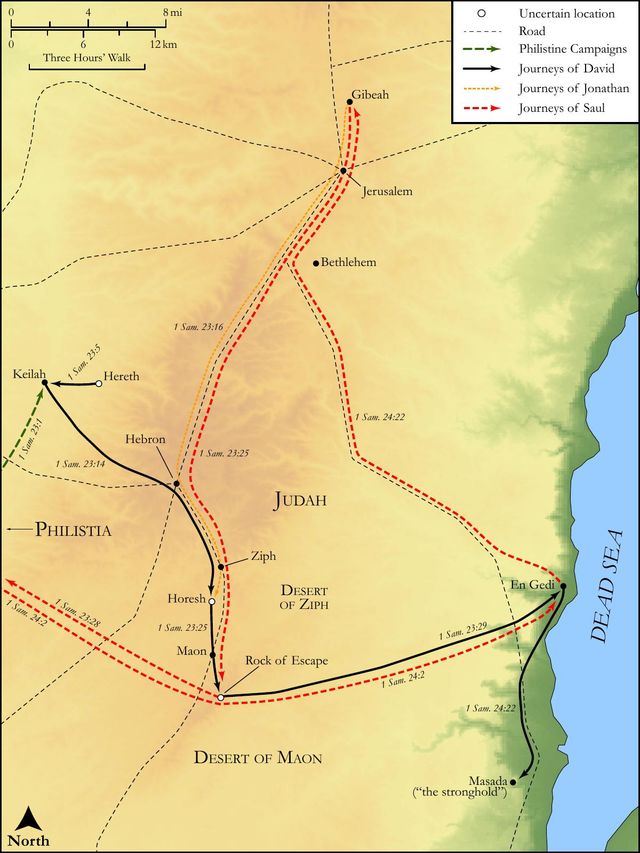
See on the biblical-era map
Study this verse
Public-domain commentary
Matthew Henry
From his Commentary on the Whole Bible. Henry comments on passages, not single verses — this entry covers 1 Samuel 24:16–22. His two-level outline is real structure in the source text, so it is rendered as structure.
Here we have,
I.Saul's penitent reply to David's speech.
It was strange that he had patience to hear him out, considering how outrageous he was against him, and how cutting David's discourse was. But God restrained him and his men; and we may suppose Saul struck with amazement at the singularity of the event, and much more when he found how much he had lain at David's mercy. His heart must have been harder than a stone if this had not affected him.
1.He melted into tears, and we will not suppose them to have been counterfeit but real expressions of his present concern at the sight of his own iniquity, so plainly proved upon him. He speaks as one quite overcome with David's kindness: Is this thy voice, my son David? And, as one that relented at the thought of his own folly and ingratitude, he lifted up his voice and wept, Sa1 24:16. Many mourn for their sins that do not truly repent of them, weep bitterly for them, and yet continue in love and league with them.
2.He ingenuously acknowledges David's integrity and his own iniquity (Sa1 24:17): Thou art more righteous than I. Now God made good to David that word on which he had caused him to hope, that he would bring forth his righteousness as the light, Psa 37:6. Those who take care to keep a good conscience may leave it to God to secure them the credit of it. This fair confession was enough to prove David innocent (even his enemy himself being judge), but not enough to prove Saul himself a true penitent. He should have said, Thou are righteous, but I am wicked; but the utmost he will own is this: Thou art more righteous than I. Bad men will commonly go no further than this in their confessions; they will own they are not so good as some others are; there are those that are better than they, and more righteous. He now owns himself under a mistake concerning David (Sa1 24:18): "Thou hast shown this day that thou art so far from seeking my hurt that thou hast dealt well with me." We are too apt to suspect others to be worse affected towards us then really they are, and than perhaps they are proved to be; and when, afterwards, our mistake is discovered, we should be forward to recall our suspicions, as Saul does here.
3.He prays God to recompense David for this his generous kindness to him. He owns that David's sparing him, when he had him in his power, was an uncommon and unparalleled instance of tenderness to an enemy; no man would have done the like; and therefore, either because he thought himself not able to give him a full recompence for so great a favour, or because he found himself not inclined to give him any recompence at all, he turns him over to God for his pay: The Lord reward thee good, Sa1 24:19. Poor beggars can do no less than pray for their benefactors, and Saul did no more.
4.He prophesies his advancement to the throne (Sa1 24:20): I know well that thou shalt surely be king. He knew it before, by the promise Samuel had made him of it compared with the excellent spirit that appeared in David, which highly aggravated his sin and folly in persecuting him as he did; he had as much reason to say concerning David as David concerning him, How can I put forth my hand against the Lord's anointed? But now he knew it by the interest he found David had in the people, the special providence of God in protecting him, and the generous kingly spirit he had now given a proof of in sparing his enemy. Now he knew it, that is, now that he was in a good temper he was willing to own that he knew it and to submit to the conviction of it. Note, Sooner or later, God will force even those that are of the synagogue of Satan to know and own those that he has loved, and to worship before their feet; for so is the promise, Rev 3:9. This acknowledgement which Saul made of David's incontestable title to the crown was a great encouragement to David himself and a support to his faith and hope.
5.He binds David with an oath hereafter to show the same tenderness of his seed and of his name as he had now shown of his person, Sa1 24:21. David had more reason to oblige Saul by an oath that he would not destroy him, yet he insists not on that (if the laws of justice and honour would not bind him, an oath would not), but Saul knew David to be a conscientious man, and would think his interests safe if he could get them secured by his oath. Saul by his disobedience had ruined his own soul, and never took care by repentance to prevent that ruin, and yet is very solicitous that his name might not be destroyed nor his seed cut off. However, David swore unto him, Sa1 24:22. Though he might be tempted, not only in revenge, but in prudence, to extirpate Saul's family, yet he binds himself not to do it, knowing that God could and would establish the kingdom to him and his, without the use of such bloody methods. This oath he afterwards religiously observed; he supported Mephibosheth, and executed those as traitors that slew Ishbosheth. The hanging up of seven of Saul's posterity, to atone for the destruction of the Gibeonites, was God's appointment, not David's act, and therefore not the violation of this oath.
II.Their parting in peace.
1.Saul, for the present, desisted from the persecution. He went home convinced, but not converted; ashamed of his envy of David, yet retaining in his breast that root of bitterness; vexed that, when at last he had found David, he could not at that time find in his heart to destroy him, as he had designed. God has many ways to tie the hands of persecutors, when he does not turn their hearts.
2.David continued to shift for his own safety. He knew Saul too well to trust him, and therefore got him up into the hold. It is dangerous venturing upon the mercy of a reconciled enemy. We read of those who believed in Christ, and yet he did not commit himself to them because he knew all men. Those that like David are innocent as doves must thus like him be wise as serpents.
Historical interpretation
Three Centuries of Reception
2 surviving comments on this verse. Each one is dated, so this reads as a timeline rather than a list.
Select a marker to jump to its quote. Markers stagger vertically where authors wrote within a few decades of each other.
What then did Saul say? Having heard David saying, “See, here is the corner of your cloak in my hand,” and everything else by which he mounted his defense along with this, he said, “Is this your voice, my child David?” O, what a great change had suddenly taken place: the one who could never bear even to call him by name, and instead hated the very mention of it, even admitted him to kinship, calling him “child.” What could be more blessed than David, who turned the murderer into a father, the wolf into a lamb, who filled the furnace of anger with heavy dew, turned the tempest into tranquility and allayed all the inflammation of resentment? Those words of David, you see, penetrated the mind of that enraged man and effected this total transformation, as you can see from those words. He did not even say, “Are these your words, my son David?” but “Is this your voice, my child David?” He was now heartened by his very utterance. Just as a father hears the voice of his son returning from somewhere and is excited not only at the sight of him but also at the sound of his voice, so Saul too, when David’s words penetrated and drove out the hostility, now recognized him as holy, and in setting aside one passion he was affected by another. That is to say, by driving out resentment he was affected by benevolence and fellow feeling.
And Saul lifted up his voice, and wept, etc. And as the Lord taught through the apostles, the people of the Jews, among those who were predestined to eternal life, lifted up their voice in the confession of faith, which they had long sunk low by denying, and washed away the stains of ancient guilt with worthy tears of repentance, confessing both the justice and goodness of the Lord; and also recalling the errors of their own wickedness, that they indeed had fiercely handed over the author of all goodness to death: but He, given to death unjustly, being omnipotent, preferred to save than to destroy those who killed Him.
Continue studying 1 Samuel 24:16 across the web’s major study libraries — every link below opens this exact verse, chapter, or book on the destination site.
Read & Compare
 BibleGatewayThis verse in more than 200 translations and 70 languages.
 Bible.comThe YouVersion reader — hundreds of translations, reading plans, and highlights.
 ESV.orgCrossway's official English Standard Version reader.
 NET BibleThe NET translation with 60,000+ translators' notes on every rendering decision.
 STEP BibleTyndale House's free study tool — original text, vocabulary, and scholarly resources.
 BibliaLogos Bible Software's free web reader.
 USCCBThe New American Bible (Revised Edition) with the U.S. bishops' study notes.
Commentaries
 BibleHub CommentariesDozens of classic commentaries on this verse, gathered on one page.
 StudyLightMore than 100 commentary sets — the largest collection on the web.
 BibleRefPlain-English commentary on what this verse means, verse by verse.
 Enduring WordDavid Guzik's free commentary on this chapter, widely used by Bible teachers.
 Bible Study ToolsVerse commentary alongside Greek and Hebrew study aids.
Original Language & Research
- BibleHub InterlinearThe verse word by word — original language, transliteration, and English.
- BibleHub LexiconEvery word's original-language definition and Strong's entry.
 Blue Letter BibleDeep-study tools — Strong's numbers, concordance, and word studies.
 SefariaThe Hebrew text with Rashi and centuries of Jewish commentary.
Sermons, Hymns & Audio


TrulyRandomVerse is not affiliated with these sites and doesn’t control their content. They’re linked because they’re genuinely useful.
Summary
1 Samuel 24:16 marks a profoundly emotional and pivotal turning point in the tumultuous relationship between King Saul and David. After David, having demonstrated extraordinary mercy by sparing Saul's life in the cave, reveals himself and addresses the king with words of profound loyalty and respect, Saul is utterly overwhelmed. His immediate reaction is one of shocked recognition, surprise, and deep sorrow, expressed through a powerful, audible outpouring of tears, signaling a temporary but potent softening of his hardened heart in the face of David's unexpected and overwhelming act of grace.
Context
ShowHideLiterary Context
This verse serves as the emotional climax of a dramatic encounter detailed in 1 Samuel 24. The chapter opens with Saul relentlessly pursuing David in the wilderness of En Gedi. David and his men are hidden in a cave when Saul, unaware of their presence, enters to relieve himself. David's men urge him to seize the moment and kill Saul, interpreting the situation as divine deliverance. However, David steadfastly refuses to harm "the LORD's anointed." Instead, he secretly cuts off a corner of Saul's robe as undeniable proof of his opportunity and his remarkable restraint. After Saul departs the cave, David calls out to him, presenting the robe piece and humbly pleading his innocence and loyalty. This verse records Saul's immediate, visceral response to David's unexpected revelation and profound demonstration of mercy, setting the stage for a brief, fragile reconciliation.
Historical & Cultural Context
The backdrop for this narrative is the nascent Israelite monarchy, a period characterized by political instability and spiritual transition. Saul, Israel's first king, has been rejected by God due to his persistent disobedience (1 Samuel 15), and David has been secretly anointed as his successor (1 Samuel 16). Saul's deep-seated jealousy and paranoia, exacerbated by David's military successes and the people's adoration (1 Samuel 18:7-9), have driven him to a relentless, murderous pursuit of David, whom he perceives as an existential threat to his throne. The concept of "the LORD's anointed" (מְשִׁיחַ יְהוָה, mashiach Yahweh) was sacrosanct; to harm the king, even a disobedient one, was considered an act of defiance against God's chosen instrument. David's profound refusal to "stretch forth his hand against the LORD's anointed" (1 Samuel 24:6), despite clear provocation and opportunity, powerfully showcases his unwavering respect for this divine institution and his deep trust in God's timing and justice.
Key Themes
ShowHideThis verse powerfully illustrates several key themes within 1 Samuel and the broader biblical narrative. It highlights the stark contrast between Saul's vengeful pursuit and David's demonstration of extraordinary mercy and restraint, underscoring David's righteous character and his reliance on God's providence rather than human violence. It also emphasizes the theme of divine anointing and the sanctity of God's chosen leaders, even when flawed, as David consistently refused to "stretch forth his hand against the LORD's anointed" (1 Samuel 24:6). Saul's intense emotional outburst speaks to the theme of recognition and conviction, as he momentarily acknowledges David's superior character and the profound wrongness of his own actions. However, the transient nature of Saul's repentance, as he later resumes his relentless pursuit of David (1 Samuel 26:1-2), underscores the theme of temporary versus transformative change, revealing the deep-seated spiritual issues that ultimately plagued Saul's reign and led to his demise.
Exposition and Analysis
ShowHideKey Word Analysis
ShowHideSaul's immediate recognition of David's voice (קֹלְךָ, qolka), meaning "your voice," is central here. This is not merely an auditory identification but a profound moment of personal realization that the man he has been relentlessly pursuing is the very one who just spared his life. The familiarity of the voice cuts through Saul's paranoia and rage, forcing him to confront the reality of David's presence and, by extension, the overwhelming magnitude of David's merciful act. It signifies a sudden, shocking shift in Saul's perception.
The address "my son" (בְּנִי, b'ni) is deeply significant. It reflects the former close relationship between Saul and David, when David was a trusted servant, musician, and son-in-law (1 Samuel 18:27). This term of endearment, coming from the king who had been relentlessly trying to kill David, conveys a sudden, overwhelming wave of paternal affection, regret, and perhaps profound shame. It marks a stark departure from the language of enemy and prey that had characterized their relationship for so long, powerfully highlighting the emotional impact of David's mercy.
The phrase "lifted up his voice, and wept" (וַיִּשָּׂא קֹלוֹ וַיֵּבְךְּ, vayissa qolo vayyevk) uses the root for "weep" (בָּכָה, bâkâh). This is a common biblical idiom for intense, audible weeping, often associated with deep grief, remorse, or overwhelming emotion. This is not a quiet shedding of tears but a loud, unrestrained expression of profound inner turmoil. For a king, especially one as proud and hardened as Saul, such an open display of emotion is highly unusual and underscores the immense psychological and spiritual impact of David's act of grace. It suggests a moment of brokenness and perhaps a fleeting glimpse of genuine repentance.
Verse Breakdown
ShowHide"And it came to pass, when David had made an end of speaking these words unto Saul"
This opening clause establishes the immediate temporal sequence, setting the stage for Saul's reaction. David has just concluded his powerful and humble address, in which he eloquently asserts his innocence, his unwavering loyalty, and his profound respect for Saul as God's anointed, even demonstrating undeniable proof of his restraint by presenting the cut-off corner of Saul's robe. The full weight of David's words and actions has just settled upon Saul.
"that Saul said, Is this thy voice, my son David?"
Saul's initial verbal response is one of utter astonishment, disbelief, and a dawning realization, framed as a rhetorical question. The question "Is this thy voice?" implies that he could scarcely believe what he was hearing and seeing – that the man he sought to destroy had just spared his life. The immediate addition of "my son David" reveals a sudden, profound shift from animosity to a rediscovered sense of paternal affection and a recognition of David's true, noble character, a character so diametrically opposed to the murderous intentions Saul had unjustly ascribed to him.
"And Saul lifted up his voice, and wept."
This final clause vividly portrays the depth and intensity of Saul's emotional response. The phrase "lifted up his voice" emphasizes the audible and public nature of his distress, indicating a complete breakdown of his royal composure and a public display of raw emotion. His loud weeping suggests a complex mixture of overwhelming shame for his relentless pursuit, profound regret for his own sin, immense relief at being spared, and perhaps a fleeting moment of genuine sorrow for the injustice he had perpetrated. This act of weeping is a powerful testament to the impact of David's radical mercy, momentarily piercing through Saul's deep-seated paranoia and pride.
Literary Devices
ShowHideThis verse is rich in Pathos, powerfully evoking deep emotion from both the characters within the narrative and the reader. Saul's sudden, overwhelming weeping upon recognizing David's voice and fully grasping the extent of David's mercy creates an intensely moving emotional climax. There is also significant Dramatic Irony at play, as the audience has been privy to David's whereabouts and his intentions throughout the cave encounter, while Saul, initially, remains completely unaware that his life was literally in David's hands. The scene functions as a classic Recognition Scene, where a key character (Saul) suddenly perceives the true identity, character, and moral superiority of another (David), leading to a profound and immediate shift in understanding and emotion. The entire encounter, and this verse in particular, is built upon Contrast – the stark difference between Saul's vengeful, paranoid pursuit and David's unwavering, God-honoring mercy, which serves to highlight David's righteous character against the backdrop of Saul's spiritual decline.
Theological and Thematic Connections
ShowHideThis pivotal moment in 1 Samuel 24:16 powerfully illustrates the transformative potential of grace and mercy when extended in the face of hostility. David's refusal to retaliate against Saul, despite immense provocation and personal danger, is not merely a strategic maneuver but a profound act of faith, trusting God to deal with His anointed rather than taking matters into his own hands. Saul's weeping, though temporary in its effect, demonstrates how an unexpected act of kindness can break through even the most hardened hearts, exposing the ugliness of one's own sin and the compelling beauty of righteous conduct. It underscores the biblical principle that our response to evil should be characterized by goodness, reflecting God's own character, which often convicts more powerfully than retribution. This scene serves as a powerful reminder that while human repentance can be fleeting, the impact of God-honoring mercy can be profoundly moving, even if it doesn't always lead to lasting, fundamental change in the other party.
Reflection and Application
ShowHideThe scene in 1 Samuel 24:16 offers profound insights into the power of grace and the nature of true leadership rooted in faith. David's decision to spare Saul's life, even when Saul was actively seeking his destruction, exemplifies a radical trust in God's sovereignty and a deep, abiding respect for God's anointing. This act of mercy, rather than an act of vengeance, completely disarms Saul, leading to a moment of raw, unadulterated emotion. For us today, this narrative challenges our natural inclination to retaliate or seek justice through our own means, especially when we feel wronged or threatened. It calls us to deeply consider how we respond to those who wrong us, whether in personal relationships, professional settings, or broader societal interactions. David's example encourages us to choose the path of grace, even when it seems counterintuitive, costly, or appears to leave us vulnerable, trusting that God's ways are higher and ultimately more effective in revealing truth and fostering conviction. While Saul's repentance was fleeting, David's character remained steadfast, demonstrating that our integrity in the face of adversity is a powerful testimony to God's transformative work within us, regardless of the ultimate outcome in others.
Questions for Reflection
ShowHideFAQ
ShowHideWhy did Saul weep so intensely upon hearing David's voice?
ShowHideSaul's intense weeping was a multifaceted emotional response to the profound realization of David's extraordinary mercy and his own egregious error. He had been relentlessly pursuing David to kill him, believing him to be a traitor and a threat to his throne. When David revealed himself, having had the perfect opportunity to kill Saul but choosing instead to spare him and show deep respect for his anointing, the sheer magnitude of David's character and the depth of his grace overwhelmed Saul. His tears likely stemmed from a complex mixture of overwhelming shame for his own murderous intentions, profound regret for his unjust and paranoid pursuit, immense relief that David had not harmed him, and a sudden, painful recognition of David's righteousness in stark contrast to his own spiritual decline. It was a moment where the truth of David's innocence and the depth of Saul's sin were laid bare before him.
Was this a true and lasting change of heart for Saul?
ShowHideWhile Saul's emotional response in 1 Samuel 24:16 was undeniably powerful and seemingly sincere in the moment, it proved to be temporary rather than a true, transformative change of heart. Immediately following this encounter, Saul acknowledges David's righteousness and even prophesies that David will indeed be king (1 Samuel 24:17-20). However, Saul's deep-seated paranoia, jealousy, and spiritual rebellion quickly resurfaced. Shortly after, he resumed his relentless pursuit of David (1 Samuel 26:1-2), demonstrating that his weeping was more an emotional reaction to a specific, overwhelming event than a fundamental shift in his character or a genuine turning back to God. This highlights the crucial difference between worldly sorrow, which can be fleeting and self-focused, and godly sorrow, which leads to true, lasting repentance (2 Corinthians 7:10).
What does David's act of mercy teach us about responding to our enemies?
ShowHideDavid's act of mercy in the cave teaches us a profound and counter-cultural lesson about responding to hostility with grace, unwavering trust in God's justice, and deep respect for divine authority. Instead of retaliating against Saul, who was actively seeking his life, David chose to honor God's anointing on Saul and to trust God to vindicate him in His own perfect timing. This demonstrates that true strength lies not in vengeance or self-vindication but in restraint, humility, and reliance on divine providence. It teaches us to "not repay evil for evil" but rather to "overcome evil with good" (Romans 12:17-21). David's actions, driven by profound faith and reverence for God, ultimately served as a powerful testimony to his character and momentarily exposed the darkness in Saul's heart, proving that grace can be a far more potent and convicting force than retribution.
Christ-Centered Fulfillment
ShowHideThe dramatic encounter in 1 Samuel 24, culminating in Saul's weeping, powerfully foreshadows the ultimate act of mercy and non-retaliation found in Jesus Christ. David, though innocent and unjustly persecuted, refused to harm God's anointed, choosing instead to leave vengeance to the Lord. This act of self-restraint and love for an enemy finds its perfect and ultimate fulfillment in Christ, who, though perfectly innocent and perpetually pursued by those who hated Him, never retaliated. Instead, Jesus, the true Lamb of God who takes away the sin of the world, willingly laid down His life for His enemies, offering forgiveness even from the cross (Luke 23:34). While David spared Saul's physical life in the cave, Christ, through His sacrificial death and glorious resurrection, offered eternal life and spiritual reconciliation to all humanity, who were His enemies in their sin and rebellion (Romans 5:8). Saul's temporary weeping in response to David's mercy pales in comparison to the transformative repentance and eternal salvation offered through the overwhelming grace of Christ, who conquers not with a sword, but with sacrificial love and an open invitation to reconciliation with God (2 Corinthians 5:18-19). David's act was a shadow; Christ's was the reality, a perfect demonstration of divine love that disarms sin, defeats death, and offers true, lasting redemption.