


1 Samuel 25:32
Bible text: King James Version (1769 Blayney text) · Public domain
Bible text: Berean Standard Bible · Public domain
Bible text: American Standard Version (1901) · Public domain
Bible text: World English Bible, Messianic edition · Public domain
Bible text: Geneva Bible (1599) · Public domain
Bible text: Young's Literal Translation · Public domain
- וַיֹּאמֶרvai·Yo·merand he saidH559Conj-w ¦ V-Qal-ConsecImperf-3msVerb Qal Consecutive Imperfect 3rd Singular Masculineוַandיֹּאמֶרhe said
- דָּוִדda·VidDavidH1732N-proper-mNoun Proper Masculine
- לַאֲבִיגַלla·'a·vi·Galto AbigailH26Prep-l ¦ N-proper-fNoun Proper FeminineלַtoאֲבִיגַלAbigail
- בָּרוּךְba·Rukh[be] blessedH1288V-Qal-PassPrtcpl-msVerb Qal Participle Passive Singular Masculine Absolute
- יְהוָהYah·wehYahwehH3068N-properNoun Proper Title
- אֱלֹהֵי'e·lo·Hei[the] God ofH430N-mpcNoun Plural Masculine Construct
- יִשְׂרָאֵלYis·ra·'ElIsraelH3478N-properNoun Proper Location
- אֲשֶׁר'a·SherwhoH834RelParticle Relative
- שְׁלָחֵךְshe·la·Chekhhe has sent youH7971V-Qal-Perf-3ms ¦ 2fsVerb Qal Perfect 3rd Singular Masculineשְׁלָחֵhe has sentךְyou
- הַיּוֹםhai·Yomthe dayH3117Art ¦ N-msNoun Singular Masculine Absoluteהַtheיּוֹםday
- הַזֶּהha·Zeh<the> thisH2088Art ¦ PrtParticle Demonstrativeהַ<the>זֶּהthis
- לִקְרָאתִיlik·ra·Tito meet meH7122Prep-l ¦ V-Qal-Inf ¦ 1csVerb Qal Infinitive Constructלִtoקְרָאתִmeetיme
English is a literal word-by-word gloss of the Hebrew, not the KJV's wording. Why?
This is the original text the KJV's translators worked from — each Hebrew word with its own literal English meaning in this verse, prepared by scholars at Tyndale House, Cambridge. The KJV translates whole sentences, not word by word, so its wording differs: one Hebrew word can become several English words, and the KJV may choose “the LORD” where the gloss reads “Yahweh”. Both are faithful — they answer different questions. For the KJV's own rendering, switch to the KJV text.
Details
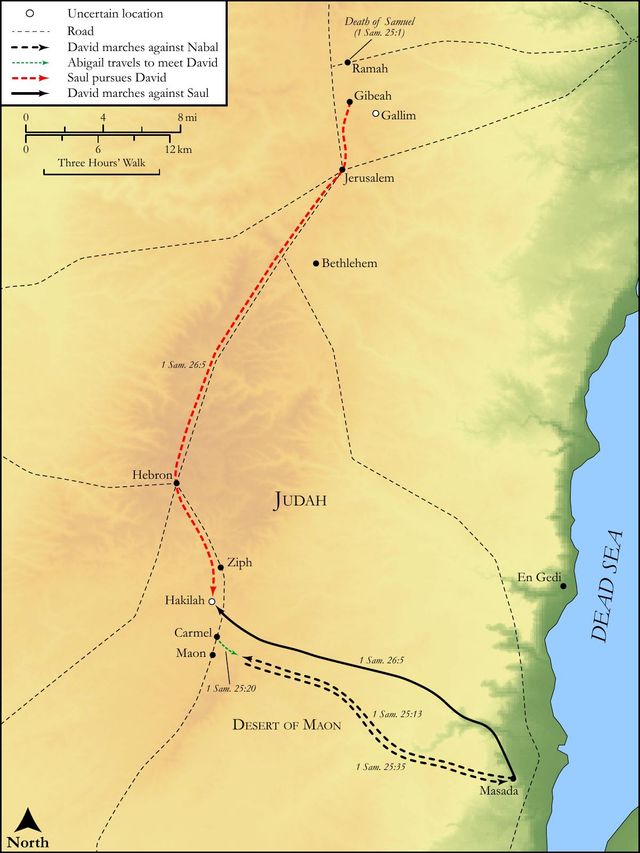
See on the biblical-era map
Study this verse
Public-domain commentary
Matthew Henry
From his Commentary on the Whole Bible. Henry comments on passages, not single verses — this entry covers 1 Samuel 25:32–35. His two-level outline is real structure in the source text, so it is rendered as structure.
As an ear-ring of gold, and an ornament of fine gold, so is a wise reprover upon an obedient ear, Pro 25:12. Abigail was a wise reprover of David's passion, and he gave an obedient ear to the reproof, according to his own principle (Psa 141:5): Let the righteous smite me, it shall be a kindness. Never was such an admonition either better given or better taken.
I.David gives God thanks for sending him this happy check to a sinful way (Sa1 25:32): Blessed be the Lord God of Israel, who sent thee this day to meet me. Note,
1.God is to be acknowledged in all the kindnesses that our friends do us either for soul or body. Whoever meet us with counsel, direction, comfort, caution, or seasonable reproof, we must see God sending them.
2.We ought to be very thankful for those happy providences which are means of preventing sin.
II.He gives Abigail thanks for interposing so opportunely between him and the mischief he was about to do:
Blessed be thy advice, and blessed be thou, Sa1 25:33. Most people think it enough if they take a reproof patiently, but we meet with few that will take it thankfully and will commend those that give it to them and accept it as a favour. Abigail did not rejoice more that she had been instrumental to save her husband and family from death than David did that Abigail had been instrumental to save him and his men from sin.
III.He seems very apprehensive of the great danger he was in, which magnified the mercy of his deliverance.
1.He speaks of the sin as very great. He was coming to shed blood, a sin of which when in his right mind he had a great horror, witness his prayer, Deliver me from blood-guiltiness. He was coming to avenge himself with his own hand, and that would be stepping into the throne of God, who has said, Vengeance is mine; I will repay. The more heinous any sin is the greater mercy it is to be kept from it. He seems to aggravate the evil of his design with this, that it would have been an injury to so wise and good a woman as Abigail: God has kept me back from hurting thee, Sa1 25:34. Or perhaps, at the first sight of Abigail, he was conscious of a thought to do her a mischief for offering to oppose him, and therefore reckons it a great mercy that God gave him patience to hear her speak.
2.He speaks of the danger of his falling into it as very imminent: "Except thou hadst hasted, the bloody execution had been done." The nearer we were to the commission of sin the greater was the mercy of a seasonable restraint - Almost gone (Psa 73:2) and yet upheld.
IV.He dismissed her with an answer of peace, Sa1 25:35.
He does, in effect, own himself overcome by her eloquence: "I have hearkened to thy voice, and will not prosecute the intended revenge, for I have accepted thy person, am well pleased with thee and what thou hast said." Note,
1.Wise and good men will hear reason, and let that rule them, though it come from those that are every way their inferiors, and though their passions are up and their spirits provoked.
2.Oaths cannot, bind us to that which is sinful. David had solemnly vowed the death of Nabal. He did evil to make such a vow, but he would have done worse if he had performed it.
3.A wise and faithful reproof is often better taken, and speeds better, than we expected, such is the hold God has of men's consciences. See Pro 28:23.
Historical interpretation
Historical reception
1 surviving comment on this verse from the historical church.
And David said to Abigail: Blessed be the Lord God of Israel, etc. The Lord refers the grace to the believing synagogue to the glory of the Father, signifying that we should always bless and praise Him; also rewarding the believing synagogue that prays even for the unbelievers with deserved blessing. Simultaneously showing how pleasing He considers a prayer that is made with a benevolent mind for the adversaries.
Continue studying 1 Samuel 25:32 across the web’s major study libraries — every link below opens this exact verse, chapter, or book on the destination site.
Read & Compare
 BibleGatewayThis verse in more than 200 translations and 70 languages.
 Bible.comThe YouVersion reader — hundreds of translations, reading plans, and highlights.
 ESV.orgCrossway's official English Standard Version reader.
 NET BibleThe NET translation with 60,000+ translators' notes on every rendering decision.
 STEP BibleTyndale House's free study tool — original text, vocabulary, and scholarly resources.
 BibliaLogos Bible Software's free web reader.
 USCCBThe New American Bible (Revised Edition) with the U.S. bishops' study notes.
Commentaries
 BibleHub CommentariesDozens of classic commentaries on this verse, gathered on one page.
 StudyLightMore than 100 commentary sets — the largest collection on the web.
 BibleRefPlain-English commentary on what this verse means, verse by verse.
 Enduring WordDavid Guzik's free commentary on this chapter, widely used by Bible teachers.
 Bible Study ToolsVerse commentary alongside Greek and Hebrew study aids.
Original Language & Research
- BibleHub InterlinearThe verse word by word — original language, transliteration, and English.
- BibleHub LexiconEvery word's original-language definition and Strong's entry.
 Blue Letter BibleDeep-study tools — Strong's numbers, concordance, and word studies.
 SefariaThe Hebrew text with Rashi and centuries of Jewish commentary.
Sermons, Hymns & Audio


TrulyRandomVerse is not affiliated with these sites and doesn’t control their content. They’re linked because they’re genuinely useful.
Summary
In 1 Samuel 25:32, David, on the verge of executing a vengeful and destructive act against Nabal and his household, encounters Abigail, Nabal's wife, who intercedes with profound wisdom and humility. This pivotal verse captures David's immediate and dramatic shift from murderous intent to heartfelt praise, as he recognizes Abigail's timely arrival not as mere chance, but as a direct, merciful intervention from the LORD God of Israel, divinely sent to prevent him from shedding innocent blood and incurring grave guilt.
Context
ShowHideLiterary Context
This verse stands as the dramatic turning point in the narrative of David, Nabal, and Abigail. Immediately preceding it, David, deeply insulted by Nabal's churlish refusal to provide provisions for his men and his contemptuous words, has sworn a solemn oath to utterly destroy Nabal and every male in his household by morning. David, with 400 armed men, is marching with a clear intent of violent retribution. Abigail, Nabal's discerning wife, having heard of her husband's foolishness and David's impending wrath from a servant, swiftly and secretly prepares a substantial offering. She then goes out to meet David, humbly prostrates herself, and eloquently pleads for her household. Verse 32 marks David's reception of her, his anger dissipating as he acknowledges the divine hand in her intervention, leading to his blessing of Abigail and his decision to turn back from his destructive path.
Historical & Cultural Context
At this stage, David is an outlaw, leading a band of approximately 600 men, living in the wilderness of Paran, constantly on the run from King Saul. His men often provided a valuable, albeit unofficial, service by protecting the flocks and property of wealthy landowners, like Nabal, from raiders and wild animals in the region. In return for this protection, it was customary and expected for landowners to provide provisions, especially during the sheep-shearing season, which was a time of feasting and generosity. Nabal's refusal was therefore not merely impolite but a grave insult, a public shaming that directly challenged David's authority, honor, and the livelihood of his men. The cultural expectation of blood vengeance (or "bloodguilt") was a powerful motivator for protecting one's honor and family in ancient Israel, though regulated by law (e.g., the cities of refuge in Numbers 35). David's vow to destroy Nabal's household reflects this deeply ingrained cultural response to perceived injustice and disrespect, underscoring the immense spiritual and social significance of Abigail's divinely orchestrated intervention.
Key Themes
ShowHideThis verse powerfully illustrates several crucial theological and narrative themes. Firstly, it highlights Divine Providence and Intervention, demonstrating God's active, meticulous involvement in human affairs, even amidst human anger and folly. David's explicit declaration that the LORD "sent" Abigail reveals his recognition of God's sovereign hand at work to protect His anointed from sin. Secondly, it underscores God's Prevention of Sin. David was on the precipice of committing a grave sin—unjustified bloodshed—which would have marred his character and future reign, potentially jeopardizing his claim to the throne. Abigail's intervention serves as God's instrument to restrain David from presumptuous sin, echoing the psalmist's plea in Psalm 19:13. Thirdly, the narrative showcases the profound Contrast Between Wisdom and Folly. Nabal embodies foolishness, arrogance, and spiritual blindness, ultimately leading to his demise, while Abigail exemplifies wisdom, discernment, humility, and courageous action, saving her household and preserving David's integrity. Her actions powerfully demonstrate the value of wise counsel in averting disaster and promoting God's purposes.
Exposition and Analysis
ShowHideKey Word Analysis
ShowHideThis word (H1288) is a primitive root meaning "to kneel," and by implication, "to bless God (as an act of adoration)" or "man (as a benefit)." When David says, "Blessed be the LORD," it is far more than a simple "thank you." It is an act of profound worship and adoration, acknowledging God as the ultimate source of all good, the one worthy of all praise for His character, faithfulness, and merciful intervention. It denotes a recognition of God's active goodness and power in the situation, as David kneels metaphorically or literally in humble submission to God's will.
The verb "sent" (H7971) is a primitive root meaning "to send away, for, or out (in a great variety of applications)." Here, it implies a divine commission or dispatch. David clearly understands that Abigail's arrival was not accidental or coincidental, but a purposeful, timely, and divinely orchestrated act. This word emphasizes God's intentional agency in guiding events and individuals to accomplish His specific will—in this case, to prevent David, His anointed, from committing a grievous sin that would have brought bloodguilt upon him.
This noun (H7125) derives from a root meaning "to call" or "to encounter," signifying "an encountering," whether accidental, friendly, or hostile. In this context, it refers to Abigail's deliberate act of encountering David. David's use of "sent... to meet me" underscores the divine orchestration of this specific encounter. It highlights the precise timing and purpose of Abigail's arrival, which was not merely to "bump into" David, but to engage him directly and intentionally, as God's instrument, at the critical moment.
Verse Breakdown
ShowHide"And David said to Abigail"
This opening phrase signifies a direct, personal address from David to Abigail, marking a crucial shift in the narrative from David's rage to his acknowledgment of her. It highlights David's immediate recognition of her and his willingness to engage with her counsel, contrasting sharply with his earlier unyielding determination to destroy Nabal. This interaction underscores the gravity of her intervention and his acceptance of its divine origin.
"Blessed [be] the LORD God of Israel"
This is an exclamation of profound praise and thanksgiving directed towards the sovereign God of Israel. David's focus immediately shifts from his own injured pride and desire for vengeance to the Almighty. This declaration reveals David's spiritual maturity and his deep-seated faith, acknowledging God as the true orchestrator of events, even those that prevent him from sinning. It is a moment of profound spiritual discernment, humility, and worship.
"which sent thee this day to meet me"
This clause explicitly attributes Abigail's timely arrival and intervention directly to God's providence. David understands that it was not by chance or human initiative alone that Abigail appeared at that precise moment. God "sent" her as His instrument, specifically "this day," emphasizing the perfect timing of the divine intervention. This recognition is the catalyst for David's change of heart, as he sees God's hand at work to protect him from his own rashness and the sin of shedding innocent blood.
Literary Devices
ShowHideThis verse is rich with Divine Intervention, as David explicitly attributes Abigail's arrival to God's sending. This highlights God's active, sovereign role in the narrative, preventing His anointed from committing a grave sin and preserving his integrity. There is also strong Contrast evident: David's initial murderous rage is dramatically juxtaposed with his subsequent humility, praise, and gratitude, demonstrating a profound spiritual transformation facilitated by God's grace and Abigail's wisdom. Furthermore, the narrative employs Dramatic Irony, as Nabal remains completely oblivious to the divine intervention that saves his household and prevents David's sin, while David, the intended avenger, recognizes God's hand. Abigail herself serves as a Type of divine messenger, her wisdom and timely mediation foreshadowing the broader theme of God's provision and guidance for His people, often through unexpected means and individuals.
Theological and Thematic Connections
ShowHideThis verse is a powerful testament to God's active, merciful, and preventative involvement in the lives of His people, particularly in preserving them from sin. It underscores the theological truth that God is not a distant observer but intimately involved in directing human affairs, often using seemingly ordinary individuals to accomplish His extraordinary purposes. David's immediate recognition of God's hand in Abigail's intervention highlights the importance of spiritual discernment and humility in acknowledging divine providence, especially when God's guidance prevents us from making destructive choices. This event serves as a profound reminder that God's grace extends not only to forgiveness but also to prevention, safeguarding His chosen ones from actions that would bring them guilt, dishonor, and compromise their divine calling. It showcases God's faithfulness to His covenant promises, protecting His servant David from a self-inflicted wound.
Reflection and Application
ShowHideDavid's experience in 1 Samuel 25:32 offers profound lessons for contemporary believers, challenging us to cultivate a spiritual sensitivity that recognizes God's hand in the seemingly ordinary, or even inconvenient, circumstances of life. It calls us to pause and discern divine intervention, especially when we are diverted from a path of anger, revenge, or foolishness. Just as David acknowledged God's sending of Abigail, we too should be quick to give thanks for the people, events, or even internal promptings that steer us away from sin or destructive decisions. This requires humility—the willingness to listen, to be corrected, and to shift from self-righteous indignation or impulsive action to God-centered praise and gratitude. It reminds us that even when our emotions threaten to overwhelm our judgment, God remains faithful to preserve us, often through the wise counsel or timely intervention of others. Our response, like David's, should be one of profound gratitude and worship for His sovereign grace that both forgives and prevents.
Questions for Reflection
ShowHideFAQ
ShowHideWhy was David so quick to anger and vengeance, despite being "a man after God's own heart"?
ShowHideDavid's rapid descent into rage and his vow of vengeance must be understood within the complex context of his circumstances and the cultural norms of his time. As an outlaw leader, David relied on a reputation for strength, honor, and the ability to protect his men and secure provisions. Nabal's insult was not just a personal slight but a public act of contempt that undermined David's authority, jeopardized his men's livelihood, and challenged his honor. In that day, such an affront, especially after providing protection, was a direct challenge that could not go unanswered without appearing weak or inviting further disrespect. David's oath to destroy Nabal's household was a culturally expected, albeit extreme, response to restore his honor and deter future challenges. However, it also reveals David's human fallibility and his struggle with his own passions, even as "a man after God's own heart" (Acts 13:22). This moment highlights that even the most devout individuals are prone to human weakness and sin without divine intervention.
How did Abigail know to intervene, and what does her action signify about divine wisdom?
ShowHideAbigail's intervention was a remarkable act of courage, wisdom, and spiritual discernment. She heard from one of Nabal's servants about his master's insolence and David's impending wrath, with the servant explicitly stating that Nabal was "too ill-natured to speak to" (1 Samuel 25:14-17). Her swift and decisive action, undertaken without her husband's knowledge, signifies not only her practical intelligence but also a profound spiritual insight into the gravity of the situation and the potential for immense bloodshed. Her humble approach, eloquent plea, and generous offering were divinely inspired, demonstrating that God often uses wise and discerning individuals as His instruments to accomplish His purposes and prevent greater harm. Her actions are a testament to the power of wise counsel and courageous mediation, ultimately saving her household and preserving David's integrity.
What does this verse teach us about God's character and His relationship with His people?
ShowHideThis verse profoundly reveals God's character as sovereign, merciful, and actively involved in the lives of His people. David's declaration, "Blessed be the LORD God of Israel, which sent thee this day to meet me," highlights God's sovereignty—His ability to orchestrate events and use individuals (like Abigail) to fulfill His will, even when human passions threaten to derail His plans. It showcases His mercy by actively preventing David, His anointed, from committing a grievous sin that would have brought guilt and stained his future reign, demonstrating that God's grace extends beyond forgiveness to proactive preservation. God's intervention demonstrates His faithfulness to His covenant promises, protecting and guiding His chosen ones even when they are prone to human weakness and passion. He is a God who not only forgives sin but actively works to prevent it, demonstrating His protective and guiding hand over His servants for His glory and their good.
Christ-Centered Fulfillment
ShowHideThe divine intervention in 1 Samuel 25:32, where God sends Abigail to prevent David from shedding innocent blood, powerfully foreshadows the ultimate divine intervention in Christ. Just as Abigail acted as a mediator, bringing a gift and a plea to avert David's wrath, so too does Jesus Christ stand as the ultimate Mediator between God and humanity (1 Timothy 2:5). Humanity, in its rebellion and sin, is like Nabal, deserving of divine wrath and judgment. Yet, God, in His infinite mercy and sovereign love, "sent" His Son, Jesus, into the world (John 3:16). Jesus, the Lamb of God who takes away the sin of the world, offered Himself as the perfect, atoning sacrifice, not merely averting human vengeance but the righteous wrath of God against sin. Through His atoning work on the cross, Christ prevents us from incurring the ultimate guilt and eternal destruction that our sins deserve, just as Abigail prevented David from incurring bloodguilt. He is our wisdom, our righteousness, our sanctification, and our redemption (1 Corinthians 1:30), representing God's ultimate act of preventative grace and redemptive love. This narrative beautifully illustrates God's proactive grace, always working to preserve and redeem His people through His divinely appointed means, culminating in the person and finished work of Jesus Christ.