


Ezra 7:27
- בָּרוּךְba·Rukh[be] blessedH1288V-Qal-PassPrtcpl-msVerb Qal Participle Passive Singular Masculine Absolute
- יְהוָהYah·wehYahwehH3068N-properNoun Proper Title
- אֱלֹהֵי'e·lo·Hei[the] God ofH430N-mpcNoun Plural Masculine Construct
- אֲבוֹתֵינוּ'a·vo·Tei·nuour ancestorsH1N-fpc ¦ 1cpNoun Plural Feminine Constructאֲבוֹתֵיancestorsנוּour
- אֲשֶׁר'a·SherwhoH834RelParticle Relative
- נָתַןna·Tanhe has putH5414V-Qal-Perf-3msVerb Qal Perfect 3rd Singular Masculine
- כָּזֹאתka·zoTlike thisH2063Prep-k ¦ PrtParticle Demonstrativeכָּlikeזֹאתthis
- בְּלֵבbe·Levin [the] heart ofH3820Prep-b ¦ N-mscNoun Singular Masculine Constructבְּinלֵב[the] heart of
- הַמֶּלֶךְha·Me·lekhthe kingH4428Art ¦ N-msNoun Singular Masculine Absoluteהַtheמֶּלֶךְking
- לְפָאֵרle·fa·'Erto beautifyH6286Prep-l ¦ V-Piel-InfVerb Piel Infinitive Constructלְtoפָאֵרbeautify
- אֶת'et<obj.>H853DirObjMParticle Object Indicator
- בֵּיתbeit[the] house ofH1004N-mscNoun Singular Masculine Construct
- יְהוָהYah·wehYahwehH3068N-properNoun Proper Title
- אֲשֶׁר'a·SherwhichH834RelParticle Relative
- בִּירוּשָׁלִָםbi·ru·sha·Lim[is] in JerusalemH3389Prep-b ¦ N-properNoun Proper Locationבִּ[is] inירוּשָׁלִָםJerusalem
English is a literal word-by-word gloss of the Hebrew, not the KJV's wording. Why?
This is the original text the KJV's translators worked from — each Hebrew word with its own literal English meaning in this verse, prepared by scholars at Tyndale House, Cambridge. The KJV translates whole sentences, not word by word, so its wording differs: one Hebrew word can become several English words, and the KJV may choose “the LORD” where the gloss reads “Yahweh”. Both are faithful — they answer different questions. For the KJV's own rendering, switch to the KJV text.
Details
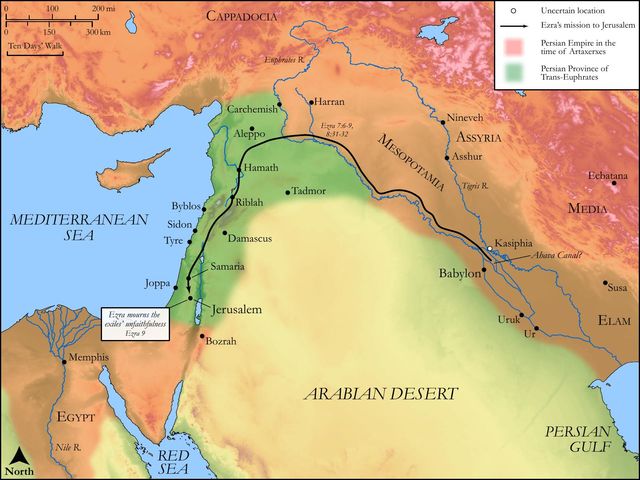
See on the biblical-era map
Study this verse
Public-domain commentary
Matthew Henry
From his Commentary on the Whole Bible. Henry comments on passages, not single verses — this entry covers Ezra 7:27–28.
Ezra cannot proceed in his story without inserting his thankful acknowledgement of the goodness of God to him and his people in this matter. As soon as he has concluded the king's commission, instead of subjoining, God save the king (though that would have been proper enough), he adds, Blessed be the Lord; for we must in every thing give thanks, and, whatever occurrences please us, we must own God's hand in them, and praise his name. Two things Ezra blessed God for: - 1. For his commission. We suppose he kissed the king's hand for it, but that was not all: Blessed be God (says he) that put such a thing as this into the king's heart. God can put things into men's hearts which would not arise there of themselves, and into their heads too, both by his providence and by his grace, in things pertaining both to life and godliness. If any good appear to be in our own hearts, or in the hearts of others, we must own it was God that put it there, and bless him for it; for it is he that worketh in us both to will and to do that which is good. When princes and magistrates act for the suppression of vice, and the encouragement of religion, we must thank God that put it into their hearts to do so, as much as if they had granted us some particular favour. When God's house was built Ezra rejoiced in what was done to beautify it. We read not of any orders given to paint or gild it, or to garnish it with precious stones, but to be sure that the ordinances of God were administered there constantly, and carefully, and exactly according to the institution; and that was indeed the beautifying of the temple. 2. For the encouragement he had to act in pursuance of his commission (Ezr 7:28): He has extended mercy to me. The king, in the honour he did him, we may suppose, had an eye to his merit, and preferred him because he looked upon him to be a very sensible ingenious man; but he himself ascribes his preferment purely to God's mercy. It was this that recommended him to the favour of his prince. Ezra himself was a man of courage, yet he attributed his encouragement not to his own heart, but to God's hand: "I was strengthened to undertake the services, as the hand of the Lord my God was upon me to direct and support me." If God gives us his hand, we are bold and cheerful; if he withdraws it, we are weak as water. Whatever service we are enabled to do for God and our generation, God must have all the glory of it. Strength for it is derived from him, and therefore the praise of it must be given to him.
Historical interpretation
Historical reception
1 surviving comment on this verse from the historical church.
Blessed be the Lord God of our fathers, etc. And who would doubt to confess His holy and mystical words, which the prophet, divinely inspired, recounts, by whom he also affirms the house of the Lord to be glorified?
Continue studying Ezra 7:27 across the web’s major study libraries — every link below opens this exact verse, chapter, or book on the destination site.
Read & Compare
 BibleGatewayThis verse in more than 200 translations and 70 languages.
 Bible.comThe YouVersion reader — hundreds of translations, reading plans, and highlights.
 ESV.orgCrossway's official English Standard Version reader.
 NET BibleThe NET translation with 60,000+ translators' notes on every rendering decision.
 STEP BibleTyndale House's free study tool — original text, vocabulary, and scholarly resources.
 BibliaLogos Bible Software's free web reader.
 USCCBThe New American Bible (Revised Edition) with the U.S. bishops' study notes.
Commentaries
 BibleHub CommentariesDozens of classic commentaries on this verse, gathered on one page.
 StudyLightMore than 100 commentary sets — the largest collection on the web.
 BibleRefPlain-English commentary on what this verse means, verse by verse.
 Enduring WordDavid Guzik's free commentary on this chapter, widely used by Bible teachers.
 Bible Study ToolsVerse commentary alongside Greek and Hebrew study aids.
Original Language & Research
- BibleHub InterlinearThe verse word by word — original language, transliteration, and English.
- BibleHub LexiconEvery word's original-language definition and Strong's entry.
 Blue Letter BibleDeep-study tools — Strong's numbers, concordance, and word studies.
 SefariaThe Hebrew text with Rashi and centuries of Jewish commentary.
Sermons, Hymns & Audio


TrulyRandomVerse is not affiliated with these sites and doesn’t control their content. They’re linked because they’re genuinely useful.
Summary
Ezra 7:27 is a profound doxology offered by the scribe and priest Ezra, expressing heartfelt praise to God for His divine intervention in the heart of King Artaxerxes. This verse celebrates God's sovereign control over earthly rulers, acknowledging that He supernaturally inclined the king to issue a decree providing extensive resources and authority for Ezra's return to Jerusalem. The ultimate purpose of this divine orchestration was to facilitate the beautification and restoration of the Temple in Jerusalem, underscoring God's unwavering commitment to His people and the sanctity of His dwelling place.
Context
ShowHideLiterary Context
Ezra 7:27 immediately follows the detailed account of King Artaxerxes' decree, found in Ezra 7:11-26. This decree is remarkably generous, granting Ezra not only permission to return to Jerusalem but also substantial financial support from the royal treasury, authority to appoint judges, and the right to enforce God's law. Ezra's response in verse 27 is an outpouring of spontaneous praise, a direct and personal acknowledgment of God's hand in orchestrating such a favorable and unexpected turn of events. It serves as a spiritual climax to the preceding narrative, shifting the focus from the human king's actions to the divine King's ultimate sovereignty. This doxology also sets the tone for Ezra's subsequent actions, as he immediately prepares to embark on his mission, empowered by this divine favor, as noted in Ezra 7:28.
Historical & Cultural Context
The events of Ezra 7 occur during the Persian Empire's dominance, specifically in the seventh year of King Artaxerxes I (circa 458 BC). This period follows the initial return of exiles under Zerubbabel and the completion of the Second Temple (around 516 BC), as chronicled in Ezra 1-6. However, Jerusalem and the Temple were still far from their former glory, and the community faced ongoing challenges in re-establishing religious and civic life. The Persian kings, while generally tolerant of local religions, held absolute power. For a pagan king like Artaxerxes to issue such a benevolent decree, empowering a Jewish priest to enforce his God's law and use royal funds for a foreign temple, was extraordinary. This highlights the unique position of the Jewish people under divine protection, even within a vast empire. The cultural context emphasizes the king's absolute authority, making his decree a powerful testament to God's ability to work through secular powers.
Key Themes
ShowHideThis verse powerfully encapsulates several key themes central to the book of Ezra and the broader biblical narrative. Foremost is the theme of Divine Sovereignty, as Ezra explicitly attributes the king's benevolent disposition to God, affirming that "the LORD God of our fathers... hath put such a thing as this in the king's heart." This resonates deeply with the principle articulated in Proverbs 21:1, which states that "The king's heart is in the hand of the LORD, as the rivers of water: he turneth it whithersoever he will." Another prominent theme is God's Providence and Faithfulness to His Covenant, demonstrating that even in exile and under foreign rule, God actively works on behalf of His chosen people, ensuring their well-being and the restoration of their spiritual life. The ultimate purpose of this divine influence—"to beautify the house of the LORD which is in Jerusalem"—underscores the theme of Restoration and the Sanctity of the Temple, highlighting God's desire for His dwelling place to be honored, properly maintained, and a focal point for worship. Finally, Ezra's immediate response exemplifies the theme of Thanksgiving and Praise, setting a model for believers to acknowledge God's hand in all circumstances, especially in unexpected blessings and divine interventions.
Exposition and Analysis
ShowHideKey Word Analysis
ShowHideThis term, derived from the primitive root H1288, primarily means "to kneel," and by implication, "to bless God (as an act of adoration)." When applied to God, as here, it signifies that God is the recipient of praise and adoration, acknowledging His inherent goodness, power, and benevolence. It is a declaration of His praiseworthiness, not an act of conferring blessing upon Him. Ezra's use here is a spontaneous outburst of worship, recognizing God's active involvement and supreme worthiness of all honor.
This primitive root (H5414) means "to give," used with a wide latitude of application including "to put" or "to make." In this context, it denotes a direct, intentional, and supernatural action by God. It implies that God did not merely inspire or suggest, but actively placed or implanted the idea and inclination within the king's heart. This emphasizes the divine origin of the king's decree, removing any notion of mere coincidence or human political maneuvering, and pointing to God's direct, causative power over human will, even that of a pagan monarch.
This primitive root (H6286) means "to gleam" or "to embellish." Figuratively, it can also mean "to boast" or "to glorify." In Ezra 7:27, it signifies making the Temple magnificent, glorious, and honorable, going beyond mere structural repair. It suggests a desire for the Temple to reflect God's glory and to be a fitting place for His worship, a place of dignity and splendor. This reflects a theological understanding that the physical state of the Temple was an outward expression of the community's devotion and God's own majesty.
Verse Breakdown
ShowHide"Blessed [be] the LORD God of our fathers,"
Ezra begins with a doxology, an act of praising God. He identifies God as "the LORD God of our fathers," connecting Him to the covenant God of Abraham, Isaac, and Jacob, emphasizing His faithfulness across generations to His people, Israel. This opening sets a tone of profound gratitude and recognition of God's historical redemptive work.
"which hath put [such a thing] as this in the king's heart,"
This is the core of Ezra's praise, identifying the specific divine action that merits blessing. The "thing" refers to the extraordinary decree of King Artaxerxes, detailed in the preceding verses, which granted Ezra unprecedented authority and resources. Ezra unequivocally attributes the king's benevolent disposition not to the king's own wisdom or generosity, but to God's direct, supernatural influence on his heart. This highlights God's sovereign control over even the most powerful human rulers.
"to beautify the house of the LORD which [is] in Jerusalem:"
This clause reveals the ultimate divine purpose behind God's influence on the king. The resources and authority granted to Ezra were specifically for the adornment and enhancement of the Temple in Jerusalem. "Beautify" implies making it glorious and splendid, not just functional. This underscores God's deep concern for His dwelling place and the proper worship of His people, signaling His desire for His presence to be honored and for the Temple to be a magnificent center for the restored community.
Literary Devices
ShowHideEzra 7:27 is rich in literary devices that amplify its theological message. The most prominent is Doxology, as the verse opens with an explicit declaration of praise: "Blessed [be] the LORD God of our fathers." This immediate shift from narrative to worship underscores the profound spiritual impact of Artaxerxes' decree on Ezra. The phrase "put [such a thing] as this in the king's heart" employs Anthropomorphism, attributing a human-like action (placing an idea) to God, illustrating His direct and intimate involvement in human affairs, specifically influencing the will of a powerful ruler. This also functions as Divine Causation, directly linking a human event (the king's decree) to God's sovereign will and action, rather than mere chance or human initiative. Furthermore, the verse uses Metonymy where "the king's heart" stands for the king's will, intentions, and decisions, emphasizing that God controls the very core of human volition. The phrase "house of the LORD" is a Metaphor for the Temple, God's dwelling place, and its "beautification" serves as a Symbol of the spiritual restoration and honor due to God's presence among His people.
Theological and Thematic Connections
ShowHideEzra 7:27 stands as a powerful testament to God's absolute sovereignty and meticulous providence, particularly in His care for His covenant people. It reveals that God's purposes are not thwarted by human rulers or political landscapes; rather, He orchestrates events, even influencing the hearts of pagan kings, to achieve His redemptive goals. This verse reassures believers that God is actively at work behind the scenes, directing circumstances for the good of His church and the advancement of His kingdom. It calls for a posture of deep gratitude and worship, recognizing that every blessing and favorable turn of events ultimately flows from His divine hand. The beautification of the Temple symbolizes God's desire for His people to prioritize His presence and worship, ensuring that His dwelling place is honored and glorified.
Reflection and Application
ShowHideEzra's immediate and profound response of praise in Ezra 7:27 serves as a powerful model for believers today. It challenges us to cultivate a spiritual sensitivity that recognizes God's hand in every circumstance, especially in unexpected breakthroughs and favorable outcomes that seem to defy human explanation. In a world often characterized by political turmoil and uncertainty, this verse reminds us that God remains sovereign over all earthly powers. We are called to trust in His unseen work, knowing that He can incline the hearts of leaders and orchestrate events for His glory and the good of His people. This should inspire us to pray earnestly for those in authority, believing that God can use them to further His divine purposes. Furthermore, the emphasis on "beautifying the house of the LORD" encourages us to consider how we prioritize and contribute to the flourishing of God's spiritual house—the church—ensuring that our collective worship and witness bring honor and glory to His name.
Questions for Reflection
ShowHideFAQ
ShowHideWhy did God choose a pagan king like Artaxerxes to help His people?
ShowHideGod's sovereignty extends over all nations and rulers, not just those who acknowledge Him. Throughout biblical history, God has repeatedly used non-believers, even powerful empires, as instruments to accomplish His divine purposes. For example, He used Cyrus the Great to allow the first return of exiles and the rebuilding of the Temple (Isaiah 44:28). In Ezra 7:27, God demonstrates that His plan for the restoration of Jerusalem and the Temple was so central to His redemptive purposes that He would supernaturally incline the heart of King Artaxerxes to provide the necessary resources and authority. This highlights God's absolute control and His ability to work through any means to achieve His will, demonstrating that no human power can thwart His ultimate plan. It also serves as a powerful testimony to His faithfulness to His covenant promises, even when His people are in exile.
Christ-Centered Fulfillment
ShowHideEzra's doxology in Ezra 7:27, celebrating God's sovereign control over the hearts of kings to beautify His house, finds its ultimate and most profound fulfillment in Jesus Christ. While the physical Temple in Jerusalem was indeed beautified, it was always a shadow pointing to a greater reality: God's dwelling among His people. Jesus Himself declared, "Destroy this temple, and in three days I will raise it up," referring to the temple of His body. Through Christ's sacrificial death and glorious resurrection, God established a new, spiritual Temple—the Church—composed of believers indwelt by the Holy Spirit (1 Corinthians 3:16). The "beautification" of this new Temple is not with gold and precious stones, but with the righteousness of Christ, the indwelling Spirit, and the spiritual gifts that build up the body of believers (Ephesians 2:21-22). Just as God inclined Artaxerxes' heart to restore the physical Temple, He inclined the Father's heart to send His Son, Jesus, to establish the eternal spiritual Temple, making us "a holy priesthood" (1 Peter 2:5) and "a royal priesthood" (1 Peter 2:9). Thus, the ultimate "beautification" is the redemption and sanctification of God's people, making them a glorious dwelling place for Him, all made possible through the sovereign work of God in Christ.