


Ezra 7:28
Bible text: King James Version (1769 Blayney text) · Public domain
Bible text: King James Version with Strong's numbers · Public domain
Bible text: Berean Standard Bible · Public domain
Bible text: American Standard Version (1901) · Public domain
Bible text: World English Bible, Messianic edition · Public domain
Bible text: Geneva Bible (1599) · Public domain
Bible text: Young's Literal Translation · Public domain
- וְעָלַיve·'a·Laiand towards meH5921Conj-w ¦ Prep ¦ 1csPreposition Definiteוְandעָלַtowardsיme
- הִטָּהhi·tahhe has extendedH5186V-Hiphil-Perf-3msVerb Hiphil Perfect 3rd Singular Masculine
- חֶסֶדChe·sedcovenant loyaltyH2617N-msNoun Singular Masculine Absolute
- לִפְנֵיlif·Nei<to> beforeH6440Prep-l ¦ N-mpcNoun Plural Masculine Constructלִ<to>פְנֵיbefore
- הַמֶּלֶךְha·Me·lekhthe kingH4428Art ¦ N-msNoun Singular Masculine Absoluteהַtheמֶּלֶךְking
- וְיוֹעֲצָיוve·yo·'a·Tzavand his counselorsH3289Conj-w ¦ V-Qal-Prtcpl-mp ¦ 3msVerb Qal Participle Plural Masculine Constructוְandיוֹעֲצָיcounselorsוhis
- וּלְכָלu·le·kholand to allH3605Conj-w ¦ Prep-l ¦ N-mscNoun Singular Masculine Constructוּandלְtoכָלall
- שָׂרֵיsa·Rei[the] officials ofH8269N-mpcNoun Plural Masculine Construct
- הַמֶּלֶךְha·Me·lekhthe kingH4428Art ¦ N-msNoun Singular Masculine Absoluteהַtheמֶּלֶךְking
- הַגִּבֹּרִיםha·gi·bo·Rim<the> mightyH1368Art ¦ N-mpNoun Plural Masculine Absoluteהַ<the>גִּבֹּרִיםmighty
- וַאֲנִיva·'a·Niand IH589Conj-w ¦ Pro-1csPronoun Personal 1st Singular common genderוַandאֲנִיI
- הִתְחַזַּקְתִּיhit·cha·Zak·tiI strengthened myselfH2388V-Hithpael-Perf-1csVerb Hithpael Perfect 1st Singular common gender
- כְּיַדke·yadaccording to [the] hand ofH3027Prep-k ¦ N-cscNoun Singular common gender Constructכְּaccording toיַד[the] hand of
- יְהוָהYah·wehYahwehH3068N-properNoun Proper Title
- אֱלֹהַי'e·lo·Haimy GodH430N-mpc ¦ 1csNoun Plural Masculine ConstructאֱלֹהַGodיmy
- עָלַי'a·Laion meH5921Prep ¦ 1csPreposition Definiteעָלַonיme
- וָאֶקְבְּצָהva·'ek·be·Tzahand I assembled !H6908Conj-w ¦ V-Qal-ConsecImperf-1cs ¦ SfxVerb Qal Consecutive Imperfect 1st Singular common genderוָandאֶקְבְּצָI assembledה!
- מִיִּשְׂרָאֵלmi·Yis·ra·'Elfrom IsraelH3478Prep-m ¦ N-properNoun Proper LocationמִfromיִּשְׂרָאֵלIsrael
- רָאשִׁיםra·ShimchiefsH7218N-mpNoun Plural Masculine Absolute
- לַעֲלוֹתla·'a·Lotto go upH5927Prep-l ¦ V-Qal-InfVerb Qal Infinitive Constructלַtoעֲלוֹתgo up
- עִמִּי'i·Miwith meH5973Prep ¦ 1csPreposition Definiteעִמִּwithיme
English is a literal word-by-word gloss of the Hebrew, not the KJV's wording. Why?
This is the original text the KJV's translators worked from — each Hebrew word with its own literal English meaning in this verse, prepared by scholars at Tyndale House, Cambridge. The KJV translates whole sentences, not word by word, so its wording differs: one Hebrew word can become several English words, and the KJV may choose “the LORD” where the gloss reads “Yahweh”. Both are faithful — they answer different questions. For the KJV's own rendering, switch to the KJV text.
Details
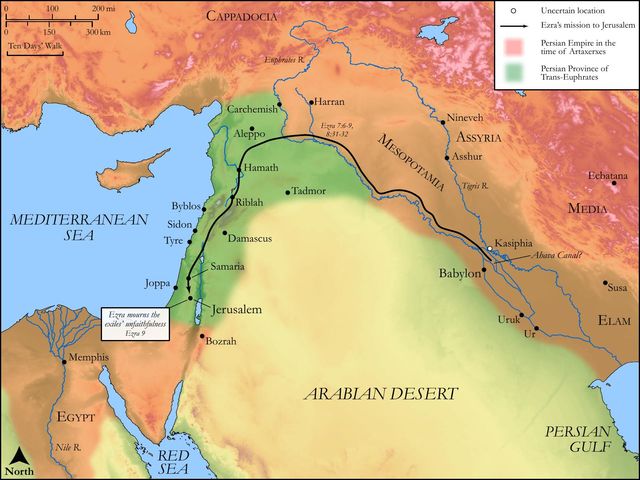
See on the biblical-era map
Study this verse
Public-domain commentary
Matthew Henry
From his Commentary on the Whole Bible. Henry comments on passages, not single verses — this entry covers Ezra 7:27–28.
Ezra cannot proceed in his story without inserting his thankful acknowledgement of the goodness of God to him and his people in this matter. As soon as he has concluded the king's commission, instead of subjoining, God save the king (though that would have been proper enough), he adds, Blessed be the Lord; for we must in every thing give thanks, and, whatever occurrences please us, we must own God's hand in them, and praise his name. Two things Ezra blessed God for: - 1. For his commission. We suppose he kissed the king's hand for it, but that was not all: Blessed be God (says he) that put such a thing as this into the king's heart. God can put things into men's hearts which would not arise there of themselves, and into their heads too, both by his providence and by his grace, in things pertaining both to life and godliness. If any good appear to be in our own hearts, or in the hearts of others, we must own it was God that put it there, and bless him for it; for it is he that worketh in us both to will and to do that which is good. When princes and magistrates act for the suppression of vice, and the encouragement of religion, we must thank God that put it into their hearts to do so, as much as if they had granted us some particular favour. When God's house was built Ezra rejoiced in what was done to beautify it. We read not of any orders given to paint or gild it, or to garnish it with precious stones, but to be sure that the ordinances of God were administered there constantly, and carefully, and exactly according to the institution; and that was indeed the beautifying of the temple. 2. For the encouragement he had to act in pursuance of his commission (Ezr 7:28): He has extended mercy to me. The king, in the honour he did him, we may suppose, had an eye to his merit, and preferred him because he looked upon him to be a very sensible ingenious man; but he himself ascribes his preferment purely to God's mercy. It was this that recommended him to the favour of his prince. Ezra himself was a man of courage, yet he attributed his encouragement not to his own heart, but to God's hand: "I was strengthened to undertake the services, as the hand of the Lord my God was upon me to direct and support me." If God gives us his hand, we are bold and cheerful; if he withdraws it, we are weak as water. Whatever service we are enabled to do for God and our generation, God must have all the glory of it. Strength for it is derived from him, and therefore the praise of it must be given to him.
Historical interpretation
Historical reception
1 surviving comment on this verse from the historical church.
And I, strengthened by the hand of the Lord my God, etc. He calls the hand of God the power of God, which works all things. Rightly does he gather those whom he will lead from Babylon to Jerusalem, who themselves are known to have the hand of God, by which they are strengthened. Because indeed, thus anyone becomes fit to bring others to God through his teaching, while first he himself is inwardly strengthened in his mind by God's grace against all things that impede the holy work.
Continue studying Ezra 7:28 across the web’s major study libraries — every link below opens this exact verse, chapter, or book on the destination site.
Read & Compare
 BibleGatewayThis verse in more than 200 translations and 70 languages.
 Bible.comThe YouVersion reader — hundreds of translations, reading plans, and highlights.
 ESV.orgCrossway's official English Standard Version reader.
 NET BibleThe NET translation with 60,000+ translators' notes on every rendering decision.
 STEP BibleTyndale House's free study tool — original text, vocabulary, and scholarly resources.
 BibliaLogos Bible Software's free web reader.
 USCCBThe New American Bible (Revised Edition) with the U.S. bishops' study notes.
Commentaries
 BibleHub CommentariesDozens of classic commentaries on this verse, gathered on one page.
 StudyLightMore than 100 commentary sets — the largest collection on the web.
 BibleRefPlain-English commentary on what this verse means, verse by verse.
 Enduring WordDavid Guzik's free commentary on this chapter, widely used by Bible teachers.
 Bible Study ToolsVerse commentary alongside Greek and Hebrew study aids.
Original Language & Research
- BibleHub InterlinearThe verse word by word — original language, transliteration, and English.
- BibleHub LexiconEvery word's original-language definition and Strong's entry.
 Blue Letter BibleDeep-study tools — Strong's numbers, concordance, and word studies.
 SefariaThe Hebrew text with Rashi and centuries of Jewish commentary.
Sermons, Hymns & Audio


TrulyRandomVerse is not affiliated with these sites and doesn’t control their content. They’re linked because they’re genuinely useful.
Summary
Ezra 7:28 serves as Ezra's profound doxological response to the extraordinary divine favor and empowerment he received, which enabled his pivotal mission to Jerusalem. This verse testifies to God's sovereign influence over earthly authorities, as He extended remarkable mercy to Ezra before the powerful Persian king, his counsellors, and his mighty princes. Simultaneously, it highlights the supernatural strengthening Ezra experienced through the tangible presence of the Lord, equipping him to diligently gather key Israelite leaders for the arduous journey back to Jerusalem, thereby facilitating the spiritual and civic restoration of the post-exilic community.
Context
ShowHideLiterary Context
Ezra 7:28 functions as the climactic personal reflection and doxology following the detailed account of King Artaxerxes' comprehensive decree in Ezra 7:11-26. The preceding verses (Ezra 7:1-10) introduce Ezra, a skilled scribe "well-versed in the Law of Moses" and describe his journey to Jerusalem. The king's decree granted Ezra extensive authority, resources, and permission to transport Temple vessels, collect funds, appoint magistrates, and teach God's law throughout Trans-Euphrates. This verse, Ezra's personal outburst of praise, immediately follows the decree, transitioning the narrative from the royal edict to Ezra's deep gratitude and preparation for the daunting task ahead. It sets the stage for the actual journey and the list of accompanying leaders detailed in Ezra 8.
Historical & Cultural Context
The setting is the vast Achaemenid Persian Empire, which, having succeeded Babylon, pursued a policy of relative religious tolerance and administrative decentralization. King Artaxerxes I (reigned 465-424 BC) was a formidable ruler whose decree was not merely an act of benevolence but likely a shrewd political move to stabilize a strategically important border region near Egypt by fostering loyalty among its diverse populations, including the Jews. For Ezra, a Jewish exile, to secure such an expansive and supportive decree from the highest levels of the Persian court—involving the king, his personal counsellors, and powerful provincial princes—was an unprecedented diplomatic achievement. This level of access and favor underscores the extraordinary nature of the divine intervention Ezra perceived, as such decrees were rare and highly significant for the preservation of Jewish identity and faith in the post-exilic period.
Key Themes
ShowHideEzra 7:28 powerfully articulates several core themes central to the book of Ezra and the broader post-exilic narrative. Firstly, it highlights Divine Sovereignty and Providence, demonstrating God's absolute control over all earthly powers, even pagan kings and their courts, to accomplish His purposes for His people. The fact that Artaxerxes "extended mercy" to Ezra underscores that God's hand was at work behind the scenes, influencing the king's heart, as articulated in Proverbs 21:1. Secondly, the verse emphasizes Divine Empowerment for Service, as Ezra explicitly states, "I was strengthened as the hand of the LORD my God was upon me." This illustrates that God equips those He calls, providing the necessary strength, wisdom, and protection for monumental tasks, a recurring motif throughout Scripture for those undertaking God's work, such as Moses or Joshua. Thirdly, it reveals the crucial interplay between Divine Enablement and Human Responsibility. While divinely strengthened, Ezra was not passive; he actively "gathered together out of Israel chief men to go up with me." This showcases the partnership where God provides the means, but human leaders must diligently respond, organize, and lead. Finally, the gathering of "chief men" speaks to the theme of Restoration and Community Building, recognizing that the spiritual and civic renewal of Jerusalem required not just divine favor but also unified leadership and communal effort, echoing the collaborative spirit seen in the rebuilding efforts described in Nehemiah 2:17-18.
Exposition and Analysis
ShowHideKey Word Analysis
ShowHideThis profound Hebrew term denotes covenant loyalty, steadfast love, and unfailing kindness. More than mere compassion, ḥesed' speaks of God's enduring faithfulness to His promises and people, often manifested in acts of deliverance, provision, and unmerited favor. Here, it indicates that God's covenantal faithfulness was the ultimate reason for the king's favorable disposition towards Ezra, reflecting divine orchestration rather than mere human diplomacy or chance.
A primitive root meaning "to fasten upon," "to seize," or "to be strong." In this context, it signifies being made firm, courageous, or fortified. Ezra's use of this word indicates a profound experience of divine enablement, where God actively imparted spiritual, emotional, and physical fortitude, empowering him to undertake the daunting task of leading the return and restoring the Law in Jerusalem. It underscores that his capacity to lead and endure came directly from God's empowering presence.
This is a significant anthropomorphism, attributing a human physical characteristic (hand) to God to describe His active power, presence, and intervention. In the Old Testament, "the hand of the LORD" consistently denotes God's strength, guidance, protection, and blessing. In Ezra, it specifically refers to God's favorable and enabling intervention in Ezra's life and mission, empowering him to overcome obstacles and achieve success in his divinely appointed task.
Verse Breakdown
ShowHide"And hath extended mercy unto me before the king, and his counsellors, and before all the king's mighty princes"
This opening clause immediately establishes God as the primary agent behind Ezra's extraordinary success. Ezra attributes the immense favor he received from the highest echelons of the Persian government—the king himself, his trusted advisors, and his powerful regional governors—directly to God's "mercy." This highlights God's sovereign ability to influence the hearts and decisions of even the most powerful secular rulers, bending their will to serve His divine purposes for His people. It underscores that Ezra's diplomatic success was not due to his own skill but to divine orchestration.
"And I was strengthened as the hand of the LORD my God [was] upon me"
This central declaration reveals the profound source of Ezra's personal empowerment. The phrase "strengthened as the hand of the LORD my God was upon me" signifies a tangible experience of divine enablement. It implies that God's active power, guidance, and protective presence were palpably felt by Ezra, providing him with the necessary spiritual, emotional, and physical fortitude to undertake the daunting task ahead. Ezra recognizes that his capacity to lead and endure came not from himself but from the direct, empowering touch of God.
"and I gathered together out of Israel chief men to go up with me"
This final clause demonstrates the practical outcome of God's mercy and strengthening. Empowered by God, Ezra actively responded by exercising his human responsibility and leadership. He didn't passively wait but diligently organized and recruited prominent leaders ("chief men") from the Israelite community still in exile. This act of gathering was crucial for the success of the expedition, ensuring that the returning contingent had capable leadership for the journey and for the subsequent work of rebuilding and reforming Jerusalem. It illustrates the essential partnership between divine enablement and human diligence in God's service.
Literary Devices
ShowHideEzra 7:28 employs several literary devices to convey its powerful message. The most prominent is Anthropomorphism, seen in the phrase "the hand of the LORD." By attributing a human hand to God, the text vividly portrays God's active, tangible power and intervention in human affairs, making His divine influence relatable and immediate. This is not to suggest God has a physical hand, but rather to emphasize His direct involvement and enabling strength. The verse also functions as a Doxology, a spontaneous expression of praise and glory to God. Ezra's personal reflection shifts from descriptive narrative to an outpouring of gratitude, emphasizing God as the ultimate source of his favor and strength. Furthermore, there is an element of Cause and Effect, where God's mercy and strengthening hand (cause) directly lead to Ezra's ability to gather leaders and undertake the mission (effect), thereby reinforcing the theme of divine enablement for human action.
Theological and Thematic Connections
ShowHideEzra 7:28 offers profound theological insights into God's active involvement in human history and individual lives. It powerfully asserts God's absolute sovereignty, demonstrating His capacity to orchestrate events and influence the hearts of even the most powerful rulers for the advancement of His redemptive purposes. Ezra's experience serves as a testament to the truth that when God calls a person to a task, He also provides the necessary enabling grace and strength, often through unexpected means and channels. This divine empowerment does not negate human responsibility but rather activates and directs it, enabling God's servants to accomplish what would otherwise be impossible. The verse thus becomes a foundational declaration of reliance on God's providential care and His strengthening presence in the face of daunting challenges, affirming that all true success in God's work flows from His initiative and sustaining power.
Reflection and Application
ShowHideEzra 7:28 provides immense encouragement and practical guidance for believers today. It reminds us that our successes, especially in areas of ministry or significant life callings, are not solely the result of our own abilities, connections, or efforts, but fundamentally stem from the "mercy" and "hand" of God upon us. When faced with seemingly insurmountable obstacles or called to tasks that feel beyond our capacity, Ezra's testimony invites us to trust in God's sovereign orchestration of circumstances and His promise to strengthen those He sends. This verse challenges us to cultivate a posture of humility and dependence, recognizing that true effectiveness comes from His empowerment, not our self-sufficiency. It also underscores the importance of actively responding to divine enablement by diligently taking steps of faith, gathering necessary resources, and leading others in God's work, knowing that His favor will precede and accompany our faithful obedience. This dynamic interplay between divine grace and human responsibility is a blueprint for all who seek to serve God effectively in a complex world.
Questions for Reflection
ShowHideFAQ
ShowHideHow did a pagan king like Artaxerxes come to show such favor to Ezra and the Jews?
ShowHideWhile the text attributes this favor to God's "mercy," historical and political factors also played a role under divine orchestration. The Persian Empire, unlike previous empires, often adopted a policy of religious tolerance and even support for local cults, viewing it as a way to maintain stability and loyalty within its vast territories. By allowing and even funding the restoration of the Jewish Temple and the re-establishment of their law, Artaxerxes likely saw an opportunity to create a loyal, well-governed province on the border of Egypt, a strategic rival. However, Ezra's consistent testimony, especially in Ezra 7:6 and Ezra 8:22, emphasizes that the "good hand of his God" was upon him, indicating that God supernaturally influenced the king's heart and decisions, as Proverbs 21:1 states, "The king's heart is a stream of water in the hand of the LORD; he turns it wherever he will."
What does "the hand of the LORD" signify in the Old Testament, particularly in Ezra?
ShowHide"The hand of the LORD" (Hebrew: yad Yahweh) is a powerful anthropomorphic expression used throughout the Old Testament to denote God's active, tangible power, presence, and intervention. It signifies His strength, authority, protection, guidance, and favor. In the book of Ezra, this phrase is a recurring motif, appearing multiple times (e.g., Ezra 7:6, Ezra 8:22, Ezra 8:31). Each instance highlights God's favorable and enabling intervention in the lives of His people and their leaders, ensuring their protection during dangerous journeys, providing success in their endeavors, and empowering them for their divinely appointed tasks of rebuilding and restoring the community. It underscores that the achievements of Ezra and the returning exiles were not by human might but by divine enablement.
Christ-Centered Fulfillment
ShowHideEzra 7:28, with its emphasis on divine mercy, strengthening, and the gathering of leaders for restoration, powerfully foreshadows the ultimate work of Christ. Ezra, empowered by the "hand of the LORD," was sent to bring spiritual and physical restoration to a remnant of Israel, teaching them the Law and rebuilding their community. This mission finds its climactic fulfillment in Jesus Christ, the true and greater Ezra, who embodies God's ultimate mercy and is the source of all spiritual strength. The "mercy" extended to Ezra by the king, orchestrated by God, points to the boundless mercy God extends to humanity through the person and work of Jesus, the Lamb of God who takes away the sin of the world!. Just as the "hand of the LORD" was upon Ezra, enabling him for his task, so too is the Spirit of God upon Christ, empowering Him for His redemptive mission. Jesus, the ultimate leader, did not merely gather "chief men" but called and commissioned His disciples, empowering them with His own authority and the presence of the Holy Spirit to go and make disciples of all nations Matthew 28:18-20. Our ability to serve God and fulfill His purposes today is not in our own strength but through the indwelling power of Christ, for it is He who strengthens us to do all things Philippians 4:13. Thus, Ezra's experience of divine enablement becomes a beautiful type of the spiritual empowerment available to all who are in Christ, enabling them to participate in His ongoing work of spiritual restoration and kingdom building, ultimately culminating in the new heavens and new earth where righteousness dwells.