


Acts 4:7
Bible text: King James Version (1769 Blayney text) · Public domain
Bible text: Berean Standard Bible · Public domain
Bible text: American Standard Version (1901) · Public domain
Bible text: World English Bible, Messianic edition · Public domain
Bible text: Geneva Bible (1599) · Public domain
Bible text: Young's Literal Translation · Public domain
- καὶkaiAndG2532CONJConjunction
- στήσαντεςstēsanteshaving placedG2476V-AAP-NPMVerb Aorist Active Participle Nominative Plural Masculine
- αὐτοὺςautousthemG846P-APMPersonal pronoun Accusative Plural Masculine
- ἐνeninG1722PREPPreposition
- τῷtōtheG3588T-DSNDefinite article Dative Singular Neuter
- μέσῳmesōmidstG3319A-DSNAdjective Dative Singular Neuter
- ἐπυνθάνοντο·epunthanontothey were inquiringG4441V-INI-3PVerb Imperfect Middle Or Passive Deponent Indicative 3rd Plural
- ἐνenInG1722PREPPreposition
- ποίᾳpoiawhatG4169I-DSFInterrogative pronoun Dative Singular Feminine
- δυνάμειdunameipowerG1411N-DSFNoun Dative Singular Feminine
- ἢēorG2228CONJConjunction
- ἐνeninG1722PREPPreposition
- ποίῳpoiōwhatG4169I-DSNInterrogative pronoun Dative Singular Neuter
- ὀνόματιonomatinameG3686N-DSNNoun Dative Singular Neuter
- ἐποιήσατεepoiēsatedidG4160V-AAI-2PVerb Aorist Active Indicative 2nd Plural
- τοῦτοtoutothisG3778D-ASNDemonstrative pronoun Accusative Singular Neuter
- ὑμεῖς;humeisyou yourselves?G4771P-2NPPersonal pronoun Nominative 2nd Plural
English is a literal word-by-word gloss of the Greek, not the KJV's wording. Why?
This is the original text the KJV's translators worked from — each Greek word with its own literal English meaning in this verse, prepared by scholars at Tyndale House, Cambridge. The KJV translates whole sentences, not word by word, so its wording differs: one Greek word can become several English words, and the KJV may choose “charity” where the gloss reads “love”. Both are faithful — they answer different questions. For the KJV's own rendering, switch to the KJV text.
Details
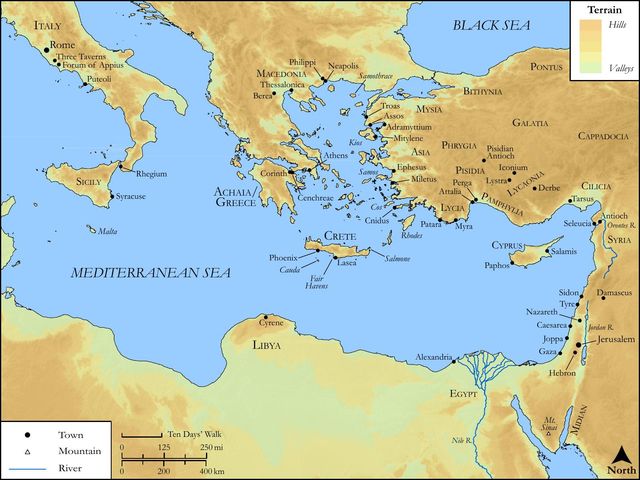
See on the biblical-era map
Study this verse
Public-domain commentary
Matthew Henry
From his Commentary on the Whole Bible. Henry comments on passages, not single verses — this entry covers Acts 4:5–14. His four-level outline is real structure in the source text, so it is rendered as structure.
We have here the trial of Peter and John before the judges of the ecclesiastical court, for preaching a sermon concerning Jesus Christ, and working a miracle in his name. This is charged upon them as a crime, which was the best service they could do to God or men.
I.Here is the court set.
An extraordinary court, it should seem, was called on purpose upon this occasion. Observe,
1.The time when the court sat (Act 4:5) - on the morrow; not in the night, as when Christ was to be tried before them, for they seem not to have been so hot upon this prosecution as they were upon that; it was well if they began to relent. But they adjourned it to the morrow, and no longer; for they were impatient to get them silenced, and would lose no time.
2.The place where - in Jerusalem (Act 4:6); there it was that he told his disciples they must expect to suffer hard things, as he had done before them in that place. This seems to come in here as an aggravation of their sin, that in Jerusalem, where there were so many that looked for redemption before it came, yet there were more that would not look upon it when it did come. How is that faithful city become a harlot! See Mat 23:37. It was in the foresight of Jerusalem's standing in her own light that Christ beheld the city, and wept over it.
3.The judges of the court.
(1.)Their general character: they were rulers, elders, and scribes, Act 4:5. The scribes were men of learning, who came to dispute with the apostles, and hoped to confute them. The rulers and elders were men in power, who, if they could not answer them, thought they could find some cause or other to silence them. If the gospel of Christ had not been of God, it could not have made its way, for it had both the learning and power of the world against it, both the colleges of the scribes and the courts of the elders.
(2.)The names of some of them, who were most considerable. Here were Annas and Caiaphas, ringleaders in this persecution; Annas the president of the sanhedrim, and Caiaphas the high priest (though Annas is here called so) and father of the house of judgment. It should seem that Annas and Caiaphas executed the high priest's office alternately, year for year. These two were most active against Christ; then Caiaphas was high priest, now Annas was; however they were both equally malignant against Christ and his gospel. John is supposed to be the son of Annas; and Alexander is mentioned by Josephus as a man that made a figure at that time. There were others likewise that were of the kindred of the high priest, who having dependence on him, and expectations from him, would be sure to say as he said, and vote with him against the apostles. Great relations, and not good, have been a snare to many.
II.The prisoners are arraigned, Act 4:7.
1.They are brought to the bar; they set them in the midst, for the sanhedrim sat in a circle, and those who had any thing to do in the court stood or sat in the midst of them (Luk 2:46), so Dr. Lightfoot. Thus the scripture was fulfilled, The assembly of the wicked has enclosed me, Psa 22:16. They compassed me about like bees, Psa 118:12. They were seated on every side.
2.The question they asked them was, "By what power, or by what name, have you done this? By what authority do you these things?" (the same question that they had asked their Master, Mat 21:23): "Who commissioned you to preach such a doctrine as this, and empowered you to work such a miracle as this? You have no warrant nor license from us, and therefore are accountable to us whence you have your warrant." Some think this question was grounded upon a fond conceit that the very naming of some names might do wonders, as Act 19:13. The Jewish exorcists made use of the name of Jesus. Now they would know what name they made use of in their cure, and consequently what name they set themselves to advance in their preaching. They knew very well that they preached Jesus, and the resurrection of the dead, and the healing of the sick, through Jesus (Act 4:2), yet they asked them, to tease them, and try if they could get any thing out of them that looked criminal.
III.The plea they put in, the design of which was not so much to clear and secure themselves as to advance the name and honour of their Master, who had told them that their being brought before governors and kings would give them an opportunity of preaching the gospel to those to whom otherwise they could not have had access, and it should be a testimony against them. Mar 13:19. Observe,
1.By whom this plea was drawn up: it was dictated by the Holy Ghost, who fitted Peter more than before for this occasion. The apostles, with a holy negligence of their own preservation, set themselves to preach Christ as he had directed them to do in such a case, and then Christ made good to them his promise, that the Holy Ghost should give them in that same hour what they should speak. Christ's faithful advocates shall never want instructions, Mar 13:11.
2.To whom it was given in: Peter, who is still the chief speaker, addresses himself to the judges of the court, as the rulers of the people, and elders of Israel; for the wickedness of those in power does not divest them of their power, but the consideration of the power they are entrusted with should prevail to divest them of their wickedness. "You are rulers and elders, and should know more than others of the signs of the times, and not oppose that which you are bound by the duty of your place to embrace and advance, that is, the kingdom of the Messiah; you are rulers and elders of Israel, God's people, and if you mislead them, and cause them to err, you will have a great deal to answer for."
3.What the plea is: it is a solemn declaration,
(1.)That what they did was in the name of Jesus Christ, which was a direct answer to the question the court asked them (Act 4:9, Act 4:10): "If we this day be examined, be called to an account as criminals, so the word signifies, for a good deed (as any one will own it to be) done to the impotent man, - if this be the ground of the commitment, this the matter of the indictment, - if we are put to the question, by what means, or by whom, he is made whole, we have an answer ready, and it is the same we gave to the people (Act 3:16), we will repeat it to you, as that which we will stand by. Be it known to you all who pretend to be ignorant of this matter, and not to you only, but to all the people of Israel, for they are all concerned to know it, that by the name of Jesus Christ, that precious, powerful, prevailing name, that name above every name, even by him whom you in contempt called Jesus of Nazareth, whom you crucified, both rulers and people, and whom God hath raised from the dead and advanced to the highest dignity and dominion, even by him doth this man stand here before you whole, a monument of the power of the Lord Jesus." Here,
[1.]He justifies what he and his colleague had done in curing the lame man. It was a good deed; it was a kindness to the man that had begged, but could not work for his living; a kindness to the temple, and to those that went in to worship, who were now freed from the noise and clamour of this common beggar. "Now, if we be reckoned with for this good deed, we have no reason to be ashamed, Pe1 2:20; Pe1 4:14, Pe1 4:16. Let those be ashamed who bring us into trouble for it." Note, It is no new thing for good men to suffer ill for doing well. Bene agere et male pati vere Christianum est - To do well and to suffer punishment is the Christian's lot.
[2.]He transfers all the praise and glory of this good deed to Jesus Christ. "It is by him, and not by any power of ours, that this man is cured." The apostles seek not to raise an interest for themselves, nor to recommend themselves by this miracle to the good opinion of the court; but, "Let the Lord alone be exalted, no matter what becomes of us." [3.] He charges it upon the judges themselves, that they had been the murderers of this Jesus: "It is he whom you crucified, look how you will answer it;" in order to the bringing of them to believe in Christ (for he aims at no less than this) he endeavours to convince them of sin, of that sin which, one would think, of all others, was most likely to startle conscience - their putting Christ to death. Let them take it how they will, Peter will miss no occasion to tell them of it. [4.] He attests the resurrection of Christ as the strongest testimony for him, and against his persecutors: "They crucified him, but God raised him from the dead; they took away his life, but God gave it to him again, and your further opposition to his interest will speed no better." He tells them that God raised him from the dead, and they could not for shame answer him with that foolish suggestion which they palmed upon the people, that his disciples came by night and stole him away. [5.] He preaches this to all the bystanders, to be by them repeated to all their neighbours, and commands all manner of persons, from the highest to the lowest, to take notice of it at their peril: "Be it known to you all that are here present, and it shall be made known to all the people of Israel, wherever they are dispersed, in spite of all your endeavours to stifle and suppress the notice of it: as the Lord God of gods knows, so Israel shall know, all Israel shall know, that wonders are wrought in the name of Jesus, not by repeating it as a charm, but believing in it as a divine revelation of grace and good-will to men."
(2.)That the name of this Jesus, by the authority of which they acted, is that name alone by which we can be saved. He passes from this particular instance to show that it is not a particular sect or party that is designed to be set up by the doctrine they preached, and the miracle they wrought, which people might either join with or keep off from at their pleasure, as it was with the sects of the philosophers and those among the Jews; but that it is a sacred and divine institution that is hereby ratified and confirmed, and which all people are highly concerned to submit to and come into the measures of. It is not an indifferent thing, but of absolute necessity, that people believe in this name, and call upon it.
[1.]We are obliged to it in duty to God, and in compliance with his designs (Act 4:11): "This is the stone which was set at nought of your builders, you that are the rulers of the people, and the elders of Israel, that should be the builders of the church, that pretend to be so, for the church is God's building. Here was a stone offered you, to be put in the chief place of the building, to be the main pillar on which the fabric might entirely rest; but you set it at nought, rejected it, would not make use of it, but threw it by as good for nothing but to make a stepping-stone of; but this stone is now become the head of the corner; God has raised up this Jesus whom you rejected, and, by setting him at his right hand, has made him both the corner stone and the head stone, the centre of unity and the fountain of power." Probably St. Peter here chose to make use of this quotation because Christ had himself made use of it, in answer to the demand of the chief priests and the elders concerning his authority, not long before this, Mat 21:42. Scripture is a tried weapon in our spiritual conflicts: let us therefore stick to it.
[2.]We are obliged to it for our own interest. We are undone if we do not take shelter in this name, and make it our refuge and strong tower; for we cannot be saved but by Jesus Christ, and, if we be not eternally saved, we are eternally undone (Act 4:12): Neither is there salvation in any other. As there is no other name by which diseased bodies can be cured, so there is no other by which sinful souls can be saved. "By him, and him only, by receiving and embracing his doctrine, salvation must now be hoped for by all. For there is no other religion in the world, no, not that delivered by Moses, by which salvation can be had for those that do not now come into this, at the preaching of it." So. Dr. Hammond. Observe here, First, Our salvation is our chief concern, and that which ought to lie nearest to our hearts - our rescue from wrath and the curse, and our restoration to God's favour and blessing. Secondly, Our salvation is not in ourselves, nor can be obtained by any merit or strength of our own; we can destroy ourselves, but we cannot save ourselves. Thirdly, There are among men many names that pretend to be saving names, but really are not so; many institutions in religion that pretend to settle a reconciliation and correspondence between God and man, but cannot do it. Fourthly, It is only by Christ and his name that those favours can be expected from God which are necessary to our salvation, and that our services can be accepted with God. This is the honour of Christ's name, that it is the only name whereby we must be saved, the only name we have to plead in all our addresses to God. This name is given. God has appointed it, and it is an inestimable benefit freely conferred upon us. It is given under heaven. Christ has not only a great name in heaven, but a great name under heaven; for he has all power both in the upper and in the lower world. It is given among men, who need salvation, men who are ready to perish. We may be saved by his name, that name of his, The Lord our righteousness; and we cannot be saved by any other. How far those may find favour with God who have not the knowledge of Christ, nor any actual faith in him, yet live up to the light they have, it is not our business to determine. But this we know, that whatever saving favour such may receive it is upon the account of Christ, and for his sake only; so that still there is no salvation in any other. I have surnamed thee, though thou hast not known me, Isa 45:4.
IV.The stand that the court was put to in the prosecution, by this plea, Act 4:13, Act 4:14.
Now was fulfilled that promise Christ made, that he would give them a mouth and wisdom, such as all their adversaries should not be able to gainsay nor resist.
1.They could not deny the cure of the lame man to be both a good deed and a miracle. He was there standing with Peter and John, ready to attest the cure, if there were occasion, and they had nothing to say against it (Act 4:14), either to disprove it or to disparage it. It was well that it was not the sabbath day, else they would have had that to say against it.
2.They could not, with all their pomp and power, face down Peter and John. This was a miracle not inferior to the cure of the lame man, considering both what cruel bloody enemies these priests had been to the name of Christ (enough to make any one tremble that appeared for him), and considering what cowardly faint-hearted advocates those disciples had lately been for him, Peter particularly, who denied him for fear of a silly maid; yet now they see the boldness of Peter and John, Act 4:13. Probably there was something extraordinary and very surprising in their looks; they appeared not only undaunted by the rulers, but daring and daunting to them; they had something majestic in their foreheads, sparkling in their eyes, and commanding, if not terrifying, in their voice. They set their faces like a flint, as the prophet, Isa 50:7; Eze 3:9. The courage of Christ's faithful confessors has often been the confusion of their cruel persecutors. Now,
(1.)We are here told what increased their wonder: They perceived that they were unlearned and ignorant men. They enquired either of the apostles or themselves or of others, and found that they were of mean extraction, born in Galilee, that they were bred fishermen, and had no learned education, had never been at any university, were not brought up at the feet of any of the rabbin, had never been conversant in courts, camps, or colleges; nay, perhaps, talk to them at this time upon any point in natural philosophy, mathematics, or politics, and you will find they know nothing of the matter; and yet speak to them of the Messiah and his kingdom, and they speak with so much clearness, evidence, and assurance, so pertinently and so fluently, and are so ready in the scriptures of the Old Testament relating to it, that the most learned judge upon the bench is not able to answer them, nor to enter the lists with them. They were ignorant men - idiōtai, private men, men that had not any public character nor employment; and therefore they wondered they should have such high pretensions. They were idiots (so the word signifies): they looked upon them with as much contempt as if they had been mere naturals, and expected no more from them, which made them wonder to see what freedom they took.
(2.)We are told what made their wonder in a great measure to cease: they took knowledge of them that they had been with Jesus; they, themselves, it is probable, had seen them with him in the temple, and now recollected that they had seen them; or some of their servants or those about them informed them of it, for they would not be thought themselves to have taken notice of such inferior people. But when they understood that they had been with Jesus, had been conversant with him, attendant on him, and trained up under him, they knew what to impute their boldness to; nay, their boldness in divine things was enough to show with whom they had had their education. Note, Those that have been with Jesus, in converse and communion with him, have been attending on his word, praying in his name, and celebrating the memorials of his death and resurrection, should conduct themselves, in every thing, so that those who converse with them may take knowledge of them that they have been with Jesus; and this makes them so holy, and heavenly, and spiritual, and cheerful; this has raised them so much above this world, and filled them with another. One may know that they have been in the mount by the shining of their faces.
Historical interpretation
Historical reception
2 surviving comments on this verse. Each one is dated, so this reads as a timeline rather than a list.
"And when they had set them in the midst, they asked, By what power, or by what name, have ye done this?" And yet they knew it well; for it was because they were "grieved that they preached through Jesus the resurrection" that they arrested them. Then for what purpose do they question them? They expected the numbers present would make them recant, and thought by this means to have put all right again.
"By what name have ye done this?" Why dost thou not speak it, what it is, but keepest that out of sight? "By what name have ye done this?"
Continue studying Acts 4:7 across the web’s major study libraries — every link below opens this exact verse, chapter, or book on the destination site.
Read & Compare
 BibleGatewayThis verse in more than 200 translations and 70 languages.
 Bible.comThe YouVersion reader — hundreds of translations, reading plans, and highlights.
 ESV.orgCrossway's official English Standard Version reader.
 NET BibleThe NET translation with 60,000+ translators' notes on every rendering decision.
 STEP BibleTyndale House's free study tool — original text, vocabulary, and scholarly resources.
 BibliaLogos Bible Software's free web reader.
 USCCBThe New American Bible (Revised Edition) with the U.S. bishops' study notes.
Commentaries
 BibleHub CommentariesDozens of classic commentaries on this verse, gathered on one page.
 StudyLightMore than 100 commentary sets — the largest collection on the web.
 BibleRefPlain-English commentary on what this verse means, verse by verse.
 Enduring WordDavid Guzik's free commentary on this chapter, widely used by Bible teachers.
 Bible Study ToolsVerse commentary alongside Greek and Hebrew study aids.
Original Language & Research
- BibleHub InterlinearThe verse word by word — original language, transliteration, and English.
- BibleHub LexiconEvery word's original-language definition and Strong's entry.
 Blue Letter BibleDeep-study tools — Strong's numbers, concordance, and word studies.
 CNTR CollationThe earliest Greek manuscripts of this verse, collated letter by letter.
Sermons, Hymns & Audio


TrulyRandomVerse is not affiliated with these sites and doesn’t control their content. They’re linked because they’re genuinely useful.
Summary
Acts 4:7 captures the pivotal moment when Peter and John, having just miraculously healed a lame man and preached the resurrection of Jesus, are brought before the Sanhedrin, the highest Jewish religious council. The powerful leaders demand to know the source of the apostles' authority and ability, specifically inquiring "By what power, or by what name," they performed such a deed. This question sets the stage for Peter's bold declaration of Jesus's resurrection and supreme authority, highlighting the clash between human religious institutions and the burgeoning power of the Holy Spirit in the early church.
Context
ShowHideLiterary Context
Acts 4:7 is situated immediately after the arrest of Peter and John, which occurred as a direct consequence of the healing of a man lame from birth at the Beautiful Gate of the Temple and Peter's subsequent sermon. In Acts 3:1-10, the miracle draws a large crowd, leading Peter to preach a powerful message in Acts 3:11-26, attributing the healing to Jesus Christ and calling for repentance. The Sadducees, who did not believe in resurrection, and the temple guard, concerned about public unrest and the apostles' teaching about Jesus's resurrection, arrested Peter and John, bringing them before the Sanhedrin. This verse, therefore, marks the beginning of the official interrogation and the first direct confrontation between the early Christian movement and the established Jewish religious authority.
Historical & Cultural Context
The Sanhedrin was the supreme Jewish judicial and ecclesiastical council, comprising seventy-one members, including chief priests, elders, and scribes. At this time, it was presided over by the High Priest, Annas, and his son-in-law, Caiaphas, both of whom had played a role in Jesus's trial and crucifixion. The council held significant religious and civil authority under Roman oversight, particularly concerning matters of Jewish law and public order. Performing public miracles or teaching without their authorization was seen as a challenge to their divinely appointed authority and a potential source of sedition. The question "By what power, or by what name" was not merely an inquiry but an accusation, designed to expose Peter and John as operating outside legitimate authority, potentially by demonic power or in the name of a false prophet.
Key Themes
ShowHideThis verse powerfully introduces several key themes that run throughout the book of Acts. Firstly, it highlights the question of authority, contrasting the human, institutional authority of the Sanhedrin with the divine authority by which the apostles acted. The Sanhedrin's inquiry is a direct challenge to the source of Peter and John's power. Secondly, it underscores the power and authority of the name of Jesus. Though not explicitly mentioned in the question, the very nature of their inquiry anticipates Peter's bold declaration in Acts 4:10, where he explicitly states that the healing occurred "by the name of Jesus Christ of Nazareth." This emphasizes that the apostles' ministry was not by their own strength but by the enablement of the resurrected Lord. Finally, the verse marks the beginning of confrontation and persecution for the early church, a recurring theme in Acts as the gospel spreads and encounters opposition from both Jewish and Roman authorities, as seen later in Acts 5:17-42.
Exposition and Analysis
ShowHideKey Word Analysis
ShowHideThis term refers to inherent ability, strength, or miraculous power. It signifies a supernatural force, often associated with God's activity. The Sanhedrin recognized that an extraordinary event had taken place, and they sought to understand the source of this "force" or "ability" that enabled the healing. It implies a recognition of something beyond mere human capability.
This preposition denotes "in," "at," or "by," indicating instrumentality or the sphere of operation. When combined with "power" and "name," it asks about the means or agency through which the apostles acted. It probes the ultimate source or authority that empowered their actions, implying a direct connection to that source.
In Hebrew thought, a "name" represented the entire character, authority, reputation, and essence of a person. To act "by a name" meant to act by the authority and in the very character of the one whose name was invoked. The council was not merely asking for a label but for the ultimate source of endorsement and authorization behind Peter and John's actions, recognizing that a name carried inherent power and identity.
Verse Breakdown
ShowHide"And when they had set them in the midst"
This phrase describes the physical arrangement for the interrogation. Peter and John were placed centrally before the Sanhedrin, emphasizing their vulnerability and the council's authority. The setting highlights the formal, judicial nature of the proceedings, designed to intimidate and control.
"they asked"
This indicates the direct initiation of the interrogation by the Sanhedrin. The verb implies an inquiry to ascertain information, but in this context, it carries the weight of a demand for justification, challenging the apostles' actions.
"By what power"
This part of the question directly probes the source of the miraculous ability displayed in the healing. The council acknowledged that an extraordinary "power" (dýnamis) was at work and sought to identify its origin, suspecting it might be unauthorized or even malevolent.
"or by what name"
This second part of the question focuses on the authority by which the apostles acted. In Israel, invoking a "name" was to invoke the authority, character, and very essence of that person. The Sanhedrin wanted to know whose authority Peter and John were operating under, as they did not recognize the authority of the crucified Jesus. This question anticipates Peter's answer, which will reveal the supreme authority of Jesus's name.
"have ye done this?"
This refers to the specific act of healing the lame man and, by extension, the public teaching that accompanied it. The council's concern was not just the miracle itself but the public display of power and the message that challenged their established religious order.
Literary Devices
ShowHideActs 4:7 prominently employs Interrogation, as the Sanhedrin poses a direct question to Peter and John, serving as the central dramatic device to propel the narrative forward and set the stage for Peter's defense. The question itself functions as a form of Antithesis, implicitly contrasting the Sanhedrin's perceived human authority with the divine authority that Peter and John will soon declare. Furthermore, the verse uses Foreshadowing, as the specific inquiry "By what power, or by what name" directly anticipates Peter's powerful and explicit answer in Acts 4:10, where he attributes the miracle solely to the name of Jesus Christ. This rhetorical setup highlights the central conflict between human institutions and divine empowerment.
Theological and Thematic Connections
ShowHideActs 4:7 serves as a foundational text for understanding the nature of spiritual authority and the inevitable clash between divine power and human opposition. The Sanhedrin's question, "By what power, or by what name," encapsulates the central theological tension: do Peter and John operate by human permission and earthly power, or by a transcendent, divine authority? The immediate context and subsequent events reveal that their authority derived solely from the resurrected Jesus Christ, empowered by the Holy Spirit. This highlights that true spiritual efficacy in the kingdom of God flows from a direct relationship with and commission from Christ, rather than from human institutions or credentials. It underscores that the church's mission and power are not of this world, but from above, often leading to conflict with worldly systems that do not recognize Christ's supreme authority.
Reflection and Application
ShowHideActs 4:7 resonates deeply with believers today, reminding us that living out our faith and proclaiming the gospel often invites scrutiny and opposition from a world that does not understand or acknowledge divine power. Just as Peter and John were challenged to account for their actions, we too may be called upon to articulate the source of our hope, our values, and our actions. This verse encourages us to be prepared to give a reasoned and Spirit-filled defense for the faith that is within us, always pointing to Jesus Christ as the ultimate source of our "power" and "name." It challenges us to examine whether our lives are truly lived "by what power, or by what name" – are we relying on human strength, wisdom, or approval, or are we genuinely operating under the authority and empowerment of the Holy Spirit, in the name of Jesus? Our boldness in the face of questioning is a testament to the living Christ within us.
Questions for Reflection
ShowHideFAQ
ShowHideWhy did the Sanhedrin ask "By what power, or by what name?"
ShowHideThe Sanhedrin asked this question because they were the supreme religious and judicial authority in Judea, and Peter and John had performed a public miracle and taught about Jesus's resurrection without their authorization. Their question was a challenge to the apostles' authority, seeking to determine if they were operating under a legitimate, recognized power (like God's through the Sanhedrin) or an unauthorized, potentially dangerous one (like a false prophet or demonic influence). In Israel, a "name" represented one's authority and essence, so asking "by what name" was asking by whose authority or character they acted. They were trying to establish a basis for condemning Peter and John, as they had previously condemned Jesus for similar claims of divine authority.
What is the significance of "power" (dýnamis) and "name" (ónoma) in this context?
ShowHideThe terms "power" (Greek, dýnamis') and "name" (Greek, ónoma') are highly significant. Dýnamis refers to inherent ability or miraculous force, indicating that the Sanhedrin recognized something extraordinary had occurred. They wanted to know the source of this supernatural enablement. Ónoma, or "name," in ancient thought, encompassed a person's entire character, reputation, and authority. To act "by a name" meant to act with the full backing and authority of that person. Thus, the Sanhedrin was not just asking for a label but for the ultimate source of authority and endorsement behind Peter and John's actions. This sets the stage for Peter's declaration that the healing was done by the name of Jesus Christ of Nazareth.
Christ-Centered Fulfillment
ShowHideActs 4:7, though a question posed by human authorities, profoundly foreshadows and affirms the Christ-centered nature of the early church's mission and power. The Sanhedrin's inquiry, "By what power, or by what name, have ye done this?", implicitly demands to know the ultimate authority behind the apostles' miraculous works. The answer, which Peter immediately provides in Acts 4:10, is unequivocally Jesus Christ. This moment reveals that all true power and authority in the new covenant era flow from the resurrected Messiah. Jesus, having been given "all authority in heaven and on earth" (Matthew 28:18), now exercises that authority through His Spirit and His disciples. The "name" by which they act is not merely a label, but the very essence and character of the exalted Lord, the one "God highly exalted and gave him the name that is above every name" (Philippians 2:9). Thus, Acts 4:7, through its very interrogation, points directly to Christ as the sole source of divine power, the ultimate authority, and the central figure through whom God's redemptive purposes are accomplished in the world. The apostles' ministry is a direct extension of Christ's ongoing work, demonstrating His continued presence and power through His Spirit, fulfilling His promise to be with His followers always (Matthew 28:20).