


Old Testament · Major Prophets · Book 23 of 66
Isaiah
The vision of Isaiah the son of Amoz: judgment on Judah and the nations, comfort for Zion, and the servant of the LORD who bears the sin of many.
- 66 chapters
- 1,292 verses
- About 2.8 hours to read
- The Hebrew Prophets, c. 800–400 BC
Isaiah is a vision “concerning Judah and Jerusalem” (1:1), and it opens as a case at law: “Hear, O heavens, and give ear, O earth” (1:2). The LORD’s people bring sacrifices and make many prayers, but “your hands are full of blood” (1:15). In the same chapter comes the offer: “though your sins be as scarlet, they shall be as white as snow” (1:18). The book holds judgment and mercy together to its last verse. The LORD of hosts breaks Assyria and Babylon and calls every nation to account, and the same LORD comforts Jerusalem, redeems Jacob, and creates new heavens and a new earth.
Through all of it the book announces one who is coming. He is a son born of a virgin (7:14), a child whose name is “The mighty God” (9:6), a rod out of the stem of Jesse (11:1), and a servant “wounded for our transgressions” (53:5). John, quoting this book, says that Isaiah spoke these things “when he saw his glory, and spake of him” (John 12:41).
But he was wounded for our transgressions, he was bruised for our iniquities: the chastisement of our peace was upon him; and with his stripes we are healed.
Isaiah 53:5 KJV
Before you read
- Who wrote it
- “Isaiah the son of Amoz” (1:1), who also appears in the narrative of Hezekiah’s reign (37:2). The New Testament quotes the book under his name: John sets 53:1 beside 6:10 as what “Esaias said” (John 12:38–41).
- When it was written
- In the reigns of four kings of Judah, “Uzziah, Jotham, Ahaz, and Hezekiah” (1:1). The vision of chapter 6 is dated “In the year that king Uzziah died” (6:1), and Sennacherib’s invasion “in the fourteenth year of king Hezekiah” (36:1). The latest event recorded is Sennacherib’s death (37:38).
How Isaiah is laid out
8 movements · 253 passages · 1,292 verses
Judgment, and the child Immanuel
Chapters 1–12 · 252 verses
The LORD charges a rebellious people and offers to make scarlet sins white as snow. Isaiah sees the Lord high and lifted up and is sent to a people that will not hear. Ahaz, threatened by Syria and Ephraim, is given the sign of Immanuel. A child is promised for David’s throne, a rod from Jesse’s stem, and the section closes in a song of salvation.
12 chapters
- 1 Isaiah's Vision and God's Indictment Against Rebellious Israel
- 2 The Vision Concerning Judah and Jerusalem
- 3 The Removal of Support and Leadership
- 4 Judgment on the Haughty Women of Zion
- 5 The Song of the Vineyard
- 6 Isaiah's Vision of the Lord
- 7 God Assures Ahaz Against Invasion
- 8 Prophecy of Mahershalalhashbaz
- 9 Light Dawns in Galilee
- 10 Woe Against Unjust Rulers
- 11 The Righteous Ruler from Jesse's Line
- 12 A Song of Personal Thanksgiving
The burdens of the nations
Chapters 13–23 · 189 verses
Burdens fall on Babylon, Philistia, Moab, Damascus, Egypt, the desert of the sea, Dumah, Arabia, the valley of vision and Tyre. The king of Babylon is mocked: “How art thou fallen from heaven, O Lucifer, son of the morning!” Isaiah walks naked three years as a sign upon Egypt and Ethiopia. Shebna the steward gives way to Eliakim, and Egypt and Assyria are promised a blessing beside Israel.
11 chapters
- 13 The Oracle Concerning Babylon
- 14 The Restoration of Israel
- 15 The Destruction of Moab's Cities and the Flight of Refugees
- 16 A Call for Refuge and Asylum
- 17 Judgment Against Damascus and Ephraim
- 18 Woe to the Land Beyond Ethiopia
- 19 The Lord's Judgment and Civil War
- 20 Historical Context and Prophetic Command
- 21 The Burden Against Babylon
- 22 The Oracle Concerning the Valley of Vision
- 23 The Oracle Against Tyre
The earth emptied, death swallowed up
Chapters 24–27 · 69 verses
The LORD empties the earth, because its people have “broken the everlasting covenant,” and punishes the host of the high ones and the kings of the earth. He reigns in mount Zion, makes a feast for all people on his mountain, and swallows up death in victory. Judah sings of a strong city, the dead are promised life, leviathan is punished, and the vineyard is kept night and day.
15 passages
- 24:1–6 The Lord's Universal Judgment
- 24:7–12 The End of Joy and Celebration
- 24:13–16 A Remnant Praises the Lord
- 24:17–20 Inescapable Terror and Cosmic Collapse
- 24:21–23 Yahweh Judges All Powers
- 25:1–5 A Song of Praise for God's Judgment
- 25:6–9 God Will Swallow Up Death Forever
- 25:10–12 God’s Judgment Against Moab
- 26:1–6 A Song of Trust in the Strong City
- 26:7–11 Waiting for God's Righteous Judgment
- 26:12–18 Confession and Prayer for Peace
- 26:19–21 The Hope of Resurrection and Final Judgment
- 27:1–6 The Defeat of Leviathan and the Protected Vineyard
- 27:7–11 The Purpose of Israel's Chastisement
- 27:12–13 The Final Gathering of the Remnant
Woes, and a sure foundation
Chapters 28–35 · 166 verses
The woes of these chapters fall on drunken Ephraim, on Ariel, the city where David dwelt, on those who go down to Egypt for help, and on the spoiler. In Zion the LORD lays a tried stone, a sure foundation. A king shall reign in righteousness, and the Spirit is poured from on high. After Edom’s judgment the desert blossoms, and the ransomed return to Zion with songs.
Hezekiah’s trust and his treasures
Chapters 36–39 · 90 verses
In Hezekiah’s fourteenth year Sennacherib takes Judah’s defenced cities, and Rabshakeh mocks the LORD before Jerusalem’s wall. Hezekiah spreads the letter before the LORD and prays, and the angel of the LORD smites the Assyrian camp. Sick unto death, Hezekiah is given fifteen years and a sign on the dial of Ahaz. He shows his treasures to envoys from Babylon, and Isaiah foretells that all will go there.
14 passages
- 36:1–3 Sennacherib Invades Judah
- 36:4–10 Rabshakeh Taunts Hezekiah
- 36:11–20 Rabshakeh Addresses the People Directly
- 36:21–22 Hezekiah's Officials Report Back
- 37:1–7 Hezekiah Seeks Counsel from Isaiah
- 37:8–13 Assyria Renews the Threat
- 37:14–20 Hezekiah's Prayer in the Temple
- 37:21–35 Isaiah Delivers the Lord's Prophecy
- 37:36–38 The Lord Delivers Jerusalem
- 38:1–8 Hezekiah's Illness and Prayer for Life
- 38:9–20 Hezekiah's Song of Recovery
- 38:21–22 Narrative Conclusion and Postscript
- 39:1–4 Babylonian Envoys Visit Hezekiah
- 39:5–8 Isaiah Prophesies the Babylonian Exile
Comfort ye my people
Chapters 40–48 · 216 verses
Jerusalem is told that her warfare is accomplished and her iniquity pardoned. The LORD who measured the waters and calls the stars by name gives power to the faint. He challenges the idols, which cannot declare what is to come, and names Cyrus his shepherd and anointed. Bel and Nebo are carried off, Babylon falls, and Israel is told to go forth from her.
9 chapters
- 40 A Message of Comfort and Pardon
- 41 God Challenges the Nations to Trial
- 42 The Servant's Character and Mission
- 43 God Promises Protection and Restoration
- 44 Assurance and Promise to Israel
- 45 God Anoints Cyrus for Israel's Sake
- 46 The Burden of Babylon's Gods
- 47 Babylon's Humiliation and Servitude
- 48 Israel's Stubbornness and Hypocrisy
The servant and his offering
Chapters 49–57 · 150 verses
The servant called from the womb is given for a light to the Gentiles, and Zion, who says she is forsaken, is not forgotten. He gives his back to the smiters; he is despised, wounded for the transgressions of others, and his soul is made an offering for sin. Barren Zion is told to sing, every one that thirsteth is called to the waters, and the outcasts are gathered.
9 chapters
- 49 The Servant's Divine Calling and Mission
- 50 God Challenges Israel's Complaint
- 51 Remember Your Ancestral Origins
- 52 Jerusalem Called to Restoration
- 53 The Servant's Rejection and Humiliation
- 54 Promise of Restoration and Expansion
- 55 Invitation to Free Salvation
- 56 The Call to Justice and Obedience
- 57 The Death of the Righteous
Zion’s light and new heavens
Chapters 58–66 · 160 verses
The LORD sets the fast he has chosen against a fast kept with strife. Iniquity has separated the people from their God, so he puts on righteousness as a breastplate and comes as Redeemer to Zion. Zion is told to arise and shine, the anointed one proclaims liberty, and the people pray that he would rend the heavens. It ends with new heavens, a new earth, and an unquenched fire.
9 chapters
- 58 Israel's Hypocritical Fasting Exposed
- 59 God Is Able, But Sin Separates
- 60 Arise, Shine
- 61 The Mission of the Anointed Servant
- 62 Zion's Righteousness and New Name
- 63 The Divine Warrior and Vengeance
- 64 A Prayer for God's Dramatic Presence
- 65 God Reaches Out to the Unseeking
- 66 God Rejects Hypocritical Worship
The words Isaiah turns on
Woe clusters in chapters 5 and 28–33 and becomes “Ho” in 55:1; redeem begins at 35:9; the Holy One runs from 1:4 to 60:14.
What Isaiah teaches
qâdôwsh · Holy One
The Holy One of Israel
Isaiah’s vision of the Lord on his throne turns on one cry: “Holy, holy, holy, is the LORD of hosts: the whole earth is full of his glory” (6:3). The prophet answers, “Woe is me! for I am undone; because I am a man of unclean lips” (6:5), and a coal from the altar is laid on his mouth: “thine iniquity is taken away, and thy sin purged” (6:7). Holiness here both condemns sin and removes it. Of the 31 verses in the KJV that use the name “the Holy One of Israel,” 25 are in Isaiah. It stands in the first charge, that the nation has “provoked the Holy One of Israel unto anger” (1:4), beside “thy redeemer” in 41:14, and in the name Zion’s oppressors will give her, “The Zion of the Holy One of Israel” (60:14).
gâʼal · redeem
Thy Redeemer
The law gave the next of kin the right to buy back what a poor relative had sold (Leviticus 25:25). Isaiah does not use the kinsman’s word until 35:9, “the redeemed shall walk there,” and from chapter 41 it is one of God’s names: “thy redeemer, the Holy One of Israel” (41:14). He redeems a people already his: “Fear not: for I have redeemed thee, I have called thee by thy name; thou art mine” (43:1). The price is not money, “ye shall be redeemed without money” (52:3), and Peter names it: “not redeemed with corruptible things, as silver and gold … But with the precious blood of Christ” (1 Peter 1:18–19). The promise is that he will come himself: “the Redeemer shall come to Zion” (59:20).
ʻebed · servant
The servant of the LORD
The servant is first the nation: “thou, Israel, art my servant, Jacob whom I have chosen” (41:8). That servant is blind: “Who is blind, but my servant?” (42:19). Then a servant speaks who is called by the same name, “Thou art my servant, O Israel” (49:3), but whose task is “to raise up the tribes of Jacob, and to restore the preserved of Israel,” and to be “a light to the Gentiles” (49:6). He gives his back to the smiters (50:6), and in chapter 53 he suffers in the place of others: “he was wounded for our transgressions, he was bruised for our iniquities” and “the LORD hath laid on him the iniquity of us all” (53:5–6). “By his knowledge shall my righteous servant justify many; for he shall bear their iniquities” (53:11).
bârâʼ · create
New heavens and a new earth
The book opened by calling heaven and earth to witness against a rebellious people (1:2). Near its end the LORD says, “behold, I create new heavens and a new earth” (65:17), the verb of the first creation, used in Isaiah in sixteen verses from chapter 40 on. Peter looks for the same thing “according to his promise” (2 Peter 3:13), and John sees it (Revelation 21:1). The verses that follow have been read in more than one way, since in them a child still “shall die an hundred years old” (65:20). Irenaeus placed them in the times of the kingdom, when the righteous shall bear rule upon their rising from the dead
, the reign of Revelation 20:4. Ephrem held that These words point to the church
. Jerome read them of the eternal city, where pain, sorrow and moaning have departed
.
Christ in Isaiah
The New Testament reads Isaiah as speaking of Christ. Matthew sets the sign given to the house of David at the birth of Jesus: “Behold, a virgin shall be with child … and they shall call his name Emmanuel, which being interpreted is, God with us” (Matthew 1:22–23). He finds the great light of 9:1–2 in Galilee, where Jesus began to preach (Matthew 4:14–16). At Nazareth Jesus was handed “the book of the prophet Esaias,” read from 61:1–2, and said, “This day is this scripture fulfilled in your ears” (Luke 4:17–21).
Chapter 53 is read of the cross. The eunuch asked of it, “of whom speaketh the prophet this? of himself, or of some other man?” and Philip “began at the same scripture, and preached unto him Jesus” (Acts 8:34–35). Peter joins the servant’s stripes to the tree: “Who his own self bare our sins in his own body on the tree … by whose stripes ye were healed” (1 Peter 2:24). The servant bears what was ours: “the LORD hath laid on him the iniquity of us all” (Isaiah 53:6).
- Jesse the stem of 11:1
- David the king
- … Matthew 1:6–8
- Uzziah the year he died, 6:1
- Jotham
- Ahaz given the sign, 7:14
- Hezekiah delivered from Sennacherib
- … Matthew 1:10–16
- Jesus, who is called Christ
People
By how many verses name them
- HezekiahSon of Ahaz and Abi; a brother of Maaseiah; husband of Hephzibah; father of Manasseh30
- IsaiahA son of Amoz; father of Shear-jashub, Maher-shalal-hash-baz16
- DavidSon of Jesse10
- Rabshakeh8
- AhazA son of Jotham; husband of Abi; father of Hezekiah and Maaseiah7
- AmozFather of Isaiah7
- EliakimA son of Hilkiah5
- RemaliahFather of Pekah5
44 more are named.
Places
121 named
- JerusalemThe city judged, spared from Sennacherib, and comforted46
- ZionThe daughter of Zion, called at the last to arise and shine38
- AssyriaThe rod of the LORD’s anger, broken in its turn35
- EgyptThe ally Judah trusted, rebuked, and one day “my people”30
- MoabThe subject of the burden in chapters 15–1616
- BabylonWhere Hezekiah’s treasures would go; its fall and idols foretold13
- LebanonIts high cedars brought low; its glory given to the wilderness9
- Cush“Ethiopia” in the KJV; its king Tirhakah came against Sennacherib (37:9)7
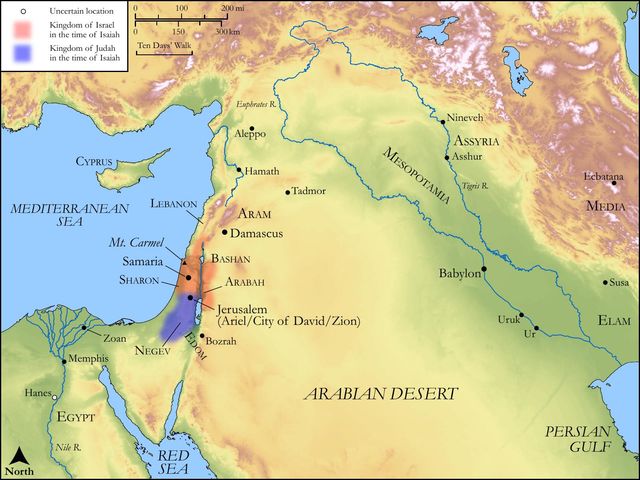
Where Isaiah reaches
The passages it leans on, and the ones that lean on it
Isaiah 6:9–10 Matthew 13:14–15
The hardening Isaiah was sent to speak, which Jesus says is fulfilled in those who hear his parables.
Isaiah 28:16 Psalms 118:22 Acts 4:11
The foundation stone laid in Zion, the stone the builders refused, and Peter’s word to the council.
Isaiah 40:3 Malachi 3:1 Mark 1:2–3
The voice in the wilderness and Malachi’s messenger, joined at the opening of Mark’s Gospel.
Isaiah 53:4–6 Matthew 8:17 1 Peter 2:24–25
The servant bears griefs and sins: Matthew reads it of Jesus’ healings, Peter of the cross.
The anointed one’s mission, read by Jesus in the synagogue at Nazareth.
Books Isaiah links to most
The Church Fathers on Isaiah
2,511 quotations from 85 writers before AD 800 · the ten most quoted, in date order
- Origen253
- Eusebius339
- Ambrose397
- Chrysostom407
- Jerome420
- Augustine430
- Cyril444
- Theodoret458
- Gregory604
- Bede735
Jerome on why Isaiah reads like a Gospel.
[Isaiah] should be called an evangelist rather than a prophet, because he describes all the mysteries of Christ and the church so clearly that one would think he is composing a history of what has already happened rather than prophesying what is to come.
Athanasius on what the sign of Immanuel means.
But what does this passage mean, if not that God has come in the flesh?
Ephrem the Syrian on the child whose name is Wonderful.
Today was born the child, and his name was called Wonderful! For a wonder it is that God should reveal himself as a baby.
Eusebius on the servant who took on himself the penalties of others.
Alone did he assume the penalties of our wicked deeds, not when we were half dead but even when already altogether foul and stinking in tombs and graves.
Keep studying
Articles