


Isaiah 37:2
Bible text: King James Version (1769 Blayney text) · Public domain
Bible text: King James Version with Strong's numbers · Public domain
Bible text: Berean Standard Bible · Public domain
Bible text: American Standard Version (1901) · Public domain
Bible text: World English Bible, Messianic edition · Public domain
Bible text: Geneva Bible (1599) · Public domain
Bible text: Young's Literal Translation · Public domain
- וַיִּשְׁלַחVai·yish·lachand he sentH7971Conj-w ¦ V-Qal-ConsecImperf-3msVerb Qal Consecutive Imperfect 3rd Singular Masculineוַandיִּשְׁלַחhe sent
- אֶת'et<obj.>H853DirObjMParticle Object Indicator
- אֶלְיָקִים'el·ya·KimEliakimH471N-proper-mNoun Proper Masculine
- אֲשֶׁר'a·SherwhoH834RelParticle Relative
- עַל'al[was] overH5921PrepPreposition
- הַבַּיִתha·Ba·yitthe houseH1004Art ¦ N-msNoun Singular Masculine Absoluteהַtheבַּיִתhouse
- וְאֵתve·'Etand <obj.>H853Conj-w ¦ DirObjMParticle Object Indicatorוְandאֵת<obj.>
- שֶׁבְנָאshev·Na'ShebnaH7644N-proper-mNoun Proper Masculine
- הַסּוֹפֵרha·so·Ferthe scribeH5608Art ¦ N-msNoun Singular Masculine Absoluteהַtheסּוֹפֵרscribe
- וְאֵתve·'Etand <obj.>H853Conj-w ¦ DirObjMParticle Object Indicatorוְandאֵת<obj.>
- זִקְנֵיzik·Nei[the] elders ofH2205Adj-mpcAdjective Plural Masculine Construct
- הַכֹּהֲנִיםha·ko·ha·Nimthe priestsH3548Art ¦ N-mpNoun Plural Masculine Absoluteהַtheכֹּהֲנִיםpriests
- מִתְכַּסִּיםmit·ka·SimcoveredH3680V-Hithpael-Prtcpl-mpVerb Hithpael Participle Plural Masculine Absolute
- בַּשַּׂקִּיםba·sa·Kimwith <the> sackcloth<s>H8242Prep-b ¦ N-mpNoun Plural Masculine Absoluteבַּwith <the>שַּׂקִּיםsackcloth<s>
- אֶל'eltoH413PrepPreposition
- יְשַׁעְיָהוּye·sha'·Ya·huIsaiahH3470N-proper-mNoun Proper Masculine
- בֶןven[the] son ofH1121N-mscNoun Singular Masculine Construct
- אָמוֹץ'a·MotzAmozH531N-proper-mNoun Proper Masculine
- הַנָּבִיאha·na·Vi'the prophetH5030Art ¦ N-msNoun Singular Masculine Absoluteהַtheנָּבִיאprophet
English is a literal word-by-word gloss of the Hebrew, not the KJV's wording. Why?
This is the original text the KJV's translators worked from — each Hebrew word with its own literal English meaning in this verse, prepared by scholars at Tyndale House, Cambridge. The KJV translates whole sentences, not word by word, so its wording differs: one Hebrew word can become several English words, and the KJV may choose “the LORD” where the gloss reads “Yahweh”. Both are faithful — they answer different questions. For the KJV's own rendering, switch to the KJV text.
Details
See on the biblical-era map
Study this verse
Public-domain commentary
Matthew Henry
From his Commentary on the Whole Bible. Henry comments on passages, not single verses — this entry covers Isaiah 37:1–7.
We may observe here, 1. That the best way to baffle the malicious designs of our enemies against us is to be driven by them to God and to our duty and so to fetch meat out of the eater. Rabshakeh intended to frighten Hezekiah from the Lord, but it proves that he frightens him to the Lord. The wind, instead of forcing the traveller's coat from him, makes him wrap it the closer about him. The more Rabshakeh reproaches God the more Hezekiah studies to honour him, by rending his clothes for the dishonour done to him and attending in his sanctuary to know his mind. 2. That it well becomes great men to desire the prayers of good men and good ministers. Hezekiah sent messengers, and honourable ones, those of the first rank, to Isaiah, to desire his prayers, remembering how much his prophecies of late had plainly looked towards the events of the present day, in dependence upon which, it is probable, he doubted not but that the issue would be comfortable, yet he would have it to be so in answer to prayer: This is a day of trouble, therefore let it be a day of prayer. 3. When we are most at a plunge we should be most earnest in prayer: Now that the children are brought to the birth, but there is not strength to bring forth, now let prayer come, and help at a dead lift. When pains are most strong let prayers be most lively; and, when we meet with the greatest difficulties, then is a time to stir up not ourselves only, but others also, to take hold on God. Prayer is the midwife of mercy, that helps to bring it forth. 4. It is an encouragement to pray though we have but some hopes of mercy (Isa 37:4): It may be the Lord thy God will hear; who knows but he will return and repent? The it may be of the prospect of the haven of blessings should quicken us with double diligence to ply the oar of prayer. 5. When there is a remnant left, and but a remnant, it concerns us to lift up a prayer for that remnant, Isa 37:4. The prayer that reaches heaven must be lifted up by a strong faith, earnest desires, and a direct intention to the glory of God, all which should be quickened when we come to the last stake. 6. Those that have made God their enemy we have no reason to be afraid of, for they are marked for ruin; and, though they may hiss, they cannot hurt. Rabshakeh has blasphemed God, and therefore let not Hezekiah be afraid of him, Isa 37:6. He has made God a party to the cause by his invectives, and therefore judgment will certainly be given against him. God will certainly plead his own cause. 7. Sinners' fears are but prefaces to their falls. He shall hear the rumour of the slaughter of his army, which shall oblige him to retire to his own land, and there he shall be slain, Isa 37:7. The terrors that pursue him shall bring him at last to the king of terrors, Job 18:11, Job 18:14. The curses that come upon sinners shall overtake them.
Historical interpretation
Historical reception
2 surviving comments on this verse. Each one is dated, so this reads as a timeline rather than a list.
For the sake of royal worship, therefore, Hezekiah wrapped himself in sackcloth and, walking from his palace to the temple, sent Eliakim, the high priest, Shebna, the scribe, and senior priests to the prophet Isaiah son of Amos, an act that must be attributed to the humility and prudence of the king. He proceeded to the temple and sent leaders of the people and senior priests, not draped in priestly stoles but covered in sackcloth, to the prophet Isaiah son of Amos, concerning which we read in the book of Kings: “Himself covered in sackcloth, having entered the house of the Lord, he sent Eliakim, leader of the house, and Shebna the scribe and senior priests, covered with sackcloth, to the prophet Isaiah son of Amos.” Because Isaiah was writing a history about himself here in his book, he did not call himself a prophet but the son of a prophet, whereas the passage just quoted does use the title prophet because it comes from a different author of the history. Similarly, we read from the Gospel of Matthew that Matthew called himself a publican, whereas other Evangelists refrained from calling him a publican, granting him such apostolic dignity.
(Chapter 37, Verse 1 and following) Then Eliakim son of Hilkiah, who was in charge of the palace, and Shebna the secretary and Joah son of Asaph the recorder went to Hezekiah with their clothes torn and told him what the field commander had said. When King Hezekiah heard this, he tore his clothes and put on sackcloth and went into the temple of the Lord. He sent Eliakim the palace administrator, Shebna the secretary and the leading priests, all wearing sackcloth, to the prophet Isaiah son of Amoz. They told him, 'This is what Hezekiah says: This day is a day of distress and rebuke and disgrace, as when children come to the moment of birth and there is no strength to deliver them.' If you want to know how the Lord your God heard the words of Rabsaces, whom the king of the Assyrians, his lord, sent to blaspheme the living God and to reproach the words that the Lord your God heard, lift up a prayer for the remainder that have been found. Then the servants of King Hezekiah came to Isaiah, and Isaiah said to them: 'Thus you shall say to your master: Thus says the Lord: Do not be afraid of the words that you have heard, with which the servants of the king of Assyria blasphemed me.' Behold, I will give to him the spirit, and he will hear the message, and he will return to his land, and I will make him fall by the sword in his land. Leaving aside the clear things, let us discuss only those in which the hidden meaning is present. They tear their clothes because they hear Rabshekah blaspheming. The king himself tears his own clothes because he believed it to be his and the people's sins that Rabshekah has come all the way to the gate of Jerusalem and has spoken such things against the Lord. Whereupon, the high priest, because he believed that he had blasphemed the Savior, tore his garments (Matt. XXVI); and Paul and Barnabas, when the people of Lystra wanted to worship them as gods, tore their garments (Acts XIV). Therefore, he wrapped himself in sackcloth for the royal worship, and as he walked from the palace to the temple, he sent Eliakim the high priest, and Shebna the scribe, and the elders of the priests to Isaiah the son of Amos the prophet. In this, the humility and prudence of the king are worth considering. He himself proceeded to the Temple; the leaders of the people and the elders of the priests, not dressed in priestly garments but covered in sackcloth, sent to Isaiah son of Amos, the prophet. Concerning him, it is read in the Book of Kings: He himself was covered with a mantle, and entered the house of the Lord, Eliakim the steward of the house, and Shebna the scribe, and the elders of the priests sent covered in sacks to Isaiah the prophet, son of Amos (2 Kings 19:1-2). Here, because Isaiah himself was writing the history about himself, he did not call himself a Prophet, but the son of a Prophet; there, because another person was writing the history, he writes about him as a Prophet. Indeed, we read this also concerning the Evangelist Matthew, that Matthew himself said that he was a tax collector (Matt. IX); but the other Evangelists remained silent about the name tax collector, and only mentioned his apostolic dignity; and that in the ranks of the Apostles, he is second in his own account and first in the others'. And they said to him: Thus says Hezekiah, not a king, not swollen with the name of empire: The day of tribulation, and the day of corruption, and the day of blasphemy: the day of our tribulation, the day of God's correction, the day of the enemies' blasphemy. And the likeness of a woman in labor and in distress, that she has come to labor and cannot give birth, nor can she say: We have conceived, O Lord, from fear of you, and we have grieved and given birth to the spirit of salvation. It follows: As how should the Lord your God hear the words of Rabsaces (Isaiah XXVI, 18, according to the LXX). For we do not dare to say O Lord, Lord of all, when such great wrath is upon us; but we say, your Lord. And we have this confidence of vengeance: because the living God is blasphemed by the worshipper of dead idols. And they reproached with the words, which the Lord your God heard: Therefore, lift up our lying prayer: not for all the people who have already perished, but for the remnants that are besieged. And when the servants of King Hezekiah came to Isaiah, the name of the Prophet was silent again, so that he would preserve the humility that had been started. And Isaiah anticipated them: for with the same spirit with which he knew the future, he had also heard the absent king: and he said what they should respond to their Lord, humbled in this trust of conscience. He said, 'Say to your master, who is your Lord; for my Lord says these things: Do not fear the words by which not you, but I am blasphemed. Nor do I say that I am going to do all the things that the king of the Assyrians wishes, lest it seem that I am boasting of my power; but that a spirit, not of God, but an adversary, is to be given to him. And upon hearing the message, let him return to his own land, and let him fall by the sword in it, so that both things which Hezekiah desired equally, he would hear: that he would be freed from the siege and danger, and that the angry and hostile king would die in his own land.' If someone asks why the book of Prophecies, which is written in the volumes of Kings and Chronicles, seems mixed, let them consider that the prophecy of history is linked, both concerning the liberation of the city and the destruction of Assyria, and concerning the return of the sun with ten and fifteen years elapsed, which is both prophecy and history.
Continue studying Isaiah 37:2 across the web’s major study libraries — every link below opens this exact verse, chapter, or book on the destination site.
Read & Compare
 BibleGatewayThis verse in more than 200 translations and 70 languages.
 Bible.comThe YouVersion reader — hundreds of translations, reading plans, and highlights.
 ESV.orgCrossway's official English Standard Version reader.
 NET BibleThe NET translation with 60,000+ translators' notes on every rendering decision.
 STEP BibleTyndale House's free study tool — original text, vocabulary, and scholarly resources.
 BibliaLogos Bible Software's free web reader.
 USCCBThe New American Bible (Revised Edition) with the U.S. bishops' study notes.
Commentaries
 BibleHub CommentariesDozens of classic commentaries on this verse, gathered on one page.
 StudyLightMore than 100 commentary sets — the largest collection on the web.
 BibleRefPlain-English commentary on what this verse means, verse by verse.
 Enduring WordDavid Guzik's free commentary on this chapter, widely used by Bible teachers.
 Bible Study ToolsVerse commentary alongside Greek and Hebrew study aids.
Original Language & Research
- BibleHub InterlinearThe verse word by word — original language, transliteration, and English.
- BibleHub LexiconEvery word's original-language definition and Strong's entry.
 Blue Letter BibleDeep-study tools — Strong's numbers, concordance, and word studies.
 SefariaThe Hebrew text with Rashi and centuries of Jewish commentary.
Sermons, Hymns & Audio


TrulyRandomVerse is not affiliated with these sites and doesn’t control their content. They’re linked because they’re genuinely useful.
Summary
Isaiah 37:2 vividly portrays King Hezekiah's immediate and profound response to the existential threat posed by the Assyrian Empire. In a display of national humility and desperate reliance on divine intervention, Hezekiah dispatches his most senior officials—Eliakim, the palace administrator; Shebna, the royal scribe; and the venerable elders of the priests, all symbolically clothed in sackcloth—to seek a word of guidance and hope from the prophet Isaiah, the son of Amoz. This pivotal moment underscores Judah's dire spiritual and military predicament and the king's recognition that true deliverance must come from God through His appointed messenger.
Context
ShowHideLiterary Context
This verse serves as the immediate follow-up to King Hezekiah's personal act of mourning and supplication in Isaiah 37:1. Having received the blasphemous and terrifying message from Sennacherib, the king of Assyria, Hezekiah tears his clothes, covers himself with sackcloth, and enters the Temple, signaling his profound distress and turning to God. Verse 2 details the next crucial step in his response: a formal, high-level delegation sent to God's prophet. This act sets the stage for Isaiah's prophetic word of comfort and assurance in Isaiah 37:6-7, which ultimately leads to God's miraculous intervention and the deliverance of Jerusalem from the Assyrian siege, culminating in the destruction of Sennacherib's army in Isaiah 37:36-38.
Historical & Cultural Context
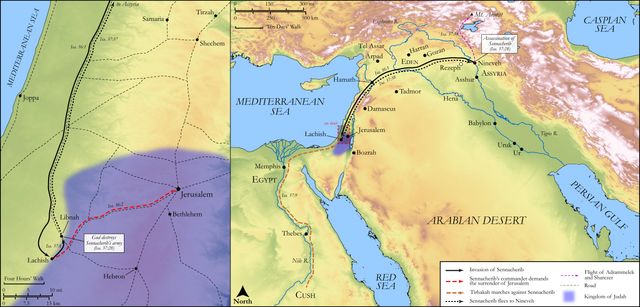
The events described in Isaiah 37 unfold during the Assyrian campaign against Judah in 701 BC, led by King Sennacherib. Assyria was the dominant superpower of that day, renowned for its military might, brutal siege tactics, and psychological warfare, often including taunts against the gods of conquered nations. Jerusalem was one of the last remaining strongholds in Judah, and its fall would mean the end of the kingdom. The cultural practice of wearing "sackcloth" was a potent symbol of deep grief, national mourning, repentance, and desperate supplication. It was a public and collective expression of humility before God, often accompanied by fasting and prayer, as seen in other biblical accounts of national crisis, such as the repentance of Nineveh in Jonah 3:5-9 or the lament of Israel in 1 Kings 21:27.
Key Themes
ShowHideThis verse significantly contributes to several overarching themes within the book of Isaiah. It powerfully illustrates the theme of Divine Sovereignty versus Human Arrogance, contrasting Sennacherib's blasphemous boasts with Hezekiah's humble appeal to Yahweh. The Assyrian king's challenge to God's power (e.g., Isaiah 36:18-20) is met not with military might, but with a spiritual plea. Secondly, it highlights the Necessity of Seeking God's Counsel through His chosen messengers, emphasizing the critical role of the prophet as a conduit for divine revelation and guidance in times of national crisis. This aligns with Isaiah's consistent call for Judah to trust in God alone, rather than in alliances or human strength (e.g., Isaiah 30:1-7). Finally, the verse underscores the theme of Humility and Dependence on God, demonstrating that even a powerful king must humble himself and acknowledge his utter reliance on God for deliverance, a posture that often precedes God's miraculous intervention.
Exposition and Analysis
ShowHideKey Word Analysis
ShowHideDerived from a root related to building, this term primarily denotes a "house" but extends metaphorically to encompass a "family," "palace," or even the "temple." In the context of Eliakim being "over the household," it signifies his role as the chief steward or palace administrator, holding immense authority and responsibility within the royal court, akin to a prime minister. His dispatch indicates the utmost gravity of the situation and the king's reliance on his most trusted official.
This word, stemming from a root meaning "old," refers to individuals of advanced age, respected for their wisdom, experience, and authority. In ancient Israel, elders held significant leadership positions in civic, judicial, and religious spheres. Their inclusion in the delegation to Isaiah signifies that the appeal for divine intervention was not merely a personal plea from the king but a collective supplication from the most venerable and respected leaders of the nation, representing the entire community.
This term refers to a coarse, rough fabric, typically woven from goat's hair, worn as a public sign of mourning, deep distress, humility, or repentance. Its use by the delegation, particularly the priests and elders, was a powerful non-verbal communication of their profound grief, desperation, and sincere supplication to God in the face of the Assyrian threat. It visually conveyed a state of utter dependence on divine mercy and intervention.
Verse Breakdown
ShowHide"And he sent Eliakim, who [was] over the household"
King Hezekiah, in his profound distress, initiates a crucial diplomatic and spiritual mission by dispatching Eliakim, his chief of staff. Eliakim's position as "over the household" signifies his immense authority and proximity to the king, underscoring the paramount importance and official nature of this delegation. His presence indicates the king's deep personal concern and the urgent need for a divine word.
"and Shebna the scribe"
Shebna, identified as "the scribe," was another high-ranking royal official. The role of a scribe in ancient courts extended beyond mere writing to include significant administrative, diplomatic, and advisory functions. His inclusion in the delegation further emphasizes the official and urgent nature of the mission, representing the intellectual and administrative acumen of the kingdom, now humbled and seeking divine guidance.
"and the elders of the priests covered with sackcloth"
This segment of the delegation represents the spiritual leadership of the nation. The "elders of the priests" were venerable figures within the priestly order, signifying the religious authority and collective spiritual state of Judah. Their being "covered with sackcloth" is a potent visual and tactile symbol of national mourning, repentance, and desperate prayer, mirroring Hezekiah's own actions. It conveys a collective, public plea for God's mercy and intervention in a time of existential crisis.
"unto Isaiah the prophet the son of Amoz"
The destination of this high-level, humbled delegation is Isaiah, God's divinely appointed prophet. Isaiah is identified by his father's name, Amoz, a common practice to establish identity and lineage. This highlights Isaiah's recognized authority and standing as God's mouthpiece to the nation. The delegation's journey to him signifies the king's and the nation's profound recognition that true wisdom, hope, and deliverance must come from God through His chosen messenger, not from human strategy or might.
Literary Devices
ShowHideIsaiah 37:2 masterfully employs several literary devices to heighten the drama and theological significance of the scene. Symbolism is profoundly evident in the "sackcloth" worn by the delegation. This coarse garment is a universal symbol of deep mourning, humility, and desperate supplication in Israel, visually communicating the profound spiritual and national distress of Judah and its leaders' complete dependence on God. The composition of the delegation itself—Eliakim (representing the royal administration), Shebna (representing the royal bureaucracy and diplomacy), and the elders of the priests (representing religious authority)—functions as a powerful form of Synecdoche. These key figures collectively represent the entire kingdom of Judah, its political, administrative, and spiritual leadership, all united in their humble plea to God through the prophet. This collective action also serves as Foreshadowing, subtly hinting that such a profound and earnest appeal to God will inevitably be met with a powerful divine response, setting the stage for the miraculous deliverance that follows.
Theological and Thematic Connections
ShowHideIsaiah 37:2 powerfully illustrates the biblical principle that in moments of overwhelming national or personal crisis, true leadership and genuine faith are characterized by profound humility and an earnest, immediate turning to God. Hezekiah's decision to dispatch his highest officials, clothed in the garments of mourning and supplication, to Isaiah demonstrates a profound recognition that human wisdom, military strength, and political maneuvering are ultimately insufficient against a sovereign God. This act of national repentance and reliance on God's prophetic word underscores that God responds to the humble cries of His people, often in ways that defy human expectation. It teaches us that our primary recourse in desperation should always be to acknowledge God's supreme authority and our utter dependence on His grace and power, inviting His miraculous intervention.
Reflection and Application
ShowHideThe scene depicted in Isaiah 37:2 offers timeless and profound lessons for believers navigating the complexities and challenges of contemporary life. When confronted with overwhelming difficulties—whether personal crises, communal struggles, or global anxieties—our innate human tendency often inclines us toward self-reliance, intellectual strategizing, or the accumulation of resources. However, Hezekiah's exemplary response calls us to adopt a radically different posture: one of deep humility and immediate, unreserved dependence on God. His act of sending a high-level delegation, clothed in sackcloth, to the prophet Isaiah serves as a powerful reminder that true wisdom begins with acknowledging our inherent limitations and turning to the divine source of all wisdom and power. It teaches us that God frequently manifests His greatest power and provides His clearest guidance when we have reached the absolute end of our own strength. This narrative invites us to set aside pride and self-sufficiency, to humble ourselves before the Almighty, and to seek His face with earnest supplication. Such a posture of dependence not only opens the door for God's miraculous intervention and guidance in our lives, but also deepens our faith and transforms our understanding of His sovereign care, just as it did for the kingdom of Judah.
Questions for Reflection
ShowHideFAQ
ShowHideWhy did Hezekiah send such important officials to Isaiah, and why were they wearing sackcloth?
ShowHideKing Hezekiah dispatched his most trusted and high-ranking officials—Eliakim, the palace administrator; Shebna, the royal scribe; and the elders of the priests—to Isaiah because the kingdom of Judah was facing an existential threat from the mighty Assyrian army, which had already conquered much of the land and was besieging Jerusalem. This was a national crisis of the highest order, requiring divine intervention, and Isaiah was God's recognized prophet, serving as a vital conduit for God's word. Their attire of sackcloth was a deeply significant cultural and religious practice in Israel. It symbolized profound grief, deep distress, humility, and desperate supplication to God. By wearing sackcloth, the delegation publicly expressed the nation's collective mourning, repentance, and urgent plea for God's mercy and deliverance, mirroring Hezekiah's own actions in Isaiah 37:1. It underscored that human efforts alone were insufficient, and their only hope lay in God's miraculous intervention.
Christ-Centered Fulfillment
ShowHideIsaiah 37:2, with its poignant depiction of a desperate king and nation seeking a divine word through a prophet, powerfully foreshadows the ultimate and perfect communication of God's will through Jesus Christ. Just as Hezekiah's delegation sought a message of hope and deliverance from Isaiah, humanity, in its spiritual distress and bondage to sin, desperately needed a definitive word from God. Jesus is revealed as the very Word made flesh, the complete and final revelation of God to humanity, far surpassing any prophetic utterance. He is the ultimate Prophet, through whom God speaks directly and perfectly, as affirmed in Hebrews 1:1-2. Furthermore, the elders of the priests, clothed in sackcloth, represent the Old Covenant's desperate plea for atonement and deliverance from sin and judgment. Christ, however, is not merely a priest but the Great High Priest who offered Himself as the perfect, once-for-all sacrifice, taking away the sin of the world and securing eternal deliverance, thereby eliminating the need for sackcloth and desperate pleas from a human priesthood. His ultimate act of humility on the cross, where He bore the weight of humanity's sin, fulfills the spirit of humility and dependence on God seen in Hezekiah's delegation, offering a salvation that no human prophet or priest could ever achieve. Through Him, we find not just temporary reprieve from earthly enemies, but eternal deliverance from sin and death, as celebrated in passages like Romans 5:8 and Colossians 2:13-15.