


2 Kings 22:12
Bible text: King James Version (1769 Blayney text) · Public domain
Bible text: King James Version with Strong's numbers · Public domain
Bible text: Berean Standard Bible · Public domain
Bible text: American Standard Version (1901) · Public domain
Bible text: World English Bible, Messianic edition · Public domain
Bible text: Geneva Bible (1599) · Public domain
Bible text: Young's Literal Translation · Public domain
- וַיְצַוvay·Tzavand he commandedH6680Conj-w ¦ V-Piel-ConsecImperf-3msVerb Piel Consecutive Imperfect 3rd Singular Masculineוַandיְצַוhe commanded
- הַמֶּלֶךְha·Me·lekhthe kingH4428Art ¦ N-msNoun Singular Masculine Absoluteהַtheמֶּלֶךְking
- אֶת'et<obj.>H853DirObjMParticle Object Indicator
- חִלְקִיָּהchil·ki·YahHilkiahH2518N-proper-mNoun Proper Masculine
- הַכֹּהֵןha·ko·Henthe priestH3548Art ¦ N-msNoun Singular Masculine Absoluteהַtheכֹּהֵןpriest
- וְאֶתve·'Etand <obj.>H853Conj-w ¦ DirObjMParticle Object Indicatorוְandאֶת<obj.>
- אֲחִיקָם'a·chi·KamAhikamH296N-proper-mNoun Proper Masculine
- בֶּןbe·no·Sha[the] son ofH1121N-mscNoun Singular Masculine Construct
- שָׁפָןSha·fanShaphanH8227N-proper-mNoun Proper Masculine
- וְאֶתve·'Etand <obj.>H853Conj-w ¦ DirObjMParticle Object Indicatorוְandאֶת<obj.>
- עַכְבּוֹרakh·BorAchborH5907N-proper-mNoun Proper Masculine
- בֶּןben[the] son ofH1121N-mscNoun Singular Masculine Construct
- מִיכָיָהmi·kha·YahMicaiahH4320N-proper-mNoun Proper Masculine
- וְאֵתve·'Etand <obj.>H853Conj-w ¦ DirObjMParticle Object Indicatorוְandאֵת<obj.>
- שָׁפָןsha·FanShaphanH8227N-proper-mNoun Proper Masculine
- הַסֹּפֵרha·so·Ferthe scribeH5608Art ¦ N-msNoun Singular Masculine Absoluteהַtheסֹּפֵרscribe
- וְאֵתve·'Etand <obj.>H853Conj-w ¦ DirObjMParticle Object Indicatorוְandאֵת<obj.>
- עֲשָׂיָה'a·sa·YahAsaiahH6222N-proper-mNoun Proper Masculine
- עֶבֶד'e·ved[the] servant ofH5650N-mscNoun Singular Masculine Construct
- הַמֶּלֶךְha·Me·lekhthe kingH4428Art ¦ N-msNoun Singular Masculine Absoluteהַtheמֶּלֶךְking
- לֵאמֹרle·Mor<to> sayingH559Prep-l ¦ V-Qal-InfVerb Qal Infinitive Constructלֵ<to>אמֹרsaying
English is a literal word-by-word gloss of the Hebrew, not the KJV's wording. Why?
This is the original text the KJV's translators worked from — each Hebrew word with its own literal English meaning in this verse, prepared by scholars at Tyndale House, Cambridge. The KJV translates whole sentences, not word by word, so its wording differs: one Hebrew word can become several English words, and the KJV may choose “the LORD” where the gloss reads “Yahweh”. Both are faithful — they answer different questions. For the KJV's own rendering, switch to the KJV text.
Details
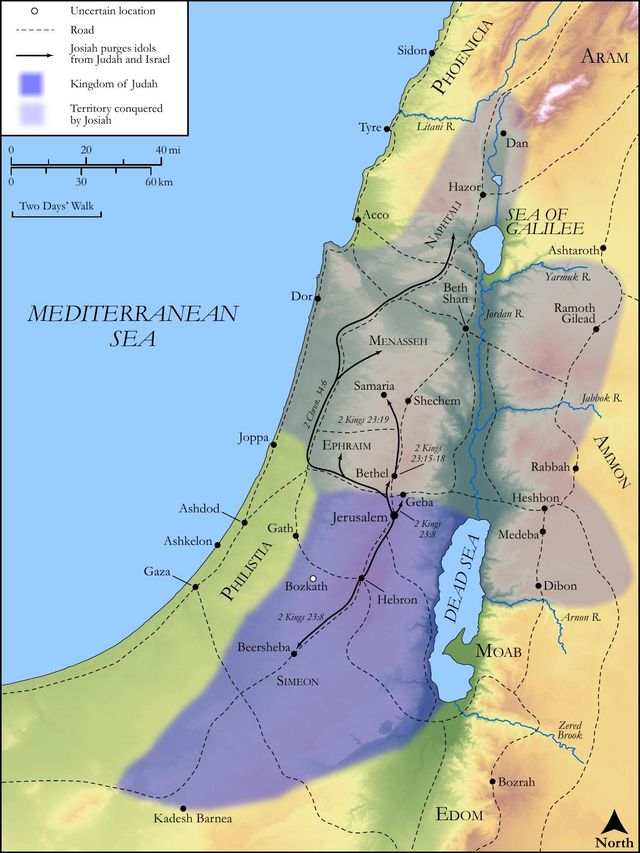
See on the biblical-era map
Study this verse
Public-domain commentary
Matthew Henry
From his Commentary on the Whole Bible. Henry comments on passages, not single verses — this entry covers 2 Kings 22:11–20. His three-level outline is real structure in the source text, so it is rendered as structure.
We hear no more of the repairing of the temple: no doubt that good work went on well; but the book of the law that was found in it occupies us now, and well it may. It is not laid up in the king's cabinet as a piece of antiquity, a rarity to be admired, but it is read before the king. Those put the truest honour upon their Bibles that study them and converse with them daily, feed on that bread and walk by that light. Men of honour and business must look upon an acquaintance with God's word to be their best business and honour. Now here we have,
I.The impressions which the reading of the law made upon Josiah.
He rent his clothes, as one ashamed of the sin of his people and afraid of the wrath of God; he had long thought the case of his kingdom bad, by reason of the idolatries and impieties that had been found among them, but he never thought it so bad as he perceived it to be by the book of the law now read to him. The rending of his clothes signified the rending of his heart for the dishonour done to God, and the ruin he saw coming upon his people.
II.The application he made to God hereupon: Go, enquire of the Lord for me, Kg2 22:13.
1.Two things we may suppose he desired to know: - "Enquire, (1.) What we shall do; what course we shall take to turn away God's wrath and prevent the judgments which our sins have deserved." Convictions of sin and wrath should put us upon this enquiry, What shall we do to be saved? Wherewithal shall we come before the Lord? If you will thus enquire, enquire quickly, before it be too late. (2.) "What we may expect and must provide for." He acknowledges, "Our fathers have not hearkened to the words of this book; if this be the rule of right, certainly our fathers have been much in the wrong." Now that the commandment came sin revived, and appeared sin; in the glass of the law, he saw the sins of his people more numerous and more heinous than he had before seen them, and more exceedingly sinful. He infers hence, "Certainly great is the wrath that is kindled against us; if this be the word of God, as no doubt it is, and he will be true to his word, as no doubt he will be, we are all undone. I never thought the threatenings of the law so severe, and the curses of the covenant so terrible, as now I find them to be; it is time to look about us if these be in force against us." Note, Those who are truly apprehensive of the weight of God's wrath cannot but be very solicitous to obtain his favour, and inquisitive how they may make their peace with him. Magistrates should enquire for their people, and study how to prevent the judgments of God that they see hanging over them.
2.This enquiry Josiah sent,
(1.)By some of his great men, who are named Kg2 22:12, and again Kg2 22:14. Thus he put an honour upon the oracle, by employing those of the first rank to attend it.
(2.)To Huldah the prophetess, Kg2 22:14. The spirit of prophecy, that inestimable treasure, was sometimes put not only into earthen vessels, but into the weaker vessels, that the excellency of the power might be of God. Miriam helped to lead Israel out of Egypt (Mic 6:4), Deborah judged them, and now Huldah instructed them in the mind of God, and her being a wife was no prejudice at all to her being a prophetess; marriage is honourable in all. It was a mercy to Jerusalem that when Bibles were scarce they had prophets, as afterwards, when prophecy ceased, that they had more Bibles; for God never leaves himself without witness, because he will leave sinners without excuse. Jeremiah and Zephaniah prophesied at this time, yet the king's messengers made Huldah their oracle, probably because her husband having a place at court (for he was keeper of the wardrobe) they had had more and longer acquaintance with her and greater assurances of her commission than of any other; they had, it is likely, consulted her upon other occasions, and had found that the word of God in her mouth was truth. She was near, for she dwelt at Jerusalem, in a place called Mishneh, the second rank of buildings from the royal palace. The Jews say that she prophesied among the women, the court ladies, being herself one of them, who it is probable had their apartments in that place. Happy the court that had a prophetess within the verge of it, and knew how to value her.
III.The answer he received from God to his enquiry.
Huldah returned it not in the language of a courtier - "Pray give my humble service to his Majesty, and let him know that this is the message I have for him from the God of Israel;" but in the dialect of a prophetess, speaking from him before whom all stand upon the same level - Tell the man that sent you to me, Kg2 22:15. Even kings, though gods to us, are men to God, and shall so be dealt with; for with him there is no respect of persons.
1.She let him know what judgments God had in store for Judah and Jerusalem (Kg2 22:16, Kg2 22:17): My wrath shall be kindled against this place; and what is hell itself but the fire of God's wrath kindled against sinners? Observe,
(1.)The degree and duration of it. It is so kindled that it shall not be quenched; the decree has gone forth; it is too late now to think of preventing it; the iniquity of Jerusalem shall not be purged with sacrifice or offering. Hell is unquenchable fire.
(2.)The reference it has, [1.] To their sins: "They have committed them, as it were, with design, and on purpose to provoke me to anger. It is a fire of their own kindling; they would provoke me, and at length I am provoked." [2.] To God's threatenings: "The evil I bring is according to the words of the book which the king of Judah has read; the scripture is fulfilled in it. Those that would not be bound by the precept shall be bound by the penalty." God will be found no less terrible to impenitent sinners than his word makes him to be.
2.She let him know what mercy God had in store for him.
(1.)Notice is taken of his great tenderness and concern for the glory of God and the welfare of his kingdom (Kg2 22:19): Thy heart was tender. Note, God will distinguish those that distinguish themselves. The generality of the people were hardened and their hearts unhumbled, so were the wicked kings his predecessors, but Josiah's heart was tender. He received the impressions of God's word, trembled at it and yielded to it; he was exceedingly grieved for the dishonour done to God by the sins of his fathers and of his people; he was afraid of the judgments of God, which he saw coming upon Jerusalem, and earnestly deprecated them. This is tenderness of heart, and thus he humbled himself before the Lord, and expressed these pious affections by rending his clothes and weeping before God, probably in his closet; but he that sees in secret says it was before him, and he heard it, and put every tear of tenderness into his bottle. Note, Those that most fear God's wrath are least likely to feel it. It should seem that those words (Lev 26:32) much affected Josiah, I will bring the land into desolation; for when he heard of the desolation and of the curse, that is, that God would forsake them and separate them to evil (for till it came to that they were neither desolate nor accursed), then he rent his clothes: the threatening went to his heart.
(2.)A reprieve is granted till after his death (Kg2 22:20): I will gather thee to thy fathers. The saints then, no doubt, had a comfortable prospect of happiness on the other side death, else being gathered to their fathers would not have been so often made the matter of a promise as we find it was. Josiah could not prevail to prevent the judgment itself, but God promised him he should not live to see it, which (especially considering that he died in the midst of his days, before he was forty years old) would have been but a small reward for his eminent piety if there had not been another world in which he should be abundantly recompensed, Heb 11:16. When the righteous is taken away from the evil to come he enters into peace, Isa 57:1, Isa 57:2. This is promised to Josiah here: Thou shalt go to thy grave in peace, which refers not to the manner of his death (for he was killed in a battle), but to the time of it; it was a little before the captivity in Babylon, that great trouble, in comparison with which the rest were as nothing, so that he might be truly said to die in peace that did not live to share in that. He died in the love and favour of God, which secure such a peace as no circumstances of dying, no, not dying in the field of war, could alter the nature of, or break in upon.
Historical interpretation
Four Centuries of Reception
2 surviving comments on this verse. Each one is dated, so this reads as a timeline rather than a list.
Select a marker to jump to its quote. Markers stagger vertically where authors wrote within a few decades of each other.
We need not wonder that Huldah, the prophet and wife of Shallum, was consulted by Josiah, king of Judah, when the captivity was approaching and the wrath of the Lord was falling on Jerusalem: since it is the rule of Scripture, when holy men fail, to praise women to the reproach of men.
“They went to the prophet Huldah,” and not to Jeremiah, even though he was already well known as a prophet, probably because Jeremiah was not there at the moment, or maybe because this woman surpassed him with the power of her gift of prophecy.
Continue studying 2 Kings 22:12 across the web’s major study libraries — every link below opens this exact verse, chapter, or book on the destination site.
Read & Compare
 BibleGatewayThis verse in more than 200 translations and 70 languages.
 Bible.comThe YouVersion reader — hundreds of translations, reading plans, and highlights.
 ESV.orgCrossway's official English Standard Version reader.
 NET BibleThe NET translation with 60,000+ translators' notes on every rendering decision.
 STEP BibleTyndale House's free study tool — original text, vocabulary, and scholarly resources.
 BibliaLogos Bible Software's free web reader.
 USCCBThe New American Bible (Revised Edition) with the U.S. bishops' study notes.
Commentaries
 BibleHub CommentariesDozens of classic commentaries on this verse, gathered on one page.
 StudyLightMore than 100 commentary sets — the largest collection on the web.
 BibleRefPlain-English commentary on what this verse means, verse by verse.
 Enduring WordDavid Guzik's free commentary on this chapter, widely used by Bible teachers.
 Bible Study ToolsVerse commentary alongside Greek and Hebrew study aids.
Original Language & Research
- BibleHub InterlinearThe verse word by word — original language, transliteration, and English.
- BibleHub LexiconEvery word's original-language definition and Strong's entry.
 Blue Letter BibleDeep-study tools — Strong's numbers, concordance, and word studies.
 SefariaThe Hebrew text with Rashi and centuries of Jewish commentary.
Sermons, Hymns & Audio


TrulyRandomVerse is not affiliated with these sites and doesn’t control their content. They’re linked because they’re genuinely useful.
Summary
King Josiah's immediate and decisive response to the rediscovery of the Book of the Law. Deeply convicted by its words, the king, demonstrating profound humility and a sincere desire for national repentance, commissions a high-level delegation. This group, comprising the high priest, a royal scribe, and other trusted advisors, is tasked with seeking divine counsel regarding the implications of God's revealed will for himself and the nation of Judah, setting the stage for significant spiritual reform.
Context
ShowHideLiterary Context
This verse is a pivotal moment within the narrative of King Josiah's reign, specifically detailing his immediate actions following the momentous discovery of "the Book of the Law" during temple repairs (2 Kings 22:8). The preceding verse (2 Kings 22:11) describes Josiah's profound reaction—tearing his clothes in repentance and distress—upon hearing the Law's words, which revealed Judah's long-standing disobedience and the impending divine judgment. 2 Kings 22:12 then initiates the king's proactive steps to address the crisis, assembling a trusted group to "inquire of the Lord." This command sets the narrative trajectory for the extensive religious reforms and spiritual revival that define the remainder of Josiah's rule, as detailed in 2 Kings 23.
Historical & Cultural Context
King Josiah ruled Judah from 640-609 BC, a period marked by the waning power of the Neo-Assyrian Empire, which had long exerted significant influence over Judah. This decline provided Josiah a unique opportunity to reassert Judah's national and religious independence. For generations prior, under kings like Manasseh and Amon, Judah had deeply apostatized, incorporating foreign idolatry, pagan rituals, and even child sacrifice into its religious practices (2 Kings 21:1-9). The temple itself had been neglected and defiled. The "Book of the Law," widely believed to be a form of Deuteronomy, had been lost or ignored for an extended period, making its rediscovery a profoundly significant event, symbolizing a potential return to the foundational covenant between Yahweh and Israel. Culturally, seeking divine guidance through priests, prophets, or prophetesses was a well-established practice in ancient Israel, particularly during times of national crisis or significant decision-making (1 Samuel 9:9, Jeremiah 21:2). Josiah's careful selection of high-ranking officials for this inquiry underscores the gravity of the Law's implications and his earnest desire for a legitimate, authoritative divine response.
Key Themes
ShowHideThis verse powerfully contributes to several overarching themes within 2 Kings and the broader Deuteronomistic History. Firstly, it highlights the Authority and Transformative Power of God's Word, demonstrating how the rediscovered Law immediately provoked deep conviction, repentance, and a desire for obedience in the king (2 Kings 22:11). Secondly, it exemplifies Godly Leadership, as Josiah, unlike many of his corrupt predecessors, responds with profound humility and a proactive commitment to seek and follow divine instruction, setting a vital standard for his kingdom. Thirdly, the dispatch of a delegation to "inquire of the Lord" underscores the critical theme of Seeking Divine Counsel, acknowledging that true reform and spiritual renewal must be rooted in God's specific guidance rather than human wisdom or political expediency alone (Proverbs 3:5-6). Finally, the detailed listing of specific, trusted officials emphasizes the importance of Wise and Godly Advisors in the execution of God's will and the righteous governance of a nation, showcasing Josiah's reliance on a diverse and capable inner circle.
Exposition and Analysis
ShowHideKey Word Analysis
ShowHideThis verb (H6680) signifies a strong, authoritative directive, not merely a suggestion. It indicates that Josiah's action was a kingly decree, reflecting his immediate and earnest conviction following the reading of the Law. This decisive command highlights the urgency he felt and his commitment to swift action in response to God's revealed will, setting the tone for the profound reforms that would follow.
The term (H3548) refers to one officiating, specifically a priest, in this context, Hilkiah the high priest. His inclusion in the delegation is paramount because he was the one who discovered the Book of the Law (2 Kings 22:8) and held the chief religious authority. His presence lends spiritual legitimacy and weight to the mission of inquiring of the Lord, signifying the religious gravity of the situation.
This noun (H5608) denotes one who scores, inscribes, or enumerates, specifically a royal secretary or scribe. Shaphan, holding this influential position, was not merely a copyist but a key administrator and advisor responsible for official documents and communications. His inclusion, along with his son Ahikam, underscores the political and administrative importance of the mission, ensuring that the king's command would be executed with precision and official backing across all relevant governmental spheres.
Verse Breakdown
ShowHide"And the king commanded Hilkiah the priest,"
This opening clause establishes King Josiah's active and immediate leadership. Upon hearing the dire implications of the Law, his first response is not despair but decisive action. Hilkiah, as the high priest and the one who found the book, is naturally the first and foremost recipient of the king's command, underscoring the profound religious nature of the impending inquiry.
"and Ahikam the son of Shaphan, and Achbor the son of Michaiah, and Shaphan the scribe, and Asahiah a servant of the king's,"
This comprehensive list meticulously details the specific individuals chosen by Josiah for this critical mission. The inclusion of multiple high-ranking officials—representing religious authority (Hilkiah), administrative and political influence (Shaphan, Ahikam), and trusted royal staff (Asahiah, Achbor)—demonstrates the gravity and multifaceted importance of the inquiry. It highlights Josiah's reliance on a diverse and trusted inner circle, ensuring that the mission would be thorough, its findings widely accepted, and its subsequent implementation effective across various sectors of the kingdom. The mention of "son of" for Ahikam and Achbor further emphasizes their lineage and standing within prominent families.
"saying,"
This concluding word serves as a direct and immediate transition, signaling that the following verses (2 Kings 22:13ff) will contain the specific instructions and precise purpose of the delegation. It builds narrative anticipation for the content of Josiah's command, which is to "inquire of the Lord" concerning the full implications of the newly discovered Law for the nation.
Literary Devices
ShowHideThe verse primarily employs Listing and Synecdoche. The meticulous Listing of five specific, named individuals (Hilkiah, Ahikam, Achbor, Shaphan, Asahiah) serves to emphasize the profound importance, official nature, and high-level composition of the delegation. It elevates the king's command beyond a general directive, underscoring the gravity of the situation by specifying the most trusted and influential figures in his administration. This detailed enumeration also utilizes Synecdoche, where a part (the named officials) represents the whole (the king's entire trusted administration and the comprehensive seriousness of the royal decree). Furthermore, the immediate and decisive nature of the phrase "And the king commanded... saying," contributes significantly to the Narrative Pacing, propelling the story forward with a sense of urgency and purpose, effectively highlighting Josiah's immediate and earnest response to the revelation of God's Word.
Theological and Thematic Connections
ShowHideThis verse profoundly illustrates the principle that true spiritual awakening necessitates a humble and immediate response to God's Word, followed by a diligent pursuit of divine counsel. Josiah's action demonstrates that hearing God's truth should lead not merely to emotional conviction, but to a proactive seeking of God's will for practical obedience and national repentance. His reliance on a diverse group of trusted advisors also highlights the wisdom of seeking counsel when confronted with weighty spiritual matters, acknowledging that God often speaks through multiple channels and wise individuals. This commitment to inquiry underscores the belief that God's will is discoverable and that His commands carry profound implications for both individual and corporate life, demanding a response that moves beyond mere knowledge to active, Spirit-led implementation.
Reflection and Application
ShowHideKing Josiah's response to the rediscovered Book of the Law in 2 Kings 22:12 offers a powerful paradigm for believers today. When confronted with the truth of God's Word, our initial response should be one of humility and deep conviction, leading us to inquire more deeply into its implications for our lives. Just as Josiah didn't merely lament but acted decisively to understand and obey, we are called to move beyond passive reception of Scripture to active engagement, seeking God's specific guidance for repentance, reform, and righteous living. This involves not only personal study and prayer but also the wisdom of seeking counsel from godly leaders and trusted advisors within the community of faith, recognizing that the Holy Spirit often illuminates truth through collective discernment. Our proactive obedience to God's revealed will, even when it exposes our shortcomings, is the pathway to true spiritual renewal and blessing, both individually and corporately, fostering a deeper walk with the Lord.
Questions for Reflection
ShowHideFAQ
ShowHideWhy did King Josiah send a delegation to "inquire of the Lord" instead of simply implementing the Law himself?
ShowHideJosiah's decision to send a delegation, rather than acting unilaterally, demonstrates profound humility and wisdom. Firstly, it acknowledged the immense gravity of the situation: the Law had been neglected for generations, and its rediscovery brought a palpable sense of impending judgment for the nation's widespread idolatry and disobedience (as indicated in 2 Kings 22:13). Josiah understood that merely reading the Law was not enough; he needed specific divine counsel on how to respond to its far-reaching implications for a nation steeped in sin. Secondly, it was a culturally accepted and divinely sanctioned practice in ancient Israel to consult a prophet or prophetess for a direct word from God concerning national crises or significant decisions (e.g., 1 Kings 22:7-8). By seeking an oracle, Josiah ensured that his subsequent reforms would be rooted in clear, authoritative divine direction, lending them greater legitimacy and spiritual weight in the eyes of the people. This action also powerfully highlighted his dependence on God for guidance, rather than relying solely on human interpretation, political expediency, or personal conviction.
Christ-Centered Fulfillment
ShowHideKing Josiah's encounter with the Book of the Law and his subsequent command to inquire of the Lord powerfully foreshadows the ultimate revelation of God's will and the means of true righteousness found in Jesus Christ. The rediscovered Law exposed Judah's deep-seated sin and the impending judgment, creating a profound sense of need for divine intervention—a need that finds its ultimate and perfect answer in the person and redemptive work of Christ. While Josiah sought counsel from a prophetess to understand the Law's demands and implications for a rebellious nation, we are called to seek counsel from the living Word, Jesus himself, who is the full embodiment of God's truth, wisdom, and grace (John 1:1, Colossians 2:3). The Old Covenant Law, though good and holy, could only reveal sin and pronounce judgment; it could not provide the means for true atonement or the power for perfect obedience. Christ, however, perfectly fulfilled the Law in His life (Matthew 5:17) and, through His sacrificial death and glorious resurrection, provides the complete cleansing from sin and the righteousness that the Law demanded but could not deliver (Romans 10:4). Just as Josiah's command initiated a period of national repentance and reform in response to God's written Word, the Gospel of Christ calls us to a deeper, heart-level repentance and spiritual transformation, empowered by the indwelling Holy Spirit, leading to a life of obedience rooted in grace, not merely in legalistic adherence (Hebrews 8:10). Christ is our ultimate High Priest and the very wisdom of God, making all further inquiry into God's will ultimately centered on Him.